Page 140 of 773
1 138 139 140 141 142 773

India: La universidad que obligó a sus estudiantes mujeres a desnudarse para comprobar si estaban menstruando

Asia/India/20 Febrero 2020/https://www.bbc.com/

La incómoda relación de India con la menstruación ha vuelto a los titulares.

Estudiantes universitarias que viven en un albergue en Gujarat, un estado en el oeste del país, se quejaron de que las obligaron a desnudarse para mostrarle la ropa interior a sus maestraspara demostrar que no estaban menstruando.

68 jóvenes fueron obligadas a salir del aula e ir al baño, donde les ordenaron quitarse su ropa interior para que pudiesen ser inspeccionada.

El incidente tuvo lugar el martes en la ciudad de Bhuj.

Las jóvenes eran estudiantes universitarias del Instituto Shree Sahajanand Girls (SSGI), dirigido por la secta Swaminarayan, un grupo religioso hindú rico y conservador.

El grupo dijo que un funcionario del albergue se había quejado al director de la universidad el lunes de que algunas de las estudiantes estaban infringiendo las reglas que se supone deben seguir las mujeres que menstrúan.

Según estas normativas, las mujeres no pueden entrar a un templo ni a la cocina, ni tocar a otros estudiantes cuando tienen el período.

Durante las comidas, deben sentarse lejos de los demás, lavar sus propios platos y, en el aula, deben sentarse en la última fila.

Registro

Una de las estudiantes le dijo a la BBC que el hostal llevaba un registro donde ellas debían escribir su nombre cada vez que tenían la regla, para que las autoridades pudieran identificarlas.

Sin embargo, durante los últimos dos meses, ninguna estudiante había escrito su nombre en el registro, algo que no sorprende si tomamos en cuenta las restricciones que deben tolerar si lo hacen.
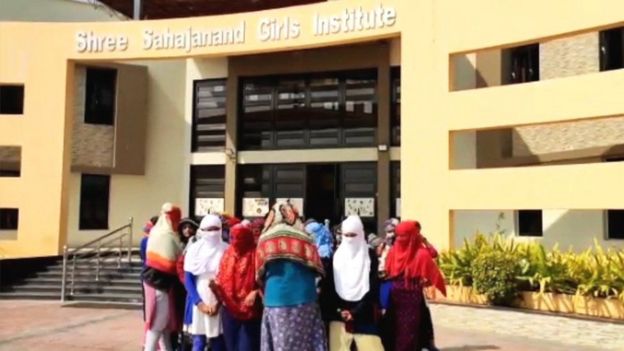
Instituto
Image captionLas jóvenes calificaron la experiencia de «tortura mental».

Por esta razón, el funcionario del albergue se quejó ante el director de la universidad de que las estudiantes que menstruaban estaban entrando en la cocina, acercándose a los templos y mezclándose con otras jóvenes del albergue.

Las estudiantes argumentan que, al día siguiente, fueron abusadas por el funcionario del hotel y el director, antes de que las obligaran a desnudarse.

Las jóvenes describieron lo ocurrido como «una experiencia muy dolorosa» que las dejó «traumatizadas«, a la que calificaron de «tortura mental».

El padre de una de las alumnas dijo que cuando llegó a la universidad, su hija y otras jóvenes se acercaron a él y estallaron en lágrimas.

«Están en schock», dijo.

Protestas

El jueves, un grupo de estudiantes organizó una protesta en el campus, exigiendo medidas contra las autoridades de la universidad que las «humillaron».
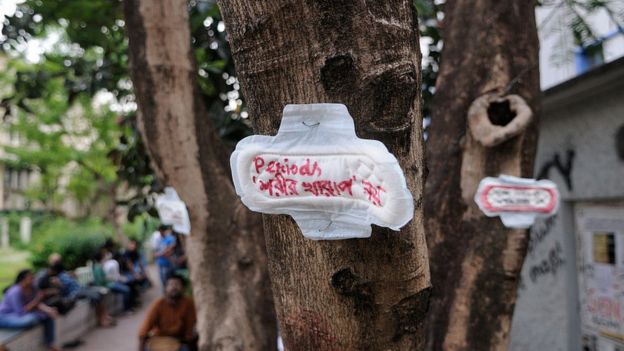
ProtestaDerechos de autor de la imagenGETTY IMAGES
Image caption«La menstruación no es una enfermedad», dice este mensaje de protesta escrito sobre una toalla femenina.

Pravin Pindoria, miembro del consejo administrativo de la institución, dijo que el incidente había sido «desafortunado», y agregó que se había ordenado una investigación y que se tomarían medida contra los culpables.

No obstante, Darsha Doholakia, vicecanciller de la universidad, culpó a las estudiantes.

Doholakia argumentó que las jóvenes habían violado las reglas y añadió que algunas se habían disculpado.

Sin embargo, algunas de las estudiantes le dijeron a la BBC que están bajo presión de las autoridades de la escuela para desestimar el incidente y no hablar de lo que pasó.

El viernes, la Comisión de Mujeres del Estado de Gujarat ordenó una investigación sobre este «vergonzoso ejercicio» y pidió a las estudiantes que «hablaran sin miedo sobre el agravio».

La policía presentó una denuncia.

Estigma

Esta no es la primera vez que estudiantes mujeres son humilladas en nombre de la menstruación.

En un caso muy similar, 70 estudiantes fueron obligadas a desnudarse hace tres años en una escuela en el norte de India, después de que una celadora encontrara sangre en la puerta de un baño.

La discriminación de las mujeres cuando tienen la regla es común en India, donde la menstruación es desde hace tiempo un tabú, y las mujeres con la regla son consideradas impuras.
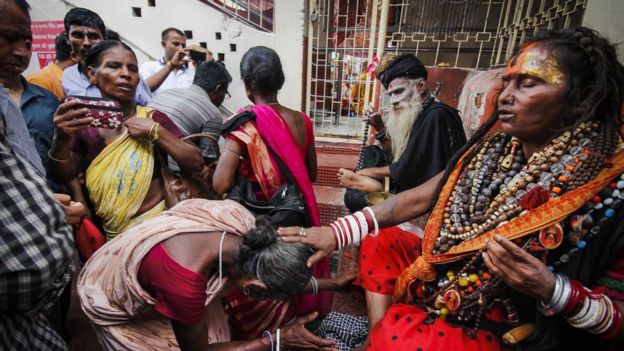
TemploDerechos de autor de la imagenGETTY IMAGES
Image captionA las mujeres que tienen el período, no se les permite entrar a los templos.

Estas suelen ser excluidas con frecuencia de eventos sociales y religiosos, se les niega la entrada a templos y santuarios, y no se las deja entrar en las cocinas.

Cada vez más, mujeres educadas de las ciudades están empezando a desafiar estas ideas. En años recientes, se ha intentado que la menstruación sea entendida como lo que es: una función natural del cuerpo femenino.

Pero esta misión ha sido demasiado exitosa.

En 2018, en un acontecimiento considerado histórico, el tribunal superior ordenó que se abrieran las puertas del santuario de Sabarimala a mujeres de todas las edades, argumentando que mantener a las mujeres fuera del templo en el estado sureño de Kerala era discriminatorio.

Pero, un año más tarde, los jueces acordaron revisar esta orden después de que se produjeran protestas masivas en el estado.

Para sorpresa de muchos, entre los manifestantes había un gran número de mujeres, una indicación de cuán profundamente arraigado está el estigma de la menstruación.

Fuente e imagen tomadas de: https://www.bbc.com/mundo/noticias-51544974
Comparte este contenido:

El coronavirus obliga a más de 280 millones de escolares chinos a estudiar en casa por Internet

Asia/China/20 Febrero 2020/elpais.com

Los alumnos de todos los niveles de enseñanza han visto sus clases suspendidas en China por la epidemia

El mundo de Lena Wang, de doce años, se ha reducido a solo 80 metros cuadrados, las dimensiones del apartamento que comparte con sus padres y su abuela paterna en el este de Pekín. Desde las fiestas del Año Nuevo lunar, hace tres semanas, apenas ha salido de su casa, para acompañar a su madre a hacer algún recado, y siempre con mascarilla. Al principio, cuando supo que las escuelas alargaban sine die las vacaciones por el coronavirus, estaba entusiasmada. Ahora ya ese pequeño mundo se le viene encima y no tiene visos de que se vaya a hacer más grande pronto.

Los Wang, como muchas otras familias en China, han tenido que hacer ajustes a su convivencia diaria desde que comenzaron las medidas extraordinarias en todo el país contra la epidemia de Covid-19, la enfermedad causada por el coronavirus 2019-nCov que ha dejado ya más de 1.500 muertos y 66.000 infectados en todo el país. Los padres, como la mayoría de los empleados de oficina estos días en China, trabajan hasta nuevo aviso desde casa, una experiencia que, admiten, se les hace “extraña”. Y Lena, acostumbrada a rellenar su horario extraescolar con clases adicionales y muchos, muchos deberes, se ve con más tiempo libre del normal, pero pocas opciones para jugar.

Para entretenerse, lee en versión cómic el clásico de la literatura china Viaje al Oeste, muy popular como lectura juvenil, y practica el weiqi, un juego de estrategia, con su padre, Tony Wang, economista de 40 años. Se comunica con sus amigas de la escuela a través de WeChat, la omnipresente aplicación de mensajería equivalente a WhatsApp. “O, si no, desespera a su abuela saltando por la casa”, dice su madre, Yinxia, asesora financiera de 38 años.

Ir a ver museos, o participar en alguna actividad cultural, no es una opción. Los lugares de esparcimiento permanecen cerrados como medida para evitar la propagación del virus. El Ministerio de Educación ha prohibido a los centros de capacitación extracurricular que impartan cualquier tipo de clase presencial por el momento. Las reuniones de varias personas, incluidas las fiestas de cumpleaños, se han prohibido también hasta nueva orden. Visitar a otras amigas se desaconseja enérgicamente; muchos complejos de viviendas ni siquiera permiten el acceso a los no residentes.

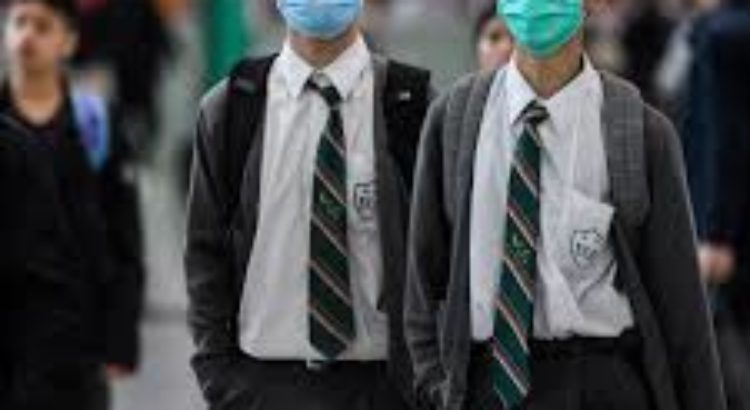
A Lena no le faltan cosas que hacer. Sus padres, preocupados por que no desaprovechara el tiempo, la han inscrito en un cursillo por Internet de Matemáticas y otro de Inglés. Cada día se ocupan de que practique los complicados caracteres del mandarín escrito. Y a partir del lunes, el día en que los estudiantes debían haber vuelto a las aulas, su escuela comenzará a ofrecer las clases online que ha previsto el Ministerio de Educación chino. «Por lo menos no tengo que madrugar tanto», comenta la niña, que asegura no sentirse asustada por la epidemia. «Bueno… Un poco sí. Por eso es importante lavarse las manos y ponerse la mascarilla al salir», puntualiza.

El regreso a las clases físicas para los 280 millones de alumnos de todos los niveles educativos en China permanece aún distante. Quizá, si todo va bien, en algún momento en marzo, aunque, dado que el pico de la epidemia está aún por llegar, esa posibilidad aparece más y más lejana.

Varias de las amigas de Lena que salieron de Pekín a pasar el Año Nuevo lunar con su familia más extensa en sus lugares de origen ancestrales aún no han podido regresar, dadas las recomendaciones de que se eviten los viajes en la medida de lo posible. Las escuelas internacionales, que también han puesto en marcha algún tipo de enseñanza a distancia, no prevén el regreso antes de finales del mes próximo. Muchos alumnos de estos centros han regresado a sus países de origen, ante la inactividad prolongada, las suspensiones de rutas aéreas y las recomendaciones de Gobiernos como el británico a sus ciudadanos de que, quien no tenga razones importantes para permanecer en China, abandone el país.

En un país obsesionado con la educación como herramienta de progreso y avance social, muchos padres, como los Wang, han vuelto a las clases por Internet, que ya se habían hecho muy populares en años pasados. Según la consultora iReseach, este sector creció en 2018 un 25,7% interanual, para generar 35.900 millones de dólares.

Más de ochenta compañías ofrecen clases en línea desde el comienzo del parón por cuarentena, hace tres semanas, según publica el diario estatal China Daily. Una de las más implantadas, Zuoyebang, ofrece clases gratuitas de las principales asignaturas académicas de ocho de la mañana a las 17.40. Youdao, subsidiaria de NetEase inc, ofrece clases en directo, en streaming, para 470.000 alumnos inscritos.

El problema de las clases perdidas no atañe solo a los alumnos en las escuelas nacionales. Los estudiantes en el extranjero que regresaron a China para pasar con sus familias el Año Nuevo se han visto, en algunos casos, impedidos de volver a sus países de acogida, bien porque se han cancelado los vuelos o bien porque esos países prohíben la entrada a quienes hayan estado en China en los 14 días previos, el tiempo máximo de incubación. Según el diario Sydney Morning Herald, Australia, que acoge en sus aulas a unos 100.000 universitarios de la segunda potencia mundial, ha pedido a Pekín que relaje de modo extraordinario su censura de Internet a estos estudiantes para que puedan seguir los módulos online de sus carreras.

EN CASA DE LOS ABUELOS

M.V,L

Algunos padres de niños pequeños, como Liang, funcionaria de 33 años en la provincia de Hubei y madre de un bebé de diez meses, han optado por cedérselos a los abuelos que viven en zonas más libres de la epidemia. “Mi marido trabaja en el hospital local, así que mi suegro dijo que nuestra casa no era segura para el niño. Así que se lo llevaron el 29 de enero, y desde entonces comparten el cuidado del bebé con mis padres, se van turnando por semanas”.

Fuente: https://elpais.com/sociedad/2020/02/14/actualidad/1581691357_050998.html

Comparte este contenido:

El primer ministro palestino advierte sobre el grave peligro del «Acuerdo del Siglo» de Trump

Asia/Palestina/19/02/2020/Autor y fuente: tercerainformacion.es

Mohammad Shtayyeh advierte a la comunidad internacional que el precedente establecido por la medida propuesta por el presidente estadounidense sentaría un precedente terrible para las relaciones internacionales.

El primer ministro palestino, Mohammad Shtayyeh, calificó de «muy peligrosa» la iniciativa del Gobierno estadounidense para resolver el conflicto en Oriente Medio, e instó a Europa a rechazarla.

«La propuesta de [Donald] Trump es muy peligrosa, simplemente porque se basa en un nuevo paradigma. Y el paradigma de Trump, en lo que se refiere a los palestinos, se basa en lo siguiente: derrotarlos, para que se rindan, para que acepten», manifestó Shtayyeh durante una discusión sobre Palestina que tuvo lugar este domingo en la Conferencia de Seguridad de Múnich.

El jefe del Gobierno palestino instó a Europa a dar una respuesta seria, fuerte y clara al llamado ‘acuerdo del siglo’, rechazándola.

El 28 de enero, Donald Trump presentó en Washington el llamado ‘acuerdo del siglo’ para la solución del conflicto palestino-israelí.

El plan prevé el reconocimiento mutuo de los Estados de Israel y Palestina, con una capital «indivisible» de Israel en Jerusalén, mientras que Palestina tendrá su capital no en todo Jerusalén Este, como aspira, sino «en la sección de Jerusalén Oriental localizada en áreas al este y al norte de la actual barrera de seguridad, incluyendo Kafr Aqab, la parte oriental de Shuafat y Abu Dis, y que podría llamarse Al Quds u otro nombre determinado por el Estado de Palestina».

No obstante, la iniciativa exige que antes de ser reconocida como un Estado, Palestina implemente una serie de reformas políticas, sociales y económicas.

Palestina ya expresó su rechazo al proyecto estadounidense que, según el líder palestino Abás, acabará en «el basurero de la historia».

Fuente e imagen:  https://www.tercerainformacion.es/articulo/internacional/2020/02/16/el-primer-ministro-palestino-advierte-sobre-el-grave-peligro-del-acuerdo-del-siglo-de-trump

Comparte este contenido:

China to relax its internet restrictions for 100,000 students hit by Australia’s coronavirus travel ban

Asia/ China/ 18.02.2020/ Source: www.theguardian.com.

China has agreed to relax its internet restrictions, after lobbying from the higher education sector, so international students can study online while they are banned from Australia during the coronavirus outbreak.

Currently more than 100,000 Chinese students, who already have Australian student visas and were planning on commencing their studies this month, are stranded outside of Australia as a result of the government’s 14-day travel ban from mainland China.

On Wednesday, Australia’s Global Reputation Taskforce – an emergency council of universities and education providers – met with education minister Dan Tehan and trade minister Simon Birmingham to discuss how they could limit the potential $8bn hit to the economy.

Phil Honeywood, the chair of the taskforce, told Guardian Australia the ministers had secured new pathways for online courses – which would let isolated students keep their Australian enrolments.

But he warned that a visa approval freeze means Australia could “absolutely lose out” to competitors as Chinese students could easily “go down the road” and obtain student visas for the US, the UK or Canada instead.

The government has not yet announced if the travel ban will be extended by another fortnight, but education providers are “not optimistic” and preparing for the worst.

Honeywood, who is also the head of the International Education Association of Australia, said internet restrictions would be lifted for students, so they could reach university portals for lecture recordings and slides, among other sites.

“There have been challenges over many years with online learning into China but the Chinese government has acknowledged that a more effectual arrangement is appropriate because of the isolation,” he said.

“We’ve been able to make good progress on online learning options into China. There have been really worthwhile negotiations with the Chinese embassy. A number of platforms have been agreed to to deliver online courses to students who are offshore still.

“Not all courses will be suited to online delivery. There will be issues with which units of study can be provided, for what period of time. [But] it is definitely a better situation than we were facing a couple of weeks ago.”

But the universities are concerned that new visa delays, combined with the travel ban, mean Australia could lose out to other countries.

New student visa approvals have been frozen by the department of home affairs since 1 February, even for students who have already been accepted by Australian universities.

Acting immigration minister Alan Tudge confirmed to the Australian that the department was “not finalising applications for individuals currently in mainland China” due to “enhanced border measures”.

International students contributed $34bn to the Australian economy last year. Australia’s main competitors for Chinese students, Canada, the US and the UK run on a different academic year, starting in September, meaning they are less disrupted by the coronavirus outbreak this year.

“The issue we have got is visas allegedly bring processed but not approved,” Honeywood said.

“A bird in the hand is worth two in the bush. If you’re a student, and you can’t get an Australian student visa to travel, any time you can go down the road to the Canadian embassy or the US embassy and they are still happily approving visas.

“Chinese students, even if they can’t travel to Australia now, once they have been given a student visa to come and study in Australia, they can once the virus is contained.

“But because no visas have been approved, they are thinking ‘How long is this going on for? Even when the virus is contained, I can’t come to Australia to study because of the whole visa process. I’ll go to Canada and the UK and delay my start date.’”

Honeywood said education minister Tehan was working with immigration minister Tudge “to get some clarification about what might be possible in that visa approval space”.

Meanwhile, individual universities are also offering alternate course schedules for affected students. Melbourne’s Monash University has already pushed back the start date of its semester by a week, while the ANU in Canberra has announced a semester during the traditional winter break to allow Chinese students to catch up on courses.

Other universities, such as the University of New South Wales, have recently changed to a trimester system, and are encouraging students to defer their enrolment to the next trimester, which starts around the beginning of June.

Honeywood said the universities “have to abide by the chief medical officer’s determination” on the length of the travel ban, but that Australia’s higher education sector was uniquely vulnerable to the delay.

“More than other study destination country, we are caught by geographic location and the fact that our academic year starts at the start of the calendar year,” he said.

“Whereas our main competitors, like Canada, the US and UK, their academic year doesn’t start until later, in September. They aren’t faced with a large influx of Chinese students wanting to commence studies until later this year. Australia and New Zealand are in a particular set of circumstances which no other competitor study destinations have.”

Source of the notice: https://www.theguardian.com/world/2020/feb/13/china-to-open-up-its-internet-for-100000-students-hit-by-australias-coronavirus-travel-ban

Comparte este contenido:

The education sector must stay vigilant

The education sector must stay vigilant

Scrapping or delaying exams may upset study schedules and add to the stress of tens of thousands of Hong Kong students, but they are necessary steps to avoid aggravating the public health crisis posed by the coronavirus

As the new coronavirus spreads wider, many public activities have been forced to scale down or be suspended, and justifiably so. Among them are classes and examinations.

The possibility of scrapping or delaying some exams by up to a month may upset study schedules and add to the stress of tens of thousands of Hong Kong students, but they are necessary steps to avoid aggravating the public health crisis.

Under the options considered by the Education Bureau, the Chinese-language speaking exams may be put back from mid-March to late May, while keeping the original schedule for written exams for most subjects. The other option is to postpone all written exams until April 24 to May 25, with the Chinese and English speaking exams cancelled.

It is still unclear which option will be adopted. But the alert seems to give students – especially cross-border ones – enough time to make suitable preparations.

Students at the Chinese University of Hong Kong recently. Photo: SCMP

Those returning from the mainland may need to be quarantined for 14 days before attending an exam, if that measure is still required at the time. No less important are the precautionary arrangements to minimise the risk of infection at exam venues.

Taking the body temperatures of students is essential, as is the provision of surgical masks to strengthen protection.

Appropriate policies and measures adopted by education authorities are always useful references for schools and students. But concerted efforts are needed to stop campuses and exam venues from becoming breeding grounds for disease. The responsibility is as much the government’s as it is the stakeholders’.

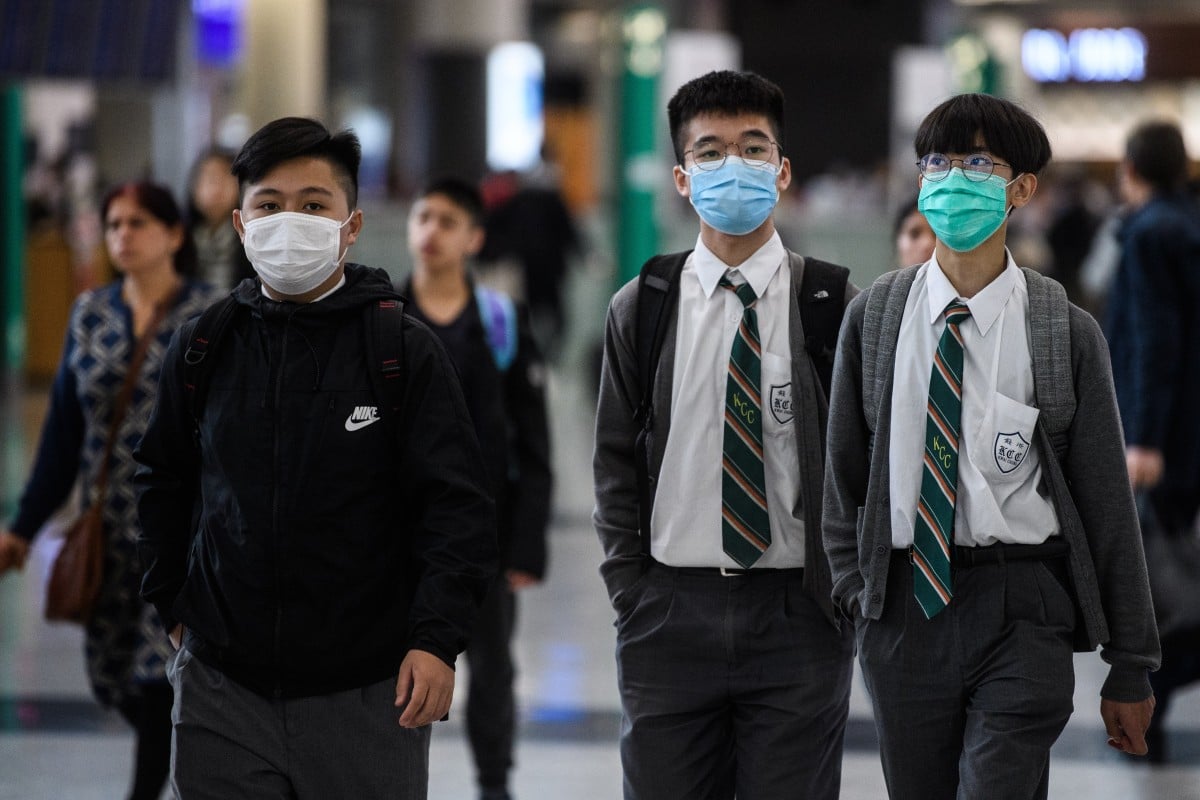
Students at Hong Kong's international airport last month. Photo: AFPStudents at Hong Kong's international airport last month. Photo: AFP
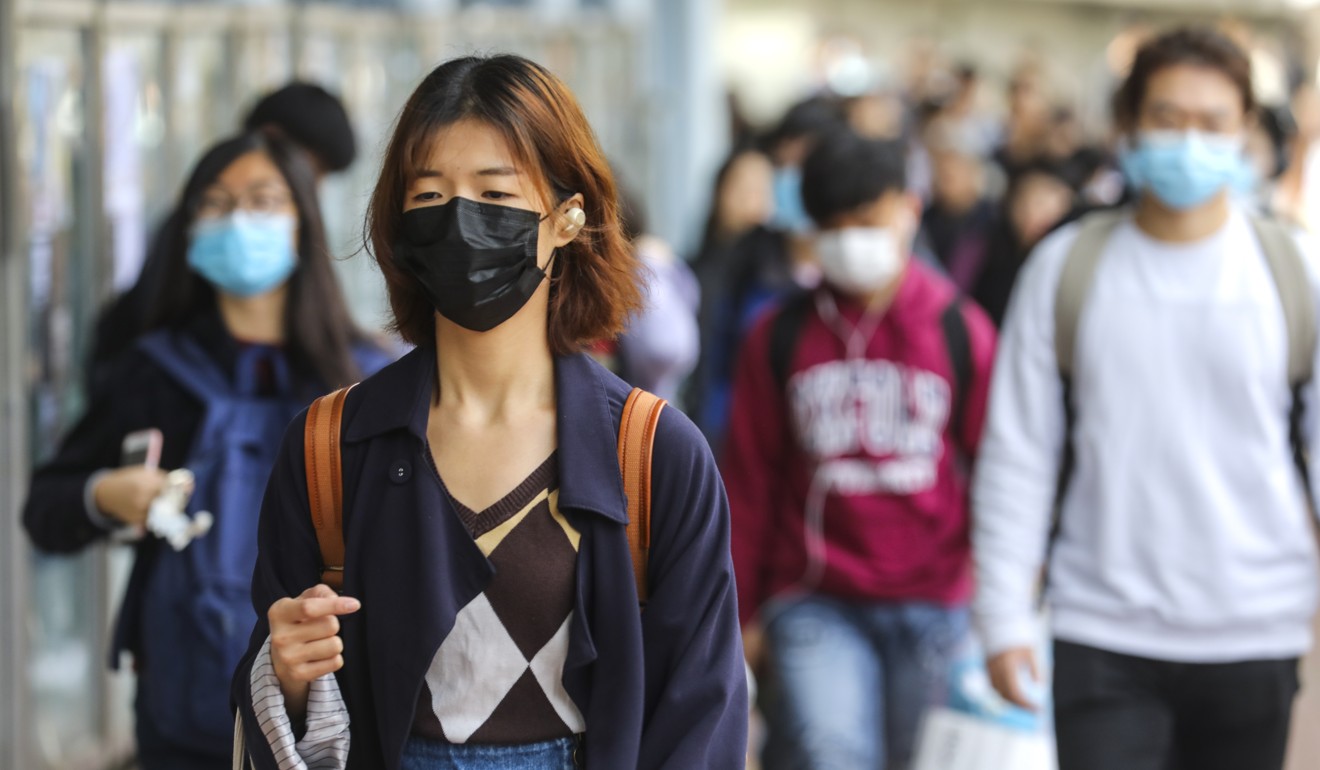
Students at Hong Kong’s international airport last month. Photo: AFP

As the new coronavirus spreads wider, many public activities have been forced to scale down or be suspended, and justifiably so. Among them are classes and examinations.

The possibility of scrapping or delaying some exams by up to a month may upset study schedules and add to the stress of tens of thousands of Hong Kong students, but they are necessary steps to avoid aggravating the public health crisis.

Under the options considered by the Education Bureau, the Chinese-language speaking exams may be put back from mid-March to late May, while keeping the original schedule for written exams for most subjects. The other option is to postpone all written exams until April 24 to May 25, with the Chinese and English speaking exams cancelled.

It is still unclear which option will be adopted. But the alert seems to give students – especially cross-border ones – enough time to make suitable preparations.

Students at the Chinese University of Hong Kong recently. Photo: SCMP

Those returning from the mainland may need to be quarantined for 14 days before attending an exam, if that measure is still required at the time. No less important are the precautionary arrangements to minimise the risk of infection at exam venues.

Taking the body temperatures of students is essential, as is the provision of surgical masks to strengthen protection.
Appropriate policies and measures adopted by education authorities are always useful references for schools and students. But concerted efforts are needed to stop campuses and exam venues from becoming breeding grounds for disease. The responsibility is as much the government’s as it is the stakeholders’.
Hong Kong to extend school closures until March 16 over coronavirus..
A decision by universities to further suspend on-site lectures can help avoid the gathering of crowds. The requirement of health declarations for staff and students returning to campus is another prudent step. Concerns were raised after some universities used hotels in the vicinity to isolate returning mainland students.
It was a convenient way to reduce the risk of infection on campus. But whether hotels make suitable quarantine facilities remains to be seen. Compliance and health protection for hotel staff are also valid issues. The education sector must stay vigilant and adjust class and exam arrangements in light of the threat posed by the deadly virus.
Fuente de la Información: https://www.scmp.com/comment/opinion/article/3050883/education-sector-must-stay-vigilant
Comparte este contenido:

Education 4.0: Is Indonesia ready?

Education 4.0: Is Indonesia ready?

In the endeavour to build the future of any nation, higher education contributes significantly by providing “global competitive talent”. The skilled workforce coupled with innovative technology and advanced infrastructures are key drivers for any country’s sustainable growth. In that context, if we inspect both India and Indonesia – two of the most populous economies – it’s evident that they are facing some of the biggest global challenges: the rapid ascension of artificial intelligence (AI), machine learning (ML), automated learning (AL) and the Fourth Industrial Revolution. Both nations are struggling to equip their respective workforces with advanced skills, attitude and knowledge essential to stay relevant in today’s education 4.0 era.

These two countries share similar peculiarities – a vibrant and energetic youth – and are faced with the same question: “How to equip their higher education system for challenges associated with ever-evolving global technological advancements, and transform their institutions into ‘world class’ universities?”

Nevertheless, the scenario for India is marginally better as the sub-continent has supplied “some” of the world’s best talents in the past. For instance, CEOs at a few global companies like Adobe, PepsiCo, Google, and Microsoft are all Indians, and the landscape has expanded over the last decade. A recent Deloitte report has shown that the number of universities in India has slowly grown from 436 in 2009–2010 to 903 in 2017–2018. The number of colleges rose from 29,000 to 39,000 in 2010. In addition, with record-breaking student enrolments (35.7 million students) India stands as the third-largest in the world, next to China and the United States (US), but despite that, the country still lags behind the standards of the world’s best universities.

While for Indonesia the agony is more severe as, in the past, it has supplied high volume but low-quality human capital. Surprisingly, according to research conducted by the Global Business Guide (GBG), Indonesia has 4,498 universities providing 25,548 majors, which is nearly double that of China, (2,825 universities); with a population that is less than one fifth of the latter. The country, in reality, is facing a 50 percent shortage of skilled workers according to data from the World Bank.

Quality versus quantity 

Merely having a massive number of universities and a record-breaking number of student enrolments does not guarantee quality. Rather, a robust and updated academic curriculum decked up with technological advancements, industry-academia collaboration, enough research funding, and quality global research, is required to transform a country’s education institutions into world class universities.

Since, in these economies, most of the universities or institutions are, mostly, privately owned, the quality of education imparted is mostly substandard resulting in “ill-equipped” graduates which encumber the global competitiveness of these countries. Merely three national universities in Indonesia managed to penetrate the world’s top 500 universities listing while India has 16. Though the latter ranked higher than Indonesia, globally, both are still far behind China and Japan with 39 universities, or South Korea and Taiwan with 24 universities.

Fearing this alarming situation, the education ministries of both nations have issued several decrees. The Ministry of Research, Technology and Higher Education in Indonesia has allowed for the appointment of foreign permanent lecturers in their public and state-owned universities and are inviting foreign universities to collaborate with local universities to boost academic achievements.

According to Universitas Sangga Buana YPKP in Kota Bandung in West Java, the Indonesian government has given its permission for 200 foreign lecturer appointments to speed up the growth of the country. On the same note, India’s former Minister of Finance and Corporate Affairs, the late Arun Jaitley made the Higher Education Financing Agency (HEFA), a non-profit organisation accountable for ameliorating the infrastructure of the country’s premier universities and establishing “20 world-class universities”.

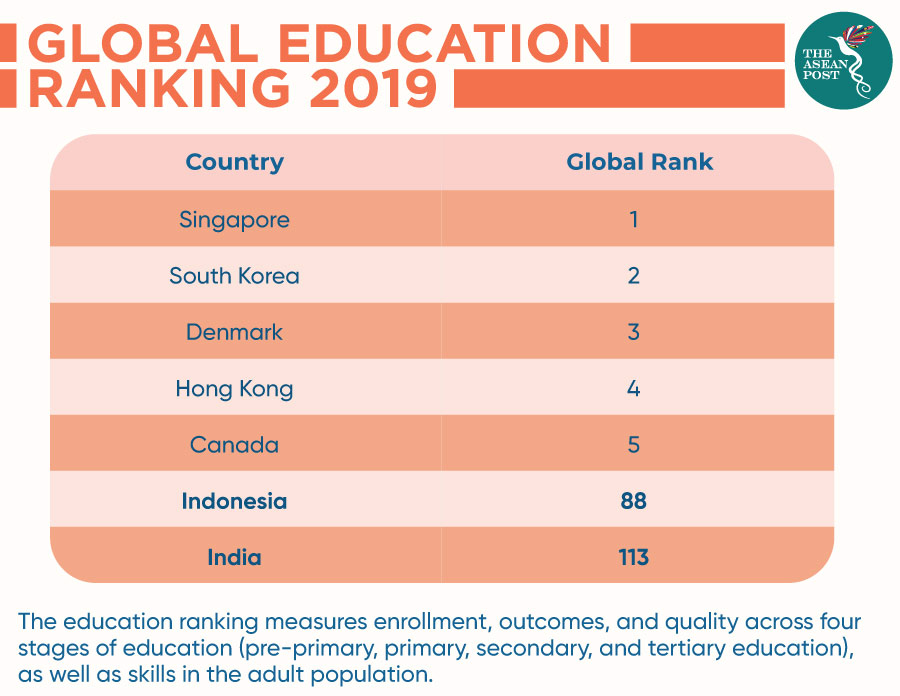
Global Education Ranking 2019

Research

Research quality and quantity issues have been an ongoing debate for ages around the globe. The plethora of research literature available globally in the realms of science and business is imposing tremendous pressure on the peer review system. Every year, around two million scientific papers, as per an estimate, are published by 30,000 journals globally, mostly from countries like the United States (US), United Kingdom (UK), Germany, and China.

On a positive note, according to the SCImago journal and country ranking, research publications are gradually increasing for both, India and Indonesia with approximately 1,670,099 papers for India and 110,610 for Indonesia. While India is clearly ahead with a global ranking of nine, it still has far to go to move up in the academic world. Both countries should invest in bolstering the number of quality research publications and develop skilled, productive and flexible labour forces such as those found in the US, UK, China, and South Korea.

Faculty

Another critical determinant for a world-class university is having acclaimed and meritorious faculty pools who are excellent in the classroom. However, sadly, both countries lack in this regard too.

According to a report by global technology specialists, GBG, most lecturers (approximately 155,591) working in Indonesia only hold a Master’s level degree. In a few cases (34,393) even Bachelor’s degree holders are permitted to teach.

According to the National Education Policy Draft Report, the quality and standard of education imparted in India is largely below the mark. The faculties are underpaid and the majority work on an ad hoc basis which eventually forces them to seek other career options which offer more appealing salary packages coupled with higher career growth prospects. In fact, it is speculated that India will soon experience around 30 to 40 percent paucity of eligible lecturers.

Funding

Sufficient funding is another key ingredient for producing independent, high-quality research and in that respect, during the last couple of years, the Indian government has remained stagnant and even moved backwards as a funder for both, public and private universities. In Indonesia, funding is gradually increasing. In 2017-2018, Indonesia’s research expenditure was 0.24 percent of its gross domestic product (GDP) whereas India’s expenditure on research stood at 0.62 percent versus China’s 2.06 percent, Singapore’s 2.36 percent and Malaysia’s 0.63 percent. Public funding, somehow, for education has remained inadequate for both countries compared to other developing nations such as Brazil and South Africa.

Higher education in both nations desperately need a revolutionary change where “industry oriented and focused teaching” is desirable. Though India stands ahead when compared to Indonesia, it is still far behind in the global ranking. The governments of both emerging economies should initiate and design innovative solutions to stand against the global forces of change. Perhaps developing an “eco-system” among all the constituents of higher education – educational institutions, students, alumni, regulatory bodies and accreditation agencies, employers, and governments – can speed up their growth and aid them in remaining relevant in the era of Education 4.0.

Fuente de la Información: https://theaseanpost.com/article/education-40-indonesia-ready


Comparte este contenido:

China tomará medidas para prevenir epidemia en universidades y colegios

Asia/China/16-02-2020/Autor(a) y Fuente: spanish.xinhuanet.com/

 China tomará más medidas para prevenir la propagación del nuevo coronavirus en colegios y universidades, informó hoy miércoles el Ministerio de Educación.

Wang Dengfeng, alto funcionario de la cartera, indicó que el ministerio ha ordenado el aplazamiento del semestre escolar debido a la epidemia.

Los colegios y universidades reanudarán el semestre a través de un calendario escalonado para evitar los picos de viaje de los estudiantes, dijo Wang, que añadió que todas las escuelas deben realizar desinfecciones tras abrir sus puertas.

Los estudiantes de las áreas más gravemente afectadas por la epidemia y los que tuvieron contacto cercano con casos confirmados, así como los que tienen síntomas como fiebre o tos, deberán someterse a cuarentena. A su vez, el resto de los estudiantes necesitarán presentarse a controles periódicos de sus condiciones de salud, informó Wang.

Los estudiantes de la provincia central de Hubei, donde se ubica la ciudad de Wuhan, epicentro del brote del virus, no podrán regresar a instituciones educativas fuera de la provincia hasta tanto sea posible satisfacer los requerimientos de la localidad de destino, concluyó.

Fuente: http://spanish.xinhuanet.com/2020-02/12/c_138777875.htm

Imagen: Gerd Altmann en Pixabay

Comparte este contenido:
Page 140 of 773
1 138 139 140 141 142 773