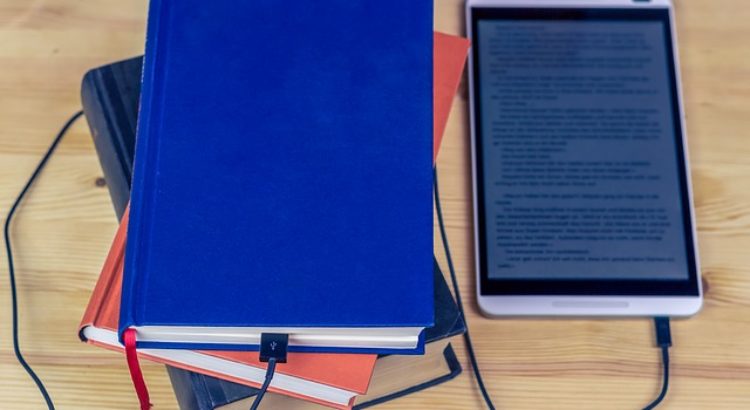
Una temporada especial de lectura comenzó el lunes en China para promover la lectura digital y tradicional en áreas rurales del país.
Siete importantes actividades, incluyendo la lectura de diferentes temas, lectura compartida y ventas de libros, se llevarán a cabo en bibliotecas de aldeas en todo el país.
Un total de 587.000 de esas bibliotecas se habían establecido hasta finales de 2018, como parte del Proyecto de Bibliotecas Rurales, que inició en 2007.
Más de 1.160 millones de libros han sido entregados a esas bibliotecas.
De las bibliotecas rurales, 125.000 han sido actualizadas para proporcionar servicios de lectura digital.
Energía con conciencia es un proyecto para estudiantes de Secundaria que busca concienciar a las generaciones futuras del uso responsable de los recursos. A través de distintas fases aprenden a ser más eficientes en el consumo de energía, agua o calor.
Fundación Repsol cuenta con un programa educativo, Energía con conciencia, que tiene como objetivo concienciar a las generaciones del futuro sobre los retos de la energía, despertar su espíritu crítico y sensibilizar para construir un mundo más sostenible.
Energía con conciencia es un proyecto educativo sobre energía y eficiencia energética, dirigido a estudiantes de 3º y 4º de Secundaria, que sensibiliza a los estudiantes sobre el uso responsable de los recursos. El curso pasado participaron un total de 36 centros educativos y desde su lanzamiento han participado más de 5.000 alumnos y 340 voluntarios.
El paso a paso del proyecto
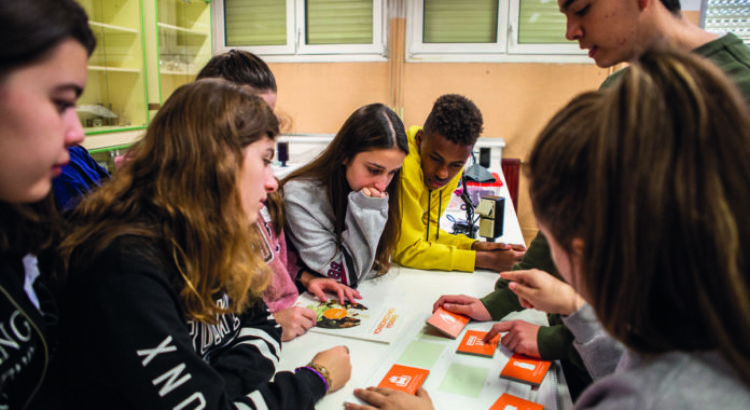
Durante el programa, los alumnos desarrollan en el aula una serie de talleres participativos y experimentos, que giran en torno a la simulación de una auditoría energética del centro educativo. De esta forma, los estudiantes se acercan al concepto de eficiencia energética y aprenden cómo reducir el consumo de energía, agua y calor. Con estas actividades se fomentan habilidades de investigación, creatividad y trabajo en equipo.
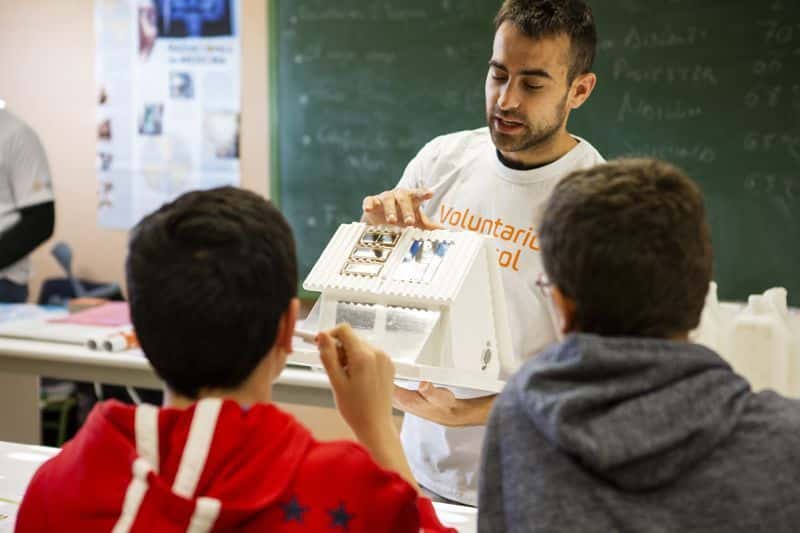
De este modo, el proyecto se estructura en diferentes fases. Primero, el docente introduce los conceptos clave a los alumnos. Posteriormente, los centros educativos reciben la visita del equipo de voluntarios Repsol, que realizan diferentes talleres y experimentos durante una jornada escolar. Tras esta actividad, los estudiantes comienzan con la auditoría energética, buscando cómo hacer un uso más eficiente de los recursos y compartiendo los resultados con el resto de sus compañeros.
Esta iniciativa va más allá de la observación, experimentación y el propio análisis científico e impulsa a las futuras generaciones a ser ciudadanos responsables y a ser preceptores de los conocimientos aprendidos, involucrando a su entorno próximo.
Con ayuda
Los estudiantes cuentan con la ayuda de voluntarios Repsol, que son empleados o antiguos trabajadores de la compañía, (hoy jubilados) con amplios conocimientos en energía, o estudiantes universitarios o de Formación Profesional que se encuentran cursando materias relacionadas con la eficiencia energética y la sostenibilidad.
Participación y convocatoria
La convocatoria para los centros educativos de la Comunidad de Madrid, Cantabria, Región de Murcia y provincias de A Coruña, Ciudad Real, Tarragona y Vizcaya que quieran participar en el curso 2019-2020 estará abierta hasta el 14 de octubre. La participación por parte de los centros es gratuita y reciben todos los materiales para desarrollar el proyecto. Así, las bases de participación están disponibles aquí y los interesados pueden inscribirse a través de este formulario.
Tras el desarrollo del proyecto, los centros educativos participantes tienen la posibilidad de presentar su informe de auditoría y competir con el resto de centros en el campeonato Energía con conciencia, en el que los dos mejores centros obtienen un premio de 7.000 y 3.000 euros respectivamente.
En la edición 2018-2019 resultaron ganadores los siguientes centros: IES Antonio Calvín (Almagro, Ciudad Real) y el IES Miguel de Cervantes (Murcia) que han recibido 3.000 y 7.000 euros.
Otras actividades
Además, la Fundación también cuenta con otras actividades en el aula, como los Talleres de Aprendenergía, que ayudan a comprender los retos actuales y futuros de la energía, a través de divertidos juegos educativos para 6º de Primaria y 3º de Secundaria. Con este juego, los participantes conocen las diferentes fuentes de energía, comprenden los procesos de transformación y tienen que diseñar un modelo energético para una ciudad o un país.
Por otra parte, la Fundación también desarrolla otras iniciativas educativas, como campañas itinerantes o actividades de ocio educativo con el objetivo de dar a conocer de una forma amena y divertida el mundo de la energía y sus retos de futuro. Asimismo, desde la Fundación se continúa desarrollando iniciativas con nuevos contenidos actualizados y formatos digitales.
Todas estas actividades son gratuitas -previa reserva- y la información de las próximas se encuentra en la agenda de Fundación Repsol.
Fuente e imagen: https://www.educaciontrespuntocero.com/noticias/fundacion-repsol-uso-energia/114499.html
Centro América/ Puerto Rico/ 23.09.2019/ Fuente: www.noticel.com.
Alegan buscan implementar nuevo proyecto
El Comité Timón, organización defensora de los derechos de estudiantes de educación especial, denunció hoy las intenciones de desmantelar los derechos adquiridos para ese sector a través de un proyecto radicado en la Cámara de Representantes.
A la misma vez, esta organización unió fuerzas con el Movimiento Por la Niñez y la Educación Pública, la Alianza de Autismo de Puerto Rico para arrojar luz al «desastre operacional» de la Oficina de Remedio Provisional que según ellos ha provocado que estudiantes tengan su educación afectada.
Según expresó la directora ejecutiva del Comité Timón, Carmen Warren González, la aprobación del Proyecto de la Cámara 1945 «trastoca las estipulaciones del Pleito de Clase Rosa Lydia Vélez y otros vs. Departamento de Educación; así como los derechos que nuestros estudiantes de Educación Especial han adquirido, gracias a la lucha de los padres, madres, abogados y abogadas del Pleito de Clase por los pasados 39 años».
«Actualmente, la Ley Núm. 51-1996, Ley IDEIA y las Estipulaciones del Pleito de Clase, son la única protección que tiene nuestra población de Educación Especial ante el gobierno y sus instrumentalidades; aprobar dicho proyecto ocasionaría un daño irreparable e irremediable en nuestra comunidad»,establece Warren en una carta escrita dirigida a los representantes de la Cámara.
Para Warren, la situación que enfrentan los estudiantes de educación especial en la isla no se resuelve con nuevas leyes, sino con la aprobación de fondos adicionales que se utilizarían para apoyar la educación de los niños del sistema de educación pública.
Por otro lado, el Comité Timón detalló que la oficina de Remedio Provisional, fue creada por el Pleito de Clase Rosa Lydia Vélez, con el fin de que cuando el Departamento de Educación no cuente con un servicio, se pueda adquirir privadamente a través de esta oficina.
De acuerdo al Comité Timón, la burocracia que perméa en la oficina ha llevado a filas interminables que convierten procesos sencillos en trámites que toman horas en concluirse, la falta de contratos para terapias, falta de comunicación telefónica, entre otros problemas.
«Declaramos la operacionalidad de esta oficina como un desastre que no se debe permitir y exigimos una reunión al Dr. Eligio Hernández donde se pueda presentar las soluciones a estos problemas de manera inmediata. No es justo que a nuestros estudiantes se les siga afectando los servicios relacionados, cuando ya el Departamento les falló. Remedio Provisional, es una oficina clerical que debe recibir las solicitudes y procesarlas en el término de ley establecido. Solicitamos la intervención de la Monitora del Pleito de Clase y el Tribunal, para que nos garanticen la operacionalidad de la oficina y que nuestros estudiantes no sigan viviendo un incumplimiento eterno, provocado por la mala administración y el exceso de burocracia. Reiteramos la importancia de que los Asistentes de nuestros hijos e hijas, puedan facturar y se les garantice sus pagos a tiempo; para no afectar sus procesos de enseñanza- aprendizaje», expresaron los miembros del Comité en una comunicación escrita.
Fuente de la reseña: https://www.noticel.com/ahora/educacion/denuncian-atentado-contra-la-ley-de-educacion-especial/1122926640
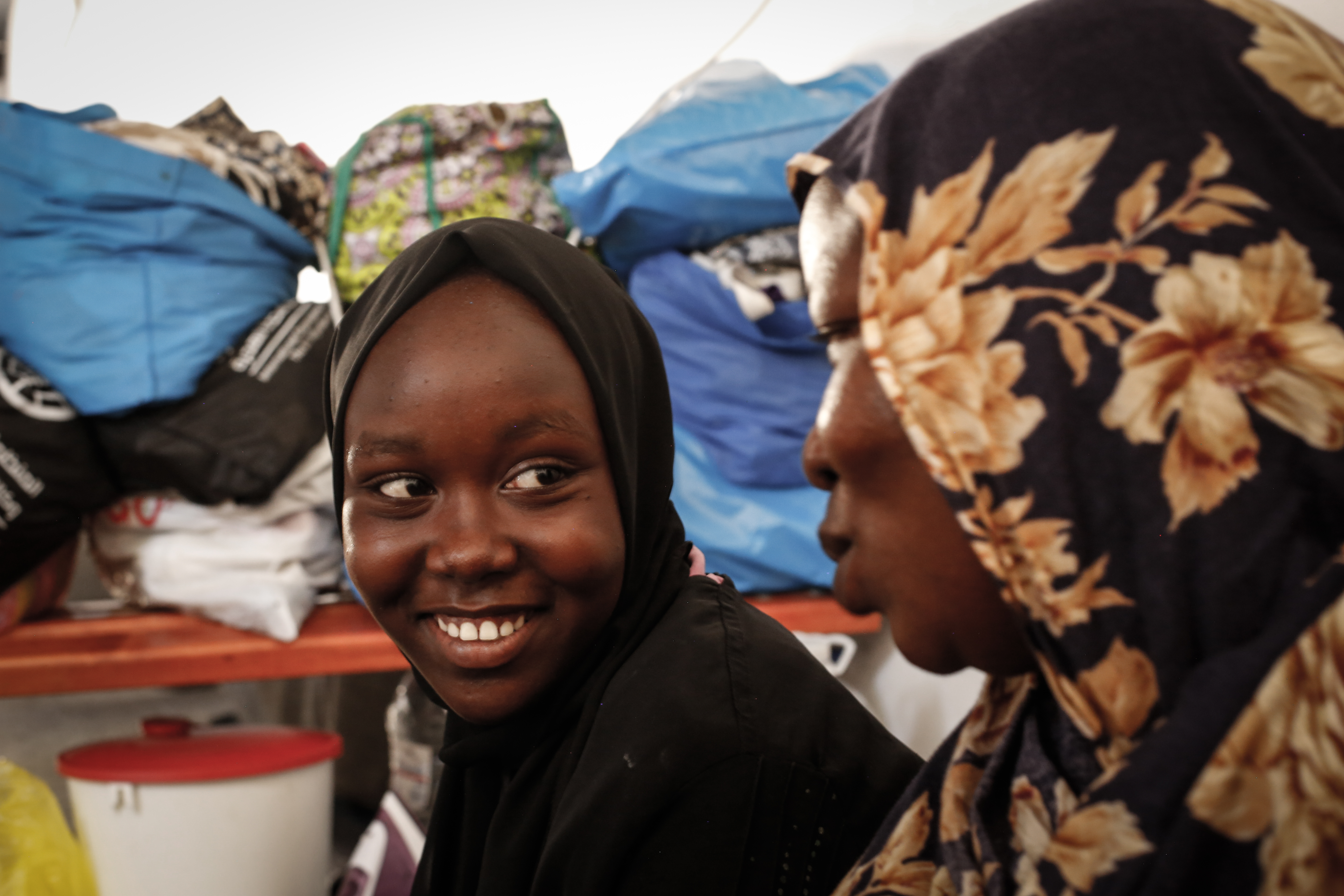
Sudanese newborns and expecting mothers are among the refugees who took shelter in the Tripoli hangar
Many refugees have fled to Libya from other war-torn countries, hoping to find respite from the violence at home. But their hardships have been far from over upon reaching the North African country, itself beset by conflict.
A number of Sudanese refugees spoke to Middle East Eye about their experiences since reaching Libya, as they have been repeatedly displaced by armed conflict and a lack of accommodations.
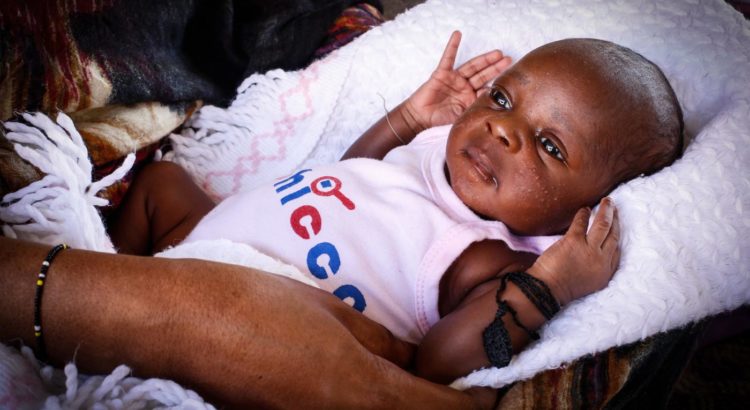
A group of Sudanese nationals, including newborn babies and pregnant women, have been living for several months in an abandoned warehouse in an area of Tripoli known as al-Riyadiya, after the United Nations High Commissioner for Refugees (UNCHR) and other humanitarian organisations failed to find them proper housing.
Before the warehouse, most had been staying in schools or mosques, with others sleeping in open fields or abandoned buildings. (MEE/Sara Creta)
Nafisa, 42, escaped genocide in Darfur, only to be displaced multiple times.
“My husband and two sons were set on fire, and my third son, Tayib, has survived and fled with me in Libya,» she told MEE. «We left Sudan into Chad before crossing the border and making our way to Umm al-Aranib, a town in Libya’s southern desert,» she said.
«There, my son Tayib was tortured: he was chained and burnt until we managed to collect money for his ransom.» (MEE/Sara Creta)
Nafisa said her son Tayib’s torture and humiliation lasted for two months, and stopped only after a sum of $3,500 was collected for his release.
«We decided to leave for Sabha and we searched for a trustworthy Libyan to take us to Tripoli,» she said.
Afterwards, Nafisa and her son initially found shelter in Ahmed bin Shatwan, a school that has been converted into a displacement camp run by the Libyan Red Crescent (LRC).
But a quarrel erupted between Sudanese refugees, an Iraqi refugee family and the shelter manager on 23 June. Meanwhile, armed groups raided the facility at night.
“They drove into the school’s courtyard and fired bullets in the air. We even saw weapons being exchanged at night,” Nafisa said. «The militia were trying to recruit my son. Even now I’m still afraid for his safety.»
It was only afterwards that her family and other Sudanese were moved to the warehouse. (MEE/Sara Creta)
Fatma Aroun Mansour and her husband Abu Bakr Adam are both from Darfur. They arrived in Libya in 2016 and lived in the town of Murzuq. But after recent clashes in the southwestern town, they decided to move to Tripoli.
They first stayed in Qasr bin Ghashir, 25km south of Tripoli. But when violent clashes erupted between forces of the internationally-recognised Government of National Accord (GNA) and the Libyan National Army (LNA), they had to leave their house and then found themselves in the Ahmed bin Shatwan school in Dhara. Like Nafisa, they felt forced to leave the school last June and have since been waiting for a more permanent solution.
“We are registered with UNHCR but we do not receive any support. My husband cannot work safely in Tripoli as he doesn’t have any legal documents, and can get kidnapped any time,» said Fatma. «We don’t get any financial help and each time we ask for financial assistance, we get told to wait.
«I had a Caesarean delivery and I’m exhausted. I don’t know how we can survive in this situation. I don’t even have milk for my children.” (MEE/Sara Creta)
Asjad, 15, her mother Awaya Mohammed, 51, and sister Abak, 13, came to Libya from Sudan through Chad.
“When we fled to Libya, we had to cross the Chadian desert. We arrived in Kufra, then we continued to Ajdabiya,» the teenager said. «At the checkpoint, my mother was captured by an armed group and they kept her for 12 days before we were able to collect money to secure her release. When we arrived in Tripoli, we fled multiple times due to the insecurity.” (MEE/Sara Creta)
Awaya said all that she wants is her daughters’ safety and for them to obtain an education.
“Due to the situation in our region in Sudan, we can’t go back,» she said. «My husband mysteriously disappeared in 2013 and I don’t know if he’s still alive. I cannot go to work and leave my daughters alone. I’m so scared that something would happen to them.
«We need safety, stability and a future. I’m also against genital mutilation and I don’t want my daughters to return to Sudan so they don’t go through the same ordeal I faced.» (MEE/Sara Creta)
For two months, families of refugees have lived in this abandoned storage facility located some 400 metres from the UNHCR’s Community Day Center (CDC) in Gurji, waiting to be moved to safer housing.
With mats on the floor for beds and neighbours’ kindness as their sole source of food and water, their living conditions remain dire. “When we go to sleep at night, we don’t know if we will wake up in the morning. We often hear fighting all through the night,” said Nafisa. (MEE/Sara Creta)
Naima, 31, and her then-4-month-old daughter came to Libya in 2013. She initially worked as a nurse in a hospital in Tripoli.
«Our problems started in 2017 when my husband was abducted for the first time,» she told Middle East Eye, saying he was held for six months.
«A few months ago, while I was pregnant, he got abducted again and I couldn’t work anymore. After I gave birth, I moved in with my sister-in-law, but where she lived was very unsafe. We were saved by our neighbours who drove us out of there,» Naima said. Her youngest daughter was only seven days old when they arrived at the Ahmed bin Shatwan shelter.
«I don’t feel safe here with my two daughters. I really don’t know what to do.” (MEE/Sara Creta)
Mussa, 25, said he spent five months in Ahmed bin Shatwan school.
«In June, while I was on my way to the UNHCR office, I was captured by a militia at a checkpoint and was brought to Tajoura detention centre with four of my friends. I had been in the centre for seven days when air raids struck Tajoura on 2 July,» he recalled.
«We were inside the bombed hangar. We hid in the toilet before we were able to escape. My ribs were broken. They brought us to the hospital where many of us were injured and one of my friends died,» Mussa said.
The young Sudanese man said he has been requesting support from UNHCR, to no avail. «I have been trying to contact UNHCR and ask for shelter, but they sent me away. Some people may have been able to work and pay rent, but now with the war, it’s more difficult and unsafe. We risk being kidnapped or forcibly recruited by militia.
«Many of my friends have gone missing,» he said. «This is not a life.” (MEE/Sara Creta)
Asma Abdulrahman, 22, told a slightly different story.
She tried to cross the Mediterranean with her brother when they were stopped by the Libyan coast guard.
«They arrested us and brought us back here,» she said. «They kept us in detention for six months, after which I paid money to be released. I arrived in Tripoli with my brother and the only place we found was this shelter. We are afraid here and we can’t sleep at night. We just want safety, security and education. Our lives are destroyed.” (MEE/Sara Creta)
Suleiman is the father of seven children. His youngest son was just only a few months old when the family crossed the Sahara desert into Libya. They were among the many families that were driven out of the Ahmed bin Shatwan shelter. Like the rest, they have been awaiting assistance in the abandoned warehouse for two months. (MEE/Sara Creta)
Muna gave birth a few days ago and had just been discharged from the hospital with her newborn baby.
“My family faced many difficulties before arriving in Tripoli, especially during our journey to the city. My husband was kidnapped in Ajdabiya but managed to escape one month later. We lived in the Crimea district of Tripoli, but when the war broke out, we were forced to leave our house. We stayed in the Ahmed bin Shatwan school-shelter until this issue escalated,» she said.
Like other refugees at the warehouse, Muna said she is not receiving any support. «I don’t have any support for my baby. Nothing at all from UNHCR.” (MEE/Sara Creta)
With most families having now been displaced multiple times, the future is uncertain for the Sudanese in Libya. Many children and their parents are reportedly dealing with the psychological ramifications of displacement, loss and grief.
«I have no future in Libya, and the region where I grew up in is gone,» Nafisa said, her words echoing the sentiments of others in the warehouse. «We need safety.”
The families are now facing a new challenge. Only a few days ago they were asked to leave the warehouse. They have nowhere to go. (MEE/Sara Creta)
Source of the article: https://www.middleeasteye.net/gallery/pictures-refugees-left-no-haven-abandoned-warehouse-libya
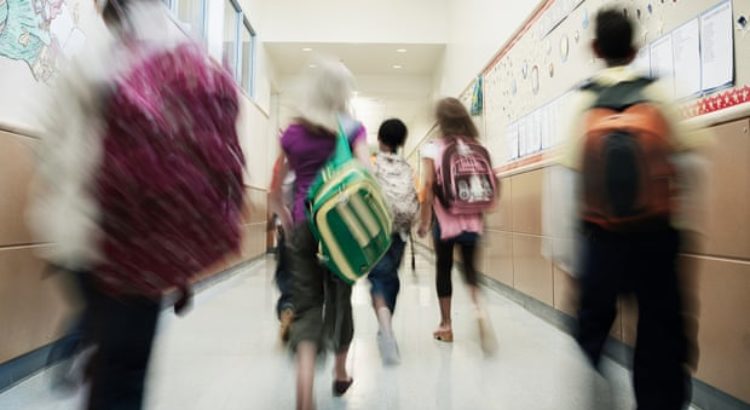
After so many school shootings, I’m not worried my kid won’t fit in – I’m praying he won’t be carried out
Ihave always loved the end of summer’s lazy promise of infinite possibility, the late August back to school buzz of limitless potential. Instead of shopping for school supplies and first day of school outfits, though, I’m online looking at Kevlar hoodies and bulletproof backpacks. This year, I’m not worried my kid won’t fit in – I’m praying he won’t be carried out.
After so many school shootings, I’m scared. Scared of what happens when that student who seems a little off or angry or cruel, whose parents don’t notice or take it seriously, whose issues the school is “dealing with”, finds access to a gun. Terrified because I know I can’t protect my child – and the government won’t. Confused because these students need help and not stigma, and it’s oddly the guns who have the stronger lobby.
Prevention of gun violence depends now on the vigilance of other parents, school administrators and law enforcement. Parents and schools are generally forewarned. School shooters exhibit “behavioral warning signs that caused others to be concerned” 93% of the time, and shooters’ plans are known to others 81% of the time. When schools ignore bullying or overlook troubling or aberrant behavior, they create a dangerous atmosphere that arming teachers, lockdowns and drills can’t later prevent. Parents who ignore warning signs put both their own and other people’s children in danger.
Law enforcement is needed before active situations develop. The El Paso killer’s mother called the police to express her concern about her son having an assault weapon. The neighbor who took in the Parkland killer says she called police to express similar concerns. Seventeen states and Washington DC have variations of red flag laws, which allow the removal of guns by judicial order from those deemed a danger to themselves or others. When warnings are heeded and social media sites monitored, would-be killers can be stopped and numerous lives saved.
There are no easy answers, particularly given political resistance to gun control legislation, but we certainly we can try. Kids can be encouraged to share information, possibly using anonymous tip lines. Metal detectors and bulletproof doors and bag checks may be widely needed, and occasional assemblies just haven’t been cutting it.
Communities can be more involved in creating individualized solutions. Violence is a great equalizer; after shootings in Columbine, Sandy Hook and Parkland, parents in all economic strata recognize no community is safe.If this sways upcoming elections, meaningful legislation could move forward and much of this issue greatly mitigated.
It’s troubling that 74% of gun owners say the right to gun ownership is “essential to their own sense of freedom”. Freedom is now predicated on access to weaponry? Obviously your gun is for protection – though research shows it’s actually more likely members of your own household will be shot with that gun than any armed intruder … But you’re different – you will keep your gun safer, never develop mental health issues, your kid would never … Most gun owners believe they can control gun safety in their homes, their risk perception flawed despite statistical evidence.
Forty years ago, my back to school was JC Penney’s, Sears or Kmart clothing advertised in shiny newspaper inserts, black-and-white marbled composition books and, if I was lucky, a novelty pen with click tabs of multiple ink colors. I was scared of the “burnouts”: boys with thick chains swinging from the loops of their faded jeans who smoked openly outside school doors, scared of gum chewing tube top-clad cool girls with their Farrah Fawcett feathered, Sun-In blonde hair … and of practically everybody else. The district’s least academic track was nicknamed “pre-jail”, there was a pregnant seventh grader whose belly strained against her overalls as she struggled to decorate our homeroom door with paper flowers, and a tall unsmiling redhead rumored to have joined the Nazi party wore enormous black boots whose stomp echoed in the narrow hallway where he called my best friend “kike” every day as he passed her. But all I feared was that someone would call me fat and everyone would laugh at me and my fatness – never guns, never being killed.
Years later, I do worry about the possibility of a shooter at my son’s tiny suburban school, though there are no grappling tweens making out in front of lockers, no lingering smoke smell at its entryway, no older kids in pick up trucks zooming out of its parking lot. In other years, I shook with PTSD at back to school night, flashing back to my tween awkwardness and pain. Now, I sit imagining someone reaching into pocket or purse and shots ricocheting around the small auditorium. Because no matter how good our body armor, none of us are bulletproof, and our most effective weapon remains our vote.
Source of the article: https://www.theguardian.com/commentisfree/2019/aug/31/school-shootings-bulletproof-backpacks-kevlar
Exigen al primer ministro, Omar al-Razzaz, atención prioritaria y personal frente a la problemática, en vez de designar subordinados en las mesas de negociación.
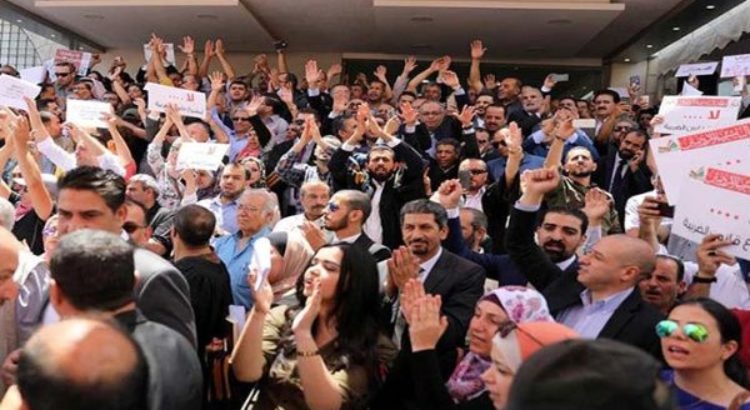
Profesores de Jordania completaron este domingo su segunda semana en huelga contra la decisión del Estado de rechazarla propuesta de aumento salarial en un 50 por ciento al cuerpo magisterial.
La jornada inició desde el pasado ocho de septiembre y cuenta con el apoyo de más de 100 mil maestros, según datos del propio magisterio, más de 4000 escuelas públicas están paralizadas hasta que el Gobierno no atienda su petición.
«La huelga continuará hasta que se cumplan las reclamaciones de los profesores (…) no hay marcha atrás posible para ningún profesor, ni para el sindicato, que representa a más de 100.000 profesores», indicó el portavoz del sindicato de profesores, Nureddin Nadim.
Docentes exigen al primer ministro, Omar al-Razzaz, atención prioritaria y personal frente a la problemática, en vez de designar subordinados en las mesas de negociación.
El sindicato único de maestros ha denunciado desde inicio de año, el salario no alcanza para comprar alimentos y los docentes tienen que asumir otros empleos para mantener a su familia.
Fuente de la noticia: https://www.telesurtv.net/news/jordania-maestros-completan-segunda-semana-huelga-20190922-0026.html
Organisers of the school strike for climate estimate 300,000 people turned out in more than 100 cities and towns
Hundreds of thousands of Australians took to the streets on Friday as they called for greater action on the climate emergency in more than 100 cities and towns across the country.
Organisers of the school strike for climate claimed about 300,000 people attended dozens of rallies, including an estimated 100,000 in Melbourne and 80,000 in Sydney. The unprecedented climate crisis protests were likely the largest public demonstrations in Australia since the marches against the Iraq War in 2003.
“I fight for climate justice because everyone deserves a safe future,” 17-year-old student Niamh told a crowd that spilled out of a Melbourne park and into the city streets. “The government is not supporting it yet, but together we will change that.”
Sparked by the first climate striking student, Swedish teenager Greta Thunberg, the protests have grown into a global movement. In Australia, they have garnered support from the wider environmental movement, but also from other non-profits and charities, unions and some businesses.
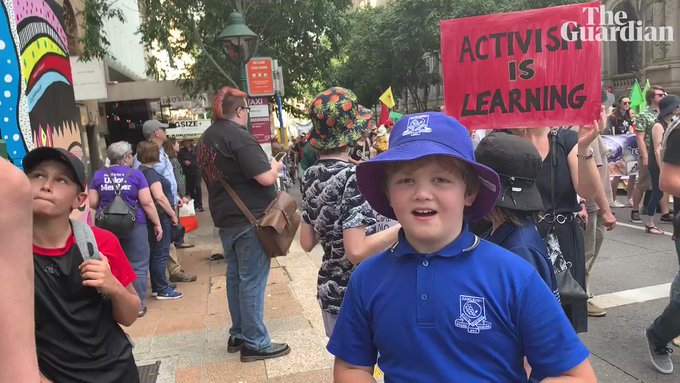
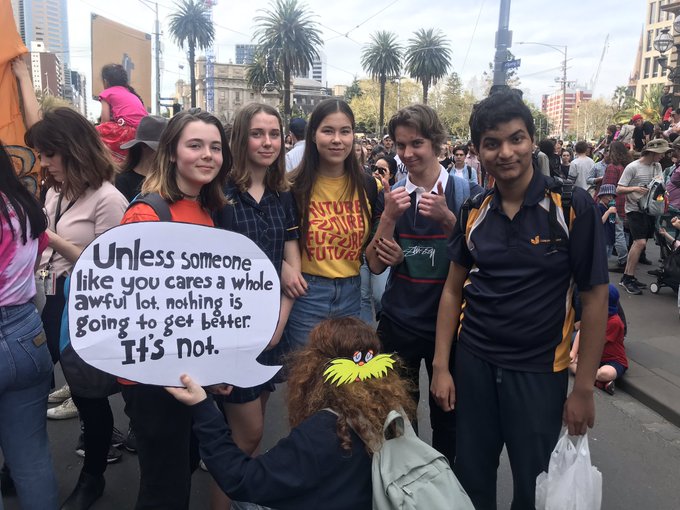
Friday’s crowds doubled the size of the student strikes in March, organisers said. Protesters ranging in age from toddlers to the elderly chanted slogans such as “we are not drowning, we are fighting,” and held up signs and placards.
Protesters packed Spring Street in Melbourne for the climate strike. Photograph: James Ross/AAP
Many were personally critical of the prime minister, Scott Morrison, who is currently in the US to visit Donald Trump. Morrison drew criticism this week after confirming he would not attend the United Nations Emergency Climate Summit in New York.
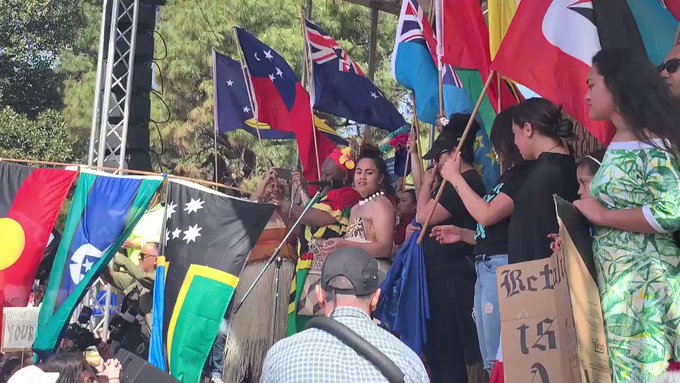
In Sydney and Melbourne, there were long lines to enter the rallies, which brought parts of both cities to a halt. Throngs of students, families, mums with strollers, officer workers and unionists filled Sydney’s Domain to hear from protest organisers, Indigenous students, Pasifika activists, and union leaders.
Pacific climate warriors: “I have a right to set foot on my islands… to see its beauty and everything it has to give. My generation and generations to come have a right to stand on the same soil our ancestors did.”#ClimateStrike#sydney
Moemoana, 18, had come from Wollongong to the protest, and her homeland is Samoa.
“I’ve come to fight for the Pacific,” she told Guardian Australia in the crowd.
“Seas are rising and it’s affecting Pacific Islands, especially Tuvalu and Kiribati, it’s a real threat and Australia needs to know that Pasifika are neighbours and Australia really needs to help out.”
Red Rebels from Extinction Rebellion join the Sydney climate strike. Photograph: Steven Saphore/AAP
Marlie Thomas, a Kamilaroi high school student from Gunnedah, said she was attending the rally on the authority of her elders, not the department of education.
“I’ve had to help collect bottled water for our family in Walgett,” she said, about the western NSW town which has run out of water after rivers dried up.
Guardian Australia
✔@GuardianAus
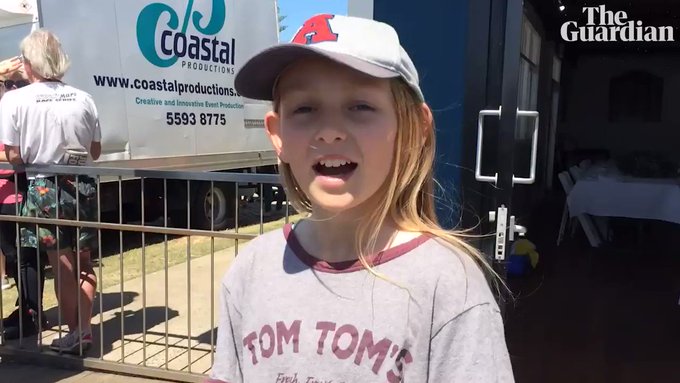
Oscar interviews Zac who is losing his voice after leading the crowds in chants at the Brisbane #ClimateStrike. “It’s so great, chanting with all the other people for what we think is right”.
About 35,000 people attended a protest in Brisbane. Across Queensland, climate strikes had a very direct local message to match the ambitious global demands of protesters: a stop to the Adani Carmichael coalmine and action to save the Great Barrier Reef.
Large crowds turned up in places torn between coal basins and the Queensland coast in places like Mackay and Townsville, which have mineworkers’ jobs and a tourist industry at stake.
“We strike because our future is in their hands,” said Brisbane year 12 student Morgan. “Our very existence sits precariously on the shoulders of politicians who care more about whether almond milk can be called milk than they do about climate change.”
Guardian Australia
✔@GuardianAus
Esther Plummer (13 years old) interviews fellow climate strikerJasper (15 years old) about why he is attending the #ClimateStrike in Byron Bay.
In Melbourne, where the protests coincided with the last day of the school term, the rally packed out Treasury Gardens and spilled onto Spring Street, where the state’s parliament sits.
“I feel like there isn’t going to be very much of a future, or if there is, it will be very short unless we do something,” said Michaela Pam, 15, who took the day off school to attend.
But the Coburg High School student told Guardian Australia of the large crowds: “It makes me feel really happy. You get a little bit of hope.”
Melbourne organisers Niamh and Freya, 16, told the crowd the protesters did not blame those who worked in the fossil fuel industry for the climate crisis.
“We understand the role fossil fuels have played in putting food on the table for families,” said Freya. “It’s vital we all work together, not against one another. It’s not about jobs versus the environment.”
Large numbers also gathered in Australia’s other major cities. Organisers estimated about 15,000 attended a strike in the capital, Canberra, while there were about 10,000 people at rallies in both Perth and Adelaide.
Organisers in Tasmania said 22,000 people attended an event in Hobart. Bob Brown, a former leader of the Greens and a giant of the environmental movement, said the crowds were larger than those during protests against the Franklin Dam in the 1980s.
Students and protesters also gathered in smaller centres, from the beaches of Byron Bay on Australia’s east coast to the outback towns of Alice Springs and Katherine. In the Queensland town of Chinchilla, a lone striker, Ariel Ehlers, 12, staged her own strike.
Marchers brought their signs – and sense of humour – to the Brisbane march. Photograph: Glenn Hunt/Getty Images
Organisations striking included 33 Australian unions, 2,500 businessesincluding Atlassian, Canva, Domain and Intrepid, and faith institutions including the Anglican Church and Uniting Church, organisers said.
Universities said they would not penalise students who missed classes to attend, while the Uniting Church synod for NSW and the ACT also allowed their students to strike. Catholic and Anglican church-run schools as well as NSW public schools said students should remain in class.
The acting prime minister, Michael McCormack, said the rallies should have been held on a weekend so they didn’t disrupt businesses, schools and universities.
Source of the notice: https://www.theguardian.com/environment/2019/sep/20/hundreds-of-thousands-attend-school-climate-strike-rallies-across-australia
OtrasVocesenEducacion.org existe gracias al esfuerzo voluntario e independiente de un pequeño grupo de docentes que decidimos soñar con un espacio abierto de intercambio y debate.
¡Ayúdanos a mantener abiertas las puertas de esta aula!












 Users Today : 372
 Total Users : 35497027
 Views Today : 388
 Total views : 3616495