Page 3104 of 6815
1 3.102 3.103 3.104 3.105 3.106 6.815

Africa: Education Begins When You Can Ask Why!

Por: africa.com/04-04-2018

I went to a bed-bug riddled school around Yaba (Yabatech) whose unofficial mandate is to make docile the crop of young people who are supposed to be movers and shakers of the community. But alas myself and an infinitesimally few others understood that the Nigerian education system is designed to bring out the corporate slaves in us, hence we educated ourselves beyond the four walls of the college.

Although earlier on throughout 2017, my political appointment as the National director of student affairs for KOWA party Nigeria,tilted my inclination towards researching into the education sector, unbeknownst to me that there is much work to be done and that the pragmatics of real changes begins with restructuring our model of education

My friend John Ashiekaa rekindled the fire when he advised me to take over my mother’s private school as the new administrator, considering that my youthfulness comes along with brilliant ideas and pragmatism that the school needed for her survival.

The last 3months has seen me code switching responsibilities as family head, school manager,business man, political appointee,and a couple of other things I would like to leave off records.

“In my time as the school manager I was able to see from the field, the impact the current education setup has on the challenges facing our immediate society.”

You would agree with me that every organized society today in any part of the world adopts an education model that is in resonance with the solution designed to solve future challenges that have been foreseen to affect the society from the concrete study of her past in relationship with current happenings.

I believe that every society should design her own model of education, ingenious to the people, extracted from the cultural system and lingua Franca with reverence to historical consciousness suitable to meet both her immediate need, and provide enough resources for the coming generation to fight a seemingly lesser and different battle.

The propaganda of our colonial education system is to keep us literate but uneducated enough to find it difficult to solve the smallest of our little problem. The education we have received has made us docile enough not to ask any questions but to rather follow instructions to letter.

Why is our education model not addressing our political, economical, and developmental challenges as a nation? Why have we not been able to ingeniously solve any of our problems? Why do we need to bring in foreigners to help with the smallest of technical work with the vast numbers of tertiary institutions around?

This questions are not far fetched, “our education system is designed to make us uneducated but sophisticated literates.”

Not until young Nigerians begin to ask “why” with the strong intent to know why, we might keep ruminating within the whims of our challenges till the next century. But if we begin to ask unusual questions we would get unusual answers that would lead us in the path of long lasting solutions to our problems.

But until we understand that education begins when you ask why, Nothing will change.

I hope you would start asking why!

Olakunle Olawole

Nat’nl Director, Directorate of student affairs, KOWA Party Nigeria.

*Fuente: https://www.africa.com/education-begins-can-ask/

Comparte este contenido:

Rab Butler revolutionised education in 1944. Let’s do it again

Por: theguardian.com/Sir Tim Brighouse/04-04-2018

Our school system is broken and only a radical new education act for the 21st century will fix it.

the last 100 years there have been two defining education acts – Butler’s in 1944 and Baker’s in 1988. They represent two distinct chapters in England’s educational story.

Tim Brighouse
Tim Brighouse was the schools commissioner for London. Photograph: Martin Godwin for the Guardian

The first witnessed new schools, colleges and curriculum innovation, especially in the arts, as well as new youth and career services. Margaret Thatcher’s neoliberalism underpinned Baker’s 1988 reform bill, which meant a prescribed national curriculum and tougher accountability, along with diversity in school provision and autonomy.

Now once again we doubt our schools – and it isn’t simply exams or test results we question. Terrorist attacks? Introduce the Prevent agenda and promote “British values”. Fall behind in the Pisa tests that compare achievement worldwide? It’s the fault of schools.

From economic woes to sporting failures, from concerns about mental health and eating habits, to a rise in drug and drink problems, schools are simultaneously seen as the cause of the problem, and the key to the solution. Schools, however, have no chance of rising to the challenge until at least five systemic structural issues have been addressed. 

The first is a growing crisis in teacher recruitment and retention: teachers stay for less and less time in the profession. “Securing and retaining a sufficient supply of suitably qualified teachers” was one of the original three duties of the secretary of state (there are now more than 2,000). Michael Gove abandoned this, believing the market would find a solution. It has: gluts in some areas, acute teacher shortages elsewhere. Without good teachers we are a lost civilisation.

Second, the curriculum is not fit for purpose. That won’t be corrected unless the deficiencies in exams are tackled simultaneously: at present these are unreliable, costly and privately run for profit by three boards. By focusing on the essential skills of numeracy and literacy we neglect others equally vital to our youngsters’ futures – such as high-level IT skills, thinking analytically within disciplines, solving inter-disciplinary problems, working in teams, interacting civilly with individuals from different cultural backgrounds and thinking for themselves while acting for others.

Third, the over-centralised governance and accountability system also needs reform. Ministers exercise too much power and too little judgment. Schools should of course be accountable – but not as academies are to the minister. Those in effect are nationalised “government schools”, a model usually found in totalitarian states.

A combination of exam league tables and high-stakes Ofsted inspections has re-enforced a myopic and narrow interpretation of what education is for. At best it celebrates the winners in a competition focusing on the measurable at the expense of the valuable; at worst it creates a climate of fear, bullying and human failure.

Rab Butler
Rab Butler, who was responsible for the 1944 Education Act. Photograph: Hulton Archive/Getty

Meanwhile, in every other developed democracy, including other parts of the UK, schools are accountable to a democratically elected local body. That is not true of the 7,000 free schools and academies that are an unholy hybrid of private company and charitable foundation, leading to financial scandals.

To these three structural failings add a fourth: school admissions arrangements based on a false prospectus of parental choice when the reality is that schools choose parents through covert selection, favouring the children of the rich over those from challenging families.

Finally, since 2010 the huge funding deficit between state funded schools and the private independent sector has widened further. Social mobility, a declared aim of both government and opposition, will remain a pipe dream until we tackle the unfair privileges this funding gap symbolises and perpetuates. Equity and equality of opportunity to live a fulfilled life are illusory unless these five issues are resolved.

An education act of 2020 should be passed after a cross-party parliamentary “conference”, jointly chaired by the education spokespeople from the three main parties and modelled on the select committee. Its task should be to take evidence from all interested stakeholders about what our future education service should look like. It would deal with the five systemic issues highlighted here and provide a comprehensive action programme for all educational entitlements, from the earliest years into old age.

It would herald an age of ambition, hope and partnership and a society committed to unlocking the talents not of a few, nor even the many, but of all its citizens.

Tim Brighouse was the schools commissioner for London from 2002-07

 Since you’re here …

… we have a small favour to ask. More people are reading the Guardian than ever but advertising revenues across the media are falling fast. And unlike many news organisations, we haven’t put up a paywall – we want to keep our journalism as open as we can. So you can see why we need to ask for your help. The Guardian’s independent, investigative journalism takes a lot of time, money and hard work to produce. But we do it because we believe our perspective matters – because it might well be your perspective, too.

I appreciate there not being a paywall: it is more democratic for the media to be available for all and not a commodity to be purchased by a few. I’m happy to make a contribution so others with less means still have access to information.Thomasine, Sweden

If everyone who reads our reporting, who likes it, helps fund it, our future would be much more secure. For as little as £1, you can support the Guardian – and it only takes a minute. Thank you.

*Fuente: https://www.theguardian.com/education/2018/apr/03/rab-butler-1944-revolutionise-education-act-tim-brighouse

Comparte este contenido:

EEUU: Teachers in Oklahoma and Kentucky Walk Out: ‘It Really Is a Wildfire’

Por: nytimes.com/ Dana Goldstein/04-04-2018

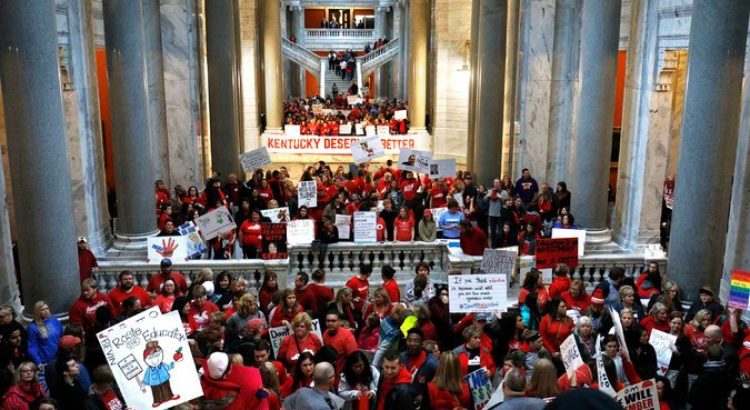
Thousands of teachers in Oklahoma and Kentucky walked off the job Monday morning, shutting down school districts as they protested cuts in pay, benefits and school funding in a movement that has spread rapidly since igniting in West Virginia this year.

In Oklahoma City, protesting teachers ringed the Capitol, chanting, “No funding, no future!” Katrina Ruff, a local teacher, carried a sign that read, “Thanks to West Virginia.”

“They gave us the guts to stand up for ourselves,” she said.

The walkouts and rallies in Republican-dominated states, mainly organized by ordinary teachers on Facebook, have caught lawmakers and sometimes the teachers’ own labor unions flat-footed. And they are occurring in states and districts with important midterm races in November, suggesting that thousands of teachers, with their pent-up rage over years of pay freezes and budget cuts, are set to become a powerful political force this fall.

The next red state to join the protest movement could be Arizona, where there is an open Senate seat and where thousands of teachers gathered in Phoenix last week to demand a 20 percent pay raise and more funding for schools.

The growing fervor suggests that labor activism has taken on a new, grass-roots form.

“Our unions have been weakened so much that a lot of teachers don’t have faith” in them, said Noah Karvelis, an elementary school music teacher in Tolleson, Ariz., outside Phoenix, and leader of the movement calling itself #RedforEd, after the red T-shirts protesting teachers are wearing across the country

“Teachers for a long time have had a martyr mentality,” Mr. Karvelis said. “This is new.”

The wave of protest is cresting as the Supreme Court prepares a decision inJanus v. Afscme, a major case in which the court is expected to make it harder for public sector unions to require workers to pay membership fees. But the recent walkouts suggest that labor activism may not need highly funded unions to be effective. Unlike in strongholds for labor, like New York or California, teachers’ unions in West Virginia, Oklahoma, Kentucky and Arizona are barred by law from compelling workers to pay dues. Yet that has not stopped protesters from making tough demands of lawmakers.

Striking West Virginia teachers declared victory last month after winning a 5 percent raise, but Oklahoma educators are holding out for more.

Last week, the Legislature in Oklahoma City voted to provide teachers with an average raise of $6,000 per year, or roughly a 16 percent raise, depending on experience. Gov. Mary Fallin, a Republican, signed the package into law.

Teachers said it was not enough. They have asked for a $10,000 raise, as well as additional funding for schools and raises for support staff like bus drivers and custodians.

About 200 of the state’s 500 school districts shut down on Monday as teachers walked out, defying calls from some parents and administrators for them to be grateful for what they had already received from the state.

To pay for the raise, politicians from both parties agreed to increase production taxes on oil and gas, the state’s most prized industry, and institute new taxes on tobacco and motor fuel. It was the first new revenue bill to become law in Oklahoma in 28 years, bucking decades of tax-cut orthodoxy.

In Kentucky, teachers earn an average salary of $52,000, according to the National Center for Education Statistics, compared with $45,000 in Oklahoma. But teachers there, thousands of whom are picketing the Capitol during their spring break, are protesting a pension reform bill that abruptly passed the State House and Senate last week. If Gov. Matt Bevin signs it into law, it will phase out defined-benefit pensions for teachers and replace them with hybrid retirement plans that combine features of a traditional pension with features of the 401(k) accounts used in the private sector. Teachers in the state are not eligible for Social Security benefits.

Andrew Beaver, 32, a middle school math teacher in Louisville, said he was open to changes in teacher retirement programs, such as potentially asking teachers to work to an older age before drawing down benefits; currently, some Kentucky teachers are eligible for retirement around age 50. But he said he and his colleagues, many of whom have called in sick to protest the bill, were angry about not having a seat at the negotiation table with Mr. Bevin, a Republican, and the Republican majority in the Legislature.

“What I’m seeing in Louisville is teachers are a lot more politically engaged than they were in 2015 or 2016,” he said. “It really is a wildfire.”

In Arizona, where the average teacher salary is $47,000, teachers are agitating for more generous pay and more money for schools after watching the state slash funds to public education for years.

“We’re going to continue to escalate our actions,” Mr. Karvelis said. “Whether that ultimately ends in a strike? That’s certainly a possibility. We just want to win.”

Oklahoma educators are holding out for more than the $6,000 per year raise that was signed by the Legislature last week. CreditAlex Flynn for The New York Times

Mr. Karvelis, 23, said teachers would not walk out of class unless they were able to win support from parents and community members across the state, including in rural areas. But he said the movement would be influential regardless of whether it shuts down schools.

“We’re going to have a lot of teachers at the ballot box who I don’t think would normally go in a midterm year,” he said. “If I were a legislator right now, I’d be honestly sweating bullets.”

With Republican legislators and governors bearing the brunt of the protesters’ fury, the Democratic Party is trying to capitalize on the moment. The Democratic National Committee plans to register voters at teacher rallies, and hopes to harness the movement’s populism.

The teacher walkouts are “a real rejection of the Republican agenda that doesn’t favor working-class people,” said Sabrina Singh, the committee’s deputy communications director. “Republicans aren’t on the side of teachers. The Democrats are.”

That type of rhetoric is a sea change from the Obama years, when many Democrats angered teachers by talking less about core issues of schools funding than about expanding the number of charter schools, or using student test scores to evaluate teachers and remove ineffective ones from the classroom.

“School reformers kind of overshot the mark, and we’re now in a pendulum swing where teachers increasingly look like good guys,” said Frederick Hess, director of education policy studies at the American Enterprise Institute, a conservative-leaning think tank.

Republicans, too, he said, should consider pitching themselves as teacher-friendly candidates, perhaps by tying teacher pay raises to efforts to expand school choice through private school vouchers or charter schools.

Lily Eskelsen García, president of the National Education Association, the nation’s largest teachers’ union, called the movement an “education spring.”

“This is the civics lesson of our time,” she said. “The politicians on both sides of the aisle are rubbing the sleep out of their eyes.”

*Fuente: https://www.nytimes.com/2018/04/02/us/teacher-strikes-oklahoma-kentucky.html

Comparte este contenido:

EEUU: What’s Christian higher education worth? How about $60 billion a year

EEUU/ April 3, 2018/BY JOSEPH JONES/Source: http://www.fresnobee.com

The Council for Christian Colleges and Universities (CCCU) last Monday issued a ground-breaking economic study of its 142 members in the United States, which includes Fresno Pacific University.

These institutions broaden the educational options for students by creating environments where students can freely integrate their Christian faith into their education. Many schools, like FPU, do not require their students to be Christians, but do encourage the integration of faith and knowledge in preparation for service to society and their communities.

The report highlights the economic value of these institutions throughout the country, and particularly addresses the 16 colleges/universities in California. FPU is the only university of this nature in the Valley, providing educational options for traditional, non-traditional and graduate students. The university has the highest degree-completion rate in the Valley and is a Hispanic-serving institution.

The CCCU study released Monday shows that its members have a national economic impact of $60 billion each year. That’s $166 million per day. This study mirrors a similar study of private colleges and universities in California by the Association of Independent California Colleges and Universities.

These 79 colleges and universities, including FPU, employ 88,800 Californians and provide a $26 billion-plus economic contribution to the state. They produce 22 percent of the bachelor’s degrees, 52 percent of the master’s degrees and 54 percent of the doctoral degrees in California.

Here are a few key findings about the Christian schools in the CCCU study:

 ▪  For every $1 in federal grant money a student receives, Christian institutions provide $5 in aid to that student through grants and scholarships.

 ▪  The student loan default rate for graduates (6.3 percent) is nearly half the national average (11.5 percent).

▪  Although tax exempt, they generate $9.7 billion in federal tax revenue each year.

▪  For every $1 in federal grant money a student receives, the schools generate more than $20 in federal tax revenue.

 ▪  One in three students are first-generation college students.

 ▪  50 percent come from families that make less than $50,000 a year.

 ▪  While approximately one in four college students across the country volunteer, more than one in three of our students participate in community service, contributing about 5.4 million hours a year.

Fresno Pacific University in comparison to other Christian and independent colleges reveals:

 ▪  49 percent of FPU students are the first in their families to attend college or university, rather than one in three, and these students graduate at the same rate as our students in general.

 ▪  56 percent come from families who earn $40,000 or less annually, rather than 50 percent of students coming from families who earn less than $50,000.

 ▪  student default rate is 4.4 percent, below the CCCU average of 6.3 percent.

 ▪  All our traditional undergraduate students perform community service.

 ▪  44 percent of our students identify themselves as Latino or Latina. They also graduate at the same rate as our students in general.

In all, the 16 CCCU institutions in California spend $1.8 billion annually on operations and capital investments, enroll over 60,000 students, employ more than 10,000 people, support more than 45,000 other jobs, attract more than $500 million in ancillary student spending and generate $370 million in state tax revenues.

Their more than 220,000 alumni earning an extra $2.8 billion a year due to the education they received. Nationwide, CCCU schools educate 445,000 students, employ 72,000 faculty and staff and serve 3.5 million alumni around the world.

The return on investment in institutions like Fresno Pacific is not just realized in dollars and cents. Our success is defined by the ways in which we produce effective graduates.

Our spiritual and ethical commitment to the Valley is only a reflection of our commitment to Christ. We have adopted the mantra to “Engage the Cultures and Serve the Cities in the Valley.” We are privileged to join with others to serve in the economic well-being of our region and this state. We look forward to partnering with others who are also committed.

Source:

http://www.fresnobee.com/opinion/readers-opinion/article207082359.html


Comparte este contenido:

Nuevos nombramientos en la dirección de la UNESCO

UNESCO/03 de abril de 2018

La Directora General de la UNESCO, Audrey Azoulay, anunció hoy el nombramiento de cuatro nuevos miembros en el equipo de dirección de la Organización.

Se trata de:

  • Xing Qu (China, 61 años), desempeñará el cargo de Director General Adjunto. Ex presidente del Instituto de Estudios Internacionales en el ministerio de Relaciones Exteriores de China (2009-2014), desde 2014 era Embajador de China en Bélgica.
  • Stefania Giannini (Italia, 57 años), ocupará el puesto de Subdirectora General de Educación. Ex ministra italiana de Educación, Universidades e Investigación (2014-2016), desde octubre de 2017 se desempeñaba como asesora del Comisario Europeo de Investigación, Ciencia e Innovación, Carlos Moedas.
  • Ernesto Renato Ottone Ramírez (Chile, 45 años) es el nuevo Subdirector General de Cultura. Ex ministro presidente del Consejo Nacional de la Cultura y las Artes (2015) y posteriormente ministro de las Culturas, las Artes y el Patrimonio de Chile, desde 2016 desempeñaba además la función de presidente del Consejo del Centro Regional para el Fomento del Libro en América Latina y el Caribe (CERLALC).
  • Moez Chakchouk (Túnez, 42 años), ha sido nombrado Subdirector General de Comunicación e Información. Ex comisario de la Comisión de la Gobernanza de Internet (2014-2016) y presidente director general de la Agencia Tunecina sobre el Internet (2011-2015), desde 2015 era Presidente Director General del Servicio de Correos de Túnez.

Todos ellos asumirán sus cargos respectivos en el curso de las próximas semanas.

Se unen al equipo directivo de la Organización, del que ya forman parte Flavia Schlegel (Suiza), Subdirectora General de Ciencias Exactas y Naturales, Vladimir Ryabinin (Federación de Rusia), Subdirector General y Secretario Ejecutivo de la Comisión Oceanográfica Intergubernamental, Nada Al-Nashif (Jordania), Subdirectora General de Ciencias Sociales y Humanas y Firmin Édouard Matoko (Congo), Subdirector General del Departamento África.

Al anunciar estos nombramientos, la Directora General declaró: “La llegada de estas cuatro personalidades a la dirección de la UNESCO se inscribe de lleno en la dinámica que quiero infundir a nuestra Organización. La calidad de sus trayectorias profesionales y su diversidad representan una verdadera riqueza para la UNESCO y atestiguan nuestra ambición de construir la paz desde una encrucijada de culturas”.

Por último, la Directora General agradeció muy calurosamente al Director General Adjunto saliente, Getachew Engida, por su compromiso al servicio de la UNESCO así como el trabajo realizado por los precedentes subdirectores generales.

Fuente de la Noticia:

https://es.unesco.org/news/nuevos-nombramientos-direccion-unesco

Comparte este contenido:

Japan: Too much of an education could be bad for your future

Japan/April 03, 2018/By: MICHAEL HOFFMAN*/Source: https://www.japantimes.co.jp

Poverty comes in many forms but one color: gray.

There is the poverty of the poor, the poverty of the rich, the poverty of the academically under-qualified, the poverty of the academically over-qualified. The poverty of the poor pretty much speaks for itself. The riches of the rich may be deceptive.

The biggest drain on them is education for the kids. Luxuries and pleasures can be sacrificed, but to compromise where the children are concerned is (or is seen to be) to deprive them of the leg-up they need (or are seen to need) to gain a foothold in life.

What high schools are open to graduates of inferior elementary schools? Inferior ones. What universities are open to graduates of second-rate high schools? Second-rate ones. What kind of career is open to graduates of merely ordinary universities? A merely ordinary one. The consequent financial strain can be felt as a kind of poverty.

If it’s true of the rich, how much more so of the poor. The high cost of education is considered a main cause of the sunken birth rate. If educating your children as the economy demands its top tier be educated requires means beyond the average, means beyond you, childlessness might well seem the more responsible option.

There’s education and education. Motives for acquiring it vary. It can be a quest for knowledge or a quest for credentials. The former is problematic. Shukan Gendai magazine tells some cautionary tales.

“Kyoko-san,” 27, studied fine arts. It was her passion. She’d learn the subject, then teach it. Undergraduate school, graduate school, post-grad school. Hard at work on her Ph.D. thesis, she suddenly noticed something: Students graduating ahead of her weren’t getting jobs.

Stupid of her not to notice before! Absorption in your studies can blind you to earthier realities. Panicking, she put aside her thesis and threw herself into job-hunting. Nothing. Universities were over-staffed, the private sector had no room for her. She eventually landed a job at a small small-town rural arts museum. The work is routine and she feels her expert knowledge rotting within her, but at least she can feed herself.

Not every one is so lucky. “Nakamura-san,” 29, is a Ph.D. scientist struggling to repay a ¥6 million student loan on a ¥2 million-a-year salary. The good news is that his employer is a university and his job description includes the word “research” — followed, unfortunately, by the word “assistant,” which translates into part-time status and lab chores far from the cutting edge.

Maybe in 10 years he’ll get an assistant professorship. Or maybe not — in which case he’ll be 40 years old and nowhere. In the meantime, he lives in a ratty ¥40,000-a-month apartment, eats at the university cafeteria and wonders, “How long can I take this?” It’s enough to make the private sector look attractive — but an exploratory foray into it showed that the private sector did not return the compliment. Knowledge beyond a certain range of commercial exploitability, comments Shukan Gendai, is to the private sector the rough equivalent of otaku-hood.

“Takada-san,” 26, is pursuing a doctorate in literature at the University of Tokyo. He’s learning something the great books don’t teach — to wit: “To get anywhere in research you need connections. I didn’t know that when I started. You need to develop relationships with influential professors who can boost your career.

“So, I get involved in academic meetings, I help out at the reception desk, I coach visiting overseas students. … In short, I’m so busy maneuvering behind the scenes that I have no time to study.”

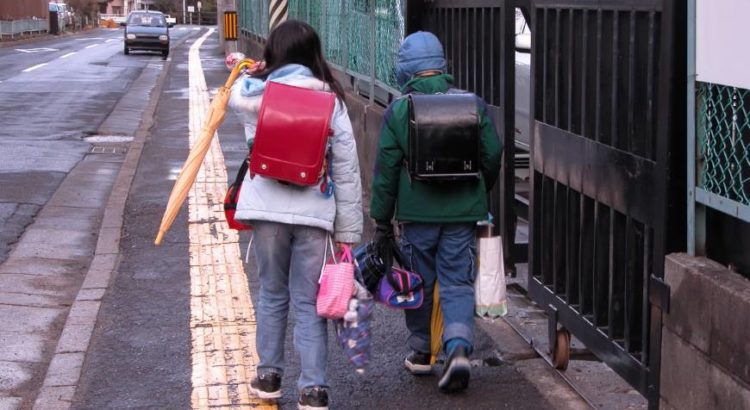
This is ironic, in view of the importance society attaches to education. Arrestingly symbolic, as the back-to-school season nears, is the iconic randoseru elementary school rucksack. The word, borrowed from Dutch, reflects the age and origin of the import, harking back as it does to the early 19th century, when a restricted number of Dutch traders were almost the only foreigners permitted in Japan. They bequeathed to their hosts a few European books, a smattering of the Dutch language, a bit of European science (and a hunger for more) — and the randoseru. Japanese kids have been saddled with it ever since.

It’s no light burden. And it’s gaining weight, as the Asahi Shimbun noted last week. Carrying a full load of books, lunch, gym clothes and whatnot, it can weigh nearly 10 kilograms. The 7-year-old second-grader gamely bracing against its downward thrust probably weighs little more than 20 kg him- or herself.

Why should the venerable randoseru be gaining weight? Because, the Asahi explains, textbooks are. There’s so much to learn! Never more than now, and more and more each year as knowledge, competition, pressure and standards rise. As of 2015, after six years of elementary schooling, an average child will have carried (and hopefully read) a total of 6,518 textbook pages — representing a 34 percent increase in 10 years. Moral education, a new subject swelling the curriculum beginning this year, will add, over six years, an estimated 1,067 pages to the load.

“Higher” education, meanwhile, languishes. “Higher education” used to mean, simply, college. A hundred years ago less than half the population got beyond elementary school, which alone was compulsory. College was for the lucky and gifted few.

Postwar democracy flung open the academic gates. What had been a mark of distinction became more or less a necessity to anyone with white-collar aspirations. Today, “higher education” means — if it means anything — not university education per se but learning for its own sake, and Shukan Gendai’s coverage is not encouraging.

It shows the number of Ph.D. students declining at a rate the declining student-age population only partly accounts for: 14,927 nationwide in 2016 as against 18,232 in 2003.

Philosophy remains a popular university alternative to raw science. Each year brings forth 1,000-odd newly fledged philosophers. They can’t all be professors. Most will have to leave academia and seek their fortunes in the “real world.” As what? Doing what? In an age of post-truth and artificial intelligence, who needs philosophers?

*Michael Hoffman is the author of “In the Land of the Kami: A Journey into the Hearts of Japan” and “Other Worlds.”

Source:

https://www.japantimes.co.jp/news/2018/03/31/national/media-national/much-education-bad-future/#.WsMQOYjwbIU

Comparte este contenido:

EEUU: La educación superior obtuvo un gran puntaje en la corta sesión legislativa de Washington

EEUU/03 de abril de 2018/Fuente: http://www.theolympian.com

Los legisladores estatales asignaron este año millones de dólares para ayudar a pagar la matrícula de estudiantes universitarios de bajos ingresos, desarrollar la informática en la universidad más representativa del estado y crear nuevas protecciones al consumidor para préstamos estudiantiles.

Para una breve sesión legislativa, el gobernador Jay Inslee firmó este mes una lista inusualmente larga de proyectos de ley en la lista de deseos de mayor jerarquía. El senador estatal Kevin Ranker, de la isla D-Orcas, que encabezó el Comité de Educación Superior del Senado este año, lo atribuye a un cambio en el equilibrio del poder: muchos proyectos de ley defendidos por los demócratas habían muerto en años anteriores bajo la educación superior senado dirigida por los republicanos comité.

Una de las mayores movidas fue la promesa de los legisladores de financiar completamente State Need Grant, el programa estatal de ayuda financiera para la universidad de $ 300 millones, que no ha podido proporcionar ayuda a todos los estudiantes que calificaron para este programa desde 2009.

En 2016-17, por ejemplo, casi 90,000 estudiantes universitarios de bajos ingresos de Washington calificaron, pero alrededor de 21,000 de ellos, la mayoría estudiando en universidades de dos años, no recibieron ningún dinero.

Este otoño, la necesidad de subsidio ayudará a 4,825 estudiantes adicionales. Los legisladores terminaron la sesión con un compromiso no vinculante de aportar más dinero cada año, hasta que todos los estudiantes que califican para el 2021 reciban ayuda, dijo el representante estatal Drew Hansen, D-Bainbridge Island, que encabeza el comité de educación superior de la Cámara.

Eso costará $ 18.5 millones adicionales en 2019, $ 38 millones en 2020 y $ 59 millones en 2021. Ranker había propuesto otorgarle a State Need Grant un derecho , pero ese proyecto de ley falló.

La facultad de ciencias de la computación de la Universidad de Washington recibió $ 3 millones adicionales para contratar docentes, asistentes de docentes, asesores de pregrado y personal de soporte técnico, todas las personas necesarias para aumentar el número de estudiantes graduados en ciencias de la computación, el más solicitado de la UW .

Es la culminación de un esfuerzo de cuatro años lanzado por Hansen y luego Rep. Chad Magendanz, R-Issaquah, para duplicar el número de estudiantes que se gradúan en ciencias de la computación, de 300 a 600 graduados al año.

«Es el voto de confianza de la Legislatura en la excelencia en informática de UW», dijo Hansen.

El representante estatal Gerry Pollet, demócrata de Seattle, defendió con éxito un proyecto de ley que evitará que las universidades con fines de lucro dirijan a los estudiantes a préstamos de alto interés ofrecidos por los mismos colegios.

Eso es lo que sucedió a principios de la década de 2000 cuando una serie de seis campus con fines de lucro de Everest College operaba en Washington. Everest, propiedad de Corinthian Colleges, guió a los estudiantes hacia préstamos de su propia agencia de préstamos estudiantiles con altas tasas de interés que tuvieron que pagarse casi de inmediato. Corinthian se declaró en bancarrota en 2015, y las sucursales de Everest, que fueron compradas por Zenith Education, pasaron a llamarse Colegios de Carreras de Altierus. La mayoría de esas universidades en todo el país ahora están cerradas.

Pollet dijo que muchos estudiantes de Everest podrían haber calificado para préstamos federales de bajo interés y asistir a universidades comunitarias estatales por un tercio del costo de un título de Everest. Él piensa que la nueva ley evitará que un futuro Everest College se aproveche de los estudiantes y podría ser un modelo para otros estados.

Otro proyecto de ley patrocinado por Pollet se asegura de que los estudiantes universitarios no pierdan parte de su ayuda financiera a las tarifas cobradas por las compañías prepagas de tarjetas de débito. Conforme a la ley, no se puede obligar a los estudiantes a utilizar una tarjeta de débito prepaga para acceder a su ayuda financiera y deben tener acceso a los cajeros automáticos que no cobran tarifas para acceder a su ayuda.

Ranker guió a través de un proyecto de ley que crea un nuevo programa para niños en el sistema de cuidado de crianza que les ayudará a seguir dos caminos después de la escuela secundaria: la universidad o un aprendizaje.

Según el programa estatal «Pasaporte a la universidad», que brinda asistencia a los jóvenes de 16 años en el sistema de cuidado temporal del estado para prepararse para la universidad, el nuevo programa comienza a una edad más temprana y abarca un número mayor de estudiantes que podrían usar la ayuda .

El programa «Pasaporte a Carreras» comenzará a ayudar a los estudiantes a los 13 años e incluirá a estudiantes sin hogar, estudiantes en el sistema tribal de cuidado de crianza y estudiantes que se mudan aquí desde otros estados pero permanecen en el sistema de cuidado de crianza de su estado natal. , Dijo Ranker.

Ayudará no solo con el asesoramiento de la universidad, sino que también ayudará a los estudiantes que no estén interesados ​​en asistir a la universidad a encontrar aprendizajes basados ​​en el trabajo. Inslee ha hecho que el crecimiento del programa de aprendizaje del estado sea una de las principales prioridades de su administración.

Los niños de crianza temporal tienen tasas universitarias muy bajas, pero Ranker dijo que los estudiantes que participan en «Pasaporte a la universidad» tenían un 50 por ciento más de probabilidades de ir a la universidad. El programa ampliado costará $ 559,000 en 2019.

Entre las otras leyes relacionadas con la educación superior que también pasaron esta sesión:

• Los legisladores aprobaron un proyecto de ley que permite a los estudiantes que llegaron a este país de forma ilegal obtener dinero del estado para ayudar a pagar la universidad con el programa de becas College Bound.

• Una nueva ley estatal requiere que los administradores de préstamos estudiantiles tengan licencia del estado y crea una oficina de defensa de préstamos estudiantiles. Podría enfrentar un desafío legal del Departamento de Educación federal, que afirma que los estados no tienen autoridad legal para regular la industria.

• El programa de matrícula prepaga del estado, Guaranteed Education Tuition, ofrecerá a los inversores un incentivo para transferir sus fondos a un nuevo plan estatal 529 de inversión universitaria.

• Se enmendó la Beca de Oportunidades del Estado de Washington, una asociación público-privada, para que pueda ofrecer ayuda a los estudiantes que desean obtener certificados y títulos de la fuerza de trabajo en colegios comunitarios y técnicos.

Fuente de la Noticia:

http://www.theolympian.com/news/politics-government/article207330029.html

Comparte este contenido:
Page 3104 of 6815
1 3.102 3.103 3.104 3.105 3.106 6.815