Saltar al contenido principal
Page 890 of 6723
1 888 889 890 891 892 6.723

Italia: Covid-19 pandemic: Italy to shut shops and schools amid infection spike

Covid-19 pandemic: Italy to shut shops and schools amid infection spike

Shops, restaurants and schools will be closed across most of Italy on Monday, with PM Mario Draghi warning of a «new wave» of the coronavirus outbreak.

For three days over Easter, 3-5 April, there will be a total shutdown.

Italy, which one year ago imposed one of the first national lockdowns, is once again struggling to contain the rapid spread of infections.

The country has reported more than 100,000 Covid-related deaths, Europe’s second-highest tally after the UK.

Italy’s vaccination campaign has been hit by delays, as has been seen elsewhere in the European Union.

Anglo-Swedish drug company AstraZeneca has announced a further shortfall in the amount of its vaccine it can supply to the European Union, blaming export restrictions imposed by some countries. It did not elaborate.

In January, it announced a large cut in the 100m doses it had originally expected to deliver to the EU by March, sparking a public spat with European Commission.
Last week the government in Rome blocked the export of 250,000 doses of the Oxford-AstraZeneca vaccine to Australia to address shortfalls of vaccines.
What are the new rules in Italy?

From Monday, schools, shops and restaurants will shut in more than half of Italy, including the two most populous regions containing Rome and Milan.

Residents will be required to stay at home except for work, health or other essential reasons.

A man closes a sandwich bar in Rome, Italy. Photo: 12 March 2021

The extra restrictions would last until Easter, Mr Draghi’s office said, and over the Easter weekend the whole country would be turned into the high-risk «red zone».

«I’m aware that today’s restrictions will have consequences on the education of your children, on the economy and on everyone’s mental health,» Mr Draghi said.

«But they’re necessary to avoid a worsening of the situation that would require even stricter measures.»

Cases have been rising across Italy for the past six weeks, exceeding 25,000 a day.

In a majority of the country’s regions «hospitals and above all intensive care units are already overloaded», the GIMBE health think-tank warned this week, the AFP news agency reported.

The island of Sardinia is the only region where infection rates are low.

Italy has had nearly 3.2 million confirmed infections since the outbreak began last year.

How are other European countries faring?

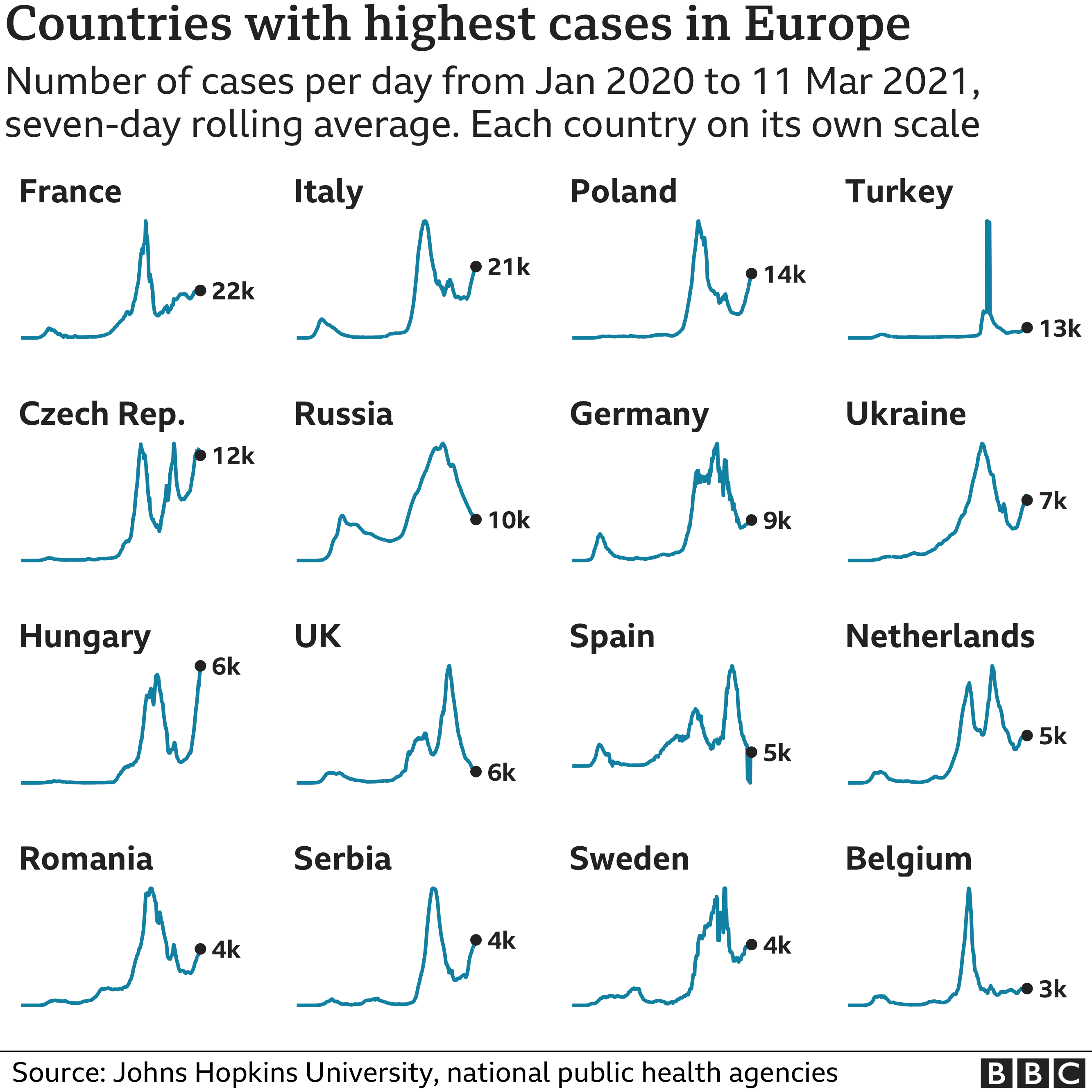
  • Poland registered nearly 21,049 new daily cases on Saturday – the highest number since November
  • Germany reported a rapid rise in infections among schoolchildren, with new Covid variants blamed
  • In France, the number of patients in intensive care units exceeded 4,000 – the highest figure for more than three months. Some patients are being flown across the country to find available beds. The government has not ruled out more regional lockdowns
  • Slovakia and the Czech Republic were hit by government crises over buying non-EU approved vaccines

Chart showing the countries in Europe with the highest average number of cases in the last week. Updated 12 March.

Fuente de la Información: https://www.bbc.com/news/world-europe-56382608
Comparte este contenido:

Myanmar: UN agency raises alarm over ‘targeted’ violence against women in Myanmar protests

UN agency raises alarm over ‘targeted’ violence against women in Myanmar protests

The United Nations entity dedicated to protection of women’s rights has voiced deep concerns over “targeted and disproportionate” violence against women being recorded during the crackdown against peaceful protesters in Myanmar.

In addition, women in detention are also reportedly experiencing sexual harassment and violence, UN-Women said in a statement on Friday.

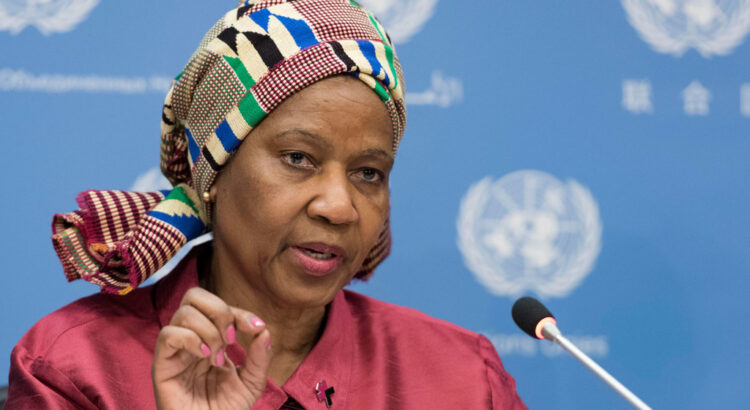
“Women have long played a celebrated and vital role in the history of Myanmar. They continue to do so and must not be attacked and punished for the peaceful expression of their views”, Phumzile Mlambo-Ngcuka, Executive Director of the agency, said.

According to UN-Women, at least six women lost their lives in the protests and close to 600 women, including young women, LGBTIQ+ and civil society activists have been arrested.

More than 70 people are reported to have been killed and many more wounded in weeks of protests following last month’s military takeover and arrests of several elected leaders and officials, including State Counsellor Aung San Suu Kyi and President Win Myint.

There are also concerns that the ongoing crisis could disrupt essential services, including safe pregnancy and childbirth and could have “serious, even life-threatening implications”, especially for the most vulnerable and disadvantaged communities.

International obligations

Ms. Mlambo-Ngcuka also said that Myanmar is a signatory to the Convention on the Elimination of All Forms of Discrimination Against Women, and that it is “clearly established” that violence against women is a form of discrimination prohibited under the Convention.

“We call upon Myanmar’s military and police to ensure that the right to peaceful assembly is fully respected and that demonstrators, including women, are not subjected to reprisals”, she stressed.

The head of UN-Women also called on the security forces to respect the human rights of women who have been arrested and detained, and reiterated the call for the immediate release of all detainees.

Fuente de la Información: https://news.un.org/en/story/2021/03/1087162


Comparte este contenido:

Etiopía: Ethiopia: Women Army Members Cherish Political, Military Leaderships in Adwa Victory

Ethiopia: Women Army Members Cherish Political, Military Leaderships in Adwa Victory

Ethiopians had been fighting just wars to defend their country’s independence against successive foreign aggressions. The fight against Italian invaders is a peculiar example in this regard.

The very first decisive victory of a black African power, Adwa, is an important event in the shared memory of the entire African population. It demonstrated the spirit of unity, love and friendship among Ethiopians and has shown the genuine role of women.

The victory of Adwa has been highly attributed to the arduous efforts of Ethiopia’s sons and daughters in all circumstances. The victory is undoubtedly the pride of Ethiopia as well as Africa as it has contributed a lot to the freedom and independence of all black people.

This is not out of the blue as a number of African counties, which were under the severe yoke of oppression of colonizers, had declared their independence following the victory of Adwa–he remarkable footsteps of Ethiopia.

This write would like to jot down the words of women army members about Adwa Victory, their contribution to all national sovereignty aspects and experiences they drawn from foremothers.

The first woman named Brigadier General Shewaye Haile spoke of the role of women in the army in relation to the double responsibility they have shouldered.

«Women played the leading role behind the victory of Adwa in preparing food and water, providing medical care for the wounded and following the solders shouldering the slogan of «freedom or death,» she cited.

She said that women are ready all the time to safeguard the sovereignty of their country and the wellbeing of fellow citizens of the nation. «It goes without saying that wars of all sorts bring destruction to human and material wealth.

Of course, the degree of devastation varies depending on the nature of the wars, areas of fighting, arms used, duration of fighting, etc. obviously, the internal wars and defensive wars against successive foreign aggressors have left their multi-dimensional impact on the social, cultural, economic and political life of the Ethiopian society.

Even though they did not take a vanguard position in major combats, the Ethiopian women had their share of the burden of wars,» she said.

According to Brigadier General Shewaye, prominent women of the royalty ones such as Empress Taitu had been reported to have played decisive roles in military affairs such as tactically advising leaders, provoking and ending wars as well as leading their army into battles.

She added that the number of such women for which we have documentation is very small, but the role they played was tremendous. Such women actively involved themselves in power struggle, promotions and demotions of officials, securing power and wealth for themselves and their relatives, using their position in relation to emperors or during their guardian roles.

According to Shewaye, unity and fraternity matter the most in overcoming and being victorious over any enmity of the country. The victory of Adwa has been the clear manifestation of Ethiopians bravery, unity and courageous move all the time and at any circumstance particularly when it comes to the sovereignty of their respected nation.

«We all have to start thinking about the contribution we have made for our country saying ‘What did I do for my country? Basically, all citizens of the country have to move in unison and in a sense of fraternity to be victorious over any challenging facing the nation. Especially they young generation has to develop sense of patriotism, sense belongingness, unity, love, respecting one another, among others,» said Brigadier General Shewaye.

As to her, the army is a segment of the society that has shouldered a responsibility of prioritizing the nation and the population. Not only has Adwa been a lifetime emblem of Ethiopia but it has also been that of the whole continent of Africa.

Lieutenant Colonel Emamir Ayalew on her part said women are farsighted, clever and committed to discharge any responsibility imposed upon them, are not in a position to violate others rights and get people well respected. When it comes to a woman soldier the responsibility becomes double even tripled since they have started thinking about their country, their pole and themselves including family members.

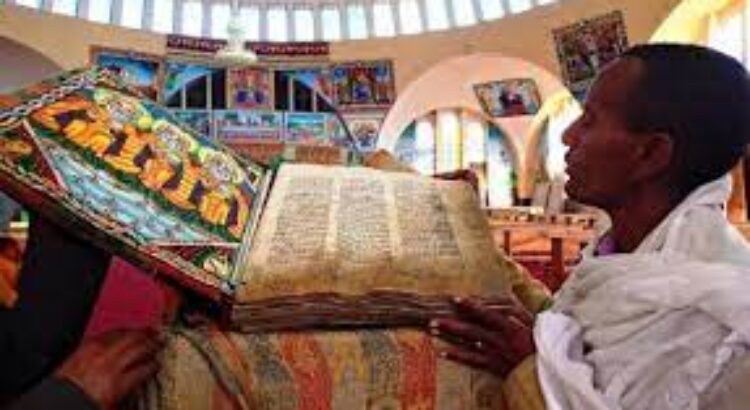
The other female army member from whom this writer has taken words is Colonel Huluagersh Dires. Women who participated in the battle of Adwa and came up with a shining victory have been, continue to be, our role models and we have been shaped with their courageous spirit, gallant gesture and sympathetic approach.

«We are real ambassadors of our country apart from being a lifetime savior of it from external and internal aggressors. We have drawn a range of lessons from Adwa.

For example, our foremothers had fought courageously and advised army officials in a proper manner and strategic fighting of course along with a number of patriots to help the nation garner the shinning victory of which generation after generation has to be proud,» she said.

On the other hand, she stated our country is the first one in deploying women army members in peacekeeping missions in various counties of the world. Be that as it may, we are always successful in effectively meeting our mission because we all the time march with strong winning spirit, bravery, patriotic move and full responsibility.

Customarily, she said, wars were mainly fought by men. Various factors, such as biological and social, mitigated the degree of the involvement of women in war in traditional societies. However, these factors did not exclude women from warfare.

Above all, in a country such as Ethiopia, the role of women was quite significant. In peacetime, for example, women glorified valor and patriotism through their reverence for brave warriors. Hence, both in women and men aspects, the role Ethiopia has been playing in peeking and warfare is always internationally commemorated.

«For instance, I took part in Northern Sudan–Darfur–and were effectively discharging all what we had been given as a mission. When anyone first is recruited to be a soldier, their prime task should be telling themselves that their prime priority has to be their country and their citizens.

The other female army member from whom this writer has taken words is Colonel Huluagersh Dires. Women who participated in the battle of Adwa and came up with a shining victory have been, continue to be, our role models and we have been shaped with their courageous spirit, gallant gesture and sympathetic approach. «We are real ambassadors of our country apart from being a lifetime savior of it from external and internal aggressors. We have drawn a range of lessons from Adwa.

For example, our foremothers had fought courageously and advised army officials in a proper manner and strategic fighting of course along with a number of patriots to help the nation garner the shinning victory of which generation after generation has to be proud,» she said.

On the other hand, she stated our country is the first one in deploying women army members in peacekeeping missions in various counties of the world. Be that as it may, we are always successful in effectively meeting our mission because we all the time march with strong winning spirit, bravery, patriotic move and full responsibility.

Customarily, she said, wars were mainly fought by men. Various factors, such as biological and social, mitigated the degree of the involvement of women in war in traditional societies. However, these factors did not exclude women from warfare.

Above all, in a country such as Ethiopia, the role of women was quite significant. In peacetime, for example, women glorified valor and patriotism through their reverence for brave warriors. Hence, both in women and men aspects, the role Ethiopia has been playing in peeking and warfare is always internationally commemorated.

«For instance, I took part in Northern Sudan–Darfur–and were effectively discharging all what we had been given as a mission. When anyone first is recruited to be a soldier, their prime task should be telling themselves that their prime priority has to be their country and their citizens.

The other female army member from whom this writer has taken words is Colonel Huluagersh Dires. Women who participated in the battle of Adwa and came up with a shining victory have been, continue to be, our role models and we have been shaped with their courageous spirit, gallant gesture and sympathetic approach.

«We are real ambassadors of our country apart from being a lifetime savior of it from external and internal aggressors. We have drawn a range of lessons from Adwa.

For example, our foremothers had fought courageously and advised army officials in a proper manner and strategic fighting of course along with a number of patriots to help the nation garner the shinning victory of which generation after generation has to be proud,» she said.

On the other hand, she stated our country is the first one in deploying women army members in peacekeeping missions in various counties of the world. Be that as it may, we are always successful in effectively meeting our mission because we all the time march with strong winning spirit, bravery, patriotic move and full responsibility.

Customarily, she said, wars were mainly fought by men. Various factors, such as biological and social, mitigated the degree of the involvement of women in war in traditional societies. However, these factors did not exclude women from warfare.

Above all, in a country such as Ethiopia, the role of women was quite significant. In peacetime, for example, women glorified valor and patriotism through their reverence for brave warriors. Hence, both in women and men aspects, the role Ethiopia has been playing in peeking and warfare is always internationally commemorated.

«For instance, I took part in Northern Sudan–Darfur–and were effectively discharging all what we had been given as a mission. When anyone first is recruited to be a soldier, their prime task should be telling themselves that their prime priority has to be their country and their citizens.

.Responding to the question how can all citizens of the country produce a patriotic generation whom they would always like to work for the country and people in connection with your disciple, Colonel Huluagersh said, «Being an army member for women doesn’t hinder themselves from contributing what is expected of them for their beloved nation–Ethiopia. When we raise children, we are always telling them to be productive, civic minded, responsible, confidently condemn lying, theft and sense of violating others rights.»

In a nutshell, successive wars fought in the country left a lasting negative impact on its economic development by eliminating the most productive elements of the country, causing physical destruction of property, moral deterioration and social insecurity, as well as encouraging banditry.

Hence, war history of the country has to be well altered and all its citizens have to consolidate unity as well as spirit of cooperation to confidently overcome all potential challenges baffling the country. «Just like their men-folk, Ethiopian women were ready to sacrifice themselves to prevent colonialists from sneaking into their country, thus forcing their children to live in servitude,»Huluagersh underlined.

Fuente de la Información: https://allafrica.com/stories/202103130087.html

Comparte este contenido:

Egipto: States break silence to condemn Egypt’s abuses at UN rights body

States break silence to condemn Egypt’s abuses at UN rights body

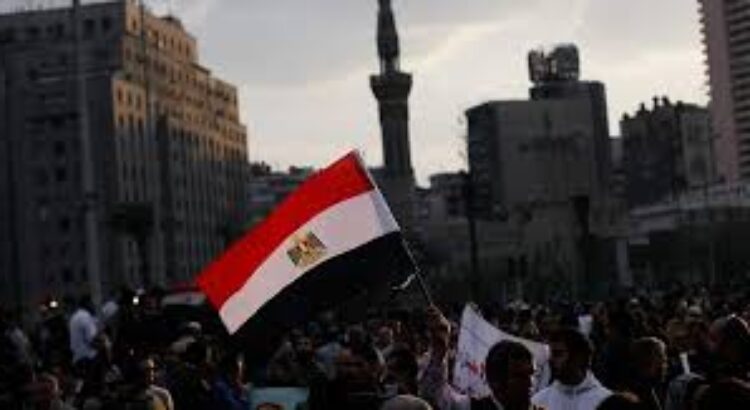
Non-governmental organizations (NGOs) from around the world expressed their strong support today for a joint declaration by UN member states condemning the human rights situation in Egypt which was delivered at the UN Human Rights Council.  In the declaration governments expressed “deep concern” for widespread human rights violations committed with impunity by the Egyptian authorities.

The joint declaration, signed by 31 states and delivered by Finland at the Council’s 46th session highlighted “restrictions on freedom of expression and the right to peaceful assembly, the constrained space for civil society and political opposition.” It also condemned the use of counter-terrorism laws to punish peaceful critics.

“The 12 March declaration ends years of a lack of collective action at the UN Human Rights Council on Egypt, despite the sharply deteriorating human rights situation in the country,” said Bahey Hassan, Director of the Cairo Institute for Human Rights Studies. “Countries should continue to make it clear to the Egyptian government that it will no longer have a carte blanche to arbitrarily imprison, torture or violate the right to life or unlawfully kill people.”

More than  100  NGOs from around the world wrote to UN member states in early 2021, warning that the Egyptian government is attempting to “annihilate” human rights organizations and eradicate the human rights movement in the country through  sustained, widespread, and systematic attacks.

The organizations had asked UN member states to adopt a resolution establishing a monitoring and reporting mechanism on Egypt. The declaration delivered on 12 March is a significant step and should be followed up by concrete action toward achieving this goal, the organizations said. The declaration was on the Council’s agenda under Item 4, which provides a space to raise concerns about grave and systematic human rights violations, including country-specific situations.

The last joint declaration on the human rights situation in Egypt at the Human Rights Council was delivered by Iceland and co-signed by 26 countries in March 2014.

Since that time the human rights situation in Egypt has deteriorated dramatically. The Egyptian authorities have virtually obliterated almost all space for free expression, peaceful assembly, and association. Under President Abdel Fattah al-Sisi’s rule security forces, with the complicity of prosecutors and judges, have arrested, detained or prosecuted thousands, including hundreds of human rights defenders, religious  minoritties rights activists, peaceful  protestrs, journalists, academics, artists, politicians an lawyears.

Many have been forcibly disappeared, tortured or  otherwise ill-treated, and detained for months or years in inhumane conditions without trial.  Those detained are regularly held on the basis of unfounded terrorism-related charges. If referred to trial individuals are often  convicted in grossly unfair proceedings before military courts and through mass trials.  Many have been sentenced to death and executed after unfair trials that have relied on statements likely obtained through torture.  The authorities have also used morality and debauchery laws to arrest and detain women influencers, sexual violence survivors and witnesses, and LGBTI individuals and activists.

«Today’s declaration sends a clear message to the Egyptian authorities that the world will no longer turn a blind eye to their relentless campaign to crush peaceful dissent.»

«Today’s declaration sends a clear message to the Egyptian authorities that the world will no longer turn a blind eye to their relentless campaign to crush peaceful dissent. he authorities must take urgent action to comply with their obligations under international law, starting by releasing the thousands of men and women arbitrarily detained, protecting those in custody from torture and other ill-treatment, and ending the crackdown on peaceful activism, » said Kevin Whelan, Amnesty International representative to the UN in Geneva.

In the 12 March joint declaration governments called for “accountability and an immediate end of impunity” for abuses.  Governments also called on Egypt to cease “abuses of due process,” the excessive use of “extended pre-trial detention,” and “the practice of adding detainees to new cases with similar charges after the legal limit for pre-trial detention has expired.”

Governments that have joined the declaration, led by Finland, include: Australia, Austria, Belgium, Bosnia and Herzegovina, Bulgaria, Canada, Costa Rica, Czech Republic, Denmark, Estonia, France, Germany, Iceland, Ireland, Italy, Latvia, Liechtenstein, Lithuania, Luxembourg, Montenegro, the Netherlands, New Zealand, Norway, Slovenia, Spain, Sweden, Switzerland, the United Kingdom, and the United States of America. Other governments can join the declaration until two weeks after the end of the current Human Rights Council session.

“Bringing the human rights situation in Egypt to the attention of the Human Rights Council and properly addressing these abuses is of fundamental importance to ensure Egypt’s long-term stability and the dignity of its people,” said John Fisher, Geneva Director at Human Rights Watch.

The Co-signing organizations to this statement include:

Amnesty International, Arab Network for Knowledge and Human Rights (ANKH), The Cairo Institute for Human Rights Studies (CIHRS), Committee for Justice, Democracy for the Arab World Now (DAWN), DIGNITY – Danish Institute Against Torture, EuroMed Rights, The Freedom Initiative, Human Rights Watch (HRW), humanrights.ch, International Federation for Human Rights (FIDH), The International Commission of Jurists (ICJ), International Service for Human Rights (ISHR), MENA Rights Group, Minority Rights Group International, The Project on Middle East Democracy (POMED), Réseau des Organisations de la Société Civile pour l’Observation et le Suivi des Elections en Guinée, People in Need,  Robert F. Kennedy Human Rights, Tunisian Coalition to Abolish the Death Penalty.

Fuente de la Información: https://www.amnesty.org/en/latest/news/2021/03/states-break-silence-to-condemn-egypts-abuses-at-un-rights-body/


Comparte este contenido:

Sudáfrica: Wits University students suspended, but not for partaking in fiery protests

Wits University students suspended, but not for partaking in fiery protests

Johannesburg – Wits University has suspended and charged five students for disrupting exams and violating Covid-19 regulations.

The university said the suspension of the five students had nothing to do with the protests that took place in the streets of Johannesburg this week. Students have blockaded traffic and burnt tyres on the streets of Johannesburg.

A government official, Mthokozisi Ntumba, 35, was shot dead, allegedly by a police rubber bullet, during the student’s protests. He had just left a clinic when he was shot.

The students were protesting against the university, calling for it to allow financially excluded students to be registered despite owing fees.

Wits University spokesperson Shirona Patel said two students were suspended for disrupting an exam and tearing up exam papers on February 8.

She said three other students were suspended and charged for violating Covid-19 regulations in February.

“Two students disrupted an examination on the 8th of March and tore up examination scripts. On the 9th of March they were issued with notices to appear before an inquiry which was held on the 10th of March, which the students did not attend.

“One of the students claimed that he did not receive these notices and he has been given another opportunity to appear before a university official today (March 12), to make his case. “The two students were suspended pending a disciplinary hearing which will take place in due course, in line with the university’s rules, policies and procedures,” said Patel.

On the remaining three students, Patel said they had breached Covid-19 regulations on February 23 and 24, this year.

“None of these suspensions or charges relate to protests that happened this week. I can confirm that these students stayed in residence last night,” said Patel.

Meanwhile, she said the university had held eight meetings with the student representative council (SRC) since January in a bid to iron out issues.

“In the last seven days we have reached out to the SRC leadership repeatedly. They agreed to meet on three occasions, including at 8.30am (Wednesday) and at 8pm last night (Thursday). “They did not pitch for these meetings.

“Wits management remains willing to engage with students to try to resolve these issues,” she said.

IOL

Fuente de la Información: https://www.iol.co.za/news/south-africa/gauteng/wits-university-students-suspended-but-not-for-partaking-in-fiery-protests-1b44b0c9-be3e-411b-8c85-2a80bc55dbfa


Comparte este contenido:

Nigeria Gunmen Abduct Dozens of Students in College Raid

Nigeria Gunmen Abduct Dozens of Students in College Raid

KANO, NIGERIA – Gunmen raided a college in northwestern Nigeria and kidnapped 39 students, government officials and parents said Friday, in the latest mass abduction targeting a school.

The abductors stormed the Federal College of Forestry Mechanization in Mando, Kaduna state, around 9:30 p.m. (2030 GMT) Thursday, shooting indiscriminately before taking students.

The Kaduna college was said to have some 300 male and female students, mostly aged 17 and older, at the time of the attack.

Map of Mando, in Kaduna state, Nigeria

Kaduna state commissioner for internal security Samuel Aruwan said 39 of the students were missing while the army was able to rescue 180 people after a battle with the gunmen.

«Further checks in the wake of the attack by armed bandits … indicate that 39 students are currently unaccounted for,» including 23 females and 16 males, Aruwan said in a statement late Friday.

He had initially said 30 students were unaccounted for.

Aruwan said the state government «is maintaining close communication with the management of the college as efforts are sustained by security agencies toward the tracking of the missing students.»

The commissioner said some of the rescued students were injured during the operation and were being treated at a military hospital.

Appeal to the government

Police and military personnel stood guard around the college at the outskirts of Kaduna city on Friday afternoon as anxious parents and families waited for news. A fighter jet flew overhead.

People are seen at the broken perimeter fence through which gunmen gained access the male and female hostels at the Federal…

Government officials said the students were found to be missing after a headcount at the college, and parents said they had been taken by the gunmen.

«We have confirmed from her colleagues our daughter Sera is with the abductors,» Helen Sunday told reporters, tears rolling down her face. «I appeal to the government to help rescue our children.»

«It is unacceptable for parents to send their children to school only to be kidnapped by criminal elements,» said Denis John, who said his brother was among those taken.

Heavily armed gangs in northwest and central Nigeria have stepped up attacks in recent years, kidnapping for ransom, raping and pillaging.

The bandits have recently turned their focus to schools where they kidnap students or schoolchildren for ransom. Thursday’s attack was at least the fourth since December.

Mass kidnappings in the northwest are complicating security challenges facing President Muhammadu Buhari’s forces who are also battling a more than decade-long Islamist insurgency in the northeast.

Late night gunfire

Residents near the Kaduna college also heard repeated gunshots in the area late Thursday.

«We kept hearing gunshots that we ignored as shooting drills from the Nigeria Defense Academy, which is a stone’s throw from the forestry college,» said Mustapha Aliyu, who lives in the area.

«It was only when we came out for the morning prayers in the mosque that we learned it was gunmen who took away students from the college,» he said.

The area is notorious for banditry and armed robbery, especially along the highway linking the city with the airport.

The gangs are largely driven by financial motives and have no known ideological leanings. Victims are often released shortly after negotiations though officials always deny any ransom payments.

Last Saturday, criminal gangs known locally as bandits broke into the staff quarters of the nearby Kaduna airport, abducting 12 people, according to airport officials.

On February 27, gunmen abducted 279 schoolgirls in nearby Zamfara state.

And a week earlier, gunmen seized 42 people, including 27 students from an all-boys boarding school in central Niger state.

In December, hundreds of schoolboys were seized in Katsina, Buhari’s home state, while he was on a visit.

The U.S. has condemned the recent attacks on schools.

«Frankly, we’re disgusted by this pattern of mass abductions of school kids. I can think of nothing more abhorrent,» said Michael Gonzales, deputy assistant secretary at the U.S. State Department’s Bureau of African Affairs, at a press briefing.

He said the U.S. «is ready to provide appropriate support to the Nigerian government if requested to do so.»

Fuente de la Información: https://www.voanews.com/africa/nigeria-gunmen-abduct-dozens-students-college-raid


Comparte este contenido:

La UE ante el derecho antidiscriminatorio

El Parlamento Europeo aprobará una resolución declarando “zona de libertad LGTBIQ” a la Unión Europea.

8 de marzo vivido desde el Parlamento Europeo. Jornada de celebración, pero también, sobre todo, reivindicativa. Todas las agendas de la lucha contra desigualdad y la discriminación están vinculadas en la lucha por la emancipación. Están interconectadas, son interdependientes, dialéctica e históricamente. Así es, desde luego, en la Unión Europea, factoría de legislación contra la discriminación, fuente de la que emanan infinitas injusticias cuyo combate se remonta a la historia de la humanidad en una de esas batallas que no conocen final.

En el pleno de marzo del Parlamento en Bruselas escuchamos discursos de mujeres que hoy encarnan liderazgo global: Jacinda Ardern, primera ministra de Nueva Zelanda, Kamala Harris, vicepresidenta de EEUU, además de Ursula von der Leyen, presidenta de la Comisión Europea. Mujeres que emblematizan energía y empatía en una lucha cotidiana cuyos emplazamientos continúan devengándose en incontables planos, cada 8-M y todos los días.

Así, en el orden del día de este pleno de marzo destacan algunos puntos de la agenda de la igualdad.

a) Primero, una iniciativa sobre la Implementación de la Directiva 2000/78 de Marco para la Igualdad de Trato en el Empleo de las Personas con Discapacidad, ante la perspectiva de la Estrategia Europea para los Derechos de las Personas con Discapacidad 2021/2030.

c) En tercer lugar, una Resolución sobre Derechos de los Menores y la Infancia en la UE, previa a la comunicación por la Comisión Europea de su Estrategia UE sobre los derechos de la Infancia 2021/2024.

El claro hilo conductor de los tres debates y votos en el pleno del PE es la beligerante defensa de la igualdad en el disfrute de los derechos en la UE. La Carta de Derechos Fundamentales de la UE entró en vigor junto al Tratado de Lisboa en 2009 con “el mismo valor jurídico que los Tratados” (artículo 6 del TUE). Se trata de una Declaración de Derechos deúltima generación.

Así se manifiesta en sus conceptos: bioética y genética; prohibición de clonación; derechos digitales; transparencia y buen gobierno…. Pero también, y sobre todo, en su estructura normativa y en su proyección sobre los Estados miembros de la UE (arts. 51 a 54 CDFUE).

Sus preceptos son vinculantes y actúan como parámetro de validez del Derecho europeo legislado y de la legislación de los Estados según la jurisprudencia sólida del TJUE de Luxemburgo. Además, protegen no solamente a los ciudadanos europeos sino a todas las personas —europeos o no, por tanto, también a los extranjeros, lo que incluye a los migrantes— ante la aplicación del Derecho europeo, sea por las instituciones de la UE, sea por las de los países.

Los artículos 20 y 21 del CDFUE consagran las cláusulas antidiscriminatorias de última generación, prohibiéndola por los supuestos clásicos (sexo, raza, religión, convicciones u opiniones…) y por otros más recientes (pertenencia a una minoría nacional, patrimonio, nacimiento, discapacidad, edad, orientación sexual…).

Por su parte, los artículos 24 y 32 del CDFUE consagran los derechos del niño con la prohibición taxativa del trabajo y la explotación infantil, y la consagración expresa del principio rector del derecho protector y correccional de los menores: la preservación ante todo del “interés superior del menor”.

Además, sus artículos 21, 26 y 34 blindan la protección europea de las personas con discapacidad, previendo su integración y promoción en todos los ámbitos con una lexicología más ajustada y actual que la que aún se mantiene en el artículo 49 de la Constitución Española de 1978. Cuya mención de los “disminuidos físicos, sensoriales y psíquicos” es objeto de una propuesta de reforma constitucional en el programa del Gobierno.

La Resolución sobre los derechos de los menoresen la UE es particularmente exhaustiva. Su punto de apoyo es la celebración de 30 años de vigencia de la Declaración de NUde 1989 en el horizonte de la Estrategia de la UE2021/2024. Pero cubre todos los frentes de la discriminación. Combate la pobreza infantil; la educación, la sanidad; los derechos de los menores en materia de migraciones y asilo; el ciberbullying; la alfabetización digital; la violencia y abusos; el trabajo infantil, y la explotación sexual. Y ¡de nuevo, una vez más! el Parlamento exige al Consejo —órgano que integra a los Gobiernos de los países— el desbloqueo de la llamada Directiva de Equal Treatment/ Directiva Horizontalde Igualdad de Trato, largos años obstruida.

La agenda de la igualdad —y de legislación, que los juristas llamamos Derecho Antidiscriminatorio (Giménez Glück, Rey Martínez…)— no está nunca colmada. Plantea siempre desafíos y desarrollos pendientes; más acuciantes aún, si cabe, ante la exasperación de todas las desigualdades causadas —también en la UE— por la crisis del coronavirus.

Fuente: https://www.huffingtonpost.es/entry/la-ue-ante-el-derecho-antidiscriminatorio_es_6048c997c5b60e0725f437bd

Comparte este contenido:
Page 890 of 6723
1 888 889 890 891 892 6.723
OtrasVocesenEducacion.org