Page 15 of 102
1 13 14 15 16 17 102

Islamic leaders: Education the key to ending intolerance

Oceania/ New Zealand/ 25.03.2019/ Source: www.journalnow.com.

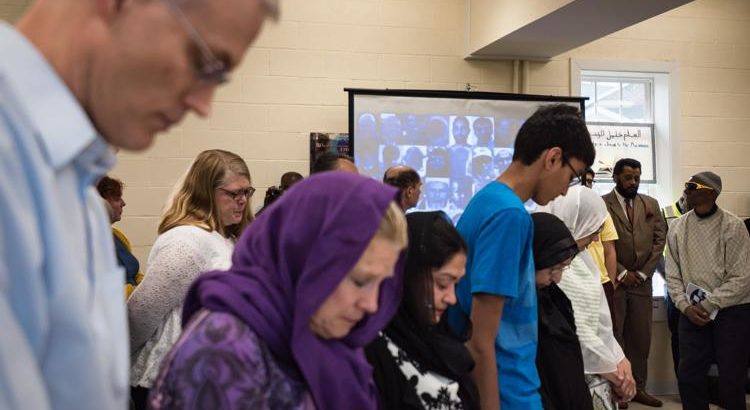
Guests and members stand to observe a moment of silence on Sunday at Annoor Islamic Center in Clemmons. More than 350 people attended the gathering.

Guests and members gather outside the Annoor Islamic Center in Clemmons on Sunday. Speakers at the event discussed ways to end intolerance in the wake of two deadly attacks on mosques in New Zealand that left 50 people dead. Imam Khalid Griggs said Islamophobia is present, and the best way to get rid of it is through education.

Nine days after a man fatally shot 50 people at two mosques in New Zealand, the greater Forsyth community gathered at a Clemmons mosque and discussed what could be done to squelch intolerance.

For some, the discussion was intensely personal.

Noor Shehata, now a freshman in college, recalls when she was a seventh-grader in social studies learning about Sept. 11.

“The teacher said he’d hate to be a brown Muslim who owned a restaurant the next day (after 9/11),” Shehata recounted. “I was a brown Muslim, and my dad owned a restaurant. All eyes in the class went to me.”

She said it was difficult to experience that from someone in a leadership position as a 13-year-old.

“Muslims are forced to grow up much earlier, they know what a terrorist is earlier,” Shehata said.

She learned to develop a filter of herself, looking at how she might appear through others’ eyes.

Imam Khalid Griggs said Islamophobia is present, and the best way to get rid of it is through education. He urged the approximately 350 people in attendance to take a stand against racism in all forms and come together as one against it.

“If we don’t come together as brothers and sisters, we will die as fools,” he said in a reference to a Martin Luther King Jr. quote.

Juana Rhili, an educator, challenged everyone in attendance to share knowledge of the Muslim religion with five other people within the next week.

“We are all, ‘One person, under God,’ and one person can make a change,” she said, referencing the Pledge of Allegiance. “We know these (shootings) will continue to happen unless we change the mindset.”

Others provided additional knowledge of Islam, including that the true message of the religion is peace, people of all nationalities are Muslim, and Muslims are against suicide.

The North Carolina division of the FBI recognized how important connections with the Muslim community are, working for more than four years to strengthen them, said Timothy Stranahan, assistant special agent in charge. Today, there’s a network of about 45 imams across the state the FBI keeps in contact with in the event something happens.

Aladin Ebraheem, with the Annoor Islamic Center in Clemmons where the gathering was held, said that trust is valuable.

He teared up discussing the mass shooting in New Zealand, but knew the community would get through it.

“That individual might have been successful in taking lives, but he failed miserably in intimidating, and the biggest proof is all of you being here,” Ebraheem told the crowd.

“This is not foreign to any of us. Just a few months ago, we were at a Jewish temple, showing support for almost the same thing,” he said, referencing the Tree of Life shooting at a synagogue in Pittsburgh in October 2018, in which 11 people were killed.

Hana Hariri, who has a young daughter, said more discussions like this need to occur in the community. She said last year, her daughter was called a terrorist because of her faith. She’s also called, “the others.”

“We need to educate more about Islam,” Hariri said. “Education, even in school, and tell kids that Islam is a religion, not terrorism like ISIS. We’re relieved that the FBI is helping.”

Source of the notice: https://www.journalnow.com/news/local/islamic-leaders-education-the-key-to-ending-intolerance/article_86ebe7a3-0664-50a0-8382-ca1cc9f0931a.html#1

Comparte este contenido:

AUSTRALIA Académicos apoyan ‘huelga estudiantil’ sobre cambio climático

Oceanía/Australia/www.universityworldnews.com

Cientos de académicos se unieron a decenas de miles de estudiantes universitarios y universitarios en una protesta nacional en Australia el viernes como parte de una «huelga estudiantil» mundial dirigida a persuadir a los políticos para que tomen medidas urgentes contra el cambio climático. 

Cerca de 800 académicos de docenas de universidades australianas firmaron una carta abierta expresando su solidaridad con los estudiantes y miles asistieron a mítines de protesta en 50 ciudades de todo el país. 

Según CNN, el canal de televisión paga estadounidense basado en las noticias, los estudiantes estaban «saliendo de las aulas en más de 100 países para protestar por la inacción climática». Los estudiantes que protestan dicen que sus gobiernos han fallado a las generaciones futuras al no reducir las emisiones y frenar el calentamiento global.

Al igual que en otras partes del mundo, la huelga australiana se inspiró en la adolescente sueca Greta Thunberg, quien inició el «ataque por la acción climática» en agosto del año pasado. 

Las manifestaciones nacionales de protesta en Australia comenzaron al mediodía en las ciudades regionales y capitales y siguieron las protestas estudiantiles en todo el país por la inacción del gobierno federal sobre el cambio climático. 

La protesta del viernes se produce meses después de que los estudiantes salieron de sus clases por primera vez para protestar por la inacción climática del gobierno. Las huelgas fueron condenadas, y siguen siendo, condenadas por los conservadores de Australia, incluido el primer ministro Scott Morrison.

Aunque su gobierno no ha tomado medidas para contrarrestar los efectos del cambio climático, que son cada vez más evidentes, Morrison se unió a comentaristas conservadores para condenar la huelga. 

Les dijo a los estudiantes que deberían ser «menos activistas» y dejar que los políticos y no los escolares se encarguen del problema. 

Un estudiante manifestante observó: «¿Sí, pero de quién es el futuro?». 

El viernes, los estudiantes australianos participaron en un día de protesta mundial, con académicos y quizás millones de estudiantes en más de 90 países participantes. 

Esta vez, también, los estudiantes fueron apoyados por grupos comunitarios más amplios en Australia, con sindicatos y académicos e incluso muchos políticos se unieron a las protestas en todo el país.

Los estudiantes de la escuela, muchos de ellos todavía vistiendo sus uniformes, tenían letreros con lemas como «El clima está cambiando, ¿por qué no lo estamos?» Y «Hacer que la tierra se enfríe de nuevo». 

En las reuniones de protesta, los estudiantes pidieron que se detuviera la apertura de una nueva mina de carbón en el centro de Queensland que está siendo planeada por un multimillonario indio. 

Los estudiantes dijeron que la mina de carbón debería abandonarse y que no se abrirían nuevas minas de carbón mientras que el país cambió a energía 100% renovable para 2030. 

En una respuesta típica del lado conservador, Christopher Pyne, un importante ministro del gabinete federal, dijo a un entrevistador de televisión que los estudiantes debería estar en la escuela

“Por lo general, las huelgas ocurren cuando los empleados retiran su trabajo de un empleador, por lo que no estoy seguro de por qué los estudiantes se retiran de la escuela. «Sólo daña su educación», dijo Pyne. 

Pero Peter Garrett, ex cantante pop, activista ambiental y ex ministro de gobierno laborista, elogió la acción de los estudiantes. 

«La idiotez condescendiente de los negadores del clima es despreciable», dijo Garrett. 

«Como ex ministro de educación federal, aplaudo a los muchos jóvenes australianos valientes que [están] en vigor».

Fuente: https://www.universityworldnews.com/post.php?story=20190315130720883

Comparte este contenido:

Australia should start planning for universal tertiary education

Oceania/ Australia/ 19.03.2019/ Source: theconversation.com.

Australia is often characterised as having a mass higher education system. In fact, it could be called near-universal. According to the 2016 Census, 56% of Australians aged 15 years and over – 9.6 million people – hold a post-school qualification, up from 46% in 2006.

Universal education does not mean every Australian should attain a higher education or tertiary qualification. It means every Australian should be given the opportunity to get one if they want.

The distinction between “mass” and “universal” is not just an academic one. Viewing higher and tertiary education as universal could help an incoming government better design policy. All Australians need to be prepared for, informed about and able to make a choice that is right for them about whether or not to pursue post-school education.

Needs-based funding of schools

If the government could do one thing to improve post-school education outcomes, it needs to happen in our primary and high schools. Prior academic achievement is one of the main predictors of higher education aspiration and success. In some studies it’s the main factor.

Needs-based funding puts more money into education. In particular, it puts more money into the schools and students who need it most.

The Gillard-led Labor government recognised the importance of this approach by adopting a needs-based school funding model. The Turnbull-led Coalition government reaffirmed this commitment, with the specific aim of helping under-achieving students focus on improvement.

This coming election, look closely at what positions the Coalition and Labor take on needs-based school funding. Both have signed up in principle, but there should be a clear commitment on how much extra money will be provided. This is not the same as simply spending more money to maintain standards in an ever-expanding system.

There also needs to be a clear explanation of how that money will be spread around, to ensure those furthest behind get the resources they need to catch up.

It’s not university or TAFE

Too many Australians – and successive governments – think in terms of students having to make a choice between university or vocational studies or neither. Tertiary education policy shouldn’t be seen this way.

For many people, the false trichotomy of degree-or-trade-or-job is locked in way too early by social and family expectations, and curriculum choices. Greater flexibility in how lifelong education is understood and explained (in terms of pathways and options) needs to be developed at the policy level.

This isn’t about merging the vocational and higher education sectors. That is neither necessary nor desirable. All tertiary education providers play a part in delivering lifelong education opportunities.

What is needed is more cooperation between state and federal governments. They need to be able to coordinate on how these various organisations will be funded and how students will be financially supported.

In many cases, there are fewer financial barriers to doing a university degree than a vocational course. This can lead some students to make a choice that seems right for them, but over the long term doesn’t work out.

The good news is all the pieces are there – even if they don’t quite fit together yet. The Coalition government has made great strides in how students can access loans for vocational courses. But the VET fee capmeans some vocational courses still result in the student having to cover the excess up front, which is not the case for higher education degrees.

For example, an Australian student studying a Diploma of Business in 2019 would have a loan cap of just over A$5,000. They would have to cover the rest of the cost of the course. Depending on the provider, this could be several thousand more.

If the same student chose to study a Bachelor of Business at a university, they would have access to a loan for the full amount, which would be more than A$30,000 for the entire degree.

Against this, students can be more sure they’re getting what they pay for from universities than from vocational education providers. The Tertiary Education Quality and Standards Agency is responsible for the registration and quality oversight of all higher education providers, public and private.

The vocational training sector could benefit from a similarly national and coordinated approach to quality assurance. Given there are more than 5,000 vocational providers, a more realistic approach might be to provide a similar oversight (or even expand TEQSA) to cover all courses offered by the public TAFES, to begin with.

Whoever forms the next government needs to finish the job of creating a more unified structure of financial support and pathway information. It should allow students to think first and foremost about what skills and knowledge are right for them and not about what the institution they’re going to or the degree they’re going to do is called.

Making Australian higher education look more like, well, Australia

The foundation of the Australian higher education system is built on two broad principles. The first is that they exist for the betterment of the nation. The second is that the doors of universities and other higher education institutions are open to everyone. This is actually written into the founding acts of our oldest universities.

The journey towards realising the second principle has been long, rocky and as yet uncompleted. Too many groups of students still remain under-represented. These include Aboriginal and Torres Strait Islander peoples, people with disability, those living in regional areas and those from lower socioeconomic backgrounds.

Progress has been made and much of the big policy picture has been painted. In particular, more institutions have been created to better meet demand, a demand-driven system of funding has been introduced so there is federal funding for each student place, and an income-contingent loan scheme has been provided to remove many of the upfront financial barriers to accessing university.

But finishing the picture requires a final push. Committing to a sustainable, needs-based funding of school education and harmonising the support structure for vocational and higher education would go a long way towards achieving this goal. It may be enough, but if not there is another thing that would work – quotas.

Quotas are contentious, as recent political debate shows. It’s likely the concern would be raised that quotas would ignore the very different institutional profiles that are in play. For example, a regionally based university is going to find it easier to recruit regional students than one in a CBD.

One solution would be to apply the quota at the sector level, rather than the institutional level. The government could then enforce the quotas in a number of ways. It could use performance-based funding to reward the universities doing the heavy lifting. Or it could allow the universities to virtually trade between themselves.

For example, a university with a below-average enrolment of regional students could “purchase” the excess from a university with an above-average enrolment. The students would not actually move institution, but the money would. This would mean the university with the extra enrolments would receive additional financial support to help with the costs associated with supporting these students.


Source of the notice: https://theconversation.com/australia-should-start-planning-for-universal-tertiary-education-110783

Comparte este contenido:

Tiroteos en Nueva Zelanda: qué significan los nombres en el armamento del pistolero que transmitió el ataque por Facebook

Redacción: BBC News Mundo

Los ataques en dos mezquitas de la ciudad neozelandesa de Christchurch fueron transmitidos en internet por un hombre que publicaba bajo el nombre de Brenton Tarrant y que fue acusado de asesinato.

En el video se ve al hombre armado llegando a una mezquita y disparando de manera indiscriminada a los hombres y mujeres que se encuentra en el templo.

Parte del suceso fue retransmitido por Facebook.

El gobierno consideró lo ocurrido un «ataque terrorista» sin precedentes en el país. Los ataques a las dos mezquitas dejaron al menos 49 muertos.

Tarrant, australiano de 28 años que se autoproclama fascista, fue imputado de asesinato, aunque la policía adelantó que recibirá más cargos.

Personajes actuales e históricos

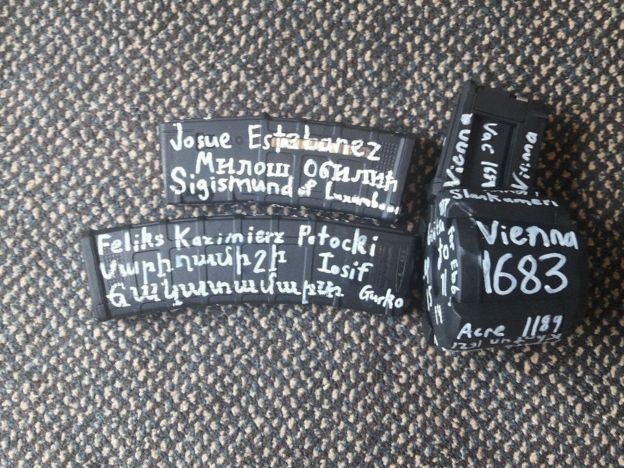
En esos cargadores publicados en la cuenta de Twitter ya eliminada, se pueden leer nombres de personas y lugares.

Uno de ellos es el de español Josué Estebánez, el exmilitar de ultraderecha encarcelado por haber matado al activista antifascista Carlos Palomino.

Estebánez apuñaló a Palomino en noviembre del 2007 en el metro de Madrid. La víctima, menor de edad, se dirigía a boicotear una manifestación de ultraderecha, por lo que el juez consideró la motivación ideológica como agravante.

CargadoresDerechos de autor de la imagenREUTERS
Image captionEn uno de los cargadores se menciona al español Josué Estebánez.

Debajo del nombre de Estebánez aparece el de Miloš Obilić, un caballero de la Serbia medieval. Es recordado por haber dado muerte al sultán otomano Murad I en la batalla de Kosovo Polje, en 1389.

Le sigue Segismundo de Luxemburgo, un noble europeo que entre finales del siglo XIV y principios del XV acumuló títulos como el de emperador del Sacro Imperio Romano Germánico o el de último emperador de la Casa de Luxemburgo.

En otro cargador se menciona a Feliks Kazimierz Potocki, un noble polaco que lideró diversas campañas militares contra los turcos y los tártaros en el siglo XVII.

También a Iosif Gurko, un capitán general ruso que también luchó contra los turcos pero un siglo después. Entre las batallas en las que jugó un papel importante está la del Paso de Shipka, que también se enumera en uno de los cargadores atribuidos a Tarrant.

Así como a esta batalla, las inscripciones aluden a otras contra el Imperio Otomano como la de Kahlenberg o Segundo Sitio de Viena, de 1863, en la que el Sacro Imperio Romano Germánico​ venció a los turcos, que entraron en declive a partir de esta derrota.

CargadoresDerechos de autor de la imagenREUTERS
Image captionDiversas inscripciones hacen alusión a batallas en las que se venció al Imperio Otomano.

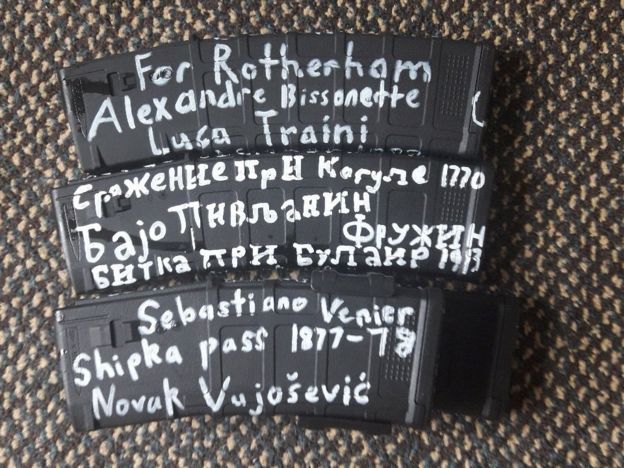
En otra foto se puede ver tres cargadores alineados con referencias parecidas.

En uno dice «Para Rotherham», en referencia a un caso de abusos sexuales que se dio en esta localidad de Reino Unido. Algunos lo consideran el mayor escándalo en el que falló la protección a menores de edad, ya que se extendió durante décadas. La mayoría de acusados eran de origen paquistaní y profesaban el islamismo.

En el mismo cargador se menciona a Alexandre Bissonnette, autor del tiroteo a una mezquita perpetrado en Québec, Canadá, en 2017 y que dejó seis muertos. También a Luca Traini, un ultraderechista italiano que disparó a inmigrantes africanos, hiriendo a seis de ellos, en febrero de ese mismo año.

Combatiendo al Imperio Otomano

En los otros dos cargadores se hace referencia a más victorias sobre el Imperio Otomano. Una es la del paso de Shipka y otra, la de Kagul, en la que los rusos los vencieron en 1770. También la de Bulair, una victoria búlgara sobre los turcos de 1913.

CargadoresDerechos de autor de la imagenREUTERS
Image captionTambién se menciona a combatientes de estas batallas.

Otras cuatro inscripciones hacen referencia a más figuras históricas que lucharon contra el Imperio Otomano: Bajo Pivljanin, un turco renegado que luchó contra este régimen en las filas de la República de Venecia en el siglo XVII; Fruzhin, un noble búlgaro del siglo XV; Sebastiano Venier, duque de Venecia del siglo XVI que es mencionado más de una vez, y Novak Vujosevic.

Además de los nombres, el usuario identificado como Tarant incluyó símbolos como el del Sol Negro, antiguo ícono germánico que luego fue adoptado por los nazis. También dibujó una versión supremacista blanca de la cruz celta y un símbolo vikingo.

Fuente: https://www.bbc.com/mundo/noticias-internacional-47584166


Comparte este contenido:

Australia: School students left ignorant of Indigenous massacres, history teachers say

Oceania/ Australia/ Source: www.theguardian.com.

Australian history teachers want to cover the history of massacres against Indigenous people during the colonial era but are squeezed for time in an already overcrowded curriculum, educators say.

On Monday, Guardian Australia launched a special report entitled The Killing Times, which details a record of state-sanctioned slaughter including mass shootings, poisonings and families driven off cliffs.

A Macquarie University senior research fellow, Kevin Lowe, said the topic was “scantily” covered in New South Wales and Queensland schools.

“It’s an issue that goes directly to the heart of the inability of the nation to come to terms with a history which they aren’t willing to own,” he told the Guardian.

“You talk to students and say, ‘When was the last massacre in Australia?’ and they are gobsmacked to realise there were massacres in Australia right through the 1920s. People say, ‘Nah, nah, nah, that can’t be true.’”

Lowe, a Gubbi Gubbi man from south-east Queensland, is a former history teacher and curriculum evaluator in NSW and Queensland. “There is the capacity for teachers to teach this stuff,” he said. “What’s missing is the narrative that goes with it.”

The History Teachers Association of Victoria executive officer, Deb Hull, said when it came to coverage of the frontier wars in classrooms, the problem wasn’t the curriculum but limited time.

“History is being squeezed out,” Hull said. “A lot of schools will say, ‘We’re all about Stem’ [Science, technology, engineering, and mathematics].’ Then everybody looks surprised when people don’t know the history of their nation.”

She said it would be possible for the massacres to be mentioned in passing but it depended on individual schools as to how they were covered.

“Teachers really want to teach this well, there’s a real desire to be part of this truth-telling,” she said. “The resistance is not coming from history teachers.”

The former prime minister John Howard railed against students being taught a “black armband view of history”, but Hull said that was inaccurate.

History teachers were rather trying to teach young people to look through a historical lens, examine evidence, weigh up its significance and consider different perspectives.

“You go into it [asking] ‘What can we know and how can we know it?’” she said. “It’s not to make them feel bad or not to make them feel good.

“One of the great dangers is when you want history teachers to teach values. That’s an utterly inappropriate thing for a history teacher to do.”

A Deakin University genocide studies scholar, Donna-Lee Frieze, said in the past 12 years she had observed a lack of prior knowledge among her students at tertiary level.

“The majority of students who come into my unit on the genocide or the Holocaust have complained they have not been taught about the Indigenous massacres or the stolen generations, in particular, during their school years,” Frieze said.

Canada is the star example of a country covering its history of genocide against its indigenous people well, Frieze said.

Sophie Rudolph, from the University of Melbourne’s graduate school of education, said it would be possible to complete 12 years of education without hearing about the massacres.

It was important to consider who was teaching the content in classrooms, she said, and how they were teaching it.

“Is it non-Indigenous people [doing the teaching] and what kind of ethical dilemmas does that raise in terms of whether that content is treated respectfully and in a way that Aboriginal and Torres Strait Islander communities would be happy with?”

Source of the notice: https://www.theguardian.com/australia-news/2019/mar/05/school-students-left-ignorant-of-indigenous-massacres-history-teachers-say


Comparte este contenido:

New Zealand: On the job learning for new teachers a disservice to them and students

Oceania/ New Zealand/ 12.02.2019/ Source: www.stuff.co.nz.

I was very excited to see the outcomes of Bali Haque’s Tomorrow’s Schools Review. It is insightful, clear, and I think, largely correct. I hope we have the courage to implement the review’s recommendations – all bar one.

I don’t believe that school-based teacher preparation pathways will improve the quality of new teachers, and believe it will have a raft of unfortunate consequences for schools and their learners.

Preparing teachers has always been a tricky business. Between 1920 and 2018 there has been a review, a White Paper, a Green Paper, consultation, an advisory committee or report to government on New Zealand’s teacher education  about every 10 years. This despite the shift of teacher education over this period from school-based preparation to training colleges and colleges of education, to universities and private providers.

These reports have the same themes: selection and recruitment, what the content of teacher education should be, where it should be taught, and what the roles of the providers and the profession are in preparing teachers; all similar concerns to those raised by the Tomorrow’s Schools Review.

So is New Zealand particularly bad at teacher preparation? Actually, no. If we look internationally, exactly the same concerns predominate in English-speaking countries around the world. Essentially it comes down to whether you think teaching is a profession or not.

Professions are defined by having an established body of knowledge that is not held by the general population, and therefore require a period of advanced education before they can be practised. Because we’ve all experienced teaching at school in a way that most of us haven’t been exposed to law, accountancy or medicine, some people think there’s not much to it; that it’s basically managing children, a practical «craft» best learned on the job.

If teaching is a profession, advanced preparation is appropriate. If it’s a craft, it could be learned by doing. In practice, of course, it’s both; a highly intellectual activity, characterised by rapid high-stakes decision-making, and a practical task with routines and strategies that need to be mastered.

So which is the right way in: learn the professional knowledge, then practise the strategies, or learn the strategies and then gain the knowledge? I believe it’s a clever combination of the two, and the institutions best placed to develop it are not schools.

But why not? It’s tempting logic, followed by England in  its «School Direct» reform (an employment-based route into teaching). It’s had some successes, but hasn’t solved the variability and supply issues the New Zealand Taskforce highlights.

And a consequence has been the disestablishment of teacher education programmes in higher education, resulting in a loss of expertise in teaching and teacher preparation from the system. Just as the schools discover how hard teacher preparation is, the number of people who could help them diminishes.

Successful schools are good at teaching students. It turns out that teaching adults how to be teachers is actually another task entirely. Putting unprepared people in front of children to «learn as they go» clearly disadvantages those children, and trying to avoid this by preparing, mentoring and evaluating prospective teachers in schools is a serious challenge.

Do we want our schools to be both schools for students and teacher education institutions?

One of the reasons school-based routes appeal is because prospective teachers are paid.

Creating long, unpaid internships as part of teacher preparation reduces the number who can afford to prepare and reduces the diversity of the workforce. Paying people to become teachers is a great idea, we used to do it, but it doesn’t mean that preparation should be led by schools.

I think schools should play a larger role in teacher preparation and be rewarded for doing so. I don’t think, however, that they should be given the whole responsibility because they have another, extremely important, job to do – teaching their students.

In a post-Tomorrow’s School Review system, where supports like advisory services and education hubs are restored, why not retain a highly skilled teacher educator service that is seen as part of the profession, and works closely with schools to provide teacher preparation?

Rather than creating a dual pathway, let’s use all the resources we have to provide quality graduates for New Zealand’s schools.

Source of the notice: https://www.stuff.co.nz/national/education/110510328/on-the-job-learning-for-new-teachers-a-disservice-to-them-and-students

Comparte este contenido:

Australia’s education system needs transforming

By Nicholas Stuart

Labor’s education spokesperson is threatening to prevent students with a low ATAR from studying education. Exactly how Tanya Plibersek would do this and what mechanism she’d use to achieve her goal isn’t clear. After all, the whole premise of our tertiary system is that universities are independent – although there are always ways around minor issues like this for a determined autocrat.

Besides, nobody would want vice-chancellors to be forced to choose between their principles and a bucket of money; you’d be knocked over in the rush. The result would not be an academic dilemma so much as a foregone conclusion.

Not that the minister, Dan Tehan, offers us much of an alternative. He spent most of Tuesday fulminating about the need for discipline, more discipline. One almost suspects he’d bring back the cane if he had his way  …

The real surprise is that Plibersek didn’t think to simply pay teachers more money. Maybe she’s unaware this is the usual way of increasing job applications.

The other way of boosting enrolments is to offer discounts on university training or even pay people to study. That’s what we do for the military. Putting someone through the Defence Force Academy costs more than half a million, even before actual officer training.

Perhaps that’s why Labor’s reluctant to offer discounts to anyone studying education: it would create a precedent.

Nursing, for example, is another profession that would benefit from discounted degrees. But offering scholarships would distort the market, and soon you’d be making a mockery of the tertiary system Labor was so proud of creating.

Much easier just to wave a big stick.

But either we have a free-market or we don’t. The reason high-scoring students clamour to work as doctors, lawyers or (shudder) even accountants, rather than embracing the excitement of teaching, is because such jobs generally pay better and offer more prestige. And not everyone is cut out to deal with the excitement and challenge of coping with thirty tired, fractious and nettlesome teenagers between 2.30 and 3 on a cripplingly hot Friday afternoon before the final bell for the week. Addressing the shortfall of high scoring applicants might have more to do with these downstream issues than anything the universities are capable of addressing.

The saddest aspect of Pliberseck’s call for higher entry standards is, though, that it suggests she doesn’t ‘get’ what education is all about.

Its central purpose is to change people; developing their capacity and adding to their natural ability and knowledge. Pliberseck seems to be suggesting that everyone’s intelligence is fixed; set in stone and measured perfectly by the HSC.

Which leaves the entire purpose of university education as something of a mystery. Isn’t it meant to stimulate and extend students? Is everyone to be forever categorised as a low, or high, achiever simply because of a mark in year 12? Is this really what she’s suggesting?

None of this is to suggest that education in Australia couldn’t be significantly improved – it can. It’s just a pity that Labor’s now playing the easy game, focusing in on low scores, rather than coming up with creative ideas to boost the averages. It’s also highly doubtful that more regulation, or arbitrary cut-offs, will provide any solutions no matter how popular such knee-jerk, simplistic and popular positioning may prove to be. Nothing Plibersek has said is likely to boost student interest in the subject – rather the reverse.

This is a shame because there are so many easy, dramatic, and creatively productive changes that could transform education.

Take starting ages. State governments don’t yet seem to have discovered that children are born all through the year. Yes, that’s right – every month! Schools, however, only begin once during this same period. This means, inevitably, that many students haven’t achieved the right degree of maturity to begin school: they have to be pushed forward or held back. Think of how much better it would be if there were two commencements each year, just as for universities. Parents would love it! It would be good for children, so why don’t the politicians push it?

Is it really too hard and too difficult? Or are we just too lazy?

And later, in secondary school, students are told they need to master STEM subjects to understand computing. Why not just engage students imagination by introducing coding and programming as separate subjects. Mike Cannon-Brookes, the Atlassian co-founder, funds a team traveling to schools in NSW to do exactly this. He’s engaging students and stimulating them with real-world challenges. They’re responding. Why is this beyond the imagination of our politicians?

Unfortunately, curricula departments across the nation seem more concerned with polishing their current offerings instead of standing back to consider which skills might best assist students to engage as future citizens. This is understandable, but it’s not a way to embrace the sort of transformative change we need. Perhaps (and I hate to admit this) even learning about SMSF’s at school might have better helped me navigate the modern world than understanding how the steady development of the Spartan navy allowed it to eventually claim victory in the Peloponnesian War. And how about the urgent need to boost the learning foreign languages (and not necessarily Ancient Greek)?

There’s far more to worry about in our tertiary education sector than the entry scores for particular courses.

Source of the article: https://www.smh.com.au/education/australia-s-education-system-needs-transforming-20190115-p50ri6.html

Comparte este contenido:
Page 15 of 102
1 13 14 15 16 17 102