América del Sur/Argentina/Abril del 2017/Noticias/http://www.diarionorte.com/
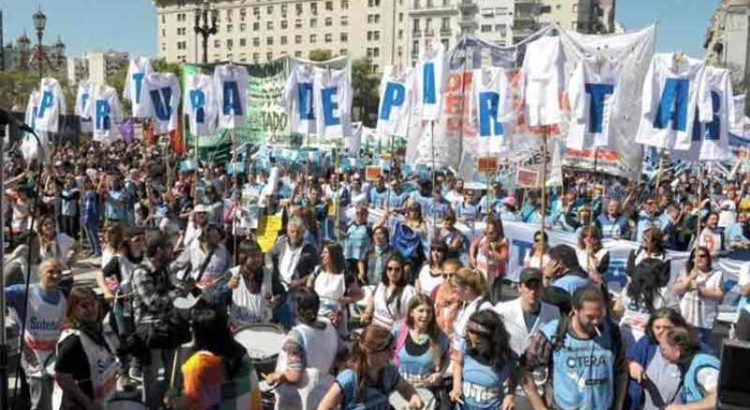
Esta tarde se inauguró la carpa que contiene a la Escuela Pública Itinerante frente al Congreso de la Nación. En la conferencia de prensa, la secretaria general de Ctera, Sonia Alesso, explicó: “Estamos acá defendiendo la Educación pública”, aseguró.
Horas antes se conocía la noticia de que el gobierno de la provincia de Buenos Aires convocó a los representantes de los gremios docentes locales a participar de una reunión de la comisión técnica salarial el lunes próximo. Esto fue confirmado por la Federación de Educadores Bonaerenses (FEB) y se detalló que el encuentro está previsto para el lunes a las 17.00, luego de que los docentes reclamaran un encuentro urgente con la administración provincial.
Por otro lado, la Unión Docentes Argentinos (UDA) anticipó también hoy que denunciará penalmente al ministro de Educación, Esteban Bullrich, si no convoca a la paritaria nacional en las próximas horas, ya que este miércoles vence el plazo que un fallo judicial le otorgó al Gobierno para hacer ese llamado.
Bajo el lema, “la escuela pública enseña, resiste y sueña”, Ctera difundió además las actividades que se realizarán dentro de la carpa. Para mañana a las 11 se proyectará el documental “10 años sin Carlos, 10 años sin justicia completa” y luego se dará la disertación titulada “No se reprime a los maestros”.
Para el viernes a las 15, un grupo de artistas visuales “Estanpueblo”, realizará una intervención para la que invitan a la gente que lleve su guardapolvo o remera. A las 18 habrá música con orquestas infantiles.
Para el sábado a las 15 también se prevén obras artísticas como un taller de bombos y un taller de stencil y a las 15 habrá una obra de teatro.
El domingo a las 16 estará el grupo “Cine y tablas” presentando un espectáculo de títeres.
Las organizaciones agrupadas en el Colectivo Nacional Argentino de CEAAL, el CEAAL Continental (Consejo de Educación Popular de América Latina), el PMSS (Programa MERCOSUR Social y Solidario), la CLADE (Campaña Latinoamericana por el Derecho a la Educación) y la REPEM América Latina y el Caribe, queremos hacer público nuestro más enérgico repudio a la represión ejercida por el Estado argentino contra docentes que en la tarde de ayer intentaban montar una carpa frente al Congreso Nacional con el objetivo de implementar una escuela itinerante como modalidad de protesta y reclamo de sus derechos vulnerados por el incumplimiento de la Ley de Financiamiento Educativo que obliga al Estado Nacional a convocar a los docentes a Paritarias Nacionales.
Este hecho se suma a una serie de intervenciones de las fuerzas represivas a lo largo y ancho del país que son legitimadas por el gobierno nacional y su ministra de seguridad. Para ellos la protesta social de los diferentes sectores en reclamo y defensa de sus derechos constituyen intentos desestabilizadores de la democracia que el mismo gobierno nacional está poniendo en cuestión a partir del desconocimiento de las leyes, del avasallamiento de derechos y la utilización de herramientas represivas de una virulencia tal, que en nuestro país recuerdan a las dictaduras.
Esta práctica de persecución y estigmatización de las organizaciones populares y sus luchas lamentablemente ya reconoce la existencia de presos políticos, manipulación de la justicia como modalidad para el disciplinamiento de quienes piensan distinto y la articulación de un discurso discriminador y xenófobo a partir de los medios masivos de comunicación que marcan el retroceso de una democracia que hasta ahora se había ido fortaleciendo con el aporte de todos y todas.
Además de condenar esta práctica autoritaria queremos hacer explícito nuestro compromiso en la defensa de la democracia y sus conquistas para lo cual defender a la educación pública, fortalecer nuestro trabajo político y social junto a los más necesitados, acompañar la lucha contra la violencia ejercida hacia las mujeres, luchar por la defensa y conquista de más y mejores derechos para nuestro pueblo es nuestra respuesta y por esto no cederemos el espacio público a las fuerzas represivas.
Programa MERCOSUR Social y Solidario, Consejo de Educación Popular de América Latina y el Caribe, CLADE y REPEM América Latina y el Caribe.
América del Sur/Chile/Abril del 2017/http://www.2001.com.ve
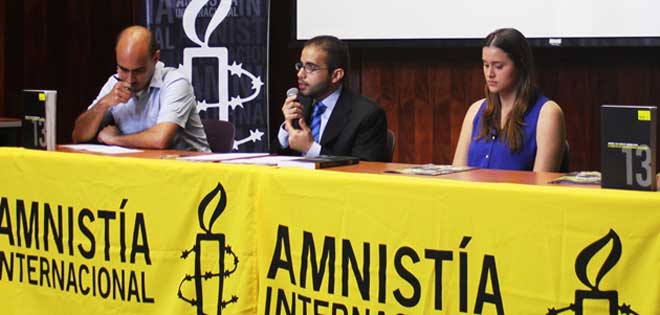
Amnistía Internacional (AI), lanzó la campaña «Chile sin barreras», cuyo objetivo es pedir al Gobierno que de prioridad a la tramitación de una ley que garantice los derechos de los inmigrantes, que en este país ya suman casi 500 mil personas.
Además, el organismo busca sensibilizar a los parlamentarios y a la ciudadanía en general sobre las continuas vulneraciones que sufren las personas extranjeras que residen en Chile y avanzar en la plena inclusión de todos ellos.
En la actualidad Chile cuenta con una ley de extranjería que data de 1975, cuyo objetivo central es preservar la seguridad nacional, regulando exclusivamente condiciones de entrada, permanencia y salida del país.
«Regular la migración con un decreto propio de la dictadura (1973-1990), y que pone foco de manera exclusiva en la seguridad y en lo económico es limitado, retrógrado y absurdo. Chile debe abordar este complejo proceso con un nuevo marco legal que cumpla en plenitud con los estándares de derechos humanos», señaló el presidente de AI en Chile, Roberto Morales.
El titular del organismo explicó que el decreto actual tiene una visión economicista de la migración y considera básicamente a los migrantes como fuentes de trabajo «estando finalmente al servicio del mercado laboral y no de las personas ni de sus derechos».
Cuatro décadas después, con 465 mil extranjeros, «el país es testigo de un flujo de inmigración nunca antes visto», dijo Morales a Efe.
Además, el director de AI aseguró que el actual articulado (ley 1094), ocasiona «graves vulneraciones al acceso a derechos» y a la vida cotidiana de las personas inmigrantes sin importar su situación legal en el país, ya que incluso los extranjeros que cuentan con visados y permanencias regulares se ven afectados.
«Contar con una ley de migración es una necesidad y una obligación, no un simple lujo. Chile ha suscrito numerosos instrumentos internacionales en esta materia que le exigen alinear sus políticas internas», aseveró Morales.
El director de AI afirmó que el compromiso de reformar la legislación migratoria formó parte del programa del gobierno de la presidenta Michelle Bachelet, pero aún la iniciativa no se traduce en proyecto de ley.
El organismo internacional espera que el proyecto de ley exprese los derechos de las personas inmigrantes y fortalezca la institucionalidad migratoria en el país.
Concluye que, si bien, los Estados tienen la facultad de determinar libremente sus programas migratorios, esto no los exime de «respetar en cada momento los derechos de las personas inmigrantes».
La inmigración latinoamericana hacia Chile se ha cuadruplicado desde el fin de la dictadura de Augusto Pinochet en 1990.
Actualmente, residen en el país 465.300 extranjeros (de una población de casi 18 millones), el 89,5 % de ellos procedentes de países de la región.
Su próspera economía, su estabilidad social y las múltiples oportunidades laborales han impulsado la creación, entre los latinoamericanos, del ‘chilean dream’ (el sueño chileno), tal y como en su día existió el ‘sueño americano’.
Los inmigrantes que llegan al país tienen entre 15 y 45 años y vienen en busca de oportunidades.
Según un informe del banco BBVA, Chile quintuplicó los residentes extranjeros en los últimos 30 años, que actualmente representan un 2,3 % de la población chilena total.
En los últimos diez años, el porcentaje de extranjeros que adquieren residencia definitiva y están clasificados como empleados en Chile aumentó desde el 30 % al 50 % del total, según las estadísticas de la entidad financiera.
Además, aseguró que la inmigración más numerosa proviene de Perú – 177 mil – aunque la que más crece procede de países caribeños, como Haití y República Dominicana.
Europa/España/Abril del 2017/Noticias/http://www.sdpnoticias.com
«Sería opcional e incluiría contenidos que sensibilicen y promuevan normas internacionales Derechos Humanos»
El gobierno de Madrid, España, se encuentra trabajando en una nueva asignatura optativa para educación secundaria que abordaría el respeto y la no discriminación a la población LGBTI.
Al respecto, la presidenta de la Comunidad de Madrid, Cristina Cifuentes, dijo que la materia sólo se incluirá en aquellos centros, que dentro de su autonomía, decidan implantarla.
En este sentido, la ley de Protección Integral contra la LGTBifobia y la Discriminación por Razón de Orientación e Identidad Sexual, recoge en su artículo 31.9 que:
«Dentro de los contenidos educativos de libre asignación de la Comunidad de Madrid se garantizará que todos los alumnos madrileños reciban la formación que promueva los valores constitucionales de convivencia, respeto e igualdad hacia el colectivo LGTBI».
América del Sur/Venezuela/Abril 2017/Noticias/http://www.mpprijp.gob.ve/
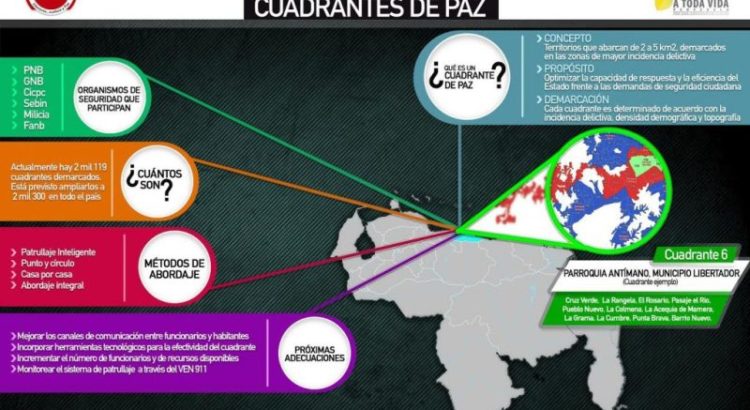
Son espacios físicos que abarcan de 2 a 5 kilómetros cuadrados, demarcados en zonas de alta ocurrencia delictiva. Actualmente hay 2.119 cuadrantes en todo el país, que a su vez concentran 79 municipios donde las estadísticas reportan particulares focos de criminalidad.
En los Cuadrantes de Paz confluyen funcionarios policiales y militares, líderes comunitarios, patrullas, motos, herramientas tecnológicas, metodologías de trabajo contra la criminalidad, todo el gabinete ministerial de interés social, consejos comunales y otras formas de organización popular. Se trata de los espacios donde se concreta el plan macro de seguridad ciudadana del Estado venezolano.
El propósito fundamental es generar una relación de proximidad entre el ciudadano y los funcionarios policiales y militares, para canalizar respuestas prácticas y efectivas frente a la delincuencia.
Aunque la iniciativa fue concebida en 2013, este año los cuadrantes de paz son objeto de ajustes que incluyen: establecer estos espacios en todo el país, más allá de la ocurrencia delictiva; incrementar la eficiencia del patrullaje inteligente; incorporar GPS a los vehículos y celulares para chequear el correcto uso de recursos dentro de cada cuadrante; monitorear las tareas de seguridad y apoyar la comunicación ciudadano-funcionario a través del servicio VEN 911.
Last week, the granting of an unlimited 60-year water licence to the Carmichael mine, in Queensland’s Galilee Basin, rattled environmentalists, farmers and community groups alike.
In a region experiencing prolonged drought conditions, the provision of unlimited water for one of the largest mining operations in the Southern Hemisphere seems like a commitment at odds with current climate predictions. The decision has also prompted a raft of wider questions about the industry’s water use.
Why do coal mines need so much water?
Underground coal mines rely on water to reduce the hazard of fires or explosion, by using it to cool the cutting surfaces of mining equipment and prevent coal dust from catching fire.
Water also helps to manage dust produced during the processing stage, when coal is crushed and ground. Coal is then transported through pipelines as a water-based slurry for further processing.
Mines also need water for things like equipment maintenance, and for consumption by the mining communities themselves.
In total, about 250 litres of freshwater are required per tonne of coal produced. This freshwater makes up around a quarter of the total water demand during coal production, the rest being “worked” (recycled) water.
What other industries use lots of water?
The Great Artesian Basin is one of the largest underground water reservoirs in the world. It underlies 22% of Australia’s land area, beneath the arid and semi-arid parts of Queensland, New South Wales, South Australia and the Northern Territory.
Its aquifers supply water to around 200 towns or settlements, most of which are allowed to draw between 100 and 500 million litres (ML) per year.
The Great Artesian Basin covers almost a quarter of Australia.Tentotwo/Wikimedia Commons, CC BY-SA
The Great Artesian Basin underpins A$12.8 billion of economic activity annually, according to a 2016 report commissioned by the federal government. Almost all of this is from mining and coal seam gas (A$8 billion) and livestock farming (A$4.7 billion).
In Queensland, mining and industry hold just over 1% (by number) of the water licences linked to the Great Artesian Basin but account for 10% of the water extracted. Coal seam gas accounts for a further 22% of water, with no licensing required. In contrast, livestock production accounts for 88% of water licences but just 46% of the extracted water.
The Carmichael mine’s 12,000ML forecasted use (equivalent to 4% of the water extracted from the Great Artesian Basin in Queensland last year) would put it alongside the biggest annual users of Great Artesian Basin water, such as the Olympic Dam copper and uranium mine in South Australia, which currently draws 10,000ML each year.
Why does Adani need unlimited water anyway?
According to the company’s own modelling, the Carmichael mine’s annual freshwater use is projected to peak at just over 12,000ML – or roughly 13 Olympic swimming pools per day.
Despite these estimates, the water licence granted to Adani puts no limit on the water it can take from the Great Artesian Basin. However, it calls for regular monitoring of water levels, quality and flow in each aquifer that is tapped.
Unlike other controversial Queensland mining projects, such as the New Acland coal mine, Adani’s water licence application was exempted from public scrutiny, courtesy of a November 2016 amendment to the existing laws.
Water licences usually specify the total amount, and/or the daily rate, of groundwater that can be taken. Changes to a water licence to increase the amount of water must be assessed like a new application and pass public scrutiny. But with an unlimited licence, there is no need for Adani to apply for a new licence if they need more water than originally predicted.
What are the environmental effects of industrial-scale water usage on the basin?
Despite a net yearly decrease of 286,000ML in the water stored within the Great Artesian Basin, it is in no danger of running dry. The past 120 years of exploitation have used up less than 0.1% of the water stored.
The real issue is water pressure. Flows from artesian bores are now roughly half what they were in 1915. Since then, the water level in some bores has fallen by as much as 80 metres, and a third of bores have stopped flowing altogether. This directly affects the human, plant and animal communities that rely on artesian water.
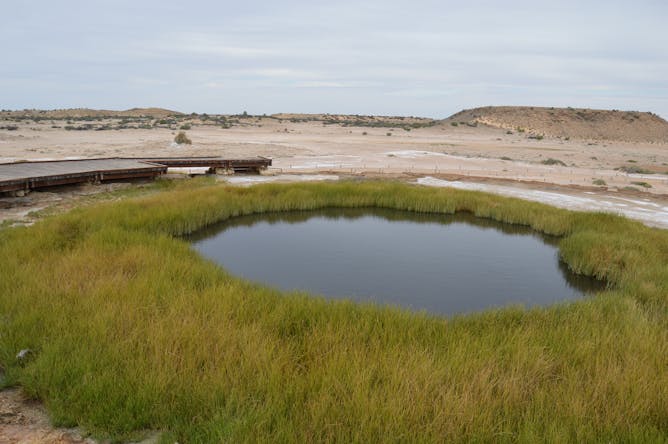
Because of their isolation, the natural springs of the Great Artesian Basin are home to many unique plant and animal species. Desert springs are particularly vulnerable to declining water pressure, and many spring habitats have been irreversibly damaged by invasive species, excavation, livestock, industrial activity and even tourists.
Recycled water is an integral part of coal mining, but it contains salt, added in the dust-management stage, which can leave the water unusable for certain processes. Nevertheless, a recent study suggests that Queensland coal mines could cut their freshwater use by 62% simply by using recycled water for processes that are not sensitive to salt levels. Diluting salty recycled water could also reduce freshwater use by 50%, and cut water costs by 40%.
Untreated seawater is perhaps the most sustainable water of all, although transporting it from coast to mine costs energy and therefore money. Its saltiness also creates chemical challenges during coal and uranium processing.
Understandably, there is significant concern that Adani’s unlimited licence will allow the mine to draw more water than predicted. Should the mine go ahead, it is important that the research community continues to scrutinise the regular water quality and usage reports that Adani is required to provide. Water licences can, after all, be revoked.
We should also be concerned about industries like coal seam gas that currently do not require water licensing, but nevertheless use huge amounts of artesian water.
Although water is an important issue, it is vital not to lose sight of the numerous other environmental impacts of the Carmichael mine. For example, an estimated 4.7 billion tonnes of greenhouse gas emissions will result from the mining and burning of Carmichael coal. Climate warming will impact Australia on multiple fronts, including bleaching of the Great Barrier Reef, increasing the intensity of tropical cyclones, causing more heat-related deaths, diseases and droughts.
África/ Este de África/Abril del 2017/Noticias/http://allafrica.com/
The ministerial meeting of the regional bloc which took place here last week stressed that for Kiswahili to be made one of the working languages, Article 137 of the Treaty has to be amended.
Article 137 of the EAC Treaty recognises English as the official language of the Community but emphasizes that Kiswahili shall be developed as a status of lingua franca, a community-wide language among the populace, of the region.
EAC Treaty is a 116 page document used as a guiding principle for regional integration. The Treaty was signed on November 30th, 1999 and went into force on July 7th, 2000. It has been amended twice; on December 14th, 2006 and August 20th, 2007.
In August last year, the East African Legislative Assembly (Eala) passed a Resolution to urge the Summit of the EAC Heads of State to amend the Treaty in order to provide for Kiswahili as one of the official languages of the bloc in January this year.
The Resolution sailed through at the regional Assembly’s session held in Kampala, Uganda early this year during which the lawmakers underscored the need to elevate Kiswahili from its current status of lingua franca.
The ministers directed the EAC partner states to formulate National Kiswahili Languages Policies and enhance the use of the language in official domains ahead of the Treaty amendment.
The EAC member countries were also urged to initiate the process of institutionalization of Kiswahili as one of the official languages through the establishment of National Kiswahili Councils and National Kiswahili Associations.
Article 119 of the EAC Treaty provides for the development and promotion of indigenous languages especially Kiswahili as a lingua franca of the region while English is the official language.
«Kiswahili will be adopted as an official language within the Community as soon as the EAC Summit of Heads of State amend the Treaty to accommodate the new resolution,» EAC secretariat said in a statement yesterday.
Officials of the secretariat said after amendment, partner states are expected to facilitate adoption of the language at the national level. However, they were not explicit on when the matter will be brought before the regional leaders.
OtrasVocesenEducacion.org existe gracias al esfuerzo voluntario e independiente de un pequeño grupo de docentes que decidimos soñar con un espacio abierto de intercambio y debate.
¡Ayúdanos a mantener abiertas las puertas de esta aula!





 Users Today : 24
 Total Users : 35490836
 Views Today : 25
 Total views : 3604248