Page 21 of 56
1 19 20 21 22 23 56

Canada: Education Reform Act headed for final vote following changes

Por: cbc.ca/14-03-2018

The McNeil government’s Education Reform Act is a step closer to becoming law — a step that followed several amendments resulting from all-party co-operation.

Bill 72 moves to third and final reading with amendments that include language guaranteeing students the option of an inclusive education at their neighbourhood school with kids their own age, as well as adding a seat to the provincial advisory committee on education for a first-voice representative of people with disabilities.

NDP education critic Claudia Chender, who proposed the latter amendment, said she feels the changes address the key concerns disability advocates expressed during law amendments on Monday.

«I do think after some fits and starts, the government seems to have gotten it right,» she said Tuesday night at Province House.

Claudia Chender

NDP education critic Claudia Chender says amendments to the Education Reform Act successfully address concerns disability advocates raised about the bill. (CBC)

The amendment about language came from the Liberals, and added the word «shall» to the bill in reference to the requirement to provide inclusive education.

Chender repeatedly proposed amendments throughout Tuesday’s committee of the whole, including multiple calls to change the term «manager» as it relates to principals and vice-principals to «administrator.»

Education Minister Zach Churchill said the government didn’t support the change because it wasn’t reflective enough of the duties principals, in particular, play within schools.

«Management is a key component of our administrators and I think it’s important to have that reflected in the legislation,» he said.

While principals and vice-principals might be «teachers first,» Churchill said «there needs to be clarity on those roles and responsibilities.»

Nova Scotia Municipal Affairs minister Zach Churchill

Education Minister Zach Churchill says the amendments Tuesday show the government’s willingness to listen to concerns raised about Bill 72. (CBC)

Likewise, an amendment to ensure that meetings of the new advisory committee on education are open to the public and its minutes are publicly available was defeated by the Grits.

Chender said she’s concerned about the shift happening with the loss of public school board meetings, and drew a comparison to the closed meetings of the Nova Scotia Health Authority’s board.

Churchill disagreed with the suggestion that blocking the amendment means the system will be less transparent. He said the new approach would enhance local voices.

«I think that we’re going to further involve our school communities at the local level and ensure that they have the capacity regionally to provide open advice to our regional offices as well as connecting that network provincially.»

Another of Chender’s amendments was also accepted, which changed the word «demoted» to «reassigned» as it relates to an administrator returning to the classroom.

‘People’s voices can be heard’

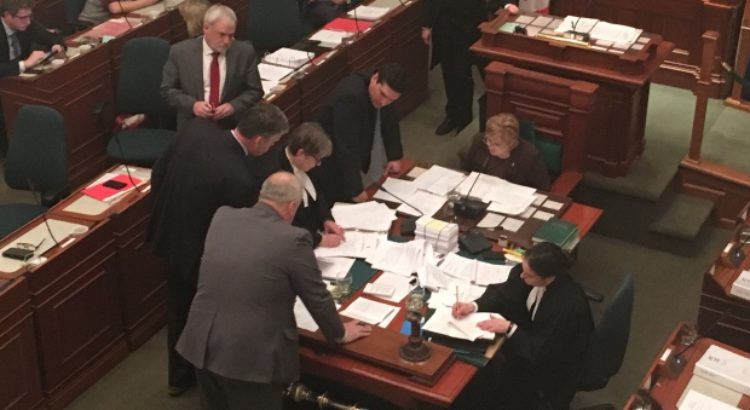
Co-operation hasn’t exactly been a hallmark of the Liberals since they came to power in 2013, so it was an unusual scene Tuesday as Premier Stephen McNeil, government House Leader Geoff MacLellan and NDP House Leader Dave Wilson huddled around the clerk’s table in the middle of the legislative chamber discussing Chender’s amendments before versions of them were ultimately passed with unanimous support of all three parties.

Churchill said all of the amendments the House passed Tuesday show the government’s responsiveness to «questions and concerns that have been raised.»

«I think that’s demonstrating that this legislative process works and that people’s voices can be heard as we build laws that impact people in this province.»

The bill moves to third reading where it will be debated for a final time, likely on Thursday.

 *Fuente: http://www.cbc.ca/news/canada/nova-scotia/education-reform-act-legislation-bill-72-churchill-chender-1.4565262
Comparte este contenido:

Canada: Le Québec se dote d’un Ordre d’excellence en éducation

Canada / 11 mars 2018 / Auteur: fjarraud / Source: Le café pédagogique

» L’Ordre de l’excellence en éducation du Québec concrétise la volonté du gouvernement du Québec de souligner officiellement le mérite de celles et ceux qui se distinguent par leur participation au rehaussement de l’enseignement québécois», annonce le minsitère québécois de l’éducation. L’ordre comptera trois niveaux de membre simple à membre émérite. Les établissements scolaire pourront proposer des nominations. Cete création a été mal accueillie par les syndicats. Notamment la FAE estime que «c’est l’ensemble de la profession que le ministre doit reconnaitre». » Les profs ne veulent pas d’un prix. Ils demandent que leur expertise soit reconnue et que les services soient au rendez-vous. Depuis sa nomination, il y a deux ans, le ministre Proulx a systématiquement rejeté les solutions des enseignantes et enseignants pour reconnaître leur expertise et leur autonomie. Le ministre refuse encore et toujours de mettre en place des balises qui élimineraient les ingérences pédagogiques dont les profs sont victimes. Dans la Loi sur l’instruction publique, il ne les reconnaît pas comme les premiers experts de la pédagogie au Québec. Au contraire, ses décisions ajoutent à la lourdeur bureaucratique que doit déjà subir le personnel enseignant», estime le syndicat. Pour lui la création de cet ordre » contribue à la détresse psychologique du personnel enseignant».

Source des nouvelles:

http://www.cafepedagogique.net/LEXPRESSO/Pages/2018/03/06032018Article636559197581844913.aspx

Source de l’image:

http://www.education.gouv.qc.ca/references/concours-prix-et-distinctions/ordre-de-lexcellence-en-education/

Comparte este contenido:

Canadá: Glaze-inspired education bill subject to heavy criticism in committee hearing

Canadá/ 05.03.2018 / From: www.thechronicleherald.ca.

Proposed legislation that would radically change the administration of Nova Scotia’s school system was derided as “undemocratic” and “unneeded” Monday as critics lined up to condemn the bill before a legislature committee.

More than 60 speakers were scheduled to make presentations before the law amendments committee on Bill 72, which would largely implement reforms recommended in a recent report by education consultant Avis Glaze.

Among other things, the legislation would eliminate the province’s seven English language school boards while revamping the membership of the 9,600-member Nova Scotia Teachers Union to remove about 1,000 principals, vice-principals and senior supervisors.

Union president Liette Doucet called on the government to remove provisions that would shift administrators from the union to an affiliated association.

“This is punishment, pure and simple, for the strong role that principals, vice-principals and administrators have played in the NSTU since its inception, up to and including work-to-rule last year and the first provincewide strike of the NSTU,” said Doucet.

She said the change would rob school administrators of basic protections, including the right to challenge discharges, suspensions or demotions for just cause.

It was a change of tone from last week when Doucet said there was hope of a new start for the union’s relationship with the government. On Monday, she said trust would once again be an issue if the legislation is passed as is.

“We can never trust that a collective agreement — a contract — is worth any more than the paper it’s written on. This government’s strong-arm approach to unions and collective bargaining has the potential to destroy collective bargaining in this province for the foreseeable future.”

Peter Day, a middle school teacher from Sydney Mines, N.S., said there was nothing in the legislation that would improve student achievement.

“The recommendations of the Glaze report are a fabricated solution to a crisis in education that does not exist,” he said, adding that the closing of school boards was “an attack on democracy.”

Day said more human resources — including teachers, speech language pathologists and social workers — would make a bigger difference in schools than administrative changes.

Suzy Hansen, a member of the Halifax Regional School Board, told the committee she opposes the elimination of boards as an African Nova Scotian with six children in the school system.

Hansen said she was worried about the unintended consequences on “the achievement gap” between the academic performance of African Nova Scotian children and other students.

“We are unaware of what policies are going to be kept and what aren’t going to be kept,” said Hansen. “There definitely are things that need to be addressed, but doing a clean sweep and an abrupt change so quickly is not going to help. It’s only going to push us back further.”

While most of the early speakers before the committee spoke against the legislation, consultant Paul Bennett spoke in favour of it, although he said it could be improved.

Under the legislation, the Acadian school board would remain in place, while the other boards would be replaced by a new Provincial Advisory Council of Education composed of 15 members representing all regions of the province.

School board offices would remain in place, but they would become regional education centres that would continue to make regional and local decisions, although the superintendents would report to the deputy minister of education. There would also be local advisory councils under the proposed model.

“I think you need to consider the regional centres and the executive directors of education. I really don’t think they are going to be sufficiently strong to represent the public,” Bennett said.

He said regional school advisory councils should be governing bodies to make them more accountable.

“Phase out the school boards, yes — decentralize decision making, restore democratic accountability and we’ll all be further ahead,” he said.

Meanwhile, a small group of protesters gathered outside the legislature to call on the government to pause the legislation.

“Nova Scotia is losing 57 elected women and removing African Nova Scotian and Indigenous voices from local decision-making,” the group said in a news release.

The legislation could pass final reading as early as Wednesday.

From: https://www.thechronicleherald.ca/novascotia/1550595-glaze-inspired-education-bill-subject-to-heavy-criticism-in-committee-hearing

Comparte este contenido:

NASSCOM y Don Tapscott construirán  Centro de Desarrollo Educativo, Empresarial y Gubernamental de Blockchain en India

India/ 27 de febrero de 2018/Por: Andrea Leal/Fuente: https://www.criptonoticias.com

La Asociación Nacional de Empresas de Software y Servicios de la India, mejor conocida como NASSCOM, firmó esta semana un memorando de entendimiento con el Instituto de Investigaciones Blockchain de Canadá (BRI) para conformar un centro de educación y capacitación sobre las tecnologías de contabilidad distribuida en la India. Una iniciativa que podría motivar la adopción de las herramientas DLT y las monedas criptográficas en este reticente territorio asiático.

El noticiero tecnológico CIO y el medio de la India INC42 fueron las plataformas que reportaron el consenso realizado por estas dos firmas empresariales. Asimismo, BRI twitteó recientemente una foto donde se encuentra su co-fundador, Don Tapscott, junto a Sangeeta Gupta, vicepresidente de NASSCOM, y Sanjay Tugnait, CEO de la firma de consultoría Capgemini Canadá —compañía que también estuvo presente en la asociación— firmando el documento que sella la alianza.

 Todo apunta a que NASSCOM y BRI establecerán un “centro de excelencia” en la India, donde se puedan fomentar abiertamente la adopción de las tecnologías de contabilidad distribuida en el sector empresarial, educativo y gubernamental por medio de la capacidad tecnológica de alta gama que ofrece BRI.

El proyecto estará constituido por un grupo de seminarios web y cursos presenciales. Asimismo, la investigación tendrá dos fases constitutivas: la primera que buscará profundizar en los sistemas de incentivos y descuentos dentro de la blockchain, y la segunda tratará de generar una plataforma DLT que ayude a hacer crecer el ecosistema digital del Estado indio de Telengana.

De esta manera, el centro podría convertirse en una plataforma capaz de brindar aprendizaje, permitir la creación de prototipos y afianzar el lanzamiento de herramientas funcionales en el sector DLT. Es debido a todas estas posibilidades, que Raman Roy, presidente de NASSCOM, cree que las tecnologías de contabilidad distribuida tiene un alto poder de transformación.

En este sentido, Roy declaró que la alianza podría fomentar el desarrollo de las herramientas DLT dentro de territorio nacional, así como tendrá la capacidad de mejorar “la visión de la economía global” que tiene actualmente el gobierno y los ciudadanos de la India sobre las monedas criptográficas y las herramientas blockchain.

 Por otro lado, Don Tapscott, también ha asegurado que esta clase de alianza podrían motivar un verdadero despertar tecnológico en la India. Una realidad que tarde o temprano enfrentaría la nación debido al nuevo contexto digital (globalizado) en que se encuentran sumergidas las sociedades actuales.

En concordancia con este logro, Roy sabe que alentar la adopción de blockchain en la India es un proyecto a largo plazo, el cual estará marcado por la espera y un enorme esfuerzo de dedicación. No obstante, por los momentos, Raman se encuentra muy satisfecho y feliz con todo lo obtenido.

La importancia de la India en el ecosistema de criptomonedas radica en gran medida a su enorme población y sus constantes proyectos basados en blockchain. En este sentido, el mercado de monedas criptográficas se ha visto perjudicado en varias ocasiones debido a la tensión gubernamental y regulatoria de estas herramientas financieras, cayendo el precio del Bitcoin debido a medidas de pago de impuestos, prohibición de intercambios y constantes advertencias financieras. Un suceso que afectará a la comunidad de criptomonedas hasta que la nación esclarezca su posición frente a las monedas digitales.

Fuente de la Noticia:

https://www.criptonoticias.com/educacion/nasscom-don-tapscott-contruiran-centro-desarrollo-educativo-empresarial-gubernamental-blockchain-india/


Comparte este contenido:

Canada: Post-secondary education made more affordable for part-time students

Canada/ February 27, 2018/By: Rattan Mall/Source: http://www.voiceonline.com

STARTING this academic year, nearly 10,000 more part-time students from low- and middle-income families will benefit from up to $1,800 in non‑repayable grants per year and up to $10,000 in loans.

This was announced by parliamentary secretary Terry Beech on behalf of Patty Hajdu, Minister of Employment, Workforce Development and Labour, on Tuesday.

Additionally, access to grants for part-time students with children will be expanded allowing them to benefit from up to $1,920 per year in grants.

Expanded access to Canada Student Grants for full-time and part-time students and students with dependants helps more Canadians afford post-secondary education. These measures will benefit Canadian women in particular, who often strive to improve their career prospects while balancing family responsibilities.

Women represent nearly two-thirds of the Canada Student Loans Program’s part-time recipients, while approximately four out of five students receiving the Canada Student Grant for students with dependent children are women.

Hajdu said: “Helping more Canadians afford post-secondary education will help grow our economy and strengthen the middle class. Far too many Canadians face challenges when pursuing post-secondary education—not only because of the cost of education itself but also because of the financial pressures and time constraints of supporting our families. Our government has Canadians covered, no matter their circumstance—whether they are going to college or university for the first time, returning to school or upgrading their skills.”
Kathy Kinloch, President, British Columbia Institute of Technology, said: “The British Columbia Institute of Technology has always supported unique paths to post-secondary education. As we empower our students to embrace the challenges of a complex world, we work alongside the government and our industry partners to enhance education access opportunities for all learners.”

The Government of Canada is investing:
– $107.4 million over four years, starting in 2018–19, and $29.3 million per year thereafter, to expand eligibility for Canada Student Grants for students with dependants.
– $59.8 million over four years, starting in 2018–19, and $17 million per year thereafter to expand eligibility for Canada Student Grants for Part-Time Students and to increase the threshold for eligibility for Canada Student Loans for part-time students.
-Expanded access to Canada Student Grants for students with dependants, starting in the 2018–19 academic year, allows more:
– full-time students with children to receive up to $200 per month per child; and
– part-time students with children to receive up to $1,920 per year in grants.

Source:

Post-secondary education made more affordable for part-time students

Comparte este contenido:

Canada: Teacher education must rise above political correctness

América del Norte/Canada/Timeshighereducation

Resumen: Cada vez más, las universidades canadienses parecen estar más preocupadas por la corrección política que por la educación de los estudiantes. Una ilustración destacada de esto es la batalla pública del psicólogo de la Universidad de Toronto , Jordan Peterson, con administradores universitarios, profesores y algunos estudiantes por su negativa a usar pronombres neutrales al género al referirse a estudiantes con diferentes orientaciones sexuales.Un ejemplo menos conocido, pero posiblemente mucho más serio, es la creciente tendencia de las facultades de educación canadienses a utilizar criterios de admisión que no están relacionados con las características y habilidades que necesitan los docentes efectivos. En la Universidad de Windsor , por ejemplo, se está prestando especial atención a los candidatos que reflejan «la diversidad etnocultural y social de las escuelas de Ontario». Y, en septiembre pasado, la Facultad de Educación de la Universidad de Manitoba fue aún más lejos con el objetivo de admitir al 45% de los candidatos a docentes entrantes sobre la base de su autoidentificación como miembros de grupos marginados, como indígenas, discapacitados, LGBTQ, minoritaria étnica o socialmente desfavorecida. Estas políticas de admisión se están implementando para que los maestros representen cada vez más la demografía social en constante cambio de las provincias. Hay algo de mérito en esa aspiración, pero hay varios problemas serios.Una es que tales autoidentidades son difíciles de verificar y, en consecuencia, son potencialmente fáciles de «jugar». Una segunda es que tales políticas no son útiles para identificar y admitir candidatos que realmente tienen el potencial de convertirse en docentes efectivos, que es la razón más importante para tener facultades de educación en las universidades.

Increasingly, Canadian universities seem to be more concerned about political correctness than educating students.

A prominent illustration of this is University of Toronto psychologist Jordan Peterson’s public battle with university administrators, professors and some students over his refusal to use gender-neutral pronouns when referring to students with varying sexual orientations.

These admission policies are being implemented so that teachers increasingly represent the ever-changing social demographics of provinces. There is some merit to that aspiration, but there are several serious problems. One is that such self-identities are difficult to verify and, consequently, are potentially easy to “game”. A second is that such policies are not useful for identifying and admitting candidates who actually have the potential to become effective teachers, which is the most important reason for having faculties of education at universities.

Parents, students and even school administrators already know that there are substantial differences between the most and least effective teachers. A number ofexcellent studies have shown that the top 25 per cent are able to effectively teach 18 months’ worth of curriculum content in a year, while the bottom 25 per cent are able to teach only about six months’ worth. In short, the best teachers are three times more effective than the worst teachers. Addressing this unacceptable disparity should be the most important priority among Canadian faculties of education.

In addition, the literature identifies three characteristics of effective teachers: high language ability; a good education in the subjects taught; and a grasp of a variety of reliable assessment instruments and techniques.

Hence, it would make much more sense for universities to assess would-be teachers on the basis of their verbal and mathematical ability. In Canada, teacher candidates generally enter the professional programme after they have completed an undergraduate degree. Consequently, faculties of education should ensure that candidates are among the strongest in the university courses related to the subjects that they expect to teach.

Unfortunately, Canadian universities and ministries of education do not currently treat the education and certification of teachers as seriously as they treat the education and certification of dentists, lawyers and medical doctors – or even the certification of meat-cutters and hairdressers – all of whom are assessed on the basis of competence alone. After completion of their programmes of study, aspiring teachers are certified in varying ways across provinces. But they should be required to pass rigorous exams, covering both knowledge and actual teaching proficiency, such as the theory and techniques of test construction. The empirical literature shows that teachers spend about 15 to 20 per cent of their time formally and informally assessing students, yet they do not always know the best ways to do this.

Both universities and ministries of education have fiduciary responsibilities to prepare and certify the excellent teachers that all Canadian parents and students deserve. Fortunately, excellent admission and certification exams already exist. The Praxis exams, developed by the Educational Testing Service, could be used for selecting candidates and certifying teachers across English-speaking Canada, if not the entire nation.

All it needs is for universities and provincial ministers of education to stop being distracted by identity politics and put into practice such simple reforms, which will benefit all Canadians, regardless of their background.

Rodney A. Clifton is senior editor at the Frontier Centre for Public Policy and emeritus professor at the University of Manitoba; Alexandra Burnett is an intern at the Frontier Centre for Public Policy.

Fuente: https://www.timeshighereducation.com/opinion/teacher-education-must-rise-above-political-correctness

Comparte este contenido:

Canada: A medida que la escasez de maestros aumenta, el distrito escolar de BC contrata ‘reemplazos’ no certificados.

América del Norte/Canada/cbc.ca

Un distrito escolar en el BC Interior se enfrenta a una escasez tan severa de maestros que anuncia anuncios de «reemplazos» de maestros no certificados para instruir y supervisar las clases.

En una publicación compartida ampliamente en Facebook, el Distrito Escolar North Okanagan-Shuswap dice que está contratando personas sin certificación docente para hacer un trabajo de guardia que coincida con la descripción de un trabajo típico de docente.

«Se necesitan reemplazos de maestros en el nivel elemental, medio y secundario con disciplinas especializadas como música, educación artística, inmersión en francés, diseño aplicado, habilidades y tecnologías, matemáticas y ciencias, artes lingüísticas en inglés, estudios sociales y educación física y sanitaria». lee el anuncio en línea publicado por el distrito.

«Los reemplazos de maestros realizarán las tareas normales de un maestro, como la instrucción, la supervisión, la preparación de la lección y el marcado de las tareas del día».

Para calificar, los solicitantes no necesitan un certificado de enseñanza, dice la publicación, sino un título universitario, experiencia trabajando con niños, la capacidad de conectarse con los estudiantes y una capacidad demostrada para administrar grupos de niños de manera segura. Los solicitantes también deben completar un control de antecedentes penales.

Las escuelas de BC generalmente requieren certificados de enseñanza emitidos por el Ministerio de Educación que se otorgan si los solicitantes tienen capacitación en educación, experiencia docente y se consideran aptos para trabajar con niños.

Muchas personas están reaccionando en línea, algunas aplaudiendo la idea, otras más críticas.

«Qué insulto a la profesión de enseñar», escribe Ben Van Nostrand.»¿Hacen lo mismo por la escasez de enfermeras o médicos? ¿No se requieren certificados?»

‘Qué farsa’

«Esto es horrible», dijo Brigette Fidler.

«Qué farsa asumir simplemente porque tienen el grado de que pueden enseñar a niños de todas las edades en todas las clases y ser lo suficientemente educados como para hacerlo correctamente».

En respuesta, el distrito escolar reitera que solo se recurrirá a los reemplazos cuando no haya maestros certificados disponibles.

Dice que la práctica de contratación está permitida según la Ley de escuelas de BC por períodos de hasta 20 días con la aprobación de la junta.

«Estoy seguro de que todos nosotros sentimos cierta incomodidad … la orientación no puede reemplazar meses y meses de experiencia práctica», dijo Peter Jory, superintendente del Distrito Escolar 83.

«Esperamos que sea de forma limitada».

‘Vamos a ir con mucho cuidado’

Jory dijo que la contratación de docentes adicionales en toda la provincia, junto con las vacaciones típicas del personal de invierno y la temporada de resfriados y gripe han contribuido a la escasez de maestros de guardia o sustitutos.

Asegura a los padres que esta es una solución a corto plazo y que se contratarán candidatos adecuados.

«Vamos a ir con mucho cuidado y lentamente y ver cómo va», dijo Jory.

Los consejos escolares advierten que restaurar el tamaño de las clases será costoso

El Ministerio de Educación de Columbia Británica dice que un bombardeo en la contratación de docentes ha reducido el número disponible para el trabajo de guardia. (CBC)

En 2016, la BC Teachers ‘Federation ganó una decisión histórica en la Corte Suprema de Canadá que devolvió su derecho a limitar el tamaño de la clase.

Desde entonces, los distritos escolares han contratado a casi 3.500 maestros , el bombardeo de contratación más grande de maestros en la historia de Columbia Británica.

El Distrito Escolar 83 continúa reclutando activamente a maestros certificados para cubrir las vacantes de guardia.

Para solicitar un puesto de reemplazo de docentes, los solicitantes deben enviar un currículum y referencias a apply@sd83.bc.ca.

Fuente: http://www.cbc.ca/news/canada/british-columbia/north-okanagan-teacher-replacements-no-certificate-1.4523663

Comparte este contenido:
Page 21 of 56
1 19 20 21 22 23 56