Page 23 of 56
1 21 22 23 24 25 56

Canada: Antisense therapy: a promising new way to treat neurological disease

America del Norte /Canada/diciembre del 2017/Noticias/https://theconversation.com/


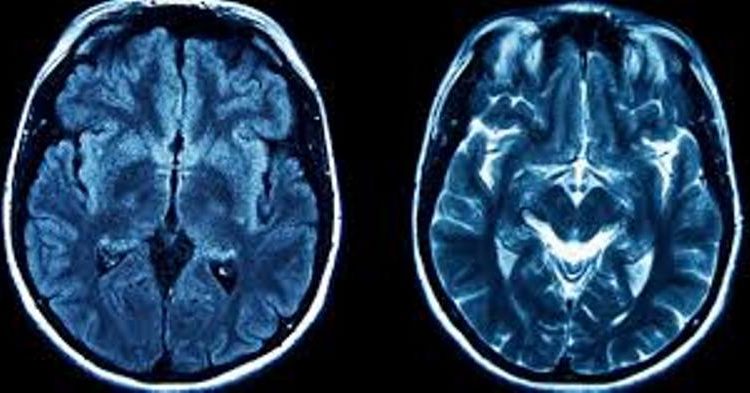
A new treatment for Huntington’s disease – a deadly brain disorder – has successfully completed first-in-human trials. The drug lowered levels of the harmful huntingtin protein in the spinal fluid of patients who took part in the trial.

Huntington’s disease is caused by a mutation in the gene that makes a protein called huntingtin. The mutation makes the protein bigger and more likely to clump together. It is this increased stickiness that scientists believe causes brain cells to die in people with Huntington’s disease. As the disease progresses, it affects movement, learning, thinking and emotions.

At the moment, there are no treatments for Huntington’s. Most people die within 15 to 20 years of receiving a diagnosis. But now, at least, there is hope. The new drug, developed by scientists at University College London working with a pharmaceutical company called Ionis, seems to be able to stop the production of the mutant huntingtin protein by silencing the mutated gene. The next stage is to show that this leads to a slowing in progression of the disease.

Antisense therapy

The experimental drug, Ionis-HTTRx, is a type of drug called “antisense oligonucleotides”. Before I explain how it works, it’s worth reviewing the fundamentals of how genes work.

Our genes are made out of DNA, a chemical code that includes the information that allows our cells to function. This information is used to make proteins, the molecular machines and building blocks that are crucial for cells to work. Antisense oligonucleotides intervene at a critical intermediate stage between DNA and proteins – where the DNA is converted into a molecule called messenger RNA (or mRNA for short).

mRNA is very similar to DNA, but much less stable, and chemically very slightly different. It acts as the template for making proteins. If you can get rid of it, the proteins don’t get made. Antisense oligonucleotides are synthetic fragments of DNA that can bind to mRNAs, causing them to be cut into pieces.
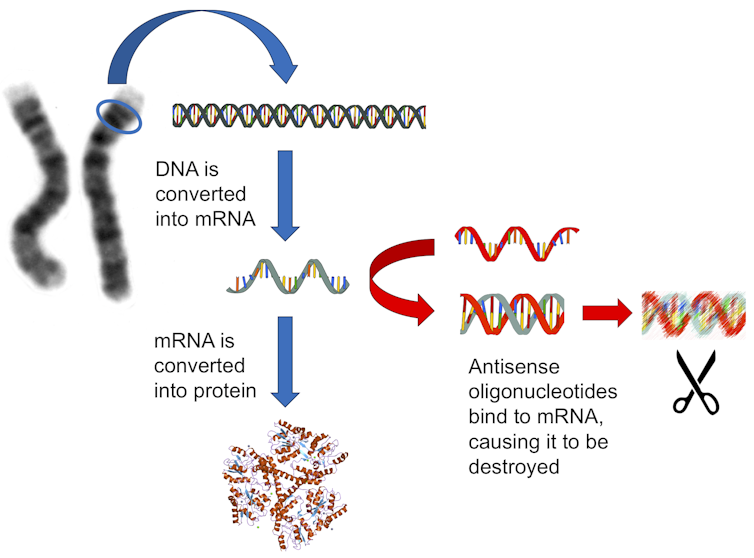
How antisense therapy works. Various public domain imagesAuthor provided

An important property of mRNAs is that the precise code they contain is specific to each protein. This means that you can design antisense oligonucleotides that can specifically target the production of protein from just one gene out of the many thousands in the human genome. In fact, if the gene you are targeting is mutated, you can even target just the mutant form of the gene.

The Huntington’s disease trial is still at an early stage, testing to see if the oligonucleotides can get inside the brain and reduce the amount of mutant protein. We don’t yet know whether the drug will slow down the disease. But there have been a couple of recent clinical trials in other neurodegenerative diseases that provide some hope that this approach might work.

Same approach, different diseases

The best example of this is for spinal muscular atrophy, a very rare (and also inherited) childhood form of motor neurone disease. In a clinical trial that was completed earlier this year, antisense oligonucleotides were used to correct a faulty version of a gene that is mutated in spinal muscular atrophy.

The scientists used a slightly different approach, but the results were very promising. In most cases, children with these mutations suffer severe problems with movement from birth, but most of the children treated with the oligonucleotides survived longer and had better movement than those without treatment.

The trial was so successful that it had to be stopped so that the child not receiving treatment could be provided with the oligonucleotides. The drug, called nusinersen, has since been approved by the US Food and Drug Administration for treating spinal muscular atrophy.

Both Huntington’s disease and spinal muscular atrophy are rare forms of neurodegeneration, but if antisense oligonucleotides can be shown to work for these disorders, then it may be possible that the same approach might work in more common diseases, like Parkinson’s or Alzheimer’s disease.

These diseases share some of the characteristics of Huntington’s disease and spinal muscular atrophy, such as the accumulation of sticky proteins (although the actual proteins that build up are different). As with Huntington’s disease, there aren’t any drugs that slow down or halt the brain cells dying in people with Alzheimer’s or Parkinson’s.

There is a lot of work that remains to be done to see whether antisense oligonucleotides could help in most types of neurodegeneration, and there are some really big challenges to be overcome. But these early studies, and smaller scale trials in rare diseases, are providing the evidence to convince medical research funding bodies and drugs companies that it is worth investigating further.

Fuente: https://theconversation.com/antisense-therapy-a-promising-new-way-to-treat-neurological-disease-89006

Imagen:

https://lh3.googleusercontent.com/LRpGLXSXbH3LnI0fdwrwYvYfisGo7pUgItJkTUzZJyxHgoJtESThOP7IZlwDiw89-ujrvac=s85

Comparte este contenido:

Canada: By casting teachers as informants, British counter-extremism policy is promoting violence

América del Norte/Canada/Diciembre del 2017/https://theconversation.com/

The Muslim children in my classroom withdrew from political debate when the Prevent counter-terrorism strategy cast me as an informant.

Prevent infers a duty on all teachers and doctors in England, Scotland and Wales to report signs of so-called “extremism” and “radicalisation” in their pupils and patients. Applying this duty is particularly difficult as “extremism” has not been legally defined by the Home Office.

Working as a secondary school teacher in London from 2005 to 2017, I was required to implement the Prevent counter-extremism strategy. My concern over the impact it was having on the dynamic of my and other classrooms led me to speak out against Prevent and counter-extremism strategy more generally.

When my Muslim students learned of my concerns, some of them approached me to express their anxiety that Prevent was a state surveillance strategy which was targeting them as a result of racial profiling – concerns supported by academic research. The children told me they hadn’t talked to other adults about this for fear that their vocal opposition to this controversial strategy would result in them being reported to the security services.

Some of the children told me that they no longer challenged the views of others that they perceived to be extreme. They feared that speaking out on sensitive issues would result in them being referred under Prevent, just by association. I have been offered examples of this happening in the classroom, on the street and in children’s homes.

Whether the children’s fears were justified or not, Prevent was altering their behaviour. I’ve heard similar examples repeated to me in focus groups I arranged of children from different schools in the London borough of Tower Hamlets.

Dialogue makes a classroom

Teachers, academics and politicians disagree over whether Prevent promotes or stifles debate in classrooms. This disagreement will continue until all of those with an interest in education recognise that there are different types of classroom debates.

The education expert Robin Alexander argues that authentic dialogue in classrooms is rare. Instead of having genuine conversations that may result in children and their teachers changing their preconceived views, children tend to be expected to offer their teachers anticipated answers. But authentic dialogue is crucial if schools are to promote a more harmonious society – for it is through genuine debate that we all moderate our views.

https://youtu.be/Ei3LIe7_mj8

Before Prevent was imposed on schools, some of the children at the secondary school where I taught approached me to discuss how they had begun to feel alienated from society. Concerns such as the impact of British foreign policy on civilians in Afghanistan, Iraq and Syria were a frequent topic of conversation. When my students raised these concerns, I was often able to tell them that I shared them – and this helped us think of possible responses.

The children raised suggestions of travelling to war zones, but quickly dismissed them in favour of peaceful, democratic solutions. Through talking, they learned to write to MPs, raise funds for refugee charities and contribute to human rights campaigns. Threats of nationalist violence were also dismissed as we explored our values through dialogue – dialogue that my students have since told me they no longer engage in.

When all that’s left is violence

Many theorists have argued that peace in a democracy relies on people having their say. Belgian political theorist, Chantal Mouffe, wrote in her book On The Political that violence “tends to flourish in circumstances in which there are no legitimate political channels for the expression of grievances”. She describes the shutting down of discourse in a democracy as “letting death in”.


Read more: We can all be a little radicalised – recognising this will help tackle extremism


The late French philosopher, Jacques Derrida, in his conversations on 9/11 and other work, described what he called the “autoimmunity of liberalism”. This results from the liberal contradiction of simultaneously trying to suppress dissent while also promoting freedom. Derrida wrote that this contradiction at the core of liberalism results from an aspiration to consensual politics but can result in a violent backlash.

In my ongoing research, I am analysing over a million words of government policy on counter-extremism. It’s revealed that the definitions of “extremism” and “radicalisation” progressively changed to become synonymous with violence between 2005 and 2015. The meaning of words affects how we perceive the world and aligning extreme and radical views with violence not only creates a perceived need for counter-extremism strategy but also acts as a catalyst for the violence that the strategy purports to address.

A strategy such as Prevent that targets radical and extreme views becomes necessary if we accept this change in the meaning of what it is to be “radical” or “extreme”. However, the experiences of my pupils show that the expression of extreme and radical views can actually help to reduce violence.

This moderation of extreme views extends beyond the classroom. People protesting against fracking as well as other student protesters have been referred to the Prevent programme. Silencing dissenting voices undermines the mechanisms by which democracy helps us to avoid violence. Labelling those who oppose the status quo as violent adds a catalyst to this already dangerous situation.

The Home Office is currently in the final stages of recruitment for a counter-extremism commissioner. While the lack of a legal definition for “extremism” makes it difficult to anticipate what this role will involve, surely the successful candidate will want to reduce political violence. Removing the Prevent duty that compels teachers to inform on their students would be a good start.


Fuente:https://theconversation.com/by-casting-teachers-as-informants-british-counter-extremism-policy-is-promoting-violence-85474

Imagen:https://lh3.googleusercontent.com/AQACrpe4v9XTNF80pzTxhT1gIKtrIuUskYQe3JT0J8tXBV_xjQHQaA64fsJrbegtXPHu_8E=s128

Comparte este contenido:

CANADA: Transphobia, Islamophobia and the free speech alibi

América del Norte/Canada/Diciembre del 2017/https://theconversation.com/

“I disagree with what you say, but I will defend to the death your right to say it.”

This quote, often attributed to the 18th-century French Enlightenment philosopher Voltaire (but actually based on the paraphrasing of his work by English biographer, Evelyn Beatrice Hall), has been used as the hallmark for freedom of speech as a fundamental democratic right.

While Voltaire may not have actually uttered those words, he did say: “Tolerance has never provoked a civil war; intolerance has covered the Earth in carnage.”

Both sentiments have come into play during recent debates about free speech in two varying contexts: University classes regarding the use of gender-neutral pronouns and in the framing of the House of Commons Motion 103 combating Islamophobia.

These may seem like disparate concerns but they are in fact related in the way the so-called “alt-right” uses free speech as a rhetorical prop in their campaigns of ideological intimidation.

I am a sociology professor at Wilfrid Laurier University where faculty concerns over a teaching assistant’s decision to show a video of University of Toronto professor Jordan Peterson arguing against the use of gender-neutral pronouns has been widely publicized and critiqued.

Supporting the right of transgender people to be acknowledged outside of gender-binary language that erases their identities and experiences is branded as left-wing, bleeding heart “political correctness.” When academics opt to keep views that refuse this acknowledgement from being uncritically purveyed, it’s seen as undermining free speech rather than preserving human rights.

As an Islamophobia studies scholar, I recently testified in support of Motion 103 before a Canadian Heritage Parliamentary subcommittee. The non-binding motion condemned Islamophobia and religious discrimination in Canada. However, the longstanding right-wing contention against the motion and the term “Islamophobia” wrongly assumes the motion will deny them the freedom to criticize Islam.

As I sit at the intersection of these free speech concerns being pitted against equally important social justice issues, the tension between freedom of expression and the intolerance that Voltaire alludes to becomes clear. Sacrificing human rights on the altar of free speech has become a strategy in the “alt-right” tool kit of bigotry.

Right-wing ideologues use free speech as an alibi for their transphobic and Islamophobic rhetoric. It has become a tool for related neo-fascist groups to mount campaigns of vandalism, harassment and intimidation. On my campus, colleagues have received death threats and transgender students have been harassed.

After putting forward Motion 103, Liberal MP Iqra Khalid received 50,000 vile sexist and racist emails in one week, and hate crimes against Muslims increased 250 per cent last year.

Yet there is silence around this from the right-wing ideologues who, if they truly regard their politics as promoting the greater good, have failed to say “not in my name” to this violent “rightlash.”

By accusing social justice classrooms as being “indoctrination cults,” Jordan Peterson  manages to claim innocence for his own political rhetoric while the actions of his extreme-right supporters say otherwise

As an academic, I support free speech as well as academic freedom. But these are not without limitations. Freedom of expression is limited by the consequences of that speech. Spreading hate is not free speech.

When I show videos of controversial speakers like Peterson and Anne Coulter in my classes, it is within a critical context where students can deliberate on the boundaries between free speech, hate speech and human rights in a democratic society based on social justice ideals.

Using free speech as an alibi to deny transgender people the freedom to identify themselves through the use of gender-neutral pronouns is tantamount to disregarding and dismissing their personhood.

Using free speech as an alibi to deny Muslims the freedom to name their oppression when members of their faith were gunned down while praying adds insult to grave injury.

Our freedoms only extend to the point where they do not infringe on the freedom of others. Promoting free speech as a democratic ideal without respecting its limits and taking responsibility for its consequences is antithetical to the greater good of a just and inclusive society.

Fuente:

https://theconversation.com/transphobia-islamophobia-and-the-free-speech-alibi-88448

Fuente imagen :

https://lh3.googleusercontent.com/QVGjcDNF8TYmXpoXcjoN9_aJSnpUkGBC7f8uAFRH2u2MxLYSJwplNi_0iWYk-wL0VYchTb0=s140


Comparte este contenido:

Canada: What to teach your preschooler about internet safety

América del Norte/Canada/Diciembre del 2017/https://theconversation.com

Fifteen years ago, parents and caregivers did not have to worry about teaching pre-school aged children about internet safety. A new reportprepared for the Children’s Commissioner of England suggests this time has passed.

Children now live in a digital age, which means internet access is a daily part of life for many young children around the world.

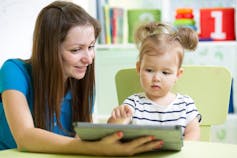
It’s easier for very young kids to go online now, because touchscreen technology requires less fine motor skills. Shutterstock

Touchscreen technologies have changed how accessible the internet is for very young children, particularly between the ages of four and five. It’s now quicker and easier to connect to the internet using these technologies, as they don’t require the same level of fine motor and literacy skills used to navigate a mouse and keyboard.

More recently, the Internet of Things has become widespread. The Internet of Things uses small chips embedded in everyday items, including children’s toys, to communicate information to the net. Children’s dolls, teddy bears and figurines can record their play and upload this information as data to the web. This can occur without children’s consent because they wouldn’t be aware they’re generating data.


Read more: Six things every consumer should know about the ‘Internet of Things’


The three main risks

Internet safety addresses three main risks faced by children online. These are contact, conduct and content risks:

  • contact risks involve children talking to unknown people on the internet. Contact risks also include the harvesting of children’s data, such as recording their activity on an online game
  • conduct risks are about behaving respectfully online and learning to manage digital footprints
  • content risks are concerned with the type of material children view and consume when accessing the internet.

For pre-school aged children, content risks include accidentally viewing inappropriate content such as pornography. Content also considers the quality of material made available to children. How people are represented in society is mirrored back to children through the media they consume. Quality content for young children has been a concern of the Australian Council on Children and the Media for many years.


Read more: The way your children watch YouTube is not that surprising – but it is a concern. Here are some tips


Contact risks are most likely to occur for pre-school aged children in the form of pop-ups. Children of this age can also be active in virtual worlds, such as Pocoyo World or Club Penguin, where they can engage with other members. Children may not always know the members they are playing with in these worlds.

Conduct involves learning how to be respectful online. Parents can model good conduct behaviours to their children by always asking permission to take photos before posting to social media.

Children as young as four are now online

Internet safety in early childhood is a new area of research because, until now, children as young as four weren’t able to easily access the internet.

A recent study conducted with 70 four-year old children examined what children understand about the internet and being safe online. In this study, only 40% of children were able to describe the internet. This was despite all of the children having access to internet at home, predominately through touchscreen technologies.

Children’s understandings of the internet were associated with their experiences going online and using technologies with their families. They defined the internet as being “in the iPad” or something they used “in the lounge room” to “play games”.

Children were also aware the internet “was used by Mummy for her work” or “by my big sister for her emails”. Some 73% of the children said they would tell someone their address on the internet. And 70% said they would also tell someone how old they were. A further 89% of children indicated they would click on a pop-up even if they did not know what the pop-up was about.


Parenting young children for internet safety

Because children face content, contact and conduct risks online, they require a basic understanding of the internet. The most important thing parents can teach their children about internet safety is that “the internet” means a network of technologies that can “talk” to each other.

This is like teaching children to be sun smart. First, we explain the sun can harm our skin. Next we teach children to wear a hat, a long-sleeved shirt and sunscreen to protect themselves.

For internet safety, we should first explain the internet uses many technologies that share information created and collected by lots of people. Then we can teach our children how to protect themselves online. Some things to teach your child are:

  • seek adult help when you encounter a pop-up
  • only use adult approved sources for content
  • don’t share personal information online
  • try to be near an adult when using a device
  • only click on apps and tabs a parent or caregiver has set up for you.

The internet forms a large part of daily life for many young children. From watching their favourite YouTube clips, to playing games, to talking with a long-distance relative over video-conferencing, being online is not much different to a young child than being offline. Being safe in both spaces is possible with adult support.

Fuente:https://theconversation.com/what-to-teach-your-preschooler-about-internet-safety-87618

Fuente imagen:

Comparte este contenido:

Canada: Record numbers of children are now homeschooled, but who’s keeping an eye on the parents?

Américadel Norte/Canada/ Diciembre del 2017/https://theconversation.com


Nearly 30,000 children in the UK were educated at home in the 2016 to 2017 academic year. This is an almost 100% increase from 2011 – when just over 15,000 pupils were classified as home taught.

I have four school age children. Tomorrow I could, without any forewarning and without notifying my local authority, withdraw them from school and educate them myself at home. My wife and my children would probably kill me. But, from a legal perspective, I would be acting within my rights.

This is because the UK has one of the lowest thresholds for the regulation and monitoring of home educators in Europe – anyone can choose to home educate and there is no requirement to inform local authorities. And local authorities are neither required to monitor who is home educating or how they are doing it.

In part, this is a consequence of ambiguous legislation such as the 1996 Education Act. This tasks parents with ensuring their children receive an education “suitable” to their age, ability and aptitude. It does not however, require school attendance.

The need for regulation

The Badman Review in 2009 and more recently Ofsted both identified “risks” associated with home education. The Badman review was instigated following the tragic death by starvation of a seven-year-old girl in Birmingham. Her mother claimed she was home educating and consequently was able to deny social workers access to her home.

Ofsted’s more recent interest in home education followed investigations into allegations that some schools in Birmingham were being hijacked by radical Muslim fundamentalists whose aim was to teach a narrow Islamocentric curriculum. This led to fears that some children were being taken out of mainstream education and instead sent to small unofficial schools that had been set up by “Islamic hardliners”.

Not all just fun and games. Shutterstock

Micheal Wilshaw, the then chief inspector of schools, wrote to the secretary of state for education describing his extreme concern for the safeguarding of Muslim home educated children.

Both Ofsted and the Badman Review recommended introducing a national register, greater monitoring regimes and more clearly defined roles for local authorities. But so far, none of their recommendations have been implemented.

The right kind of education

My previous research with Gypsy families also revealed concerns about some types of families being identified as problematic “home educators”, who are “putting their children at risk”. Many Gypsy families have traditionally chosen to home educate, and following the Badman Review, these families came under scrutiny, with suspicions they were “using” home education to avoid prosecution when their children did not attend school.

Similar negative responses to home schooling are often seen with poor families who choose to home educate – with claims they are putting their children at risk of neglect and abuse. These findings echo the sentiments and suggestions that many Muslim families use home education as a “cover” to radicalise their children into non British values.

But quite often while Muslims, Gypsies and poor families are identified as potential sources of “risk” in terms of home education, other families such as those from middle class backgrounds seem to be portrayed in a more positive light.

Many home-schooled children are often taught in local groups. Shutterstock

Newspapers are often full of “lifestyle” stories exploring the different choices made by middle class home educators. Typically these families are portrayed as sacrificing the material luxuries of their daily lives in favour of extended child-centric travelogues.

More recently, there was also sympathetic accounts of home education for children with special educational needs. Let down by failing, underfunded state schools parents were said to have been forced to make the difficult decision to home educate.

Parental choice

Our more recent research found that while there are many different types of home educators, a large majority of parents came to the decision to home school for similar reasons. Many ethnic minority families, including all the Muslim and Gypsy families we interviewed, described racism and bullying in schools as a significant factor in their decision. Families from lower socioeconomic backgrounds also described how letdown they felt by local schools.

In this way, we found that many home educators are simply parents who have actively made choices to help meet the needs of their children. But despite this, not all families who home educate are viewed positively. In this way, stereotypes of home educators distort both negative and positive accounts – home educators often seen as problematic not based on what they do, but rather on who they are.

This is where a national register of home educated children and the monitoring of their well-being would be a step in the right direction. This would not impose on parental choice, it would simply help to monitor what, can at times be, something of a grey area within the UK education system.

Ultimately, what all this shows is that for many families there is a real need for home education, because of problems with schooling, bullying or racism. And in this way, home education is not always a lifestyle choice. But even when it is, this decision should still be respected, because as our research shows, choosing home education is a difficult and challenging decision – but one that is often made with the best interests of the children in mind.

Fuente:https://theconversation.com/record-numbers-of-children-are-now-homeschooled-but-whos-keeping-an-eye-on-the-parents-88449

Fuente Imagen:https://lh3.googleusercontent.com/QtvQ7TFNeV_LIfWQNduiYkb6MZrplYp278NwrMvlehtmczTejrCtA2K8SANYJnhJ5Rfp=s85


Comparte este contenido:

Canada: El Ministerio de Educación finalmente establece un grupo de trabajo sobre educación obligatoria contra el genocidio

América del Norte/Canada/thesuburban.com/

En un momento de creciente radicalización y de menos respeto por las minorías, es más importante que nunca enseñar a nuestros jóvenes los peligros del prejuicio. Heidi Berger decidió hacer algo al respecto e inició la Fundación para la Educación Obligatoria del Genocidio. El problema y su iniciativa son tan importantes, especialmente en Quebec, donde la historia es solo una materia electiva en sec.v, que The Suburban decidió dedicar una cobertura completa a sus actividades. Personalmente, tuve el privilegio de participar en el trabajo de la Fundación para llegar a los funcionarios públicos en su nombre, participar en diálogos interconfesionales con Heidi en sinagogas y mezquitas y animar a la comunidad en general en eventos especiales.

No hay mejor manera de enseñarles a los jóvenes la responsabilidad de la decencia y la tolerancia que concienciarles sobre las consecuencias de la ignorancia y el odio. Como lo ha dicho Irwin Cotler con tanta frecuencia, «El Holocausto comenzó con palabras no con balas». Heidi basa sus presentaciones y programas en el trabajo de su difunta madre Ann Kazimierski, una maestra, educadora del Holocausto y autora de «Witness to Horror».

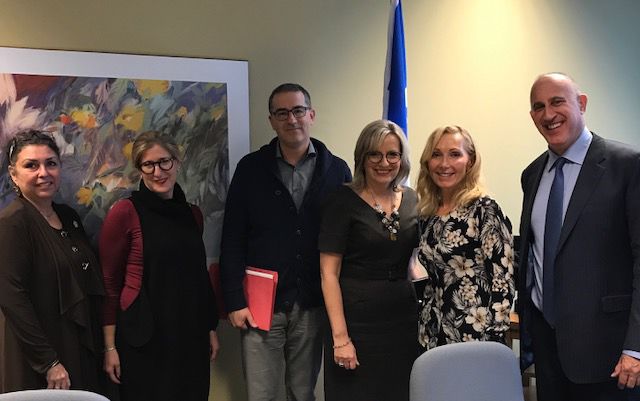
Por lo tanto, es muy gratificante informar que después de años de esfuerzos incansables, se produjo un gran avance con el gobierno de Quebec durante el mes pasado. En noviembre, Heidi y algunos de sus colegas, entre ellos Lucy Shapiro, Michael Flinker y Marcy Bruck, se reunieron con la viceministra adjunta de educación primaria y secundaria, Anne-Marie Lepage. También estuvieron presentes los burócratas departamentales, incluido el director de educación intercultural, Georges Lemieux.

La reunión fue un éxito rotundo. El ministerio ofreció asociarse con la Fundación para formar un comité de trabajo pedagógico para crear una colección de recursos y un manual para la formación docente. Tener al gobierno trabajando en esto hace que sea más probable que los maestros lo enseñen. Este fue un paso vital en la misión de la Fundación para la educación obligatoria sobre el genocidio. La Sra. Lepage estaba de acuerdo con los argumentos sobre la urgencia de que este tema se enseñara eficazmente como un medio para prevenir la radicalización y una mayor intolerancia en nuestra sociedad.

Varias semanas después de ese encuentro, la primera reunión del Comité sobre la Enseñanza del Genocidio se celebró en las oficinas del Ministerio de Educación en Montreal el 30 de noviembre. Fue presidido por Georges Lemieux y el comité incluye a miembros de la Fundación para la Educación contra el Genocidio, educadores del Holocausto del Museo del Holocausto de Montreal, académicos de las universidades de Quebec y maestros capacitados de las escuelas secundarias de toda la provincia.

El Comité organizó dos grupos de trabajo. Un grupo comenzará el trabajo crucial de identificar los mejores recursos disponibles sobre la historia del genocidio y los enfoques de enseñanza, para que puedan combinarse en una guía accesible. El otro grupo trabajará en el desarrollo y la programación de talleres para la formación de docentes. La próxima reunión tendrá lugar a principios del año nuevo con el objetivo de compilar la guía en junio de 2018. Después de tanto esfuerzo, el objetivo de la educación obligatoria sobre el genocidio puede convertirse pronto en realidad.

Fuente: http://www.thesuburban.com/news/city_news/education-ministry-finally-establishes-working-group-on-compulsory-genocide-education/article_8b0241f8-5565-5e38-bd24-60de95c5a04d.html

Comparte este contenido:

España: El Ministerio de Educación convoca cerca de 1.000 plazas para docentes en el exterior

España/11 de Diciembre de 2017/El Mundo

El Ministerio de Educación va a reforzar su acción educativa en el exterior con la publicación de tres convocatorias de puestos de trabajo para cerca de 1.000 plazas de docentes de todos los niveles educativos previos a la enseñanza universitaria y de Escuelas Oficiales de Idiomas.

El objetivo es «contar con docentes adecuados para trabajar en entornos educativos diferentes, deseosos de difundir la lengua y la cultura española en otros países a través de la educación y promover la interculturalidad y el plurilingüismo», ha informado en una nota el departamento que dirige Íñigo Méndez de Vigo.

La convocatoria más amplia es la de profesores visitantes en Estados UnidosCanadá Reino Unido, con 777 vacantes para maestros y profesores de Enseñanza Secundaria, sean funcionarios de carrera o no.

Por su parte, la red de centros y programas españoles del Ministerio de Educación en el extranjero necesita 181 funcionarios docentes de carrera para cubrir puestos en 16 países de los cinco continentes: AndorraArgentinaAlemaniaAustraliaBélgicaBrasilColombiaEstados UnidosFranciaIrlandaItaliaLuxemburgoMarruecosPortugalSuiza Reino Unido.

Los profesores seleccionados trabajarán en instituciones educativas variadas como centros españoles en el exterior, secciones en centros de otros Estados, Escuelas Europeas o Agrupaciones de Lengua y Cultura Españolas.

Asimismo, 25 profesores funcionarios de carrera de Enseñanza Secundaria o de Escuela Oficial de Idiomas tendrán la oportunidad de trabajar como asesores técnicos en el exterior, en 15 países tan diversos como Nueva ZelandaFilipinasRusia, o Brasil.

Los docentes que cumplan los requisitos necesarios para cada una de las

convocatorias, podrán participar en las mismas inscribiéndose en la sede electrónica del Ministerio de Educación. El plazo para presentación de solicitudes para Profesores Visitantes vence el 14 de diciembre y el de Docentes y Asesores en el Exterior el 21 de diciembre.

117 plazas de profesorado en la UNED

Además, el Gobierno ha autorizado a la Universidad Nacional de Educación a Distancia (UNED) a convocar la Oferta de Empleo Público de personal docente e investigador correspondiente a 2017 con un total de 117 plazas, de las que 70 son para profesor contratado doctor y 47 de profesor titular.

La validez de la autorización de esta oferta por parte del Consejo de Ministrosestá condicionada a que se apruebe en el Consejo de Gobierno de la UNED, que se reúne el próximo día 12, y a que posteriormente se publique en el BOE antes de que finalice el año, ha informado en una nota el Ministerio de Educación.

Esta oferta responde a los criterios de la Ley de Presupuestos Generales del Estado que fija hasta un máximo del 100% en la tasa de reposición de efectivos para cuerpos de catedráticos, profesores titulares de Universidad y contratados

doctores.

La Ley también obliga a cada universidad a reservar el 15% del total de plazas que oferte para personal investigador doctor que haya finalizado el Programa Ramón y Cajal con certificado I3.

Así, de las 47 plazas destinadas a profesor titular de Universidad, dos estarán ocupadas por investigadores de dicho programa y de las 70 plazas autorizadas en la categoría de profesor contratado doctor, la reserva será de 11 plazas.

La oferta de empleo público autorizada acumula la tasa correspondiente a las

lazas de personal administrativo a las de personal docente investigador, de tal forma que ésta se compone exclusivamente de profesorado.

Ello se justifica por la necesidad de la UNED de abordar la falta de docentes para la impartición de determinadas titulaciones de grado y máster cuya implantación comienza en este curso académico, así como de aquellas otras titulaciones con volúmenes elevados de estudiantes cuyos equipos docentes se han visto mermados por el elevado número de jubilaciones acaecidas desde 2016.

Fuente: http://www.elmundo.es/espana/2017/12/07/5a294561ca474154038b4636.html

Comparte este contenido:
Page 23 of 56
1 21 22 23 24 25 56