América del norte/Estados Unidos/26 Julio 2018/Fuente: El país
La carga financiera por la universidad obliga a los graduados a retrasar varios años inversiones como la compra de una vivienda
La generación Y, la que nació entre mediados de los años 1990 y comienzos del nuevo milenio, está hundida en deudas. El dato de la Reserva Federal sobre el estado de las finanzas familiares es preocupante. Cuatro de cada diez personas que terminaron los estudios universitarios debe devolver algún tipo de prestamos. El total acaba de superar los 1,5 billones de dólares (lo que los americanos llaman trillions, equivalentes a 1,27 billones de euros), una cantidad que supera la riqueza de una economía avanzada como la de España.
La deuda universitaria supera cómodamente los 1,1 billones de los créditos para la compra del automóvil. También la que se acumula en las tarjetas de crédito, que se acerca al billón. El problema, como muestran las estadísticas del banco central de Estados Unidos, es que estos préstamos se combinan. La deuda media de un graduado asciende así a los 28.400 dólares (unos 24.000 euros), según el The College Board. La cifra es mayor para los estudiantes que van a universidades privadas.
Las mujeres deben dos terceras partes del total, a partir de los cálculos que utilizan como base el informe de la Fed correspondiente al primer trimestre y otras instituciones. La American Association of University Women (AAUW), una organización que promueve la educación entre las adolescentes, explica que en parte se debe a que hay más mujeres matriculadas que los hombres. Representaban un 56% del total en 2016. También porque piden más prestado.
La brecha de género en la deuda estudiantil se explica a que una graduada debe de media 2.740 dólares más que un varón. Los datos también muestran que la devuelven más lentamente, lo que implica que acaban pagando más por los intereses. “Es un problema al que no se presta atención”, señala la AAUW, que lo achaca a que las mujeres tienen menos renta disponible para repagar.
El coste medio de la matrícula en un centro público es de 14.210 dólares si el estudiante se queda en su mismo estado. Esa cifra se eleva a 20.090 dólares cuando se incluye el gasto de dormitorio. La diferencia también se explica por las becas disponibles en función del origen del graduado. Los precios suben más rápido que la inflación, a un ritmo superior al 10% en los últimos cinco años.
Retrasos en los pagos
Hay más de 44 millones de estadounidenses que arrastran algún tipo de deuda desde los estudios. El volumen total crece a un ritmo de vértigo. Hace diez años rondaba los 640.000 millones. Se duplicó en 2012 y los factores que impulsan esta escalada no van a desaparecer con la Fed subiendo tipos, hasta el punto de que los expertos ven una burbuja como la hipotecaria de 2008.
El pago mensual medio del crédito se acerca a los 400 dólares, estima la Fed. En términos generales, el 20% va con retraso. Los que tienen más problemas son los que optaron por no terminar sus estudios. Esta carga, a su vez, amenaza con retrasar inversiones para el futuro, como la compra de una vivienda. El índice de propiedad en el 21%, frente al 32% antes de la recesión.
El salario medio para los nuevos graduados ronda los 50.000 dólares, según un estudio de la firma Korn Ferry. Es un 14% más que para la clase que terminó antes de la recesión. Pero como señala la National Association of Realtors, se está retrasando siete años la compra de la vivienda por la deuda. En paralelo, indica la Fed, se elevó en un 45% los jóvenes que se quedan en casa de sus padres.
Aliviar la deuda
El alza de las matrículas, el estancamiento de los salarios y el recorte de las inversiones públicas en la educación superior provocan que las familias estadounidenses sean más dependientes de los créditos. La American Student Assistance añade que esta situación provoca que muchos opten por retrasar su formación. Por eso piden a los legisladores que rebajen la carga a los estudiantes.
El Institute for Higher Education Policy señala que esta escala del endeudamiento representa un fracaso a la hora de afrontar la desigualdad que domina en el sistema educativo en EE UU. Un cambio legislativo que permita aliviar la situación cancelado parte de la deuda, según cálculos del Levy Economics Institute, aportará cerca de 100.000 millones al crecimiento económico cada año.
The New Orleans turnaround shows the power of giving more freedom to teachers and principals — and then holding them accountable for their performance
Twelve years later, Nigel Palmer still remembers the embarrassment of his first days as a fourth grader in Monroe, La. He was a Hurricane Katrina evacuee from New Orleans, living with his family in a La Quinta Inn, 250 miles from home. As soon as the school year began, he could tell that the kids in his new school seemed different from him.
They could divide numbers. He really couldn’t. They knew the 50 states. He didn’t. “I wasn’t up to par,” he quietly told me. It’s a miserable feeling.
Until the storm, Palmer had been attending New Orleans public schools, which were among the country’s worst. The high-school graduation rate was 54 percent, and some students who did graduate had shockingly weak academic skills.
After Katrina’s devastation, New Orleans embarked on the most ambitious education overhaul in modern America. The state of Louisiana took over the system in 2005, abolished the old bureaucracy and closed nearly every school. Rather than running schools itself, the state became an overseer, hiring independent operators of public schools — that is, charter schools — and tracking their performance.
Dominique Newton was the 2016 valedictorian of G.W. Carver High School. But she initially struggled in college, at Xavier, while also helping care for her father, who is on dialysis. She now is doing better, and majoring in political science.CreditWilliam Widmer for The New York Times
This month, the New Orleans overhaul entered a new stage. On July 1, the state returned control of all schools to the city. The charter schools remain. But a locally elected school board, accountable to the city’s residents, is now in charge. It’s a time when people in New Orleans are reflecting on what the overhaul has, and has not, accomplished.
So I decided to visit and talk with students, teachers, principals, community leaders and researchers. And I was struck by how clear of a picture emerged. It’s still a nuanced picture, with both positives and negatives. But there are big lessons.
New Orleans is a great case study partly because it avoids many of the ambiguities of other education reform efforts. The charters here educate almost all public-school students, so they can’t cherry pick. And the students are overwhelmingly black and low-income — even lower-income than before Katrina — so gentrification isn’t a factor.
Performance on every kind of standardized test has surged. Before the storm, New Orleans students scored far below the Louisiana average on reading, math, science and social studies. Today, they hover near the state average, despite living amid much more poverty. Nationally, the average New Orleans student has moved to the 37th percentile of math and reading scores, from the 22nd percentile pre-Katrina.
This week, Douglas Harris — a Tulane economist who leads a rigorous research project on the schools — is releasing a new study, with Matthew Larsen, another economist. It shows that the test-score gains are translating into real changes in students’ lives. High-school graduation, college attendance and college graduation have all risen.
Jewel Dauphin, a 2017 Carver graduate, now attends Opportunities Academy, a program that teaches life skills. He also does work as an advocate pushing the city to improve transportation options for people with disabilities. CreditWilliam Widmer for The New York Times
One example: In most of Louisiana, the share of 12th graders going directly to college has fallen in recent years, probably because of budget cuts to higher education. In New Orleans, Harris and Larsen report, the share has jumped to 32.8 percent, from 22.5 percent before Katrina.
People here point to two main forces driving the progress: Autonomy and accountability.
In other school districts, teachers and principals are subject to a thicket of rules, imposed by a central bureaucracy. In New Orleans, schools have far more control. They decide which extracurriculars to offer and what food to serve. Principals choose their teachers — and can let go of weak ones. Teachers, working together, often choose thei
r curriculum.
“It puts decisions really close to the school site and the students,” Towana Pierre-Floyd, the principal of KIPP Renaissance High School, told me. Victor Jones, an English teacher at G.W. Carver High School, says, “We don’t have to wait to make changes when we know changes need to be made.”
Jones and his colleagues recently decided that their ninth graders needed more writing practice than they were getting from their literature-heavy curriculum. But the teachers still wanted to expose the students to great books. So they combined two curriculum plans to get the right mix, cutting down on novels without eliminating them. The students now read “Lord of the Flies,” “Romeo and Juliet,” “Parable of the Sower,” Ray Bradbury short stories and journalism about terrorism, among other things, and also do more writing than they used to.
Crucially, all of this autonomy comes with accountability: Schools must show their approach is working. They are evaluated based on test scores, including ACT and Advanced Placement, and graduation rate — with an emphasis on the trend lines. Schools that fail to make progress can lose their contract.
Over the past decade, the district has replaced the operators of more than 40 schools in response to poor performance. “You have to meet these minimum standards to continue to have the privilege of educating kids,” Patrick Dobard, the superintendent until last year, told me. Harris’s research has found that much of the city’s progress has stemmed from closing the worst charter schools and letting successful charters expand.
Think about how different this is from the norm in American education. In most districts, a single entity — a board of education — is responsible for both running schools and evaluating them. That combination is not a recipe for rigorous evaluation and consequences. It’s akin to letting students grade themselves.
Obviously, very few districts elsewhere are going to replicate the New Orleans model and start from scratch. But most would benefit from introducing both more freedom and more accountability. Together, the two spark human ingenuity.
For all of the improvement here, the schools still have their troubles. The academic results still trail those in less impoverished districts, and progress has slowed lately. “We’re not where we want to be,” Rhonda Dale, the principal of Abramson Sci Academy, said. Some residents told me they hoped that the new local control could accelerate academic progress – while also making the school system feel like more a local institution and less like one imposed on the city. My column next week will focus on these challenges.
Yet even with the caveats, it would be a terrible mistake to let the imperfections obscure the progress here. The city’s residents certainly recognize that progress. In a recent poll by Tulane’s Cowen Institute, 70 percent of public-school parents said the charter schools had improved education.
And what ended up happening to Nigel Palmer? In seventh grade, he moved back to New Orleans, a stronger student than when he left. Fortunately, the city’s schools had improved too. His high school, KIPP Renaissance, was “a fun, competitive environment — people wanted a high G.P.A.,” he said. “School was cool.”
This spring, he graduated from Xavier University, a historically black Catholic college here, and he recently started his first job — as a middle-school social studies teacher in New Orleans.
Source of the article: https://www.nytimes.com/2018/07/15/opinion/columnists/new-orleans-charter-schools-education-reform.html
Hay pocos estudios referentes al impacto de los recursos educativos abiertos, y parece que su importancia se empequeñece a la simple reducción del costo de materiales escolares. Aunado a lo anterior, estos recursos, por ejemplo los libros electrónicos gratuitos, se perciben como de baja calidad y grandes repositorios de información pasan desapercibidos.
La Universidad de Georgia, EE. UU., realizó un estudio a gran escala en el que reveló el potencial de los recursos abiertos. Para ello, los investigadores compararon el desempeño académico de 11,681 estudiantes de programas tradicionales con libros de texto comerciales, frente a 10,141 alumnos en cursos con libros digitales gratuitos.
El análisis de datos recolectados en un periodo de seis años arrojó que el grupo de estudiantes con libros gratuitos obtuvo mejores resultados. Se evidenció que, si todos los estudiantes comienzan los cursos con los materiales necesarios, el rendimiento de aprendizaje mejora de forma significativa.
De acuerdo al sistema de calificación estadounidense, que utiliza letras para evaluar, el 42,52% de encuestados que estudiaron con libros gratuitos obtuvieron A y A-, a comparación del 29,29% que estudió con libros comerciales. A su vez, la tasa de estudiantes que desertó o que recibió calificaciones reprobatorias fue 2,68% menor en los que usaron libros gratuitos.
A muchos estudiantes les resulta imposible hacer gastos elevados en materiales educativos. En ocasiones cursan los programas sin el apoyo de textos comerciales o en el peor de los casos abandonan la universidad por los elevados costos.
Los académicos que efectuaron la investigación sugieren que los recursos educativos abiertos no sólo aminoran el gasto que representa cursar una carrera universitaria, además, pueden apoyar a mejorar rendimiento académico y bajar las tasas de deserción.
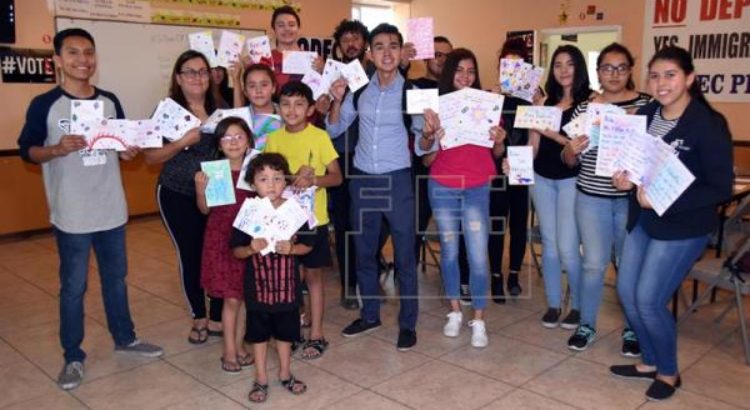
Jóvenes centroamericanos que llegaron a Estados Unidos como indocumentados y permanecieron en albergues o centros de detención lideran ahora una iniciativa para escribir cartas llenas de «esperanza» y «palabras con cariño» a niños inmigrantes que actualmente están detenidos por el Gobierno Trump.
«Si yo hubiera tenido alguien afuera orando por mí o pensando en mí, esto (una carta) hubiera sido una gran diferencia», le comentaron algunos centroamericanos que fueron detenidos a Luz Gallegos, de la organización Formación para el Desarrollo Ocupacional de las Comunidades Educativas (TODEC).
This first roundtable in the series What Education Do We Need? comprises two parts. Part one features a lead essay by Henry A. Giroux titled “Educated Hope in Dark Times: The Challenge of the Educator/Artist as a Public Intellectual”; the second part includes four responses by thinkers from different backgrounds: Nicolas Buchoud and Lan-Phuong Phan (France and Vietnam), Yaacov Hecht (Israel), Thomas Krüger (Germany), and Helena Singer (Brazil).
Education impacts everything else and makes us who we are as individuals, communities, and society. Exclusion in education impoverishes the human mind and diminishes humanity. To quote Comenius, the father of modern education: “The school is the manufactory of humanity… the whole is not the whole if any part is lacking… whoever then does not wish to appear a half-wit or evil-minded, must wish good to all men, and not only to himself, or only to his own near ones, or only to his own nation.”
While we have deemed those tenets self-evident, various leaders and movements have recently emerged who wish good firstly to themselves, or only to their near ones, or only to their own nation. The first roundtable on Democracy and Education opens with Henry Giroux’s essay, in which he addresses this particular challenge personified by the presidency of Donald Trump.
Trump’s presence in American politics has made visible a plague of deep seated civic illiteracy, a corrupt political system, and a contempt for reason; it also points to the withering of civic attachments, the collapse of politics into the spectacle of celebrity culture, the decline of public life, the use of violence and fear to numb people into shock, and a willingness to transform politics into a pathology.
Giroux situates Trump’s presidency in a broader socio-political context of neoliberal ideology that has instrumentalized education and art by turning them into commodity. He emphasizes the necessity of reclaiming the primary mission of pedagogy as a political and moral practice, as educated hope that provides a counterweight and resistance to a growing authoritarianism.
Pedagogy is not a method but a moral and political practice, one that recognizes the relationship between knowledge and power, and at the same time realizes that central to all pedagogical practices is a struggle over agency, power, politics, and the formative cultures that make a radical democracy possible. This view of pedagogy does not mold, but inspires, and at the same time it is directive, capable of imagining a better world, the unfinished nature of agency, and the need to consistently reimagine a democracy that is never finished.
In its closing section, Giroux is challenging artists and educators to engage in a practice thataddresses the possibility of interpretation as intervention in the world. He demands to reposition “pedagogy as a central category of politics itself,” and hence defines the artist and educator as a public intellectual who understands pedagogy as central to politics. He points out that when progressive artists and activists present “what might be called a barrage of demystifying facts and an aesthetics of transgression,” they fail to address the crises of imagination and agency. In the last paragraph, Giroux outlines a series of tasks that educators and artists as public intellectuals face today:
Pressing the claim for economic and political justice means working hard to develop alternative modes of consciousness, promote the proliferation of democratic public spheres, create the conditions for modes of mass resistance, and make the development of sustainable social movements central to any viable struggle for economic, political, and social justice. No viable democracy can exist without citizens who value and are willing to work towards the common good. That is as much a pedagogical question as it is a political challenge.
Increasingly, neoliberal regimes across Europe and North America have waged a major assault on critical pedagogy, public pedagogy, and the public spheres in which they take place. For instance, public and higher education are being defunded, turned into accountability factories, and now largely serve as adjuncts of an instrumental logic that mimics the values of the market. But, of course, this is not only true for spaces in which formal schooling takes place, it is also true for those public spheres and cultural apparatuses actively engaged in producing knowledge, values, subjectivities, and identities through a range of media and sites. This applies to a range of creative spaces including art galleries, museums, diverse sites that make up screen culture, and various elements of mainstream media.[1] What the apostles of neoliberalism have learned is that artistic production and its modes of public pedagogy can change how people view the world, and that pedagogy can be dangerous because it holds the potential for not only creating critically engaged students, intellectuals, and artists but can strengthen and expand the capacity of the imagination to think otherwise in order to act otherwise, hold power accountable, and imagine the unimaginable.
Pedagogies of repression…further a modern-day pandemic of loneliness and alienation.
Reclaiming pedagogy as a form of educated and militant hope begins with the crucial recognition that education is not solely about job training and the production of ethically challenged entrepreneurial subjects and that artistic production does not only have to serve market interests, but are also about matters of civic engagement and literacy, critical thinking, and the capacity for democratic agency, action, and change. It is also inextricably connected to the related issues of power, inclusion, and social responsibility.[2] If young people, artists, and other cultural workers are to develop a deep respect for others, a keen sense of the common good, as well as an informed notion of community engagement, pedagogy must be viewed as a cultural, political, and moral force that provides the knowledge, values, and social relations to make such democratic practices possible. In this instance, pedagogy needs to be rigorous, self-reflective, and committed not to the dead zone of instrumental rationality but to the practice of freedom and liberation for the most vulnerable and oppressed, to a critical sensibility capable of advancing the parameters of knowledge, addressing crucial social issues, and connecting private troubles into public issues. Any viable notion of critical pedagogy must overcome the image of education as purely instrumental, as dead zones of the imagination, and sites of oppressive discipline and imposed conformity.
Pedagogies of repression do more than impose punishing forms of discipline on students and deaden their ability to think critically, they also further a modern-day pandemic of loneliness and alienation. Such pedagogies emphasize aggressive competition, unchecked individualism, and cancel out empathy for an exaggerated notion of self-interest. Solidarity and sharing are the enemy of these pedagogical practices, which are driven by a withdrawal from sustaining public values, trust, and goods and serve largely to cancel out a democratic future for young people. This poses a particular challenge for educators and other cultural workers who want to take up the role of engaged public intellectuals because it speaks less to the role of the intellectual as a celebrity than it does to the kind of pedagogical work in which they engage.
At stake here is the need for artists, educators, and others to create pedagogical practices that create militant dreamers, people capable of envisioning a more just and democratic world and are willing to struggle for it. In this instance, pedagogy becomes not only central to politics but also a practice dedicated to creating a sense of belonging, community, empathy, and practices that address changing the way people think and navigate conflicts emotionally—practices that awaken passion and energize forms of identification that speak to the conditions in which people find themselves. In the shark-like world of neoliberal-driven values, excessive competition, uncertainty, and deep-seated fears of the other, there is no room for empathetic conversations that focus on the common good, democratic values, or the pedagogical conditions that would further critical dialogue and the potential for students to learn how to hold power accountable.
Critical pedagogy…should be cosmopolitan and imaginative…
Domination is at its most powerful when its mechanisms of control and subjugation hide in the discourses of common sense, and its elements of power are made to appear invisible. Public intellectuals can take up the challenge of not only relating their specialties and modes of cultural production to the intricacies of everyday life but also to rethinking how politics works, and how power is central to such a task. Bruce Robbins articulates the challenge well in both his defense of the intellectual and his reference to how other theorists such as Michel Foucault provide a model for such work. He writes:
But I also thought that intellectuals should be trying, like Foucault, to relate our specialized knowledge to things in general. We could not just become activists focused on particular struggles or editors striving to help little magazines make ends meet. We also had a different kind of role to play: thinking hard, as Foucault did, about how best to understand the ways power worked in our time. Foucault, like Sartre and Sontag and Said, was an intellectual, even at some points despite himself. He helped us understand the world in newly critical and imaginative ways. He offered us new lines of reasoning while also engaging in activism and political position-taking. Why, then, is there so much discomfort with using the term “intellectual” as an honorific?[3]
But power is not just a theoretical abstraction, it shapes the spaces in which everyday life takes place and touches peoples’ lives at multiple registers, all of which represent in part a struggle over their identities, values, and views of others and the larger world. Critical pedagogy must be meaningful in order to be critical and transformative. That is, it should be cosmopolitan and imaginative—a public affirming pedagogy that demands a critical and engaged interaction with the world we live in, mediated by a responsibility for challenging structures of domination and for alleviating human suffering. This is a pedagogy that addresses the needs of multiple publics. As an ethical and political practice, a public pedagogy of wakefulness rejects modes of education removed from political or social concerns, divorced from history and matters of injury and injustice. This is a pedagogy that includes “lifting complex ideas into the public space,” recognizing human injury inside and outside of the academy and using theory as a form of criticism to change things.[4] This is a pedagogy in which artists, educators, and other cultural workers are neither afraid of controversy nor a willingness to make connections between private issues and broader elements of society’s problems that are otherwise hidden. Nor are they afraid of using their work to address the challenges of the day.
As the practice of freedom, critical pedagogy arises from the conviction that artists, educators and other cultural workers have a responsibility to unsettle power, trouble consensus, and challenge common sense. This is a view of pedagogy that should disturb, inspire, and energize a vast array of individuals and publics. Critical pedagogy comes with the responsibility to view intellectual and artistic work as public, assuming a duty to enter into the public sphere unafraid to take positions and generate controversy, functioning as moral witnesses, raising political awareness, making connections to those elements of power and politics often hidden from public view, and reminding “the audience of the moral questions that may be hidden in the clamor and din of the public debate.”[5]
…our responsibilities as cultural workers cannot be separated from the consequences of the knowledge we produce, the social relations we legitimate, and the ideologies and identities we offer…
Pedagogy is not a method but a moral and political practice, one that recognizes the relationship between knowledge and power, and at the same time realizes that central to all pedagogical practices is a struggle over agency, power, politics, and the formative cultures that make a radical democracy possible. This view of pedagogy does not mould, but inspires, and at the same time it is directive, capable of imagining a better world, the unfinished nature of agency, and the need to consistently reimagine a democracy that is never finished. In this sense, critical pedagogy is a form of educated hope committed to producing young people capable and willing to expand and deepen their sense of themselves, to think the “world” critically, “to imagine something other than their own well-being,” to serve the public good, take risks, and struggle for a substantive democracy that is now in a state of acute crisis as the dark clouds of totalitarianism are increasingly threatening to destroy democracy itself on a global scale.[6]
Pedagogy is always the outcome of struggles, especially in terms of how pedagogical practices produce particular notions of citizenship and an inclusive democracy. Pedagogy looms large in this instance not as a technique or a prioriset of methods but as a political and moral practice. As a political practice, pedagogy illuminates the relationship among power, knowledge, and ideology, while self-consciously, if not self-critically, recognizing the role it plays as a deliberate attempt to influence how and what knowledge and identities are produced within particular sets of social relations. As a moral practice, pedagogy recognizes that what cultural workers, artists, activists, media workers and others teach cannot be abstracted from what it means to invest in public life, presuppose some notion of the future, or locate oneself in a public discourse.
The moral implications of pedagogy also suggest that our responsibilities as cultural workers cannot be separated from the consequences of the knowledge we produce, the social relations we legitimate, and the ideologies and identities we offer up to students. Refusing to decouple politics from pedagogy means, in part, that teaching in classrooms or in any other public sphere should not only simply honor the experiences people bring to such sites, including the classroom, but should also connect their experiences to specific problems that emanate from the material contexts of their everyday life. Pedagogy in this sense becomes performative in that it is not merely about deconstructing texts but about situating politics itself within a broader set of relations that addresses what it might mean to create modes of individual and social agency that enables rather than shuts down democratic values, practices, and social relations. Such a project recognizes not only the political nature of pedagogy, but also situates it within a call for artists, intellectuals, and others to assume responsibility for their actions, to link their teachings to those moral principles that allow us to do something about human suffering, as Susan Sontag once suggested.[7] Part of this task necessitates that cultural workers anchor their own work, however diverse, in a radical project that seriously engages the promise of an unrealized democracy against its really existing and radically incomplete forms. Of crucial importance to such a project is rejecting the assumption that theory can understand social problems without contesting their appearance in public life. Yet, any viable cultural politics needs a socially committed notion of injustice if we are to take seriously what it means to fight for the idea of good society. I think Zygmunt Bauman is right in arguing that “If there is no room for the idea of wrong society, there is hardly much chance for the idea of good society to be born, let alone make waves.”[8]
“left intellectuals must recognize that the most important forms of domination are not only economic but also intellectual and pedagogical, and lie on the side of belief and persuasion.”
Artists and other cultural workers should consider being more forceful, if not committed, to linking their overall politics to modes of critique and collective action that address the presupposition that democratic societies are never too just or just enough, and such a recognition means that a society must constantly nurture the possibilities for self-critique, collective agency, and forms of citizenship in which people play a fundamental role in critically discussing, administrating and shaping the material relations of power and ideological forces that bear down on their everyday lives. At stake here is the task, as Jacques Derrida insists, of viewing the project of democracy as a promise, a possibility rooted in an ongoing struggle for economic, cultural, and social justice.[9] Democracy in this instance is not a sutured or formalistic regime, it is the site of struggle itself. The struggle over creating an inclusive and just democracy can take many forms, offers no political guarantees, and provides an important normative dimension to politics as an ongoing process of democratization that never ends. Such a project is based on the realization that a democracy that is open to exchange, question, and self-criticism never reaches the limits of justice.
Theorists such as Raymond Williams and Cornelius Castoriadis recognized that the crisis of democracy was not only about the crisis of culture but also the crisis of pedagogy and education. Cultural workers would do well to take account of the profound transformations taking place in the public sphere and reclaim pedagogy as a central category of politics itself. Pierre Bourdieu was right when he stated that cultural workers have too often “underestimated the symbolic and pedagogical dimensions of struggle and have not always forged appropriate weapons to fight on this front.”[10] He goes on to say in a later conversation with Gunter Grass that “left intellectuals must recognize that the most important forms of domination are not only economic but also intellectual and pedagogical, and lie on the side of belief and persuasion. Important to recognize that intellectuals bear an enormous responsibility for challenging this form of domination.”[11] These are important pedagogical interventions and imply rightly that critical pedagogy in the broadest sense is not just about understanding, however critical, but also provides the conditions, ideals, and practices necessary for assuming the responsibilities we have as citizens to expose human misery and to eliminate the conditions that produce it. Matters of responsibility, social action, and political intervention do not simply develop out of social critique but also forms of self-critique. The relationship between knowledge and power, on the one hand, and creativity and politics, on the other, should always be self-reflexive about its effects, how it relates to the larger world, whether or not it is open to new understandings, and what it might mean pedagogically to take seriously matters of individual and social responsibility. In short, this project points to the need for cultural workers to address critical pedagogy not only as a mode of educated hope and a crucial element of an insurrectional educational project, but also as a practice that addresses the possibility of interpretation as intervention in the world.
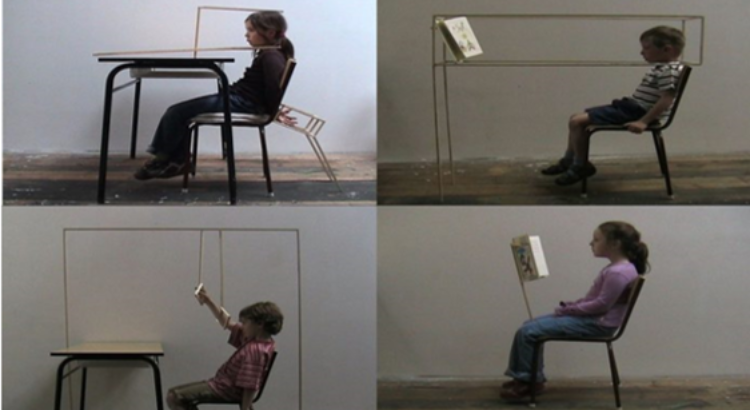
Graziela Kunsch, Escolas [Schools], 2016. Video, 3:45, 1920 x 1080, 16:9, NTSC, color, no sound. Courtesy of the artist and featured in the exhibition, Back to the Sandbox: Art and Radical Pedagogy at the Western Gallery, Western Washington University, Bellingham, WA.
Critical pedagogy can neither be reduced to a method nor is it non-directive in the manner of a spontaneous conversation with friends over coffee. As public intellectuals, authority must be reconfigured not as a way to stifle the curiosity and deaden the imagination, but as a platform that provided the conditions for students to learn the knowledge, skills, values, and social relationships that enhance their capacities to assume authority over the forces that shape their lives both in and out of schools. Power and authority are always related, but such a relationship must never operate in the service of domination or the stifling of autonomy but in the service of what I have called the practice of freedom. The notion that authority is always on the side of repression and that pedagogy should never be directive is for all practical purposes a political and theoretical flight from the educator assuming a sense of moral and political responsibility. For artists and educators to be voiceless, renounce the knowledge that gives them a sense of authority, and to assume that a wider public does not need to be exposed to modes of knowledge, histories, and values outside of their immediate experience is to forget that pedagogy is always about the struggle over knowledge, desire, identity, values, agency, and a vision of the future. Critical pedagogy for public intellectuals must always be attentive to addressing the democratic potential of engaging how experience, knowledge, and power are shaped in the classroom in different and often unequal contexts, and how teacher authority might be mobilized against dominant pedagogical practices as part of the practice of freedom, particularly those practices that erase any trace of subaltern histories, historical legacies of class struggles, and the ever persistent historical traces and current structures of racial and gender inequalities and injustices. In this sense, teacher authority must be linked both to a never-ending sense of historical memory, existing inequities, and a “hopeful version of democracy where the outcome is a more just, equitable society that works toward the end of oppression and suffering of all.”[12] As I have said elsewhere:
Authority in this perspective is not simply on the side of oppression, but is used to intervene and shape the space of teaching and learning to provide students with a range of possibilities for challenging a society’s commonsense assumptions, and for analyzing the interface between their own everyday lives and those broader social formations that bear down on them. Authority, at best, becomes both a referent for legitimating a commitment to a particular vision of pedagogy and a critical referent for a kind of autocritique.[13]
Any viable understanding of the artist and educator as a public intellectual must begin with the recognition that democracy begins to fail and civic life becomes impoverished when pedagogy is no longer viewed as central to politics. This is clearly the case as made visible in the election of Donald Trump to the presidency. Trump’s claim that he loves the uneducated appears to have paid off for him just as his victory makes clear that ignorance rather than reason, emotion rather than informed judgment, and the threat of violence rather than critical exchange appear to have more currency in the age of Trump. In part, this political tragedy signifies the failure of the American public to recognize the educative nature of how agency is constructed, to address the necessity for moral witnessing, and the need to create a formative culture that produces critically engaged and socially responsible citizens. Such a failure empties democracy of any meaning. Such actions represent more than a flight from political and social responsibility; they also represent a surrender to the dark forces of authoritarianism. Democracy should be a way of thinking about education in a variety of spheres and practices, one that thrives on connecting equity to excellence, learning to ethics, and agency to the imperatives of the public good.[14] The question regarding what role education and pedagogy should play in democracy becomes all the more urgent at a time when the dark forces of authoritarianism are on the march all over the globe. Public values, trust, solidarities, and modes of education are under siege. As such, the discourses of hate, humiliation, rabid self-interest, and greed are exercising a poisonous influence in many Western societies. This is most evident at the present moment in the discourse of the right-wing extremists vying to consolidate their authority within a Trump presidency, all of whom sanction a war on immigrants, women, young people, poor Black youth, and so it goes. Under such circumstances, democracy is on life support. Yet rather than being a rationale for cynicism, radical democracy as both a pedagogical project and unfinished ideal should create an individual and collective sense of moral and political outrage, a new understanding of politics, and the pedagogical projects needed to allow democracy to breathe once again.
If the authoritarianism of the Trump era is to be challenged, it must begin with a politics that is comprehensive in its attempts to understand the intersectionality of diverse forces of oppression and resistance.
Trump’s presence in American politics has made visible a plague of deep-seated civic illiteracy, a corrupt political system, and a contempt for reason; it also points to the withering of civic attachments, the collapse of politics into the spectacle of celebrity culture, the decline of public life, the use of violence and fear to numb people into shock, and a willingness to transform politics into a pathology. Trump’s administration will produce a great deal of violence in American society, particularly among the ranks of the most vulnerable: poor children, minorities of colour, immigrants, women, climate change advocates, Muslims, and those protesting a Trump presidency. What must be made clear is that Trump’s election and the damage he will do to American society will stay and fester for quite some time because he is only symptomatic of the darker forces that have been smoldering in American politics for the last 40 years. What cannot be exaggerated or easily dismissed is that Trump is the end result of a longstanding series of attacks on democracy and that his presence in the American political landscape has put democracy on trial. This is a challenge that artists, educators, and others must address. While mass civil demonstrations have and continue to erupt over Trump’s election, what is more crucial to understand is that something more serious needs to be addressed. We have to acknowledge that at this particular moment in American history the real issue is not simply about resisting Donald Trump’s insidious values and anti-democratic policies but whether a political system can be reclaimed in which democracy is not on trial but is deepened, strengthened and sustained. This will not happen unless new modes of representation challenge the aesthetics, culture, and discourse of neo-fascism. Yet, under a Trump presidency, it will be more difficult to sustain, construct, and nurture those public spheres that sustain critique, informed dialogue, and a work to expand the radical imagination. If democracy is to prevail in and through the threat of “dark times,” it is crucial that the avenues of critique and possibility become central to any new understanding of politics. If the authoritarianism of the Trump era is to be challenged, it must begin with a politics that is comprehensive in its attempts to understand the intersectionality of diverse forces of oppression and resistance. That is, on the one hand, it must move towards developing analyses that address the existing state of authoritarianism through a totalizing lens that brings together the diverse registers of oppression and how they are both connected and mutually reinforce each other. On the other hand, such a politics must, as Robin D.G. Kelley has noted, “move beyond stopgap alliances”[15] and work to unite single issue movements into a more comprehensive and broad-based social movement that can make a viable claim to a resistance that is as integrated as it is powerful. For too long progressive cultural workers and activists have adhered to a narrative about domination that relies mostly on remaking economic structures and presenting to the public what might be called a barrage of demystifying facts and an aesthetics of transgression. What they have ignored is that people also internalize oppression and that domination is about not only the crisis of economics, images that deaden the imagination, and the misrepresentation of reality, but also about the crisis of agency, identification, meaning, and desire.
The crisis of economics and politics in the Trump era has not been matched by a crisis of consciousness and agency. The failure to develop a crisis of consciousness is deeply rooted in a society in that suffers from a plague of atomization, loneliness, and despair. Neoliberalism has undermined any democratic understanding of freedom, limiting its meaning to the dictates of consumerism, hatred of government, and a politics in which the personal is the only emotional referent that matters. Freedom has collapsed into the dark abyss of a vapid and unchecked individualism and in doing so has cancelled out that capacious notion of freedom rooted in bonds of solidarity, compassion, social responsibility, and the bonds of social obligations. The toxic neoliberal combination of unchecked economic growth and its discourse of plundering the earth’s resources, coupled with a rabid individualism marked largely by its pathological disdain for community and public values, has weakened democratic pressures, values, and social relations and opened the door for the election of Donald Trump to the American Presidency. This collapse of democratic politics points to an absence in progressive movements and among various types of public intellectuals about how to address the importance of emotional connections among the masses, take seriously how to connect with others through pedagogical tools that demand respect, empathy, a willingness to listen to other stories, and to think seriously about how to change consciousness as an educative task. The latter is particularly important because it speaks to the necessity politically address the challenge of awakening modes of identification coupled with the use of language not merely to demystify but to persuade people that the issues that matter have something to do with their lived realities and daily lives. Pressing the claim for economic and political justice means working hard to develop alternative modes of consciousness, promote the proliferation of democratic public spheres, create the conditions for modes of mass resistance, and make the development of sustainable social movements central to any viable struggle for economic, political, and social justice. No viable democracy can exist without citizens who value and are willing to work towards the common good. That is as much a pedagogical question as it is a political challenge.
[1] Henry A. Giroux, On Critical Pedagogy (New York: Bloomsbury, 2011).
[2] On this issue, see Henry A. Giroux, Neoliberalism’s War on Higher Education(Chicago: Haymarket Press, 2014); Susan Searls Giroux, “On the Civic Function of Intellectuals Today,” in Gary Olson and Lynn Worsham, eds. Education as Civic Engagement: Toward a More Democratic Society (Boulder: Paradigm Publishers, 2012), pp. ix-xvii.
[4] Edward Said, Out of Place: A Memoir (New York: Vintage, 2000) p. 7.
[5] Edward Said, “On Defiance and Taking Positions,” Reflections On Exile and Other Essays (Cambridge: Harvard University Press, 2001), p. 504.
[6] See, especially, Christopher Newfield, Unmaking the Public University: The Forty-Year Assault on the Middle Class (Cambridge: Harvard University Press, 2008).
[7] Susan Sontag, “Courage and Resistance,” The Nation (May 5, 2003), pp. 11-14.
[8] Zygmunt Bauman, Society under Siege (Malden, MA: Blackwell: 2002), p. 170.
[9] Jacques Derrida, “Intellectual Courage: An Interview,” trans. Peter Krapp, Culture Machine, Volume 2 (2000), pp. 1-15.
[10] Pierre Bourdieu, Acts of Resistance (New York: Free Press, 1998), p. 11.
[11] Pierre Bourdieu and Gunter Grass, “The ‘Progressive’ Restoration: A Franco-German Dialogue,” New Left Review 14 (March-April, 2002), P. 2
[12] Richard Voelz, “Reconsidering the Image of Preacher-Teacher: Intersections between Henry Giroux’s Critical Pedagogy and Homiletics,” Practical Matters (Spring 2014), p. 79.
[13] Henry A. Giroux, On Critical Pedagogy (New York: Continuum, 2011) p.81.
[14] Henry A. Giroux, Dangerous Thinking in the Age of the New Authoritarianism(New York: Routledge, 2015).
[15] Robin D. G. Kelley, “After Trump,” Boston Review (November 15, 2016). Online: http://bostonreview.net/forum/after-trump/robin-d-g-kelley-trump-says-go-back-we-say-fight-back
Con el hambre en aumento, las bolsas de pobreza estancadas en algunas regiones del mundo y el progreso en las energías renovables avanzando a ritmo lento, dos altos funcionarios de la ONU instaron este lunes a los Estados a redoblar sus esfuerzos para alcanzar los Objetivos de Desarrollo Sostenible previstos en la Agenda 2030.
A 12 años de que se venza el plazo para la Agenda 2030, la vicesecretaria general de la ONU y el presidente de la Asamblea General aseguraron que los esfuerzos son lentos y que persisten muchos desafíos.
“Entre 2015 y 2016, el número de personas desnutridas aumentó de 777 millones a 815 millones” advirtió Amina Mohamed ante los ministros que participan en el Foro Político de Alto Nivel sobre el Desarrollo Sostenible, destacando que la pobreza se ha vuelto urbana y los jóvenes tienen tres veces más probabilidades de estar desempleados que los adultos.
Para Miroslav Lajčák, los avances logrados contra la pobreza extrema no beneficiaron a todos. «En algunas partes del mundo, especialmente en el África subsahariana, la gente sigue viviendo en condiciones que la mayoría de nosotros ni siquiera podíamos imaginar», dijo ante ese mismo Foro, cuyas reuniones comenzaron la semana pasada y se prolongarán a lo largo de esta.
Entre 2015 y 2016, el número de personas desnutridas aumentó de 777 millones a 815 millones.
El presidente de la Asamblea General recordó que muchos siguen muriendo de enfermedades que pueden curarse o prevenirse, que los niños aún no reciben educación de calidad y que muchas mujeres y niñas siguen siendo excluidas u oprimidas.
“El acceso al saneamiento aún está fuera del alcance de millones de personas”, expresó Mohammed. En 2018, una de cada seis personas todavía no tiene acceso al agua potable. «Esto significa que cada minuto muere un niño a causa de agua contaminada o falta de saneamiento«, aseguró Lajčák haciéndose eco a las palabras de la vicesecretaria.
Además, el avance en el acceso a la energía renovable no es lo suficientemente rápida. En África, más de 250 millones de personas no tienen acceso a energía limpia para cocinar. «Y, es casi difícil de creer que hoy, en la era digital, todavía haya personas (casi mil millones) sin electricidad en sus hogares», comentó el presidente de la Asamblea General.
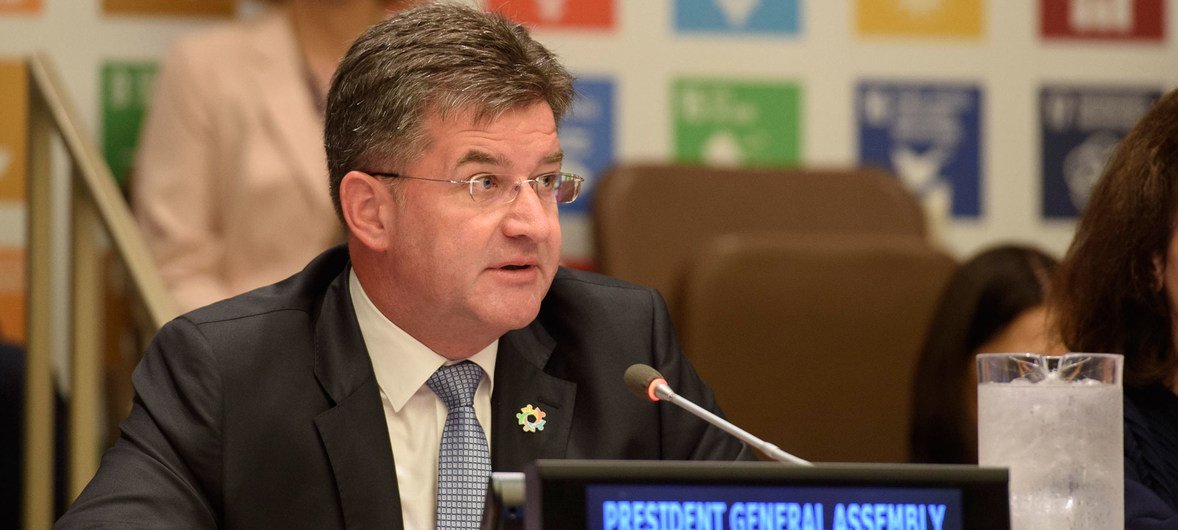
ONU/Loey Felipe
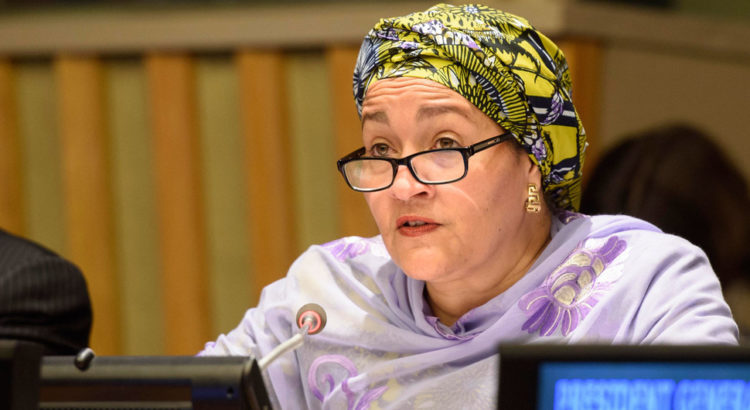
El presidente de la Asamblea General, Miroslav Lajčák, durante la apertura del segmento de alto nivel del Foro de Desarrollo Sostenible.
El cambio climático, otro gran desafío
Tanto Lajčák como Mohammed resaltaron que la emergencia climática es otro gran desafío. «El planeta se está derritiendo, literalmente», afirmó el presidente de la Asamblea, que deploró la disminución de los esfuerzos para combatir el cambio climático recordando que 2017 fue uno de los tres años más cálidos de la historia.
El planeta se está derritiendo, literalmente.
“La Tierra todavía está experimentando una disminución alarmante en la biodiversidad, un aumento del nivel del mar y de la erosión costera, unas condiciones climáticas extremas y un incremento de las concentraciones de gases de efecto invernadero”, recalcó la vicesecretaria.
Lajčák llamó a los Estados a desarrollar un enfoque intersectorial e inclusivo al involucrar a más mujeres y jóvenes, así como al sector privado, la sociedad civil y los actores regionales para luchar contra este flagelo y lograr los demás Objetivos de Desarrollo Sostenible.
Falta de recursos
Durante la reunión, los líderes de la ONU lamentaron una vez más la falta de recursos destinados a alcanzar a esos Objetivos.
«No tenemos suficiente dinero para lograr nuestras metas«, advirtió Miroslav Lajčák, señalando que la participación del Estado «no es suficiente». «Debemos invertir para lograr resultados tangibles”, remachó Amina Mohammed.
Ambos instaron una vez más a los gobiernos a ser más creativos y proactivos en el financiamiento del desarrollo sostenible. «Tenemos que ver resultados sobre el terreno. No tenemos tiempo para perder», expresaron.
Fuente de la Noticia: https://news.un.org/es/story/2018/07/1437952
As I pen this commentary from my office at the National University of Singapore or NUS – my alma mater and summer academic home – I have been notified that NUS has emerged 11th in the Quacquarelli Symonds or QS World University Rankings and reclaimed its position as Asia’s number one university.
Tellingly, however, the top 10 universities are based in the West: five are in the United States, and the other five are European institutions. And while NUS has much to celebrate, having climbed steadily in the rankings over the past decade, it is also engaged in joint ventures with Duke University and Yale University to enhance its medical and liberal arts education programme, respectively.
Such a joint arrangement, which is representative of transnational education (TNE), is the focus of Professor Phan Le-Ha’s recent book, Transnational Education Crossing ‘Asia’ and ‘the West’.
Top-ranked universities like NUS and other middling Asian institutions, according to Phan, appear to have a fascination with Western universities, resulting in the latter exporting versions of their educational model abroad by establishing overseas campuses in China, Japan, Malaysia, Saudi Arabia, the UAE and Vietnam.
TNE has, however, also drawn its fair share of criticisms as sceptics have been quick to point out that the practice of exporting Western models of higher education to Asian countries constitutes a form of neocolonialism; more often than not, host countries are coerced into granting concessions and providing resources such as land to create these satellite campuses.
Another unfavourable outcome is the ostensible exploitation of its students who, as Phan notes, may receive a mediocre education. Equally disturbing is how some TNE students are individuals who are merely biding their time as they await degree completion and future employment at the home countries of these degree-granting universities.
In other words, both the host institution and host country become stepping stones as these students aspire to eventually move on to the West.
Neoliberalism and TNE
As a critical applied linguist who studies issues of power, and inequality associated language-related issues to better understand their roles in the lives of individuals and conditions in society, I am particularly disturbed by the neoliberal turn that characterises TNE.
For one, students are generally viewed as customers in this financially lucrative enterprise where English is often the medium of instruction. As a consequence, English becomes a commodity, a means toward realising an end that can potentially have negative social implications.
One major implication is the reification of the (white) Western native English instructor whose variety of English and race are valued over the local variety of English used by local instructors. Put simply, a negative outcome of TNE is that it can promote institutional racism through the adoption of ‘rent-a-foreigner’ hiring practices. More often than not, these foreign instructors are also paid more than their local counterparts to do the same job.
Best of both worlds
As real as these ill effects of TNE may be, Phan reminds us that we should not to be too quick to subscribe to an Asian-as-victim trope. After all, some Asian universities are themselves complicit in perpetuating an asymmetrical relationship by electing, for example, to hire token white foreign instructors who might not be formally trained to deliver instruction.
Other Asian-based institutions might not hesitate to use the West-Asia paradox to their advantage by advertising that TNE allows students to enjoy a Western education while being ensconced in Asian values. TNE is thus promoted as a way of preserving one’s Asian values against the insidious cultural influence of the demonised West, an opportunity to enjoy the best of both worlds.
Understandably, Asian universities have much to be proud of. In the latest QS rankings mentioned earlier, four other institutions made the top 25 list: Nanyang Technological University (12), Tsinghua University (17), the University of Tokyo (23) and the University of Hong Kong (25).
The strong performances of Asian universities will probably improve in the future, buoyed by the brain circulation that Asia is experiencing. Many Western-trained academics are returning home, drawn by the attractive remuneration offered by improved local universities. In the long term, the internal ‘Westernisation’ of local universities fuelled by faculty returnees may erode the allure of TNE.
Cooperation rather than competition
Rather than being bound by the West-Asia binary, Phan recommends that TNE institutions adopt a less antagonistic stance and instead “engag[e] with a multidimensional, pro-West and practical-minded Asia”.
This is a valid point because competition can co-exist with cooperation, and cooperation will be essential if TNE is to survive and thrive. However, Western universities need to see the value of such cooperation because some are wary of ceding their rights to overseas campuses and diluting their brand name.
I think that any reservations these institutions might have need to be actively assuaged, with deliberate attempts made to preserve intellectual property rights and maintain academic standards. Intellectual espionage is without a doubt a contemporary reality, and institutions are right to be cautious about leaked content.
However, the solution is not to curtail TNE or, relatedly, restrict graduate student admission of Asian students to Western institutions on the grounds of national security. Instead, stricter measures need to be put in place to safeguard an equitable two-way exchange of knowledge and ideas.
Steps also need to be taken to tackle institutional racism and to value the expertise local talent can bring to TNE institutions. Rather than populating these institutions with ‘foreign’ talent, joint venture campuses should hire capable multilingual local faculty who are well versed with English as an international lingua franca, and thus do their part in facilitating global brain circulation.
At a time when multilateralism appears to be in jeopardy, TNE can take a leadership role in connecting institutions and people.
Unfortunately, university rankings do matter, and it is increasingly difficult to escape the audit culture that pervades higher education. What TNE needs to do is to design measures that will foster genuine cross-institutional collaboration and cooperation. If designed well, this could become a valuable template for other educational crossings, not just between the West and Asia.
Source of the article: http://www.universityworldnews.com/article.php?story=20180626103409378
OtrasVocesenEducacion.org existe gracias al esfuerzo voluntario e independiente de un pequeño grupo de docentes que decidimos soñar con un espacio abierto de intercambio y debate.
¡Ayúdanos a mantener abiertas las puertas de esta aula!







 Users Today : 19
 Total Users : 35460228
 Views Today : 24
 Total views : 3418919