Page 377 of 400
1 375 376 377 378 379 400

Libro y Película. La Ladrona de Libros

La ladrona de libros” Reseña de una película de Brian Percivel sobre un libro de Markus Zusak, USA – Alemania 20th Century Fox, 2013.

Autora de la Reseña: Carolina Urtasun. Universidad Nacional de La Plata. Argentina

Entre otras cosas, escribo para que no suceda lo que temo; para que lo que me hiere no sea; para alejar al Malo. Se ha dicho que el poeta es el gran terapeuta. En este sentido, el quehacer poético implicaría exorcizar, conjurar y, además, reparar. Escribir un poema es reparar la herida fundamental, la desgarradura. Porque todos estamos heridos.
Alejandra Pizarnik

Podemos decir que la historia de Liesel es una historia de pérdidas. Cada hito de la historia está marcado por una negación, una falta hacia ella y eso hace que la película tenga una carga emocional muy fuerte. Pero también podemos decir que el relato tiene sus ganancias. Son esos momentos en que, a pesar de la oscuridad que la rodea, Liesel encuentra cabos de los que sostenerse, que le permiten construir una trama para seguir adelante. Uno de esos cabos son los libros. En medio del conmocionante contexto de guerra en el que vive, la protagonista desarrolla relaciones clave con personas que le ayudan a conseguir libros para leer y con quienes comparte el placer de la lectura.“La ladrona de libros”, película de Brian Percivel basada en una novela de Zusak, cuenta la historia de una niña alemana, Liesel, a quien sus padres dejan en adopción antes de huir de la Alemania nazi tiempo antes de la Segunda Guerra Mundial. Liesel es acogida por una pareja de mediana edad, con la que aprende a convivir y a leer. El primer día de clases en la escuela sus compañeros se burlan de ella porque, en lugar de su nombre, escribe apenas unas grandes cruces en el pizarrón. Sin embargo, su padre adoptivo fomenta su pasión por los libros: le lee antes de dormir y pinta en las paredes del sótano de la casa un gran abecedario para que Liesel escriba todas las palabras que va conociendo. Cuando Liesel aprende a leer, y la relación con su padre adoptivo se hace más profunda, se suma un integrante al seno familiar: Max, un joven judío escapado de la Noche de los Cristales Rotos (Noviembre de 1938), a quien los padres adoptivos de Liesel deciden refugiar en el sótano, y de quien la niña se hace íntima amiga.

La familia que acoge a Liesel procura sobrevivir en esa sociedad y responder formalmente a las autoridades. Como bien se sabe, la sociedad civil alemana no era homogénea respecto a su postura sobre el régimen, como tampoco ajena a él. En aquella época, el nazismo pretendió ejercer una influencia muy grande sobre las personas, en especial sobre los más jóvenes, convocándolos a vivir por y para el Führer (líder), haciendo que las familias perdieran autoridad y autonomía frente a la formación de los hijos1.

En la película pueden verse algunas características de esta educación destinada a los jóvenes. En primer lugar, vemos la escuela, como toda la ciudad, con banderas rojas con la esvástica en las paredes. Dentro del aula, vemos el cuadro de Hitler colgado por encima del pizarrón. A su lado, una gran lámina con imágenes de rostros dibujados desde distintos ángulos que remiten a las “ciencias raciales”. En otro momento, vemos el coro de niños de la escuela, con sus camperas pardas y una esvástica sobre tela roja en el brazo, cantando una canción en alusión al pueblo alemán. En la misma secuencia, Rudy -vecino y amigo de Liesel- es castigado por sus padres porque quiere ser como el corredor de carreras negro Jesse Owen, sin embargo, soldados de la SS lo incorporan al equipo “ario” de promesas deportivas.

Asimismo, los jóvenes participan en un acto oficial de quema de libros. En esa escena, un compañero de la escuela pone a prueba a Liesel y a su amigo Rudy, desafiándolos a ejercitar la lealtad al Führer quemando libros en la hoguera que ocupa el centro de una plaza.

Hacia el final de la escena, cuando en la plaza ya no queda nadie la protagonista inquieta se acerca a la pila ardiente y trata de rescatar un libro humeante. Mientras tanto es observada desde un auto por la esposa del alcalde que la mira sin decir nada y se retira velozmente. Liesel queda expuesta pero establecerá con esa mujer una complicidad inesperada. La esposa del alcalde le abre a Liesel las puertas de su casa y de su biblioteca. Le habilita el acceso a una colección amplia, propia de una familia rica y poderosa del pueblo, donde Liesel puede dejarse llevar por las lecturas y la esposa del alcalde recordar a su hijo muerto en la guerra. En la tranquilidad de esa biblioteca, la relación entre ellas se hace más cercana; pero el alcalde no consentirá ese vínculo y expulsará a Liesel de la casa y del acceso a los libros. Sin embargo, la protagonista persistirá en su deseo lector de modo clandestino y comenzará a robar los libros ingresando por una ventana de la casa señorial.

Los libros robados son compartidos con Max en largas jornadas de lecturas furtivas en el sótano de su casa. Liesel ofrece a su refugiado amigo un mundo de descripciones, viajes e historias que lo alimentan y le dan fuerzas para sobrellevar sus propias pérdidas. De allí surge una escena clave para pensar la película en términos pedagógicos. Max regala a Liesel el libro “Mi Lucha” de Hitler con las hojas pintadas de blanco y una inscripción en hebreo que dice: “escribe”. Lo hace para que ella pueda transformarlo su propio cuaderno de historias. Un acto clandestino que da espacio a la producción de la propia palabra escrita. Una sugerencia amorosa y transgresora para que Liesel escriba en un idioma prohibido una historia también prohibida.

Hacia el final de la película, la ciudad es bombardeada convirtiendo a todos los edificios y casas en escombros. Los padres adoptivos de Liesel y sus vecinos mueren pero ella logra sobrevivir porque se encontraba en el sótano escribiendo en el cuaderno que Max le regaló. En la última toma, se muestra a Liesel ya como una escritora consagrada en un lujoso departamento capitalino. Esa escena refuerza una mirada individual sobre la “salvación” que poco invita a pensar en la liberación (y en la lectura) en términos más colectivos. En este sentido, la película se apoya de alguna manera en una tradición liberal de relatos sobre los totalitarismos que reivindica la fortaleza personal de ciertos individuos que logran oponerse a un régimen que niega su autonomía. En este sentido no contribuye a profundizar la reflexión en términos sociales más amplios que den cuenta del lugar de la “lectura” como un terreno de disputa donde más que “individuos vs régimen” hay distintos sectores sociales en pugna, donde unos colaboran, otros callan y sólo algunos resisten.

En síntesis, la película relata la historia de una niña que sobrevive al nazismo y a la guerra leyendo; una “ladrona de libros” que se convierte en una reconocida escritora en su adultez. Es una historia de transformación en la que, como dice Pizarnik en la cita que da comienzo a esta reseña, la protagonista logra reparar su herida. Los personajes muestran en la película una mirada hacia el otro que supera el temor por el castigo propio. Frente al horror del régimen, la guerra y la educación de los jóvenes en ese sistema, aparecen la construcción de relaciones personales, la lectura de libros -literatura principalmente- y la escritura de la propia historia como prácticas que ayudan a liberar y liberarse, re-construirse, re-vivir la experiencia.

Ficha técnica

Título: La Ladrona de Libros
Título original: The Book Thief
Dirección: Brian Percival
País: USA – Alemania
Año: 2013
Duración: 131 min
Género: Drama, Bélico
Estreno: 10/01/2014
Reparto:  Geoffrey Rush, Emily Watson, Nico Liersch, Joachim Paul Assböck, Sandra Nedeleff, Kirsten Block, Matthias Matschke, Roger Allam, Sophie Nélisse, Oliver Stokowski
Adaptación: Michael Petroni
Fotografía: Florian Balhaus
Música: John Williams
Producción: Karen Rosenfelt
Producción ejecutiva: Redmond Morris
Basada en una novela de Markus Zusak.

 Cita sugerida: Urtasun, C. (2014). [Reseña de la película La ladrona de libros, sobre un libro de Markus Zusak de Percivel, B.]. Archivos de Ciencias de la Educación, (8). Recuperado de http://www.archivosdeciencias.fahce.unlp.edu.ar/article/view/Archivos08a17
Notas

1 Michaud, E. (1996) “’Soldados de una idea’. Los jóvenes bajo el Tercer Reich”, en Levi, Giovanni; Schmitt, Jean-Claude (Dir.) Historia de los jóvenes, II. La Edad Contemporánea, Madrid, Taurus.

Fuente de la Reseña:

http://www.archivosdeciencias.fahce.unlp.edu.ar/article/view/Archivos08a17/html_44

Comparte este contenido:

María Daniela Castillo se destaca en Estados Unidos

EEUU/27 abril 2016/Fuente:  Vanguardia.com – Galvis Ramírez y Cía. S.A.

La deportista santandereana, quien estudia en la Universidad de Wisconsin-Madison, en Estados Unidos, logró excelentes resultados en el Torneo Nacional Universitario.

María Daniela Castillo, una santandereana amante del tenis de mesa, sigue figurando en Estados Unidos, donde cursa la carrera de Ciencias Ambientales en la Universidad de Wisconsin-Madison.

Pese a que llegó a este claustro en el mes de enero, la santandereana ya se destaca en el ámbito deportivo gracias a su precisión con la raqueta y ha logrado resultados importantes.

María Daniela empezó con los torneos distritales y allí logró el título en equipos mixtos y el tercer puesto en individual. Después jugó la fase regional y celebró el triunfo en equipos femenino, el segundo lugar en individual y el tercero en equipos mixtos, resultados que le permitieron clasificar a la final nacional, donde están los mejores representantes de todas las universidades norteamericanas y algunas de Canadá.

En el evento, cumplido en Round Rock, Texas, María Daniela estuvo acompañada por Pamela Song, Yixin Zhang y Chen Sun, de China, así como de Yash Shah, de India.

Los resultados obtenidos por la santandereana son para destacar, pues acabó segunda en la modalidad equipos femeninos.

María Daniela y sus compañeras superaron en la fase de grupos a la Universidad del Sur de California, USC; Universidad de Nueva York, NYU, y Virginia Tech. Luego vencieron a Toronto y a Western, pero en la final cayeron 3-2 ante Texas Wesleyan.

“En individual Pamela y Chen perdieron, mientras que Yixin y yo ganamos, sin embargo, en el duelo decisivo donde hice pareja con Pamela perdimos. Las jugadoras de Texas son de Ucrania, Alemania y Brasil, y su nivel es muy bueno”, comentó la deportista colombiana.

Pero ese no fue el único logro de la tenismesista local. En dobles, haciendo pareja con Pamela Song, también acabó segunda, tras superar a los equipos de Toronto, California, Los Ángeles y Nueva York, aunque en la final nuevamente cayeron ante Texas Wesleyan.

“En términos generales, nos fue muy bien, pues mi universidad nunca había tenido buenos resultados en unos Nacionales, y nosotros logramos dos segundos puestos. Además, esta temporada dominamos en la región en equipos femeninos y eso es muy meritorio”, concluyó la santandereana.

DUELO DE PAISANAS

Por cosas del destino, en el cuadro del torneo individual, María Daniela tuvo una rival muy singular. Se trató de Susana León, una bumanguesa que cursa una maestría en Texas A&M. “Con Susana nos conocemos hace casi 10 años. Cuando yo empecé a entrenar en la Liga Santandereana, ella ya era jugadora y la verdad fue muy emocionante que dos jugadoras de Bucaramanga estuviéramos en un evento de tal importancia representado a nuestras respectivas universidades. La verdad fue una coincidencia muy grande que nos hubiera tocado jugar en el mismo cuadro”, contó María Daniela, quien salió victoriosa en el duelo, pero posteriormente cayó ante Isabel Chu, de la UCLA, y no pudo llegar a la final.

Fuente de la Noticia:
Este contenido ha sido publicado originalmente en Vanguardia.com en la siguiente dirección: http://www.vanguardia.com/deportes/otros-deportes/356206-maria-daniela-castillo-se-destaca-en-estados-unidos.

Comparte este contenido:

Enfocarse en los mejores maestros para fomentar futuros talentos

A juzgar por las noticias, podría parecer que los políticos en los Estados Unidos se dedican únicamente a participar en intensas luchas políticas internas. Sin embargo, un área donde existe una oportunidad para evitar la paralización política es la educación. Durante el presente otoño, el actual Congreso tiene una última oportunidad para reformular la legislación educativa más importante del país, conocida como No Child Left Behind  Act (ley “Que Ningún Niño se Quede Atrás”). Una de las piezas legislativas más interesantes que podrían formar parte de las modificaciones propuestas es la del senador demócrata Al Franken, que propone establecer un Cuerpo de Profesores para Ciencia, Tecnología, Ingeniería y Matemáticas (STEM, según sus siglas en inglés). La crisis en la educación especializada en ciencia, tecnología, ingeniería y matemáticas ha sido bien documentada en los Estados Unidos. Los informes nacionales de naturaleza bipartidista lo comparan con una tormenta en formación y un huracán de categoría 5 acercándose rápidamente, y que podría afectar el liderazgo mundial de Estados Unidos en ciencia e ingeniería.

Estoy de acuerdo con esta apreciación, pero la reforma legislativa propuesta es de gran relevancia, más allá de los Estados Unidos.

En América Latina, los niveles de aprendizaje a nivel primario y secundario, junto con las tendencias actuales del empleo, representan un serio desafío. El mercado laboral exige trabajadores con conocimientos y habilidades específicos que les permitan trabajar de manera productiva en las industrias vinculadas a la ciencia, la tecnología, la ingeniería y las matemáticas. Sin embargo, la mayoría de los estudiantes abandonan el sistema educativo careciendo incluso de nociones básicas de matemáticas y ciencias. Es muy probable que los problemas de aprendizaje, al menos en parte, sean el resultado de la elevada proporción de profesores de ciencia, tecnología, ingeniería y matemáticas que están enseñando fuera de su especialidad o que están insuficientemente preparados. Tal vez algunas de las soluciones propuestas por el Senador Franken podrían inspirar a otros países en el hemisferio a tomar medidas similares.
La ley del Cuerpo de Profesores se propone aumentar los sueldos de los maestros que conforman el 5 por ciento de los maestros primarios y secundarios que enseñan ciencias, tecnología, ingeniería y matemáticas.El incremento salarial tiene como objetivo ayudar a evitar que los mejores profesores de esas especialidades abandonen la docencia para trabajar en posiciones más lucrativas en el sector privado, un problema que Estados Unidos comparte con muchos países de América Latina.
Los profesores más calificados de los cursos de ciencias, tecnología, ingeniería y matemáticas pueden a su vez servir de modelos y mentores de otros profesores de esas mismas especialidades, incluyendo a los que recién comienzan. También pueden crear redes con la comunidad educativa experta en esos rubros para compartir prácticas y recursos pedagógicos exitosos. Estos profesores deben enseñar en aquellas escuelas que padecen los problemas más graves de aprendizaje en relación a ciencias, tecnología, ingeniería y matemáticas, y que son centros educativos que tradicionalmente enfrentan mayores dificultades para contratar y retener a los buenos maestros de cualquier materia, pero particularmente en las áreas mencionadas.
Si se aprueba, el paquete de medidas propuesto tiene el potencial de crear un grupo muy nutrido de profesores talentosos e inspiradores en las áreas de ciencias, tecnología, ingeniería y matemáticas y que sean capaces a su vez de preparar a los estudiantes para enfrentar un mundo que exige cada vez más habilidades específicas en esas materias, y que les sirva también para el trabajo y la vida.

Comparte este contenido:

Youth Resistance Unleashed: Black Lives Matter

“Those who kill their own children and discriminate daily against them because of the color of their skin; those who let the murderers of blacks remain free, protecting them, and furthermore punishing the black population because they demand their legitimate rights as free men—how can those who do this consider themselves guardians of freedom?”

Che Guevara
Before the United Nations
12-11-1964

In my lifetime young people rose up to challenge and change the world in Little Rock and Birmingham, in Soweto and Tiananmen, in Palestine and Chiapas. In the last decade we saw the rise of Arab Spring and Occupy, and now we are in the midst of vivid mass resistance to the police killing of unarmed Black men and women spurred by the death of Michael Brown in Ferguson, Missouri. Now and historically, it is the youth who reject taken-for-granted injustices.[1] In this moment, young people are the social actors – the leadership, catalysts,  the activists, and the organizers – who seized and defined a continuing travesty of North American life: the police murder of Black lives. Rising up against the thickening layers of institutionalized white supremacy, young people are insisting that Black Lives Matter.

Black Youth Project 100 action to #DecriminalizeBlack (Photo Credit: Sarah Jane Rhee)

With their radical impulse to revolt, that spirit of hopefulness and possibility, the laser-like insight of adolescents into the hypocrisies of the adult world, propel youth to break the rules, resist together, and transcend the immoral status quo. Inspired by the courage and determination of Ferguson youth, young people across the nation walked out of schools, sat-in, died-in, blocked highways and bridges – becoming the fresh, searing forces for equality, racial justice, and dignity.

Youth were not unaware of the risks they were taking by challenging police violence. In fact, it is young people who were painfully and brutally aware of the police targeting of Black youth, and pervasive US institutionalized de-valuing of Black lives.

Though many young activists had already been challenging police violence and the criminalization of Black lives in their own communities, the harrowing, police stalking and shooting of unarmed teenager Michael Brown on August 9, 2014 in Ferguson, Missouri, became the spark that generated a fresh wave of youth uprisings. This new movement in the long struggle for racial justice brought young people together across the country to become more than the sum of their parts.

The activism of the Black Lives Matter movement not only illustrates the brilliance and clarity of young people, but also flies in the face of popular currency that children and youth are less competent, less thoughtful, less wise and more dangerous than adults. The continuing reality of young people as social actors stands in opposition to official policies of silencing, suppressing, expelling and punishing our youth, depriving them of an education and denying their creativity and right to be heard.

Think of young peoples’ loss of rights, for example, through truancy laws; school censorship of high school newspapers, email communication and graduation speeches; the banning of books; relentless harassment and violence against LGTBQ and trans youth; school locker searches and drug testing without reasonable suspicion or due process; school zero tolerance policies that include punishments, school suspensions and expulsions, gang terrorism profiling, stop and frisk, and the calling of police for minor misbehavior. Control, cameras, drug searches, testing, arrests, and school exclusion have replaced dignity.

Rights vs. protections and the myth of the “Superpredator”

Children and youth, in fact, are whole persons who bear human and constitutional rights. They are inevitably an active part of their time and place, their culture and community, their race, class, and ethnicity, and their extended family. Simultaneously, they may also be more vulnerable, more easily manipulated and used by adults, such that they must be, to the extent possible, protected, sheltered and insulated from serious harm, both from their own impulses, and adults who might prey upon them or use youth for their own purposes. This is why human rights activists, for example, advocate for children to be protected from the harshest consequences of war and hazardous labor and family violence.

Of course, young people are becoming-persons, not yet fully adults; but what kind of a person is a child? In considering children as social actors, this contradiction is worthy of continuing deliberation and nuance. How can society heed this paradox – rights versus protections – and tilt toward children as bearers of rights while taking the responsibility for providing youth with equal access, due process, Constitutional rights, economic rights, and human rights? Are youth not right to see the adult world as compromised, duplicitous, and worst of all—indifferent to the crimes and suffering around them?

Children were acknowledged as Constitutional persons almost fifty years ago in the landmark U.S. Supreme Court case of In re Gault.  Yet the with the subsequent repressive wave to restrict their active whole personhoods, U.S. courts and legislators have shrunken the Constitutional rights of children by constricting or eliminating their rights to speech and expression, association, action, education, privacy, health care, due process, equal protection, and their right to liberty (by depriving them of liberty). This has been done in the name of either protecting them and “saving” them from themselves, or by constructing some children as superpredators, fearful, larger- than-life monsters, wolf-packs and gangs out to rob, rape and even kill (white) adults. Consequently, specific populations of children are seen as dangerous and capable of destroying civilization.

The diabolical invention of the 1990s youth predator by law enforcement, academics, and the mass media resulted in the harsh criminalization of youth of color– subjecting them to arrests, incarceration, trials in adult criminal courts, and extreme sentencing. The profound echo of young Black men as “superpredator” would arise again with the Ferguson grand jury testimony of Officer Darren Wilson, who saw in Michael Brown someone enormous, looming up and becoming larger even after being stalked and shot by Wilson six times.

It looked like a demon,” Wilson told the grand jury.

Fully 75% of youth who are locked up are confined for non-violent offenses. Racial and ethnic disparities are unconscionable, but the naked disproportion of who is arrested, beaten, and killed characterize the entire youth justice system.[2]

At its best, contemporary analysis of children and adolescents recognizes the dialectical nature of youth: being and becoming, categorically less culpable than adults, and with enhanced prospects for recovery, rehabilitation, and “attaining a mature understanding of [one’s] humanity.”[3]  Diminished culpability is not, however, the same as lesser competence or capacity.  Culpability is commonly misunderstood, and the current conversations about adolescent development research frequently becomes an imprecise discourse that easily collapses into language of lesser adolescent competence or moral action.

Military arsenal deployed against Ferguson protesters

The story of the Aug. 9, 2014 police killing of Michael Brown stayed in the news because the young people in Ferguson refused to leave the streets. And although the protests there and nationally was one of the broadest and most sustained radical coalitions in decades, the protesters themselves were largely young, black, queer, poor, working-class, secular, women and trans.

The young people of Ferguson did not back down in the face of a highly militarized small town police force armed with federally-funded Kevlar helmets, assault-friendly gas masks, combat gloves and knee pads, woodland Marine Pattern utility trousers, tactical body armor vests, some 120 to 180 rounds for each shooter, semiautomatic pistols attached to their thighs, disposable handcuff restraints hanging from their vests, close-quarter-battle receivers for their M4 carbine rifles and Advanced Combat Optical Gunsights[4].

There are scattered reports of stun grenade use in Ferguson, also known as flashbangs or flash grenades. This weapon of choice for American SWAT teams (and Israeli soldiers) originated within British Special Forces more than four decades ago. Ostensibly less than lethal, stun grenades have been known to kill or severely injure numerous victims, and the device was recently in the news for burning a 19-month-old baby in Georgia, resulting in a coma, during one of the thousands of domestic police raids this year. They are designed to temporarily blind and deafen, thanks to a shrapnel-free casing that is only supposed to emit light and sound upon explosion

The grenade launchers used against unarmed youth in Ferguson included the ARWEN 37, which is capable of discharging 37mm tear gas canisters or wooden bullet projectiles. The police used tear gas unsparingly in Ferguson. The Chemical Weapons Convention of 1993 actually bans the gas as a permissible means of warfare. Then again, it is allowed for domestic riot control, and nations like Turkey, Bahrain, Israel and the United States who have exploited the loophole to great avail. Tear gas sucks out your organs, hogs your oxygen and burns you inside and out. Interim blindness and extended coughing fits are common, as well as an overall sense that you are dying or dead. These are police weapons against an unarmed, Black, civilian, domestic population.

The use of “pepper balls” is lethal; the Boston Police Department banned them after a young woman was killed by one which passed right through her eye and skull to the brain. She was guilty of being present in a rowdy crowd after a Red Sox/Yankees game in which the former won. The same goes for the rubber bullets, wooden bullet projectiles, and beanbag projectiles on view with the police in Ferguson

Contemplate the Ferguson police department’s possession of the BEARCAT G3, the SWAT team’s version of the military’s Mine Resistant Ambush Protected (MRAP) vehicle, or its MRAP All Terrain Vehicle. This armored tank was donated to the Ferguson police by the US Department of Homeland Security.  There are no known mines or IEDs in Ferguson, an ambush is unlikely, so the decision of the St. Louis County Police Department to roll out (or even own) one of these tanks is apparently the contemporary version of fire hoses and dogs.

K-9 dogs. Yes, the 2014 St. Louis County and Ferguson Police Departments also used growling German shepherds to threaten demonstrators. In addition, these police forces had access to the Long Range Acoustic Device (LRAD), which emits a sound so pain-inducing that is causes bleeding from the ears. LRADs were also on display (though not used) during the Chicago anti-NATO demonstrations in 2011. On top of all this, the police department of Ferguson – a police force that is 94% white, in a town that is 67% Black – not only possessed an armored personnel carrier and weapon loads to intimidate demonstrators, carried out surveillance of the protesters from an MD Helicopter 500 Series in the sky above Ferguson.

Vibrant transformation of the possible

The fierce young, unarmed and highly disciplined young people who dared to stand up against police violence are to thank for revealing to the US public that the war-making hardware, paid for by our tax dollars, is coming home to police forces for use against the Black, Latino, indigenous communities and to patrol US borders.

This military-grade weaponry of the police in Ferguson was not about riot control during the long months leading up to the grand jury verdict in the murder of Michael Brown. It was the arsenal of white supremacy and racial oppression.

In the face of this violent intimidation, young people continued to peacefully demonstrate in Ferguson and to document their struggle at websites like Ferguson Action and using Twitter hashtags like #SHUTITDOWN.

Created in the crucible of Black Lives Matter is a new generation of young, African American organizers and activists, with experience in strategy development, tactics, decision-making under pressure, coalition building, and clarity about long range, radical goals, about their vision. They are savvy and wise, filled with love and caring for each other and for everyone who has suffered the terror of police violence: youth, their families and loved ones, allied people of color, trans and LGBTQ youth, native and Palestinian people, victims of police violence and whole communities.

Thus the Chicago struggle for city reparations for those who suffered police torture and subsequent decades on death row or juvenile life without parole before they were exonerated utilizes art, performance, persistence and unlikely allies. New York activists agitate for divestment from corporation that construct and operative for-profit prisons. There are movements to end solitary confinement from California to Rikers Island, and renewed efforts to commemorate and open old cases of lynchings across the nation.  The struggle for dignity and justice continues in immigrant rights struggles and the fierce, elegant courage of the youth and dreamers who have seamlessly embraced their queerness, their multiple heritages, and their human rights.

All this indicates a vibrant transformation of the possible. Police torture and killing of African Americans is visible, no longer background normal, as Black youth resist being branded as criminals at birth. Their resistance is communal, shared, and collective.

Can we hold the moment? Do we have the knowledge that young people are capable of seeing and seizing what adults cannot imagine?  In the uncertainty and complexity of civil strife and disciplined rebellion, shall we see children and young people capable of being agents of their own liberation?


[1]   Sources for the Ferguson story include: Darryl Pinckney, Ferguson and Resistance Against the Black Holocaust, © 2015 The New York Review of Books, Distributed by The New York Times Syndicate;Chris Crass, SpeakOut | Op-Ed; Kevin Zeese and Margaret Flowers, Ferguson Exposes the Reality of Militarized, Racist Policing, Popular Resistance | News Analysis; Adeshina Emmanuel, Ferguson Case Highlights Need for National Data on Police Shootings, The Chicago Reporter .

[2]  See the website of the W. Haywood Burns Institute, at www.burnsinstitute.org for racial and ethnic disparities at every stage of the youth justice system.

[3] See the trilogy of U.S. Supreme Court cases and the accompanying Amicus briefs: Roper v. Simmons(2005) , Graham  v. Florida (2010), and Miller v. Alabama (2012).

[4] See Radley Balko’s Rise of the Warrior Cop: The Militarization of America’s Police Forces (2013) for this research, photos, and the following details of Ferguson police weaponry.


Comparte este contenido:

The scourge of illiteracy and the authoritarian nightmare

At the present historical moment, Americans live in a society in which thinking is viewed as an act of stupidity, and ignorance is treated as a virtue. Literacy is now regarded with disdain, words are reduced to data, and science is confused with pseudo-science. For instance, two thirds of the American public believe creationism should be taught in schools and most of the Republicans in Congress do not believe that climate change is caused by human activity, making the U.S. the laughing stock of the world. News has become entertainment and echoes reality rather than interrogating it. Popular culture revels in the spectacles of shock and violence. Unsurprisingly, education in the larger culture has become a disimagination machine, a tool for legitimizing ignorance, and it is central to the formation of an authoritarian politics that has gutted all those public spheres in which thoughtfulness, critical exchange, and informed dialogue can take place.

Illiteracy has become a scourge and a political tool designed primarily to make war on language, meaning, thinking, and the capacity for critical thought. Illiteracy no longer simply marks populations immersed in poverty with little access to quality education; nor does it only suggests the lack of proficient skills enabling people to read and write with a degree of understanding and fluency. More importantly, illiteracy is about what it means not to be able to act from a position of thoughtfulness, informed judgment, and critical agency. It suggests not only learning the skills and knowledge to understand the world but also to intervene in it and change it when necessary. Illiteracy has become a form of political repression that discourages a culture of questioning, renders agency as an act of intervention inoperable, and restages power as a mode of domination. It is precisely this mode of illiteracy that both privatizes and kills the imagination by poisoning it with falsehoods, consumer fantasies, data loops, and the need for instant gratification.

This is a mode of manufactured illiteracy and education that has no language for relating the self to public life, social responsibility or the demands of citizenship. It is important to recognize that the rise of this new mode of illiteracy is not simply about the failure of public and higher education to create critical and active citizens; it is about a society that eliminates those public spheres that make thinking possible while imposing a culture of fear in which there is the looming threat that anyone who holds power accountable will be ignored or punished. At stake here is not only the crisis of a democratic society, but a crisis of memory, ethics, and agency.

What role might education and critical pedagogy have in a society in which the public goods disappear, emotional life collapses into the therapeutic, and education is reduced to either a private affair or a kind of algorithmic mode of regulation in which everything is reduced to a market-based outcome. What role can education play to challenge the deadly claim of casino capitalism that all problems are individual, regardless of whether the roots of such problems lie in larger systemic forces? In a culture drowning in a new love affair with instrumental rationality, it is not surprising that values that are not measurable — compassion, vision, the imagination, trust, solidarity, care for the other, and a passion for justice — wither.

One of the challenges facing the current generation of educators, students, progressives, and other cultural workers is the need to address the role they might play in educating students to be critically engaged agents, attentive to addressing important social issues and being alert to the responsibility of deepening and expanding the meaning and practices of a vibrant democracy. At the heart of such a challenge is the question of what education should accomplish, not simply in a democracy but at an historical moment when the United States is about to slip into the dark night of authoritarianism. In a world in which there is an increasing abandonment of egalitarian and democratic impulses, what will it take to educate young people and the broader polity to challenge authority and hold power accountable? How might we construct an education capable of providing students with the skills, ideas, values, and authority necessary for them to nourish a substantive democracy, recognize anti-democratic forms of power, and to fight deeply rooted injustices in a society and world founded on systemic economic, racial, and gendered inequalities? What will it take for educators to recognize that the culture of education is not simply about the business of culture but is crucial to provide the conditions for students to address how knowledge is related to the power of both self-definition and social agency? What work do educators have to do to create the economic, political, and ethical conditions necessary to endow young people and the general public with the capacities to think, question, doubt, imagine the unimaginable, and defend education as essential for inspiring and energizing the citizens necessary for the existence of a robust democracy?

.

Henry A. Giroux is a widely published social critic and McMaster University professor who holds the McMaster Chair for Scholarship in the Public Interest, the Paulo Freire Distinguished Scholar Chair and is a Visiting Distinguished University Professor at Ryerson University. Born in Rhode Island, he held numerous academic positions in the U.S. and now lives in Hamilton.

Comparte este contenido:

India: How UoH and JNU Have Taken Us From Public Protest to Public Pedagogy

Fuente: thewire.in/ Por Pramod K. Nayar/ 27 de Abril de 2016

In the public debates around key concepts raised by the students, democracy finds its greatest strength: the right to speak, the right to be heard and the right to plurality

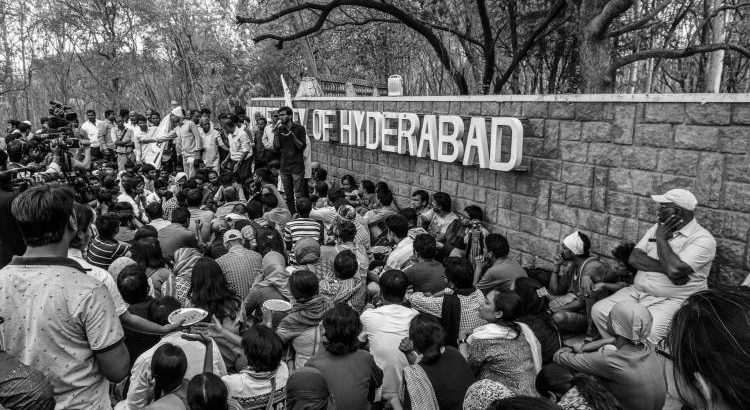
Fotografia: Two spaces in India have been radically transformed since January 18, 2016: the educational institution and the public space of the town/city.

January 18, 2016 saw the first protests over the suicide of the Dalit student-scholar, Rohit Vemula, at the University of Hyderabad (UoH), driven to despair over his suspension from residential areas of the educational institution by a university order, allegedly at the behest of a ruling party’s local member of parliament, and unfairly tried before being convicted. On February 12, 2016, Kanhaiya Kumar, president of the Jawaharlal Nehru University Students’ Union (JNUSU) was arrested on sedition charges for allegedly raising anti-India slogans at a student gathering. Widespread protests across the country resulted, and we saw a merger of both ‘causes’ in the protests.

Numerous public intellectuals, activists, jurists, educationists, and politicians gave interviews, wrote opinion pieces, joined campaigns and signed petitions. Processions and protests also included, expectedly, shut-downs of educational institutions, street protests and online campaigns across Indian cities. Heated debates on television were accompanied by letters to respected newspapers from parents, former teachers, alumni of these institutions and others. Worldwide coverage came in the form of BBC and CNN reportage and signature campaigns by academics, submitted to the Indian government, the president and others.

What do the protests congealing around Rohit/UoH and Kanhaiya/JNU mean for the landscape of ‘public pedagogy’ and how might they transform the scene of education itself, if followed through?

Public pedagogy, as theorists such as Henry Giroux have defined it, is an essential system of education that works outside institutions:

learning and education happening outside of formal schooling systems and position informal spaces of learning such as popular culture, the Internet, public spaces such as museums and parks, and other civic and commercial spaces, including both old and new social movements, as sites of pedagogy containing possibilities for both reproduction and resistance.

The protests around Rohit/UoH and Kanhaiya/JNU moved out of public educational institutions to public spaces: the streets. The streets and open spaces outside public offices, government buildings in the campaigns such as ‘Chalo UGC’become, I propose, spaces of education.

There is, in other words, an educative force and appeal in the protests. Pedagogy, said Henry Giroux, ‘is not simply about the social construction of knowledge, values, and experiences; it is also a performative practice embodied in the lived interactions among educators, audiences, texts, and institutional formations’. We saw these interactions in the above protests.

Public pedagogy as embodied in the protests is essential to India’s democracy for several reasons.

First, it takes theories and ideas, ideologies and ideologies from the classroom to the public space of debate. Point-counterpoint, the clash of ideologies (SFI/ABVP, Congress/BJP, Marxist/Neoliberal) were embodied in the speeches and discussions outside the institution and thus explicated in real-time in a real-life situation. This is a pedagogy that emerges from outside the institution as well, when thinkers and commentators as diverse as protesting mothers and lawyers (Teesta Setalvad) inform the public of what wrongs have been perpetrated and, more importantly, what is at stake.   This is therefore a pedagogy of the public, emerging from outside the licensed scholarly world of academia and is more akin to cultural work around social justice and ideas of democracy.

Second, ideas of nationalism, continuing discrimination, identity, patriotism, freedoms (of various kinds) were articulated in ways that these became, at least for the duration of the protests, a public lingua franca. Here protests that debated key concepts were pedagogic for the public (okay, the public that cared to listen, exactly as in a class room). It brought to public attention issues of academic freedoms, the right to protest, the modes of social integration, the subtleties of discrimination and the education policies around, say research programs in universities. This pedagogy for the public is an important development in Indian democracy because it is not a set of state-governed instructions as to what to think or how to think. Public pedagogy cohering around Rohit/Kanhaiya and concepts of discrimination or freedoms mobilizes public sentiment through the instruction generated by the protests.

Third, the protests around identity and concepts such as freedom or nationalism altered the polis. The polis, wrote Hannah Arendt, ‘is the organisation of the people as it arises out of acting and speaking together’. Thus, the polis was a pluralised space, with arguments and counterarguments around abstract ideas of nationhood and identity being articulated in a blurring of advocacy, education and activism.

Fourth, it expanded the public educational institution to encompass the street at a time when the space of public institutions is shrinking. Judith Butler writing about the Occupy movement: by “performatively laying claim to public education … precisely at a historical moment in which that access is being shut down”, through budget cuts, censorship and fee-hike, the protests symbolically lay claim to “buildings that ought properly, now and in the future, to belong to public education.” The public institution where debates around abstract concepts and concrete social inequities may be debated extends into the public space of the city when these protests move out of the walls. The public institution is then projected as a space where these inequities are institutionalised, even as they are spaces segregated from the surrounding city or context. The protests in these two cases demonstrated how the institution only reflects its surrounding social realities, as the nation yet again learnt what it meant to be inside places of higher learning devoted, ostensibly, to ideas of equality, freedom and justice. The protests also underlined the need for public institutions to be truly public and not subject to ideological regimentation, to be truly public and plural.

Fifth, the direction in which protests such as these move is not determined by an agenda from the outside or from within an educational regime. It emerges from within the very recognition of what is at stake: freedom from discrimination, freedom to access equality and social justice, etc. We can see the protests as public pedagogy for the political learning they disseminate about what it means to be a part of the Indian public. These protests took a crisis within public institutions into the public outside the institution so that they fed off each other.

Sixth, the public pedagogy the protests embody is about publicness, about being a concerned public. By drawing attention to structures and regimes of exclusion – including censorship, which is a process of excluding words – the protests educate us on what is at stake in being a public, a polis. This is not to say that politics replaces education. Rather, from a theoretical standpoint, education for the public is drawn from a political campaign and thereby it, the public, understands itself better as a public.

The Rohit/Kanhaiya protests are important because of these pedagogic effects they can potentially generate, for the ideas around which they cohered and for the political learning they offer to the ones who heard them. In the public debates around key concepts, democracy finds its greatest strength: the right to speak, the right to be heard and the right to plurality.

Pramod K. Nayar is a Professor at the University of Hyderabad


Enlace original:  http://thewire.in/

Comparte este contenido:
Page 377 of 400
1 375 376 377 378 379 400