Page 1036 of 1671
1 1.034 1.035 1.036 1.037 1.038 1.671

EPN: la reforma educativa, el mejor regalo a la niñez mexicana

México/ 02 de mayo de 2017/Fuente: https://elmercurio.com.mx

El Presidente Enrique Peña firmó ayer modificaciones al reglamento de la Ley del Servicio Exterior Mexicano (SEM) y anunció cinco acciones con las que, dijo, cristalizarán su proceso de renovación.

Durante el anuncio, el mandatario recalcó que una de las prioridades en esta materia es fortalecer el papel de México en el mundo por medio de la diversificación de las relaciones económicas, políticas y de cooperación con todos los países, y construir una nueva etapa de diálogo fructífero con Estados Unidos.

En la Residencia Oficial de Los Pinos, el mandatario nacional anunció una prueba de ingreso durante los próximos meses para 100 plazas dentro del SEM por lo que la administración federal concluirá con 330 nuevos miembros.

Expuso que, como parte de las cinco acciones para reforzar al SEM, habrá un concurso de ascenso con la mayor cantidad de vacantes ofertadas en la historia, entre ellas, 50 lugares para escalar de consejero a ministro, pues en la actualidad estos procesos contemplan sólo 10 posiciones.

Aunado a ello, destacó, habrá un programa emergente de rotación para fomentar la movilidad que permitirá a los miembros del SEM y a sus familiares una mejor posición para planear su desarrollo.

Uno de los aspectos más relevantes, sostuvo el titular del Ejecutivo federal, es que las reformas posibilitan que sus integrantes tomen hasta un año para realizar estudios e investigación relacionados con la diplomacia, lo que fomentar su desarrollo profesional ampliando sus oportunidades de especialización Regalo a la niñez. Posteriormente, en el estado de Hidalgo, en víspera de la celebración del Día del Niño, el Presidente Peña asistió a la inauguración de la Casa del Niño Indígena “Nicolás Flores”, en donde festejó el Día del Niño, acompañado por su esposa, Angélica Rivera de Peña.

En el evento resaltó que en el país hay mil 323,instalaciones similares en las que 75 mil niños y niñas “tienen la oportunidad de contar con un albergue donde cuentan con alimentación diaria y desde donde pueden ir a la escuela”.

Apuntó que en lo que va de su administración se han rehabilitado cerca de 250 Casas del Niño Indígena.

En el lugar el Jefe del Ejecutivo federal y la primera dama entregaron juguetes a niños y partieron un pastel.

Objetivos

  1. Pasar de 10 a 50 nuevas plazas para ascenso de Consejero a Ministro
  2. Implementar un programa de rotación, a fin de dar movilidad al personal
  3. Brindar hasta un año para realizar estudios de grado en diplomacia.
  4. Abrir un nuevo concurso de ingreso para ofertar 100 plazas
  5. Transmitir los conocimientos del personal experimentado a nuevas generaciones.

Fuentes de la Noticia:

https://elmercurio.com.mx/nacional/epn-la-reforma-educativa-mejor-regalo-a-la-ninez-mexicana/print/

Comparte este contenido:

Transición en el INEE

Este mes de mayo el Instituto Nacional para la Evaluación de la educación (INEE) conmemora un año más de vida al mismo tiempo que es testigo su primera transición en la presidencia de su Junta de Gobierno: deja el cargo Sylvia Schmelkes y lo toma Eduardo Backhoff.

El INEE es una institución nueva. Es verdad que su origen se remonta al año 2002, pero con su arquitectura institucional actual, el INEE tiene solo cuatro años de vida.

El legislador dotó al instituto de dos rasgos distintivos: por un lado, lo proveyó de autonomía y, por otro, le otorgó la facultad de evaluar todos los aspectos del sistema educativo (componentes, procesos y resultados). Eso significa que el INEE fue dotado de un poder excepcional —poder que carece de antecedentes.

Se trata de una entidad colocada en paralelo o frente a las autoridades educativas (federales y estatales) que puede evaluar tanto al sistema como a la educación y hacer públicos sus resultados.

Por otro lado, la ley otorga al INEE la prerrogativa de emitir directrices, lo cual quiere decir que, con base en las evidencias que arrojan las evaluaciones y con base en información rigurosa, puede producir recomendaciones sobre política pública que las autoridades deben atender.

De lo anterior se colige que el instituto puede actuar, no solo como un espejo que asegura la transparencia en el sistema educativo, sino además como una agencia capaz de actuar como control y orientación en la marcha del sistema escolar en sus niveles de educación obligatoria.  Esta circunstancia es única: por primera vez en la historia, se ha creado una fuerza autónoma que equilibra a las fuerzas que gobiernan la educación nacional y que, se está convirtiendo en un motor poderoso del cambio y de la mejora del sistema educativo.

¿Cómo asegurar que el INEE tenga una dirección adecuada? Siempre y cuando se garantice que la membresía dentro de su Junta de Gobierno se otorgue a personas que, además de ser conocedoras de la educación y la evaluación, sean éticas y políticamente independientes. Un INEE sin autonomía real no puede darse sino como una impostura institucional. Para que el instituto cumpla la función que se le asignó, se necesita asegurar que su cuerpo directivo tenga criterios propios y no se guíe por opiniones subordinadas al gobernante en turno.

Sylvia Schmelkes es una persona cuyas competencias e integridad moral son ampliamente reconocidas, lo mismo que su vocación a favor de la educación indígena y del reconocimiento de la diversidad cultural. En su papel como presidenta del INEE, Sylvia Schmelkes actuó, durante cuatro años, con tal acierto y libertad de criterio que merece el reconocimiento de todos. Por su parte, Eduardo Backhoff, con su largo historial en evaluación y su prestigio como persona recta y limpia, sabrá seguramente conducir con éxito al instituto en esta nueva —y todos esperamos, productiva—  etapa histórica.

Fuente del Artículo:

Transición en el INEE

Comparte este contenido:

Shutting Down American-Style Authoritarianism

By Henry A. Giroux

Editor’s note: A shorter version of this piece appeared in CounterPunch.

It is impossible to imagine the damage Trump and his white nationalists, economic fundamentalists, and white supremacists friends will do to civil liberties, the social contract, the planet, and life itself in the next few years.

Rather than address climate change, the threat of nuclear war, galloping inequality, the elimination of public goods, Trump and his vicious acolytes have accelerated the threats faced by these growing dangers. Moreover, the authoritarian steam roller just keeps bulldozing through every social protection and policy put in place, however insufficient, in the last few years in order to benefit the poor, vulnerable, and the environment.

A neo-fascist politics of emotional brutality, militant bigotry, and social abandonment has reached new heights in the United States. Think about the Republican Party call to eliminate essential health benefits such as mental health coverage, guaranteed health insurance for people with pre-existing conditions, and the elimination of Meals on Wheels program that benefit the poor and elderly.
As the Trump regime continues to hollow out the welfare state, it builds on Obama’s efforts to expand the surveillance state but with a new and deadly twist. This is particularly clear given the Congressional Republicans’ decision to advance a bill that would overturn privacy protections for Internet users, allow corporations to monitor, sell, and use everything that users put on the Internet, including their browsing history, app usage and financial and medical information.

This is the Orwellian side of Trump’s administration, which not only makes it easier for the surveillance state to access information, but also sells out the American public to corporate demagogues who view everything in terms of markets and the accumulation of capital.

On the other side of the authoritarian coin is the merging of the punishing society and permanent warfare state with a culture of fear and cruelty. Under these circumstances, everyone is viewed as either a potential terrorist or narcissistic consumer making it easier for the Trump machine to elevate the use of force to the most venerable national ideal while opening up lucrative markets for defense and security industries and the growing private prison behemoth.

At the level of everyday life, the merging of corporate and political brutalism into a war culture were on full display in the savage beating of a United Airlines passenger who refused to give up his seat because the airlines over booked. Couple this with the Star War spectacle of the United States dropping a 21,600 pound non-nuclear bomb on the Achin district in Afghanistan, which has a population of around 95,000 people. Nobody on the plane came to the aid of the passenger as he was being assaulted and dragged from his seat as if he were a dangerous criminal suggesting that brutality, fear, and powerlessness have become normalized in America.

Moreover, the relative silence of the American public in the face its government dropping the “Mother of All Bombs” in Afghanistan and unloading endless weapons of death and destruction in Syria testify to the amnesiac state of the country and the moral coma which has settled like a dense fog on so many of its inhabitants. As historical memory is erased, public spheres and cultural spaces are saturated with violence and the endless spectacles of civic illiteracy. Pedagogies of repression now enable the suffering produced by those most vulnerable, who disappear amidst the endless trivialization produced by the mainstream media, which anxiously awaits for Trump’s next tweet in order to increase their ratings and fuel the bottom line.

The government propaganda machine has turned into a comic version of a failed Reality TV series. Witness the daily spectacle produced by the hapless Sean Spicer. Spicer dreams about and longs for the trappings of Orwell’s dystopia in which he would be able to use his position as a second rate Joseph Goebbels to produce, legitimate, and dictate lies rather than be in the uncomfortable scenario, in which he now finds himself, of having to defend endlessly Trump’s fabrications. For Spicer, the dream of the safety of Orwell’s dystopia has given way to the nightmare of him being reduced to the leading character in the Gong Show. Actually, maybe he is the confused front man for our stand-in-president who increasingly resembles the psychopath on steroids, Patrick Bateman, from the film, American Psycho—truly a symbol for our times. Ignorance is a terrible wound, when it is the result of systemic constraints or self-inflicted, but it is a pathology and plague when it is willful—the active refusal to know- and translates into power. Trump and his mostly incompetent and ignorant government appointees are not just stupid and offensive in their ideological smugness, they are a threat to the very act of thinking and its crucial connection to memory, justice and truth.

Neo-fascist policies and practices now feed a war culture and demand more than a political and moral outrage. At the very least, it must be recognized that neo-fascism must be restored as Paul Gilroy has argued “to its proper place in the discussions of the moral and political limits of what is acceptable.” This would suggest making visible not only the elements of neo-fascism that animate the new policies and political formations being produced in the Trump administration, but also unveiling how power is reproduced through those architects, managers, and intellectuals and institutions for hire that legitimate this distinctively American neoliberal-military machine.

The supine response of the mainstream press and the general public to ongoing acts of state and corporate violence is a flagrant and horrifying indication of the extent to which the United States government has merged the corporate state with the military state to create a regime of brutality, sadism, aggression, and cruelty. State sovereignty has been replaced by corporate sovereignty. All the while, militarized ignorance expands a culture awash in public stupidity and views critical thought as both a liability and a threat making it all the more difficult to recognize how authoritarianism appears in new forms.

The established political parties and politicians are nothing more than crude lobbyists and shock troops for the financial elite who believe everything is for sale. The boundaries of humanity are now inscribed and defined exclusively through the metrics of the twin logic of commercial transactions and the politics of disposability. The horrors unfolding under the Trump administration are not only abetted by white supremacists, religious evangelicals, but also by liberals who still believe that capitalism and democracy are synonymous, and who appear to delight and rush to support any military intervention or act of aggression the United States wages against a foreign power. Liberals are affronted over alleged charges of Russian spying but say nothing about their own country which does far more than spy on other countries it disagrees with, it overthrows them through either illegal means or military force.

Trump’s brand of authoritarianism is a combination of the savagery of neoliberalism and civic illiteracy on steroids. This legacy of neo-fascism represents more than a crisis of civic literacy and courage, it is a crisis of civic culture, if not politics itself. As civic culture wanes, a market based ideology increases its grip on the American public. This militant ideology of sadism and cruelty is all too familiar and is marked by unbridled individualism, a disdain for the welfare state, the elevation of unchecked self-interest to an organizing principle of society, the glorification of militarism, and a systemic erosion of any viable notion of citizenship.

This ideology has produced over the last forty years an agency killing form of depoliticization that paved the way for the election of Donald Trump and an updated version of American authoritarianism. This homegrown and new edition of neo-fascism cannot be abstracted from the cultural spectacles that now dominate American society and extend from the trivializing influence of celebrity culture and the militarism of video game culture to the spectacles of violence that dominate Hollywood and the mainstream media.

The new technologies increasingly lock people into orbits of isolation and privatization while the wholesale deformation of the formative cultures and public spheres that make a democracy possible disappear at a terrifying pace. Neo-fascism feeds on the spectacle, a misplaced populism, and a “mood economy” that reduces all problems to matters of self-blame and defective character. Under such circumstances, the militarization of society expands more readily and reaches deeply into everyday life producing militarized subjects, exalting military-style discipline, criminalizing an increasing range of social behaviors, transforming local police into paramilitarized soldiers, and normalizing war and violence. Rather than viewing war and militarization as a source of alarm, they become sources of national pride. The curse of the theatrical performance so endemic to fascism has been updated with the Internet and new digital technologies and allows the legacies of fascism to live on in a distinctively American modality.

The war culture must be stopped and hopefully more and more efforts will be made in the name of collective struggle to think anew what an effective form of resistance might look like. Any struggle that matters must acknowledge “that eradicating racial oppression ultimately requires struggle against oppression in all of its forms… [especially] restructuring America’s economic system.”

There is no shortage of diverse movements operating in multiple spheres that extend from the local to national levels. Some aim at winning general elections, conduct sit-ins, or engage in direct action such as blocking the vehicles of immigration officers. Others provide support for sanctuary movements that include institutions that range from churches to institutions of higher education. Many of these movements do not call for a qualitative change in fundamental institutions of power, especially in the economic realm, and as such offer no long term solutions. But, no viable form of collective struggle will succeed if it fails to link resistance efforts among the local, state, federal, and international spheres.

There are a wealth of strategies available that contain the possibility of becoming more radical, capable of merging with other sites of resistance, all of which look beyond tactics as diverse as organizing massive protests, direct resistance, and rebuilding the labor movement.

Martin Luther King, Jr. in his speech at the Riverside Church spoke eloquently to what it meant to use non-violent, direct action as part of a broader struggle to connect racism, militarism, and war. His call to address a “society gone mad on war” and the need to “address the fierce urgency of now” was rooted in an intersectional politics, one that recognized a comprehensive view of oppression, struggle, and politics itself. Racism, poverty, and disposability could not be abstracted from the issue of militarism and how these modes of oppression informed each other.

This was particularly clear in a program put forth by The Black Panther Party, which called for “equality in education, housing, employment and civil rights” and produced a 10 Point Plan to achieve its political goals. A more recent example of a comprehensive notion of politics and can be found in the Black Lives Matter movement’s call to connect police violence to wider forms of state violence, allowing such a strategy to move from a single-issue protest movement into a full-fledged social movement.

Such struggles at best must be about both educating people and creating broad-based social movements dedicated not merely to reforms but transforming the ideological, economic, and political structures of the existing society. Social transformation has to be reconnected with institutional change. This means rejecting the notion that global capitalism cannot be challenged successfully at any of these levels alone, especially if such resistance, however crucial, is not connected to a comprehensive understanding of the reach of global power. Lacino Hamilton is right in arguing that “institutional patterns and practices will not change unless protesters go beyond rallying, marching, and what usually amounts to empty slogans. “The function of activists,” he writes, “is to translate protest into organized action, which has the chance to develop and to transcend immediate needs and aspirations toward a radical reconstruction of society.”

Clearly, resistance to this impending and ongoing reality of neo-fascism is more urgent than ever and necessitates challenging not only the commanding structures of economic power but also those powerful cultural apparatus that trade in the currency of ideas. A formidable resistance movement must work hard to create a formative culture that empowers and brings together the most vulnerable along with those who inhabit single issue movements.

The power of such a broad-based movement could draw inspiration from the historically relevant anti-war, anti-racist, and civil rights movements of the sixties and the ACT UP movement of the late eighties. At the same time, current social movements such as Podemos in Spain also offer the possibility of creating new political formations that are anti-fascist and fiercely determined to both challenge authoritarian regimes such as the Trump regime and dismantle the economic, ideological, and cultural structures that produce them. What all of these movements revealed was that diverse issues ranging from the war abroad to the racist and homophobic wars at home were symptomatic of a more profound illness and deeper malady that demanded a new understanding of theory, politics, and oppression.

There is certainly something to be learned from older proven tactics such as using education to create a revolution in consciousness and values along with broad-based alliances to create the conditions for mass disruptions such as the use of the general strike. Such tactics combine theory, consciousness and practice as part of a strategy to paralyze the working of this death dealing machinery of casino capitalism and its recent incarnation in the Trump administration.

One of the most powerful tools of oppression is convincing people that the conditions of oppression they experienced are both normal and cannot be changed. At the same time, this oppressive ideology of normalization prevents any understanding of the larger systemic forces of oppression by insisting that all problems are individually based and ultimately a matter of individual character and responsibility. Dominant ideology spread its message through a range of cultural apparatuses extending from the schools to the mainstream media. The message was generally the same in that it insisted that there are no structures of domination only flawed individuals solely responsible for the problems they experience and that the system of capitalism as a whole was organized for their own good. The sixties produced a range of critical thinkers who challenged this central element of oppression, and included Herbert Marcuse, Malcom X, W. E. B. Du Bois, James Baldwin, Robin Morgan, and Susan Willis to brilliant theorists such as Stanley Aronowitz, Mary Daly, Louis Althusser, Pierre Bourdieu, Zygmunt Bauman, and many others. For them structures of domination were rooted in both subjectivity itself as well as in larger economic apparatuses.

Those who believe in a radical democracy have got to find a way to make this regime ungovernable. Planting seeds and local actions are important, but there is a more urgent need to educate and mobilize through a comprehensive vision and politics that is capable of generating massive teach-ins all over the United States so as to enable a collective struggle aimed at producing powerful events such as a nation-wide boycott, sit-ins, and a general strike in order to bring the country to a halt.

The promise of such resistance must be rooted in the creation of a new political party of democratic socialists, one whose power is rooted in the organization of unions, educators, workers, young people, religious groups, and others who constitute a popular progressive base. There will be no resistance without a vision of a new society and new mechanisms of resistance. In this instance, resistance registers as a form of total paralysis for the financial elite, religious fundamentalists, and neo-conservative warmongers. In doing so, it gives birth to what we might term a politics of ungovernability.

America now chokes on its claim to innocence. Up until now, it has been successful in both evading that fact and covering up its lies—lies about its history, about social mobility, about freedom, about justice, about the end of racism, about the value of meritocracy, about spreading democracy abroad, and so it goes. The era of hiding behind this mythical innocence has passed. In the age of Trump, the raw brutality of casino capitalism, with its highly visible acts of violence against all aspects of ethical and political decency, is enacted without apology.

A moral political coma now drives an authoritarian society that embraces greed, racism, hatred, inequality, stupidity, disposability, and lawlessness, all of which are celebrated as national virtues. The dark present is now the endpoint of a history of violence and barbarism that can no longer be camouflaged, in part, because it is unapologetic about the viciousness of its practices and the savagery of its effects. I want to hope that this moment of unmitigated violence, this period of punitiveness, and era of unimaginable cruelty will provoke people to wake up from the nightmare that has befallen the American public. Hopefully, in that wakefulness, in a resurgent act of witnessing and moral outrage will grow and provide the basis for a new kind of politics, a fierce wind of resistance, and a struggle too powerful to be defeated.
 

Henry A. Giroux is a Contributing Editor for Tikkun magazine and the McMaster University Professor for Scholarship in the Public Interest and The Paulo Freire Distinguished Scholar in Critical Pedagogy. His most recent books include The Violence of Organized Forgetting (City Lights, 2014), Dangerous Thinking in the Age of the New Authoritarianism (Routledge, 2015), coauthored with Brad Evans, Disposable Futures: The Seduction of Violence in the Age of Spectacle (City Lights, 2015), and America at War with Itself (City Lights, 2016). His website is www.henryagiroux.com.
Comparte este contenido:

EEUU: Los Angeles School Board race takes center stage in battle for public education

EEUU/02 May 2017/By

On May 16 voters in Los Angeles, California will head to the polls to vote in a Los Angeles School Board runoff election that pits supporters of public education against the charter school industry and their allies in the corporate education reform effort.

The outcome of this critically important election could determine whether billionaire Eli Broad’s plan to turn half of Los Angeles public schools over to charter schools gains the support it needs on the LA School Board.

Broad and a plethora of wealthy corporate elite, along with a long list of owners, operators and executives of charter schools, are dumping millions of dollars into the race to unseat Los Angeles School Board President Steve Zimmer.

 The charter school advocates are also seeking to pick up control of an open seat on the LA School Board. During the earlier primary phase of the election, charter school proponents already won one of the other school board seats up for election this year.

 As for why these opponents of public education are working so hard to take control of the LA School Board, Diane Ravitch recently observed in a blog post:

“Why do they want to control it? None of them has a child in the system. They despise public schools and they want to turn Los Angeles into a charter school demonstration district. It is all about power and money.”

The truth is, the battle in Los Angeles, like the attacks that are taking place in at the federal, state and local level are nothing short of an unmitigated attempt to privatize public education in the United States.

Supporters of privately owned, but publicly funded charter schools see the Los Angeles school board race is another opportunity to buy up the policy makers who will then dutifully sell public education to the private sector.

And these opponents of public education are willing to spend millions to achieve their goals.

Zimmer is facing a well-financed assault by charter school ally Nicholas Melvoin.

Zimmer was elected to the Los Angeles Unified School District (LAUSD) Board of Education in 2009 after 17 years as a school teacher and counselor. Melvoin, a Teach For America alumnus, is closely associated with a variety of charter school advocacy groups including Teach Plus and Educators 4 Excellence.

The run-off election was set up when Steve Zimmer fell short of the needed majority, collecting 47.5 percent of the vote in the primary compared to Melvoin’s 31.2 percent.

Zimmer, has the support of the Los Angeles County Democratic Party, along with teacher and labor unions. He has also picked up the endorsements of a variety of Democratic elected officials including Rep. Judy Chu (D-CA), Rep. Karen Bass (D-CA) and Rep. Maxine Waters (D-CA); California Superintendent of Public Instruction Tom Torlakson and many members of the Los Angeles City Council.

Melvoin, on the other hand, has the support of the major players in the corporate education reform world including former Secretary of Education, Arne Duncan and Los Angeles Mayor Richard Riordan, who made a $1 million contribution to an independent campaign in support of Melvoin.

Melvoin’s donor list also includes billionaires John Arnold, Michael Bloomberg, Eli Broad, Bruce Karsh, Howard Marks, Lynn Schusterman and a who’s who of the hedge fund and corporate elite backing the national effort to undermine public education in the United States.

With more than a month to go before the election, the two sides have raised more than $5 million dollars in the race for the 4th District seat. Nicholas Melvoin has raised more than $584,000 to Zimmer’s $222,000, while independent expenditures for Melvoin have exceeded $1.8 million and outside group spending for Zimmer is in the $3 million range.

The other major battle is taking place in the Los Angeles School Board District 6 seat. Charter school teacher, Kelly Fitzpatrick-Gonez is battling it out with public school advocate Imelda Padilla. In the initial round, Fitzpatrick-Gonez collected 36 percent of the vote to Imelda Padilla’s 31 percent.

Like Zimmer, Padilla have the support of the United Teachers of Los Angeles and other labor groups, while the California Charter School Association and its allies are supporting Fitzpatrick-Gonez. Arne Duncan, and charter school billionaires like Eli Broad are also supporting Fitzpatrick-Gonez.

Breaking all records for the most expensive board of education races in the nation, billionaire Eli Broad and his allies are making an extraordinary effort to control the outcome of the election.

At stake is the very future of Los Angeles public school system.

Jonathan Pelto is a former state representative in Connecticut, and an education advocate. He is the founder and coordinator of the Education Bloggers Network, a confederation of more than 250 pro-public education bloggers from around the country. He was 2014 candidate for governor in Connecticut. Follow him on Twitter @jonathanpelto.

Source:

http://thehill.com/blogs/pundits-blog/transportation/331087-los-angeles-school-board-race-takes-center-stage-in-battle

Comparte este contenido:

Maestros mexicanos convocan paro por dos días

México/01 mayo 2017/Fuente: Telesurtv

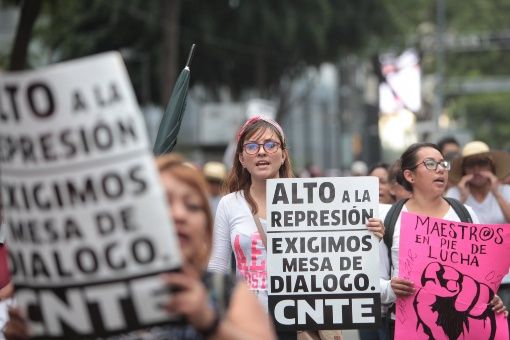
En el marco de la conmemoración del Día del Trabajador, el gremio de docentes en México anunció un paro de 48 horas con el fin de exigir la abrogación de la reforma educativa, entre otras demandas.
La Coordinadora Nacional de Trabajadores de la Educación (CNTE) convocó a una marcha nacional este 1° de mayo y acordó suspender los días 2 y 3 las actividades en las escuelas públicas del país para pedir al gobierno estatal una mesa de negociación con carácter resolutivo.

Durante las próximas 72 horas, el gremio de docentes tiene preparado organizar marchas, así como bloqueos a dependencias federales y carreteras, toma de tiendas trasnacionales y liberación de casetas de peaje.

El secretario general del gremio, Eloy López Hernández, señaló que los bloqueos iniciaron este lunes en horas de la mañana y se retirarán conforme cada grupo así lo decida.

El objetivo es presionar al gobernador de Oaxaca, Alejandro Murat, a retomar la mesa de diálogo.

“Vamos a empezar con una marcha masiva para el 1° de mayo aunado a un probable paro laboral de tres días, donde demostraremos nuestro músculo, y unidad de nuestras bases con las que esperamos doblegar al Estado mexicano”, afirmó Hernández.

«Esta jornada de 72 horas debe ser contundente para exigir la mesa nacional única de negociación a nivel federal y en Oaxaca exigirle al Gobierno del Estado la bilateralidad para atender los temas educativos», declaró por otra parte Wilbert Santiago, vocero de la Sección 22.

¿Cuáles son las demandas?


Entre los puntos que exigen los profesores se encuentran la abrogación de la reforma educativa, impulsada por el presidente Enrique Peña Nieto en 2013.

La reforma plantea la evaluación obligatoria para que los docentes puedan ingresar y mantenerse dentro del sistema educativo, así como también para acceder a mejores sueldos y poder aspirar a mejores cargos.

Los docentes alegan la falta de legitimidad con la que fue realizado el proceso de promulgación de esa ley, debido a que nunca consultaron a la ciudadanía ni al gremio magisterial, además, afirman que ha causado miles de despidos injustos.

Asimismo, exigen también castigo y justicia por los hechos violentos ocurridos el 19 de junio de 2016, en los que policías federales desalojaron de forma violenta el plantón que los profesionales de la educación mantenían en Salina Cruz, Oaxaca.

Entre sus demandas está la libertad incondicional de presos políticos, aparición con vida de los 43 normalistas de Iguala, Guerrero; el respeto irrestricto a los derechos laborales y sindicales de la Sección 22 del Sindicato Nacional de Trabajadores (SNTE) y la búsqueda de una solución inmediata a los problemas sindicales.

En el estado de Oaxaca, la sección 22 del Sindicato Nacional de Trabajadores de la Educación (SNTE), gremial adherente a la Coordinadora Nacional convocó a sus 37 sectores a bloquear carreteras en las ocho regiones de la entidad del estado

Este 1° de mayo, en Ciudad de México, la Coordinadora marchará para entregar su pliego petitorio a la Secretaría de Gobernación de México.

En Chiapas por su parte, las secciones 7 y 40 de Chiapas marcharán en Tuxtla Gutiérrez y posteriormente realizarán un plantón indefinido.

Fuente:http://www.telesurtv.net/news/Maestros-mexicanos-convocan-paro-por-dos-dias-20170501-0015.html

Comparte este contenido:

Anuncian arrancará en Baja California programa educativo para repatriados de Estados Unidos

Estados Unidos/01 mayo 2017/Fuente: El Sol de Tijuana

Baja California será la entidad piloto donde arrancará el programa “Educación sin fronteras” para atender con asesoría educativa a la población mexicana repatriada de Estados Unidos.

El director del Instituto Nacional para la Educación de los Adultos (INEA), Mauricio López Velásquez, dijo que se prevé arrancar dentro de 15 días en Tijuana y Mexicali a la población migrante y repatriada voluntaria que presenta rezago educativo.

Dijo que se trata de uno de los programas emblemáticos que atiende a la población adulta y que se aplicó en cinco estados del occidente del país para certificarlos y apoyarlos en la conclusión de su educación básica.

Mencionó que a partir del endurecimiento de las políticas migratorias estadunidenses, las autoridades educativas decidieron simplificar los trámites que permitiera a los repatriados regularizar sus estudios.

Recordó que de las 217 mil personas repatriadas, dos mil 125 fueron de los llamados dreamers, “el sistema educativo mexicano tiene más de cinco millones de lugares para bachillerato hasta la universidad, por lo que la educación no colapsará, hay espacio”.

Explicó que parte de la simplificación de trámites para acceder a este programa es que se recibirán sin documentos “en la bolsa, bajo protesta de decir verdad, vamos a recibir a la mayoría que soliciten servicio educativo”.

Agregó que estas personas serán ubicadas en el nivel que corresponda luego de ofrecerles una prueba de diagnóstico, “de acuerdo con las encuestas, Tijuana es la principal frontera; estamos trabajando en las adecuaciones para recibir a los paisanos”.

Dijo que existen en la actualidad 13 estados de la República de la frontera que se encuentran revisando todas las adecuaciones que se van a realizar, “sólo les daremos información, y en sus respectivos municipios les prestaremos el servicio”.

Fuente: https://www.elsoldetijuana.com.mx/local/anuncian-arrancara-en-bc-programa-educativo-para-repatriados-de-eua

Comparte este contenido:

México: Las organizaciones magisteriales realizarán un paro el 1 de mayo

México/01 de Mayo de 2017/El Nuevo Día

Protestarán en contra de las medidas de austeridad del gobierno, incluyendo el proyecto cameral 938.

El Frente Amplio en Defensa de la Educación Pública convocó a un paro magisterial el próximo 1 de mayo en contra de las  medidas de austeridad que alegan el gobierno pretende implementar.

Representantes de varias organizaciones que integran el Frente denunciaron que el efecto principal de lo que busca el gobierno es cerrar sobre 300 escuelas, así como la municipalización y privatización de otros planteles del Departamento de Educación (DE).

En conferencia de prensa afuera del Capitolio, los líderes magisteriales también señalaron que las medidas causarán el “desmantelamiento” del sistema de retiro de los educadores, la Universidad de Puerto Rico y la eliminación de recursos de los servicios de educación especial.

Por su parte, la portavoz de EDUCAMOS, Eva Ayala, dijo que los maestros también deben denunciar el proyecto cameral 938 que está pautado para ir a votación mañana en la Cámara de Representantes.

Vamos a perder beneficios marginales, nuestras vacaciones y muy probable el bono de navidad, entre otros”, sostuvo.

Asimismo, denunciaron que esta medida legislativa también reducirá los días por enfermedad y eliminará los convenios colectivos vigentes.

La convocatoria para el paro del 1ro. de mayo incluye una concentración en los predios del Departamento del Trabajo en Hato Rey, de donde  marcharán hacia el sector de la “Milla de Oro” en Hato Rey.

Ese mismo día, diversos sindicatos en la Isla realizarán una manifestación, como parte del Día Internacional del Trabajo.

“Nuestro llamado a los padres, madres, maestros y trabajadores en general es que se unan el 1 de mayo en defensa de la educación pública, en defensa de la Universidad y de un sistema de salud accesible”, manifestó Mercedes Martínez, presidenta de la Federación de Maestros.

“Nos están destruyendo el país a los que no creamos la crisis. Aquí hay unos buitres que siguen garantizándose sus millones a costa del sistema público de enseñanza y somos nosotros los llamados a luchar para defender lo que nos compete. Para tener garantía de que mañana nuestros hijos tendrán una educación accesible, para que puedan estudiar en la universidad del país”, agregó.

Más temprano esta mañana, trascendió que la presidenta de la Asociación de Maestros, Aida Díaz, se reunió en la Fortaleza para buscar que se enmiende el proyecto cameral 938 para que los maestros quedaran excluidos de la reducción en la licencia por enfermedad. La Fortaleza también señaló que no les aplica la reducción de vacaciones por el receso académico del DE.

No obstante, el Frente sostuvo que, más allá de no confiar en que así resulte, de todas formas se opondrán a la pieza legislativa por afectar a los otros trabajadores públicos.

Para entregar una carta con sus reclamos a legisladores, los portavoces trataron de entrar al Capitolio por el ala sur, pero allí tuvieron un intercambio con oficiales de la Policía, quienes les indicaron que esas puertas están cerradas desde las protestas de la semana pasada.

Posteriormente, tuvieron acceso por las entradas laterales y llegaron hasta la oficina del presidente cameral, Johnny Méndez.

Fuente: http://www.elnuevodia.com/noticias/locales/nota/lasorganizacionesmagisterialesrealizaranunparoel1demayo-2314225/


Comparte este contenido:
Page 1036 of 1671
1 1.034 1.035 1.036 1.037 1.038 1.671