By Henry A. Giroux
Across the globe, a new historical conjuncture is emerging in which attacks on higher education as a democratic institution and on dissident public voices in general – whether journalists, whistleblowers, or academics – are intensifying with alarming consequences for both higher education and the formative public spheres that make democracy possible. Hyper-capitalism or market fundamentalism has put higher education in its cross hairs and the result has been the ongoing transformation of higher education into an adjunct of the very rich and powerful corporate interests. Marina Warner has rightly called these assaults on higher education, “the new brutalism in academia.”[i] It may be worse than she suggests. In fact, the right-wing defense of the neoliberal dismantling of the university as a site of critical inquiry is more brazen and arrogant than anything we have seen in the past. What we are witnessing is an attack on universities not because they are failing, but because they are public. This is not just an attack on political liberty but also an attack on dissent, critical education, and any public institution that might exercise a democratizing influence on the nation. In this case the autonomy of institutions such as higher education, particularly public institutions are threatened as much by state politics as by corporate interests. How else to explain in neoliberal societies such as the U.S., U.K. and India the massive defunding of public institutions of higher education, the raising of tuition for students, and the closing of areas of study that do not translate immediately into profits for the corporate sector?
The hidden notion of politics that fuels this market-driven ideology is on display in a more Western-style form of neoliberalism in which the autonomy of democratizing institutions is under assault not only by the state but also by the rich, bankers, hedge fund managers, and the corporate elite. In this case, corporate sovereignty has replaced traditional state modes of governance that once supported higher education as a public good. That is, it is now mostly powerful corporate elites who despise the common good and who as the South African Nobel Prize winner in literature, JM Coetzee, points out “reconceive of themselves as managers of national economies” who want to turn universities into training schools equipping young people with the skills required by a modern economy.”[ii] Viewed as a private investment rather than a public good, universities are now construed as spaces where students are valued as human capital, courses are defined by consumer demand, and governance is based on the Walmart model of labour relations. For Coetzee, this attack on higher education, which is not only ideological but also increasingly relies on the repressive, militaristic arm of the punishing state, is a response to the democratization of the university that reached a highpoint in the 1960s all across the globe. In the last twenty years, the assault on the university as a center of critique, but also on intellectuals, student protesters, and the critical formative cultures that provide the foundation for a substantive democracy has only intensified.[iii]
Coetzee’s defense of education provides an important referent for those of us who believe that the university is nothing if it is not a public trust and social good; that is, a critical institution infused with the promise of cultivating intellectual insight, the civic imagination, inquisitiveness, risk-taking, social responsibility, and the struggle for justice. Rather than defining the mission of the university by mimicking the logic of the market in terms of ideology, governance, and policy, the questions that should be asked at this crucial time in American history might raise the following issues: how might the mission of the university be understood with respect to safeguarding the interests of young people at a time of violence and war, the rise of a rampant anti-intellectualism, the emerging specter of authoritarianism, and the threat of nuclear and ecological devastation? What might it mean to define the university as a public good and democratic public sphere rather than as an institution that has aligned itself with market values and is more attentive to market fluctuations and investors than educating students to be critically engaged citizens? Or, as Zygmunt Bauman and Leonidas Donskis write: “how will we form the next generation of … intellectuals and politicians if young people will never have an opportunity to experience what a non-vulgar, non-pragmatic, non-instrumentalized university is like?”[iv] As public spheres – once enlivened by broad engagements with common concerns – are being transformed into “spectacular spaces of consumption”,[v] financial looting, the flight from mutual obligations and social responsibilities has intensified and resulted in not only a devaluing of public life and the common good, but also a crisis in the radical imagination, especially in terms of the meaning and value of politics itself.[vi]
What I am suggesting is that the crisis of higher education is about much more than a crisis of funding, an assault on dissent, and a remaking of higher education as another institution designed to serve the increasing financialization of neoliberal driven societies; it is also about a crisis of memory, agency, and the political. As major newspapers all over the country shut down and the media becomes more concentrated in the hands of fewer mega corporations, higher education becomes one of the few sites left where the ideas, attitudes, values, and goals can be taught that enable students to question authority, rethink the nature of their relationship with others in terms of democratic rather than commercial values, and take seriously the impending challenges of developing a global democracy.
The apostles of predatory capitalism are well aware that no democracy can survive without an informed citizenry, and they implement a range of policies to make sure that higher education will no longer fulfill such a noble civic task. This is evident in the business models imposed on governing structures, defining students as customers, reducing faculty to Wal-Mart workers, imposing punishing accounting models on educators, and expanding the ranks of the managerial class at the expense of the power of faculty.
As politics is removed from its political, moral, and ethical registers – stripped down to a machine of social and political death for whom the cultivation of the imagination is a hindrance, commerce is the heartbeat of social relations, and the only mode of governance that matters is one that rules Wall Street. Time and space have been privatized, commodified, and stripped of human compassion under the reign of neoliberalism. We live in the age of a new brutalism marked not simply by an indifference to multiple social problems, but also defined by a kind of mad delight in the spectacle and exercise of violence and what the famed film director, Ken Loach, has called “conscious cruelty.”[vii] America is marked by a brutalism that is perfectly consistent with a new kind of barbaric power, one that puts millions of people in prison, subjects an entire generation to a form of indentured citizenship, and strips people of the material and symbolic resources they need to exercise their capacity to live with dignity and justice.
For those of us who believe that education is more than an extension of the business world and the new brutalism, it is crucial that educators, artists, workers, labour unions, and other cultural workers address a number of issues that connect the university to the larger society while stressing the educative nature of politics as part of a broader effort to create a critical culture, institutions, and a collective movement that supports the connection between critique and action and redefines agency in the service of the practice of freedom and justice. Let me mention just a few.
First, educators can address the relationship between the attack on the social state and the transformation of higher education into an adjunct corporate power. As Stefan Collini has argued, under the regime of neoliberalism, the “social self” has been transformed into the “disembedded individual,” just as the notion of the university as a public good is now repudiated by the privatizing and atomistic values at the heart of a hyper-market driven society.[viii] Clearly, in any democratic society, education should be viewed as a right, not an entitlement. This suggests a reordering of state and federal priorities to make that happen. Much needed revenue can be raised by putting into play even a limited number of reform policies in which, for instance, the rich and corporations would be forced to pay a fair share of their taxes, a tax would be placed on trade transactions, and tax loopholes for the wealthy would be eliminated. It is well known that the low tax rate given to corporations is a major scandal. For instance, the Bank of America paid no taxes in 2010 and “got $1.9 billion tax refund from the IRS, even though it made $4.4 billion in profits.”[ix]
In addition, academics can join with students, public school teachers, unions, and others to bring attention to wasteful military spending that if eliminated could provide the funds for a free public higher education for every qualified young person in the country. While there is growing public concern over rising tuition rates along with the crushing debt students are incurring, there is little public outrage from academics over the billions of dollars squandered on a massive and wasteful military budget and arms industry. As Michael Lerner has pointed out, democracy needs a Marshall Plan in which funding is sufficient to make all levels of education free, while also providing enough social support to eliminate poverty, hunger, inadequate health care, and the destruction of the environment. There is nothing utopian about the demand to redirect money away from the military, the powerful corporations, and the upper 1 percent.
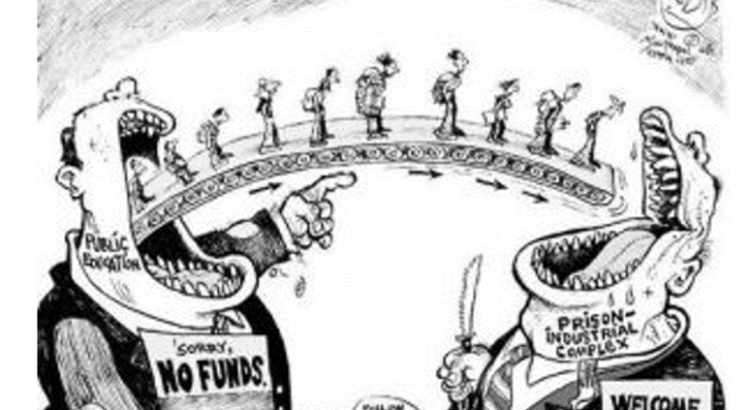
Second, addressing these tasks demands a sustained critique of the transformation of a market economy into a market society along with a clear analysis of the damage it has caused both at home and abroad. Power, particularly the power of the largest corporations, has become more unaccountable and “the subtlety of illegitimate power makes it hard to identify.”[x] Disposability has become the new measure of a savage form of casino capitalism in which the only value that matters is exchange value. Compassion, social responsibility, and justice are relegated to the dustbin of an older modernity that now is viewed as either quaint or a grim reminder of a socialist past. This suggests, as Angela Davis, Michelle Alexander, and others have argued, that there is a need for academics and young people to become part of a broader social movement aimed at dismantling the repressive institutions that make up the punishing state. The most egregious example of this is the prison-industrial complex, which drains billions of dollars in funds to put people in jail when such funds could be used for expanding public and higher education.We live in a country in which the police have become militarized, armed with weapons from the battlefields of Iraq and Afghanistan.[xi] The United States prison system locks up more people than any other country in the world, and the vast majority of them are people of color.[xii] Moreover, public schools are increasingly modeled after prisons and are implementing policies in which children are arrested for throwing peanuts at a school bus or violating a dress code.[xiii] The punishing state is a dire threat to both public and higher education and democracy itself. The American public does not need more prisons; it needs more schools, free health services, and a living wage for all workers.
Third, academics, artists, journalists, and other young people need to connect the rise of subaltern, part-time labour – or what we might call the Walmart model of wealth and labour relations – in both the university and the larger society to the massive inequality in wealth and income that now corrupts every aspect of American politics and society. No democracy can survive the kind of inequality in which “the 400 richest people…have as much wealth as 154 million Americans combined, that’s 50 percent of the entire country [while] the top economic 1 percent of the U.S. population now has a record 40 percent of all wealth and more wealth than 90 percent of the population combined.”[xiv] Senator Bernie Sanders provides a statistical map of the massive inequality at work in the United States. In a speech to the U.S. Senate, he states:
Today, Madam President, the top 1% owns 38% of the financial wealth of America, 38%. And I wonder how many Americans know how much the bottom 60% own. They want people to think about it. Top 1% own 38% of the wealth. What do the bottom 60% own? The answer is all of 2.3%. Top 1% owns 38% of the financial wealth. The bottom 60% owns 2.3%. Madam President, there is one family in this country, the Walton family, the owners of Wal-Mart, who are now worth as a family $148 billion. That is more wealth than the bottom 40% of American society. One family owns more wealth than the bottom 40% of American society…That’s distribution of wealth. That’s what we own. In terms of income, what we made last year, the latest information that we have in terms of distribution of income is that from 2009-2012, 95% of all new income earned in this country went to the top 1%. Have you all got that? 95% of all new income went to the top 1%, which tells us that when we talk about economic growth, which is 2%, 3%, 4%, whatever it is, that really doesn’t mean all that much because almost all of the new income generated in that growth has gone to the very, very, very wealthiest people in this country.[xv]
Democracy in the United States, and many other countries, has been hijacked by a free-floating class of ultra-rich and corporate powerbrokers and transformed into an oligarchy “where power is effectively wielded by a small number of individuals.”[xvi] At least, this is the conclusion of a recent Princeton University study, and it may be much too moderate in its conclusions.
Fourth, academics need to fight for the rights of students to get a free education, for them to be given a formidable and critical education not dominated by corporate values, and to have a say in the shaping of their education and what it means to expand and deepen the practice of freedom and democracy. In many countries such as Germany, France, Denmark, Cuba, and Brazil, post-secondary education is free because these countries view education not as a private right but as a public good. Yet, in some of the most advanced countries in the world such as the United States and Canada, young people, especially from low income groups have been excluded from getting a higher education and, in part, this is because they are left out of the social contract and the discourse of democracy. They are the new disposables who lack jobs, a decent education, hope, and any semblance of a life better than the one their parents inherited. They are a reminder of how finance capital has abandoned any viable vision of a better future for young people. Youth have become a liability in the world of high finance, a world that refuses to view them as an important social investment.
Fifth, there is a need to oppose the ongoing shift in power relations between faculty and the managerial class. Too many faculty are now removed from the governing structure of higher education and as a result have been abandoned to the misery of impoverished wages, excessive classes, no health care, and few, if any, social benefits. As political scientist Benjamin Ginsburg points out, administrators and their staff now outnumber full time faculty producing two-thirds of the increase in higher education costs in the past 20 years. This is shameful and is not merely an education issue but a deeply political matter, one that must address how neoliberal ideology and policy has imposed on higher education an anti-democratic governing structure.
Sixth, it is important to stress once again that education must be viewed not simply as a practice endemic to schooling but goes on throughout society through a range of cultural apparatuses extending from the mainstream media to various aspects of screen culture. Education is at the center of politics because it is crucial to how agency is formed, how people view themselves and their relations to others. Educators and other cultural workers must acknowledge that domination is as much ideological as it is economic and structural. This means taking on the challenge of embracing the symbolic and ideological dimensions of struggle as part of the struggle against oppression and domination. Educators need to launch pedagogical campaigns aimed at dismantling the common sense logic of neoliberalism: people are only consumers, government is the enemy, the market should govern all of social life, social bonds are a pathology, self-interest is the highest virtue, and last but not least the market should govern itself. University faculty must join together and find ways to press the claims for economic and social justice and do so in a discourse that is aimed at multiple audiences and is both rigorous and accessible. Universities need to defend not only the idea of the university as a democratic public sphere but also faculty as public intellectuals capable and willing to question authority, hold power accountable, and be critical of existing affairs.
Finally, seventh, the fight to transform higher education cannot be waged strictly inside the walls of such institutions by faculty and students alone. As radical social movements more recently in Spain, Portugal, and India have made clear, there is a need for new social and political formations among faculty, unions, young people, cultural workers, and most importantly social movements, all of which need to be organized in part for the defense of public goods and what might be called the promise and ideals of a radical democracy. Any struggle against the anti-democratic forces that are mobilizing once again all over the world must recognize that power is not global and politics is local. A financial elite operates now in the flow and international spaces of capital and have no allegiances to nation-states and can impose their financial will on these states as we have seen recently in some European countries. Resistance must address this new power formation and think and organize across national boundaries. Resistance on a global level is no longer an option, it is a necessity.
Neoliberal societies now live in the shadow of the authoritarian corporate state, but the future is still open. The time has come to develop a political language in which civic values and social responsibility – and the institutions, tactics, and long-term commitments that support them – become central to invigorating and fortifying a new era of civic engagement, a renewed sense of social agency, and an impassioned international social movement with the vision, organization, and set of strategies capable of challenging the neoliberal nightmare that now haunts the globe and empties out the meaning of politics and democracy.
Photo: Google Images
[i] Marina Warner, “Dairy,” The London Review of Books 36:17, September 11, 2014.
[ii]JM Coetzee, “JM Coetzee: Universities head for extinction” Mail & Guardian, November 1, 2013.
[iii] Ibid.
[iv] Zygmunt Bauman and Leonidas Donskis, Moral Blindness: The Loss of Sensitivity in Liquid Modernity, (Cambridge, UK: Polity Press, 2013), p. 139.
[v] Steven Miles, Social Theory in the Real World (Thousand Oaks, Sage, 2001), p. 116.
[vi] Joshua Kurlantzick, Democracy in Retreat (New Haven: Yale University Press, 2013).
[vii] Fran Blandy, “Loach film on shame of poverty in Britain moves Cannes to tears,” Yahoo News, May 13, 2016.
[viii] These two terms are taken from Stefan Collini, “Response to Book Review Symposium: Stefan Collini, What are Universities For,” Sociology 1-2 (February 5, 2014).
[ix] Michael Snyder, “You won’t believe who is getting away with paying zero taxes while the middle class gets hammered,” InfoWars.com, February 19, 2013.
[x] Susan George, “State of Corporations: The Rise of Illegitimate Power and the Threat to Democracy,” in Transnational Institute and Occupy.com. State of Power 2014: Exposing the Davos Class (February 2014).
[xi] Radley Balko, Rise of the Warrior Cop: The Militarization of America’s Police Forces (New York: Public Affairs, 2013), and Jill Nelson, ed. Police Brutality (New York: Norton, 2000).
[xii] Michelle Alexander, The New Jim Crow (New York: The New Press, 2010).
[xiii] Henry A. Giroux, Youth in a Suspect Society (New York: Palgrave, 2012).
[xiv] David DeGraw, “Meet the Global Financial Elites Controlling $46 Trillion in Wealth,”Alternet, August 11, 2011.
[xv] Sen. Bernie Sanders, “A Threat to American Democracy,” RSN, April 1 , 2014
[xvi] Tom McKay, “Princeton Concludes What Kind of Government America Really Has, and It’s Not a Democracy,” Popular Resistance, April 16, 2014.
Bio:
Henry A. Giroux is University Professor for Scholarship in the Public Interest at McMaster University in Hamilton, Ontario. His many books include Theory and Resistance in Education(1983), Critical Theory and Educational Practice (1983), Teachers as Intellectuals: Toward a Critical Pedagogy of Learning (1988), Border Crossings: Cultural Workers and the Politics of Education (1992),Living Dangerously: Multiculturalism and the Politics of Culture (1993), Pedagogy and the Politics of Hope Theory, Culture, and Schooling (1997), Impure Acts: The Practical Politics of Cultural Studies(2000), Public Spaces/Private Lives: Democracy Beyond 9/11 (2003), Take Back Higher Education: Race, Youth, and the Crisis of Democracy in the Post Civil Rights Era (co-authored with Susan Searls Giroux, 2004), The Terror of Neoliberalism: Authoritarianism and the Eclipse of Democracy(2004), The University in Chains: Confronting the Military-Industrial-Academic Complex (2007),Youth in a Suspect Society: Democracy or Disposability? (2009), America’s Education Deficit and the War on Youth (2013), and America’s Addiction to Terrorism (2016).



 Users Today : 113
 Total Users : 35510923
 Views Today : 591
 Total views : 3643449
Resumen: Dos proyectos de ley de educación se encuentran en sección de discusión la legislatura de New Jersey. Ambos son factibles para ganar la aprobación en la Asamblea Estatal y el Senado, respectivamente. Esa aprobación llegó como gobernador Chris Christie estaba haciendo el caso para revertir la histórica decisión del distrito escolar ABAD del estado, y la minoría republicana de la Asamblea tenido duras declaraciones de denegación demócratas para entretener a un compromiso con el gobernador en la financiación de las escuelas. El primero de estos dos proyectos de ley, patrocinado por el presidente del Senado Steve Sweeney (D-3), tiene que ver con la creación de una comisión para financiar completamente a las escuelas con fondos suficientes, pues, ha habido déficit de hasta $ 1 billón un año durante el mandato de Christie. El segundo proyecto terminaría la práctica del estado de forzar fiadores de los padres para continuar el pago de préstamos estudiantiles de sus hijos, incluso en el caso de su muerte. Nueva Jersey es un caso atípico entre los estados similares en sus prácticas de cobro agresivas y recibió atención negativa en la prensa después de una investigación ProPublica mostró una mujer todavía pagar los préstamos de su hijo después de su asesinato. Ese proyecto de ley, patrocinado por los Asambleístas Vince Mazzeo (D-2) y Andrew Zwicker (D-16).