América del Norte/México/10.07.18/Por César Acosta Amaya/Fuente: www.noticiasdelsoldelalaguna.com.mx.
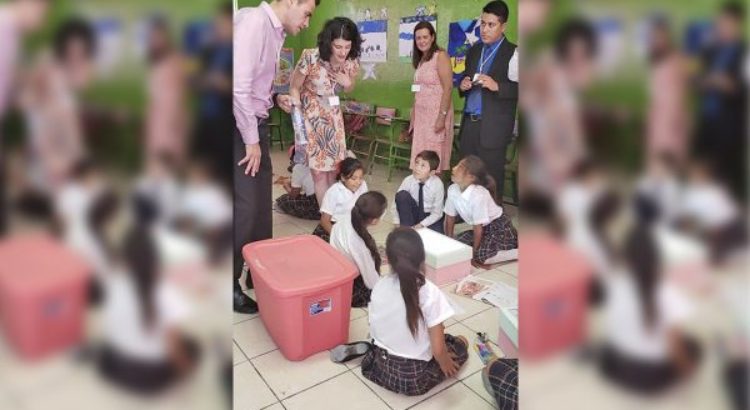
La Secretaría de Educación, a través de la Subsecretaría de Educación en la Región Laguna Durango, ha implementado el programa de Fortalecimiento de la Igualdad de Género, con el objetivo de diseñar e instrumentar acciones que permitan la transversalidad de las perspectivas de igualdad de género, derechos humanos y erradicación de la violencia de género en el sector educativo estatal.
El programa contempla acciones que favorezcan la igualdad de género en documentos normativos que regulan los procesos educativos de la educación básica, media superior y superior, como son planes y programas de estudio, contenidos curriculares, materiales educativos, así como sensibilización del personal docente y administrativo de las instituciones de educación inicial, básica, media superior y superior.
Una de las metas establecidas en el proyecto para la Institucionalización de las Perspectivas de Género es la formación y capacitación en perspectiva de género al año 2022, 1,450 Enlaces de Género, enlaces que deberán obtener la certificación correspondiente.
A partir del inicio del ciclo escolar 2018-2019, se realizarán actividades que permitan la actualización de reglamentos escolares, acuerdos de convivencia y códigos de ética con perspectivas de igualdad de género, derechos humanos y erradicación de violencia de género.
Será implementado también el Sistema Automatizado de Registro de Casos de Violencia Escolar y Laboral de Género, sistema que dará cuenta de la incidencia de violencia y permitirá generar acciones preventivas.
Se realizarán campañas de difusión para promover una cultura institucional basada en el respeto a los derechos humanos, igualdad de género y erradicación de la violencia de género y se desarrollarán estudios para la elaboración de los diagnósticos de las situaciones de discriminación y violencia de género en el Sistema Educativo Estatal.
El subsecretario de Educación en la Región Laguna Durango, Cuitláhuac Valdés Gutiérrez, destacó que estas acciones se realizan con la participación de los directores, docentes y personal de apoyo y asistencia a la educación de las instituciones ubicadas en los once municipios de la jurisdicción de esta Subsecretaría.
Cabe destacar que las matriculas en las escuelas de la Región Laguna actualmente son muy similares entre hombres y mujeres, anteriormente la cantidad de hombres que estudiaban era mayor.
En nivel preescolar se cuenta con 424 escuelas, el universo total de estudiantes es de 23,557, de los cuales 12,185 son hombres y 11,372 mujeres; en primaria son 518 escuelas con 71,353 alumnos, 36,267 son hombres y 35,086 mujeres; en secundaria hay 185 escuelas, del universo total de alumnos que son 31,017, son 15,701 hombres y 15,306 mujeres y en Bachillerato hay 80 escuelas con 25,101 estudiantes, de los cuales 12,282 son hombres y 12,819 mujeres. Estas cifras reflejan mayor equidad de género cuando se trata de educación.
Fuente de la noticia: https://www.noticiasdelsoldelalaguna.com.mx/local/igualdad-de-genero-en-la-educacion-seed
A great deal has changed in recent decades, in educating our young people to meet various challenges along the path of life. Most would agree that there have been major strides in technology and teaching techniques, designed to better equip students for a changing world with emphasis on knowledge needed for success. Nothing wrong with that, except in the process, it would appear that some traditional values have faded.
In the modern world today, where much of life rumbles along at a maddening pace, even commenting on this aspect of our educational system could be frowned upon as being out of step with education in today’s world. Education officials are confronted with a wide range of complex issues these days, and obviously officials strive to provide the best for students. However, no educational system is perfect, and there are always problems that require input from parents and community leaders, in trying to uphold values such as discipline and respect.
In Bermuda today, just as it is in many countries, the impact of illegal drugs and the consumption of alcohol by some young people, has been a problem that threatens the vulnerable, in addition to creating additional problems for parents and teachers, and eventually the community.
It is a situation that has challenged every government.
It should be noted that our teaching professionals are to be commended for their daily contribution in classrooms throughout the island, a task too often taken for granted.
With numerous changes in teaching from the way it was decades ago, it is also worth noting that it is still crucial for students to learn the true meaning of why discipline, respect, and a commitment to being a good citizen, are values that never change.
Our schools are generally thought of as learning centres for all there is to know about how to be successful. But these days in many countries, values such as discipline and respect have diminished with an increase in negative behaviour patterns.
Many of Bermuda’s heroes will never have their names flashed across the television screens, or in banner newspaper headlines. Yet these were the people who diligently toiled against enormous hardships and social injustices, to help steer Bermuda towards a society where decency, respect, and truth formed the pillars of society.
Yes, they knew the importance of economic success, but they also knew without values, success would be shallow.
Bermuda needs to take a deep look at itself in the area of values, because without them, our future will be up for question. While the Government cannot solve all community problems, they must be seen and heard to do everything possible to avoid a gradual slide to an “anything goes” society, where respect for others is shoved under the bus. This is a growing concern throughout our communities.
If our young people are influenced by the notion that what is popular gains more attention than what is right, the next generation will face even bigger challenges. Education involves far more than academics.
We often hear of things being different today, but when essential values are bypassed, as being outdated, or no longer relevant, seeds are being planted for a weakened society with the door open for potential civil chaos.
Discipline and respect were very much a part of our education system years ago, and with Bermuda being a religious community, it was normal for most schools to have a brief moment of devotion, prior to starting the school day.
Much has changed. Today, families seldom sit together at meal times to discuss matters of interest. The home should be the setting where education begins.
Instead, swallowed up in a world of cyberspace activity, there is little time for one-on-one family conversation. Some might say this is just a part of modern society.
We hear often that more financial investment should be made to enhance our educational system, and while that is positive, a real concern should be about what values have faded from the system, when it comes to discipline and respect for strong values.
Students of today are expected to be leaders of tomorrow, but they will only be successful if armed with solid values and a commitment to making Bermuda a safe and peaceful island. Bermuda must make use of all of its resources to protect values for future generations.
It is a challenge bigger than politics, and success will depend on how well we all work together for the good of the community.
Source of the article: http://www.royalgazette.com/al-seymour/article/20180630/what-may-be-missing-in-our-education-system
América del Norte/México/10.07.18/Fuente: www.elsoldepuebla.com.mx.
En este primer acercamiento, el rector reconoció la victoria en el ámbito local de Claudia Sheinbaum, de quien dijo “es muy cercana a nosotros y vamos a colaborar
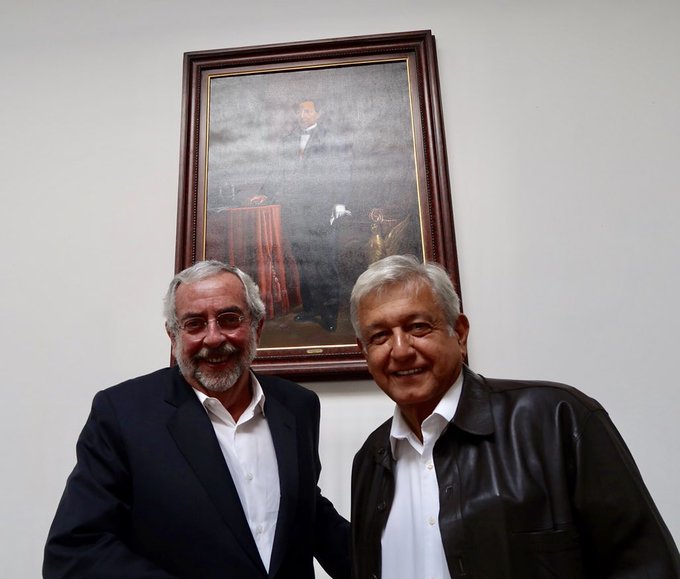
El rector de la UNAM, Enrique Graue, se reunió con el candidato ganador de la elección presidencial, Andrés Manuel López Obrador, para dialogar sobre las contribuciones de la máxima casa de estudios del país al próximo Plan Nacional de Desarrollo.
En entrevista a su llegada a las oficinas ubicadas en la colonia Roma, puntualizó que “México espera muchísimo de este gobierno y ahí hay un ánimo generalizado de cambio. Espero un México esforzado, honorable, trabajando por el desarrollo”.
Indicó que además de acudir a felicitar al candidato presidencial por su victoria, fue también a “presentarle las propuestas que la Universidad hace para el Plan Nacional de Desarrollo, tanto en temas prioritarios del país como en lo que tenemos en relación a educación, ciencia, tecnología e innovación”.
Graue Wiechers manifestó que se trata de 10 temas que se desarrollaron en documentos trabajados de manera conjunta con universidades públicas y los centros de investigación del país.
En este, el primer acercamiento con el candidato presidencial triunfador, Graue también reconoció la victoria, en el ámbito local, de Claudia Sheinbaum, de quien dijo “es muy cercana a nosotros, es una gente de primera, vamos a colaborar”.
A su salida del encuentro, Graue Wiechers indicó que se trabaja en un plan para analizar cómo aumentar la capacidad en educación superior, que si bien no podría hacerse de inmediato, “sí hay que hacer un proyecto para crecerla y es lo que presentaremos”.
En el breve encuentro, en que consideró haber tenido “la mejor de la recepciones”, por la sencillez del ganador de la elección presidencial, mencionó que la próxima reunión entre ambos sería una vez que éste sea designado presidente electo.
El rector de la Universidad Nacional Autónoma de México (UNAM) manifestó que López Obrador “entiende muy bien la Universidad” y se congratuló de que nueve de los personajes que han sido propuestos para integrar el próximo gabinete federal procedan de esta casa de estudios.
Fuente de la noticia: https://www.elsoldepuebla.com.mx/mexico/politica/rector-enrique-graue-presenta-a-amlo-propuestas-de-unam-para-mejorar-educacion-1822354.html?token=807494996
The minutes and hours of the school day are critical to build knowledge, foster student motivation, and drive student outcomes. To make the most of precious instructional time, teachers must first develop engaging lessons that meet the various needs of students. This requires teachers to collaborate, plan, and reflect outside of instructional time. Effective school schedules maximize the time teachers spend with their students but also recognize teachers’ additional responsibilities beyond instructional time. Unfortunately, not enough schools successfully balance these priorities.
Teachers in the United States spend far more time engaged in active instruction than teachers in other high-performing countries.1 Based on self-reported data, teachers in the United States spend 27 hours teaching out of 45 hours of work per week.2 Compare this with teachers in Singapore, who teach for only 17 hours per week, or teachers in Finland, who teach for a total of 21 hours per week.3 Schools in these countries prioritize time for planning and collaboration, recognizing that developing and executing lessons take time and preparation.4 According to a recent analysis of more than 140 school districts, the average length of a U.S. teacher’s workday is 7.5 hours.5 In another analysis of more than 120 school districts, the most common length of time allotted for planning was 45 minutes per day.6 In this short time, teachers must grade student work, plan for future lessons, engage with families, and complete necessary paperwork. As a result, teachers have little time to plan or collaborate with peers.7
The squeeze for time to plan lessons and complete other administrative tasks shapes a school’s professional environment and, ultimately, affects the quality of instruction. In a recent survey from the American Federation of Teachers, one of teachers’ two most cited “everyday stressors” was time pressure.8 As teachers are largely separate from other educators during instruction, lack of time for collaboration can be very isolating. More than half of lower secondary school teachers in the United States report that they do not teach jointly or observe other teachers.9 Such practices can improve teaching quality by granting teachers opportunities to receive feedback on their lesson execution and infuse new best practices into their repertoire.
In addition, providing teachers with more time to plan and attend to other responsibilities throughout the school day creates systematic opportunities to support new teachers and stretch more seasoned teachers—increasing the likelihood of teacher retention. During this structured planning time, new teachers should receive the coaching and personalized training they need to maximize their effectiveness and meet their professional goals. Meanwhile, experienced teachers can pursue leadership roles or coach new teachers.
Fortunately, schools can look to several promising models to change their typical schedules. The Center for American Progress compiled five of these innovative school schedules. Some of these schedules have already been implemented in schools across the country to improve instruction and ensure that teachers have ample time to teach, prepare, and develop their craft. CAP has also included teachers’ ideas for alternatives to the traditional school day model.
While each example schedule varies, there were similarities in how school leaders and teachers at each school reimagined the use of time. These innovative schedules all included:
Additional time for planning and collaboration
Flexible instructional blocks to differentiate content to student need
Opportunities for small group instruction or student-directed learning
Innovative school schedules: Example schedules from schools across the country
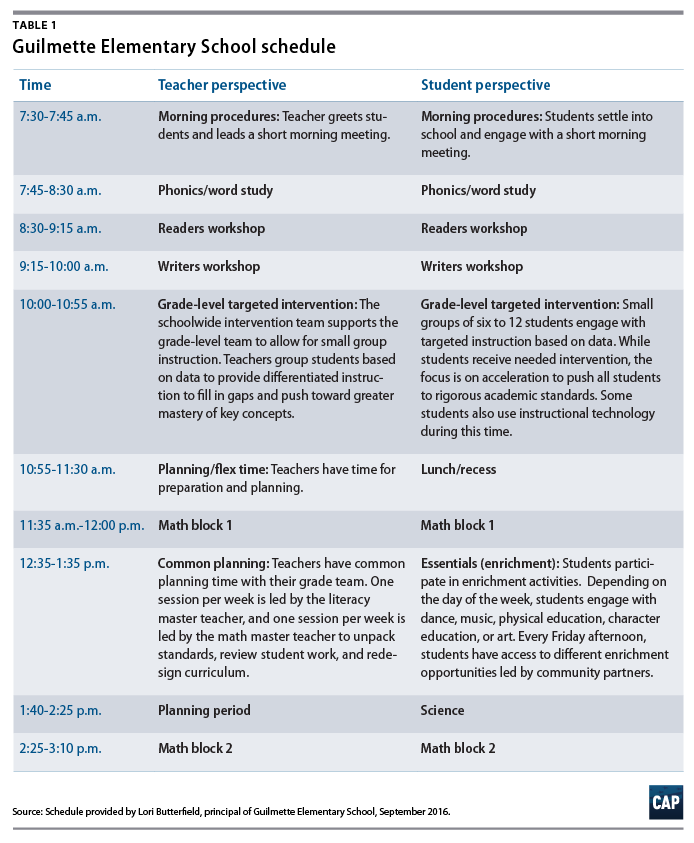
Guilmette Elementary School in Lawrence, Massachusetts, added more than 260 hours of instructional time to the school year and built in common planning time by extending the school day and strategically aligning grade team schedules. The schedule also allows for targeted intervention and enrichment opportunities for all students. (see Table 1) Students follow a similar schedule on Mondays through Thursdays. On Fridays, students participate in high-quality enrichment programming from noon to 2:30 p.m., which is led by community partners. These enrichment activities include art, music, yoga, and cooking. Teachers participate in professional development and planning at that time.10
Operations and cost
The extra instructional hours are a significant cost. The district’s teacher contract provides teachers with a stipend of $2,500 per year for added hours that is distributed evenly across their paychecks. Moreover, the quality of the enrichment programs offered on Friday is dependent on the community partners that teach the programs. Guilmette has worked to find high-quality, affordable partners.11
Outcomes
In the four years since Guilmette has implemented the new schedule, its English language arts and math proficiency scores have steadily improved; since 2013, Guilmette outperformed other elementary schools in the district. More information is available on the school’s report card.12
Objectives
Add 260 or more instructional hours each school year
Provide collaborative planning time for teachers
Create added opportunities for enrichment and targeted intervention that focuses on acceleration
Achievement First Greenfield middle school schedule, New Haven, Connecticut
What’s different about this schedule?
Greenfield schools, which are a part of the Achievement First network, designed a schedule that leverages four modalities of learning: self-directed learning; small group learning; large group instruction, and immersive expeditions.13 Students engage in daily self-directed learning to build responsibility and differentiate the pace of their learning. During this time, students use independent work or technology to review new concepts and move through mastery of content at their own pace. Students also participate in small group learning in sections of 14 to 16 students to dig into specific topics and receive individual feedback. Larger group instruction is reserved for seminars, debates, and experiments.
Every eight weeks, students engage in immersive expeditions for one to two weeks that explore a specific issue and apply skills to the real world. Expeditions such as creating a play, television show, or movie allow them to use writing, improvisation, and teamwork skills to bring stories to life. For example, in the expedition “Make your story come to life,” students write and produce scenes or short plays to be performed by other actors. They engage with a professional theater company for storytelling workshops and go on behind-the-scenes tours.14
Interactive digital learning is a key element of the Greenfield model. A cloud-based Personalized Learning Platform, or PLP, takes the place of traditional textbooks. Students use a laptop to access their online self-directed content, track progress toward their goals, and take assessments to demonstrate mastery of concepts. This system minimizes teachers’ work and increases transparency of student progress. Teachers or students do not need to input results to track progress; the platform does it automatically. Teachers, students, and families can log in to access student progress anywhere with an internet connection. It also helps the school communicate with parents and families.15
Every teacher is responsible for leading one instructional area—either humanities, math, science, writing, or social studies. This specialization allows teachers to focus on achieving ambitious results in their content area. A yearly pacing calendar identifies where students must perform at every point in the year in order to be on track with these ambitious outcomes. Teachers use pacing reports each day to determine where students are performing relative to the bar and to adjust their instruction in ways that will maximize the number of students who are on and ahead of pace.16
In addition, Greenfield differentiates teachers’ roles and schedules to allow for specialization, planning, and life balance.17 This includes collaborative planning time for all teachers, differentiated coaching, and professional development, as well as growth opportunities based on teachers’ skills and experience. Greenfield also offers a staggered teaching schedule for more experienced teachers.
Within each grade, students are organized into goal teams of 10 to 12 students and assigned a goal coach. These teams meet daily in order to set and reflect on academic, life habit, or enrichment goals; deepen relationships with the goal coach and other goal team members; and build habits of success. Within goal teams, students are paired off with another student, called a running partner. These pairs provide mutual support and accountability to one another as they strive for ambitious short- and long-term goals. Goal teams are led by a goal coach who is a staff member in the school. The goal coach works closely with one goal team to build community and to be a primary support for each student and running partner pair.18
Operations and cost
The ongoing operation of this schedule is not more costly than other schedules that Achievement First operates in its network. Core to Achievement First’s mission is to operate with the same public dollars as traditional district schools in the geographies where it operates.19
Outcomes
The Greenfield schools piloted the model in kindergarten and middle school grades, all of which saw proficiency exceed or equal the scores of other Achievement First schools in Connecticut after just one year. Kindergartners exceeded 90 percent proficient rates in reading, and 60 percent of students demonstrated at least 75 percentile growth in math. For middle school grades, average scores on English language arts weekly quizzes ranked first or second in the overall Achievement First Connecticut network. Fifth grade math scores exceeded the network average, but sixth grade scores were below the average.20For more information on socioemotional growth, review the Achievement First’s Greenfield Schools Year 1 Pilot.21
Objectives
Allow for accelerated, differentiated academics through four modalities of learning: self-directed learning time; small group learning; large group learning; and immersive expeditions
Build in time for enrichment
Foster habits of success in all kids, including curiosity, personal growth, empathy, gratitude, drive, and teamwork
Emphasize the importance of student, family, and staff motivation
Differentiate teacher roles based on experience and create more time for planning for all instructional staff
Reduce turnover by finding ways to accommodate senior teachers who need more flexible schedules
Generation Schools secondary schedule, Brooklyn, New York
What’s different about this schedule?
Generation Schools Network’s secondary school model creates up to 30 percent more learning time than traditional public schools in New York City and provides opportunities for differentiated instruction. It also reduces student-to-teacher ratios and overall teacher workloads to facilitate the development of supportive teacher-student relationships.22
Furthermore, teachers have more time for collaboration and professional development. All teachers, as part of their approximately 180-day work year, participate in a one- to two-week Summer Institute dedicated to collaborative planning in preparation for the school year.23 In addition, grade teams have two weeks of professional collaborative time staggered throughout the year when their students are in intensives. This is in addition to the collaborative time that teachers have every day.24
To reduce teacher workload and increase instructional time, the Generation Schools Network differentiates instructional roles—foundation, studio, and intensive teachers. This allows the school to build on a wider range of teachers’ strengths and to design roles and responsibilities that help teachers be effective and reduce turnover. In addition, it reduces teachers’ student load. Teachers have 75 or fewer students daily compared with their peers in New York City traditional public high schools, who often teach 150 students daily.25 The model organizes teachers into grade level teams and a college and career intensives team. The college and career intensives team rotates from grade to grade over the course of the year, spending a month with students exploring college and career pathways. Teachers on that designated grade team are not responsible for students that month and can use that time for collaboration and breaks. By staggering teacher breaks, Generation Schools Network expands the instructional year for students without increasing the number of working days for teachers.26
Every student also has a differentiated schedule that fits their needs. Students participate in extended foundation courses—including interdisciplinary courses on humanities or science, technology, engineering, and math, or STEM—which teach required subjects for all students as well as have various studio courses based on their interests. Studio courses include art history, physical education, art, foreign languages, or advanced sciences.27
Operations and cost
Generation Schools’ model reconfigures the same number of staff members who are employed in a conventional school model so that each school can offer much more planning time to teachers and instructional time to students without increasing staff costs, which are a majority of a school’s budget. Depending on how districts budget, this type of schedule may require additional costs for maintenance or transportation.28
Outcomes
Generation Schools Network has improved student achievement and graduation rates. Brooklyn Generation School, or BGS, has improved attendance, course completion, and graduation rates. At 69 percent, the four-year graduation rate at BGS has matched that for the city overall—70 percent—and outperformed schools with a similar demographic of students. These achievements are especially remarkable, as 85 percent of BGS’ students enter high school behind or significantly behind. In addition, 100 percent of the 2016 graduating class was accepted into college—many receiving multiple admissions and significant financial aid to make the opportunity real.29
Objectives
Increase instructional time for all students and opportunities to differentiate instruction
Reduce student-to-teacher ratios and overall teacher workloads to facilitate the development of supportive teacher-student relationships
Integrate collaborative planning time for teacher teams
Model school schedules designed by teachers
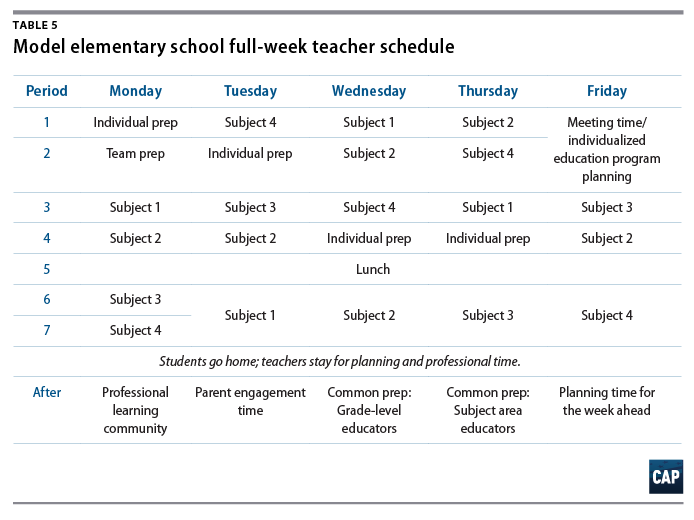
Model elementary school schedule
Created by Lexie Woo, fourth and fifth grade teacher in Queens, New York
What’s different about this schedule?
This schedule allows educators the opportunity to improve their instruction through strategic collaboration with colleagues, additional planning time, and ongoing feedback from administrators.
The timing of instructional blocks rotates to diffuse the negative impact of time-sensitive factors, such as tardiness, early dismissals, fatigue, medication use, and attention span. In addition, each subject has a double instructional block once per week, providing time for innovative educational practices, including multidisciplinary learning; project-based learning; and science, technology, engineering, art and design, and math, or STEAM, and STEM. This allows students to engage in a more self-directed and autonomous educational experience, growing as independent thinkers and doers.
With this dynamic schedule, teachers can select preferred preparation times, allowing teachers to shape their day to fit their working style. In other words, teachers can deliver instruction at the height of their energy.30
Objectives
Create more teacher planning time and develop more opportunities for teachers to receive feedback on their instruction
Allow teachers to self-select preparation periods to ensure that the timing works for their teaching and working styles
Offer double instructional blocks for each subject throughout the week
Rotate the timing of instructional blocks
Model high school schedule
Created by Crischelle Navalta, high school teacher in Donna, Texas; Jillian Harkins, high school teacher in New Haven, Connecticut; Mary Kreuz, high school teacher in Toledo, Ohio; Megan Williams, eighth grade teacher in Washington, D.C.; and Amanda Zullo, high school teacher in Saranac Lake, New York
What’s different about this schedule?
This schedule strategically minimizes teachers’ workloads to ensure that they have time to build their content expertise. In addition, teachers have additional time apart from active instruction to collaborate with their content team, plan independently, or assume a leadership position.31
Objectives
Reduce instructional load by ensuring that teachers teach no more than two different course subjects, and limit teaching time to only 60 percent of a teacher’s day
Build in approximately 40 percent of the day for conference time, leadership roles beyond the classroom, common planning time with content or grade team, and professional development
Conclusion
Tasked to deliver differentiated, high-quality instruction that prepares students for the social and academic challenges in college and beyond, schools must push their thinking on how they allocate time throughout the school day. Innovative school schedules should meet diverse student needs and ensure that all teachers are primed to deliver engaging, rigorous content. As this issue brief demonstrates, various models already exist to accomplish these goals. As schools across the country reimagine their school day schedules, they will be most successful if they customize the use of time to meet content needs rather than adapting content to fit a fixed schedule.
Meg Benner is a Senior Consultant at the Center for American Progress. Lisette Partelow is the Director of K-12 Strategic Initiatives at the Center.
National Council on Teacher Quality, “The NCTQ Teacher Trendline: A snapshot of district-level teacher policies from NCTQ’s Teacher Contract Database” (2015), available at http://www.nctq.org/commentary/article.do?id=186. ↩
Personal communication from Jonathan Spear, co-founder and former chief learning officer, and Wendy Loloff Piersee, chief executive officer, Generation Schools Network, July to August 2016. ↩
Personal communication from Lexie Woo, fourth and fifth grade teacher, Queens, New York, July 2016. ↩
Personal communication from Crischelle Navalta, high school teacher, Donna, Texas; Jillian Harkins, high school teacher, New Haven, Connecticut; Mary Kreuz, high school teacher, Toledo, Ohio; Megan Williams, eighth grade teacher, Washington, D.C.; and Amanda Zullo, high school teacher, Saranac Lake, New York, July 2016. ↩
Source of the article: https://www.americanprogress.org/issues/education-k-12/reports/2017/02/23/426723/reimagining-the-school-day/
La educación en México ha sido un punto clave analizado por el gobierno actual a partir de la reforma educativa, cuyo objetivo consiste en mejorar la calidad de la enseñanza a partir de políticas educativas integrales que transformen la relación entre autoridades, docentes, alumnos y sociedad.
Las políticas implementadas se enfocan en eliminar los vicios del sistema, con maestros seleccionados con base en sus capacidades, fortalecer la autonomía de las escuelas, exigir la profesionalización de maestros con evaluaciones anuales, actualizar los programas de estudio y promover la inclusión, reduciendo así la desigualdad en el acceso a la educación y ofreciendo financiamientos y becas que permitan a los jóvenes continuar con sus estudios.
En la educación superior, una de las disyuntivas es mejorar la calidad y la expansión del sistema de las universidades públicas, pero para hacerlo tangible es crucial fomentar políticas de transparencia y eficiencia de los recursos. Un análisis de la administración de los recursos para el sistema educativo revela que gran parte de los fondos para la educación son destinados a la nómina de los docentes, disminuyendo la inversión para capacitación, certificaciones, infraestructura y equipo especializado.
Bajo esa premisa, se puede confirmar la relevancia política que tiene el tema educativo en la coyuntura electoral. La reforma educativa que entró en vigor entre 2012-2013 se convirtió en un punto crítico para la población, ya que inició una reestructura del sistema educativo permitiendo que más estudiantes tengan acceso a educación de calidad. El proyecto de esta reforma conlleva un proceso a largo plazo. La complejidad de esta problemática es tan extensa que los resultados serán visibles paulatinamente y no puede esperarse que se modifique por completo en tres años.
Por esto, es crucial que el próximo gobierno retome el proyecto en pro de la educación y no elimine las políticas que han logrado implementarse, ya que la única consecuencia que tendría es un retroceso en el sector educativo. La competitividad y la educación son desafíos que enfrenta el capital humano; una preparación académica integral da como resultado trabajadores profesionalizados con facultades para desempeñarse y competir de manera equitativa a nivel internacional y la única forma de conseguirlo es construyendo un sistema educativo sólido.
Los docentes son parte indispensable en la formación de los jóvenes y la implementación de evaluaciones anuales permitiría una constante capacitación del personal promoviendo la calidad en la enseñanza. Sí, es cierto que los maestros deben formar parte del rediseño de la reforma del sistema educativo, pero ¿por qué los sabios considerados así en la antigüedad se negarían a presentar exámenes que sólo confirmarían sus conocimientos? No es humillar, es enaltecer a los docentes y capacitarlos para promover su sabiduría.
En un mundo globalizado, en el que la competitividad entre profesionistas ha incrementado considerablemente, los docentes tienen la gran tarea de instruir a los estudiantes y darles las herramientas necesarias para competir en un ámbito laboral internacional. Ejemplo de esto es el Tratado de Libre Comercio de América del Norte, ¿cómo afecta en la educación este acuerdo trilateral?
La apertura comercial entre México, Canadá y EU es la clave del reto en la educación y la competitividad, sus disposiciones no sólo se enfocan en eliminar aranceles, sino en el papel que tienen los gobiernos en relación con la propiedad intelectual y los servicios.
Marcela de la Sota, directora de la Licenciatura en Economía, comentó que “el TLCAN representa un reto importante en la concepción, financiamiento y desarrollo de las instituciones de educación superior; la apertura comercial y la mayor competencia exigen la modernización de la educación superior, replanteando la forma en que la profesión se ejerce en el mercado laboral”.
Como consecuencia, descubrimos que la internacionalización de la educación superior, a través de intercambios académicos o docentes, permite mejorar la calidad de enseñanza e investigación a partir de la globalización y modernización en la formación del capital humano. En México, las oportunidades de hacer posgrados ha crecido y se han logrado alianzas estratégicas con universidades extranjeras para propiciar estos encuentros; las facilidades en el marco migratorio en años anteriores representó una parte crucial de la relación cooperativa entre estos países. Un ejemplo es el intercambio docente, en el que maestros especializados son contratados por universidades extranjeras y solicitan las visas otorgadas a través del marco TLCAN.
Es importante tomar en cuenta que desde 1985 el comercio de servicios ha crecido de forma exuberante, específicamente en educación a distancia. El marco migratorio para los estudiantes no se vería directamente afectado con las visas de estudiante; sin embargo, si algún corporativo extranjero busca contratar estudiantes foráneos, no podría solicitar las visas otorgadas a través del TLCAN y tendría que recurrir a un proceso migratorio complejo, que implicaría una mayor inversión económica y de tiempo.
En relación con el sector económico, si el TLCAN no se renegocia equitativamente tendríamos como consecuencia una depreciación de la moneda nacional, disminuyendo considerablemente el número de jóvenes que tendrían el poder adquisitivo para sostener una educación fuera del país. Retomando el concepto, el capital humano es el principal generador de riqueza y por eso la inversión en la educación podría combatir la desigualdad social.
Debido a la incertidumbre de las campañas electorales y de la renegociación del TLCAN, la elección de nuestro gobernante definirá el curso que tomará no sólo la educación sino las relaciones internaciones de México con el mundo. Es crucial ser un país independiente y soberano, pero sin cerrar los ojos y caer en la soberbia de creer que no necesitamos de nadie para mejorar. Vivimos en un mundo globalizado; por ello, debemos ser críticos y trabajar en conjunto para buscar soluciones y alianzas estratégicas que beneficien y promuevan el reconocimiento y crecimiento económico del país, a partir no sólo de la apertura comercial sino de la integración y restructuración del sector educativo.
*La autora es egresada de la Universidad Anáhuac, Campus Norte. El artículo se realizó con la asesoría de la Dra. Marcela de la Sota, directora de la Facultad de Economía y de la estudiante Almudena Wolff; egresada de la licenciatura en Relaciones Internacionales de la Universidad Anáhuac México, Campus Norte.
Fuente del artículo: https://www.eleconomista.com.mx/politica/Mejorar-la-calidad-educativa-para-combatir-la-desigualdad-social-20180707-0018.html
América del Norte/México/09.07.18/Fuente: www.20minutos.com.mx.
Para lograr un México mejor, en paz, más justo y con mayor desarrollo, la educación es un elemento central, afirmó el oficial mayor de la Secretaría de Marina-Armada de México, José Luis Vergara…
Para lograr un México mejor, en paz, más justo y con mayor desarrollo, la educación es un elemento central, afirmó el oficial mayor de la Secretaría de Marina-Armada de México, José Luis Vergara Ibarra, quien aseguró que esta dependencia está lista para seguir sirviendo a la nación con lealtad, honor y patriotismo.
Al encabezar la ceremonia de graduación de 442 alumnos egresados de especialidades, maestrías y un doctorado del Centro de Estudios Superiores Navales, aseguró que esta celebración es un sinónimo de los buenos resultados de quienes cursaron estos estudios de posgrado.
Recordó que el esfuerzo de la formación académica de la Secretaría de Marina ha sido reconocido por el Consejo Nacional de Ciencia y Tecnología (Conacyt), porque ha crecido 10 veces el número de posgrados navales que ya se encuentran inscritos en el Programa Nacional de Posgrados de Calidad.
Tras felicitar a los graduados y reconocer el apoyo de sus respectivas familias, el almirante indicó que los elementos que hoy se gradúan cuentan con capacidades para asumir nuevas comisiones y mandos, y les recomendó aplicar sus conocimientos en el bien de México.
Previamente y a nombre de los graduados, el almirante Rubén Alfonso Vargas Suárez, quien obtuvo el primer lugar en el Doctorado de Defensa y Seguridad Nacional, destacó la importancia de la educación de calidad para consolidar a la sociedad mexicana en los desafíos que le plantea el futuro.
La transformación efectiva del país va hacia un mejor futuro y pasa necesariamente por la educación, que es la base del progreso de todos los pueblos y de allí la importancia de constantemente capacitar a los mandos militares y navales, manifestó.
A la ceremonia efectuada en el patio de honor de las instalaciones de la Secretaría de Marina, en el sur de la capital mexicana, acudieron familiares de los graduados, entre quienes se encuentran algunos agregados militares de diversos países acreditados en México.
Fuente de la noticia: https://www.20minutos.com.mx/noticia/392110/0/educacion-elemento-central-para-lograr-la-paz-y-la-justicia-de-mexico/
OtrasVocesenEducacion.org existe gracias al esfuerzo voluntario e independiente de un pequeño grupo de docentes que decidimos soñar con un espacio abierto de intercambio y debate.
¡Ayúdanos a mantener abiertas las puertas de esta aula!









 Users Today : 60
 Total Users : 35471573
 Views Today : 136
 Total views : 3569173