Page 796 of 1672
1 794 795 796 797 798 1.672

Canada: Antisense therapy: a promising new way to treat neurological disease

America del Norte /Canada/diciembre del 2017/Noticias/https://theconversation.com/


A new treatment for Huntington’s disease – a deadly brain disorder – has successfully completed first-in-human trials. The drug lowered levels of the harmful huntingtin protein in the spinal fluid of patients who took part in the trial.

Huntington’s disease is caused by a mutation in the gene that makes a protein called huntingtin. The mutation makes the protein bigger and more likely to clump together. It is this increased stickiness that scientists believe causes brain cells to die in people with Huntington’s disease. As the disease progresses, it affects movement, learning, thinking and emotions.

At the moment, there are no treatments for Huntington’s. Most people die within 15 to 20 years of receiving a diagnosis. But now, at least, there is hope. The new drug, developed by scientists at University College London working with a pharmaceutical company called Ionis, seems to be able to stop the production of the mutant huntingtin protein by silencing the mutated gene. The next stage is to show that this leads to a slowing in progression of the disease.

Antisense therapy

The experimental drug, Ionis-HTTRx, is a type of drug called “antisense oligonucleotides”. Before I explain how it works, it’s worth reviewing the fundamentals of how genes work.

Our genes are made out of DNA, a chemical code that includes the information that allows our cells to function. This information is used to make proteins, the molecular machines and building blocks that are crucial for cells to work. Antisense oligonucleotides intervene at a critical intermediate stage between DNA and proteins – where the DNA is converted into a molecule called messenger RNA (or mRNA for short).

mRNA is very similar to DNA, but much less stable, and chemically very slightly different. It acts as the template for making proteins. If you can get rid of it, the proteins don’t get made. Antisense oligonucleotides are synthetic fragments of DNA that can bind to mRNAs, causing them to be cut into pieces.
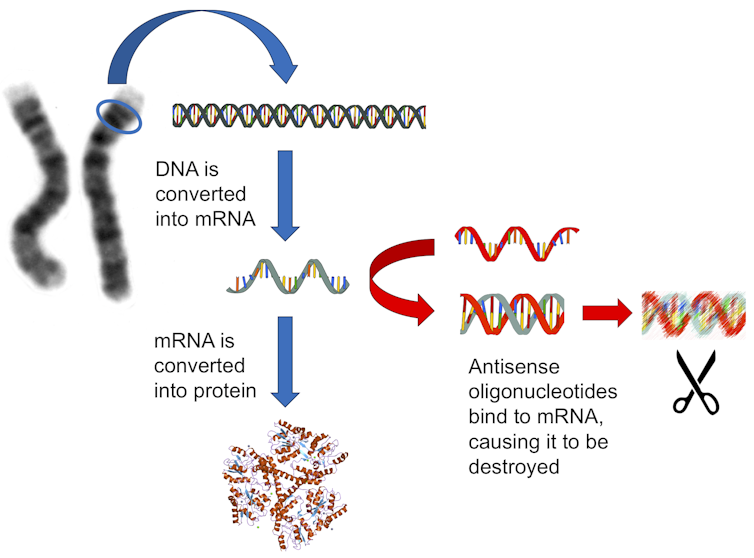
How antisense therapy works. Various public domain imagesAuthor provided

An important property of mRNAs is that the precise code they contain is specific to each protein. This means that you can design antisense oligonucleotides that can specifically target the production of protein from just one gene out of the many thousands in the human genome. In fact, if the gene you are targeting is mutated, you can even target just the mutant form of the gene.

The Huntington’s disease trial is still at an early stage, testing to see if the oligonucleotides can get inside the brain and reduce the amount of mutant protein. We don’t yet know whether the drug will slow down the disease. But there have been a couple of recent clinical trials in other neurodegenerative diseases that provide some hope that this approach might work.

Same approach, different diseases

The best example of this is for spinal muscular atrophy, a very rare (and also inherited) childhood form of motor neurone disease. In a clinical trial that was completed earlier this year, antisense oligonucleotides were used to correct a faulty version of a gene that is mutated in spinal muscular atrophy.

The scientists used a slightly different approach, but the results were very promising. In most cases, children with these mutations suffer severe problems with movement from birth, but most of the children treated with the oligonucleotides survived longer and had better movement than those without treatment.

The trial was so successful that it had to be stopped so that the child not receiving treatment could be provided with the oligonucleotides. The drug, called nusinersen, has since been approved by the US Food and Drug Administration for treating spinal muscular atrophy.

Both Huntington’s disease and spinal muscular atrophy are rare forms of neurodegeneration, but if antisense oligonucleotides can be shown to work for these disorders, then it may be possible that the same approach might work in more common diseases, like Parkinson’s or Alzheimer’s disease.

These diseases share some of the characteristics of Huntington’s disease and spinal muscular atrophy, such as the accumulation of sticky proteins (although the actual proteins that build up are different). As with Huntington’s disease, there aren’t any drugs that slow down or halt the brain cells dying in people with Alzheimer’s or Parkinson’s.

There is a lot of work that remains to be done to see whether antisense oligonucleotides could help in most types of neurodegeneration, and there are some really big challenges to be overcome. But these early studies, and smaller scale trials in rare diseases, are providing the evidence to convince medical research funding bodies and drugs companies that it is worth investigating further.

Fuente: https://theconversation.com/antisense-therapy-a-promising-new-way-to-treat-neurological-disease-89006

Imagen:

https://lh3.googleusercontent.com/LRpGLXSXbH3LnI0fdwrwYvYfisGo7pUgItJkTUzZJyxHgoJtESThOP7IZlwDiw89-ujrvac=s85

Comparte este contenido:

Canada: By casting teachers as informants, British counter-extremism policy is promoting violence

América del Norte/Canada/Diciembre del 2017/https://theconversation.com/

The Muslim children in my classroom withdrew from political debate when the Prevent counter-terrorism strategy cast me as an informant.

Prevent infers a duty on all teachers and doctors in England, Scotland and Wales to report signs of so-called “extremism” and “radicalisation” in their pupils and patients. Applying this duty is particularly difficult as “extremism” has not been legally defined by the Home Office.

Working as a secondary school teacher in London from 2005 to 2017, I was required to implement the Prevent counter-extremism strategy. My concern over the impact it was having on the dynamic of my and other classrooms led me to speak out against Prevent and counter-extremism strategy more generally.

When my Muslim students learned of my concerns, some of them approached me to express their anxiety that Prevent was a state surveillance strategy which was targeting them as a result of racial profiling – concerns supported by academic research. The children told me they hadn’t talked to other adults about this for fear that their vocal opposition to this controversial strategy would result in them being reported to the security services.

Some of the children told me that they no longer challenged the views of others that they perceived to be extreme. They feared that speaking out on sensitive issues would result in them being referred under Prevent, just by association. I have been offered examples of this happening in the classroom, on the street and in children’s homes.

Whether the children’s fears were justified or not, Prevent was altering their behaviour. I’ve heard similar examples repeated to me in focus groups I arranged of children from different schools in the London borough of Tower Hamlets.

Dialogue makes a classroom

Teachers, academics and politicians disagree over whether Prevent promotes or stifles debate in classrooms. This disagreement will continue until all of those with an interest in education recognise that there are different types of classroom debates.

The education expert Robin Alexander argues that authentic dialogue in classrooms is rare. Instead of having genuine conversations that may result in children and their teachers changing their preconceived views, children tend to be expected to offer their teachers anticipated answers. But authentic dialogue is crucial if schools are to promote a more harmonious society – for it is through genuine debate that we all moderate our views.

https://youtu.be/Ei3LIe7_mj8

Before Prevent was imposed on schools, some of the children at the secondary school where I taught approached me to discuss how they had begun to feel alienated from society. Concerns such as the impact of British foreign policy on civilians in Afghanistan, Iraq and Syria were a frequent topic of conversation. When my students raised these concerns, I was often able to tell them that I shared them – and this helped us think of possible responses.

The children raised suggestions of travelling to war zones, but quickly dismissed them in favour of peaceful, democratic solutions. Through talking, they learned to write to MPs, raise funds for refugee charities and contribute to human rights campaigns. Threats of nationalist violence were also dismissed as we explored our values through dialogue – dialogue that my students have since told me they no longer engage in.

When all that’s left is violence

Many theorists have argued that peace in a democracy relies on people having their say. Belgian political theorist, Chantal Mouffe, wrote in her book On The Political that violence “tends to flourish in circumstances in which there are no legitimate political channels for the expression of grievances”. She describes the shutting down of discourse in a democracy as “letting death in”.


Read more: We can all be a little radicalised – recognising this will help tackle extremism


The late French philosopher, Jacques Derrida, in his conversations on 9/11 and other work, described what he called the “autoimmunity of liberalism”. This results from the liberal contradiction of simultaneously trying to suppress dissent while also promoting freedom. Derrida wrote that this contradiction at the core of liberalism results from an aspiration to consensual politics but can result in a violent backlash.

In my ongoing research, I am analysing over a million words of government policy on counter-extremism. It’s revealed that the definitions of “extremism” and “radicalisation” progressively changed to become synonymous with violence between 2005 and 2015. The meaning of words affects how we perceive the world and aligning extreme and radical views with violence not only creates a perceived need for counter-extremism strategy but also acts as a catalyst for the violence that the strategy purports to address.

A strategy such as Prevent that targets radical and extreme views becomes necessary if we accept this change in the meaning of what it is to be “radical” or “extreme”. However, the experiences of my pupils show that the expression of extreme and radical views can actually help to reduce violence.

This moderation of extreme views extends beyond the classroom. People protesting against fracking as well as other student protesters have been referred to the Prevent programme. Silencing dissenting voices undermines the mechanisms by which democracy helps us to avoid violence. Labelling those who oppose the status quo as violent adds a catalyst to this already dangerous situation.

The Home Office is currently in the final stages of recruitment for a counter-extremism commissioner. While the lack of a legal definition for “extremism” makes it difficult to anticipate what this role will involve, surely the successful candidate will want to reduce political violence. Removing the Prevent duty that compels teachers to inform on their students would be a good start.


Fuente:https://theconversation.com/by-casting-teachers-as-informants-british-counter-extremism-policy-is-promoting-violence-85474

Imagen:https://lh3.googleusercontent.com/AQACrpe4v9XTNF80pzTxhT1gIKtrIuUskYQe3JT0J8tXBV_xjQHQaA64fsJrbegtXPHu_8E=s128

Comparte este contenido:

Cambiar las reglas de juego, no el clima

 Cambiar las reglas de juego, no el clima

Por: https://www.ecologistasenaccion.org

Construir un futuro ecológicamente sostenible requerirá mucho más que realizar declaraciones o actos simbólicos. Es muy urgente el ajuste del metabolismo de la economía a los límites impuestos por la naturaleza en múltiples escalas, desde lo local a lo global, así como afrontar y prever las consecuencias que el cambio climático ya está teniendo.

Es fundamental que los proyectos políticos y sociales alternativos tomen conciencia de las implicaciones que suponen estos límites y diseñen propuestas de cambio audaces que vayan al origen del problema. En este sentido, Ecologistas en Acción ha publicado este informe que recoge algunas de las medidas que una ley de cambio climático debería contener.

La crisis política y la crisis económica sólo se podrán superar si al mismo tiempo se supera la crisis ecológica. Y del mismo modo, la crisis ecológica solo se resolverá si hay una transformación radical del sistema que las produce cada vez con mayor intensidad.

La ley de Cambio Climático y Transición Energética deberá establecer las medidas básicas para la reducción de las emisiones en cada sector o ámbito, que se desarrollarán modificando la legislación sectorial en el plazo de un año.

[Informe] Cambiar las reglas de juego, no el clima

Estas medidas deberán ir en la línea de:

  1. Reducir en términos netos nuestra demanda energética, el consumo actual es insostenible. Solo podremos frenar el cambio climático si se establece una hoja de ruta para reducir la cantidad de energía que consume un español de las 2,42 tep actuales a un máximo de 1 tep.
  2. Eliminar de forma constante nuestro consumo de combustibles fósiles. Una eliminación que debe de hacerse en base a presupuestos de carbono decrecientes, que deberán lograr una reducción mínima del 5 % anual en las emisiones de gases de efecto invernadero hasta el 2030.
  3. El cambio de lo local a lo global, acortando las cadenas de distribución, produciendo alimentos y productos desde entornos más cercanos y de una forma más respetuosa con los ecosistemas.


Fuente: https://www.ecologistasenaccion.org/article35461.html

Imagen:https://lh3.googleusercontent.com/j5tsiMQZNz5poaxumVX6uUiBFy-Isj4BpzrEWPn49knutCM1yaf44KvrWBQRR_vupyMR=s85

Comparte este contenido:

Indigenous languages must feature more in science communication

Diciembre del 2017/Noticias/ https://theconversation.com

There is no denying that English is one of the world’s major languages. It’s the mother tongue of nearly 370 million people. English is also very frequently used by scientists in academic journals and book chapters, along with other common languages like French, Spanish and Portuguese.

But what about the billions of people who speak very little English, or none at all? How can we improve their access to scientific information and knowledge?

In a bid to tackle this issue, along with other factors of marginalisation such as distance from urban areas and ethnic exclusion, we and our colleagues created the Imagine Project at the Federal University of Santa Catarina in Brazil. According to a UNESCO report, people living in remote areas and those belonging to ethnic and linguistic minorities are the most vulnerable in terms of access to education. Rural children are four times less likely to ever attend school than their urban counterparts from similar economic backgrounds.

Giving these groups the opportunity to learn and to hear about science is an essential way of including them as citizens.

Imagine Project is an initiative that aims to take scientific knowledge out of the laboratory and share it particularly with rural and indigenous communities. As part of a competition linked to our work we recently translated four winner scientific videos, about different topics such as astronomy and pharmacology, into a number of languages. These feature in the videos as subtitles.

The languages include Tsonga (also known as Changana and spoken in Mozambique, South Africa, Swaziland and Zimbabwe) and Guarani, an indigenous language from Brazil, Paraguay, Bolivia and Argentina.

Science made accessible – thanks to translation into a variety of languages.

This and similar initiatives are crucial if scientists are to properly communicate the knowledge they’ve produced; sometimes with the very communities they study or which are affected, in their own languages.

The combination of knowledge and communication – along with a few other fundamental conditions such as liberty and respect – leads to social, cultural and technological development. That is why it is so important for people whose job is to generate knowledge to share their findings with ordinary people.

Opening up science

Open communication has long been seen as a fundamental condition for scientific development. The advent of the internet made even greater, more open communication possible. A scientist can write an article that is available in an online journal or record a video that’s uploaded to YouTube. But what about scientists who don’t speak English, or users who might be interested in what’s being shared but don’t speak English?

It is a general rule of the so-called “hard sciences” that all widely read, high impact scientific journals are in English. For research to be considered internationally, it needs to be in English. Yet, science cannot be properly communicated or popularised unless language barriers are tackled. We knew this when we launched the Imagine Project in 2013. Initially, the project focused on creating a series of hands-on scientific activities to be carried out in rural communities. These involved working scientists, high school students and teachers.

Then our team generated open educational resources in Portuguese that were translated and published online in English, Spanish and French. We are continuously producing new material, including PDF protocols and documentary videos showing our field experiences.

In 2017 we scaled up our ambitions and created Imagine-PanGea, a multilingual science popularisation competition. We were supported by three major organisations that work to popularise science: African Gong, which is pan-African; RedPop, which works in Latin America and the Caribbean; and SBPC, the Brazilian Society for the Advancement of Science.

There have been similar competitions elsewhere in the world that required entrants to work in either English or French. We created a video competition for African and Latin American graduate students across scientific disciplines, asking that their research be presented in a three minute video in either English, French, Portuguese or Spanish. There were 55 entrants.

The three overall winners and the best presentation from each continent had their videos translated into a range of languages. The videos were then widely publicised through the organisations that supported the competition.

Tough translation

A network of institutions and people representing different regions of Africa and Latin America were involved in this initiative. Their home languages and those of the people they worked decided what languages we’d translate videos into. We also relied on them to be our translators – and they didn’t always find this an easy task.

Many of the scientific terms used in the videos did not exist in the indigenous languages we’d chosen. In these instances, we kept words in French, English, Portuguese or Spanish. For example, Portuguese words can be found in the middle of the Guarani subtitles.

Further translations are underway into, among others, Yoruba from Nigeria and Umbundo and Kimbundo from Angola.

The competition was based entirely on voluntary work. We had practically no funding. For the next edition, we’re hoping to find some kind of sponsorship, particularly to offer winners material prizes like goods, money or travel expenses to attend an international scientific meeting.

We are trying to find new translators for Quechua (an Andean language), Berber (from North Africa), Chinese and as many indigenous languages we can get. For this to happen, we’ll need to find more volunteer translators.

This is a new way of thinking about science communication: it’s the kind of people we reach, not the number, that matters. And it’s worked. When the Imagine project was launched, we were told that indigenous Brazilian people would be not interested in learning basic science such as genetics and molecular biology. The critics have been proved wrong.

The Guarani people we’ve worked with have flourished, conducting experiments with DNA and telling the team they want to learn more. In parallel with the Imagine Project, our university has introduced undergraduate degrees specifically to attract people from indigenous nations. In addition, a certain number of places are reserved across all degrees for indigenous Brazilians.

Our long term goal is to get more indigenous and rural people to become real scientists. This is already happening in Brazil: one of our collaborators, Joana Mongelo, is the first Guarani science master’s graduate in the south of the country.

Fuente :https://theconversation.com/indigenous-languages-must-feature-more-in-science-communication-88596

Imagen:https://lh3.googleusercontent.com/SzJLi4cJCYJdisF3JOystdR4tR4oCe_S7jAmOGQk5naWYzTVsj0BzhUT5qPDORCCMBruZTI=s128

Comparte este contenido:

México: SEP y sindicato de maestros acuerdan avanzar en reforma educativa.

América del Norte/México/21.12.2017/Autor y Fuente: http://www.uniradioinforma.com

El secretario de Educación Pública, Otto Granados Roldán, y el presidente del Sindicato Nacional de Trabajadores de la Educación (SNTE), Juan Díaz de la Torre, se comprometieron a fortalecer y avanzar en la implementación de la reforma educativa en el país.

Granados Roldan señaló que México vive un momento particularmente importante y crucial para la educación pública, laica, gratuita y de calidad para todos los niños de México y en ese sentido agradeció la colaboración de los maestros representados en el SNTE.

Al encabezar una reunión con integrantes de órganos nacionales de gobierno y secretarios generales sectoriales del sindicato, el funcionario federal destacó que la reforma educativa es en favor de los niños de México, así como de los maestros de todo el país.

Aseveró que es justo reconocer que los avances de la citada reforma han sido posibles gracias a la decidida participación y apoyo del sindicato magisterial, y se dijo «razonablemente optimista de lo que junto hemos logrado todos en favor de una mejor educación y de calidad”.

Afirmó que son innegables los componentes principales que ha tenido la reforma educativa: un nuevo Servicio Profesional Docente, la puesta en marcha de un nuevo modelo educativo, un programa más robusto en la formación continua de docentes, y acciones a favor de los niños del país.

A su vez, el dirigente del sindicato magisterial aseveró que de las reformas estructurales avaladas en el actual sexenio, la educativa es sin duda la más importante del país, «pues con base en este principio se construye un país como México».

Añadió que «todos los días se ponen en acción más de 32 millones de estudiantes, más de seis millones de familias y más de un millón 800 mil maestros en esta gran hazaña, lo que tenemos en nuestras manos es darle conducción, mantenimiento y operación a este gran cuerpo».

En el encuentro realizado en el Salón Iberoamericano de la Secretaría de Educación Pública (SEP), Díaz de la Torre aseveró que los maestros se debe sentir orgullosos de tener esta gran responsabilidad, pero al mismo tiempo asumir el compromiso que representa tener este privilegio.

Fuente: http://www.uniradioinforma.com/noticias/mexico/506029/sep-y-sindicato-de-maestros-acuerdan-avanzar-en-reforma-educativa.html

Imagen: https://www.uniradioserver.com/media/news_thumbs/201712/20171219170032_61.jpg

Comparte este contenido:

La educación atropellada.

Por: Manuel Gil Antón.

De nuevo, y desde las más altas esferas del gobierno, se subordina la educación a las necesidades políticas de corto plazo. Desfachatez. Quien se dijo, innumerables veces, comprometido con la madre de todas las reformas, la educativa; se retrató cuantas veces pudo en las escuelas a las que, previo aviso, asistió; el que presumió haber construido un nuevo modelo para el siglo XXI y recuperado, para el Estado, la rectoría de la educación, Aurelio Nuño Mayer, en cuanto recibió la orden de dejar la titularidad de la Secretaría de Educación, para encargarse de coordinar la campaña política de Mead a la presidencia de la república por el PRI, no lo dudó ni un instante. Para cumplir la liturgia, “presentó su renuncia”, y quien decidió el cambio, al darlo a conocer, se atrevió a decir que la había aceptado. Cínicos: ya ni la burla perdonan.
Lo que queda claro es que, al mandar al secretario a organizar la campaña del abanderado del oficialismo, no ha recuperado el gobierno actual, en efecto, la rectoría del sistema educativo, sino a un operador electoral probado: es decir, un experto que, orientado por el interés de conservar el poder a toda costa, sabe negociar, vender y comprar, obtener recursos opacos, pactar con quien sea, y lo que sea, con el fin de no perder la rectoría que realmente les importa: la que ejerce el grupo al que pertenece en la secretaría de la corrupción y la impunidad.
¿Algún elemento que anticipe lo que viene? Ofrezco una conjetura: horas después del anuncio de la alianza del Partido Nueva Alianza (PANAL) con el PRI – al cuarto para las doce, por cierto – se destraban los impedimentos legales y la maestra Gordillo obtiene, por fin, el beneficio de la prisión domiciliaria que se le había negado sistemáticamente. Digo conjetura porque el antecedente y el consecuente de los eventos no es, siempre ni necesariamente, causalidad. Pero, a su vez, la relación entre la alianza electoral (que ocurre antes) y las gestiones de la PGR para que la profesora siga el proceso legal desde su casa (posteriores, casi inmediatas) no parece ser resultado de la casualidad. Cuesta trabajo creerlo.

Luego de la ceremonia en Los Pinos, en que el presidente le agradece todo lo que lo ha apoyado y nombra a quien lo va a sustituir, el ya ex secretario se desplaza a la SEP para informar, a sus colaboradores, una gran noticia: Albricias: “he recibido la honrosa invitación del precandidato Meade para que coordine su campaña”. Aplausos a granel.
Recuerdo la respuesta de Emilio Chuayffet cuando, al inicio del sexenio, se le preguntó si la consulta sobre la reforma que organizó iba en serio, si sería real o pura apariencia. Con su clásico estilo, citando a alguien, respondió: “¿Sabe usted por qué la gente no cree en lo que dicen los políticos? Porque los políticos no creen en lo que dicen”.
Cuando se le inquiría al ahora operario electoral del PRI si aspiraba a la candidatura presidencial, su respuesta era que estaba ocupado, de tiempo completo, con la reforma educativa, porque no había mayor servicio, ni beneficio para México, que hacer que se concretara y surgiera el nuevo ciudadano, el del siglo XXI. Eso dijo. Y con sus actos recientes ha mostrado que su palabra no tiene valor: no le tocó ser lo que, quizás, anhelaba, pero contribuir al triunfo del partido que les garantiza protección – impunidad – a sus jefes, padrinos y aliados, corruptos a más no poder, lo considera un honor. ¿Por qué? Porque estos servicios se pagan, y se pagan bien en el futuro.
Sin vergüenza, sin que adviertan lo contradictorio de su proceder, ajenos a la incoherencia entre sus palabras y lo que hacen, se marchan, orondos, a lo que sigue, sea lo que sea. Están ocupados en las próximas elecciones, no en las próximas generaciones. Es lo que importa y les urge. ¿Más claro? Imposible.

Fuente: https://www.debate.com.mx/opinion/La-educacion-atropellada-20171216-0298.html

Imagen: http://www.elpoderdelapalabra.com.mx/wp-content/uploads/2017/10/Escuela-1747085.jpg

Comparte este contenido:

Aprender de la mentira .

Por: Francisco Guerrero Aguirre.

Desarrollar la capacidad crítica de los ciudadanos es un deber cívico que debería acompañar a todas las democracias. Distinguir entre la verdad y la mentira es un elemento crucial para decidir entre propuestas y candidatos, en un entorno inundado por marejadas de información de dudosa procedencia.

Como lo describe Roberto Armocida, en Reforma hace unos días, llama la atención la campaña educativa implementada en Italia contra las fake news. La idea de fondo es dotar de herramientas a los jóvenes para identificarlas y combatirlas.

Esta peculiar estrategia se ha impuesto el reto de educar a los adolescentes dotándolos de instrumentos para dilucidar entre lo falso y lo verdadero.

Desarrollar desde la escuela una capacidad  analítica frente a los millones de datos, imágenes y videos que ofrece la red es la única alternativa para construir una sociedad sana con cánones de veracidad mínimos.

El modelo es impulsado por la Secretaría de Educación y la Cámara de Diputados. Basta Bufale (Ya Basta de Engaños) visita las escuelas dotando a los estudiantes, de entre 11 y 15 años, de herramientas útiles para diferenciar entre lo falso y lo verdadero en las noticias que fluyen en la red.

Los jóvenes digitalizados de hoy pueden pasar hasta diez horas diarias conectados a internet. La percepción que se construye en su entorno depende casi de manera total de la información que llega a sus computadoras y teléfonos inteligentes.

Expertos en el tema han indicado que los jóvenes del siglo XXI usan internet y las nuevas tecnologías de manera intensiva para comunicar, aprender y socializar.

Lo anterior genera la necesidad de asimilar, de forma responsable y reflexionada, cuáles son los riesgos relacionados al uso de internet, sabedores de que la red es un “oasis” donde se abreva por conocimiento sin supervisión de padres o maestros.

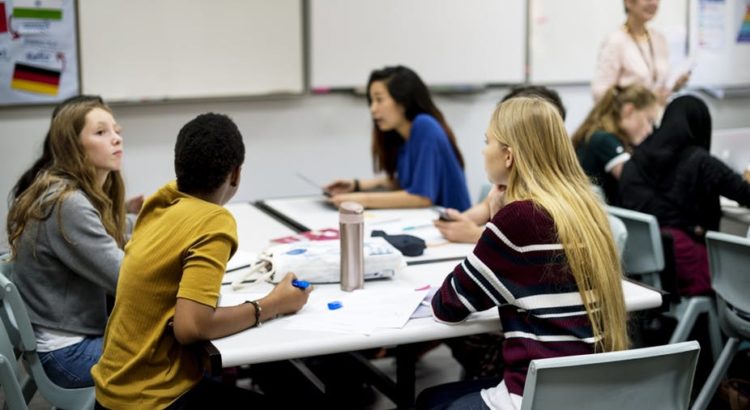
El maestro se dirige a la clase proponiendo una reflexión sobre la manipulación de las imágenes y las fotos ilusorias, algo presente constantemente en la red, explicando al grupo cuáles pueden ser los instrumentos para detectarlas.

Los estudiantes interactúan con el profesor a través de sus computadoras portátiles, enlazadas en internet con el pizarrón electrónico del propio salón.

Se parte de la convicción de que las noticias falsas pueden provocar daños irreversibles al tejido social y facilitar que intereses inconfesables y oscuros lastimen a la comunidad al edificar monumentos a la falsedad y la mentira.

En la pared del salón de clases hay un decálogo, entregado a las escuelas secundarias del país como parte de esta campaña. Se trata de una especie de tabla de la ley, compuesto por ocho artículos. Los dos faltantes son añadidos por los alumnos como parte de sus propias experiencias.

Balance 

Este proyecto busca despertar la conciencia crítica de las nuevas generaciones a través de búsquedas cruzadas para averiguar la legitimidad de una información y, si la noticia resulta ser falsa o no convence, buscar que los lectores la ignoren por completo al revisar el origen y la fuente correspondiente. Aprender de las mentiras estimula el aprecio de la verdad.

Las contiendas políticas de las próximas décadas se desarrollarán en un ambiente cargado por la desinformación y la guerra sucia en internet. Rescatar del lodo de la descalificación propuestas útiles para resolver problemas complejos dependerá de nuevos ciudadanos con capacidad crítica, dispuestos a ignorar las mentiras y las trampas. Proyectos como Basta Bufale son el camino a seguir.

Fuente: http://www.excelsior.com.mx/opinion/francisco-guerrero-aguirre/2017/12/13/1207504

Imagen: https://encrypted-tbn0.gstatic.com/images?q=tbn:ANd9GcSW5rFBNjrnS2H-U-yQSCoxBgz7vEn5NxG9tRjEBcOlglfi4SCH

Comparte este contenido:
Page 796 of 1672
1 794 795 796 797 798 1.672