Page 929 of 1684
1 927 928 929 930 931 1.684

Why the Democratic Party Can’t Save Us From Trump’s Authoritarianism

By Henry Giroux

There is a certain duplicity in the Democratic Party’s attempts to remake itself as the enemy of the corporate establishment and a leader in a movement to resist Trump and his mode of authoritarianism.

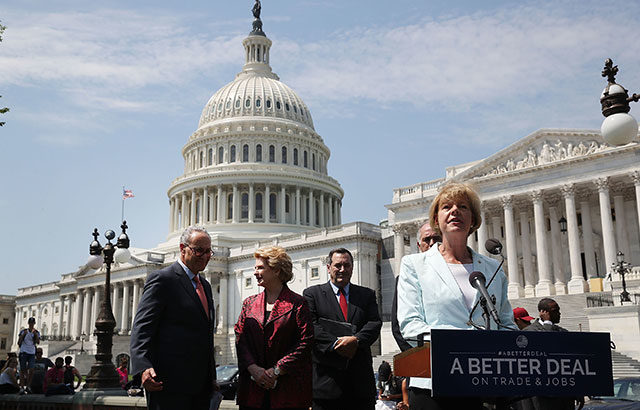
Democrats, such as Ted Lieu, Maxine Waters and Elizabeth Warren, represent one minority faction of the party that rails against Trump’s racism and authoritarianism while less liberal types who actually control the party, such as Chuck Schumer and Nancy Pelosi, claim that they have heard the cry of angry workers and are in the forefront of developing an opposition party that will reverse many of the policies that benefited the financial elite. Both views are part of the Democratic Party’s attempt to rebrand itself.

The Democrats’ new populist platform, called «A Better Deal: Better Skills, Better Jobs, Better Wages» has echoes of FDR’s New Deal, but it says little about developing both a radical democratic vision and economic and social policies that would allow the Democratic Party to speak more for the poor, people of color and young people than for the corporate and financial elite that run the military-industrial-entertainment complex. Their anti-Trump rhetoric rings hollow.

For Democratic Party leaders, the rebranding of the party rests on the assumption that resistance to Trump merely entails embracing the needs of those who are the economic losers of neoliberalism and globalization. What they forget is that authoritarianism thrives on more than economic discontent, as the recent white supremacist violence in Charlottesville, Virginia, made clear. Authoritarianism also thrives on racism, xenophobia, exclusion, expulsion and the deeming of certain subgroups as «disposable» — a script that the «new» Democratic Party has little to say about.

David Broder has recently argued that being anti-Trump is not a sufficient political position because doing so inures people to a myriad of neoliberal policies that have impoverished the working class, destroyed the welfare state, waged foreign wars and a war on public goods, polluted the environment, created massive inequities and expanded the reach of the punishing and mass incarceration state. Even though these neoliberal policies were produced by both Republicans and liberal Democrats, this message appears to have been taken up, at least partly, by the Democrats in a focused attempt to rebrand themselves as the guardians of working class interests.

For too many members of the Democratic Party, Trump is the eccentric clown who unexpectedly stepped into history by finding the right note in rousing an army of «deplorables» willing to invest in his toxic script of hatred, demonization and exclusion. Of course, as Anthony DiMaggio, Thomas Frank, Michelle Alexander, Naomi Klein, Paul Street and others have pointed out, this is a false yet comforting narrative for a liberal elite whose moralism is as suffocating as is their belief in centrist politics. Neoliberal policies, especially under Clinton and Obama, created the conditions for Trump to actually come to power in the first place.

Trump’s presidency represents not merely the triumph of authoritarianism but also the tragedy of a neoliberal capitalism that benefited investment bankers, Wall Street, lawyers, hedge fund managers and other members of the financial elite who promoted free trade, financial deregulation, cutthroat competition and commercialization as the highest measure of individual and market freedom. Trump is not simply the result of a surprising voter turnout by an angry, disgruntled working class (along with large segments of the white suburban middle class), he is also the endpoint of a brutal economic and political system that celebrated the market as the template for governing society while normalizing a narrative of greed, self-interest and corporate power. Trump is the mirror reflection of the development of a form of illiberal democracy and authoritarianism that mixes neoliberal economic policies, anti-immigrant bigotry, the stifling of free speech, hyper-nationalism and a politics of disposability and exclusion.

A History of Betrayal by Both Political Parties

Getting in bed with Wall Street has also been a favorite pastime of the Democratic Party.

The tyranny of the current moment bespeaks a long history of betrayal by a financial and political class that inhabits both major parties. It is no secret that the Republican Party has been laying the groundwork for an American-style authoritarianism since the 1970s by aggressively pushing for massive tax cuts for the rich, privatizing public goods, promoting a culture of fear, crushing trade unions, outsourcing public services and eliminating restrictions designed to protect workers, women and the environment. But they have not been the only party reproducing the dictates of neoliberalism. Getting in bed with Wall Street has also been a favorite pastime of the Democratic Party.

It was the Democratic Party, especially under President Clinton, that prepared the groundwork for the financial crisis of 2007 by loosening corporate and banking regulations while at the same time slashing welfare provisions and creating the conditions for the intensification of the mass incarceration state. The Clinton administration did more than court Wall Street, it played a decisive role in expanding the neoliberal gains that took place three decades before he was elected. Nancy Fraser insightfully sums this up in her contribution to The Great Regression anthology:

Neoliberalism developed in the United States roughly over the last three decades and was ratified with Bill Clinton’s election in 1992…. Turning the US economy over to Goldman Sachs, it deregulated the banking system and negotiated the free-trade agreements that accelerated deindustrialization…. Continued by his successors, including Barack Obama, Clinton’s policies degraded the living conditions of all working people, but especially those employed in industrial production. In short, Clintonism bears a heavy share of responsibility for the weakening of unions, the decline of real wages, the increasing precarity of work, and the rise of the ‘two-earner family’ in place of the defunct family wage.

The Obama administration continued this abandonment of democratic values by bailing out the bankers and selling out millions of people who lost their homes while at the same time aggressively prosecuting whistleblowers. It was the Obama administration that added a kill list to its foreign policy and matched it domestically with educational policies that collapsed education into vocational training and undermined it as a moral and democratizing public good. Obama mixed neoliberalism’s claim to unbridled economic and political power with an educational reform program that undermined the social imagination and the critical capacities that made democracy possible. Promoting charter schools and mind-numbing accountability schemes, Obama and the Democratic Party paved the way for the appointment of the hapless reactionary billionaire Betsy DeVos as Trump’s Secretary of Education. And it was the Obama administration that enlarged the surveillance state while allowing CIA operatives who tortured and maimed people in the name of American exceptionalism and militarism to go free. In short, the flirtation of neoliberalism with the forces of illiberal democracy was transformed into a courtship during the Clinton and Obama administrations and until death do us part under Trump.

The growing disregard for public goods, such as schools and health care, the weakening of union power, the erosion of citizenship to an act of consumption, the emptying out of political participation, and the widening social and economic inequality are not only the product of a form of ideological extremism and market fundamentalism embraced by Republicans. The Democratic Party also has a long legacy of incorporating the malicious policies of neoliberalism in their party platforms in order to curry favor with the rich and powerful. Neoliberalism stands for the death of democracy, and the established political parties have functioned as its accomplice. Both political parties, to different degrees, have imposed massive misery and suffering on the American people and condemned many to what David Graeber has described in his book The Democracy Project as «an apparatus of hopelessness, designed to squelch any sense of an alternative future.» While Trump and the Republican Party leadership display no shame over their strong embrace of neoliberalism, the allegedly reform-minded Democratic Party covers up its complicity with Wall Street and uses their alleged opposition to Trump to erase their criminogenic history with casino capitalism. With Republican majorities, mainstream Democrats share an unwillingness to detach themselves from an ideology that challenges the substance of a viable democracy and the public spheres and formative cultures that make it possible.

Democratic Party Remains Complicit in Neoliberal and Authoritarian Politics

Chris Hedges has laid bare both the complicity of the Democratic Party in neoliberal and authoritarian politics as well as the hypocrisy behind its claim to be the only political alternative to challenge Trump’s illiberalism. He is worth quoting at length:

The liberal elites, who bear significant responsibility for the death of our democracy, now hold themselves up as the saviors of the republic. They have embarked, despite their own corruption and their complicity in neoliberalism and the crimes of empire, on a self-righteous moral crusade to topple Donald Trump. It is quite a show…. Where was this moral outrage when our privacy was taken from us by the security and surveillance state, the criminals on Wall Street were bailed out, we were stripped of our civil liberties and 2.3 million men and women were packed into our prisons, most of them poor people of color? Why did they not thunder with indignation as money replaced the vote and elected officials and corporate lobbyists instituted our system of legalized bribery? Where were the impassioned critiques of the absurd idea of allowing a nation to be governed by the dictates of corporations, banks and hedge fund managers? Why did they cater to the foibles and utterings of fellow elites, all the while blacklisting critics of the corporate state and ignoring the misery of the poor and the working class? Where was their moral righteousness when the United States committed war crimes in the Middle East and our   militarized police carried out murderous rampages?

According to Katie Sanders, writing in PunditFact, under the Obama presidency, the Democrats «lost 11 governorships, 13 U.S. Senate seats, 69 House seats, and 913 state legislative seats and 30 state legislative chambers.» And the losses and humiliations got worse in 2016 elections. It is no secret that the Democratic Party is a political formation of diminished power and hopes. Yet, in the face of Trump’s authoritarianism, it has attempted to reinvent itself as the party of reform by updating its worn out economic policies and ideological scripts. As proof of its reincarnation, it has proposed a platform titled «A Better Deal,» signaling a populist turn in economic policy. A number of its economic reforms would certainly help benefit the poor and underprivileged. These include proposed increases of the minimum wage to $15, tax credits to encourage job training and hiring, regulations to lower drug costs, stronger anti-trust laws and a trillion-dollar infrastructure plan. The platform, however, does not support universal health care, and it says nothing about providing free higher education, reducing military spending or reversing the huge growth in inequality.

As Anthony DiMaggio points out, the plan «doesn’t even reach a Bernie Sanders level of liberalism, and it is a far cry from the kind of progressive populist policies introduced in FDR’s New Deal and Johnson’s Great Society/War on Poverty.» Eric Cheyfitz adds to this argument by insisting that the plan does nothing to challenge the rapacious system of unfettered capitalism the Democrats and Republicans have supported since the 1970s. Democrats are completely unrepentant about having supported the deregulation of capital and thus ushered in a new form of US authoritarianism. Moreover, any reform policy worth its name would directly address income inequality and the power of the military-industrial complex, while fighting for single-payer health care and a redistribution of wealth and power. There will have to be a massive refiguring of power and redistribution of wealth to address the health care crisis, poverty, climate change, inadequacies in education and the plague of mass incarceration — problems not addressed in the Better Deal. It is not unreasonable to assume that such vexing challenges cannot be addressed within a two-party system that supports the foundational elements of predatory capitalism.

In spite of the horrendous neoliberal ideology and reactionary policies driving the Democratic Party, various Democrats and progressives cannot bring themselves to denounce either capitalism as the bane of democracy nor its suffocating hold on its reform efforts. They appear thunderstruck when asked to denounce a corrupt two-party system and develop a social movement and political apparatus that supports democratic socialism.

For instance, unrepentant centrist liberals, such as Mark Penn and Andrew Stein, have castigated progressives within the party while unapologetically embracing neoliberalism as a reform strategy. They believe that the Democratic Party has lost its base because it rushed to defend «identity politics» and leftist ideas and that workers felt abandoned by the party’s «shift away from moderate positions on trade and immigration, from backing police and tough anti-crime measures.» Instead, they claim that the Democratic Party needs «to reject socialist ideas and adopt an agenda of renewed growth, greater protection for American workers … return to fiscal responsibility, and give up on … defending sanctuary cities.»

This sounds like a script written by a Trump policy advisor. It gets worse. Others such as Leonard Steinhorn have argued that the real challenge facing the Democratic Party is not to change their policies but their brand and messaging techniques. This argument suggests that the Democrats lost their base because they failed to win the messaging battle rather than the loss being due to moving to the right and aligning themselves with corporate and moneyed interests.

Suffering from an acute loss of historical memory, Jonathan Chait argues that the Democratic Party never embraced the policies of neoliberalism and has in its recent incarnations actually moved to the left, upholding the principles of the New Deal and Great Society. As Leah Hunt-Hendrix observes:

One need not be anti-capitalist to understand that the Democratic [Party] … allowed for policies that deregulated the finance sector (under President Bill Clinton), allowed for the privatization of many public goods (including the weakening of the public education system through the promotion of charter schools) and bailed out Wall Street banks without taking measures to truly address the needs of struggling working Americans.

Chait seems to have overlooked the fact that Trump and Sanders have proved conclusively that the working class no longer belongs to the Democratic Party or that the Democratic Party under Clinton and Obama became the vanguard of neoliberalism. He goes even further, arguing implausibly that neoliberalism is simply an epithet used by the left to discredit liberals and progressive Democrats. Chait appears oblivious to the transformation of the Democratic Party into an adjunct of the rich and corporate elite.

Is Chait unaware of Clinton’s elimination of the Glass-Steagall Act, his gutting of the welfare system and love affair with Wall Street, among his many missteps? How did he miss Obama’s bailout of Goldman-Sachs, the abandonment of education as a public good, his attack on whistleblowers, or the Democrats’ assault on organized labor via NAFTA? Was he unware that, in a White House interview given to Noticias Univision 23, Obama admitted that his «policies are so mainstream that if I had set the same policies that I had back in the 1980s, I would be considered a moderate Republican?»

In the end, Chait is most concerned about what he calls an attempt on the part of the left to engage in the trick of bracketing «the center-left with the right as ‘neoliberal’ and force progressives to choose between that and socialism.» He goes on to say that «The ‘neoliberal’ accusation is a synecdoche for the American left’s renewed offensive against the center-left and a touchstone in the struggle to define progressivism after Barack Obama [and] is an attempt to win an argument with an epithet.» Because of his fear of democratic socialism, Chait is like many other centrists in the Democratic Party who are oblivious to the damaging effects of the scorched-earth neoliberal polices adopted under the Clinton and Obama administrations.

Other progressive spokespersons, such as John Nichols and Leah Hunt-Hendrix, and groups, such as Our Revolution and the Incorruptibles, want to rebuild the Democratic Party from the base up by running candidates with progressive values «for local offices: in state houses, city councils, planning commissions, select boards and more.» The emphasis here would be for activists to revitalize and take over the Democratic Party by turning it to the left so that it will stand up for the poor and underprivileged.

Tom Gallagher adds to this reform strategy by arguing that Bernie Sanders should join the Democratic Party — forgetting that when he supported Hillary Clinton in the presidential election, he presented himself as a defacto member of the party in all but name.

Many of the strategies proposed to move the Democratic Party away from its history of centrism and the violence of neoliberalism are noble: If they were enacted at the level of policies and power relations, they would certainly make life easier for the poor, vulnerable and excluded. Progressives are right to be motivated and inspired by Sanders’s courage and policies. Sanders’s campaign against a rigged economy that redistributed wealth and income upward on a massive scale to the rich and corporate robber barons, coupled with his critique of the fixed political system that protected neoliberalism, provided a new language that had the potential to be visionary. But there is a difference between calling for reform and offering a new and compelling vision with an emphasis on a radical transformation of the political and economic systems.

At the same time, calls for a new vision and supporting values for radical democratic change do not mean abandoning attempts at reforming the Democratic Party as much as viewing such attempts as part of a broader strategy designed to make immediate progressive gains on a number of fronts. Most importantly, such a strategy moves beyond reform by pushing the party to its ideological and political limits so as to make visible the endpoint of liberal reform. At stake here is the assumption that such a strategy will make clear that the Democratic Party is incapable of being transformed radically and as such should not be expected to be on the forefront of radical democratic change.

Political and ideological centrism is endemic to the Democratic Party: It has never called for restructuring a system that is corrupt to the core. As a result, in the words of Nancy Fraser, the antidote to authoritarianism «is a left project that redirects the rage and the pain of the dispossessed towards a deep societal restructuring and a democratic political ‘revolution’.» The power of a left-progressive presence in the United States will, in part, depend on developing a comprehensive and accessible narrative that is able, as Nancy Fraser observes, to «articulate the legitimate grievances of Trump supporters with a fulsome critique of financialization on the one hand, and with an anti-racist, anti-sexist and anti-hierarchical vision of emancipation on the other.» The left needs a populism with a social conscience, one that allows young people, workers, the middle class, and others to see how their futures might develop in a way that speaks to their needs and a more just and equitable life, one in which the utopian possibilities of a radical democracy appear possible.

Looking Beyond the Democratic Party

A new vision for change cannot be built on the legacy of the Democratic Party. What is needed is a concerted attempt to figure out what democratic socialism will mean and look like in the 21st century. This suggests rethinking the meaning of politics, one that can rekindle the social imagination. Central to such a struggle is the role education must play in creating the formative culture capable of creating critical and engaged citizens. In this case, politics moves beyond ephemeral protests and recalibrates itself to create the public spheres that enable progressives to think about what long term movements, organizations and institutions can be aligned to create new political formations willing to confront neoliberal capitalism and other forms of oppression, not simply as symptoms of a distorted democracy but as part of a more radical project unwilling to compromise on identifying root causes.

Michelle Alexander is right in warning us that it would be a tragedy to waste the growing resistance against Trump «by settling for any Democrat the next time around.» I would similarly argue that we should not settle for a choice between good or bad Democrats. We must instead struggle for a radical restructuring of society, one that gives meaning to a substantive democracy. Resistance cannot be either defensive or ephemeral, reduced to either a narrow criticism of Trump’s policies or to short-lived expressions of protests. As Michael Lerner has pointed out, protests are moments, and however pedagogically and politically valuable, do not constitute a movement. As Zygmunt Bauman and Leonidas Donskis have suggested in their book Liquid Evil, protests function as «an explosion of political subjectivity» and generally tell us what people are against but not what they want. Coupled with a new vision, moral language and democratic values, the left and other progressives need a platform for thinking beyond neoliberal capitalism.

As David Harvey observes, the problems Americans face are too intractable and extensive to resolve without a strong anti-capitalist movement. This will only take place if progressives create a broad-based social movement that aligns struggles at the local, state and national level with democratic movements at the global level. The peripheral demands of single-issue movements cannot be abandoned, but they must translate into wider opportunities for social change. There should be no contradiction between the call for educational reform, women’s rights and ecological change and what Katrina Forrester calls an alternative economic and political vision for America. At the same time, it is a mistake for progressives to look at society only in terms of economic structures and issues. A mass-based movement to challenge neoliberalism and authoritarianism cannot be constructed unless it also commits to struggle against the many forms of oppression extending from sexism and racism to xenophobia and transphobia. Only a movement that unifies these diverse struggles will lead us toward a radical democracy.

Politics becomes radical when it translates private troubles into broader systemic issues and challenges the commanding institutional and educational structures of neoliberalism. To be effective, it must do so in a language that speaks to people’s needs, enabling them to both identify and invest in narratives in which they can recognize themselves and the conditions that produce the suffering they experience. For this reason, the call for institutional change is inextricably connected to the politics of social transformation. Such transformation must propel us toward an international movement to build a society that embraces the beauty of universal emancipation and promise of a radical democracy. At a time in history when the stakes for democracy are so threatened and life on the planet itself so imperiled, collective action is the only way out of the age of illiberal democracy. It is time to go for broke.

Source:

http://www.truth-out.org/news/item/41672-why-the-democratic-party-can-t-save-us-from-trump-s-authoritarianism


Comparte este contenido:

EEUU: Paladino Ousted From Buffalo Board of Education

EEUU/August 22, 2017/Source: http://cnyvision.com

The past few months have seen some of the most truly spectacular political oustings in the history of our country on the national scale. In all the tumult, another ousting on the local level might have slipped under your radar: the divisive former gubernatorial candidate Carl Paladino has been shown the door, with the State Education Commissioner forcibly removing the beleaguered businessman from his position on the Buffalo Board of Education.

The dismissal was the result of a week-long hearing that took place in June after his fellow member petitioned the state to unseat him. According to the Democrat and Chronicle, the board charged that Paladino had “willingly shared” information about teacher union negotiations and a pending lawsuit, both of which were confidential.

Paladino and his attorney, Dennis Vacco, see it differently.

“The determination to remove him, at least, is excessive in the context of all of the circumstances and facts of this case,” Vacco said to the Democrat and Chronicle, insinuating that Paladino was being punished for offensive comments made in a December interview in Artvoice.

In the article, when Paladino was asked about what he’d most like to see go away in 2017, he answered, “Michelle Obama. I’d like her to return to being a male and let loose in the outback of Zimbabwe where she lives comfortably in a cave with Maxie, the gorilla.”

Despite the claims of Paladino and his legal team, however, Education Commissioner MaryEllen Elia agreed with the board, finding that Paladino had, in fact, violated the Open Meetings Law.

In her finding, Elia said, “The record demonstrates that respondent disclosed confidential information regarding collective negotiations under the Taylor Law which he gained in the course of his participation as a board member in executive session and that his disclosures constituted a willful violation of law warranting his removal from office.”

Paladino was first elected to the school board in 2013, three years after his failed gubernatorial bid, which was rocked with an eclectic collection of scandals, including racist and sexually explicit emails, homophobic remarks, and unsubstantiated accusations of marital infidelity against his opponent. Despite the many controversies, however, Paladino managed to win all eight Western New York counties and 34% of the votes.

Recently, Paladino has been raising the possibility a second gubernatorial run, citing the election of President Trump, another politician with a long record of controversial comments.

“I think he’s proven in his days in office that the kind of change that he is bringing to Washington is something that we need in Albany,” Paladino said to Spectrum News Buffalo.

How this public ousting will effect Paladino’s chances at a second attempt for the New York governorship has yet to be seen.

For the time being, however, teachers unions are rejoicing in Paladino’s removal. With three-fourths of U.S. kids attending preschool programs and 50 million students attending public elementary and secondary school nationwide, these groups argue there is no place for such disruptive behavior on school boards.

A statement from the New York State United Teachers union put out an official statement approving of Elia’s decision, according to the Democrat and Chronicle. The statement read, “There is absolutely no place in public education for someone who flagrantly disregards the rules and spouts disgusting, racially charged ideas that harm students and the teaching environment.”

Source:

http://cnyvision.com/paladino-ousted-from-buffalo-board-of-education/

Comparte este contenido:

Entrevista a Samir Delgado: “La poesía es humanidad que se levanta y camina”

Entrevistador: Fernando Salazar Torres*

¿Qué es el Tren de los Poetas y cuáles son sus fundamentos?

—Realmente es un tren imaginario, existe únicamente durante el trayecto de los poetas que viajan en cualquier medio de transporte para llegar a la ciudad y compartir las literaturas del mundo, por eso el tren es un símbolo poético, un paradigma para el ensueño. Y los fundamentos siempre han sido universalizar la poesía, la dimensión creativa de la humanidad, a todos los ámbitos de la sociedad. Los orígenes del proyecto radican en Castilla-La Mancha, territorio quijotesco; el proyecto fue fundado en 2013 como un homenaje a los poetas hispanoamericanos que cruzaron en tren el bando republicano durante la guerra civil española en una muestra de solidaridad internacional. El Tren de los Poetas es el mismo que llevó a Pablo Neruda, César Vallejo y tantos más, aunque ahora transporta hasta la ciudad de Durango en México a escritores de todo el mundo; el sueño continúa en el corazón mismo del país que acogió fraternalmente a todos los refugiados de la república española. Por eso mismo el Tren de los Poetas es un hito cultural con vocación de futuro.

En el Tren de los Poetas hemos conocido el testimonio de autores como Abdul Hadi Sadoun, de Irak, o Rayen Kvyeh, de la nación mapuche, que aspiran a todo.

—¿Cuáles serían las repercusiones culturales y sociales de los vínculos actuales entre México y España?

—En este año 2017 se cumple el cuadragésimo aniversario del restablecimiento de las relaciones entre México y España, es importante destacarlo debido a que los gobiernos van a su ritmo y las sociedades de ambas orillas habitan un mismo pálpito, hay un vínculo muy especial entre México y los distintos pueblos del Estado español que hay que seguir profundizando; en arte y literatura los puentes de conexión resultan de enorme trascendencia y todavía hay mucho que hacer para superar la distancia oceánica. Sólo cabe pensar en la embajada mexicana en Madrid, es un espacio con galerías de arte y la biblioteca del centenario de Octavio Paz, ningún país tiene nada que se parezca en toda Europa. Y me lastima especialmente que por ejemplo a día de hoy el legado de poetas como Luis Cernuda, Pedro Garfias o Emilio Prados permanezcan en un limbo, prácticamente desconocidas sus tumbas, tan ajenos a lo que sucede en Madrid. Y otros desajustes impropios para la altura de estos tiempos, donde exponentes de la generación abstracta mexicana como Manuel Felguérez o uno de los últimos muralistas, Guillermo Ceniceros, sean poco divulgados en España, teniendo un parentesco generacional indiscutible con otros pintores del mismo género en la otra orilla.

—¿Por qué considera importante el testimonio de los poetas como visión alternativa en el contexto social e histórico en que vivimos?

—En plena globalización neoliberal la poesía representa un bastión de resistencia cultural para la defensa del derecho universal a la vida, a la pluralidad lingüística de las naciones y a la igualdad total más allá de toda frontera impuesta. La literatura es biografía, vida que se escribe, escritura de lo que está vivo, las identidades de los pueblos y las experiencias individuales y colectivas sobre el mundo, los entornos de las ciudades, la naturaleza, el amor. Cada voz poética es una mirada singular, transferencia simbólica al común de los mortales de todo aquello bello y justo que nace de la creación literaria, ese duende del que habló García Lorca, el ángel de la jiribilla de Lezama Lima. En el Tren de los Poetas hemos conocido el testimonio de autores como Abdul Hadi Sadoun, de Irak, o Rayen Kvyeh, de la nación mapuche, que aspiran a todo, y poetas de tantos otros lugares que representan una cartografía fundamental del sentir poético de la humanidad.

—¿Cuáles son los criterios usados para que participen los poetas a este proyecto?

—Cada poeta tiene su propio registro literario, siempre consideramos la variedad y el pluralismo como vectores enriquecedores, debido a los recursos racionales y equilibrados de los presupuestos económicos siempre se aspira a que los poetas estén cerca o de paso para que no resulte excesivo el gasto, apostamos por un modelo de gestión alejado de los capitales privados y que siempre las inversiones culturales repercutan en la sociedad plenamente, que la poesía llegue a nuevos públicos, fomentando la lectura en lugares deprimidos socialmente, intensificando las actividades en bibliotecas y centros educativos. Todos los poetas del mundo son bienvenidos, y los esfuerzos para que todo esto funcione siempre han sido a favor de una cultura participativa, el cambio social y el desarrollo comunitario. La poesía, los poetas, sus libros suman un valor inconmensurable a la vida social que no entra en las cotizaciones de la bolsa ni en los debates parlamentarios. La poesía es humanidad que se levanta y camina.

México es el lugar ideal para un tren de poetas, para continuar avivando la utopía de un mundo mejor.

—Además del papel de los poetas, ¿existen otras actividades que acompañen al Tren de los Poetas?

—Desde una perspectiva cultural el Tren de los Poetas siempre se nutre de un abanico de actividades complementarias que acompañan a los poetas en sus estadías: ciclos de cine, muestras de libros, exposiciones de arte. En este primer semestre del proyecto en México hemos inaugurado una colección de libros bajo el nombre de “Nuestra América” en la Biblioteca Pública del Estado de Durango; comenzamos a desarrollar las líneas de trabajo para hacer itinerante el programa de visitas a otros estados de la república con la presencia de autores nacionales y latinoamericanos, además de la próxima aparición del sello editorial del Tren de los Poetas a escala transfronteriza, hispanohablante. Y por supuesto la plantación simbólica de los árboles de la poesía en homenaje a escritores de todas las lenguas y geografías.

—¿Cuál es la visión de la mexicanidad desde el exterior?

—México ha sido un lugar paradigmático para la ensoñación del extranjero, aquellos escritores de otras latitudes que miraban a México con la atracción de aquello distinto, exótico y fascinante, no han sido pocos los poetas y artistas que hicieron de México su lugar de preferencia para la creación. La mexicanidad sigue siendo una identidad dinámica, plural y atrayente, a pesar de los problemas estructurales que asolan, dificultan y pervierten la calidad de vida de las mayorías y los derechos democráticos de cada rincón de la república, el mayor patrimonio del país es la cultura, el potencial inmenso de las nuevas generaciones y el legado de las culturas indígenas, México por eso es el lugar ideal para un tren de poetas, para continuar avivando la utopía de un mundo mejor, para seguir construyendo puentes de paz entre los pueblos de la Tierra.

Fuente de la Entrevista:

https://letralia.com/entrevistas/2017/08/21/samir-delgado-la-poesia-es-humanidad-que-se-levanta-y-camina/

Fernando Salazar Torres *

 Escritor mexicano (Ciudad de México, 1983). Poeta, ensayista y gestor cultural. Licenciado en filosofía por la Universidad Autónoma Metropolitana, unidad Iztapalapa (UAM-I), donde también obtuvo el grado de Maestría en Humanidades, especialidad en teoría literaria. Ha publicado el poemario Sueños de cadáver (el golem editores, 2010) y Visiones de otro reino (el golem editores, 2015). Su poesía y ensayos se han publicado en distintas gacetas y revistas literarias impresas y electrónicas, entre las que destacan Círculo de Poesía (México) y Valenciana, revista de la Universidad de Guanajuato. Fue cofundador del grupo Literagen y subdirector de la revista de crítica literaria el golem; actualmente forma parte de el golem editores. Dirige el taller literario “el golem”. Coordina las mesas críticas sobre literatura mexicana “Crítica y pensamiento sobre la poesía y la narrativa en México” y “Vértice en el tiempo. Reunión de poetas”.
Comparte este contenido:

México: Algunos grupos especialmente vulnerables, en particular las niñas, están expuestos a un peligro mayor de explotación sexual

México/21 agosto 2017/Fuente: López-Dóriga Digital

En México se han detectado más de 12 mil 300 cuentas de internet que distribuyen fotos y videos que exhiben a niños explotados sexualmente, alertó la Procuraduría General de la República (PGR).

Lo anterior, ubica al país en el primer lugar mundial en difusión de pornografía infantil, según la clasificación que ha realizado la Organización de Naciones Unidas, así como el Departamento de Seguridad de Estados Unidos.

En un dictamen aprobado por la Comisión Permanente, advierte que a nivel nacional, Veracruz es una de los estados en el que se ha incrementado el delito de pornografía infantil.

Lo anterior, fue revelado por el suboficial del Centro de Delitos Electrónicos contra Menores de la Policía Federal, José Antonio Monroy Valdés, quien dijo que las principales víctimas de este delito son menores, mujeres de entre 11 a 15 años de edad.

Los Derechos Humanos de niñas, niños y adolescentes están previstos en la Constitución Política, en los tratados internacionales y en las demás leyes aplicables, esencialmente en la Convención sobre los Derechos del Niño y en la Ley General de los Derechos de Niñas, Niños y Adolescentes (publicada el 4 de diciembre de 2014), la cual reconoce que algunos grupos especialmente vulnerables, en particular las niñas, están expuestos a un peligro mayor de explotación sexual.

La representación de niñas entre las personas explotadas sexualmente es desproporcionadamente alta.

De acuerdo con el documento de la Segunda Comisión de Relaciones Exteriores, Defensa Nacional y Educación Pública, se han realizado diversas acciones por las autoridades para combatir este delito, como el operativo multinacional denominado Operación Sin Fronteras, en el que se ejecutaron 97 órdenes de cateo y se detuvieron a 60 sospechosos de distribución de pornografía infantil en 12 países, incluido México.

Foto de CNN

A través de la División Científica de la Policía Federal, se realizan técnicas especiales de investigación y ciberinteligencia, que han permitido localizar y detener a presuntos responsables del delito de transmisión y almacenamiento de pornografía infantil.

Datos del informe Seguridad infantil en internet: retos y estrategias mundiales, del Fondo de Naciones Unidas para la lnfancia (Unicef), calculó que habían 16 mil 700 sitios web a nivel mundial que contienen millones de imágenes de abuso infantil, donde el 73 por ciento de las víctimas parecen ser menores de diez años de edad, y las imágenes son cada vez más gráficas y violentas.

Para hacer frente a esta problemática, ese organismo internacional demandó a las naciones medidas creativas para ejercer sistemas de control necesarios que permitan proteger plenamente a ese sector de la población.

El Congreso de la Unión hace un llamado a los gobiernos locales para que, en el ámbito de su competencia, fortalezcan las acciones para sancionar y erradicar la pornografía infantil.

En el caso del estado de Veracruz, solicitó al gobierno un informe sobre las medidas adoptadas respecto al combate de la pornografía infantil.

Con información de Quadratín

Fuente: https://lopezdoriga.com/nacional/mexico-lidera-difusion-de-pornografia-infantil-onu/

Comparte este contenido:

Investigador asegura que educación en México se volvió un negocio

México/21 agosto 2017/Fuente: Vanguardia

Asegura investigador que el Estado flexibilizó las obligaciones de las escuelas privadas y la oferta educativa cayó
 Tendríamos que pensar en un alumno (formado) desde jardín de niños hasta universidad”.
RAÚL ROMERO LARA, EDUCADOR.

Raúl Romero Lara, doctor Interinstitucional en Educación, consideró que la educación se ha convertido en un negocio provocado por una política nacional que tiene ver con el asunto de la cobertura.

El catedrático de la Universidad Iberoamericana plantel Ciudad de México, sostuvo que el gobierno no alcanza a cubrir la demanda poblacional desde su estructura educativa, por lo que la apertura de escuelas y reglamentos se ha flexibilizado. “Por eso alguien monta en su casa un jardín de niños, cuando tendríamos que pensar que un alumno desde jardín  hasta universidad, debería estarse formando integralmente, en mente, cuerpo y espíritu; en espacios artísticos de disciplina, deportivos, etcétera”, dijo el especialista.

Romero Lara dijo que tendríamos que exigir que las escuelas tengan estos espacios integrales. Mientras tanto, en diferentes zonas del país, dijo, se alcanza a distinguir una sobreoferta de instituciones educativas; principalmente universidades.

“En la Ciudad de México no somos la excepción, hay cinco planteles de una universidad en la zona sur. Y terminamos con esta cuestión de patios reducidos, bibliotecas pequeñas, ofertas de pocas licenciaturas. Se cubre la demanda, pero qué tanto cubrimos las necesidades sociales y de formación del sujeto”, cuestionó el pedagogo.

Raúl Romero Lara, educador.
 No hay política que quiera trascender, se debe hacer un plan integral”.
RAÚL ROMERO LARA, EDUCADOR.

Resaltó que las instituciones educativas en general, pareciera que solo buscan resolver la demanda poblacional del momento. En La Laguna, Veracruz, Oaxaca, añadió, han surgido universidades pequeñas que solo calman la demanda del momento, pero sin visión a largo plazo.

Comentó que una de las razones por las que la educación en el país no avanza es porque la educación tiene una visión sexenal.

Mencionó que en cada sexenio, la política pública inicia y no retoma. “Cada Presidente y Secretario de Educación quiere poner un sello propio y en parte es error porque hay cosas que valen la pena que tengan continuidad”, sostuvo.

El también miembro de la Red Iberoamericana de Investigadores sobre la Evaluación de la Docencia, criticó que las reformas y planes prácticamente se parchan y se hacen al aventón.

“España hace 15, 20 años hizo una reforma educativa, pero en ella planteó la modificación de planes y programas desde educación básica hasta media superior y casi iniciada la de universidad; cuando estaba todo listo se implementó completa.
“En México se implementó preescolar, luego primero y segundo de primaria junto con quinto y sexto, dejando como sándwich tercero y cuarto, y cuando iban a ingresar de secundaria, había que implementar algo en secundaria. No hay política que quiera trascender, se debe hacer un plan integral aunque tarde en implementarse”, concluyó el especialista.

DATOS

Se abren escuelas o universidades privadas sin planes firmes, solo para cubrir la demanda.

Y se termina con instituciones de patios reducidos, bibliotecas pequeñas y pocas licenciaturas.

Se cubre la demanda, pero no las necesidades sociales y de formación del sujeto.

Fuente: http://www.vanguardia.com.mx/articulo/investigador-asegura-que-educacion-en-mexico-se-volvio-un-negocio

Comparte este contenido:

La educación diferenciada se muestra más efectiva en Estados Unidos

Estados Unidos/21 agosto 2017/Fuente: Actuall

Separar chicos y chicas, un tabú, un dogma intocable y no racional de la izquierda en España, no es tema inabordable para la izquierda de Estados Unidos.

La educación diferenciada ha recibido numerosas críticas en España al considerar el hecho de separar a los niños de las niñas es un acto sexista. Sin embargo, en países como Estados Unidos, donde defienden un modelo así, los resultados dicen todo lo contrario.

De hecho, la mayoría de los alumnos que estudian en colegios de educación diferenciada se gradúan y con muy buenas notas.

Actuall depende del apoyo de lectores como tú para seguir defendiendo la cultura de la vida, la familia y las libertades.

Reproducimos por su interés el artículo publicado en Religión en Libertad:

“El alcalde de Nueva York, Bloomberg, no se podía creer que casi todos nuestros estudiantes se graduaran y muchos con buenas notas. Se entusiasmó y se volcó en ayudarnos. Otros estados nos piden nuestras escuelas, como Nueva Jersey. Tenemos ya 6 escuelas en todo el país con más de 3.000 estudiantes”, explica en una entrevista en La Vanguardia David Banks, fundador de la Eagle Academy (www.eafny.com).

Se financian con dinero público porque funcionan, porque sus alumnos aprenden, se gradúan, se integran en la sociedad

Son unas escuelas diferenciadas, unas para chicos, otras para chicas, pensadas especialmente para ayudar a muchachos que estaban en pandillas o en las calles. Se financian con dinero público porque funcionan, porque sus alumnos aprenden, se gradúan, se integran en la sociedad.

Hasta una feminista e izquierdista radical como Hillary Clinton las ha apoyado. Separar chicos y chicas, un tabú, un dogma intocable y no racional de la izquierda en España, no es tema inabordable para la izquierda de Estados Unidos.

HIllary Clinton posa con la camiseta diseñada por una humorista anti Trump y proaborto.

Cuando no hay chicas, los chicos se centran más

Cuando sólo hay chicos, no tienen que competir por la atención de las chicas ni por mantener esa armadura ante ellas. Se lo explicamos a Hillary Clinton cuando era senadora por Nueva York y, cuando vio los resultados, nos apoyó y nos pidió que hiciéramos más y más escuelas así en todo el país”, explica Banks.

“Las autoridades nos dejaron abrir una en cada distrito donde ya hubiera otra de todo chicas. La diferencia en nuestro caso es que las nuestras son públicas y la mayoría de las demás escuelas de chicos o de chicas son privadas. En la nuestra los padres no pagan nada”, añade.

Jóvenes universitarios.

Este tipo de escuelas que Clinton ha apoyado rompe varios dogmas: primero, que con los chavales de las pandillas y las calles no se pueda hacer nada; segundo, que sea problemático o negativo crear escuelas para un solo sexo; tercero, que las chicas “no distraen” a los adolescentes. Porque sí distraen. Las chicas dificultan que los chicos puedan trabajar sobre sus sentimientos… al menos estos chicos.

“Cuando sólo hay chicos, no tienen que competir por la atención de las chicas ni por mantener esa armadura ante ellas”, explica Banks

“Cuando sólo hay chicos, no tienen que competir por la atención de las chicas ni por mantener esa armadura ante ellas”, explica Banks, que dice que así se lo contó a Hillary Clinton para que ella lo entendiera.

La armadura del joven varón con poca autoestima

Esa armadura es parte del problema del joven pandillero o callejero. “Francis, por ejemplo, había sido detenido cinco veces antes de los 14 años. Era hijo de madre soltera y llevaba el peso de ser el hombre de la casa. Por eso llevaba puesta una armadura de mutismo y dureza para sobrevivir en la calle. Los hombres no hablan, actúan… Imitan a la calle, donde hay que llevar esa armadura para que no te machaquen. Por eso nos cuesta después descubrirles que la verdadera fortaleza consiste en mostrar tus sentimientos. Es lo que devuelve la autoestima”.

Tres jovenes con las nuevas tecnologías
Tres jovenes con las nuevas tecnologías/ selligent

Recuperar esa autoestima da la fuerza al joven. Y perderla, le hace convertirse en carne de cañón para ser usado por bandas.

“Nosotros empezamos por escucharle con respeto y reconocimiento a la persona que es”

“Es lo primero que intentamos devolver a quienes la han perdido. No hay recuperación posible sin ella. Por eso también es lo primero que tratan de quitarle las bandas juveniles para reclutarle. Cualquier organización que necesita de tu obediencia empieza por minar tu autoconfianza. Para que les obedezcas, deben deconstruirte como individuo, y lo logran con humillaciones para que después vuelvas a renacer como soldado de su banda. Nosotros empezamos por escucharle con respeto y reconocimiento a la persona que es. Y nos damos cuenta de que a menudo llevan años, a veces toda su vida, sin que nadie les escuchara. Y entonces empiezan a quitarse poco a poco su armadura”.

Aprender imitando a un modelo admirable… 

También explica Banks que los chavales no aprenden tanto de contenidos impartidos como de intentar imitar a quienes valoran. Pero… ¿un chico negro, fuerte, de las calles, puede querer imitar a una profesora blanca, delgadita, educada, del colegio? 

A los chicos les gusta competir, pero no tanto uno contra otro como un equipo contra otro

“Nuestro problema con los estudiantes es que muchos son afroamericanos. La inmensa mayoría de los profesores americanos son mujeres y blancas. Les es más difícil identificarse con ellas. Por eso yo soy tan importante para ellos y les pongo sobre los pasos de gigantes: Nelson Mandela, Muhammad Ali, el escritor Langston Hughes… Les hemos dedicado aulas y los chavales les han puesto su nombre a sus equipos deportivos.A los chicos les gusta competir, pero no tanto uno contra otro como un equipo contra otro. Eso nos ayuda a recuperar el prestigio de la educación y de la escuela y de estudiar”, explica Banks.

Fuente: https://www.actuall.com/educacion/la-educacion-diferenciada-se-muestra-mas-efectiva-estados-unidos/

Comparte este contenido:

Fusión de grupos y cierre de escuelas, reflejo del poco compromiso por la calidad educativa

Por: Pluma Invitada

A finales de 2016, Aurelio Nuño Mayer, titular de la Secretaría de Educación Pública, anunció la implementación de un plan para reconcentrar la matrícula estudiantil de las escuelas rurales pequeñas en centros escolares más grandes. Durante el ciclo escolar 2016-2017, profesores de primaria y secundaria de diversas delegaciones de la Ciudad de México denunciaron que en numerosas escuelas secundarias habían desaparecido turnos vespertinos, provocando una saturación de los grupos matutinos e impidiendo así un trabajo adecuado. Poco tiempo después, en vísperas del ciclo escolar 2017-2018, profesores de secundaria del municipio de Armería, Colima, se manifestaron a las afueras de su centro escolar en rechazo a los propósitos de las autoridades de fusionar grupos de su institución, no obstante, señalaron, cumplir con el número mínimo de alumnos requerido por grupo. En esa misma entidad, poco tiempo después, un dirigente sindical señaló que la Secretaría de Educación local buscaba cerrar 1,300 grupos. Hechos como los anteriores dejan de manifiesto las intenciones de las autoridades educativas por reducir la cantidad de grupos o instituciones y pone en entredicho su compromiso con el logro de la calidad educativa que tanto pregonan.

La fusión de grupos y el cierre de escuelas con baja matrícula tienen una evidente justificación económica: de ninguna manera es discutible que puedan darse ahorros en el gasto educativo a través de este tipo de acciones. Sin embargo, las razones económicas palidecen cuando se observa, por ejemplo, el estratosférico presupuesto que se asigna a la difusión de la Reforma Educativa (900 millones de pesos en los últimos tres años), lo que indicaría que el dinero no sería una excusa para sostener a los grupos y escuelas. Aunado a las justificaciones relacionadas con los recursos económicos, existen también razones desde el punto de vista de la matrícula para validar la reducción de espacios escolares: según el documento Sistema Educativo de los Estados Unidos Mexicanos, Principales cifras 2015-2016 (SEP, 2017) el número de alumnos de educación primaria ha decrecido 4.5% desde el ciclo escolar 2011-2012 hasta el 2015-2016, pasando de 14,909,419 a 14,250,425 estudiantes; mientras que en educación secundaria, a pesar de que la población no ha dejado de crecer, del ciclo escolar 2014-2015 al 2015-2016 se produjo un crecimiento casi nulo (0.1%), al pasar de 6,825,046 a 6,835,245 estudiantes, lo que deja entrever una reducción de la matrícula en un plazo muy próximo.

A pesar de las razones económicas y demográficas que se han presentado, la reducción de grupos y escuelas no goza de aceptación por parte de los docentes no sólo por, obviamente, poner en riesgo su fuente de empleo, sino por razones meramente pedagógicas. Para ningún maestro es un secreto que los grupos reducidos representan una ventaja para el trabajo académico con los estudiantes. Al respecto, un estudio de Botello-Peñaloza señala “una relación negativa entre el tamaño de la clase y el desempeño académico de los estudiantes en América Latina con base en la prueba internacional PISA de 2012” (2016, p. 106). Para el autor, los grupos reducidos suponen múltiples ventajas: posibilitan una participación activa de todos los estudiantes, una atención más personalizada por parte del docente, reducción del número de interrupciones y además una mejor oportunidad para ajustar la acción educativa a las condiciones del entorno social. No obstante que las ideas anteriores son ampliamente aceptadas por los docentes, la Organización para la Cooperación y el Desarrollo Económicos (OCDE) señala que “en conjunto no hay pruebas determinantes acerca de la repercusión del tamaño de las clases en el rendimiento de los estudiantes” (p. 418).

Vale la pena revisar cómo está México en cuanto al tamaño de los grupos y la relación del número de alumnos y profesores, a la vista de la OCDE: en educación primaria, los grupos mexicanos son de aproximadamente 19 alumnos (dos por debajo de la media de la organización), mientras que en educación secundaria, de 28 estudiantes (cinco por encima). Es decir, en conjunto, en educación primaria y secundaria, los grupos mexicanos tienen un promedio de 23.5 alumnos, por 22 en promedio de los países integrantes de la OCDE. Así pues, el tamaño de los grupos mexicanos está ligeramente por encima de los países de la organización señalada. En cuanto a la relación entre el número de alumnos y profesores el panorama cambia radicalmente: mientras la media de la OCDE es de 14 alumnos por cada maestro de educación primaria y secundaria, en nuestro país es de más del doble: 30; de hecho, en educación secundaria, el número de alumnos (33) para cada profesor mexicano, es casi el triple del resto de los profesores de la organización (13).  Considerando las cifras negativas en cuanto a los estudiantes que le toca atender a cada profesor mexicano, es inentendible la tendencia de las autoridades del país a cerrar grupos y escuelas.

Es indiscutible que la matrícula de educación primaria lleva ya seis años en un ligero pero sostenido retroceso, mientras que la de educación secundaria aparentemente está próxima a un leve declive. Sin embargo, el cristal con el que las autoridades miran esta situación dice mucho de su compromiso con la calidad educativa: si se tratara de un gobierno sensible a la causa educativa, vería en estos hechos la oportunidad propicia para formar grupos con un número razonable de estudiantes que redunden en un mejor servicio educativo; sin embargo, obstinadas en ahorrar a como dé lugar en los gastos sociales, nuestras autoridades han demostrado que, para ellas, la reducción de la población de escuelas primarias y secundarias es la oportunidad perfecta para ahorrar recursos económicas cerrando grupos y centros escolares, sin importarles la saturación de aulas y las consecuencias negativas que de ella se desprenden. Así pues, estos fenómenos desnudan el escaso compromiso de las autoridades y demuestran que su supuesto interés por la calidad educativa es únicamente parte de un discurso hueco y propagandístico. El intento por reducir lo más posible el gasto educativo irrita no sólo a los afectados directos (docentes y estudiantes) con este tipo de medidas, sino a la población en general, que ve con enojo como la austeridad impera cuando se trata de gastos sociales mientras que la abundancia, el despilfarro y los privilegios dominan en los presupuestos asignados a la clase política y gobernante.

*Docente colimense de Educación Primaria (Esc. Prim. Distribuidores Nissan No. 61 T.V.) y de Educación Superior (Instituto Superior de Educación Normal del Estado de Colima). Licenciado en Educación Primaria y Maestro en Pedagogía. 

Twitter: @proferoger85

REFERENCIAS

BOTELLO-PEÑALOZA, Héctor. Desempeño académico y tamaño del salón de clase: evidencia de la prueba PISA 2012. Actualidades pedagógicas (67), 97-112. Bucaramanga: Universidad Industrial de Santander, 2016.

OCDE. Panorama de la Educación 2016. Indicadores de la OCDE. Madrid: Santillana, 2016.

SEP. Sistema Educativo de los Estados Unidos Mexicanos, principales cifras 2015-2016. México: SEP, 2017.

Fuente: http://www.educacionfutura.org/fusion-de-grupos-y-cierre-de-escuelas-reflejo-del-poco-compromiso-por-la-calidad-educativa/

Comparte este contenido:
Page 929 of 1684
1 927 928 929 930 931 1.684