Page 1904 of 6821
1 1.902 1.903 1.904 1.905 1.906 6.821

Future Innovative Report on Educational Technology Market 2019-2025 by Top Key Players like Chungdahm Learning, Dell, Educomp Solutions, Next Education

Educational technology is the use of both physical hardware, software, and educational theoretic to facilitate learning and improving performance by creating, using, and managing appropriate technological processes and resources. Educational Technology market is a report that has been recently added to the abundant repository of QYReports. The prolific study offers a clear understanding of various business aspects of the   Educational Technology market. The research amasses data using primary and secondary research techniques. These exhaustive methods extract and analyze accurate data of various dynamic aspects of the businesses. It covers a range of aspects that inform and define businesses like, historical records, existing scenarios, and future prospects. Additionally, it offers SWOT analysis to study what drives or hinders businesses.

The Educational Technology Market size is expected to grow at a CAGR of +11% during the forecast period 2019-2025

Forerunners in the industry have been outlined from regions like Asia-Pacific, North America, Latin America, Africa, and India. It also offers a panoramic view of the competitive landscape that will aid in differentiating competition at global and national level. To approximate risks and challenges involved, various business models have been presented.

Request a pdf copy of this report at https://www.qyreports.com/request-sample/?report-id=101340

Key Strategic Manufacturers are Chungdahm Learning, Dell, Educomp Solutions, Next Education, Samsung, TAL Education Group, Tata Class Edge, Adobe Systems, Blackboard, BenQ, Cengage Learning, D2L, Ellucian ,IBM, Intel, Knewton, Mcmillan Learning, McGraw-Hill Education, Microsoft, Oracle, Pearson Education, Promethean World, Saba Software, Smart Technologies

The report is rich with illustrations like infographics, chart, tables, and pictures to generate a strong footing for detailed analysis of recent trends and technological advancements in the   Educational Technology market. Additionally, it offers region wise productivity along with their clear details. It also offers facts of market shares which has been held by several   Educational Technology market industries. Different effective market channels and business strategies have been explained in detail to articulate the best strategies readers at the reader’s disposal.

Researchers of the report throw light on economic factors that affect the progress of the market. A comparative analysis of regional players has been included in the research report. It includes some online and offline activities suggestions for branding the businesses strategized by out team of expert analysts.

Avail 40% Discount on this report at https://www.qyreports.com/ask-for-discount/?report-id=101340

The report provides insights on the following pointers:

Market Penetration: Comprehensive information on the product portfolios of the top players in the Educational Technology market.

Product Development/Innovation: Detailed insights on the upcoming technologies, R&D activities, and product launches in the market

Competitive Assessment: In-depth assessment of the market strategies, geographic and business segments of the leading players in the market

Market Development: Comprehensive information about emerging markets. This report analyzes the market for various segments across geographies

Market Diversification: Exhaustive information about new products, untapped geographies, recent developments, and investments in the   Educational Technology market

Inquire Before Buying:

https://www.qyreports.com/enquiry-before-buying/?report-id=101340

Table of Contents

Global Educational Technology Market Research Report

Chapter 1 Educational Technology Market Overview

Chapter 2 Global Economic Impact on Industry

Chapter 3 Global Market Competition by Manufacturers

Chapter 4 Global Production, Revenue (Value) by Region

Chapter 5 Global Supply (Production), Consumption, Export, Import by Regions

Chapter 6 Global Production, Revenue (Value), Price Trend by Type

Chapter 7 Global Market Analysis by Application

Chapter 8 Manufacturing Cost Analysis

Chapter 9 Industrial Chain, Sourcing Strategy and Downstream Buyers

Chapter 10 Marketing Strategy Analysis, Distributors/Traders

Chapter 11 Market Effect Factors Analysis

Chapter 12 Global Market Forecast

Fuente de la Información: https://www.marketexpert24.com/2019/10/21/future-innovative-report-on-educational-technology-market-2019-2025-by-top-key-players-like-chungdahm-learning-dell-educomp-solutions-next-education/
Comparte este contenido:

NSW education interim report finds curriculum too focused on HSC exams.

Schools across NSW are set for an overhaul after the first review into the curriculum in 30 years found it was too dense and should focus less on the HSC.

Key points:

  • The interim report proposed to decrease the amount of content learned and focus on skills for further learning
  • It said the syllabus didn’t allow flexibility for teachers to accommodate all learning needs
  • The final report, written by Professor Geoff Masters, will be handed down next year

The State Government today released an interim report into the review of what students learn from Kindergarten to Year 12.

The report, written by Professor Geoff Masters, was highly critical of the current syllabus, particularly what it described as its «crowded nature».

«[This] is not conducive to teaching in-depth or helping students see the relevance of what they are learning,» the report said.

The report also raised concerns about the «lock-step nature» of the curriculum, which the review concluded did not allow for flexibility for teachers to meet the learning needs of all students.

The report also found the curriculum was doing a disservice to senior students.

«Teaching and learning in the senior secondary school are perceived to be overly focused on examination preparation, maximising the Australian Tertiary Admission Rank (ATAR), and university entrance,» it said.

It said the curriculum was, «insufficiently focused on equipping every student with the knowledge, skills and attributes they will require for further learning, life and work».

Significant changes to the curriculum are proposed to decrease the amount of content and reduce the number of subjects offered in senior years.

«The review envisages syllabuses that are leaner in content and more focused on developing deep understandings of disciplinary concepts and principles,» the report said.

«A curriculum structure that better recognises and accommodates the wide variability in students’ levels of attainment.»

‘We see standards dropping’

Premier Gladys Berejiklian welcomed the interim report and supported a «back-to-basics approach».

«Students need to have strong foundations in maths, English and science to be prepared for the jobs of the future and for attaining lifelong skills,» she said.

The final report with formal recommendations will be handed down next year.

Education Minister Sarah Mitchell said the review had made some bold recommendations.

«I’m really pleased with what’s come out of the interim review,» she said.

«I think it’s in line with a lot of the feedback that I’ve been getting from those working in the education sector, especially around the decluttering of the curriculum.

«I think that the content over the last few years has gotten too broad.»

Shadow Education Minister Prue Carr said the Government must act on the review’s recommendations.

«Parents and the education community have been calling [for] a review to the curriculum for some time,» she said.

«We see standards dropping, we less and less students going into vocational training which has resulted in a dramatic skill shortage.

«This has taken far too long and in addition it will take ten years to implement.»

NSW premier Gladys Berejiklian

PHOTO: Gladys Berejiklian wants changes to the state’s curriculum. (AAP: Danny Casey)

Fuente de la Información: https://www.abc.net.au/news/2019-10-22/nsw-education-report-finds-curriculum-too-focused-on-hsc/11624880

Comparte este contenido:

Corea del Norte: Science and Technology Education in North Korea Enters the 21st Century

North Korea is moving ahead with a comprehensive reform of its education system that puts science and technology at its center. Plans were approved at a cabinet meeting over the weekend and follow a call by Kim Jong Un in September to improve the level of the nation’s education.

At the weekend meeting, education officials were told by Vice-Premier Jon Kwang Ho to “brace themselves to put the level of the country’s education on the most developed level as soon as possible,” KCNA reported on Monday, October 21.[1]

The meeting follows a Rodong Sinmun editorial on October 7 that highlighted the vital role that science and technology plays in strengthening North Korea’s economy and underlined the importance of teachers in fostering new generations of engineers. The editorial noted that, “At various sectors in the society, the demand for talents to lead the new era is dramatically increasing…Teachers of our country are working hard to play their role to realize the party’s goal to…turn the country into one with strong talents.”[2]

The editorial, which was to mark “World Teachers’ Day,” comes as North Korea appears to be reforming its secondary and higher education systems for science and technology. The reform puts more emphasis on identifying, capturing and fostering talent at a younger age. The new system has created 11 new secondary schools of information technology, one in each province, according to a September 3 Rodong Sinmun report.[3] The newspaper also said 37 universities had established 85 new departments and corresponding courses on subjects including information security, robotics and engineering.

This new strategy is a step beyond much of what we’ve seen in North Korea, where sci-tech strategy has focused on research and development. The roots of the change can be traced back to the April 2018 plenary session of the Party Central Committee where Kim Jong Un called on delegates to strengthen the country’s science and technology development by improving the education system. North Korea has emphasized science and technology for decades and it’s always been closely tied to development of the national economy and, although often unstated, the military as well. But this new push appears to be more focused on information technology.[4]

Following the April 2018 Workers’ Party of Korea plenary session, Kim Jong Un used his 2019 new year speech to link sci-tech development to economic development but added an emphasis on education: “It is necessary to improve the quality of training talented personnel, who will shoulder the socio-economic development, by improving the teaching contents and methods in conformity with the world trend of developing education and pedagogical requirements.”

Last month, the National Conference of Teachers was held for the first time in five years and in a message to delegates, Kim said North Korea’s education system “lags far behind” the world and the party’s plans. He called on educators to rectify this “as early as possible,” and stated that, “We should set a high goal of developing new technologies and concentrate our efforts on the research into core technologies of great practical and economic significance, so as to secure the leading force of economic growth.”

The new secondary schools will work as a funnel, taking in children who have shown an aptitude for science and technology and giving them a specialized education before sending them off to university. We can see how this works through what North Korea has already done in mathematics and computer programming. Kids are exposed at an early age to mathematics and computers and teachers look out for those with an above-average aptitude. Those children are sent to more specialized classes to encourage those skills. Towards the end of their secondary education, they take part in a national programming contest and these best performers get offered places at top universities.

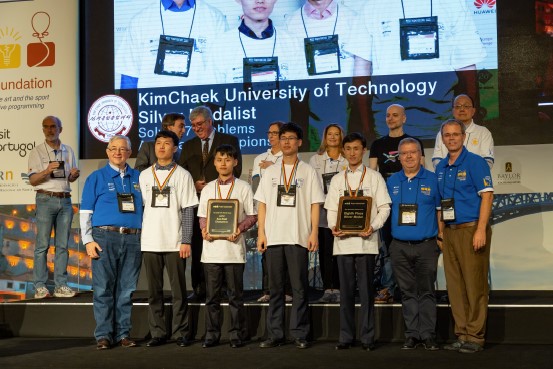
The system works well. We know this because the best children end up competing at the International Mathematics Olympiad and the International Collegiate Programming Contest (ICPC). At the 2019 event, the team from Kim Chaek University of Technology came in eighth place, ahead of many world-class universities including Oxford, Cambridge, Harvard and Stanford. It might take several years for the results of this new focus to bear fruit, but the strategy appears to be in place and in operation.

Figure 1. Kim Chaek University of Technology students at the 2019 International Collegiate Programming Contest (Photo: ACM ICPC)

In another part of his message to teachers, Kim Jong Un also called for greater cooperation between scientists and enterprises, so engineers can work on problems faced by the country’s factories and workplaces. He opined that, “We should also take institutional measures so that scientific research institutes and enterprises, in close cooperation, can boost production and technological development and enhance intellectual creativity.”

On September 16, the state-run Sogwang website echoed this message, saying that such cooperation can also benefit scientists by giving them real-world experience and,

“In conjunction with scientific research institutes, every business should strongly engage in research and development of new technologies, something that is necessary to realize localization of raw materials, fuel and facilities, CNC (computer numerical control) and unmanned production processes.”[5]

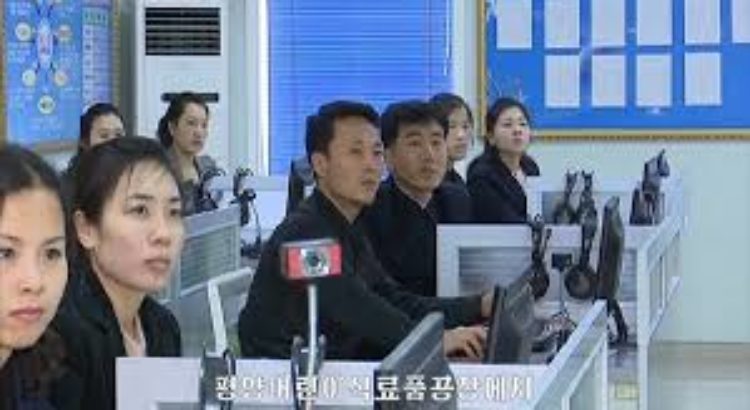
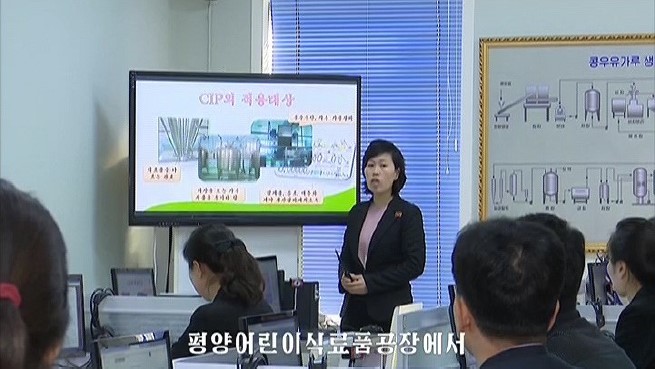
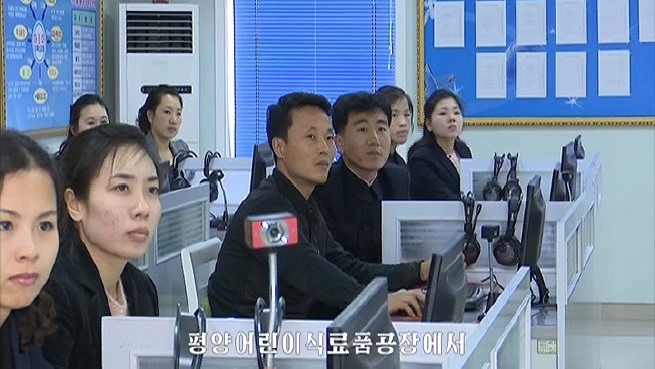
The new focus on secondary education comes a few years after the party began pushing science and technology education in the workplace. Many newer workplaces now have a science and technology room where workers can learn new skills or improve on how they do things. The image below shows one such room at the Pyongyang Children’s Foodstuff Factory. It appears this is a lesson on “clean in place,” a method for cleaning the inside of pipes and tanks and other equipment without taking it apart. Many of these rooms are connected to the national intranet so, in addition to in-person lectures, lessons can be streamed from universities in Pyongyang.

Figure 2. The sci-tech education room at Pyongyang Children’s Foodstuff Factory (Source: KCTV via Martyn Williams)
Figure 3. The sci-tech education room at Pyongyang Children’s Foodstuff Factory (Source: KCTV via Martyn Williams)

But perhaps the greatest indication of the importance that the government is giving science and technology can be seen in the changing face of Pyongyang. The Sci-Tech Complex now dominates Ssuk Islet and there are two distinct neighborhoods of apartments given to scientists for work on the nuclear and space programs.


  1. [1]

    “Enlarged plenary of DPRK Cabinet held,” KCNA (Accessed through KCNA Watch), October 20, 2019, https://kcnawatch.org/newstream/1571599842-464652687/enlarged-plenary-meeting-of-dprk-cabinet-held/.

  2. [2]

    박진향, “세계적으로 더욱 중시되고있는 교원의 역할,” Rodong Sinmun (Accessed through KCNA Watch)October 7, 2019, https://kcnawatch.org/newstream/1570395682-18657515/세계적으로-더욱-중시되고있는-교원의-역할/.

  3. [3]

    김명훈, “교육체계가 완비되고있다,” Rodong Sinmun (Accessed through KCNA Watch), September 3, 2019, https://kcnawatch.org/newstream/1567458191-378899746/교육체계가-완비되고있다/.

  4. [4]

    It should be noted that in typical North Korean usage, “science and technology” encompasses the entirety of both subjects and not just high-tech. So a sci-tech development could just as easily be a new robot as it could be a new method of rearing fish.

  5. [5]

    “생산과 기술발전 추동히는 과학연구관, 기업체들의 협력,” 서광, September 16, 2019, http://sogwang.com/kp/post/5d7f72f72b73750318b6406b.

    Fuente de la Información: https://www.38north.org/2019/10/mwilliams102119/

Comparte este contenido:

Orlando Alzuru: El paro docente es por una mejor educación

Por: Noticiero Digital. 


El presidente de Fevemaestros, Orlando Alzuru, dijo este martes que el paro nacional de docentes convocado la semana pasada para hoy y mañana, no es solo por los bajos salarios, sino por una mejor educación para Venezuela, al asegurar que los niños y niñas estudian en condiciones paupérrimas.

“El paro es por una mejor educación para Venezuela, para nuestros niños y niñas, no podemos seguir permitiendo que los niños sigan estudiando en condiciones paupérrimas, hay centros educativos donde los baños están inservibles, escuelas con 800 niños ni un solo baño, no hay agua, no hay luz, tomando agua de chorro y el PAE que cada día sigue mas irregular, además de que los profesores no cuentan con recursos didácticos para ejercer su profesión en la aulas de clase”, aseveró Alzuru.Asimismo, mencionó la situación salarial, la cual se encuentra deteriorada, a su juicio; y que además no cuentan con seguro HCM ni funerario. “Todas estas cosas y muchas más, han hecho que hoy reaccionemos”.

Indicó Alzuru que la situación ha sido comunicada al Ministerio de Educación pero que no han accionado y que por ellos, “nosotros decidimos conjuntamente con nuestros sindicatos y filiales” parar las actividades en muestra de manifestación a la crítica situación del Magisterio Venezolano.

Insistió el profesor en que un docente con tres hijos debe cancelar al menos 15 millones de bolívares en textos y uniformes “y eso es un descalabro para la educación venezolana”.

“Las aulas están solas, no hay nadie estudiando educación porque no es atractiva para nadie y eso para nosotros es demasiado grave porque dentro de unos años nos quedaremos sin docentes bien formados (…) Tenemos que deducir que vamos a tener un futuro demasiado negro para nuestro país”, advirtió en una entrevista con Román Lozinski.

Fuente de la entrevista: http://www.noticierodigital.com/2019/10/orlando-alzuru-paro-docente-una-mejor-educacion/

Comparte este contenido:

Venezuela: Educadores en Venezuela advierten con ir a huelga nacional

América del Sur/ Venezuela/ 22.10.2019/ Fuente: www.analitica.com.

La solidaridad de los padres y representantes permitieron que los maestros estuvieran en las calles por 48 horas, además educadores advirtieron una huelga nacional de no tener respuesta en las próximas horas.

Docentes y maestros dependientes del Ministerio de Educación tomaron este martes 22 de octubre, desde tempranas horas las calles para exigir mejoras salariales y denunciar las precariedades de los colegios e instituciones.

Los educadores también respaldan el paro nacional de 48 horas, convocados por los distintos sindicatos y gremios del sector educativo.

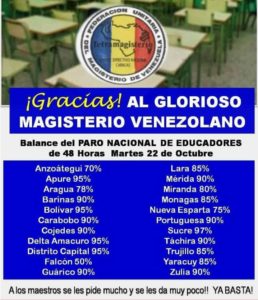
El presidente del Sindicato Venezolano de Maestros del Distrito Capital, Édgar Machado, informó durante una concentración en la Plaza Parque Carabobo de Caracas, el paro nacional de 48 horas convocado por los docentes se ha cumplido en un 80% en todo el país.

El presidente de la Asociación de Profesores de la Universidad Central de Venezuela, Víctor Márquez, reiteró que la UCV cumple con el paro de actividades pautado para este 22 y 23 de octubre y afirmó que buscan generar mejores condiciones para los estudiantes y trabajadores.

“El sector docente gana el menor de los salarios del mundo, a los profesores y a los maestros no les alcanza para adquirir la canasta alimentaria, las condiciones de vida son cada vez peores”, dijo Márquez.

Igualmente, Lourdes Ramírez de Viloria, presidente de la Federación de Asociaciones de Profesores Universitarios de Venezuela (Fapuv), aseguró que el gobernante Nicolás Maduro acabó con el sistema educativo del país.

“Vamos a tener una medida progresiva de protestas generalizadas”, manifestó Ramírez de Viloria.

La Fapuv se unirá a las próximas acciones convocadas por los docentes, las mismas podrían incluir otro paro de 72 horas, y de no obtener respuestas, advierten una huelga nacional.

Destacó que se están organizando para realizar una gran marcha universitaria o una concentración de carácter nacional en los primeros días de noviembre.

Asimismo, anunció que el viernes 25 de octubre realizarán una reunión para definir los últimos detalles de las próximas acciones.

Docentes altomirandinos dispuestos a sumarse a paro indefinido nacional

De no tener respuesta por parte a sus demandas, los docentes están dispuestos a convocar y acatar un paro de actividades de forma indefinida en las próximas semanas, aseguró este martes Miriam Silva, docente Sanantoñera que se sumó a la protesta realizada en la redoma del Municipio Los Salias.

Recordó que iniciaron el conflicto la semana pasada paralizando actividades 24 horas, “hoy estamos iniciando uno de 48 horas y de no lograrse ningún acuerdo vamos a uno de 72 horas, si siguen sin responder vamos a introducir un pliego de carácter conciliatorio que puede convertirse en conflictivo e iríamos a un paro indefinido”, dijo.

Destacó que el gobierno les está violando la convención colectiva, “aun cuando el gobierno decretó un reciente aumento de sueldo a nosotros se nos adeuda más o menos 300 % de aumentos anteriores que aún no han sido reconocidos”.

“No queremos ese tabulador de la Onapre que pone por el piso las cláusulas de reconocimiento del docente, con ese salario Onapre nos han metido a todos dentro de un mismo saco y no es posible que un docente no tenga ni para pagar el pasaje, queremos que el gobierno rectifique, queremos un salario digno”, reseñó.

Silva, quien marchó desde la plaza Bolívar de San Antonio de los Altos por toda la avenida perimetral hasta la redoma, agregó cuentan con un seguro HCM y funerario que no les alcanza para vivir “y mucho menos para morir”.

Simultáneamente en la ciudad de Los Teques cientos de maestros de las siete parroquias del Municipio Guaicaipuro se concentraron inicialmente en el boulevard Bermúdez, desde donde se movilizaron posteriormente hasta la avenida Independencia.

Los docentes informaron que este miércoles vuelven de nuevo a las calles en lo que será la segunda jornada de paro nacional, en el caso de Los Salias convocan a la redoma y piden el apoyo de padres y representantes.

En Táchira los educadores marcharon hasta la Defensoría del Púeblo

El gremio de educadores del estado Táchira marchó hasta Defensoría del Pueblo con el objetivo de consignar un documento para exigir a esta instancia gubernamental que sea mediadora ante el ministerio del educación para que cumpla con las múltiples solicitudes que tienen los docentes de todo el país.

A los docentes se sumaron representantes del gremio de la salud y profesores universitarios que se concentraron en la llamada Redoma del Educador en San Cristóbal y recorrieron la Quinta y Séptima avenida para llegar a la sede de la Defensoría del Pueblo, en donde se hizo entrega del escrito

“Si mañana el gobierno nacional no da respuesta al petitorio que ha hecho el sector universitario, el sector salud y el sector de educación sobre las propuestas que tenemos, lamentablemente iremos a un paro de 72 horas y posteriormente nos declararemos en la hora “0” hasta tanto el Gobierno nacional no se siente a discutir lo que está plasmado en las Contrataciones Colectivas”, expresó Gerardo Ramírez miembro de la coalición sindical.

Ramírez aseguró que el paro en el Táchira se cumplió en un 95% y agregó que debido al éxito que tuvieron durante este primer día de protesta, en los próximos días vendrán más acciones de calle.

De igual forma Douglas Barboza, presidente de la asociación de Profesores de la Universidad de Los Andes explicó que el documento entregado en la Defensoría del Pueblo denuncia la violación de los derechos humanos , económicos, sociales y culturales del personal docente, administrativo y obrero al servicio del estado venezolano.

Manifestó que por esta vía inician un proceso se puede llegar a instancias internacionales para que se condene al Estado venezolano por la vulneración de los Derechos Humanos.

Fuente de la noticia: https://www.analitica.com/actualidad/actualidad-nacional/educadores-en-venezuela-advierten-con-ir-a-huelga-nacional/

Comparte este contenido:

Venezuela: Profesores venezolanos en paro por 48 horas

Redacción: Crónica Uno

El sector educativo venezolano comenzó este martes su segundo paro en el mes, en esta oportunidad por dos días seguidos, en busca – entre otras cosas – de mejoras salariales y laborales.

El llamado lo hizo la Federación Venezolana de Maestros el pasado 14 de octubre luego de una primera movilización. Según los educadores, antes del reciente aumento salarial, ganaban aproximadamente 2 dólares mensuales. Su exigencia es de al menos unos 600 dólares mensuales.

Como en otras oportunidades, un grupo de profesores se concentró en el Ministerio de Educación, ubicado en el centro de Caracas, para poder llevar sus reclamos.

Un grupo de docentes venezolanos decidieron llevar el paro y su protesta precisamente hasta la sede del Ministerio de Educación, en el centro de Caracas, el jueves 10 de octubre de 2019. Foto: Álvaro Algarra - VOA.

Docentes en paro en Venezuela: «Suben la carne y los maestros mueren de hambre»

“Nosotros fuimos víctimas de un despido indirecto, porque cuando tú sales y lo ganas que no te alcanza ni para cubrir el pasaje para el traslado, no tenemos nada que perder”, aseguró la profesora Zuleika Matamoros.

La educadora hizo un llamado a sus compañeros a seguir articulados, conversar entre el sector y con los representantes, y seguir movilizados. “No nos quitarán el derecho a protestar”, agregó.

La Asociación de Profesores Universitarios de la Universidad Central de Venezuela también se unió al paro. Foto: Álvaro Algarra - VOA.
La Asociación de Profesores Universitarios de la Universidad Central de Venezuela también se unió al paro.  

Según Griselda Sánchez, coordinadora nacional de la Coalición de Trabajadores Públicos por el Sector Educación, “la educación en Venezuela está hoy paralizada en defensa de recuperar nuestra nobel labor”.

Sánchez indicó que, hay movilizaciones en 15 de los 23 estado de la nación suramericana. Advirtió que, de no cumplirse sus demandas, van a convocar a una huelga general.

Claudia Rodríguez, otra profesora, comentó  su preocupación por la falta de profesionales en las aulas, razón por lo que algunos padres deciden no mandar a sus hijos al colegio.

“No es posible, ¿ese es el retraso que va tener el país? Va ser muy difícil recuperarlo, cuidado y es irreversible. Son generaciones enteras sin poder recibir formación”, expresó.

Víctor Márquez, presidente de la Asociación de Profesores Universitarios de la Universidad Central Venezuela, anunció este lunes en una conferencia de prensa que su gremio también se unía al paro.

«Esta acción del sector universitario tiene como finalidad fortalecer la lucha de todos los sectores gremiales y sindicales dado el deterioro en las condiciones de vida y de trabajo que está sufriendo toda la población venezolana», indicó Márquez.

Afirmó que el incremento salarial no satisface las demandas de ningún sector laboral. “Seguimos padeciendo condiciones de miseria. Seguimos padeciendo dificultades”, agregó.

Hay movilizaciones en 15 de los 23 estado de Venezuela en favor al sector educativo. Foto: Álvaro Algarra - VOA.
Hay movilizaciones en 15 de los 23 estado de Venezuela en favor al sector educativo. Foto: Álvaro Algarra –Fuente:  http://cronica.uno/en-las-regiones-fue-un-exito-el-paro-de-maestros-y-advierten-que-seguiran-en-la-calle/

Comparte este contenido:
Page 1904 of 6821
1 1.902 1.903 1.904 1.905 1.906 6.821