Asia/Nepal/25.09.18/Source: www.hrw.org.
Children with disabilities in Nepal face serious obstacles to quality, inclusive education, Human Rights Watch said today.
Despite progress in law and policy, the government segregates most children with disabilities into separate classrooms. It has yet to train teachers to provide inclusive education, in which children with and without disabilities learn together. Tens of thousands of children with disabilities remain out of school.
“Despite several new policies to promote disability rights, including for access to education, many children with disabilities in Nepal are not getting a quality, inclusive education,” said Alpana Bhandari, disability rights fellow at Human Rights Watch. “Public schools should provide adequate support for children with disabilities to learn in classrooms with other children and not segregate them.”
Based on research conducted in May 2018 in 13 public schools in five districts across Nepal, Human Rights Watch found that segregating children with and without disabilities has denied many children with disabilities their right to education. Human Rights Watch interviewed 80 children with disabilities, their families, representatives of organizations for people with disabilities, teachers, principals, government officials, and United Nations staff.
Based on UN and World Health Organization estimates, Nepal has 60,000 to 180,000 children ages 5 to 14 with disabilities. In a 2011 report, Human Rights Watch estimated that at least 207,000 children in Nepal have a disability. In 2016, UNICEF found that 30.6 percent of children with disabilities, or approximately 15,000 to 56,000 children, ages 5 to 12, did not attend school.
Very few mainstream public schools enroll children with disabilities. Out of more than 30,000 schools in Nepal, just 380 have what they call “resource classes,” where children with a particular disability, such as children who are blind or who have an intellectual disability, are grouped with others with a similar disability. In the schools Human Rights Watch visited, children in resource classes ranged in age from 7 to 17, with some even in their 20s. Children often remain in these classes for years, although some may move to mainstream classrooms in the higher grades, with limited support.
Nepal has no academic curriculum for children with intellectual disabilities, including children with Down Syndrome. Those who do attend school learn only basic skills, largely focused on self-care. Denying education based on a child’s disability is discriminatory, Human Rights Watch said.
In 2010, Nepal ratified the UN Convention on the Rights of Persons with Disabilities (CRPD), which guarantees the right to inclusive, quality education. Children with and without disabilities should learn together in classrooms with adequate support in an inclusive environment. Research shows that an inclusive approach can boost learning for all students and combat harmful stereotypes of people with disabilities.
“Sunita,” 15, who is deaf, attends a resource classroom in a public school in Lalitpur. “I have never been to a regular class,” she said. “I want to learn together with others. It is more fun learning together with friends.”
Most mainstream schools visited also lack teachers trained in how to use accessible learning materials, such as braille and audio equipment, and how to make testing accessible. The classrooms lack accessible infrastructure.
A principal at a public mainstream school in the Gorkha district in western Nepal said that one former student with a physical disability crawled on his hands and knees to get from one classroom to another for the seven years he attended the school, because the school was not wheelchair accessible.
Since 2011, the Nepali government has introduced reforms to strengthen the rights of people with disabilities and to expand educational opportunity. The 2015 constitution says that education is a fundamental right and provides for free and compulsory primary education and free secondary education, as well as the right to free education through braille and sign language.
In 2017, Nepal adopted the Disability Rights Act and an Inclusive Education Policy for Persons with Disabilities. The policy says that children should be able to study, without discrimination, in their own communities, but also allows educating for children with disabilities separately.
The government is also developing an inclusive education master plan to create disability-friendly educational infrastructure and facilities, improve teacher training, and develop a flexible curriculum by 2030. However, the government has yet to articulate in law or policy a clear understanding of what quality, inclusive education in line with international standards requires and how to provide it.
Nepal’s major education reform, the School Sector Development Plan for 2016 to 2023, covers pre-school through high school education. The budget for the first five years is estimated at US$6.46 billion. Eleven percent of the cost is provided by international donors, including the World Bank, Asian Development Bank, and the European Union. The program builds on a previous reform plan, which the government acknowledged did not do enough to ensure education for children with disabilities.
The government should ensure schools are accessible for all children, children with disabilities are taught in mainstream classrooms, and all teachers are trained to provide inclusive education, Human Rights Watch said.
The overnment should also provide reasonable accommodations to support individual learning. This can include braille textbooks, audio, video, and easy-to-read learning materials; instruction in sign language for children with hearing disabilities; and staff to assist children with self-care, behavior, or other support needed in the classroom.
“Nepal’s government and its international partners have made education a clear priority, including for children with disabilities, but they need to do much more to make this vision a reality,” Bhandari said. “Support for children to study in mainstream classrooms, teacher training, and a flexible curriculum are essential to make sure children with disabilities aren’t left behind.”
Nepal’s Education System for Children with Disabilities
Until early July 2018, mainstream schools could apply to the Education Ministry for funding to teach children with disabilities. As of August 28, schools apply to local authorities instead. However, funding is only allocated if a school has a set minimum number of children with a specific type of disability. Because of the funding structure, children are compartmentalized into classrooms based on their disability. And if a school has funding for one type of disability, it may not have the resources to teach children with other disabilities.
Problems of Grouping Classes by Disability
The principal of one school in the Gorkha district told Human Rights Watch that his school has a resource classroom for children with intellectual disabilities and is not physically accessible, nor can it accommodate children with hearing and visual disabilities. Similarly, the principal of a public school in Mahottari, which has a resource class for children who are blind or have low vision, said that his school cannot enroll students with intellectual or hearing disabilities because the school does not have the necessary accessible learning materials, sign language interpreters, or trained teachers.
A teacher at a different public school in Mahottari said that the school has 10 students with visual disabilities. One girl is blind and has a mental health disability, which causes the student to frequently move around the classroom. The teacher said that she did not have the training and skills to teach this student, who was not making academic progress as a result.
If a neighborhood school doesn’t offer instruction for a child with a particular disability, the child may be forced to study and live in a school that does, in some cases as far as 500 kilometers from their home.
Ten-year-old Sita, who is blind and attends a school in Mahottari, said:
I live in a hostel … I go to school… I miss home, but I love school. There is no school near my home [that can educate blind children]. My mom says you cannot learn anything at home, and I must go to school to learn.
Shyam, who has cerebral palsy, attended a neighborhood school near his home in Kathmandu in the early grades. However, at the end of sixth grade, the teachers encouraged his parents to place him in another school because seventh grade and other upper grades were on upper floors. Shyam now travels with his father up to two hours each way by bus to attend a public mainstream school in Jorpati that enrolls children with cerebral palsy, Down Syndrome, and physical disabilities.
Segregation
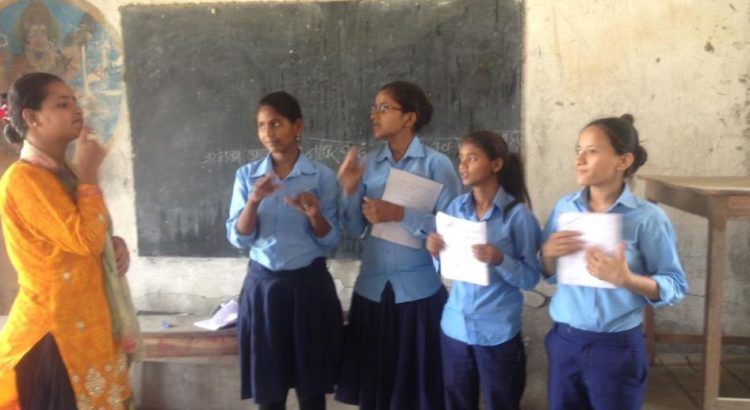
Some schools that Human Rights Watch visited had children in different grades together in one resource classroom. Others had children in different grades in separate resource classes. In resource classrooms, children with hearing disabilities learn sign language and children with visual disabilities learn braille.
Human Rights Watch interviewed children who expressed their desire to study with children in mainstream classrooms, rather than to remain segregated. Sunita, the 15-year-old girl who is in a resource classroom for deaf students in a public school in Lalitpur, said:
I study in grade 5 … I have never been to a regular class. I want to learn together with others … It is more fun learning together with others. After grade 6, I would want to study together with friends. I [would] get a chance to teach sign language to other kids in the regular class and I can communicate with them. I want to be a teacher when I grow up because I want to teach children with hearing disabilities.
An Education Ministry official involved in developing an inclusive education policy said resource classes should be preparatory environments for younger children who should move to a mainstream classroom around grade six. However, based on interviews with principals, teachers, disability rights advocates, and parents of children with disabilities, children do not consistently move into mainstream classrooms as they get older, due to the lack of accessibility and reasonable accommodations.
Some older children remain in resource classrooms for their entire basic education, through grade 8. Some parents said that when their children did not move to the older grades in mainstream schools, they felt compelled to place their children in other segregated environments, such as a special school or vocational training program. Few older children studied in mainstream classrooms in the schools Human Rights Watch visited.
Gita, who is 16 and attends school in Lalitpur, was able to move into a mainstream classroom. She said: “I am 16 years old. I am in grade 10. … I am deaf. I joined the regular classroom in grade 7. I like studying together with others because learning together becomes fun, and we learn from each other.” A sign language teacher supports Gita’s learning in the mainstream classroom.
Lack of Physical Accessibility
Most schools visited had limited physical access for students with disabilities, including at school entrances, classrooms, and toilets. In some cases, this means that children who use wheelchairs cannot remain in school. The father of a 20-year-old man with cerebral palsy who uses a wheelchair said:
I enrolled my son in a public secondary school [in Kathmandu] for one year and he passed grade 6. But then the teachers said, “Your child is disabled, your child does not fit with children without disabilities. Take your child to a school where children with disabilities attend. The seventh grade is on the third floor, and your child will not be able to reach it.
Out of the 13 schools that Human Rights Watch visited, including two that were recently constructed after the 2015 earthquake, only one, in Jorpati, Kathmandu, was accessible for children who use wheelchairs. The school has an accessible entrance, no internal stairs, an accessible toilet, and a flat playground that allowed children who use wheelchairs to move freely. The school has 354 students, of whom 27 use wheelchairs. The principal said the school does not provide specific, individualized support for children in the classroom, such as an aide who can provide direct support in personal care, moving around the school, or other tasks. Instead, teachers encourage other students to support their peers who have physical disabilities.
Disability rights activists confirmed most schools lack physical accessibility. A disability rights activist and representative of the National Federation of the Disabled Nepal, who lives in the Gorkha district, said he is not aware of any public schools out of roughly 450 primary and secondary schools in the district that are accessible for students who use wheelchairs.
Under international human rights and Nepal law, public buildings – including schools – should be accessible for people with disabilities based on Universal Design principles. Universal Design means the design of products, environments, programs, and services should be usable by everyone to the greatest extent possible, without adaptation or specialized design. This should include assistive devices for particular groups of people with disabilities, as needed. Nepal’s Disability Rights Act of 2017 establishes accessibility standards for the construction of buildings, including educational institutions, housing, workplace, road, and transport facilities that are intended for public use, while the National Building Code requires public buildings and facilities to be accessible for people with disabilities.
The 2015 earthquake destroyed or damaged 92 percent of public schools, leaving many children, with and without disabilities, out of school across the country, according to a 2017 Asian Development Bank report. Newly built or renovated schools should adhere to Nepal’s National Building Code and Accessibility Guidelines and comply with accessibility obligations under the CRPD.
However, the two newly built schools that Human Rights Watch visited did not comply with national building codes and universal design principles. One, in the Gorkha district, had stairs at the entrance and no ramp or lift, and stairs inside as the only way to reach upper floors. In Lalitpur, the principal of a public school admitted the school does not meet national physical accessibility standards, and an additional building under construction is slated to have only an entrance ramp and only stairs internally to reach the upper floors.
Lack of Reasonable Accommodations
Human Rights Watch visited some schools where children with disabilities studied in a regular classroom with children without disabilities. However, most of the schools Human Rights Watch visited did not provide sufficient reasonable accommodations to ensure children with disabilities receive a quality education.
Schools do not have a full range of textbooks in braille, or material in audio or easy-to-read formats. Schools lacked adequate staff, such as aides to support children’s participation in mainstream education. The aides, who are not fully licensed teachers, can constructively address behavioral challenges, provide personal care assistance, or take on other support roles.
Typically, schools who teach deaf children only have one sign language teacher, who works in the resource classroom. The instruction is limited to approximately 5,000 words in sign language, a fraction of the spoken vocabulary taught in mainstream schools.
The lack of vocabulary, as well as the absence of visual materials, means that even deaf children in a mainstream classroom may not receive a full education. One sign language teacher at a school that Human Rights Watch visited said,
There are 46 students in the class, one of whom is deaf. It is difficult to teach children who are deaf due to a lack of visual materials and a limited sign language vocabulary. When the teacher teaches in the class and new words come up during a lesson, it becomes difficult to describe and explain the lesson.
Samjhana, an 18-year-old deaf student there, described her experience:
Sometimes it is difficult to understand lessons that are taught in the class. I ask my [sign language] teacher when I do not understand. The teacher tries to explain, but I do not understand the words. The learning is more fun and easier with something you can see and understand.
Children who are blind or have low vision learn braille in resource classes, but a limited number of textbooks are available in braille and very few, if any, materials are available in audio or digital formats. One 17-year-old girl, who is blind, described her experience in a mainstream classroom in Lalitpur:
The challenge I have is that I am not able to see and follow what is written on the blackboard. I depend on other students to understand what is written on the blackboard. Not many braille books are available. In this school, children who are blind do get the opportunity to learn, teachers are helpful and so are my friends.
In Kathmandu, Suman, 14, who is blind, attends a mainstream classroom in a school with a teacher who knows braille to support children with visual disabilities. Suman used technology at home to learn, though, since none was available at the school:
I got my digital tablet from an NGO … I also use my mobile telephone at home. I read books with the tablet. … The app has a voice, and I can read by listening. I spoke with my teachers about digital learning, and teachers say they are hoping to adopt that.
The lack of reasonable accommodations, such as aides, can also place serious burdens on families. Some family members may feel compelled to give up employment and the care of their other children to accompany their child with a disability at school. Hari, the father of an eighth grader with cerebral palsy who uses a wheelchair in Kathmandu, said he had to quit work when his son was 8 to accompany him in school all day. The public school Shyam attends does not provide an aide to help him move between classes and feed him. His father said:
My son is big. Who would care for him? I come to school every day to support my son in the school. The school does not provide assistance to support my child. … He can fall any time.
The school principal said the staff encourages Shyam’s classmates to help him with homework and classwork.
Lack of Reasonable Accommodations for Examinations
The schools Human Rights Watch visited provide few accommodations for students with disabilities during exams, though most are mandatory for passing to the next grade or for enrolling in high school or a university. The accommodations provided – such as a writing assistant for students with visual disabilities – are often ineffective. The assistant is often another child, typically from a lower grade, who is not paid.
In one example, there are no options for children with visual disabilities to take math and science tests in an accessible format. Tests often require description of diagrams or pictures, which blind children cannot see.
Nisha, in grade 10, who is blind and attends a public school in Mahottari, said:
The writing assistant helped me take my tenth grade exam. The writing assistant would read me the questions, and I would answer, and then the writing assistant would write down the answers for me. … I wish I could take exams on my own, not with the help of a writing assistant. It’s difficult to perform math and science exams because they have questions related to geometry and questions with drawings, and I cannot see them.
Furthermore, the family of the student taking the exam must pay for the transportation and meals for the assistant. Teachers and disability advocates said exams are not modified for children who are deaf who have been instructed in a limited vocabulary.
Children with Intellectual Disabilities
Children with intellectual disabilities do not receive an academic education and have few if any opportunities to enroll in secondary education or a university. Under the Disability Rights Act of 2017, a person is considered to have an intellectual disability if their “intellectual development does not progress with their age and therefore has difficulty performing activities based on age and environment.” The Education Ministry’s Curriculum Development Center created a curriculum for children with intellectual disabilities in 2015. The curriculum limits children with intellectual disabilities to learning practical life-skills in resource classrooms or special schools for up to 10 years. It includes tasks like personal hygiene, brushing teeth, going to the toilet, getting dressed, and eating independently. Children who are 14 and 15 years old can learn vocational skills such as candle-making, sewing, or origami.
A teacher in the resource classroom at a public school in Mahottari, said:
The school has not received any curricula for children with intellectual disabilities from the government. I teach children with intellectual disabilities using pictures. It would be possible to teach children with intellectual disabilities by using simplified curricula that suits their learning style.
Lack of Trained Teachers
Nepal’s 2017 Disability Rights Act (section 23.2) provides for special training for teachers who educate children with disabilities to promote their access to quality education, but does not mention training for teachers in inclusive education. Training is focused on developing specialized teachers, rather than training all teachers in inclusive methods that will benefit diverse learners. One mainstream classroom teacher said the only training she had on children with disabilities was a one-week program focused on discipline and classroom management conducted by a non-governmental organization.
The Education Ministry’s Center for Education and Human Resource Development, formerly the National Center for Education Development (NCED), is responsible for teacher training. The agency’s deputy director, Upendra Dahal, told Human Rights Watch the government provides one month of professional development training to special education teachers who work in resource classes or in special schools. He told Human Rights Watch the center is currently not offering the five-day refresher training that exists. Occasionally, the agency holds training sessions of a day or two for specific disability-related topics, such as teaching children with autism.
Human Rights Watch found some resource teachers had received less than a month of training. Kumar, a resource teacher for children with intellectual disabilities at a public school in Gorkha, said:
I have been a resource teacher for three years. I only received nine days of training from the Department of Education [Now the Center for Education and Human Resource Development]. Otherwise, I have received training from the local nongovernmental organization, Blind Association Gorkha. I do not know how to teach children with intellectual disabilities. I want to teach these students, but I do not know how to impart knowledge to them.
Monitoring
Until early 2018, federal, district, and regional authorities were responsible for monitoring schools. In mid-2018, with the decentralization of education funding to municipal and village authorities, local education offices will have that responsibility.
An Education Ministry official said monitors examine schools’ budget implementation, student attendance, teaching methods, uniforms, school sanitation, food quality, and quality of accommodations in residential schools.
For schools with resource classes, monitoring also examines whether schools have met requirements for a resource classroom. Those include the presence of a full-time, permanent teacher and of the required minimum number of children, and the “minimum enabling conditions,” which include a separate classroom, separate toilet for girls, a ramp at the school entrance, and a disability-friendly classroom, although there is no clear definition for this.
Recommendations
The government of Nepal should:
- Guarantee quality, inclusive education for children with disabilities in community mainstream schools on an equal basis with others, in line with the CRPD
- Ensure maximum inclusion of children in mainstream classrooms and avoid segregation of children with disabilities in separate classrooms. Education should be delivered in the most appropriate languages and modes and means of communication for the individual, and in environments which maximize academic and social development, in line with the CRPD.
- Ensure reasonable accommodations for children with disabilities, based on individual learning requirements. These can include braille textbooks and other materials; digital, visual, audio, and easy-to-read learning materials; instruction in sign language for children with hearing disabilities; and aides to assist students with behavior, self-care, and other considerations.
- Ensure children who require individual support, or support for small group coursework, are fully included in the school environment with other students.
- Ensure all schools are physically accessible. Ensure all schools renovated or newly built adhere to Nepal’s building codes and Universal Design Principles.
- Ensure the examination and assessment system is flexible and responsive to the needs and academic progress of individual learners, based on their individual learning requirements.
- Mandate the Education and Human Resource Development Center to provide adequate pre-service and ongoing training in inclusive education for all teachers, including on how to address all children’s diverse learning needs.
- Ratify the Marrakesh Treaty, which permits the reproduction and distribution of published works in formats accessible to people with visual disabilities.
- Strengthen monitoring and oversight to ensure children with disabilities are enrolled in school and they receive reasonable accommodations to receive a quality education on an equal basis with other children in mainstream classrooms.
- Collect data on the total number of children with disabilities in the country, including the number of children in and out of school, disaggregated by disability-type, location, and other demographic markers. Formulate educational policies, plans, and programs based on data.
Multilateral and Bilateral Donors should:
- Ensure the government of Nepal prioritizes the inclusion of children with disabilities in schools across the country and provide adequate resources to ensure they can study in mainstream classrooms with flexible curricula, reasonable accommodations, and trained teachers and other staff
- Support the government to improve systematic data collection on children with disabilities by age, gender, d
Source of the notice: https://www.hrw.org/news/2018/09/13/nepal-barriers-inclusive-education




 Users Today : 18
 Total Users : 35462593
 Views Today : 25
 Total views : 3424208