Page 3 of 4
1 2 3 4

CLADE: Comité de Desarrollo Internacional del Parlamento del Reino Unido plantea serias preocupaciones sobre las escuelas de Bridge

CLADE/16 de enero de 2018/Fuente: http://privatizacion.campanaderechoeducacion.org

Un comunicado de prensa firmado por varias redes y organizaciones de la sociedad civil, entre las que se encuentran la Campaña Mundial por la Educación (CME) y la Campaña Nacional por el Derecho de la Educación de Brasil (coalición integrante de CLADE), destaca algunas de las conclusiones a las que ha arribado un nuevo informe del Comité de Desarrollo Internacional (IDC) del parlamento británico.
Entre estos planteamientos, se señala que el modelo de las escuelas Bridge International Academies (BIA) es problemático y genera dudas sobre la financiación de Reino Unido a esta cadena estadunidense de educación privada.

Entre las principales preocupaciones que resalta el informe se encuentran: la calidad de la educación y los contenidos de los currículos, el costo de las tarifas, los resultados de aprendizaje, el despido de maestros/as en gran escala y la expulsión masiva de estudiantes. También son objeto de preocupación, las relaciones que mantienen con los gobiernos y la inobservancia de sus regulaciones, así como aspectos relativos a la transparencia y la sostenibilidad.

En base a ello, el informe recomendó que no se realicen más inversiones en BIA hasta tanto no se esclarezcan estas cuestiones.

La semana pasada, la Comisión Africana de Derechos Humanos y de los Pueblos nuevamente expresó su preocupación sobre el grado de cumplimiento de las regulaciones por parte de Bridge.

Camilla Croso, Presidenta de la CME y coordinadora general de la Campaña Latinoamericana por el Derecho a la Educación (CLADE) expresó: “Este informe muestra cómo el apoyo a los actores privados no ha cumplido con el derecho a la educación. Esperamos con interés que los Estados donantes fortalezcan los fondos para la educación pública“.

Encuentre el comunicado de prensa completo aquí (en inglés).

Fuente de la Noticia:

http://privatizacion.campanaderechoeducacion.org/comite-de-desarrollo-internacional-del-parlamento-del-reino-unido-plantea-serias-preocupaciones-sobre-las-escuelas-de-bridge/

Comparte este contenido:

Interview, Katarina Popović: A commitment to free and universal education is very important for eradicating poverty, achieving equality and a better life for all

By: CLADE

In the context of the UN High Level Political Forum, we spoke with Katarina Popović, General Secretary of ICAE

The UN High Level Political Forum (HLPF 2017), the international platform for monitoring and reviewing the Sustainable Development Goals (SDG) is held in New York from 10 to 19 July 2017 in New York.

In this context, we had a dialogue with Katarina Popović, General Secretary of International Council for Adult Education (ICAE), organization that impels the Education and Academia Stakeholder Group (EASG) – which integrates the structure of civil society participation in the debates on SDG in the United Nations-, alongside the Global Campaign for Education (GCE), Education International (EI) and the European Students’ Union. «The HLPF has spaces for civil society and stakeholder groups to present their reports and we were invited to bring examples of how we contributed to the implementation of the 2030 Agenda and how we helped governments in doing so», says Katarina about her participation in the High Level Political Forum. Read the complete interview:

What were the main issues that were discussed during the side event organized by the EASG in NY yesterday and why are they important?

The opportunities and challenges for the implementation of the Education Agenda 2030 have been analysed in several sections, and many aspects have been mentioned and explained, such as the fact that education is underfunded and experience budget cuts in many countries, further on there is the growing trend towards privatization and commercialization of education, undermining the responsibility of the state as the duty bearer for the 2030 agenda.

These were highlighted as the major challenges to achieving the Agenda 2030’s Goal 4 on education. In addition, and that is something that other SDGs are also facing, there are problems with the implementation of the goals: how to move from rhetoric to action and move from the overall agenda to a national and regional level. Further on, there is a strong focus on indicators, measuring and testing, and on quantitative data. Even if this is the precondition for the accountability, it narrows down the understanding of education and the approach to quality education for everyone. While reviewing of the implementation is being intensively discussed, there is no enough political commitment and financial support for the implementation itself.

There were lots of discussions about the role of the Member States and Major and Stakeholder Groups and about the best ways for civil society for taking on its responsibilities for both implementation and monitoring. In the discussions, we from the EASG always pointed out that the State has the main responsible for these tasks, but with the spaces for dialogue always open for participation of other actors.

Considering the role of civil society, it is double: there is, on one hand, the question of how to contribute to the implementation and monitoring, and on the other, the question of how to hold governments accountable, how to make sure that they take responsibility for these processes. Many sessions during HLPF resulted in concrete proposals.

HLPF offered spaces for civil society and stakeholder groups to present their reports, experiences and recommendations, and to bring concrete examples. Of course, we still believe that this exchange and dialogue could be improved, but HLPF is ‘young’ mechanism and we are all still ‘shaping’ it.

In which events or side events organized in the context of HLPF did you participate and which highlights would you like to share about these encounters?

The Education and Academia Stakeholders Group organized a side event at the HLPF in New York, whose main focus was the intersectionality of the global agenda. Why is this so important if that goal is not under review that year? With this event, we wanted to send the message that the implementation of the SDG4 is crucial for the implementation of the other goals.

A commitment to free and universal education is very important for eradicating poverty, achieving equality and better life for all. The experts who participated in the event pointed out that the commitment to education and lifelong learning, accompanied with sufficient investment, is the answer to most of the world’s problems. We emphasize the indivisibility and interdependence of all human rights reflected in all 17 SDG, and that achieving universal, quality, affordable education is the requirement for achieving them all.

The interdependence of the goals, and relationship between education and other goals is mutual: poverty, hunger, health problems, gender discrimination and environmental disasters are detrimental elements to the SDG4. In our event, we pointed out that it is necessary to break the traditional silose-thinking for more cross-sectoral partnership. It was the message of all speakers, both from Member States and civil society, as well as participants that took part in the discussion.

What are the main opportunities and challenges for the realization of the 2030 Education Agenda, according to the discussions that has taken place in the HLPF until now, and what are the expectations of civil society about possibilities of advocacy in this context?

The HPFL 2017 is a very dynamic event. In addition to the main sessions, there are numerous side events, discussions, and side meetings that we use for effective coordination of our activities with other stakeholder groups.

Yesterday, one of the session of the main programme – “Thematic review: Eradicating poverty and promoting prosperity in a changing world: Multi-stakeholder perspectives”, gave us the opportunity to bring up our views and specific issues. At that session I had the opportunity, as the representative of the EASG, to present our vision and to remind the plenary of the intersectorality of the agenda and of some important facts. One of them – the world map of illiteracy coinciding with maps of poverty, malnutrition, ill health, high infant and child mortality, proves that education hast to be the “golden thread that runs through the implementation of all 17 SDGs”.

There were also other events where we could discuss and get to know other aspects and dimensions of that topic, and get important information and ideas for our future advocacy actions. We also met with our allies and other groups, such as the Women’s Major Group, which organized daily events, meetings and actions, the Major Group of Persons with Disabilities and the Major Group for Aging. “No one should be left behind” is the idea that connects us in a very strong way. We believe that increasing collective efforts will help us improve the way we oversee the implementation of the Agenda.

I would say that the HLPF this year is more inclusive, and civil society has more spaces to discuss, raise issues and ask questions. But there is also a sense of urgency and a feeling that we all need to make more efforts together to implement Agenda 2030.

Source:

http://v2.campanaderechoeducacion.org/en/news/778-2017-07-17-16-37-46.html
Comparte este contenido:

Experiencias pedagógicas en contra de la discriminación en las escuelas brasileñas

CLADE – Brasil/18 de julio de 2017/Fuente. http://v2.campanaderechoeducacion.org/

El programa Gênero e Educação, impulsado por la organización Ação Educativa, tiene la intención de contribuir al fortalecimiento de la agenda de igualdad de género en la política educativa en Brasil, compilando en su página web un banco de experiencias con proyectos desarrollados en las escuelas que contribuyen para este objetivo. El OREI recogió algunos de ellos que destacamos a continuación:

El proyecto “Educación para la igualdad de género: las mujeres protagonistas de su historia” resultó del diagnóstico realizado por los/as profesores/as sobre el tema de las relaciones de género en la escuela. Su objetivo es promover la equidad entre hombres y mujeres y superar la cultura patriarcal que disminuye y discrimina a las mujeres.

Esto se logra a través de la investigación sobre la violencia contra la mujer; el aprendizaje acerca de la historia de los movimientos feministas; la reflexión sobre la situación social de las mujeres en diferentes culturas y sus derechos en diferentes épocas históricas en todo el mundo.

Los resultados aparecieron a través de testimonios que informaron un cambio efectivo en la vida familiar después de la participación en las reuniones con los/las estudiantes celebradas en la Escuela Estadual de Enseñanza Fundamental Francisco Campos, en João Pessoa, capital del estado de Paraíba.

El proyecto “Escuelas sin Homofobia: reflexiones sobre conceptos, prejuicios, actitudes y valores”, realizado en el sistema de educación pública del estado de Tocantins, atiende a  una demanda por más información sobre este tema, una vez que los prejuicios basados en la orientación sexual (homofobia) y el sexismo son elementos constantes en la experiencia cotidiana de los y las estudiantes.

Comprendiendo que el rol del o de la docente es mediar conflictos y estimular la pluralidad de experiencias socio-culturales de los/as estudiantes, el primer paso fue estimular la deconstrucción de los parámetros sociales heteronormativos.

A partir de la exhibición de películas y realización de lecturas y debates en las clases de sociología, fue posible estimular reflexiones y, según los/as organizadores/as, los resultados positivos indican la utilidad de estos métodos para abordar ese tema con el público adolescente en el contexto escolar.

Por fin, el proyecto “Hablar de género en la escuela: el desafío de construir prácticas pedagógicas emancipadoras”, desarrollado por el Centro de Estudios y Formación en Género y Lucha contra la Violencia contra la Mujer Vanete Almeida, en la ciudad de São José do Egito, en Pernambuco, trató de desarrollar prácticas pedagógicas emancipadoras estudiando temas de género y feminismo, utilizando documentos de referencia producidos por este Centro, que contienen indicaciones de películas, libros, canciones, experiencias exitosas, tesis, artículos y documentales.

Fuente de la Noticia:

http://v2.campanaderechoeducacion.org/

Comparte este contenido:

Nueva resolución de la ONU insta a fortalecer el compromiso por la educación pública

ONU- CLADE/4 de julio de 2017/Autor: CLADE/Fuente: https://www.aler.org

La resolución reafirma la importancia de la educación pública así como la urgencia de abordar los impactos negativos de la comercialización de la educación.

Adoptada por consenso por el Consejo de Derechos Humanos de las Naciones Unidas el pasado jueves 22 de junio, la resolución reconoce la importancia de la inversión en educación pública con el máximo de los recursos disponibles, y aumentar y mejorar el financiamiento interno y externo para la educación, como se estableció en Declaración de Incheon, así como de garantizar que las políticas y medidas en materia de educación sean compatibles con las normas y principios de derechos humanos, y de fortalecer el compromiso de todas las partes pertinentes para contribuir a la educación como bien público (párrafo 3).

Además, insta a todos los Estados a establecer un marco regulador para los proveedores de educación (ya sea que operen de manera independiente o en asociación con los Estados), con arreglo a las obligaciones internacionales en materia de derechos humanos, aludiendo a normas y estándares mínimos para la creación y el funcionamiento de servicios educativos, al abordaje de cualquier impacto negativo de la comercialización de la educación, al fortalecimiento del acceso a recursos apropiados y a  la reparación de las víctimas de violaciones del derecho a la educación (párrafo 2.e).

Asimismo,  exhorta a todos los Estados a que regulen y supervisen a los proveedores de educación, responsabilizando a aquellos cuyas prácticas tienen un impacto negativo en el disfrute del derecho a la educación, así como apoyar actividades de investigación y sensibilización para comprender mejor el amplio impacto de la comercialización de la educación sobre el disfrute de este derecho (Párrafo 4).

Para conocer más sobre esta resolución, pueden encontrar en adjunto el comunicado de prensa firmado o acceder al texto del mismo en línea aquí.

El texto completo de la Resolución A/HRC/35/L.2 del Consejo de Derechos Humanos sobre el derecho a la educación pueden encontrarla aquí.

Fuente de la Noticia:

https://www.aler.org/index.php/node/2054


Comparte este contenido:

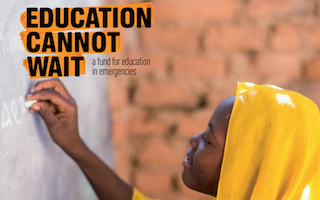
Education Cannot Wait – a fund for education in emergencies: Statement by the Global Campaign for Education

By CLADE

462 million school-aged children – or one in four around the world – live in countries affected by crisis. 75 million are either in danger of, or are already, missing out on their right to a free, quality education. Education empowers and promotes resilience, provides a safe space and stability, is fundamental for children, youth and adults to tackle emergencies, and breaks the cycle of conflict.

Supporting children and young people living in some of the world’s most difficult contexts has proven to be a serious challenge: in 2015, only 12% of children identified as living in conflict situations were reached by humanitarian funding dedicated to education. Efforts must be redoubled if the world is to meet its shared ambition to leave no one behind.

As such, the Global Campaign for Education welcomes the launch of the Education Cannot Wait fund for education in emergencies, which was announced at the World Humanitarian Summit in Istanbul, Turkey, 23-24 May 2016. The fund aims to reach more than 13.6 million children and young people living in crisis situations, such as conflict, natural disasters and disease outbreaks, with quality education over the next five years, and 75 million by 2030. GCE believes that the new fund constitutes an historic opportunity to fund the future by ensuring access to quality education for some of the world’s most vulnerable children and young people.

The European Union, the Netherlands, Norway, the United Kingdom, and the United States have all made financial contributions for the first year of the fund so far, with Denmark indicating its willingness to make a financial contribution in 2017. The fund’s target for the first year is US$150 million, with an overall ambition of achieving $3.5 billion over a five-year period; by the close of the World Humanitarian Summit, just over 50% of the year one target had been pledged.

GCE welcomes these pledges and will be holding governments to account by analysing these commitments in the coming days. It is crucial to ensure that new monies have been pledged, and that countries supporting the new Fund do not double-count commitments, such as those made during the February 2016 Syria Conference, or draw back their support from existing mechanisms, such as the Global Partnership for Education.

Similarly, GCE urges those governments making pledges to the new fund to commit to delivering the vision of equitable, inclusive and free quality education to which they have pledged for every child in the Sustainable Development Goals (SDGs) and the Education 2030 Framework for Action; all children, young people and adults have the same rights, and these rights should not be compromised for those living in crisis contexts. We particularly call on governments to ensure that public funds dedicated to education are used for quality, public provision and systems, and not to support for-profit private companies seeking to draw financial profit from humanitarian crises. This practice, known as ‘disaster capitalism’, has already been applied in several cases and contexts, and has proven to be profoundly detrimental to the realisation of human rights. For the right to education, it places quality, equity, and inclusion in serious jeopardy.

GCE also welcomes the fund’s commitment to being inclusive and transparent in its own governance. We call on the fund to adhere to the principle of engaging with and including civil society, both in its own governance arrangements and in its ways of working on the ground. The voice of citizens is vital to ensuring that its work is well-informed, and held accountable by those it seeks to serve.

GCE submitted its own pledge to the World Humanitarian Summit. The pledge encompassed building civil society capacity in countries afflicted by disaster and conflict to ensure citizens are involved in sector planning in and for such contexts, as well as monitoring education financing and delivery. At local, national, regional and international levels, GCE is also committed to advocating for increased and additional resources for education in emergencies and crises, and monitoring such commitments and delivery of services.

The statement above can be downloaded in English.

Source:

http://www.campaignforeducation.org/en/news/global/view/679-education-cannot-wait-a-fund-for-education-in-emergencies-statement-by-the-global-campaign-for-education

Comparte este contenido:

Bolivia: Instituciones, Organizaciones y Activistas de la Sociedad Civil se movilizarán por el Derecho a la Educación

Bolivia/ 06 de junio de 2017/Fuente: http://v2.campanaderechoeducacion.org

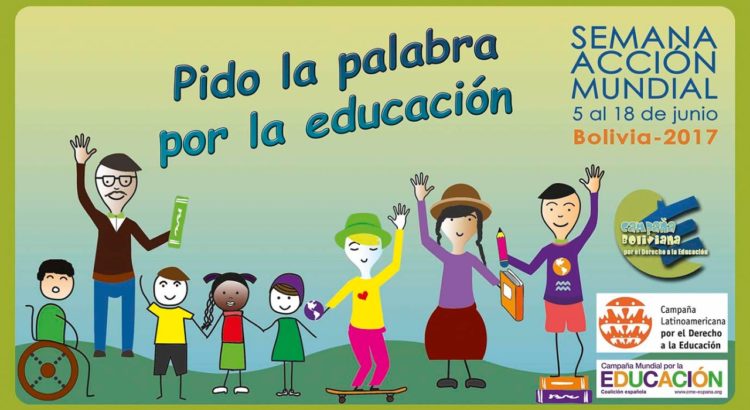
“Pido la Palabra por la educación”, la Campaña Boliviana por el Derecho a la Educación del 5 al 18 de junio, celebrará la Semana de Acción Mundial por el Derecho a la Educación, con el objetivo de instalar espacios de diálogo, análisis y reflexión, a través de la movilización social que promueva una participación ciudadana en el seguimiento al ODS4 y la Agenda Educativa 2030.

En el marco de la Semana de Acción Mundial por el Derecho a la Educación – SAME, a realizarse del 5 al 18 de junio, bajo el lema “Pido la Palabra por la Educación”, la Campaña Boliviana por el Derecho a la Educación – CBDE, llama la atención sobre la importancia de la participación activa de la ciudadanía, en los procesos necesarios para que el derecho a una educación inclusiva, equitativa y de calidad para todos y todas sea una realidad.

Es necesario, remarcar que la Campaña Boliviana por el Derecho a la Educación CBDE, es una plataforma articulada a organizaciones e instituciones de la sociedad civil, con adhesión a la CLADE y la Campaña Mundial por el Derecho a la Educación, orientada a fortalecer la participación social, desarrollando propuestas y acciones de incidencia en las políticas educativas.

En ese sentido, es bueno puntualizar que desde el año 2001 la Campaña Mundial por la Educación (CME) lleva adelante la Semana de Acción Mundial por la Educación (SAME). Es una semana donde más de 124 países que trabajan por garantizar el derecho a la educación se movilizan para llamar la atención de la comunidad educativa, de los medios de comunicación, de la sociedad en general y especialmente de los representantes políticos, sobre la necesidad de hacer real y efectivo el derecho a una educación de calidad para todos y todas.

Este año, en Bolivia, la Semana de Acción Mundial por el Derecho a la Educación (SME 2017) se celebrará del 5 al 18 de junio, abordando el rol de la Sociedad Civil frente al Objetivo de Desarrollo Sostenible 4 – referido a Educación, bajo el lema “Pido la palabra por la educación” como reflejo de la importancia de la participación de la ciudadanía, donde se exigirá a los representantes políticos el cumplimiento de la Agenda de Educación 2030. Ante este escenario, los espacios de reflexión y análisis que se instalaran permitirán dialogar bajo cuatro ejes:

– Financiamiento en educación: Costo alumno calidad

– La aplicación de pruebas estandarizadas y sus efectos negativos en la educación

– Violencia y acoso escolar

– Educación para la primera infancia, una prioridad política

Cabe remarcar que las acciones instaladas en la Semana de Acción Mundial por el Derecho a la Educación, permitirá aportar al diálogo y a la reflexión sobre el sentido político y pedagógico de la educación, indagando y debatiendo sobre una educación de calidad, inclusiva y equitativa, principalmente remarcar que la educación debe ser transformadora, emancipadora y garante de derechos.

En esa línea se instalará, el 7 y 8 de junio el Foro Internacional: El Rol de la Sociedad Civil frente al ODS4 y la Agenda Educativa 2030, donde participaran expertos internacionales como: Daniel Cara de Campaña Brasilera por el Derecho a la Educación; Alberto Croce, de la Campaña Argentina por el Derecho a la Educación – CADE; Elizabeth Ivaldi, Presidenta Organización Mundial para la Educación Preescolar – OMEP Uruguay; Rosa María Torres, Investigadora y Especialista en temas educativos – Ecuador; Omar Pulido, Investigador y Especialista en temas Educativos – Colombia; Gilda Aguilar, Especialista en Educación Inclusiva – Costa Rica. Entre los exponentes nacionales podemos mencionar: María Soledad Quiroga, Coordinadora del Área de Investigación en Conflictividad Social y Comunicación Democrática – Fundación UNIR; Mónica Novillo, Coordinador de la Mujer; Sergio Von Vacano, Especialista Regional en Educación Plan Internacional; Fernanda Rivera, Delegada Juvenil de Bolivia ante la ONU, entre otras.

Sin lugar a dudas los espacios de movilización social nos permitirán instalar agendas inclusivas desde los derechos humanos, el ejercicio de la ciudadanía, el respeto por la diversidad, la interculturalidad, el diálogo de saberes, abriendo caminos para una educación de convivencia y armonía con la madre tierra.

En ese marco, la Campaña Boliviana por el Derecho a la Educación, convoca a todos y todas a participar de los espacios de reflexión, información, sensibilización y movilización social que permitirá deliberar, dialogar y analizar sobre el cumplimiento de los compromisos en relación al ODS4 y la Agenda Educativa 2030.

Fuente de la Noticia:

http://v2.campanaderechoeducacion.org/es/noticias/749-2017-06-02-18-30-33.html

Comparte este contenido:

Entrevista: «¡Pedimos la palabra por la educación! – Es hora de garantizar este derecho».

Entrevista a Camilla Croso, presidenta de la Campaña Mundial por la Educación y coordinadora de la Campaña Latinoamericana por el Derecho a la Educación (CLADE), quién nos detalla la lucha y movilización durante la SAME 2017.

Con esta consigna se marca la Semana de Acción Mundial por la Educación (SAME 2017), iniciativa de movilización internacional coordinada por la Campaña Mundial por la Educación (CME), este año la semana está dedicada a exigir a los gobiernos que rindan cuentas sobre la implementación de la Agenda de Educación 2030 en sus países y teniendo como premisa la participación activa de la ciudadanía en el seguimiento de estos compromisos, se realizarán actividades de incidencia política y movilización social en más de 100 países de todo el mundo.

Durante la SAME 2017, también se abordan los desafíos para la realización del Objetivo de Desarrollo Sostenible 4 – referido a Educación – a nivel mundial, entre ellos la disputa sobre el concepto de calidad educativa; el debilitamiento del rol de los Estados como garantes del derecho a la educación pública y gratuita; y la reducción de espacios para la participación ciudadana en muchos países, inclusive con casos de criminalización y represión de la protesta social.

Descargue aquí el programa con la entrevista, producido por la Asociación Latinoamericana de Educación Radiofónica (ALER).

Fuente de la Entrevista:

http://same2017.campanaderechoeducacion.org/index.php/mediateca/130-pedimos-la-palabra-por-la-educacion-es-hora-de-garantizar-este-derecho

Comparte este contenido:
Page 3 of 4
1 2 3 4