Saltar al contenido principal
Page 1857 of 6197
1 1.855 1.856 1.857 1.858 1.859 6.197

Estados Unidos: What do you want to know about education in Alabama?

It’s back-to-school time in Alabama.

School started this week. And while I can’t help with math homework, I do know a little about what’s happening in the education universe. Test scores? Budgets? Discipline? What’s on your mind?

I’m all ears. Submit your questions in the box below, and I’ll do my best to find answers and report back later this week.

Parents are certainly interested in school start dates. On Monday, we reported on a poll showing 85% of Alabamians want longer summers. What do you think? Were you ready to go back to school?

The annual PDK poll about the public’s attitude toward public schools also came out this week—it included teachers for the first time since 2000—and showed some concerns about teacher morale. Just half of teachers said their community values them a great deal or good amount, and nearly half of teachers have considered quitting their jobs—for a range of reasons, including pay but also underfunding of schools in general.

The poll also showed that teachers and parents are worried about school discipline not being strict enough. What do you think? Is discipline handled well in your child’s classroom?

And how about college? How’s that going? Is the cost a concern?

Fuente de la Información: https://www.al.com/news/2019/08/what-do-you-want-to-know-about-education-in-alabama.html


Comparte este contenido:

Nigeria: Ekiti begins mass recruitment of primary school teachers

Africa/ Nigeria/ 07.08.2019/ Source: www.pulse.ng.

The Ekiti State Universal Basic Education Board (SUBEB) on Monday commenced the process of recruiting teachers into public primary schools in the state.

A statement made available to the News Agency of Nigeria (NAN) in Ado-Ekiti by the Executive Chairman of SUBEB, Prof. Francisca Aladejana, said the planned mass recruitment was sequel to the approval of Gov. Kayode Fayemi.

According to her, the governor has directed the board to fill vacancies in public primary schools in the state without delay.

She said that application forms would be distributed free to applicants at the SUBEB headquarters in Ado-Ekiti on Tuesday and Wednesday between 8 am. and 4 pm.

Aladejana stated further that only applicants with verifiable credentials would be allowed to obtain the application forms.

She advised interested applicants with prerequisite qualifications to visit the SUBEB headquarters to collect their forms which must be submitted in person at the same venue on or before Friday for processing.

According to her, qualifying examination will hold on Aug. 17 at Ado-Ekiti, Ikere-Ekiti, Ikole-Ekiti, Ido-Ekiti, Ijero-Ekiti and Ode-Ekiti.

The SUBEB chairman warned that the board would not accept application forms submitted late .

Source of the notice: https://www.pulse.ng/communities/student/ekiti-begins-mass-recruitment-of-primary-school-teachers/rkc16mg
Comparte este contenido:

Estados Unidos: There is a way out of the schools LGBT protest mess – but ministers need to get behind it

The introduction of mandatory relationships and sex education (RSE) in English schools was always going to be controversial. When the government consulted with the public, 40% of the responses were from people of faith. Overall, 58% of respondents disagreed with the content of relationships education in primary school and there was considerable opposition to teaching about LGBT relationships. Socially conservative Christian, Jewish and Muslim parents made their opinions known. But were they heard?

The Department for Education’s guiding principles remained unchanged and schools were left to determine how to implement the teaching. The government seemed to think things would somehow sort themselves out and headteachers could navigate their own path. The DfE was unwilling to discuss how the guidance would play out in complex multi-faith, multi-ethnic schools and communities. This was a dereliction of duty by ministers.

Six months on, we have a damaging, polarising imbroglio. Ugly protests in Birmingham against teaching about LGBT relationships at primary schools have spread to Nottingham, and teachers in other cities will be worried.

This was disingenuous at best, as officials had already exerted “extreme pressure” in “frantic” phone calls to Hazel Pulley, the chief executive of Birmingham’s Parkfield school’s academy trust, to suspend its “No Outsiders” programme.

The protests are wrong and have been almost universally condemned for the use of homophobic slogans and harassment outside schools. Yet some of the language used to describe the situation has also not been helpful. Those who ask questions about the teaching of LGBT awareness in primary schools are not all “homophobic”, or behaving as “bigots” or “extremists” – just some of the labels being thrown around. And neither is this solely a “Muslim issue”. The protests reflect wider concerns from some Christians and Jews too.

Digging deeper, we find communities who feel they have been backed into a corner and judged as not compatible with 21st century British values. Some mainstream Muslim school leaders in Birmingham feel marginalised.

Polarisation is not a sustainable position. Heads have to work closely with their communities but they also need strong backing from the government, given the strength of feeling that has been expressed.

Meanwhile, since 2014, Birmingham’s education system has been recovering from the Trojan Horse episode, when pupils were exposed to intolerant and non-inclusive teaching. The recovery has been based on the Unicef Rights Respecting Schools award, adopted by more than 250 schools. This has worked enormously well because it has enabled nursery-aged children through to sixth formers to understand their place in family, community, school and the world.

Learning about the 42 children’s rights is a sound basis upon which children can grow towards making informed choices about their own lives. The convention on the rights of the child and its articles are silent on sexuality (although clear about sexual exploitation), but rich on freedom of thought and association and the right to education that embraces all faiths and none. LGBT awareness can be incorporated by building in dialogue around mutual respect and care for children from all kinds of families.

This approach enables pupils to understand all aspects of their identity and is now widely respected in Birmingham. It also has a strong national footprint.

It is vital for primary school children to learn about equality and diversity, including LGBT relationships, in an age-appropriate way. Unicef gives us the foundation for a way forward that includes all children, all families and all faiths. When work on this comes to fruition in a relationships curriculum bound by the convention on the rights of the child, the government should fully, explicitly and enthusiastically support it.

Colin Diamond is professor of educational leadership at the University of Birmingham

Fuente de la Información; https://www.theguardian.com/education/2019/aug/06/way-out-of-schools-protest-mess-birmingham-trojan-horse

Comparte este contenido:

Chile: Gobierno, atienda la educación pública

América del Sur/ Chile/ 06.07.2019/ Fuente: www.latercera.com.

Cerca de 240.000 niños se matriculan cada año en cada nivel de las escuelas de Chile. De ellos, alrededor del 36% se matricula en una escuela pública. Antes de la municipalización, en dictadura, la educación pública constituía cerca del 80% del total. La caída es inquietante, porque en la educación pública actual aún se forma la gran mayoría de los hijos de la mitad de las familias de Chile, las de menores ingresos.

Es esencial revertir esta tendencia. La educación pública asegura acceso, inclusión, desarrolla talentos que podrían perderse. Además, entrega una formación republicana, promueve mayor interacción social entre jóvenes de distintos orígenes, abre a la diversidad y reduce la desigualdad. En todos los países desarrollados la educación pública es mayoritaria.

El Estado debe conferirle prioridad, destinar recursos para elevar la calidad, de modo de hacerla atractiva a un número creciente de padres, por su rigor, valores, seguridad, y también por cercanía al hogar. La ley que creó en 2017 los Servicios Locales de Educación Pública y la Dirección de Educación Pública ha sido un paso muy importante para colocar a las escuelas y liceos en manos de instituciones públicas mejor preparadas y de objetivo único. Esta es una herramienta esencial.

Fuente de la noticia: https://www.latercera.com/opinion/noticia/gobierno-atienda-la-educacion-publica/768051/
Comparte este contenido:

Maestros jubilados en Ecuador cumplen 14 días de protesta pacífica

América del Sur/ Ecuador/ 06.07.2019/ Fuente: www.prensa-latina.cu.

 Maestros jubilados en Ecuador cumplen hoy 14 días de protesta pacífica fuera de la sede de la Asamblea Nacional para exigir al gobierno de Lenín Moreno el pago retroactivo de sus pensiones.

Acampados en carpas blancas en los exteriores de las instalaciones del poder legislativo, protagonizan una huelga de hambre de la que ya varias de estas personas, en su mayoría de la tercera edad, presentan algunos problemas de salud.

Los docentes también demandan que esta cancelación se haga en efectivo y no mediante la entrega de bonos, como intenta proceder el Ministerio de Finanzas.

Igualmente alegan no sentirse ni escuchados ni atendidos por las autoridades nacionales, aún cuando hasta solicitaron un encuentro con el presidente Moreno.

Además de la movilización en la capital, se reportan iniciativas similares en Santo Domingo de los Tsáchilas y Guayas, para reforzar el reclamo del pago de las compensaciones jubilares atrasadas desde el 2008 hasta el 2018.

En un video publicado en las redes sociales, el ministerio de Finanzas explicó el proceso de pago de las compensaciones jubilares con bonos, afirmando que están cumpliendo de forma responsable con esta deuda, de la cual responsabilizan a la administración anterior.

El exmandatario Rafael Correa desmintió en su cuenta de Twitter estas declaraciones.

Mentira. Deuda se origina por Ley Interpretativa promulgada por la Asamblea de Ecuador en enero de 2019, que otorgó retroactivamente derecho a quienes salieron antes de vigencia de la Ley Orgánica de Educación Intercultural y por ofrecimientos de facilitar jubilación voluntaria a los 60, escribió.

Asimismo, recordó a la población que precisamente ‘fue la derecha y los que hoy están en el Gobierno los que siempre se opusieron a la indemnización de fin de carrera’.

Fuente de la noticia: https://www.prensa-latina.cu/index.php?o=rn&id=296047&SEO=maestros-jubilados-en-ecuador-cumplen-dos-semanas-de-protestas.
Comparte este contenido:

FECH rechaza idea de Chile Vamos de impulsar proyecto Aula Segura para educación superior

América del Sur/ Chile/ 06.07.2019/ Fuente: www.biobiochile.cl.


Desde la Federación de Estudiantes de la Universidad de Chile (FECH) rechazaron la idea planteada por diputados de Chile Vamos, que buscan impulsar un proyecto de ley como Aula Segura para la educación superior, tras los últimos hechos de violencia que han afectado a alumnos de ese plantel.

La agresión sufrida el 10 de julio pasado por la estudiante Polette Vega -militante de una organización de centroderecha- y la golpiza que recibió el hijo de la diputada del PPD Cristina Girardi, ambos en el Campus Juan Gómez Millas de la Universidad de Chile, serán analizados por la Comisión de Educación de la Cámara de Diputados durante la sesión de esta tarde.

Sin embargo, desde Chile Vamos lanzaron la idea de presentar un proyecto de ley para abordar estos hechos, similar a lo que se estableció con la Ley Aula Segura para los colegios, pese al fracaso que ha significado esta norma para terminar con la violencia escolar.

Fue la diputada de la UDI e integrante de la Comisión de Educación, María José Hoffmann, quien planteó la idea.

La iniciativa fue rechazada de plano por la presidenta de la FECH, Emilia Schneider, quien junto con condenar la violencia que se ha vivido en el plantel, señaló que la idea es poder buscar soluciones más profundas y no repetir malas fórmulas legislativas.

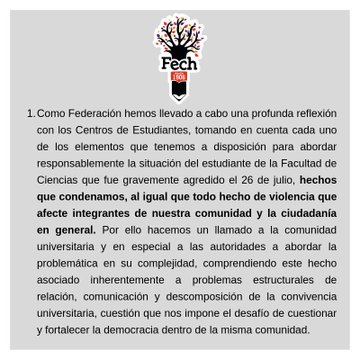
Desde la FECH además emitieron un comunicado sobre las situaciones de violencia que se han registrado al interior del campus mencionado. En el escrito condenaron la agresión contra el hijo de Girardi al igual que “todo hecho de violencia que afecte integrantes de nuestra comunidad y la ciudadanía en general”.

“Por ello hacemos un llamado a la comunidad universitaria y en especial a las autoridades a abordar la problemática en su complejidad, comprendiendo este hecho asociado inherentemente a problemas estructurales de relación, comunicación y descomposición de la convivencia universitaria”, añadieron.

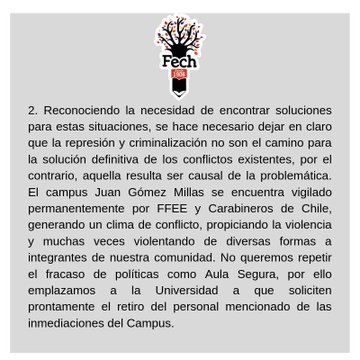
En el comunicado además pidieron el retiro del personal de Carabineros que se encuentran en las inmediaciones del campus Juan Gómez Millas.

“El campus se encuentra vigilado permanentemente por FFEE y Carabineros de Chile, generando un clima de conflicto, propiciado a la violencia y muchas veces violentando de diversas formas a integrantes de nuestra comunidad”, aseguraron.

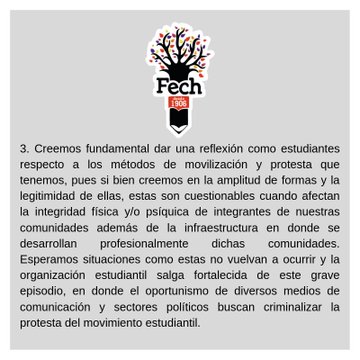
View image on TwitterView image on TwitterView image on TwitterView image on Twitter
Comparte este contenido:

New NZ digital curriculum set for 2020, are schools ready?

Oceania/ New Zealand/ 06.07.2019/ Source: www.rnz.co.nz.

The Education Review Office last year slammed the way schools and the Education Ministry were preparing for the introduction of the new digital technologies curriculum in 2020, a just-published report shows.

It shows the office warned the ministry in December that many schools would fail to meet their obligation to start teaching the curriculum in January next year when it becomes mandatory for children in Years 1-10.

The Education Ministry told RNZ things had improved since the review office surveyed schools last year and all schools would be ready to start teaching the subject.

But the Principals’ Federation and the Auckland Primary Principals’ Association said many schools were poorly prepared.

The new curriculum includes teaching children as young as five the basic principles of computer coding.

The review office report said schools had made slower-than-expected progress toward introducing the curriculum and school leaders had indicated they needed more time and resources.

It said some schools and principals were not taking seriously their obligation to introduce the curriculum and indicated boards of trustees needed to get tough on their principals.

«The lack of commitment by some school leaders to this compulsory curriculum content is of concern. Boards of trustees should consider including a component in their principal’s appraisal focusing on meeting the obligation to implement the DT [digital technologies] curriculum content from January 2020,» the report said

It said delays in setting up a coherent support programme were to blame for much of the problem.

«Too many schools did not know about the DT curriculum content, where to find the best information, or what PLD [professional learning and development] options were available to them. Too many schools have not started to look at the DT curriculum content, and, of those that have, too few have sufficient understanding, knowledge and skills to start to implement the Digital Technology curriculum content,» the report said.

The report said only 35 percent of schools reported that both senior leaders and teachers knew about the new curriculum and their obligation to start teaching it from January 2020.

«More schools must start to engage seriously with what is required of them if they are to meet their curriculum obligations,» the report said.

The curriculum was introduced by the previous government which committed $40 million to resources and training to support it.

The ministry’s deputy secretary for early learning and student achievement, Ellen MacGregor-Reid, said the ministry improved its support for schools in light of the report and over the past 12 months momentum had grown.

«We think that all schools will be ready to start teaching the digital curriculum and that that teaching will develop over time,» Ms MacGregor-Reid said.

She said teachers were motivated to start teaching the curriculum.

«We know there’s been a growing momentum in them engaging in the supports we’re offering, 12-and-a-half-thousand teachers alone have engaged with the digital readiness programme which is just one of the supports and it’s on that basis that we’re confident that schools will be teaching the digital curriculum from next year.»

The president of the Principals’ Federation, Whetu Cormick, said some schools were not ready to start teaching aspects of the curriculum such as the skills behind computer programming.

«In some schools that won’t be happening because we won’t be ready for it. Schools will do their very, very best to put this in place and I’m sure they will be planning for that next year but we have to question will teachers actually have the skills to do it themselves in every single classroom throughout every single school,» he said.

Mr Cormick said he had doubts about the number of schools that had received training in the new curriculum.

«I know my own school hasn’t and I’ve spoken to lots of school leaders who haven’t participated in any professional development. We’ve even heard reports that they found the application process difficult and they were declined.»

Auckland Primary Principals’ Association president Heath McNeil said he was not aware of any schools that would not introduce the curriculum next year as required.

However, he said schools would have varying degrees of familiarity with the curriculum, which he said should be included in daily teaching rather than taught once-a-week as a discrete subject.

Mr McNeil said the teacher shortage and high degree of churn among staff in Auckland schools had hampered their preparations for the curriculum.

In addition, training for teachers had been under-resourced.

«A compounding factor was that the professional learning and development were contestable rather than if-you-want-it-you-get-it. So if we want two-and-a-half thousand schools to implement something, we need to resource two-and-a-half thousand schools,» he said.

Mr McNeil said the current industrial action being taken by primary and intermediate school principals who belonged to the Educational Institute (NZEI) was also affecting schools’ preparations. The principals were refusing to participate in any ministry initiatives, including training for the digital technologies curriculum.

Souce of the notice: https://www.rnz.co.nz/news/national/395986/new-nz-digital-curriculum-set-for-2020-are-schools-ready

Comparte este contenido:
Page 1857 of 6197
1 1.855 1.856 1.857 1.858 1.859 6.197
OtrasVocesenEducacion.org