Page 3835 of 6181
1 3.833 3.834 3.835 3.836 3.837 6.181

Educación de Omán: OCCI y ministerio discuten el papel del sector privado en las escuelas públicas

Omán/30 de mayo de 2017/Fuente: http://timesofoman.com

Muscat: La posibilidad de operación y gestión de las escuelas públicas en el Sultanato por parte del sector privado se discutió en una reunión de alto nivel el lunes.

El Comité de Educación de la Cámara de Comercio e Industria de Omán celebró una reunión con Saud bin Salim Al Balushi, Subsecretario del Ministerio de Educación para la Planificación de la Educación y el Desarrollo de Recursos Humanos, para discutir el enfoque del Ministerio sobre la posibilidad de operar y administrar escuelas públicas por el sector privado especializado (Escuelas Públicas Autorizadas).

Saleh Al Kiyoumi, Presidente de la Junta Directiva de OCCI, dijo que la reunión es una confirmación de la asociación entre los sectores público y privado en muchos sectores de desarrollo y el sector de la educación en particular para servir los objetivos de desarrollo en Omán.

 Saud bin Salim Al Balushi, Subsecretario del Ministerio de Educación para la Planificación de la Educación y Desarrollo de los Recursos Humanos, dijo que el objetivo de la reunión era estudiar la cuestión de la educación en la Sultanía y discutir el enfoque del Ministerio de Educación sobre la posibilidad de operar y la gestión de las escuelas públicas por el sector privado especializado, sobre la base de la aprobación del consejo de educación.

En la reunión se debatió el nuevo planteamiento al poner la gestión de las escuelas bajo el contrato operativo con el sector privado y el mecanismo de contratación de cuadros humanos en estas escuelas, especialmente el personal educativo y el mecanismo de evaluación.

La reunión también discutió el papel del sector privado en apoyar este enfoque, su mecanismo de éxito y las leyes y la legislación que rigen este proceso contractual para mantener los derechos de todas las partes.

Fuente de la Noticia:

http://timesofoman.com/article/110088/Oman/Education/Oman-education:-OCCI-ministry-explore-role-for-private-sector-in-public-schools

Comparte este contenido:

Colombia, un país sin educación y equidad

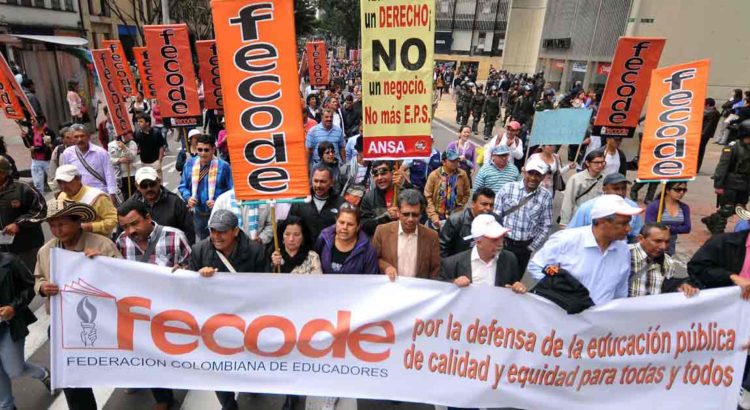
“Hoy los maestros y maestras de todo el país se unen para pedir unas condiciones dignas para el ejercicio de su profesión, mejoras en la calidad educativa y mayor presupuesto para la educación pública”

Colombia/30 de mayo de 2017/Por: Rosa María Acevedo Jaramillo/ Fuente: www.las2orillas.co

Desde el pasado 11 de mayo los educadores del país, vinculados a FECODE (Federación Colombiana de Trabajadores de la Educación), el mayor sindicato de profesores del país, se encuentran en paro. Este convoca cerca de 380.000 maestros en todo el territorio nacional para que cesen sus actividades indefinidamente..

Actualmente cerca de 8 millones de niños, niñas y adolescentes se encuentran fuera de las aulas de clase por el cese de actividades iniciada por los maestros. La razón que ha llevado al paro es el incumplimiento del pliego de condiciones pactado en el año 2015 con el sindicato de maestros. Y unas nuevas exigencias presentadas que se pueden resumir en tres puntos clave: aumento salarial, mejoría en el sistema de salud y reforma a la jornada única.

 Dentro del pliego presentado por FECODE al Ministerio de Educación Nacional (MEN) se pueden identificar algunos puntos que son claves para poder llegar  a un acuerdo entre los dos sectores. Uno de ellos es el aumento de la financiación a la educación pública a 7,5 % del PIB, quiere decir  que el gobierno nacional debe comprometerse a generar mayores recursos para la educación pública. Actualmente el gobierno nacional no ha cumplido con la implementación de la jornada única en el país porque no se ha construido la infraestructura necesaria para llevar a cabo dicha tarea.

Así mismo, los estudiantes deben tener unas condiciones mínimas para la permanencia en el sistema escolar como son: la alimentación y el transporte, asegurando de esta manera que puedan tener un mejor desempeño y evitando que se incrementen los niveles de desescolarización.

Los educadores del país también piden unas mejores condiciones salariales generando incentivos para que se dignifique el ejercicio de la  docencia, así mismo, también pide al gobierno nacional que se mejore las condiciones de acceso a los servicios de salud. Hoy los profesores cuentan con un régimen especial de Salud establecido en la Ley 91 de 1.989 que no ha dado respuesta a los problemas de acceso al derecho fundamental de la salud por parte de los docentes. Donde se encuentran en un sistema arcaico de la salud colombiana, la tramitología de las EPS desangran a nuestros maestros, no pueden acceder a una salud digna de una prestación de un servicio fundamental.

El gobierno nacional en cabeza del Presidente Juan Manuel Santos ha denominado su Plan de Desarrollo 2.014 – 2.018 “Paz, Equidad y Educación”, poniendo como uno de los pilares la educación, pero la situación actual que vive este sector no refleja la voluntad política del gobierno para abanderarse de la educación como motor de transformación y de cierre de brechas  para los sectores más excluidos de la sociedad.

Nuestra carta magna reafirma la educación como un derecho fundamental, y es allí donde el gobierno nacional debe poner todo su interés en asegurar que nuestros niños, niñas y adolescentes tengan las mejores condiciones educativas para poder generar su desarrollo y propiciar condiciones que eviten que caigan en el círculo de la pobreza.

Hoy los maestros y maestras de todo el país se unen para pedir unas condiciones dignas para el ejercicio de su profesión, mejoras en la calidad educativa y mayor presupuesto para la educación pública, la respuesta del gobierno nacional es que no se cuenta con los recursos para acceder al pliego de condiciones de este sector.

Este es un llamado para que se piense en el bienestar superior de los estudiantes, un día más por fuera del aula de clase representa una restricción a sus derechos fundamentales que deben ser protegidos y el Estado no ha hecho pronunciamientos y pone trabas en los acuerdos, debido a que sus intereses están en otros puntos, según para ellos más importantes que la educación, cuando sabemos que el educar un país es el futuro para las nuevas generaciones.

Aunque los gobiernos están llamados a un administración eficiente de los recursos y a ser responsables en el manejo fiscal del presupuesto, no por esta razón, se puede desatender el llamado de un sector tan importante como el educativo, si queremos construir un mejor país, debemos apostar a una educación pública de calidad que destine mayores recursos para mejorar las condiciones de infraestructura.

Pero no se puede tener una mejor educación si nuestros docentes no cuentan con buenas condiciones salariales que permitan que se dignifique el ejercicio de la profesión docente en Colombia y que estimule a que muchos de nuestros jóvenes tomen el camino de ser maestro.

Creo que la Educación es el motor de la transformación social y que es la mejor herramienta para construir un país en paz, espero que el gobierno nacional y los maestros puedan llegar a un acuerdo donde se vea reflejada la voluntad por hacer un esfuerzo por mejorar la educación de nuestro país y que se respete el derecho fundamental de tener un país más educado.

Porque no se puede desatender las exigencias válidas de nuestros maestros por un lado, pero por otro se negocia con grupos que han estado al margen de la ley, debemos construir un país donde se respete y se asegure las condiciones para el ejercicio de los derechos fundamentales y se distribuyan los recursos para el beneficio de nuestros ciudadanos y poder creer en el eslogan de la presidencia “Equidad para todos”.

Fuente de la Noticia:

Colombia, un país sin educación y equidad


Comparte este contenido:

EEUU: Trump admin considers shifting student debt from Education to Treasury: report

EEUU/30 may 2017/

The Trump administration is considering shifting oversight for more than $1 trillion in student debt to the Treasury Department from the Education Department, according to a new report.
The New York Times reported Thursday that the possible change was revealed in a memo sent by the former head of the Education Department’s federal student aid program.
James Runcie abruptly resigned Tuesday night after Education Secretary Betsy DeVos asked him to testify in front of the House Oversight Committee about improper payment rates for federal student aid programs, saying he was the wrong person to speak on the matter.

“This is just another example of a project that may provide some value but will certainly divert critical resources and increase operational risk in an increasingly challenging environment,” Runcie wrote about moving the aid program.

Shrinking the size of the Education Department has been a priority for Republicans in the past — Rep. Thomas Massie (R-Ky.) proposed a bill that would eliminate the entire department in February. Seven other Republican lawmakers signed on to the legislation.
President Trump’s proposed budget, unveiled this month, also recommends cutting nearly $5 billion in funding from the Education Department, or nearly 50 percent of the department’s budget.
Source:
http://thehill.com/homenews/administration/335247-trump-admin-considers-shifting-student-debt-from-education-to
Comparte este contenido:

Zimbabwe: African foundation leader advocating for international education aid

Africa- Zimbabwe/30 may 2017/

Funding to keep education available to everyone can be the difference between children growing to be successful adults or a “lost generation,” the head of an African non-profit organization said.

Patrick Makokoro, founder and executive director of the Nhaka Foundation, said his own lack of early childhood education in Zimbabwe left him behind the curve in his later education.

He went on to complete elementary and high school and received a bachelor’s degree in social and human studies from the University of South Africa and a post-graduate diploma in early childhood development from the University of Victoria, but he still sometimes gets colors mixed up because he didn’t have the early foundations.

  Makokoro said his father motivated him to pursue all available education.

“Growing up my father always used to say, ‘education is the key to success’ and that was sufficient motivation for me to always look at attaining a level of education that would bring about that success,” he said.

But he is fearful for what he calls a generation of lost kids, an enormous portion of whom were unable to attend school between 2008 and 2011 in Zimbabwe because of a lack of government funding for education.

In an interview May 15, Makokoro emphasized the consequences of whether children receive early childhood education. He said students in Zimbabwe who enter elementary school with the foundations provided by preschool are much more likely to finish elementary and high school.

The alternatives to school, Makokoro said, range from peddling eggs on the street to thieving, which often progresses to worse behavior with age.

Makokoro is working with members of RESULTS to advocate for replenishment of the Global Partnership for Education fund, which works with more than 60 developing nations on education.

He said the GPE works with national governments and civil society organizations to ensure funding for national education plans.

“In Zimbabwe a key part of GPE funding went towards the development of Education Sector Strategic Plan that has now become the operational document for the Ministry of Primary and Secondary Education,” Makokoro said. “Along with the strategic plan an education curriculum was developed.

Makokoro listed three ways in which the support is a boon to schools:

  • It allows for smooth implementation of national education plans, including development of infrastructure to improve access.
  • It provides teachers with teaching aides.
  • It promotes teacher practice standards, which translate into improved quality of education.

Thanks to GPE assistance, about 574,000 children in Zimbabwe were able to get access to early reading instruction, Makokoro said.

Colin Smith with RESULTS said the goal is to get countries to commit $3.1 billion to the GPE over the next three years. Historically the United States has been the 10th largest contributor to the GPE, he said.

Noah Trapp, a member of the RESULTS student chapter at Kansas State University from Ellsworth, said he got to see the importance of education in developing nations while teaching math and reading for a summer in the Dominican Republic.

“I had read the USAID studies that revealed how most children in the country only actively learn for a little more than two hours per day, but meeting a 16-year-old who can’t spell their name was a tragic experience that really brought educational inequality into perspective,” Trapp said.

School, he said, is vital for teaching more than reading, writing and arithmetic. It also is important for teaching life skills. For instance, he said the incidence of teen pregnancy in the Dominican Republic is dramatically lower among teens who are in school.

Source:

http://www.hutchnews.com/news/national_world_news/african-foundation-leader-advocating-for-international-education-aid/article_e55154dd-b7b3-5d74-b98d-7303795788a0.html

Comparte este contenido:

EEUU: What Betsy DeVos Calls Education Transformation Is Actually Public Theft

EEUU/ 30 May 2017/By Jeff Bryant, Campaign for America’s Future/Source: http://www.truth-out.org

Betsy DeVos wants to give your tax dollars to private schools and businesses and tell you it’s an education «transformation.»

That’s the main theme of an address she gave this week to a conference held by the organization she helped found and lead, the American Federation for Children.

Declaring «the time has expired for ‘reform,'» she called instead for a «transformation… that will open up America’s closed and antiquated education system.» Her plan also opens your wallet to new moochers of taxpayer dollars.

By the way, AFC, according to SourceWatch, is a «conservative 501(c)(4) dark money group that promotes the school privatization agenda via the American Legislative Exchange Council (ALEC) and other avenues.» It also grew out of a defunct PAC connected to DeVos called «All Children Matter» that ran afoul legally in Ohio and Wisconsin and still owes Ohio $5.3 million for breaking election laws.

So DeVos had a supportive crowd for her speech, but what should the rest of us think of it?

The transformation she calls for seems to rest on the premise that, «It shouldn’t matter where a student learns so long as they are actually learning.» But what does she mean by «learning»? And what should the public expect about how its funds are being spent?

In kicking off her address (transcript here), DeVos thanked Denisha Merriweather for introducing her. Merriweather, as I’ve previously reported, often appears with DeVos at events extolling school vouchers that allow parents to send their children to private schools at taxpayer expense.

In Merriweather’s case, exercising school choice meant using Florida’s education tax credit program’s education tax credit program to attend a fundamentalist Christian academy that presents the Bible as literal history and science, teaches young earth creationism, and demeans other religions.

DeVos then quickly moved to the story of a recent graduate of a Catholic private school, Bishop Luers High School in Fort Wayne, Indiana, who used that state’s voucher program to transfer from a public school to a private religious school at taxpayer expense.

Based on that student’s life story, DeVos declared, «Here in Indiana, we’ve seen some of the best pro-parent and pro-student legislation enacted in the country.»

Reporters at NPR recently looked at what «pro-parent and pro-student» policies have accomplished in Indiana and found the state’s voucher program, which DeVos is no doubt extolling, is essentially a coupon program for parents who already send their kids to private schools.

«More than half of all voucher students in the state have no record of attending a public school,» NPR reports. «Recipients are also increasingly suburban and middle class. A third of students do not qualify for free or reduced-price meals,» a proxy for poverty widely used in education.

Clearly taxpayers should be concerned about picking up the tab for an expense that many families seem to be able to afford in the first place. In fact, that’s a point conservatives frequently level in their claims of widespread welfare fraud.

But so long as students are learning, DeVos contends, what’s the beef? Well, evidence of these students actually learning by exercising their «school choice» is scant.

A recent op-ed in the New York Times cites a study which found Indiana students using the state’s voucher program to transfer from public schools to private schools voucher students «experienced significant losses in achievement» in mathematics and «saw no improvement in reading.»

But one thing Indiana’s voucher program certainly accomplished is to provide a huge cash infusion to religious schools. As Mother Jones recently reported, of the more than 300 schools receiving voucher money in the Hoosier state, only four aren’t «overtly religious.» The remaining four are for special needs students.

Another premise DeVos argues is, «Education should reward outcomes, not inputs.» But outcomes at what cost?

That’s a question many who disagree with DeVos’s preference for «high performing» charter schools have about her praise for school choice.

In her reporting on a supposedly high performing charter chain in Arizona, Carol Burris, an award-winning educator and leader of the Network for Public education, looked at the school’s supposed great outcomes and found a troubling backstory.

The BASIS Arizona charter chain, she found, «provides insight into how charter schools can cherry-pick students, despite open enrollment laws. It also shows how through the use of management companies profits can be made — all hidden from public view.»

DeVos counters any objections to her preference for school choice with the argument, «All parents instinctively know that their child should not follow the money — the money should follow their child,» which is a favorite phrase of the school choice crowd.

Here’s something else parents know: Kids don’t come with price tags. And educating the nation’s future workers, leaders, citizens, and artists has always been, and must continue to be, a communal enterprise shared by parents and non-parents alike.

In her efforts to create the education transformation she calls for, DeVos is supremely eager to «get Washington and the federal bureaucracy out of the way,» but still wants you to pay the cost of privatizing our schools. That’s not an agenda for better schools. It’s about stealing public money.

Source:

http://www.truth-out.org/news/item/40711-what-betsy-devos-calls-education-transformation-is-actually-public-theft

Comparte este contenido:

Pakistan: Only half of education budget utilised thus far

Pakistan/ 30 may 2017/By Ammar Sheikh/Source:https://tribune.com.pk

LAHORE: 

Despite a steady increase in the development budget of schools in Punjab, the provincial government was able to spend only half of the allocated amount in the fiscal year as of April 30, 2017.

According to a summary of the development budget expenditure in the current fiscal year, the Punjab government has spent a little more than 52.56% of the total amount for the education sector. The summary of the Punjab Finance Department details expenditures up to April 30, 2017 of the development budget allotted in the budget of fiscal year 2016-17.

Documents available with The Express Tribune revealed that around Rs63.01 billion were allocated in the development budget under Education Affairs and Services. The document also provides an estimated expenditure until April, 2017, according to which a total of Rs52.51 billion were expected to be spent. However, the provincial government only managed to spend Rs33.12 billion until April, 2017.

The document breaks down the total development budget into four different heads for Pre and Primary Education Affairs and Services with a total development budget of Rs1.88 billion and expected expenditure of Rs1.56 billion. Just Rs354.292 million was amount spent until April, 2017. For the Secondary Education Affairs and Services, Rs47.29 billion had been allocated, with an expected expenditure of Rs39.41 billion and the spent amount stood at Rs22.33 billion.


For Tertiary Education Affairs and Services, Rs13.16 billion had been allocated with an expected expenditure of Rs10.96 billion with Rs10.28 billion spent. For Education Services Non-definable by Level, Rs669.013 million had been allocated with Rs557.511 million expected to be spent by April, 2017. However, only Rs148.593 million was spent.

A similar trend has been seen in previous years during which the Punjab government failed to utilise the allocated budget for development. According to the annual budget documents also available on the Punjab Finance Department’s website, for the fiscal year of 2014-15, Rs25.968 billion were allocated for school education, but only Rs19.653 billion were spent. Similarly, for the fiscal year 2015-16, a total of Rs32.849 billion were allocated for schools in the development budget, while only Rs13.926 billion were spent and reported in the revised expenditure for the fiscal year.

Associate Professor of Economics at Lahore University of Management Sciences (LUMS) and Senior Research Fellow at the Institute of Development and Economic Alternatives (IDEAS) Faisal Bari said the problem lay in the system whereby budgetary allocations were not released on time and were delayed in bureaucratic circles and the departments involved. With all the built-in delays in the system, a lot work remained incomplete. He said another problem was that government officials remained hesitant to spent money because of the lengthy mechanisms in place to account for funds spent. “An overhaul is needed in the government system with devolution of the decision-making process.”

Other problems Bari pointed out were that the government announces projects in the budget for political reasons, but did not intend to implement them. Because of such projects, he said, funds remained under-utilised. Another reason, he said, was reappropriation of funds, especially in the education budget.

“There is a need to increase the education budget even if we don’t have the capacity to spend the whole amount. Even with the argument that we have been unable to spend the allocated budget on education, we need to increase the capacity and fulfill the constitutional responsibility of Article 25-A and our international commitments of Sustainable Development Goals (SDGs),” Bari said.

When contacted for comments, Punjab School Education Minister Rana Mashhood said he was attending a ceremony in Multan and would be able to comment later. He was contacted several times subsequently, but did not respond.

Source:

https://tribune.com.pk/story/1420111/half-education-budget-utilised-thus-far/

Comparte este contenido:

EEUU: $92,000 in college scholarships awarded by Education Foundation

EEUU/30 May 2017/Source: http://www.hoodrivernews.com

Hood River Valley High School seniors went home on Thursday night with over $69,000 in Hood River County Education Foundation (HRCEF) funds for their post-secondary educations. In addition, the Education Foundation announced 12 recipients of HRCEF Continuing College scholarships totaling over $23,000, for a total donation of over $92,000 in HRCEF Scholarships this year.

The Education Foundation manages 28 freshman scholarship funds and four continuing college scholarships, donated by Hood River residents and their friends and families. In addition, two freshman scholarships may be renewed for additional years.

#Seventy-one different scholarships were awarded to 51 HRV students in the class of 2017, with some students receiving up to three scholarships. Twelve continuing college scholarships were awarded to HRVHS graduates for their 2017-18 sophomore, junior or senior years in college.

#“The scholarships represent Hood River County so well. Scholarship donations come from many different families and civic groups, from the Cascade Locks Alumni Association to the Parkdale PTO,” said Pat Evenson-Brady, HRCEF Scholarship chair. “Twenty of our scholarships are memorials, and several are from local businesses. Our only regret is that we receive applications from so many deserving students and we don’t have scholarships for all of them.”

#The Cascade Locks Alumni Association awarded five freshman scholarships and one continuing college scholarship this year, continuing a long tradition of support for post-secondary education to Cascade Locks students from their own community. New scholarships this year included the eight HRVHS AVID scholarships to support students who have been historically under-represented in college education. Funds for the AVID scholarships were raised primarily by HRVHS staff.

#A unique HRCEF scholarships is the Nathan Hazlett Memorial Scholarship, which provides funding for flight training for a student wanting to be a professional pilot. The scholarship was not awarded in 2017.

Source:

http://www.hoodrivernews.com/news/2017/may/27/92000-college-scholarships-awarded-education-found/

Comparte este contenido:
Page 3835 of 6181
1 3.833 3.834 3.835 3.836 3.837 6.181