Page 29 of 56
1 27 28 29 30 31 56

CityU in Canada graduate programs in counselling and education taught by practitioner scholars

Canadá/Agosto de 2017/Fuente: Straight

Resumen: Hay practicantes de varias disciplinas en el mundo laboral. Y hay académicos de varias disciplinas en la academia. Pero en la City University de Seattle, en Vancouver, el director de programas canadienses dice que los programas de posgrado de su escuela en asesoramiento y educación son impartidos por «académicos practicantes». Éstos son aprendices de por vida que permanecen ocupados en sus campos en un nivel práctico y teórico. «Son las personas que ven presentando en conferencias, dando talleres, publicando artículos, y así sucesivamente, además de ser practicantes porque tienen que seguir aprendiendo», dijo Arden Hanley al Straight por teléfono. «Esto ha conducido a un pensamiento interesante – y el pensamiento se llama» práctica deliberativa «. Vamos a hacer que un enfoque de nuestros programas de posgrado.

There are practitioners of various disciplines in the working world. And there are scholars of various disciplines in academia.

But at City University of Seattle in Vancouver, the principal of Canadian programs says his school’s graduate programs in counselling and education are taught by “practitioner scholars”. These are lifelong learners who remain engaged in their fields on a practical and a theoretical level.

“They’re the people who you see presenting at conferences, giving workshops, publishing papers, and so forth, as well as being a practitioner because they’ve got to keep learning,” Arden Hanley told the Straight by phone. “This has led to some interesting thinking—and the thinking is called ‘deliberative practice’. We’re going to make that a focus of our graduate programs.

“Here’s a quote from Mahatma Gandhi that introduces the concept: ‘An ounce of practice is worth more than tons of preaching,’ ” Hanley added.

Hanley has 35 years of experience as a family therapist, so he knows whereof he speaks. His professional career has imbued him with a passion for social justice to go along with his relentless curiosity about how people learn.

He said research has demonstrated that passive learning—such as by reading about a topic or listening to someone speak—is not the optimal way to improve a practitioner’s performance as a counsellor. Along similar lines, he noted, passive learning wouldn’t necessarily help someone master a violin or perform better in track and field.

“What does improve performance? Well, you have to establish a baseline of strengths and weaknesses,” Hanley said. “And then you have to provide the learner with feedback in terms of the strengths and weaknesses. Then, having identified weaknesses, you have to practise solutions to the identified weaknesses.”

Just as with professional athletes, sometimes the best approach is designing role-play exercises. He pointed out that a counselling or educational instructor can also videotape a student overseeing a therapy session or a class. This enables the student to benefit even more from the feedback provided.

“Our graduates know what to do on Monday morning,” Hanley stated emphatically. “You’re not looking at somebody who knows about counselling and then you have to train them how to perform counselling. Our graduates know about counselling but they are also performance-ready.”

The master’s degree of counselling is designed to help students meet the requirements to become a registered clinical counsellor or a Canadian certified counsellor.

At CityU in Canada—as the school is sometimes called—counselling education is delivered in three ways. There’s a Saturday-only program, which is well suited for working professionals and takes three years to complete.

Then there’s a “mixed mode”, which is 49 percent online and 51 percent face-to-face instruction. It also takes three years. The face-to-face classes take place in intensive four-day sessions on a quarterly basis.

“We designed that with the thought in mind that we could extend our geographical reach,” Hanley explained. “To a certain extent, that’s true, but the other thing we found that was so interesting is it’s well suited for single parents.”

That’s because some find it easier to arrange for childcare over four-day periods four times a year rather than having to find someone to mind their kids every Saturday.

There’s also a traditional weekday format, primarily offering face-to-face instruction, which takes two years to complete.

Hanley said that virtually all of the master’s of education students are working full-time, so this program is delivered on weekends. It is school-district based, which means that courses are adjusted to reflect idiosyncrasies and demographics of particular areas where students are employed.

“That’s proven to be of tremendous value to them,” Hanley said.

Fuente: https://www.straight.com/news/948441/cityu-canada-graduate-programs-counselling-and-education-taught-practitioner-scholars


Comparte este contenido:

OP-ED: Restoring Free Tuition fees. Why Education Is The Great Equalizer

By John Horgan

Premier of British Columbia,

Education is the great ePqualizer. It opens the door to a good-paying job, and a secure future. We need to give help, hope and opportunity to people who want to get a basic education to learn the skills they need to join the workforce and build a better life for themselves and their families.

That journey starts with opening the doors to adult basic education and English language learning. These programs should be within reach for everyone, from new Canadians and recent immigrants, to students preparing for university and adult learners upgrading their skills for work.

The previous government put up barriers to a basic education when they introduced tuition fees for Adult Basic Education and English Language Learning in 2015. Fees were set by each institution, but could cost up to $1,600 per semester of full-time studies, which is the same as the average cost for an arts and science degree program.

Many people could not afford to pay these new tuition fees. As a result, enrolment in Adult Basic Education and English Language Learning programs dropped 35% from more than 10,000 students a year to just under 6,700 students a year.

We cannot afford to shut thousands of people out of opportunity. Families can’t afford it. And B.C.’s economy can’t afford it. Our long term economic growth depends on an educated and skilled workforce.

 This is why our government is removing the roadblocks to education by eliminating tuition for adult basic education and English language learning starting September 1, 2017. This change will open the doors to tens of thousands of British Columbians to upgrade their education and skills each year.

By investing in education and opportunity for people, we are making a long-term investment in our economy and our future.

We will continue to make changes that give families relief from high costs and fees, and invest in better services that give people help and hope for a better life.

Source:
Lea más en http://thelinkpaper.ca/?p=64475#GFWP3vYdcKTqe4c0.99

Comparte este contenido:

Una novela para adolescentes que mira al autismo de frente

América del norte/Canadá/12 Agosto 2017/Fuente: Infobae

La escritora canadiense Victoria Grondin imagina en Diferente un mundo donde la norma es el autismo y no hay lugar para personas «normales».

La OMS estima que uno de cada 160 niños tiene algún trastorno del espectro autista. Siguiendo esa lógica, en el planeta habría aproximadamente 46 millones de jóvenes que padecen este tipo de trastornos.

Sin embargo, el mundo todavía no encuentra la forma de moldearse para terminar de aceptar e incluirlos en los puestos de trabajo, en la educación, en la política y en la vida diaria. Muchos padres de niños autistas los someten a decenas de tratamientos experimentales para curar una enfermedad incurable y no comprenden que lo que tienen que cambiar es el mundo, no a sus hijos.

Imagínense, entonces, un mundo en donde la gran mayoría de la población es y siempre fue autista, donde la educación y el mercado laboral están hechos para aprovechar y entrenar el «don» u «obsesión» que caracteriza a cada uno de sus habitantes (quienes padecen este trastorno), donde todos están acostumbrados a los ataques de pánico por ciertas imágenes o sonidos y sepan cómo ayudar a quienes los están sufriendo, un mundo donde cada minuto de cada hora de la jornada de una persona esté calculado desde antes de despertarse.

Eso mismo se imaginó Victoria Grondin (Quebec, 1997) mientras estudiaba el autismo como parte de su programa educativo. Victoria, entonces, escribió Diferente (Planeta, 2017), una novela corta situada en una Canadá de dichas características, y la presentó como trabajo final de la secundaria.

Una novela donde lo “anormal” es lo “normal”

Una novela donde lo “anormal” es lo “normal”

Diferente tiene como protagonista a Guillaume, un adolescente que padece el Síndrome de Wing, un trastorno cerebral que sólamente padecen otras 8 personas en el mundo y que lo hace significativamente distinto a los demás. Para decirlo más claramente, él no es autista y, en su realidad, eso es catalogado como una enfermedad. Este síndrome hace que Guillaume, a diferencia de la gente «normal», no sufra ningún tipo de ansiedad provocada por estímulos sensoriales. Sus cinco pulseras verdes, que debe llevar obligatoriamente, indican que no sufre ningún tipo de alteración en ninguno de sus cinco sentidos. También suele hablar usando excesivamente metáforas y figuras retóricas, lo que desconcierta a los demás. Y, fundamentalmente, no tiene ningún don en particular. Mientras su hermano gemelo, William, es dotado en neurociencia, Guillaume no tiene ninguna especialización en particular, lo que hace que otros y él mismo piensen que es tonto.

Cansado de la incompresión de su familia, de ser constantemente apabullado por los médicos que quieren estudiar su condición y de tener que vivir en un mundo que no está hecho para él, Guillaume termina encontrando apoyo en una chica nueva en su escuela que es como él y parece tener todas las características del Síndrome de Wing excepto una, es dotada en Jazz.

Debo decir que esta novela me sorprendió gratamente. Mientras esperaba la clásica historia del joven diferente e incomprendido que encuentra a una chica como él que lo entiende, se enamoran y, entonces, o hay un final feliz o al final se muere uno, me encontré con una historia atípica, profunda y de gran valor literario. Además de ser una novela juvenil entretenida, es un rico estudio sobre la sociedad humana y los trastornos autistas.

La prosa (juvenil pero correcta) de Grondin nos mete con la historia y nos invita a que nos identifiquemos con su protagonista porque, por esta vez, él es diferente, pero igual a nosotros. La narración es muy dinámica y no se estanca en descripciones. Novela breve, dura lo justo y necesario; puede leerse tranquilamente de un tirón en una tarde. Diferente es una nueva joyita de la literatura de y para jóvenes que sabe abrirse paso.

Imagen: http://www.infobae.com/new-resizer/aCRoZBZ6VWXMl9Ae62q7d7QSTvo=/600×0/s3.amazonaws.com/arc-wordpress-client-uploads/infobae-wp/wp-content/uploads/2017/08/08160911/Victoria-Grondin-%C2%A9-Francois-Couture.jpg?token=bar

Fuente: http://www.infobae.com/grandes-libros/2017/08/09/una-novela-para-adolescentes-que-mira-al-autismo-de-frente/

Comparte este contenido:

Canada: How to save zoos? Focus on education, conservation

América del Norte/Canada/Agosto del 2017/Noticias/https://theconversation.com

One of my earlier memories from my childhood is visiting the Frankfurt zoo in Germany. I watched several elephants in an indoor enclosure, and while they were huge and fascinating, it also saddened me to see such magnificent animals in captivity. I also remember having straw thrown in my face by one of those elephants, although my parents dispute this.

Now, with my own children, we visit the Toronto Zoo with all of its animals in more naturalistic enclosures, and the many educational and conservation programs and displays. It’s a different world.

For many, zoos are central to some of their favourite memories as children. Seeing lions, tigers and elephants and other less familiar animals, never mind smelling them, can be a wonderful experience.

But the role of zoos in society has led to serious discussion about whether zoos should even exist. A strike earlier this year by workers at the Toronto Zoo had many musing about whether the zoo should re-open at all. The Toronto Star reported that social media and emails they received argued “zoos are outdated, inhumane attractions that should be closed outright, or converted to animal sanctuaries.”

That’s a widespread sentiment, manifested in part by the existence of organizations such as Zoocheck, which acts to “promote and protect the interests and well-being of wild animals,” including those held in captivity.

Zoos a thing of the past?

Some of the negative perceptions of zoos may be the result of their past. The modern zoo is based on a history of colonialism in which exotic animals from faraway lands were brought back for public amusement. A particularly ugly aspect of this history occurred when Indigenous people from colonized countries were also brought to Europe and the United States for display at human zoos, even as late as the 1950s.

While the ethical questions surrounding zoos today are not as controversial, they are no less important.

The social contract that zoos have with society has changed. Due largely to animal welfare concerns, the general public now has a predominately negative view toward the display of animals solely for entertainment, and the traditional zoo as a menagerie is no longer considered acceptable.

The modern zoo must become more than a source of entertainment, and must embrace conservation, research and education as part of its mandate. For example, in its most recent strategic plan, the Toronto Zoo has stated one of its goals is to become a zoo-based “conservation centre of excellence.”

A lion at the Toronto Zoo.

Increasingly, zoos must also now be accredited. For example, in Canada, CAZA (Canada’s Accredited Zoos and Aquariums) has an accreditation program that ensures animal welfare and promotes conservation research and outreach with the public.

Similar organizations exist globally, including in the United States (where the AZA has taken a global lead in zoo accreditation requirements) and Europe (EAZA). While there is room for criticism about how these organizations manage their programs, it’s clear that accredited zoos are the standard to which the modern zoo must be held.

Modern zoos are institutions that reflect complicated and sometimes conflicting values related to entertainment, conservation and animal welfare. Modern zoos in many ways represents a paradox – they’re organizations with a mandate to support conservation and education of the public regarding wild animals and nature that also manage captive wildlife. It’s this paradox that fuels much of the criticism of zoos.

In the United States, where arguably this transition from menagerie to conservation organization is most advanced, zoos such as the San Diego Zoo and the National Zoo in Washington, D.C., have rebranded themselves (e.g. San Diego Zoo Global), highlighting their contributions to conservation, research and the training of conservation professionals.

In Canada, the Toronto Zoo, the Calgary Zoo and the Vancouver Aquarium probably have the most developed research and conservation programs. But they fall short relative to their American counterparts in terms of the scope of these activities, in part because of the huge disparity in financial support.

Nonetheless, there’s no doubt that zoos make significant contributions to conservation.

Endangered species saved

Captive breeding programs and the accompanying reintroductions have saved many endangered species from extinction. Currently, captive breeding by Canadian zoos is a significant component of the conservation programs for a number of species, mostly of those native to Canada (e.g. the Vancouver Island marmot, the Eastern loggerhead shrike, wood turtle, burrowing owl, and black-footed ferret).

The endangered black-footed ferret.(Shutterstock)

These programs often stand between the extinction and the survival of these species. In addition, the people who work for conservation and education in the zoos are passionate and skilled.

But there remain untapped opportunities for zoos to enhance their work in conservation and research. Zoos should be pressured by the general public to ensure that the conservation and education mandate of the modern zoo is upheld.

Determining the efficacy of conservation and education efforts by zoos is important and will give confidence to the general public that zoos are fulfilling the evolving social contract with society.

Do zoos actually do good?

For example, how do we know that education programs at zoos actually work?

The research of my colleague Dr. Chantal Barriault (Director of the Science Communication graduate program at Laurentian University) indicates that the general public doesn’t learn as much as we would like or expect.

The efficacy of conservation programs should also be examined. How successful are the captive breeding and reintroduction programs? Are there ways to improve these conservation outcomes? As zoos evolve into conservation organizations, in Canada and globally, it is critical that appropriately trained conservation professionals support these efforts.

While the zoo community has tremendous veterinary expertise related to the care and captivity of animals, there is an opportunity for professionals trained in evolution, population genetics and other conservation-oriented disciplines to support zoo conservation.

Clearly, zoos are already asking these questions of themselves. The public should encourage more of this self-examination so that zoos evolve into more valuable institutions.

Fuente : https://theconversation.com/how-to-save-zoos-focus-on-education-conservation-81005

Fuente imagen:

https://lh3.googleusercontent.com/5L7oZf57gOSvj6eE4pLHn7bdHl7qdwmgfZ4DLYY7kiG2orSH3zQcxpnnEO2NnDrrJhQPOA=s170

Comparte este contenido:

Canada: Immigrant children’s play can clash with mainstream cultures

América del Norte/Canada/Agosto del 2017/Noticias/https://theconversation.com/

Every child in the world is a master of play. Play is part of the basic developmental experiences of human lives. Children learn about culture, social norms and language through play. Precisely because of its sociocultural nature, children in different cultures engage in play differently due to differences in language, context and social norms.

Parents in different cultures also perceive play differently. Some see children’s play as part of their natural learning process — “learning through play.” In other cultures, children’s play may be seen as just a pastime and separate from learning.

When children move to another culture and context, their experiences of play can be more complex than commonly thought. Play can be an effective and natural way for immigrant children learn to socialize with children in their new country. On the other hand, differences in context, language, social norms and parental perceptions of play may create social conflicts among children in cross-cultural contexts.

The living arrangements of families influence how children play in their new land. This week, Statistics Canada released new census data on multi-generational and multi-family dwellings. From 2001 to 2016, multi-generational households rose 38 per cent. The data also points to increasing settlement patterns of multi-family dwellings in several immigrant-rich cities such as Brampton, Markham and Vaughan on the northern edges of Toronto, and other suburban communities such as Surrey, near Vancouver. These trends, even though they’re likely due to financial reasons, may help immigrant families preserve and reconstruct play environments for their children in the new land.

Children-led play versus adult-supervised spaces

One of the major differences many immigrant children and their parents experience in Canada and the U.S. is the different contexts and social expectations of play. One example is the adult-controlled nature of play versus the child-initiated peer play in many other cultures. This can make common concepts such as the “play date” foreign to many immigrant parents and children.

The Sudanese and Vietnamese refugee families in my studies, for example, were accustomed to children playing freely with each other in their villages without adult organization or supervision. When they immigrated to an inner city in the U.S., they found this kind of play, without adult supervision, was no longer possible. Instead, they had to closely watch whom their children were playing with and where they played. Often, due to the unsafe environments of their neighborhoods, the children were confined indoors in crowded spaces.

Too many toys and too much screen time

Contextual differences can also be reflected in the materials available in the environment. A North American child’s upbringing is filled with toys and games (both electronic and non-electronic). It is reported that an average 10-year-old in a Western society can have as many as 238 toys. In pre-school in North America, 90 per cent of children’s play is toy-dominated.

Children in the U.S. and Canada are increasingly getting more screen time. (Shutterstock)

In addition to toys, children in Canada and the U.S. are increasingly getting more screen time, a concern for many mainstream and immigrant parents. These differences in the medium of play available in the environment can have a significant impact on how children play cross-culturally.

Language and social norm differences

Another challenge is language and social norms that mediate children’s play. Children bring social language use into play. For example, in role-playing, children often imitate adult use of language and interpret social relations they observe in their culture.

Since language use and social relations are different in diverse cultures, children must engage in negotiating these differences in cross-cultural play. One researcher documented a newly arrived Korean boy who bowed repeatedly while pretending to be a postman, as this is how it was in his culture. His peers laughed at his behaviour and caused great distress for the boy who did not know what went wrong.

While language may be an apparent barrier for immigrant and mainstream children’s play activities, the more important layer is the socio-cognition, that is, the ways of thinking and behaving associated with language use.

One example is the well-cited story, “How to be happy,” about an anthropologist who asked the children in a remote African tribe to race for the prize of a gift basket of fruit under a tree. Instead of racing against each other, to the anthropologist’s surprise, the children took each other’s hands and ran together to the tree and enjoyed their prize as a group. These differences in socio-cognition or ways of thinking and behaving can affect how children from different cultures interact with each other in play.

Parental perceptions of play

Parental perception of play is also an important factor that affects how children play in cross-cultural contexts. Chinese immigrant parents from my studies, for example, often came with the perception that play is just for fun and for relaxing, and is not a learning activity.

Many Chinese parents believed that too much play is a waste of time for learning and therefore will not encourage play, and sometimes limit their children’s play time in order to maximize their academic learning time. Some parents even considered the mainstream ways of teaching — for example, “experiential learning” in school — as just play and not learning. To compensate, they tried to structure more organized learning periods at home or through community tutoring services.

One child in one of my studies said that his mom created a second “home school” immediately after his day school, with repeated learning sessions alternated by some playtime — often TV watching or game playing.

These differences suggest that play in cross-cultural contexts is complex and dependent on many sociocultural and sociolinguistic factors that stimulate or regulate children’s play activities. It’s important to note that there is no “normal,” “ordinary” or “right” way of play. These differences must be interpreted within the socio-cultural contexts and backgrounds that they come from.

Fuente:https://theconversation.com/immigrant-childrens-play-can-clash-with-mainstream-cultures-81927

Fuente imagen:

https://lh3.googleusercontent.com/M9t6QYacW5iGLTwO0z7td15N8yWz7VcFsP_QJQTb81iGam_rNnlizHE9jDIxqCv1_YWX1Q=s85

Comparte este contenido:

OECD Grades Indigenous Education in Canada

Canadá/Agosto de 2017/Fuente: Indian Country

Resumen: Un nuevo informe de la Organización para la Cooperación y el Desarrollo Económico (OCDE) otorga marcas mixtas para la educación de estudiantes indígenas en cuatro provincias canadienses y dos territorios. Por un lado, dijo el estudio publicado en París el 8 de agosto, algunas prácticas están funcionando muy bien. Por otro lado, las cuestiones derivadas de la colonización todavía no se abordan adecuadamente, lo que interfiere con la medición de las necesidades de los estudiantes y la comprensión de la mejor manera de educarlos.

A new report from the Organization for Economic Co-operation and Development (OECD) gives mixed marks for the education of indigenous students in four Canadian provinces and two territories. On the one hand, said the study released in Paris on August 8, some practices are working extremely well. On the other, issues stemming from colonization still are not being adequately addressed, and that interferes with gauging students’ needs and understanding how best to educate them.

“We are confident that the findings, practices, approaches and priorities identified in this study can help to achieve and accelerate progress,” the OECD wrote in the 130-page study, Promising Practices in Supporting Success for Indigenous Students. “We would question, however, whether there is sufficient breadth and intensity system-wide to achieve the Truth and Reconciliation Commission of Canada’s recommendation that the education achievement gap be closed within one generation.”

Researchers visited Alberta, Manitoba, New Brunswick, Nova Scotia, the Northwest Territories and Yukon, working and meeting with educators, indigenous elders and students “to identify promising strategies, policies, programs and practices that support improved learning outcomes for Indigenous students and to build an empirical evidence base on Indigenous students
in education,” studying student well-being, participation, engagement and achievement,” the report said. They also studied education in Australia and New Zealand.

The team found many positive factors, as well as sound reasons to focus even more on indigenous students. Schools in which indigenous education was succeeding shared a “common formula,” the report said: “an inspirational leader; strong relationships with students, parents and local communities; capable and committed staff; the use of every possible lever to engage and support students to be successful, and sustained commitment to achieve improvements.”

Moreover, the report noted, the positive results at these schools also benefited non-indigenous students.

“All students benefit from high-quality, responsive teaching in combination with localized curriculum and learning activities, within a safe and inclusive school environment,” the report said. “Successful schools mainstream local indigenous values, history and cultural approaches as part of everyday school life, rather than add-ons targeted only to indigenous students.”

In particular was a school in Manitoba that uses sweat lodges to help teachers learn about local indigenous culture, the report said, a practice that also helps connect staff and students, as the Winnipeg Free Press reported.

Researchers noted a high level of interest among non-indigenous students toward learning about native cultures. Nevertheless, the team also found resistance from some non-indigenous parents to measures that would accommodate indigenous practices.

“In some cases, school leaders will have to hold their ground in the face of resistance to such changes from some non-indigenous parents,” the report said. “In one school we visited, the principal was dealing with a campaign by non-Indigenous parents who oppose the installation of a smudging facility on the school grounds.”

Another downside noted in the report was a distinct lack of regional cooperation, the report’s authors found.

“Every school we visited that was achieving sound results for indigenous students had a highly effective and committed school principal and teachers who were doing whatever it takes to support students in their learning,” the report said. “But they were doing it on their own. The research team did not find one Canadian school that had teamed with any other school to learn from one another or to accelerate progress.”

Education has long been a sticking point in relationships between Indigenous Peoples and the Canadian government. Disagreement over the efficacy of the First Nations Education Act was partly what led to the resignation of then–Assembly of First Nations National Chief Shawn A-in-chut Atleo in 2014.

Fuente: https://indiancountrymedianetwork.com/education/native-education/oecd-indigenous-education-canada/

Comparte este contenido:

Canada Has Homework If It Wants To Be An ‘Education Superpower’

Canadá/Agosto de 2017/Fuente:  Huffpost

Resumen:  En el artículo publicado el 2 de agosto por la BBC, «Cómo Canadá se convirtió en una superpotencia de la educación», Sean Coughlan toma los resultados de la evaluación de la última prueba PISA y concluye que Canadá es una «superpotencia de la educación». Los resultados del rendimiento de 2015 indican que Canadá ha subido al nivel más alto de los rankings internacionales y está en la posición número 10 en matemáticas, lectura y ciencia. A nivel universitario, Canadá tiene la proporción más alta del mundo de adultos en edad laboral que han pasado por la educación post-secundaria – 55 por ciento en comparación con un promedio en los países de la OCDE de 35 por ciento. Más de un tercio de los adultos jóvenes en Canadá son de familias donde ambos padres son de otro país. Los hijos de las familias migrantes recién llegadas parecen integrarse rápidamente y desempeñarse al mismo nivel que sus compañeros de clase. La variación de las calificaciones en Canadá causada por los estudiantes «favorecidos» y «desfavorecidos» era baja y las diferencias socioeconómicas en Canadá eran del 9%, frente al 20% en Francia y el 17% en Singapur.

Cherry picking a single test point and creating a generalization based on a single set of data can lead to inaccurate assessments and conclusions. In the article published on August 2 by the BBC, «How Canada became an education superpower,» Sean Coughlan takes assessment results from the latest PISA test and concludes Canada is an «education superpower.»

Coughlan uses the following reasons to give Canadian education such an honorary standing:

  • 2015 performance results indicate Canada has climbed into the top tier of international rankings and ​​​is in the top-10 position in math, reading and science.
  • At university level, Canada has the world’s highest proportion of working-age adults who have been through post-secondary education — 55 per cent compared with an average in OECD countries of 35 per cent.
  • More than a third of young adults in Canada are from families where both parents are from another country. Children of newly arrived migrant families seem to integrate quickly and perform at the same level as their classmates.
  • The variation in scores in Canada caused by «advantaged» and «disadvantaged» students was low, and that socio-economic differences in Canada was nine per cent, compared with 20 per cent in France and 17 per cent in Singapore.

Thank you for the gracious pat on the back, Mr. Coughlan and the BBC, but let’s look at more data before our Canadian school policy makers and universities believe their «achievements.»

Where other countries are systematically and carefully investing in their education, we are falling behind.

International assessment rankings

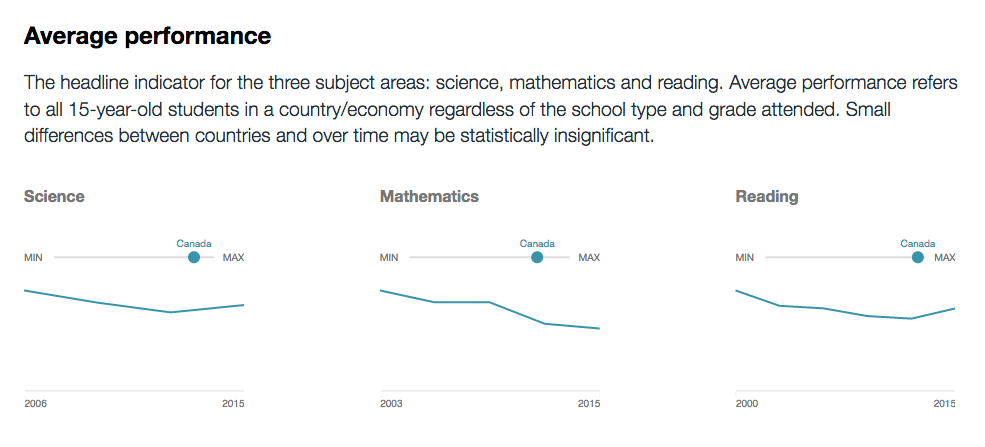
Looking at the historic data dating back to early 2000s, Canada’s performance on PISA tests is in decline. We are definitely not climbing any ranks. In PISA 2003, only two countries performed better than Canada on the combined mathematics scale. In PISA 2015, Canada ranked in the 10th position. Our students today aren’t as strong in their knowledge and problem-solving skills as those who took the test a decade earlier, and we have been outranked by more than a handful of countries during this time.

HTTP://WWW.OECD.ORG/CANADA/PISA-2015-CANADA.HTM
Source: PISA 2015

(Source: PISA 2015)

The downward trend isn’t only in our PISA scores. Two Chinese universities took giant steps forward in the 2017 Times Higher Education World University Ranking and outranked the University of British Columbia and McGill University, two of Canada’s top universities. In the midst of global competition where other countries are systematically and carefully investing in their education, we are falling behind.

Canada’s high proportion of working-age adults with post-secondary education

Pumping out post-secondary students doesn’t say much about the health of a country’s education system. Post-secondary studies are more accessible for Canadian students, as university and college tuition isn’t as astronomical as countries like the United States or the U.K. Also, our low population density and the presence of ample universities and colleges ready to accept tuition money creates an atmosphere where a larger percentage of our population gets a post-secondary education. This has led to our degrees losing their worth — even minimum-paying jobs require a post-secondary education. An exchange student commented on UBC Confessions Facebook page:

«As an exchange student at Sauder, there’s something I don’t understand. I come from a country where we have around 30-35 hours of classes a week, with essays to write and presentations to make as often as here, and where the grading system is way more harsh. However, I see more students getting overwhelmed by the amount of work here at UBC in one semester than in my three years at my home university. This semester honestly felt like holidays to me while I passed all my classes with better grades than what I’m used to.»

Canada’s high proportion of post-secondary degree holders doesn’t tell the entire story or indicate the health of our education system.

YAKOBCHUKOLENA VIA GETTY IMAGES

Quick integration of migrant children

I see that most of the time the children of new migrants are a couple of years ahead in math and science courses compared to their Canadian schoolmates. And often they come from countries where education is highly respected and valued. They have already achieved a level of mastery in learning and study skills that allows them to adapt to their new environment quickly. This is not a true indicator of the health of our education system, either.

We have a lot of work to do to stop the decline in our education.

Low performance variation in ‘advantaged’ and ‘disadvantaged’ children

It’s important to look closer into who is in the «disadvantaged» group to get a full picture of the situation. A large group that is «disadvantaged» in Canada is the children of first-generation immigrant parents who are highly educated and highly skilled, but because their training and education was from another country they struggle to find relevant work in Canada. Although their socio-economics may be low, these families place a high priority on their children’s education, giving our PISA results a false boost in equity. Canadian education equity needs a lot of work, as many of our students from a poor background or students with learning disabilities struggle and don’t receive the support they need.

Our students have a lot of potential. They want to learn. They want to create high quality work. Are our schools and universities willing to raise the bar on Canadian education and give our teachers the training and the support they need?

As much as it feels good for policy makers to have their egos stroked and be proud for their work being viewed as having some «superpower» status, we have a lot of work to do to stop the decline in our education. As long as we refuse to recognize the symptoms of our failing system and accept there is a problem, our situation will not get any better.

Fuente: http://www.huffingtonpost.ca/mehrnaz-bassiri/canada-has-homework-if-it-wants-to-be-an-education-superpower_a_23062342/

Comparte este contenido:
Page 29 of 56
1 27 28 29 30 31 56