Saltar al contenido principal
Page 179 of 400
1 177 178 179 180 181 400

Fascism’s return and Trump’s war on youth

By: Henry Giroux

Fascism is all too often relegated to the history books.

The word conjures up a period in which civilized societies treated democracy with contempt, engaged in acts of systemic violence, practised extermination and elimination, supported an “apocalyptic populism,” suppressed dissent, promoted a hyper-nationalism, displayed contempt for women, embraced militarism as an absolute ideal and insisted on obedience to a self-proclaimed prophet.

But the seeds that produced such fascist horrors have once again sprung to life, returning in new social and political forms.

Today, a culture of fear dominates American society, one marked by massive inequities in wealth and power that not only uphold structures of domination, but also view differences as threats, compassion as weakness and shared responsibilities —if not the common good itself — as pathology.

Fascist thought is on the rise all over the world, but its most blatant and dangerous manifestation has emerged in the Trump administration.

Fear and the ethos of mass consumerism —coupled with widespread insecurity and ignorance —now drive people into a malignant notion of security, self-inflicted cynicism and into the arms of demagogues like Trump. For too many Americans, critical thinking and hope have given way to emotional bonding and the revival of the discourse of ultra-nationalism and bigotry.

Trump: Not Hitler, but dangerous nonetheless

Trump is not Hitler in that he has not created concentration camps, shut down the critical media or rounded up dissidents; moreover, the United States at the current historical moment is not the Weimar Republic.

But in the Trump era, remnants of fascism exist in different shapes and forms and include a celebration of the cult of the leader, systemic racism, the embrace of a toxic macho-populism and state support for ultra-nationalism, racism and the threat of violence against critics.

All of these elements are evident in Trump’s rhetoric and policy initiatives.

Trump’s corporate brand of neoliberal fascism is highly visible in right-wing policies that favour deregulation, corporate power and the interests of the ultra-rich.

Instead of draining the corporate swamp, Trump has embraced the merging of corporate and political power, and in doing so has turned the state into a battering ram designed to serve the most powerful and wealthiest members of society.

Trump’s mode of fascism is a unique product of our times, our commercial culture, and a corporate controlled media, all of which saps the foundations of a viable democracy.

American culture is advertising-saturated and celebrity-based, and has permitted a rich self-promoter to abandon any pretense of civility, accountability or integrity in order to hype, scam and market his way to power.

Call it Fascism, American-Style. It’s returned in the shadow of neoliberalism, with its celebration of the market as the template for governing all of society and its concentration of economic and political power in relatively few hands.

Friendly with dictators

How else to explain Trump’s unapologetic support and friendly attitude toward right-wing dictators such as the self-confessed killer, Rodrigo Duterte, president of the Philippines, Russia’s Vladimir Putin and China’s Xi Jinping, all of whom have a fawning attraction to Trump given he exhibits little interest in their massive human rights violations.
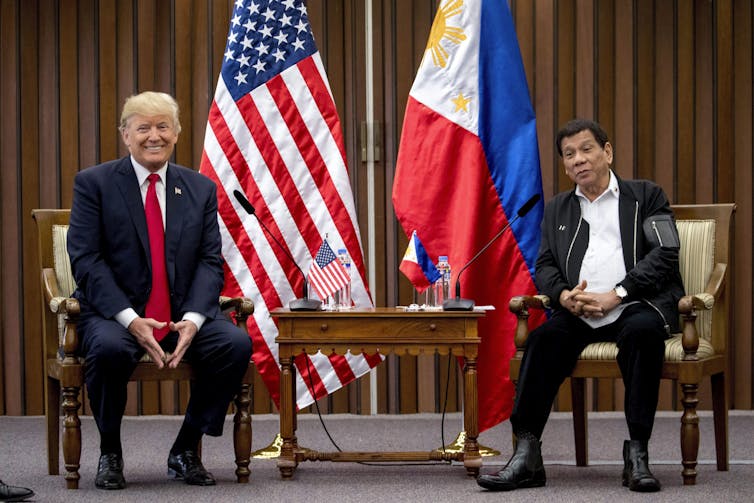
Trump and Philippines President Rodrigo Duterte speak during a bilateral meeting at the ASEAN Summit in Manila in November 2017. (AP Photo/Andrew Harnik)

Trump’s fascism is also on full display in his ramping up of the police state, his relentless racist rhetoric, taunts and policies that cast Blacks, immigrants and Muslims as people unworthy of respect, compassion and dignity, and in his support for a war culture.

The latter is marked by his expansion of the U.S. military budget, his provocations aimed at North Korea and reckless policies such as recognizing Jerusalem the capital of Israel —widely condemned by almost all world leaders — that destabilize the Middle East, Asia and other parts of the world.

But there are more subtle, if not under-examined, indicators that point to resurgence of fascist principles in the United States.

One of the most powerful is Trump’s war on youth.

Finance capitalism now drives politics, governance and policy in unprecedented ways. And it’s more than willing to sacrifice the future of young people for short-term political and economic gains, if not democracy itself.

In an apparent war on children, the Trump administration provides a disturbing index of a society in the midst of a deep moral and political crisis — not the least of which was the president’s support and defence of an accused serial pedophile, Roy Moore, in his unsuccessful attempt to win an Alabama Senate seat.

‘Foreclosed hope’

Too many young people today live in an era of foreclosed hope, an era in which it is difficult either to imagine a life beyond the tenets of a savage form of casino capitalism or to transcend the fear that any attempt to do so can only result in a more dreadful nightmare.

Youth today are not only plagued by the fragility and uncertainty of the present, they are, as the late Polish philosopher Zygmunt Bauman has argued, “the first post-war generation facing the prospect of downward mobility [in which the] plight of the outcast stretches to embrace a generation as a whole.”

American youth, especially those marginalized by race and class, are subject to the dictates of the punishing state. Not only is their behaviour being criminalized in schools and on the streets, they are also subject to repressive forms of legislation.

Several states are sponsoring legislation that would make perfectly legal forms of protest a crime that carries a huge fine, or subjects young people to possible felony charges? Increasingly, young people are viewed as a public disorder, a dream now turned into a nightmare.

The most recent example is evident in budget and tax reform bills that shift millions of dollars away from social programs vital to the health of poor youth to the pockets of the ultra-rich, who hardly need tax deductions.

As U.S. children’s rights activist Marian Wright Edelman points out, such actions are particularly alarming and cruel at a time when “millions of America’s children today are suffering from hunger, homelessness and hopelessness.”

She adds: “Nearly 13.2 million children are poor – almost one in five. About 70 per cent of them are children of colour, who will be a majority of our children by 2020. More than 1.2 million are homeless. About 14.8 million children struggle against hunger in food insecure households.”

Cruel mindset

The Trump administration is more than willing to pass massive tax cuts for the rich while at the same time refusing to fund the Children’s Health Insurance Program, which supports over nine million children.

Republican Senator Chuck Grassley, meantime, has argued that tax cuts shouldn’t benefit the poor because they will just waste the money on booze and women.

So if you’re not rich, it’s because you’re lazy. Really? Tell that to the 10,000 people, some of them children, who may die each year as a result of losing their health insurance due to the proposed Senate tax bill.

Such a mindset, and statements like Grassley’s, are more than cruel, they represent a political and economic system that has abandoned any sense of moral and social responsibility.

In this view, children are undeserving of aid because offering such government support flies in the face of a ruthless neoliberal ideology that insists that the only responsibility of government is to aid the rich and powerful corporations.

If the poor are suffering and subject to harsh conditions, according to Grassley’s logic, it is because of a lack of character.

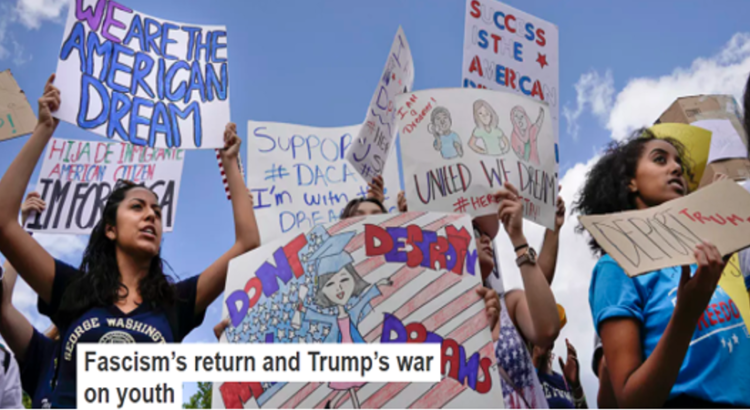
Another under-analyzed example of Trump’s war on youth can be seen his cancellation of the DACA program (Deferred Action for Childhood Arrivals), instituted in 2012 by former president Barack Obama.

Under the program, over 800,000 undocumented immigrants brought to the country as children or teens before 2007 were allowed to live, study and work in the United States without fear of deportation.
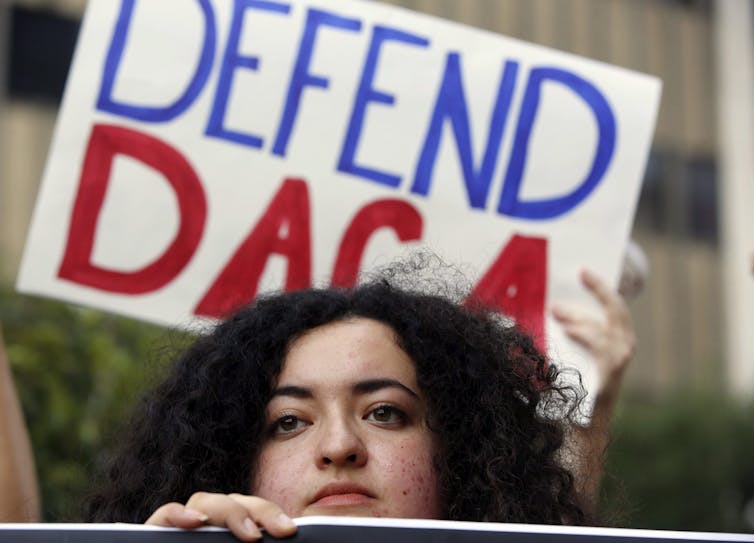
Loyola Marymount University student and dreamer Maria Carolina Gomez joins a rally in support of the Deferred Action for Childhood Arrivals, or DACA program, in California in September 2017. (AP Photo/Damian Dovarganes)

In revoking the program, Trump enacted a policy that is both cruel and racist, given that 78 per cent of DACA residents are from Mexico. These are the same immigrants Trump once labelled rapists, drug addicts and criminals.

Trump’s contempt for the lives of young people, his support for a culture of cruelty and his appetite for destruction and civic catastrophe are more than a symptom of a society ruled almost exclusively by a market-driven survival of the fittest ethos.

‘Systemic derangement’

It is about the systemic derangement of democracy and emergence of fascist politics that celebrates the toxic pleasures of the authoritarian state with no regard for its children.

Trump is the apostle of moral blindness and unchecked corruption, and he revels in a mode of governance that merges his never-ending theatrics of self-promotion with deeply authoritarian politics.

One of the most disturbing features of Trump’s fascism is his disregard for the truth and his embrace of an infantilism that demonstrates, for young people, a lack of any viable sense of critical thought, agency and commitment to social and economic justice.

What’s more, Trump has unleashed a rancid populism and racist-fuelled ultra-nationalism that mimics older forms of fascism and creates a culture of cruelty that both disparages its children and cancels out a future that makes democracy possible for them — and therefore all of us.

At the same time, Trump has embraced a merging of corporate power and politics that is characteristic of all fascist regimes, and in doing so, he has shifted wealth and resources away from vital social programs for young people into the hands of the financial elite.

There is more at work here than regressive tax policies, there is also an attempt to disable the welfare state by eliminating its funding.

Domestic terrorism

One result is what might be called the unleashing of a form of domestic terrorism — terrorism practised in one’s own country against one’s own people —in which young people are subject to state violence and relegated to forms of terminal exclusion, spheres of social abandonment and set adrift in a state of disorientation and despair.

Under this new resurgence of fascism, thinking is dangerous, public spheres that promote critical thought are considered pathological and youth are viewed as a threatening disoriented class, especially those marginalized by race, sexual orientation and class.

And so under Trump, the winds of fascism have accelerated into a hurricane and pose a haunting crisis for youth, the future and democracy itself.

That crisis of youth under the Trump regime is a political disaster of the first order and threatens every vital cultural and political ideal, principle, social formation and public sphere that makes a democracy possible. It’s best illustrated by Trump’s support for Moore, a homophobe, unabashed racist and an accused child predator, sexual harasser and sexual abuser.

Yes, fascism us making a comeback and is with us once again — yet Moore’s defeat in the deep-red state of Alabama to his Democratic challenger gives us reason to hope. Black voters, particularly black women, and young voters stood up to say “no more.”

Fascism requires those among us who value equity, fairness, justice and morality to defeat it. To stop fascism, it is crucial that we show that democracy is the only alternative, and that the grotesque elements of fascism will be challenged. Here’s hoping Alabama is just the beginning of such a struggle.

Source:

https://theconversation.com/fascisms-return-and-trumps-war-on-youth-88867
Comparte este contenido:

EEUU Juez bloquea prohibición de estudios étnicos en Arizona

America del NOrte/EEUU/ 

Comparte este contenido:

Los ataques contra los niños han alcanzado proporciones alarmantes en los conflictos de todo el mundo, dice UNICEF

Nueva York / 05 de enero de 2018 / Fuente: https://www.unicef.org/

“No quedan lugares seguros para los niños, ya que son un objetivo bélico en sus hogares, sus escuelas y las zonas donde juegan“

Los ataques contra los niños han alcanzado proporciones alarmantes durante todo el año en las zonas en conflicto del mundo entero, advirtió hoy UNICEF, y las partes beligerantes se han negado a cumplir de manera flagrante con las disposiciones del derecho internacional diseñadas para proteger a los más vulnerables.

“Los niños han sido blancos de guerra y han estado expuestos a ataques y a una violencia brutal en sus hogares, escuelas y zonas de juego”, dijo Manuel Fontaine, Director de Programas de Emergencia de UNICEF. “A medido que estos ataques se repiten año tras año, no podemos volvernos insensibles a ellos. Esta brutalidad no puede ser la nueva normalidad”.

En los conflictos de todo el mundo, los niños se han convertido en objetivos de primera línea, utilizados como escudos humanos, asesinados, mutilados y reclutados para participar en los combates. La violación, el matrimonio forzado, el secuestro y la esclavitud se han convertido en tácticas habituales en los conflictos que asolan países como Iraq, Siria, Yemen, Nigeria, Sudán del Sur o Myanmar.

En algunos contextos, los niños secuestrados por grupos extremistas vuelven a ser víctimas de abusos después de su liberación, cuando son detenidos por las fuerzas de seguridad. Millones más de niños están pagando un precio indirecto por estos conflictos, ya que sufren desnutrición, enfermedades y traumas debido a que se les priva de los servicios básicos –incluido el acceso a alimentos, agua, saneamiento y salud– o a que estos servicios sufren daños o quedan destruidos durante los combates.

En el transcurso de 2017:

– En Afganistán, casi 700 niños fueron asesinados en los primeros 9 meses del año.
– En la República Centroafricana, después de meses de reiterados combates, la intensificación grave de la violencia llevó a que los grupos armados asesinaran, violaran, secuestraran y reclutaran a numerosos niños.
– En la región de Kasai, en la República Democrática del Congo, la violencia ha expulsado a 850.000 niños de sus hogares, mientras que más de 200 centros de salud y 400 escuelas fueron atacados. Se estima que 35.000 niños han sufrido de desnutrición aguda grave.
– En el noreste de Nigeria y Camerún, Boko Haram ha obligado a por lo menos 135 niños a actuar como terroristas suicidas, casi cinco veces más que en 2016.
– En Iraq y Siria, según los informes, los niños han sido utilizados como escudos humanos, atrapados en asedios, atacados por francotiradores y sometidos a intensos bombardeos y actos de violencia.
– En Myanmar, los niños rohingya sufrieron y presenciaron casos de una violencia terrible y generalizada cuando fueron atacados y expulsados de sus hogares en el estado de Rakhine; mientras tanto, los niños que viven en las zonas fronterizas remotas de los estados de Kachin, Shan y Kayin continúan sufriendo las consecuencias de las tensiones entre las Fuerzas Armadas de Myanmar y diversos grupos étnicos armados.
– En Sudán del Sur, donde el conflicto y una economía en caída libre llevaron a que se declarara la hambruna en partes del país, más de 19.000 niños han sido reclutados por las fuerzas armadas y los grupos armados, y más de 2.300 niños han muerto o sufrido heridas desde que el conflicto estallara por primera vez en diciembre de 2013.
– En Somalia se notificaron 1.740 casos de reclutamiento de niños en los primeros 10 meses de 2017.
– En Yemen, tras casi 1.000 días de enfrentamientos, al menos 5.000 niños murieron o sufrieron heridas, según datos verificados, aunque se teme que las cifras reales sean mucho más altas. Más de 11 millones de niños necesitan asistencia humanitaria. De los 1,8 millones de niños que padecen malnutrición, 385.000 están gravemente desnutridos y corren peligro de morir si no reciben un tratamiento urgente.

UNICEF hace un llamamiento a todas las partes en el conflicto para que cumplan sus obligaciones en virtud del derecho internacional y pongan fin de inmediato a las violaciones contra los niños y los ataques contra la infraestructura civil, incluidas las escuelas y los hospitales. UNICEF también hace un llamamiento a los Estados con influencia sobre las partes en conflicto para que usen esa influencia para proteger a los niños.

En todos estos países, UNICEF trabaja con sus asociados para proporcionar a los niños más vulnerables servicios de salud, nutrición, educación y protección infantil.

Fuente noticia: https://www.unicef.org/spanish/media/media_102357.html

Comparte este contenido:

La educación debe ser fundamental en la política migratoria.

Por: Internacional de la Educación.

La educación tendría que ser la base del nuevo Pacto Mundial sobre Migración, según la Internacional de la Educación, que incidió en la importancia de contar con un enfoque migratorio que tenga en cuenta a toda la sociedad en un ámbito local y nacional.

Los estados miembros de la ONU y, de hecho, todos los gobiernos, están obligados a garantizar los derechos humanos de todos los migrantes. Es lo que afirmó Dennis Sinyolo, de la Internacional de la Educación (IE), a lo que añadió que «dichos derechos se resumen en los pactos y tratados de Naciones Unidas (ONU) actuales».

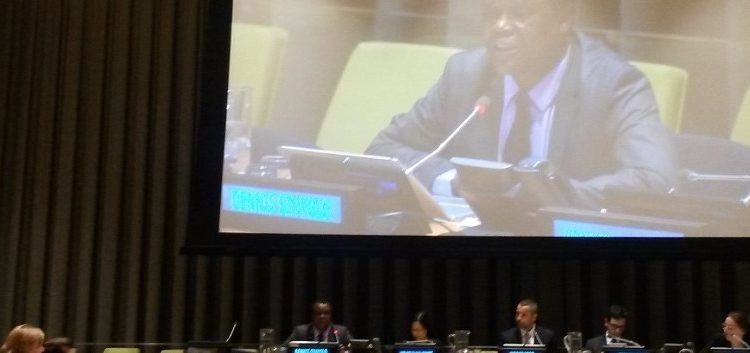
Sinyolo realizó estas declaraciones en el marco de un panel sobre perspectivas nacionales para un enfoque que abarque a toda la sociedad y facilite un movimiento migratorio seguro, ordenado y normal. El panel tuvo lugar durante unas sesiones informales con varias partes interesadas previas a la reunión del Pacto Mundial sobre Migración y la conferencia intergubernamental sobre migración internacional. Se celebró el 18 de diciembre en la sede de Naciones Unidas (ONU) en Nueva York, Estados Unidos.

En la sesión, los participantes tuvieron la oportunidad de debatir sobre la necesidad de cooperación y alianzas entre diferentes segmentos de la sociedad, incluida la sociedad civil, el sector privado, comunidades en la diáspora, migrantes, autoridades locales y nacionales, expertos y otros implicados para desarrollar y poner en práctica un enfoque sobre migración coherente y que abarque al conjunto de la sociedad.

El Presidente de la Asamblea General de la ONU, Miroslav Lajcak, explicó: «Estamos aquí para analizar cómo afecta la migración a las autoridades locales. Queremos ir más allá del ámbito nacional y revisar ejemplos de buenas prácticas en un entorno local y de cómo los migrantes contribuyen a las comunidades locales, por ejemplo, a través de sus destrezas».

El proceso de negociación intergubernamental sobre el Pacto Mundial, como recordó a los presentes, se iniciará en febrero de 2018, y exige que «se escuche a numerosas partes diferentes, especialmente a quienes aplican leyes y políticas migratorias, como enfermeras, docentes y agentes de las fuerzas de seguridad».

Por otra parte, subrayó que no hay mejor forma de celebrar el Día Internacional del Migrante que presentar propuestas sobre cómo tratar los retos que les afectan. También destacó la necesidad de basarse en un enfoque que tenga en cuenta a toda la sociedad y el gobierno, además de escuchar a todos los implicados.

Diálogo social

El punto de partida para garantizar un enfoque efectivo que llegue al conjunto de la sociedad a la hora de gestionar la migración presenta dos vertientes, según explicó Sinyolo:

(1) Todos los gobiernos, incluidos los de países de acogida y tránsito, deberían ratificar e implementar por completo las disposiciones de la ONU y la Organización Internacional del Trabajo (OIT) sobre migración, empleo y otros acuerdos relevantes.

(2) Los gobiernos deberían garantizar el establecimiento de mecanismos institucionalizados para el diálogo social.

También resulta de vital importancia llevar a cabo una consulta y un diálogo reales con los trabajadores migrantes a través de las organizaciones que los representan, los sindicatos en particular, dado que la mayoría de los migrantes se desplazan en busca de un trabajo decente, señaló.

La lucha y las acciones que llevan a cabo los sindicatos, la sociedad civil y otros agentes tampoco se deben subestimar, añadió Sinyolo. Estas organizaciones se han esforzado mucho para garantizar que no se niegue a los migrantes el acceso a las necesidades vitales y servicios públicos básicos, como la salud, la educación y la justicia, por su condición migratoria.

IE: Defender los derechos educativos de migrantes y refugiados

La Internacional de la Educación ha estado trabajando con sus afiliadas nacionales, organizaciones juveniles y comunidades estudiantiles y locales para defender y fomentar los derechos educativos de migrantes y niños y jóvenes refugiados en varios países europeos y de fuera de Europa, según manifestó Sinyolo.

Los educadores y sus sindicatos llevan mucho tiempo luchando para que los niños indocumentados tengan derecho a una educación de calidad y cuestionando su detención en campos de refugiados, afirmó. La IE también ha proporcionado formación y un desarrollo profesional a docentes locales, migrantes y refugiados para que puedan adaptarse a las necesidades específicas de los migrantes y refugiados, incluido apoyo psicosocial y formación lingüística.

«La educación es el mayor antídoto ante el azote de la xenofobia, el racismo y la discriminación, ya que ayuda a inculcar y fomentar los valores del entendimiento intercultural, el respeto, la tolerancia y la coexistencia pacífica». De hecho, la educación dota a migrantes y niños y jóvenes refugiados de las destrezas necesarias en su vida y trabajo, declaró, además de enfatizar que este aspecto debería ser una parte fundamental del nuevo Pacto Mundial.

«Un enfoque que implique al conjunto de la sociedad solo se puede alcanzar si todos los países y gobiernos dan un paso al frente en la creación de un entorno que acepte a los refugiados, tanto en el plano legislativo como socioeconómico», indicó. «Necesitamos tomar medidas inteligentes y significativas para avanzar, y que nadie las ignore o se haga a un lado, porque la gestión mundial de la migración es un esfuerzo mutuo que atañe a los países de partida, tránsito y destino».

Para finalizar, recordó la necesidad de que la ONU y los gobiernos sigan contando con sindicatos y sociedad civil en el proceso de negociación intergubernamental, hecho que motivó la respuesta por parte del Presidente de la Asamblea General de la ONU, que anunció que convocará dos sesiones/consultas más en febrero y mayo de 2018.

Fuente: https://www.ei-ie.org/spa/detail/15621/la-educaci%C3%B3n-debe-ser-fundamental-en-la-pol%C3%ADtica-migratoria

Imagen: https://www.ei-ie.org/resources/views/admin/medias/timthumb.php?src=https://www.ei-ie.org/media_gallery/original_687a3.jpg&w=1200&h=530&zc=1

Comparte este contenido:

Reseña de Película: La esperanza de navidad.

TÍTULO ORIGINAL: The Christmas Hope
otro titulo: La Esperanza De Navidad
AÑO: 2009
DURACIÓN: 89 min.
PAÍS: Estados Unidos
DIRECTOR: Norma Bailey
GUIÓN: Wesley Bishop (Novela: Donna Van Liere)
MÚSICA: Lawrence Shragge
FOTOGRAFÍA: Mathias Herndl
REPARTO: Madeleine Stowe, James Remar, Tori Barban, Ian Ziering, Jayne Eastwood, Devon Weigel, Aaron Hughes, Phillip Jarrett, Alicia Johnston, Daniel Boiteau, Rebecca Gibson, Omar Khan
PRODUCTORA: Lifetime Television
WEB OFICIAL: mylifetime.com/movies/the-christmas-hope
GÉNERO: Drama | Familia. Navidad.

Una pareja al borde del divorcio a causa de la muerte de su hijo acoge en su casa a una niña de ocho años sin madre. Poco a poco todos se recuperarán de la pérdida de sus seres queridos y Emily será el motivo de la pareja para seguir adelante y superar el aniversario de la muerte del pequeño.

Fuente: https://youtu.be/kbzzOUENiYg

Imagen: https://www.peliculasflv.tv/wp-content/uploads/2015/03/Una_vida_para_sonar.jpg

Comparte este contenido:

Trump’s war on children

 by Henry A. Giroux

Under the authoritarian reign of Donald Trump, finance capitalism now drives politics, governance, and policy in unprecedented ways and is more than willing to sacrifice the future of young people for short-term political and economic gains. More than willing to wage a war on America’s children, the Trump administration provides a disturbing index of a society in the midst of a deep moral and political crisis. Too many young people today live in an era of foreclosed hope, an era in which it is difficult either to imagine a life beyond the tenets of a savage form of casino capitalism or to transcend the fear that any attempt to do so can only result in a more dreadful nightmare.

Youth today are not only plagued by the fragility and uncertainty of the present, they are as the late Zygmunt Bauman has argued «the first post war generation facing the prospect of downward mobility [in which the] plight of the outcast stretches to embrace a generation as a whole.» As the social state is decimated, youth, especially those marginalized by race and class, are subject to the dictates of the punishing state. Not only is their behaviour being criminalized in the schools and on the streets, they are also subject to repressive forms of legislation. How else to explain the fact that at least 25 states are sponsoring legislation that would make perfectly legal forms of protest a crime that carries a huge fine or subjects young people to possible felony charges? Increasingly, young people are viewed as a public disorder, a dream now turned into a nightmare.

While there is much talk about the influence of Trumpism, there are few analyses that examine its culture of cruelty and its effects on children. The most recent example is evident in budget and tax reform bills that shift millions of dollars away from social programs vital to the health of poor youth to the pockets of the ultra-rich, who hardly need tax deductions. As Marian Wright Adelman points out, such actions are particularly alarming and cruel at a time when «Millions of America’s children today are suffering from hunger, homelessness and hopelessness. Nearly 13.2 million children are poor — almost one in five. About 70 per cent of them are children of colour who will be a majority of our children by 2020. More than 1.2 million are homeless. About 14.8 million children struggle against hunger in food insecure households.» The Trump administration is more than willing to pass massive tax cuts for the rich while at the same time refusing to fund the Children’s Health Insurance Program, which supports over nine million children. When asked to defend the cuts, Republican Senator Orrin Hatch stated «I have a rough time wanting to spend billions and billions and trillions of dollars to help people who won’t help themselves, won’t lift a finger and expect the federal government to do everything.» Remember he is talking about children who are poor, vulnerable, and at risk for a range of illnesses. Such statements are more than cruel, they represent as political and economic system that has abandoned any sense of moral and social responsibility.

Another under-analyzed example of Trump’s war on youth can be seen his cancellation of the DACA program [Deferred Action for Childhood Arrivals], instituted in 2012 by former president Obama. Under the program, over 800,000 undocumented immigrants brought to the country as children or teens before 2007 were allowed to live, study, and work in the United States without fear of deportation. In revoking the program, Trump enacted a policy that is both cruel and racist, given that 78 per cent of DACA residents are from Mexico — these are the same immigrants Trump once labelled as rapists, drug addicts, and criminals.

Trump’s contempt for the lives of young people, his support for a culture of cruelty and his appetite for destruction and civic catastrophe are more than a symptom of a society ruled almost exclusively by a market-driven survival of the fittest ethos with its willingness if not glee in calling for the separation of economic, political, and social actions from any sense of social costs or consequences. It is about the systemic derangement of democracy and emergence of a politics that celebrates the toxic pleasures of the authoritarian state with no regard for its children. Trump is the apostle of moral blindness, unchecked corruption, and revels in a mode of governance that merges a never-ending theatrics of self-promotion with a deeply authoritarian politics. He has unleashed a rancid populism and racially inspired ultranationalism that mimics older forms of totalitarianism and creates culture of cruelty that both disparages its children and cancels out a future that makes democracy possible.

Henry A. Giroux is a widely-published social critic and McMaster University professor who holds the McMaster Chair for Scholarship in the Public Interest, the Paulo Freire Distinguished Scholar Chair, and is a Visiting Distinguished University Professor at Ryerson University. Born in Rhode Island, he held numerous academic positions in the U.S. and now lives in Hamilton.

Source:

https://www.thespec.com/opinion-story/8027469-trump-s-war-on-children/

Comparte este contenido:

Estados Unidos trata de dar más acceso a la educación preescolar

Estados Unidos/01 de Enero de 2018/El Nuevo Día

A lo largo y ancho del país, se está haciendo evidente que no hay suficientes cupos para recibir a todos los niños, ni los suficientes fondos para financiarlo.

Aunque suene quizás paradójico, estados de histórica tendencia conservadora como Oklahoma y Virginia Occidental están liderando las gestiones para hacer más accesible la educación preescolar.

«Son estados de sueldos deprimidos, de fuerza laboral de escasa educación y con el deseo de cambiar esa situación”, declaró Steven Barnett del Instituto Nacional de Educación Preescolar.

«Digan lo que digan, los políticos de Virginia Occidental saben muy bien que el futuro del estado no está en la industria del carbón”, añadió.

Otros estados conservadores con innovadores programas educativos son Alabama y Georgia. Pero incluso ciudades de tendencia liberal como Seattle y Nueva York están impulsando esquemas para promover la educación preescolar.

Los expertos advierten que urge hacer más accesible la educación preescolar debido a los altos costos del cuidado infantil. Según múltiples estudios científicos, los niños que asisten a buenas escuelas preescolares tienden a rendir mejor en su futura vida académica y de adultos, a tener empleos mejor remunerados y estilos de vida más saludables.

Pero a lo largo y ancho del país, se está haciendo evidente que no hay suficientes cupos para recibir a todos los niños, ni los suficientes fondos para financiarlo.

En ciudades como Seattle y Nueva York los programas de preescolar gozan de amplio apoyo local, que a su vez redunda en una mayor presión política sobre los legisladores locales frente a la desigualdad en el acceso educativo y a estudios según los cuales una buena educación es clave para el desarrollo temprano del niño.

“Obviamente sería mucho mejor tener un programa que cubra al estado entero y que sea accesible a todos los chicos de 3 y 4 años. Es la mejor inversión que podemos hacer para corregir este problema», dijo Tim Burgess, ex alcalde de Seattle que fundó un programa para impulsar la educación preescolar en la ciudad.

El programa ya lleva tres años e incluye a 979 niños cuyos padres pagan según su capacidad económica. Aproximadamente un 80% participa gratuitamente. Burgess está ahora en campaña tratando de que el programa abarque todo el estado de Washington.

La iniciativa de hacer más accesible a la educación preescolar alcanzó su auge bajo la presidencia de Barack Obama pero ha sido prácticamente ignorada bajo la de Donald Trump. Ivanka Trump, hija y asesora del presidente, ha hablado en ocasiones a favor de reducir los costos educativos.

Un estudio realizado por legisladores demócratas este año indica que menos de la mitad de los niños de entre 3 y 4 años de edad en el país están inscritos en un programa prekinder. El nivel de participación varía de estado a estado. En la capital Washington, D.C., es de 75% pero en Idaho es de apenas 30%.

Fuente: https://www.elnuevodia.com/noticias/eeuu/nota/estadosunidostratadedarmasaccesoalaeducacionpreescolar-2385214/

Comparte este contenido:
Page 179 of 400
1 177 178 179 180 181 400
OtrasVocesenEducacion.org