Page 351 of 400
1 349 350 351 352 353 400

EEUU: Teachers Take On Student Discipline

Fuente: labornotes / 20 de junio de 2016

Two kindergarteners are poking each other with their pencils. What starts as a game soon gets out of hand. With one child bleeding, the teacher brings them to the principal’s office. Later, she finds out both kids were suspended and sent home.

It’s not an uncommon scenario in today’s public schools. But as activists draw attention to high rates of suspensions, racial disparities, and the “school-to-prison pipeline,” the political winds are shifting. Policymakers at the federal and district levels have begun to demand fewer suspensions, especially for minor rule-breaking.

It’s an issue where not all teachers see eye to eye. But a growing number of teachers and unions are rising to the challenge, pushing their school districts to back up suspension bans with the resources to make alternatives really work.

A BETTER WAY

Elana Eisen-Markowitz, a 10-year teacher New York City, is active in a campaign to introduce “restorative practices,” an alternative approach to solving student behavior problems.

The idea is that teachers and students meet to discuss the behavior and the root problems that might cause students to act out—such as stress, anxiety, or problems at home.

For instance, suppose a student yells and curses at a teacher in the hallway. Instead of removing the student from his next class or sending him home, the teacher would sit down with him. Both would explain their experiences of the incident. Often a parent or even a peer student joins the meeting, too.

This new approach requires a culture change. But in her experience, Eisen-Markowitz says, it’s more effective than punitive discipline.

“So rarely I’ve seen a suspension work, where a student returns feeling ready to learn,” she said. “I personally feel safer knowing I’ve had a face-to-face conversation, rather than [just] seeing them in the hall again and again.”

Eisen-Markowitz is pleased that New York has moved to limit suspensions for behavior issues and explore restorative practices—though she’s already questioning the city’s rollout. She stresses that teachers must have a say in planning and implementing a restorative practices program. It can’t be outsourced or dropped from headquarters.

Besides being a building rep (shop steward) for her union, Eisen-Markowitz organizes with the activist group Teachers Unite, a network of educators who are using and promoting restorative practices. Teachers Unite discourages outsourcing the topic to specialist trainers, who won’t be able to build relationships or stick around long-term.

New York’s United Federation of Teachers—the largest teacher local in the U.S., with 100,000 members—hasn’t been so welcoming. “The UFT has centered the conversation on teachers’ need to kick students out,” Eisen-Markowitz said.

Another teacher group, the Movement of Rank-and-File Educators—modeled after the caucus that leads the Chicago Teachers Union—ran for top offices in the local, with a platform that includes reforming student discipline and taking on racial justice issues.

‘CART BEFORE THE HORSE’

African American students, though only 15 percent of the elementary school population in Seattle, were receiving nearly half the suspensions.

After that jarring statistic drew public attention, last September Seattle’s school board approved a one-year citywide moratorium on elementary school suspensions for disruptive behavior.

It’s a common starting place for district and state policymakers—lessening or halting “willful defiance” suspensions, for example, while leaving administrators and teachers the discretion to act on more extreme behavior. Minneapolis, New York City, Los Angeles, and Oregon have imposed similar bans.

But Seattle special education teacher Shelly Hurley believes her district “put the cart before the horse” by curbing suspensions without adding other support for teachers.

The policy change “looks great” on paper, she said. “Suspensions are going down—but that doesn’t mean learning is going up.”

Seattle teachers, meanwhile, are working to build long-term alliances with parents and community groups. In last year’s negotiations, the union brought up the problem of racially biased suspensions.

At first, Hurley said, “we wanted hours and hours of professional development.” But eventually, “we came to realize we wanted it to be something more organic that grew at every school.”

Seattle teachers don’t see this issue as isolated. They also fought for guaranteed recess, less testing, and much-needed raises. In September, they went on strike.

Their final contract settlement created racial equity teams at 30 schools to examine how discipline affects kids of color. There’s also a citywide behavioral support team of five staff. After a school year with the changes, a union-management committee will make recommendations to the school board.

T TAKES MONEY
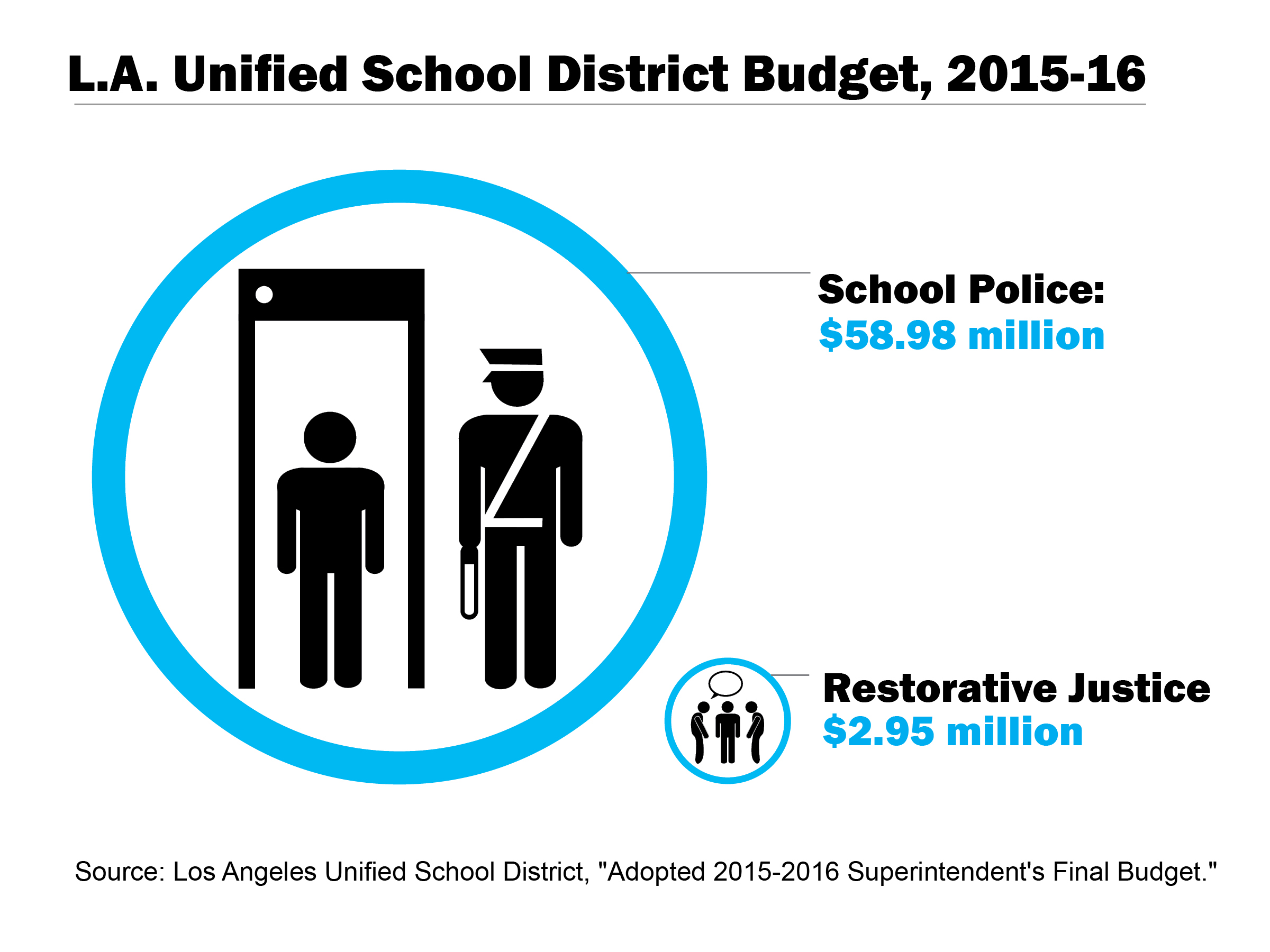

Infographic: Sonia Singh. Click to enlarge.

Where the rubber hits the road is whether a rule-change is backed up with the necessary resources. “It’s going to cost money,” Hurley said. “There’s no way around it.”

San Francisco teachers saw this firsthand. They were on board from the start with their district’s “Safe and Supportive Schools” initiative, which called for scaling back suspensions, introducing restorative practices, and hiring coaches to train teachers.

But two years after implementation, the district has dismantled the team of coaches and is scaling back the resources to run the programs.

“You can’t just say it in name only,” said Lita Blanc, president of United Educators of San Francisco.

To fully realize the initiative, the union has responded with its own set of demands: a teacher’s aide in every class, and in every school, a parent engagement plan and an alternative learning center, staffed with a school employee—so students who’ve been removed from class aren’t just warehoused in an office.

Five hundred teachers rallied at the school board in May for “Safe, Stable, and Supportive Schools,” sending the message that it takes long-term resources to transform school climate. They want language addressing these demands in their next contract.

Teachers in St. Paul, Chicago, and elsewhere are also linking these worksite issues to bigger social and political demands, like supporting the Fight for $15 and stopping banks from foreclosing on families. After all, students bring those problems to school, too.

Training is a big part of bringing restorative practices into classrooms. But St. Paul Federation of Teachers Vice President Nick Faber said unions must not lose sight of the need for ongoing staffing too. “Teachers are so on overload of initiatives, they can’t keep them straight,” he said.

In recent bargaining, St. Paul teachers won expanded school-climate improvement teams, which include parents. Each school’s team can apply for a $150,000 grant for restorative practices, using the money for additional staff or training as the local committee sees fit. Six schools are now in the process of creating their own plans.

“The key is to have this work pilot in schools,” said Faber, “and pilot in schools that are ready, not just be dumped on a school.”


A version of this article appeared in Labor Notes #447, June 2016. Don’t miss an issue, subscribe today.
Samantha Winslow is a staff writer and organizer with Labor Notes.samantha@labornotes.org
Comparte este contenido:

Secundarios: denuncian malas condiciones en la escuela Tomás Guido y EEUU

América del Norte / Estados Unidos / Fuente y Autor: La Izquierda Diario


Los problemas edilicios, falta de agua y persecución a la organización –en el Guido- provocó el repudio de los estudiantes de ambos colegios. La Corriente 9 de abril brindó su apoyo al reclamo.

Reproducimos el comunicado.

Desde la 9 de abril saludamos la pelea que vienen dando los estudiantes del EEUU y Tomás Guido. Los problemas edilicios (que se suman a los del ISFD 113 que es parte de la misma unidad académica) y la falta de agua en las dos escuelas –comparten edificio- son producto de las políticas de vaciamiento de la educación pública que se dio de forma sistemática durante la década kirchnerista y que se profundizan bajo el gobierno de Cambiemos.

Frente a esta situación los estudiantes del EEUU llevaron adelante una sentada para repudiar no sólo los problemas de infraestructura sino también el ataque de la dirección del Guido contra la organización: las autoridades de esa institución buscan amedrentar labrando actas a los estudiantes que impulsan asambleas, el órgano más democrático de discusión que tenemos tanto trabajadores como estudiantes.

Mientras la gobernadora María Eugenia Vidal eleva los sueldos de sus funcionarios -el último aumento es equivalente al salario que reciben los auxiliares (7500 pesos)- hay cientos de escuelas con enormes problemas de infraestructura, comedores y miles de docentes que no cobran su sueldo en tiempo y forma –a tal punto que se naturaliza el doble o triple cargo para obtener un salario igual a la canasta familiar-.

En este sentido y siguiendo el ejemplo de los estudiantes de la Técnica 4 de Ciudadela es de primer orden que la conducción del Suteba San Martín – Tres de Febrero se ponga a la cabeza de este proceso de lucha por la educación pública. La unidad y la organización de docentes y estudiantes es fundamental si queremos torcer la mano a las políticas de ajuste del gobierno.


Fuente de la noticia: http://www.laizquierdadiario.com/Secundarios-denuncian-malas-condiciones-en-la-escuela-Tomas-Guido-y-EEUU

Comparte este contenido:

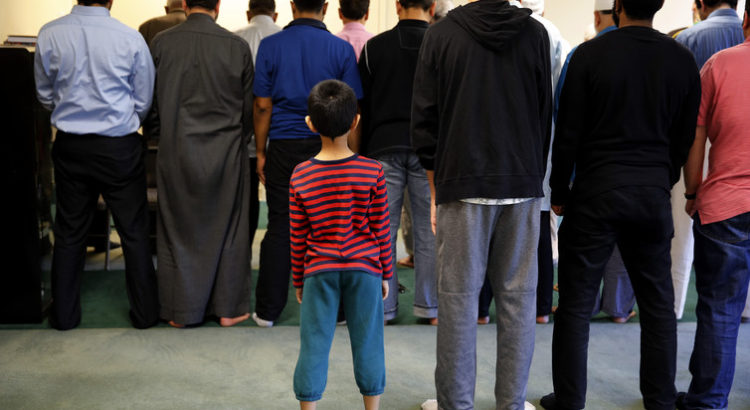
48 hours as a Muslim American: A professor reflects

América del Norte/EEUU/Junio 2016/Autor: Mohammad Hassan Khalil / Fuente: theconversation.com

Resumen:  La tarde del pasado viernes, antes de una audiencia global, el ex presidente Bill Clinton (cristiano) y el cómico Billy Crystal (un Judio) elogiaron «al más grande«, el más famoso musulmán estadounidense de todos los tiempos, Muhammad Ali. El domingo, los estadounidenses se despertaron con la trágica noticia de que un joven musulmán estadounidense había perpetrado el tiroteo más mortífero en la historia estadounidense, cuando tomó la vida de decenas de inocentes en el club nocturno Pulse de Orlando.

What a difference 48 hours can make.

Last Friday afternoon, before a global audience, former president Bill Clinton (a Christian) and comedian Billy Crystal (a Jew) eulogized “the Greatest,” the most famous Muslim American of all time, Muhammad Ali.

The televised audience also took in Islamic invocations, recitations from the Qur’an, and, if they listened carefully, gleeful shouts of “Allahu akbar” (“God is the greatest”) from many of the thousands of attendees who packed Louisville’s KFC Yum! Sports Arena for the memorial service. President Barack Obama declared that Ali “will always be America.” And prior to his passing, a moment of silence in his honor was taken before tip-off at two NBA Finals games, once at Oracle Arena in Oakland, another time at Quicken Loans Arena in Cleveland.

On Sunday, Americans awoke to the tragic news that a young Muslim American had perpetrated the deadliest mass shooting in American history when he took the lives of dozens of innocents at Orlando’s Pulse nightclub.

His proclaimed affiliation to ISIS and reports of his homophobia and anger problems were all over the news.

Presidential candidate Donald Trump tweeted that the shooter reportedly shouted “Allahu akbar” during the horrific rampage. President Obama condemned what “was an act of terror and an act of hate.” And a moment of silence in honor of the victims was taken prior to tip-off at the most recent NBA Finals game in Oakland.

To say this past week has been a turbulent one would be an understatement.

Numerous Muslim Americans expressed how pleasantly surprised they were at seeing widely broadcast positive portrayals of their coreligionists in a nonetheless sobering Ali memorial.

At the Louisville, KY Islamic funeral service, the prominent Muslim American scholar Sherman Jackson had declared, “Ali put the question as to whether you could be a Muslim and an American to rest.” What is more, “Ali made being a Muslim cool.”

But with vile criminals such as the above-mentioned shooter (whose name I shall not bother to mention) dominating the headlines, it is easy to see why many Americans see Muslims as being very uncool.

Surveys show that non-Muslims who do not regularly interact with Muslims tend to have a significantly more negative impression of them. This should not come as a surprise given recent events and the media coverage of these events.

It certainly does not help that there exist numerous misconceptions and oversimplifications about both Islam and Muslims that are widely propagated online. (Of course, one could say something similar about America itself. If Islam and Muslims have a “public relations problem” in the West, the same is true for America and Americans in many countries overseas.)

Indeed, as a professor of religious studies, I find that I spend much of my time debunking popular myths.
The demographics

The reality is that with a population of over three million, most Muslim Americans are not nearly as “great” as Ali; and they are certainly nothing like the Orlando shooter. The reality is that most Muslims are everyday people.

Muslim Americans are extremely diverse: 63 percent are immigrants hailing from 77 countries. They are, on average, relatively young. Their levels of education mirror those of the U.S. population as a whole. As a Pew survey put it several years ago, they are “decidedly American in their outlook, values and attitudes.”

What is more, they have been here for a long time.
Coming to America

Some arrived on slave ships centuries ago. Others – including famous figures such as Ali, Malcolm X, basketball legend Kareem Abdul-Jabbar, U.S. Representative Keith Ellison, author G. Willow Wilson, singer Jermaine Jackson, comedian Dave Chappelle and a 19th-century writer and U.S. Consul to the Philippines named Alexander Russell Webb (1846-1916) – chose to convert to Islam.

Most – including numerous physicians, researchers, business owners and cab drivers – immigrated to this country to seek a better life, and, in the process, like other immigrants, made America a better country.

One such immigrant was the late Fazlur Khan, an architect originally from Bangladesh who designed the iconic Sears Tower (now called Willis Tower) and the John Hancock Center in Chicago. And just this past year, another immigrant, this time from Turkey, scientist Aziz Sancar, received the Nobel Prize, making him the second Muslim American Nobel Laureate in Chemistry. (The first was Egyptian-American Ahmed Zewail in 1999.)

Finally, many Muslims – from hip-hop artist Lupe Fiasco to U.S. Army Specialist and Purple Heart recipient Kareem Khan (who was killed in combat in 2007) – were born into Muslim families right here in the United States. According to the Pentagon, there are almost 6,000 Muslims currently serving in the U.S. military.

The Islamic State does not even account for one percent of one percent of the worldwide Muslim population. And among the many devout Muslim Americans I know personally, I have yet to meet or even hear about a single ISIS sympathizer; I see only looks of disgust whenever they’re mentioned.

Such sympathizers obviously exist. But this relatively small collection of individuals represent only themselves.

A friend on Facebook shared a story about how he came to learn about the Orlando shootings. He was passing through an airport when he noticed a crowd huddled around a television screen. When it was revealed that the shooter came from a Muslim family, a man in the crowd remarked, “Those damn Muslims.”

Three million diverse, overwhelmingly peaceful and productive Muslim Americans reduced to “those damn Muslims.”

Interestingly, just hours before the attack in Orlando I was discussing the Ali memorial service with a group of Muslim friends. Though sad about the passing of “the Greatest,” they all had smiles on their faces as they recounted the speeches from the service and imagined the effects those speeches might have on the broader American public. They had never felt better represented. At that moment, at least, they felt cool.

Fuente de la noticia: https://theconversation.com/48-hours-as-a-muslim-american-a-professor-reflects-60991

Fuente de la imagen: https://62e528761d0685343e1c-f3d1b99a743ffa4142d9d7f1978d9686.ssl.cf2.rackcdn.com/files/126431/width754/image-20160614-29209-1qiovg1.jpg

Comparte este contenido:

En EEUU: Adolescentes latinas luchan por su propia vida

Un programa las ayuda a estudiantes hispanas de la ciudad a combatir el suicidio

América del Norte/ EEUU/ Carolina Ledezma / Especial para EL DIARIO NY

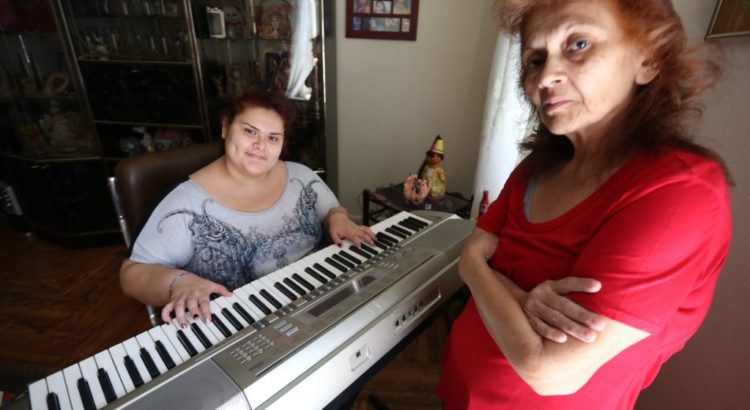
Ymalay Rodríguez sueña con cantar en el Madison Square Garden. Pero hasta hace poco, la joven de 16 años en vez de tener aspiraciones lo que pretendía era ponerle un freno a su futuro, mediante varios intentos por quitarse la vida.

La adolescente de El Bronx de raíces mexico-puertorriqueñas forma parte de un segmento de la población que mantiene en alerta a las autoridades: El de un 18.5% de estudiantes latinas de secundaria de Nueva York que consideran seriamente la idea del suicidio, y de las cuales el 13.2% ya ha atentado en contra de sus vidas (casi el doble del porcentaje de neoyorquinas blancas), según las estadísticas de 2015 que recientemente difundió elCentro para el Control de Enfermedades de Estados Unidos (CDC).

Entre 2013 y 2015 se dio “el mayor incremento entre las adolescentes latinas que consideraron seriamente el suicidio”, indicó la fundadora de la organización sin fines de lucro Comunilife, Rosa Gil. “Un aumento de 34% se registró en El Bronx (de 13.7% en 2013 a 18.3%  en 2015)”, especificó Gil. Este condado no es la excepción en la ciudad, ya que entre 19% y 20%  de las hispanas entre 12 y 18 años que residente en Staten Island, Queens yManhattan están en riesgo de quitarse la vida. Brooklyn es el único condado donde las cifras bajaron de 23% a 15% en dos años.

Gil ha estudiado cómo esta tendencia suicida ha ido creciendo en el país desde 2008. Por eso diseñó el programa La Vida es Preciosa (LIP), una iniciativa que Comunilife (www.comunilife.org) lleva a cabo en El Bronx, Brooklyn y Queens, y que provee a Ymalay, y otras 90 chicas como ella y sus familias, las herramientas que necesitan para salir adelante.

Entre la vida y la muerte

Ymalay descubrió cuán delgada es esa línea entre la vida y la muerte cuando apenas tenía 11 años y creyó ser “bipolar”. Además, la enfermedad de su madre, aunado a las malas compañías y la pérdida temporal de su visión, detonaron sus miedos. “Como mi terapista decía, yo no sentía nada y por eso empecé a cortarme para sentir algo”, contó la joven.

Tras no conseguir la ayuda deseada en un centro psiquiátrico, Ymalay fue referida a LIP de El Bronx.“El centro es mi casa fuera de la casa”, expresó la estudiante que aspira ser unaterapista musical, agregando que “como todas estamos en la escuela, los miembros del centro nos ayudan a hacer las tareas”.

Las adolescentes en este programa también participan en actividades de arte y música, y disponen de computadoras y libros. En el caso de Ymalay, ahora también toca piano y está aprendiendo guitarra con los instructores de LIP.

Como y como ella misma explicó, LIP les provee la compañía y opciones positivas para aprovechar el tiempo que no tienen en casa.

Entre tanto, Gil destacó que las artes creativas han sido claves para ayudarlas a decir lo que sienten a través de la pintura, la poesía o la música. En el programa, además, se les dan clases de cocina, asesoría sobre nutrición (porque muchas de ellas sufren de sobrepeso) y actividades de ejercicio físico, “porque si están contentas con cómo lucen, ellas se sienten mejor”.

Beneficios para toda la familia

“En el programa conseguí una familia, porque ahora mi mamá tiene ahijadas [compañeras de Ymalay en LIP] que son como mis hermanas”, contó.

Su madre, Blanca Nieves, también siente que LIP ha sido de gran beneficio para ella. “Mis comadres y mi terapista me han ayudado mucho con la nena, a tolerarla un poquito más y aguantarme mis rabias, porque yo era muy explosiva”, dijo.

Blanca Nieves siente que el programa ha ayudado a su hija Ymalay.

“El factor de la emigración produce conflictos familiares, la falta de aceptación en la comunidad donde viven y en las escuelas, el estrés generado por la inmigración y el propio cambio de la adolescencia crean un problema serio”, indicó Gil, quien busca fondos para abrir un centro en Manhattan este año.

Desde 2008 unas 250 adolescentes han logrado aferrarse a la vida gracias a su participación en LIP. “Esa concienciación en grupo es muy saludable, porque ellas no se abochornan de tener esos pensamientos porque saben que hay otras que también están pasando por un mal momento en sus vidas”, dijo la experta.

El progreso de hijas y padres va de la mano. “Con ellos trabajamos para que puedan entender la disyuntiva que tienen los adolescentes y las diferencias que existen entre sus hijas debido a los cambios culturales”.

La Universidad de Columbia ha monitoreado de cerca la experiencia de LIP en los últimos tres años. En sus hallazgos destaca que desde el primer mes que una adolescente está en el programa, la tendencia suicida va cediendo.

Suicidio en cifras:

  • 25.6% de las estudiantes hispanas de secundaria han pensado en el suicidio.
  • 18.5% de las adolescentes latinas en NYC han considerado seriamente suicidarse.
  • 20.4% es el porcentaje de hispanas con tendencia suicida en Staten Island. 18.8% lo ha intentado al menos una vez.

– Fuente: Centro para el Control de Enfermedades de Estados Unidos, 2015.

Ayuda por mensaje de texto

Desde enero de este año, el servicio de mensajería de texto NYC Teen provee asistencia inmediata las 24 horas a adolescentes en riesgo.

Este servicio de la Asociación de Salud Mental de la Ciudad de Nueva York (MHA-NYC) recibe 29 o más mensajes diarios de texto de chicos entre 14 y 18 años buscando ayuda.

Sólo basta enviar un mensaje con el código 65173 para que un consejero de crisis les conteste.

“Sabemos que los mensajes de texto son la forma preferida de comunicarse de los adolescentes”, explicó Lynn Kaplan, directora del proyecto LifeNet de la MHA-NYC . Este sistema “reduce barreras para que ellos busquen ayuda, porque pueden escribir desde donde estén, nadie tiene que saber lo que están haciendo, pueden hacerlo cuando quieran sin tener que esperar por una cita” y hace más fácil revelar información personal, ya que no es una comunicación cara a cara.

Por ahora NYC Teen está disponible solo en inglés, pero a partir de octubre de este año también estará en español. Una línea de pares 24/7 y una mayor atención para seguir a los individuos que llaman o envían textos a este sistema de ayuda también serán añadidos.

“Una de las cosas que realmente nos ha ayudado a mejorar el sistema de texto fue incorporar consejeros juveniles de nuestros centros”, explicó Kaplan. Ellos han sido asesorados para responder los mensajes y asegurarse a lograr la conexión para que quien solicite ayude no corte la comunicación.

Si quien llama –advierte Kaplan– está renuente a hablar, el consejero debe escuchar su historia para generar empatía, proveer validación y hacerle sentir que sus sentimientos son normales. “Es hermoso cuando eso pasa”.

MHA-NYC cuenta con los llamados Centros de Capacitación de Adolescentes (ASCs), en El Bronx, Queens y Manhattan, donde ayudan a jóvenes con problemas emocionales y de conducta a avanzar académicamente y desarrollar capacidades para su futuro.

También es pionera en servicios de ayuda en español y chino. En 1997 creó la línea Ayúdese (1-877-2983373). Además el sitio web Lifenet.nyc ofrece amplia información sobre servicios para personas en crisis y consejos para mantenerse mentalmente saludable en español.

Fuente: http://www.eldiariony.com/2016/06/16/adolescentes-latinas-luchan-por-su-propia-vida/

Comparte este contenido:

Estados Unidos: Kansas State Board of Education votes to ignore Obama’s transgender bathroom directive

Estados Unidos: Kansas State Board of Education votes to ignore Obama’s transgender bathroom directive

Norte América/E.E.U.U./Junio de 2016/The Washington Post

RESUMEN: La Junta de Educación del Estado de Kansas ha votado para ignorar la directiva de la administración Obama sobre la acogida de los estudiantes transgénero, uniéndose a una ola de oposición por parte de los políticos en todo el país que dicen que el decreto equivale a la extralimitación federal. El Consejo de Kansas argumentó que las escuelas locales son los más adecuados para decidir cómo manejar los problemas que confrontan los estudiantes transgénero en la escuela, incluyendo los que se les permite baños de utilizar ya que el nombre y el género aparece en las listas de clases y otros registros de la escuela.»Somos firmes en nuestra creencia de que las decisiones sobre la atención, la seguridad y el bienestar de todos los estudiantes se hacen mejor por el distrito escolar local basada en las necesidades y deseos de los estudiantes, los padres y las comunidades a las que sirven,» dijo el comunicado adoptado Martes.
The Kansas State Board of Education has voted to ignore the Obama administration’s directive on accommodating transgender students, joining a wave of opposition from politicians nationwide who say the decree amounts to federal overreach.
The Kansas board argued that local schools are best suited to decide how to handle issues that transgender students confront in school, including which bathrooms they are allowed to use and which name and gender appears on class rosters and other school records.
Its vote to push back against the Obama administration’s decree – which requires schools to allow transgender students to use the bathroom that matches their gender identity – was unanimous Tuesday afternoon.
«We are firm in our belief that decisions about the care, safety and well-being of all students are best made by the local school district based on the needs and desires of the students, parents and communities they serve,» said the statement adopted Tuesday.
«In Kansas, like many other states, our schools have been addressing transgender student needs with sensitivity and success for many years.»
The Obama administration’s guidance is not legally binding, but schools and districts that don’t comply can be investigated and can lose federal education funding if they refuse to come into compliance. Its not clear whether the state board’s vote is enough to put Kansas at risk of losing its federal education funding, which amounts to about 9 percent of the state’s K-12 education budget, according to a spokeswoman for the state education department.
A spokesperson for the U.S. Education Department did not immediately respond to a request for comment Wednesday morning.
Obama administration officials and LGBT activists have said that the directive is necessary to ensure that schools are protecting the civil rights of some of their most vulnerable students. Transgender people report high rates of bullying and harassment, as well as depression and attempted suicide.
But the directive has sparked a backlash from politicians and activists who say that the administration’s stance – and particularly its stance on bathroom and locker room access for transgender children – amounts to a federal overreach that endangers students’ privacy.
Texas and 10 other states have filed a federal lawsuit challenging the administration’s directive, saying it «has no basis in law» and could cause «seismic changes in the operations of the nation’s school districts.» Kansas Attorney General Derek Schmidt said earlier this month that Kansas would also sue, but that it had not decided whether to join the 11 other states or file a separate suit.
Not everyone agrees that Kansas schools are effectively serving transgender children.
Stephanie Mott, executive director of the Kansas Statewide Transgender Education Project, said she regularly receives phone calls, emails and text messages from students who don’t feel comfortable in school because their teachers insist on calling them by the wrong name or won’t allow them to use the restroom that matches their identity.
Mott called the board’s vote «extraordinarily sad.»
«The state board of education has no idea what it’s like to be a transgender person in this state, especially a transgender youth in a school that’s not accommodating,» she said.
Mott and other activists say that Republican state lawmakers are turning transgender children into a bargaining chip in a long-running fight over school funding, threatening to introduce legislation that would force children to use bathrooms that match the sex listed on their birth certificates unless Democrats fall into line with the Republican majority.
State Rep. John Whitmer, R-Wichita, told the Wichita Eagle that he plans to introduce the transgender bathroom bill only if Democrats «muck us up» during an upcoming special session on school funding. If the legislature fails to come up with an equitable funding plan, the state supreme court could force public schools to shut down at the end of the month.
«The school board is sitting up there going, ‘Everything is wonderful in Kansas schools,’ and at the same time we have a legislator who’s going, ‘I’m going to make it more difficult for all transgender students in the state of Kansas,’ » Mott said. «There’s a huge disconnect there.»
In an interview Wednesday, Whitmer said that he wants the special session to move quickly and stay focused on funding, and would only introduce the bathroom bill if Democrats try to pass new gun controls or other such unrelated measures. «Once you put your pet issues on the back burner, I’ll do the same with mine,» he said.
Whitmer said he does expect the legislature to consider the bathroom bill during its next regular session.
Here is the full text of the statement adopted by the Kansas board on Tuesday:
The Kansas State Board of Education believes that every child has the right to a high quality education delivered within a safe, inclusive and supportive school system.
In Kansas, like many other states, our schools have been addressing transgender student needs with sensitivity and success for many years. Just as every child is unique, so too is every school community. With that understanding, we are firm in our belief that decisions about the care, safety and well-being of all students are best made by the local school district based on the needs and desires of the students, parents and communities they serve.
The recent directive from the civil rights offices of the United States Department of Education and the U.S. Department of Justice regarding the treatment of transgender students removes the local control needed to effectively address this sensitive issue. We must continue to provide our schools the flexibility needed to work with their students, families and communities to effectively address the needs of the students they serve.
Por: Emma Brown

Fuente: http://www.stripes.com/news/us/kansas-state-board-of-education-votes-to-ignore-obama-s-transgender-bathroom-directive-1.414884

Comparte este contenido:

Enseñar a nativos digitales. Una propuesta pedagógica para la sociedad del conocimiento

Marc Prensky

La editorial SM ha publicado ‘Enseñar a nativos digitales’, del estadounidense Marc Prensky. El libro, que salió a la venta el día 21 de noviembre, está en formato tradicional y digital, y se presenta dentro de una nueva colección: Biblioteca Innovación Educativa.

La obra engloba las reflexiones de un autor que combina su experiencia como profesor, orador, escritor, asesor y creativo en las áreas de la educación y el aprendizaje, con las entrevistas que cada año realiza a cientos de alumnos. De esta forma, Prensky enseña a los profesores a mirar la educación desde los ojos de los estudiantes en plena era digital.

Prensky, gurú de reconocido prestigio internacional que acuñó los términos “nativos digitales” e “inmigrantes digitales”, inventa un nuevo lenguaje educativo utilizando estos términos para referirse a alumnos y profesores, respectivamente. De esta forma, presenta un intuitivo e innovador modelo de pedagogía de la “coasociación” donde los alumnos se especializan en la búsqueda y presentación de contenidos a través de la tecnología.

Según el autor, los educadores, padres y docentes, tienen que especializarse en guiar a los estudiantes en el uso de estas herramientas para el aprendizaje efectivo: proporcionándoles preguntas y contextos, diseñando el proceso de aprendizaje y garantizando su calidad.

Imagen: https://www.google.com/search?q=Marc+Prensky+nativos+digitales&espv=2&biw=1366&bih=667&source=lnms&tbm=isch&sa=X&ved=0ahUKEwj3urmwxK3NAhVLmR4KHfBlAXYQ_AUIBigB#imgrc=KnbYL3-B5tpqAM%3A

Comparte este contenido:

El propósito de la educación, por Noam Chomsky


Noam Chomsky

En el presente micro Noam Chomsky nos conversa sobre varios tópicos de importancia para la educación: Los objetivos de la educación, el impacto de la tecnología en la educación, el costo o inversión de la educación y la evaluación versus la autonomía. De los cuatro aportes realizados por el investigador retomaré en este abre boca de su intervención lo concerniente a lo que Noam considera como los dos objetivos del sistema educativo, para lo cual nos dice que existe una interpretación tradicional de la educación que se remonta a la época de la Ilustración ligado a que la educación es el resultado de la investigación, la creación y la búsqueda del conocimiento de las cosas. En este sentido, el investigador desarrolla sus propios métodos para acercarse a la comprensión y abstracción del mundo que le rodea y, depende de cuánto el individuo logre dominar y a dónde pueda llegar con lo que descubre. El otro objetivo de la educación, según Chomsky, es el adoctrinamiento, el cual invita a aceptar las estructuras ya existentes sin cuestionarlas, por ende, los sistemas educativos se tornan con un mayor control y mayor formación vocacional, provocando una situación que contrapone las ideas provenientes de la Ilustración.

En consecuencia, existen constantes conflictos entre estas dos perspectivas, pues representan dos visiones que apuntan por caminos distintos, el primero, con un énfasis en la investigación creativa y, el segundo, hacia un buen desempeño en exámenes, en lo estandarizado.

Sin embargo, existen estructuras poderosas en la sociedad que prefieren enfocarse que las personas estén adoctrinadas y conformadas, que sean obedientes y que no hagan muchas preguntas, que asuman satisfactoriamente los roles que se les han asignado, y que no hagan tambalear los sistemas de poder y de autoridad.


Comparte este contenido:
Page 351 of 400
1 349 350 351 352 353 400