Page 590 of 1685
1 588 589 590 591 592 1.685

The Denver teachers strike is over. They won.

By: Alexia Fernández Campbell.

Denver teachers snagged $23 million in pay raises during a three-day strike.

Denver’s teachers may soon be returning to school.

More than 2,000 educators, who have been on strike since Monday, said they reached a tentative deal Thursday with the local school district.

Details are not yet available, but the deal includes an average 11.7 percent pay raise and annual cost of living increases, according to the school district and the Denver Classroom Teachers Association, a labor union representing more than 5,000 educators in Denver public schools. It will also include raises for school support staff. Bus drivers and cafeteria workers may also get a raise, but that’s not part of the official agreement with the teachers union.

It also addresses the teachers’ biggest concern: the need to overhaul the merit-pay system, which relies heavily on annual bonuses that fluctuate from year to year. The new system will place more emphasis on education and training when considering promotions, while keeping some bonuses in place.

Where will they find the $23 million to pay for this? The district agreed to cut back on administrative costs, and will eliminate about 150 positions in the school’s central office. Five-figure bonuses for senior school administrators will also come to an end.

The pact was reached after an all-night negotiation marathon between the union and school administrators. Henry Roman, president of the union, described it as a “historic” deal. “No longer will our students see their education disrupted because their teachers cannot afford to stay in their classrooms,” Roman said in a statement Monday morning.

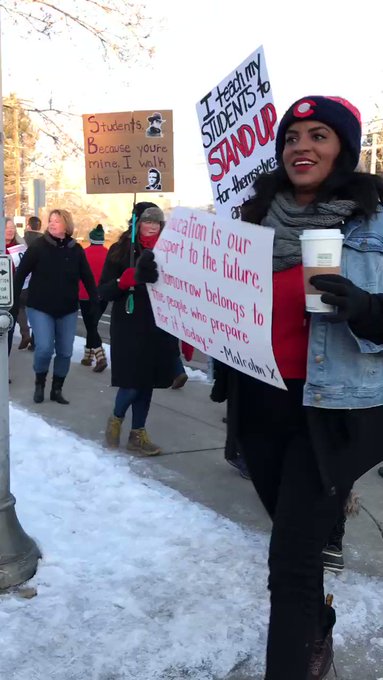
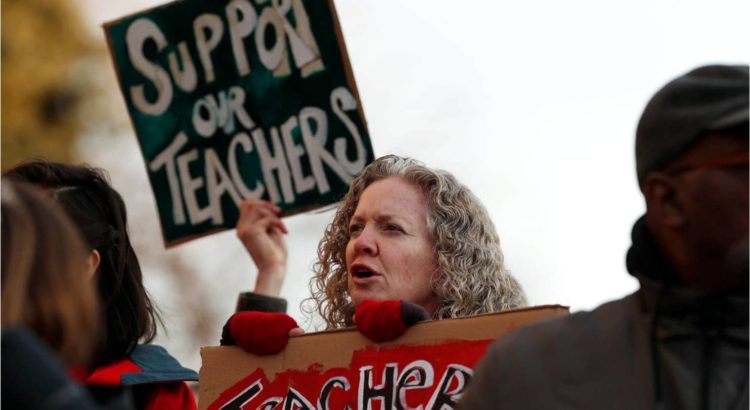
Teachers did make some concessions, but the deal represents a remarkable win for Denver’s teachers, who have been picketing and rallying in the streets for the past two days, while school administrators struggled to keep classes on schedule. It’s also a sign of the overwhelming momentum teachers have on their side from months of widespread teacher strikes across the country over school funding cuts and low teacher pay.

Arbitrary bonuses and low pay

Teachers were most upset about Denver’s incentive pay system, which started more than a decade ago. The district pays bonuses based on teacher performance, and to encourage teachers to work in high-poverty schools.

But the union says the bonuses vary too much from year to year, creating financial instability for educators and their families. They also say it’s unclear how the district measures good performance and determines bonuses.

Instead, teachers wanted the district to lower bonuses and increase their base salaries, and to give them salaries based on education and training, like most school districts do.

Colorado teachers are among the lowest-paid in the country, earning an average of $46,155 in 2016 — ranking Colorado 46th in average teacher pay, according to the National Education Association. The state also spends about $2,500 less per student each year than the national average. The new deal would boost starting pay for teachers by 7 percent, but the average pay raise for all educators, nurses, and counselors will be 11.7 percent.
Embedded video

The Denver Classroom Teachers Association voted to authorize a strike in January with support from 93 percent of its members. At the time, the two sides were about $8 million apart in reaching an agreement.

After authorizing a strike, the school district fought back. Officials asked Democratic Gov. Jared Polis to intervene, a legal move that delayed the strike as the state government weighed its options. But last week, the governor declined to take part in the dispute, which could have further delayed a strike by up to 180 days.

That wasn’t the first attempt to keep teachers from going on strike, though. Far from it.

Republican lawmakers tried to make striking illegal

In April, two Republican state legislators tried to shut down a potential teachers strike in Colorado with the threat of jail time.

The bill, introduced in the state Senate, prohibited districts from supporting a teachers strike and required schools to dock a teacher’s pay for each day they participate in a walkout. The teachers could also have faced up to six months in jail and a $500 daily fine if they violated a court order to stop striking.

The bill was a reaction to the teacher strikes sweeping red and purple states, including OklahomaWest VirginiaArizona, and Kentucky. Thousands of teachers in Colorado had joined the grassroots movement, holding rallies at the state capitol to demand a pay raise and more funding.

The bill failed. The strike happened — and it worked. Now, it looks like Denver teachers are going back to class.

Comparte este contenido:

In 2018, Labor Strikes Had the Largest Increase of the Last Three Decades. Here’s Why

By: Britanny Shoot. 

If it seemed like a lot of workers went on strike in 2018, well, it wasn’t your imagination. There were at least 20 major work stoppages in the United States involving 485,000 workers, which is the highest increase in striking workers since 1986. Of the groups that walked out, a staggering 90% were from education, healthcare, and social assistance workers such as those in childcare, according to work stoppage data published by the Bureau of Labor Statistics. By comparison, between 2009 and 2018, those groups otherwise accounted for just half of work stoppages.

It’s an interesting moment for industrial actions to be on the rise again, with renewed focus on the 1919 general strike in Seattle on its centennial. (During the 1919 strike, 65,000 union workers walked off the job for six days, paralyzing the Pacific Northwest city.) But unlike previous eras, when workers on strike tended to come from sectors such as manufacturing, the 2018 surge in walkout was led by educators demanding better pay and benefits, as well as smaller class sizes and more funding.

One reason for all the walkouts? Salaries for educators and childcare workers have stagnated or even declined due to inflation. In some regions, those strikes were also the first in a generation. For example, around 33,000 West Virginia teachers and school services workers went on strike in February 2018, the first time they’d done so in the Mountain State since 1990. Tens of thousands of teachers in other states followed suit, including Arizona, Kentucky, and Oklahoma. And among the many costs of education strikes is that school districts basically bleed money when student attendance plummets.

Already in 2019, the costs of strikes have started to mount. The teachers strike in Los Angeles ended in January, and the Los Angeles Unified School District told CNN low attendance cost the district tens of millions of dollars. And nationwide, there’s little sign of a teacher strike slowdown. On Thursday, after three days on strike, teachers in Denver reached a tentative agreement. Educators in Oakland, Calif. also recently voted to authorize a strike if teachers can’t reach an agreement with the district on class size and pay.

Teacher strikes may cost money, but Labor Secretary Alexander Acosta told theWall Street Journal that strikes are a sign of a healthy labor market. After all, if workers feel empowered to demand better pay and protections, “that reflects their confidence that they have options and opportunities,” he explained.

It remains to be seen whether that type of bargaining power will stop another federal government shutdown. With another possible closure still feared, a union representing flight attendants has mentioned the potential need for a demonstration, anda a possible general strike. It’s hard to imagine the national cost, in dollars and in other quantifiable measures, such an action might entail, given that the last shutdown, which lasted a record 35 days, cost the country $11 billion, at least $3 billion of which is unrecoverable.

Source of the article: http://fortune.com/2019/02/14/strike-teacher-salary-pay-general-strike-union-labor-walkout/

Comparte este contenido:

Why teacher strikes show no signs of slowing down

By: Alex Caputo-Pearl.

More American workers — 533,000 — were involved in strikes or work stoppages last year than at any point since 1986, according to Labor Department data released Friday. The driving force behind this remarkable development: educators who are finally fed up with years of cutbacks and government indifference to public education. The two largest labor actions of 2018 were statewide teacher strikes in Arizona (involving 81,000 teachers and staff) and Oklahoma. “Statewide major work stoppages in educational services also occurred in West Virginia, Kentucky, Colorado, and North Carolina,” the Labor Department noted.

In 2019, teachers will continue standing up for public education. Last month, 33,000 educators in Los Angeles picketed, and thousands of parents and students rallied in support. On Monday, Denver teachers went on strike for the first time in 25 years.

The Angeles teachers succeeded in winning a new contract that, in addition to a 6 percent pay increase, brings reductions in class size; more nurses, counselors and librarians; and less standardized testing. The contract also includes a mayoral and district endorsement of a state school funding measure called Schools and Communities First; a district call for a moratorium on charters; a reduction of searches that criminalize students; and an immigrant defense fund.

The Los Angeles teachers strike, the first in 30 years, was one of the most stirring events I’ve witnessed in my long experience with public education. I grew up attending Prince George’s County public schools in the 1970s and 1980s, then joined Teach for America in its first year, 1990, and moved to Los Angeles. I taught for 22 years in South Los Angeles and helped start an organization with parents and students called Coalition for Educational Justice. In 2014, I was elected president of United Teachers Los Angeles, or UTLA.

I was proud to lead the organization that is finally setting Los Angeles schools on a better pathway after years of battling forces arrayed against public education in California, as they are across much of the country.

California is the fifth-largest economy in the world, yet in measures of states’ per-pupil spending, Education Week ranked California 46th in the nation for 2017, and the California Budget and Policy Center pegged it at 41st in 2015-2016. California also permits the unregulated growth of privately run charter schools, undermining neighborhood public schools.

The over 98 percent participation in the strike by Los Angeles teachers, and strong support from parents, reinforced three basic premises: People will fight for reinvestment in public neighborhood schools and against privatization. Unions and parents will work together for the benefit of students. And strikes work.

Another teacher strike may come soon in Oakland, Calif., and mass teacher protests are planned in the state capitals of Maryland and Texas. These labor actions are essentially demands for reinvestment after decades of deliberate underfunding of public schools.

In the 1990s and 2000s, pushed by conservative think tanks and the corporatization of the Democratic Party, a bipartisan consensus seemed to emerge in Congress and many statehouses. The emphasis regarding public neighborhood schools shifted from providing adequate funding to de facto privatization through vouchers and the charter industry. Federal efforts stalled in fully funding Title I (a 1965 provision directing federal help for schools and school districts with a high percentage of students from low-income families) and the 1975 Individuals with Disabilities Education Act. Many states also cut education spending. Privately run schools with less accountability would now receive public money, further draining public schools of already scarce resources.

Because of ideology and economic philosophy, the current Republican Party leadership will not lead on reinvestment in neighborhood public schools. For the Democratic Party, it is time for leaders to choose a side. Several potential Democratic presidential candidates expressed support for the Los Angeles teachers strike, but few offered ways to adequately fund public schools. The preliminary budget of California’s new Democratic governor, Gavin Newsom, increased spending for K-12 and community college by $2.8 billion, for a total of $80.7 billion, but that is not enough after years of austerity in a state with more than 6 million public-school students.

Parents and students supported the teachers in the Los Angeles strike because they wanted to win on matters such as class size. But they also supported the strike because it articulated some basic truths: Students aren’t getting what they need. In the richest country in the world, the issue is not a lack of money but a lack of political will. If neither political party is capable of leading on reinvestment, teachers and parents and students will continue taking to the streets to defend the essential civic institution of public education.

Source of the article: https://www.washingtonpost.com/opinions/why-teacher-strikes-show-no-signs-of-slowing-down/2019/02/11/5b8a6d80-2e18-11e9-8ad3-9a5b113ecd3c_story.html?noredirect=on&utm_term=.5a3c8a468298

Comparte este contenido:

Cortometraje:¿Qué significa hacer algo #ComoNiña?

Por: Always Latinoamérica.

En Always damos inicio a una batalla épica para mostrar que hacer las cosas #ComoNiña es algo impresionante. Usar #ComoNiña como insulto es un golpe a la confianza de cualquier adolescente. Conoce más aquí: http://goo.gl/W5Pyxe Queremos asegurarnos que las niñas de todo el mundo mantengan su confianza a lo largo de la pubertad y toda su vida. «»En mi trabajo como documentalista, he sido testigo de la crisis de confianza en las niñas y los efectos negativos de los estereotipos de primera mano»», dijo Lauren Greenfield, directora de cine y directora del video #ComoNiña. «»Cuando se utilizan las palabras ‘como una niña’ para simbolizar algo malo, es profundamente descalificador. Estoy orgullosa de asociarme con Always para destacar como esta simple frase puede tener un impacto significativo y duradero en las niñas y las mujeres. Estoy muy emocionada de ser parte del movimiento para redefinir ‘como una niña’ en una afirmación positiva»». Así que dinos … ¿qué haces #ComoNiña? Durante los últimos 30 años, Always ha ayudado a las niñas a nivel mundial, entregando educación sobre la pubertad a millones de niñas adolescentes

Fuente de la reseña: https://www.youtube.com/watch?v=s82iF2ew-yk

Comparte este contenido:

Aprende.org, herramienta para la transformación social

Por: Unionguanajuato.

Aprende.org fue reconocida por la iniciativa Case for Change, como un herramienta para la transformación social

Aprende.org es herramienta educativa diseñada por la Fundación Carlos Slim, para la inclusión digital.

Esta plataforma promueve temas en materia de capacitación, educación, cultura y salud, a través de iniciativas como: Capacítate para elempleo, Maestro Innovador, PruébaTKhan Academy en español, Académica, Coursera, Udacity, MIT y ClikiSalud.

Aprende.org se divide en tres grandes apartados:

Educación y Cultura. Ofrece cursos en distintas categorías como ¿qué es aprender?, educación inicial, básica y media, educación superior, maestro innovador, historia, atrévete a saber, arte, habilidades digitales, entre otras.

Capacítate para el empleo. Ofrece cursos de administración y finanzas, alimentos, energía, construcción, agropecuario, salud, turismo, tecnología y también diplomados, incluso cuenta con un apartado de bolsa de trabajo.

Salud. En esta área podrás encontrar propuestas para el cuidado de la salud en el trabajo, en la escuela, programas para controlar la diabetes, cómo cuidar la salud después de un sismo, entre otros.

Actualmente, la plataforma ya se encuentra en diversos países de Sudamérica como República Dominicana y Panamá, donde el objetivo principal es impulsar la conectividad, contenidos educativos y culturales de calidad para todas las personas.

La información disponible y de acceso gratuito puede ser consultada desde cualquier computadora, smartphone o tableta.

En 2018 Aprende.org fue reconocida por la iniciativa Case for Change, como un herramienta para la transformación social de acceso gratuito a la educación y capacitación.

Fuente de la reseña: http://www.unionguanajuato.mx/articulo/2019/02/14/educacion/aprendeorg-herramienta-para-la-transformacion-social


Comparte este contenido:

México: Impulsar educación plurilingüe, plantea Instituto de Pueblos Indígenas

América del Norte/ México/ 18.02.2019/ Fuente: www.20minutos.com.mx.


El director del Instituto Nacional de los Pueblos Indígenas (INPI), Adelfo Regino Montes, afirmó que es necesaria la impartición de educación indígena plurilingüe e intercultural y que se reconozca…

El director del Instituto Nacional de los Pueblos Indígenas (INPI), Adelfo Regino Montes, afirmó que es necesaria la impartición de educación indígena plurilingüe e intercultural y que se reconozca al mismo tiempo la educación comunitaria.

Al participar en la VII y última mesa de las audiencias públicas, en la Cámara de Diputados, para discutir y analizar la iniciativa de reforma constitucional en materia educativa también destacó la importancia de que en la Carta Magna quede establecido el concepto de comunidades y lenguas indígenas.

De acuerdo con el funcionario, en la actualidad el concepto de educación indígena bilingüe y bicultural está rebasado, pues ahora se habla de una interacción de diversas culturas, por lo cual el término más apropiado debe ser el de educación intercultural y plurilingüe.

“El término bicultural es demasiado acotado y no cumple con los objetivos de integración y pluriculturalidad, adoptado tanto en instrumentos jurídicos internacionales como nacionales”, comentó Regino Montes. Señaló que el término de pueblos originarios también resulta insuficiente para referirse a las comunidades indígenas, debido a los flujos migratorios, ya que en el sur del país se hablan idiomas indígenas que no son nativos de México.

Por ello resaltó la importancia de que en la Constitución Política de México quede establecido el concepto de comunidades y lenguas indígenas, además de que se incluya el reconocimiento de la educación comunitaria indígena, para que sea impartida por las instituciones de los pueblos y comunidades indígenas.

“Esta educación dará eficiencia a las disposiciones constitucionales y cumplimiento a los tratados internacionales en la materia, además de ser un mecanismo para el cumplimiento de los objetivos de la Ley General de Derechos Lingüísticos de los Pueblos Indígenas y los compromisos de nuestro Estado con la comunidad internacional”, manifestó.

En tanto, el secretario de la Comisión de Educación, Azael Santiago Chepi, aseveró que con la participación de todos los actores del sector educativo se debe aprovechar la oportunidad de construir “una verdadera reforma educativa, plural, incluyente, con equidad y con contenido humanista, que contenga argumentos sólidos, teóricos, pedagógicos, jurídicos y sociales.

«Para que no sea una simulación, sino que impulse y consolide una verdadera reforma de la mano de los maestros, autoridades y sociedad, que contribuya a la Cuarta Transformación de México”, expresó. A su vez, el diputado del PAN, Fernando Macías Olvera, sentenció que no se permitirán retrocesos con la desaparición del Instituto Nacional para la Evalución de la Educación (INEE) ni que se elimine la evaluación para el ingreso y permanencia de los docentes.

Tras señalar que no puede seguir el mecanismo de herencia y venta de plazas ni que un grupo de líderes sindicales tenga el control de la educación en el país, reconoció que la evaluación prevista en la ley vigente no se aplicó del modo adecuado. El legislador panista agregó que no se puede permitir el rechazo de la evaluación para el ingreso y la promoción, «porque en ese escenario estamos cayendo en lo que sucedió antes, que la corrupción coopte la educación».

Fuente de la noticia: https://www.20minutos.com.mx/noticia/481480/0/impulsar-educacion-plurilingue-planteainstituto-de-pueblos-indigenas/

Comparte este contenido:

Podcast: Radio OVE – Reporte Educativo – Enero 2019 (Audio)

México – Venezuela / 17 de febrero de 2019 / Autor: Editores OVE

Otras Voces en Educación Radio presenta lo más destacado de lo ocurrido en el mundo educativo durante el pasado mes de enero de 2019, destacándose la huelga de maestros de Los Ángeles y el Día Internacional de la Educación, entre otros acontecimientos más.

Los invitamos a que se comuniquen con nosotros y nos envíen sus saludos, colaboraciones, artículos, noticias y audios a nuestro correo de contacto en el portal para que hagamos este espacio entre todos y los invitamos también a que se suscriban y nos sigan en nuestras redes sociales que son:

En twitter: @ovemundo

En instagram: ove.mundo

En Facebook: facebook.com/ovemundo

y en Youtube en el Canal: Otras Voces en Educación.

ove/mahv


Comparte este contenido:
Page 590 of 1685
1 588 589 590 591 592 1.685