Page 287 of 773
1 285 286 287 288 289 773

How A People-First Culture Is Transforming Education In India

Por: forbes.com/Laura Garnett

Since 2005, when he became president and later CEO of HCL Technologies, Vineet Nayar has led a remarkable turnaround that saw the company triple its revenues and income growth. He wrote about this in his book, Employees First, Customer Second. The value-based leadership simultaneously resulted in the company being ranked by Hewitt Associates as the Best Employer in India and by BusinessWeek among the top five most influential companies in the world.

Nayar is now trying to transform the education of India’s children. He’s taking on a huge goal, and I’ve always admired his focus on people. I wanted to sit down with him and talk about his current work with his own fund and figure out how he plans to transform education.

Laura Garnett: What is the problem that you’re trying to solve and what is your goal?

Vineet Nayar: In India, government-led primary school education systems suffer from a myriad of issues, not only preventing families from sending their children to these schools but also affecting the learning outcomes for those 144 million children who attend. Most children in grade 5 can’t do basic math or construct simple sentences in English.

 Sampark Foundation was founded with a belief that “frugal innovation,” along with relentless execution in partnership with the government, can drive large scale change in learning outcomes. Our goal is to design and implement frugal innovation ideas that will transform learning outcomes for 20 million children studying in 200,000 rural government schools by 2025, at less than $1 per child per annum. As of today, we have touched the lives of 7 million children across 76,000 schools.

Garnett: How did you come up with the Innovative ideas that you speak about?

Nayar: While many educational change initiatives are in-flight in India currently, we realized they have not been able to deliver impact because they are either sub scale or resource intensive, or they ignore the ground realities surrounding these kids. For example, you can’t just solve this problem by giving away iPads to children in an environment that lacks electricity.

We believe that for any long-lasting change to happen it has to be driven by practical and sustainable solutions that are frugal but at a large scale. Our area of investment and focus was on design thinking and coming up with frugal innovation ideas (low on resources, high on impact) and leveraging them to deliver a comprehensive, multi-fold improvement in learning outcomes that can be sustained.

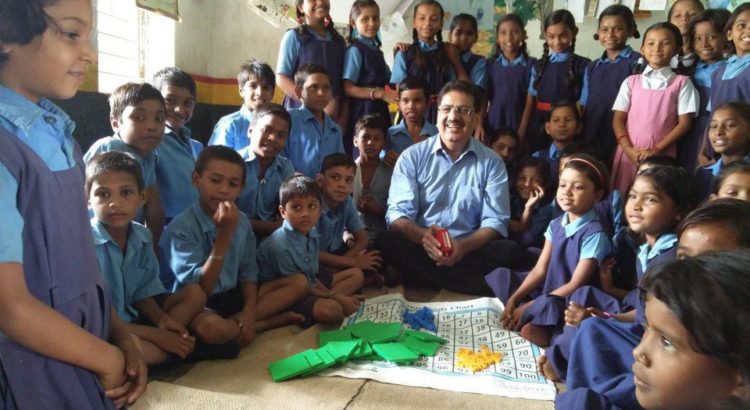
This led to Sampark Smart Shala: a learning-outcome focused, frugal innovation-led initiative that uses audio technology, a voice mascot called “Sampark Didi,” toys, folklore, board games and teacher training modules combined with rigorous monitoring in collaboration with state governments.

Garnett: What allowed you to have these innovative ideas?

Nayar: Our design thinking was inspired by three ideas. The first came from an unlikely source: Bollywood! Going to a movie in an Indian village is an open-air three-hour deeply immersive experience of life enacted through dance, songs and dramatic scripts. We asked ourselves – could we bring that experience to the classroom too?

The second came from watching people in villages charge cell phones using their bicycles. Could this battery drive an audio device with a big speaker that could be used in a class? And the third inspiration came from Teaching Learning Materials (TLM’s). Students retain 70% of what is said in the first 10 minutes of class and only 20% of what is said in last 10 minutes. Adding visual aids and stories increases retention by 250% even in the last 10 minutes.

Garnett: How are these ideas making an impact on your goal?

Nayar: The results have been nothing short of magical – a 56% increase in learning outcomes measured through an independent assessment study. This is also now a case study at the Harvard Business School, showcasing how frugal innovation can create large scale social impact.

Garnett: How are you bringing people first customer second to your foundation and how does it operate?

*Fuente: https://www.forbes.com/sites/lauragarnett/2018/05/08/how-a-people-first-culture-is-transforming-education-in-india/#134b06435ef2

Comparte este contenido:

China aumentó durante 2017 los gastos en educación

Asia/China/10 Mayo 2018/Fuente: Prensa Latina

 China destinó más de 675 mil millones de dólares al presupuesto educativo en 2017, lo cual significó un aumento interanual de casi 10 por ciento, confirmó hoy el ministerio de Educación en un informe preliminar.
Estadísticas de esa entidad indican que los gastos se distribuyeron en todos los niveles de enseñanza para elevar la calidad de los programas académicos y las condiciones de los centros docentes.

En China la educación es obligatoria entre los seis y 15 años de edad y datos internacionales corroboran que la tasa de alfabetización supera el 94 por ciento de la población.

Como parte de las reformas institucionales en marcha, el Gobierno planea introducir medidas para hacerla cada vez más accesible y menos competitiva.

Fuente: http://www.prensa-latina.cu/index.php?o=rn&id=176860&SEO=china-aumento-durante-2017-los-gastos-en-educacion
Comparte este contenido:

Guatemala y la India firman acuerdos en educación y energía

Centro América/Guatemala/10 Mayo 2018/Fuente: Forbes

El presidente de Guatemala, Jimmy Morales, recibió al vicepresidente de la India Venkaiah Naidu, durante este lunes 7 de mayo, para suscribir acuerdos e inversiones en el sector energético, en educación y en la industria cinematográfica.

El encuentro se llevó a cabo en la casa presidencial de la nación centroamericana con el fin de fortalecer las relaciones entre ambos países y los programas de cooperación.

“Sabemos que los lazos de amistad y cooperación de ambos países se verán fortalecidos”, manifestó el presidente Morales, tras expresar su bienvenida a Guatemala al Vicegobernante.

La India cuenta con un buen desarrollo en el tema de energéticos renovables y que han sido implementados en aeropuertos y terminales de transporte. De concretarse los acuerdos, la nación de oriente ejecutará iniciativas de energía solar dentro de Guatemala.

En materia de educación, Guatemala se verá beneficiado con becas de estudio para jóvenes y médicos subsidiadas por India, además de proporcionar a mujeres analfabetas herramientas relacionadas con el estudio de energía solar.

El vicemandatario Naidu, exhortó a Guatemala a participar en la Alianza Solar Internacional –ISA, por sus siglas en inglés.

ISA es una alianza de 121 países ricos en recursos solares con sede en Gurugram, India, que desplegará más de 1,000 Gigavatios de energía solar, y movilizar más de 1,000 millones de dólares estadounidenses para la energía solar hasta 2030.

El programa facilita y acelera a gran escala de la energía solar en los países en desarrollo, con el fin de satisfacer la creciente demanda de energía y ayudar a combatir el cambio climático.

“Estamos agradecidos por esa intención de intercambiar experiencias del cine, en especial porque es una oportunidad para los jóvenes guatemaltecos”, señaló.

Con estas acciones se fortalecerán lazos económicos, culturales y políticos entre ambos países, asi como también detonará las relaciones con el resto de Latinoamérica.

Esta reunión se suscitó en el marco de una visita oficial que el vicemandatario indio cumple a Guatemala, que contempla encuentros con el vicepresidente Jafeth Cabrera, el presidente del Congreso de la República, Álvaro Arzú, y una visita a la Antigua Guatemala.

Fuente: https://www.forbes.com.mx/guatemala-y-la-india-firman-acuerdos-en-educacion-y-energia/

Comparte este contenido:

Vietnam por reducir cifra de niños que mueren ahogados

Asia/Vietnam/10 Mayo 2018/Fuente: Prensa Latina

Un programa de natación para niños se activará de mayo a agosto en 63 grandes localidades de Vietnam a fin de reducir y prevenir las muertes por ahogamiento, anunció hoy la junta organizadora.
Entre el dolor y el desconcierto, instituciones médicas y sociales investigaron cómo puede ser esa una de las principales causas de mortalidad infantil en un país con más de tres mil 400 kilómetros de costas y una gran cantidad de ríos y lagos.

Como consecuencia, el Ministerio de Cultura, Deporte y Turismo, y el de Educación y Capacitación, activarán esa iniciativa con ayuda de cientos de activistas y profesores de natación para que esta no solo sea una actividad extracurricular o se enseñe únicamente en cursos fuera de las escuelas.

La acción forma parte de una estrategia del gobierno encaminada a que todos los centros docentes incluyan clases de natación en sus actividades extraescolares y universalice la natación entre todos los estudiantes en el 2020.

El vicedirector de la Administración de Deportes y Entrenamiento Físico, Pham Van Tuan, citó un informe según el cual la proporción de niños capaces de nadar en Vietnam es inferior al 30 por ciento, lo que deja una dolorosa secuela sobre todo en el verano y la temporada de tormentas.

Fuente: http://www.prensa-latina.cu/index.php?o=rn&id=176988&SEO=vietnam-por-reducir-cifra-de-ninos-que-mueren-ahogados
Comparte este contenido:

How A People-First Culture Is Transforming Education In India

India/May 08, 2018/By: Laura Garnett /Source: https://www.forbes.com

Since 2005, when he became president and later CEO of HCL Technologies, Vineet Nayar has led a remarkable turnaround that saw the company triple its revenues and income growth. He wrote about this in his book, Employees First, Customer Second. The value-based leadership simultaneously resulted in the company being ranked by Hewitt Associates as the Best Employer in India and by BusinessWeek among the top five most influential companies in the world.

Nayar is now trying to transform the education of India’s children. He’s taking on a huge goal, and I’ve always admired his focus on people. I wanted to sit down with him and talk about his current work with his own fund and figure out how he plans to transform education.

Laura Garnett: What is the problem that you’re trying to solve and what is your goal?

Vineet Nayar: In India, government-led primary school education systems suffer from a myriad of issues, not only preventing families from sending their children to these schools but also affecting the learning outcomes for those 144 million children who attend. Most children in grade 5 can’t do basic math or construct simple sentences in English.

Sampark Foundation was founded with a belief that “frugal innovation,” along with relentless execution in partnership with the government, can drive large scale change in learning outcomes. Our goal is to design and implement frugal innovation ideas that will transform learning outcomes for 20 million children studying in 200,000 rural government schools by 2025, at less than $1 per child per annum. As of today, we have touched the lives of 7 million children across 76,000 schools.

Garnett: How did you come up with the Innovative ideas that you speak about?

Nayar: While many educational change initiatives are in-flight in India currently, we realized they have not been able to deliver impact because they are either sub scale or resource intensive, or they ignore the ground realities surrounding these kids. For example, you can’t just solve this problem by giving away iPads to children in an environment that lacks electricity.

We believe that for any long-lasting change to happen it has to be driven by practical and sustainable solutions that are frugal but at a large scale. Our area of investment and focus was on design thinking and coming up with frugal innovation ideas (low on resources, high on impact) and leveraging them to deliver a comprehensive, multi-fold improvement in learning outcomes that can be sustained.

This led to Sampark Smart Shala: a learning-outcome focused, frugal innovation-led initiative that uses audio technology, a voice mascot called “Sampark Didi,” toys, folklore, board games and teacher training modules combined with rigorous monitoring in collaboration with state governments.

Garnett: What allowed you to have these innovative ideas?

Nayar: Our design thinking was inspired by three ideas. The first came from an unlikely source: Bollywood! Going to a movie in an Indian village is an open-air three-hour deeply immersive experience of life enacted through dance, songs and dramatic scripts. We asked ourselves – could we bring that experience to the classroom too?

The second came from watching people in villages charge cell phones using their bicycles. Could this battery drive an audio device with a big speaker that could be used in a class? And the third inspiration came from Teaching Learning Materials (TLM’s). Students retain 70% of what is said in the first 10 minutes of class and only 20% of what is said in last 10 minutes. Adding visual aids and stories increases retention by 250% even in the last 10 minutes.

Garnett: How are these ideas making an impact on your goal?

Nayar: The results have been nothing short of magical – a 56% increase in learning outcomes measured through an independent assessment study. This is also now a case study at the Harvard Business School, showcasing how frugal innovation can create large scale social impact.

Garnett: How are you bringing people first customer second to your foundation and how does it operate?

Nayar: Since Sampark Foundation is a small not-for-profit organization, it has barely 100 people, or ‘Sparks’ as we call them. In this model, it is the government schoolteachers who are the front-line workers in the value zone, the classroom. Therefore, following the EFCS principles, our role is to enthuse, encourage and empower them. So, we set our eyes on enhancing the teacher’s power to teach and bring excitement into the classroom through Sampark Smart Shala.

Our 100 Sparks travelled over 15,000 kilometers within 100 days into remote interiors of the country to help train 100,000 teachers each year on the use of Sampark Smart Shala teaching aids to bring excitement back into the classroom and drive significant transformation in learning outcomes. The one thing that brings a smile to my face is the fact that the impact and learning outcome has been achieved by enthusing the teachers, empowering them with the teaching aids, encouraging and mentoring them through helplines and periodic training sessions – and most importantly, by transferring the ownership of change to them. This is employee-first at its best.

Garnett: What is your biggest challenge now and how can people that read this that want to help, get involved?

Nayar: The biggest challenge now for us is if we should focus on higher grade levels with the 7 million children already in the program in the existing four states, or should we add more children to the grade 1-3 program by scaling up to more states. Doing both could break the back of operations, and there is a limit to how far our resources can take us. Our foundation is inviting new ideas, new approaches, new and frugal ways to improve learning levels which will help us go the extra mile and provide a path for millions of children studying in government-funded primary schools to see the light at the end of the dark tunnel.

Source:

https://www.forbes.com/sites/lauragarnett/2018/05/08/how-a-people-first-culture-is-transforming-education-in-india/2/#2898c849303d

Comparte este contenido:

India: Primary Problem. Gujarat’s Dismal School Education System

India/May 08, 2018/by RITU SHARMA/ Source: http://indianexpress.com

Last month, the Gujarat government wrapped up its eighth edition of evaluation of government primary schools, Guntosav. The findings of the National Achievement Survey, released by the Centre’s HRD Ministry in January, overall paint a dismal state of school education in Gujarat.

Despite the Gujarat government’s claim of improving the quality of education, the situation on the ground is very different. With the state facing criticism for failing to do a lot, the findings of the National Achievement Survey (NAS), released by the Centre’s HRD Ministry in January, shows that the state has a lot of catching up to do.

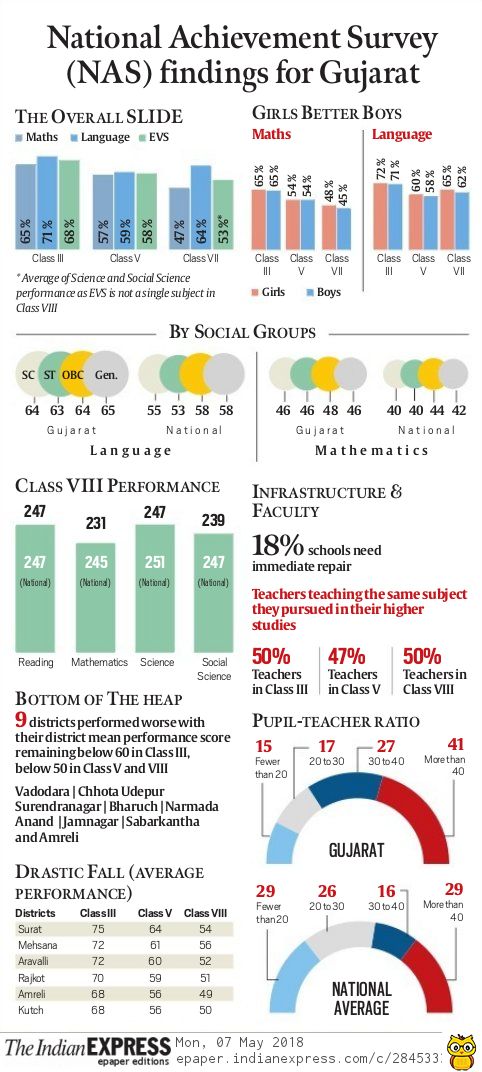
The survey, which was conducted in all the 33 districts of the state interviewing over 1.25 lakh students, shows a consistent decline in the learning levels of students in mathematics, language and science from Class III to Class VIII in the government school system — both government schools and government-aided schools. The drop in the overall learning levels being sharp in all the three subjects.

For instance, the response level of students fell from 65 to 47 per cent in mathematics, 71 per cent to 64 per cent in language and 68 to 52 per cent in science subjects.

The dismal state of the primary education in Gujarat could be gauged from the NAS findings. For example, in Class III, 41 per cent of students could not read and write numbers up to 999. The situation worsens as one interviews students from higher classes. For instance, more than half of the 41,393 Class VIII students (53 per cent) could not solve problems on daily life situations involving addition and subtraction of fractions and decimals and nearly 7 out of 10 students (69 per cent) could not calculate the surface area and volume of a cuboidal and cylindrical object.


While 4 out of 10 students of Class V could not read and write numbers bigger than 1000 being used in their surroundings, 56 per cent of Class VIII students could not interpret division and multiplication of fractions.
Faring even low in social science, only 27 per cent Class VIII students were able to describe the functioning of rural and urban local government bodies and 91 per cent failed to justify judicious use of natural resources. However, when it came to issues related to caste, women, social reforms, 63 per cent students could analyse them. At the same time more than half of the Class VIII students failed to apply knowledge of Fundamental Rights to find about their violation in a given situation.

The good news from the survey was the performance of girls performing marginally better than boys. However, when it comes to gender enrolment ratio — percentage of eligible girl population (in the age group of 18 to 23 years) pursuing higher education — Gujarat is in the bottom heap of eight states with poor GER ratio. [See What after school?]

NAS vis-à-vis Gunotsav

While the state government claims of improving the quality of school education through its own Gunotsav surveys, lakhs of students failed to write simple sentences in their mother tongue, Gujarati. As reported by The Indian Express earlier, the Gunotsav VI results revealed that despite attempts being made to improve performance of the students, the state’s average could reach only 53.4 per cent — same as the last Gunotsav V.

Even as the state government claims that in the last seven years, schools under Grade A category has increased from 5 to 2,100, the NAS findings show a geographically skewed performance of schools.

For Class VIII, four districts scored a mean average of below 50 in the NAS. While Bharuch scored 44, two districts from Saurashtra — Amreli and Jamnagar — scored 29 and 48, respectively. The tribal districts of Sabarkantha and Narmada scored 48 and 46, respectively.

In Bharuch, the district with lowest performance learning outcomes, only 25.41 per cent students could solve problems related to daily life situations involving rational numbers, 26.13 per cent could calculate surface area and volume of a cuboidal and cylindrical object, 27.10 per cent could generalise properties of addition, subtraction, multiplication and division of rational numbers through patterns and 30.48 per cent could solve problems related to conversion of percentage to fraction and decimal and vice versa.

However, if the performance of Class III, V and VIII are taken together, then nine of the total 33 districts make it to the bottom of the heap. They are Vadodara, Chhota Udepur, Surendranagar, Bharuch, Narmada, Anand, Jamnagar, Sabarkantha and Amreli. (See box)

For the government, the solace from the NAS findings is that the government schools have performed marginally better than grant-in-aid schools across the three subjects as well as classes. For instance, in Class III, the learning level of students in government schools in environment science is 68, compared to 63 of grant-in-aid schools, 72 against 69 in language and 65 against 61 in mathematics. In Class V, the performance gap in science was 10 per cent, maths 12 per cent and language 7 per cent with government school students faring better than grant-in aid schools. Similarly, in Class VIII, the highest gap is in social science where 54 per cent students of government schools could perform exercises compared to 46 per cent students of in grant-in-aid schools.

These numbers may be comforting for the government, but the NAS surveys and the government’s own reports point to poor school infrastructure and need for better quality teachers.

According to the government’s own data, a large number of posts of teachers and principals are lying vacant in government schools. In the residential schools in the tribal districts, the figure is staggering — over one-third teachers’ posts are lying vacant.

The state government runs several categories of residential schools — Eklavya Girls Residential schools, Adarsh Nivasi Shala, Model schools and Ashram Shalas in the 14 tribal districts of the state. But poor facilities in such affect the education. For instance, the government has spent over Rs 6.5 lakh to improve English among the students in one tribal district of Dang. But the same district has the highest percentage of vacant posts (47.3 per cent) among the seven tribals districts, according to the government’s reply in the last Assembly session.

The NAS too has found poor pupil-teacher ratio in the state. According to it, 41 per cent of schools in Gujarat has pupil-teacher ratio of above 40. Nationally, the percentage of such schools is only 29 per cent. Similarly, while the healthy pupil-teacher ratio of fewer than 20 is found in 29 per cent of schools annually, it is only 15 per cent in Gujarat.

The survey also found that 47 per cent of the 2,630 teachers taught students of Class V the same subject they pursued during their higher studies. It also found that 18 per cent of school buildings were in need of urgent repair.

Fee regulation quagmire

In all these years, the crumbling school infrastructure and the declining standard of education in government and government-aided schools have led to a boom in the number of private schools in the state. Though the number of government schools stands at 44,000, the state currently has over 16,000 private schools — 9,300 primary, 3,800 secondary and 3,100 higher secondary schools.

The increase in demand of private schools also led to a surge in the fees. With parents finding it difficult to pay high fees, the government last year passed a law to regulate the school fees. The Gujarat Self Financed Schools (Regulation of Fees) Act is aimed at fixing the annual fees at Rs 15,000 for primary eduction, Rs 25,000 for secondary and higher secondary (non-Science). However, the law has not been implemented till now in full due to numerous litigations and political slugfest over it.

“Trying to have some control over private schools in a way is good, but its political misuse made schools and education sector lose its dignity,” Gujarat Self Financed School Management Federation general secretary Bharat Gajipara.

The federation claims that the schools are ready to fix the fee at Rs 15,000 for the primary classes, but the state government should also lay down specific guidelines. “For instance, there needs to be guidelines on how much fans a classroom should have; how many children should be in a class; how many teachers among other things. We are ready not to collect extra fees, the government can keep that but give our teachers salaries and the expenses incurred by the school,” Gajipara says.

Even the parents are not happy with the turn of the events. “We have lost faith on all fronts in the last one year. More than any good, the fee regulation Act has harmed everybody,” says Amit Panchal, one of the parents spearheading the protests for over an year now. “The stricter implementation of the Act could be one measure to safeguard affordable quality education but for a long-term solution, the state government needs to improve its government as well as grant-in-aid schools. To counter the burgeoning fee demand of private schools, there is a necessity to raise an alternate affordable education system, which in this case are government and grant-in-aid schools,” says Sukhdev Patel, founder of Waali Swaraj Manch, a parents’ outfit.

Govt’s defence

The state government, however, blames the “falling standards of primary education” on the landmark Right to Education Act and its no detention policy. The law which was enacted by the previous UPA government at the Centre has been consistently opposed by BJP-led government in the state, demanding the rules to be revoked for the last two years.

“In the NCERT meeting with the Human Resource Development Minister Prakash Javadekar, I had categorically stated that until the Right to Education Act’s provision for no holding back a student till Class VIII is done away with, the quality of primary education will deteriorate,” says Education Minister Bhupendrasinh Chudasama said.

But the government’s own measures to improve quality of education by introducing NCERT books has led to criticism. Some of the government’s policies like making Gujarati compulsory till Class VIII in all boards in a phased manner has led to a resentment among schools as well as parents. “The new lot of vidyasahayaks (primary teachers) is very talented and intelligent. I am sure with the energy and dedication, the government school students will be at par with any good private school,” Chudasama promises.

http://indianexpress.com/article/education/hardlook-state-of-education-in-gujarat-part-ii-5166122/
Comparte este contenido:

Syrian children’s enrollment in secondary education still low: Expert

Syria/ May 08, 2018/ By: Sevil Erkuş – ANKARA/Source: http://www.hurriyetdailynews.com

Turkey continues to host the largest number of school-aged refugee children and youth, which increased to 976,200 in 2017 from 833,039 in 2016, with efforts provided increasing enrollment in primary schools, yet access to secondary education is still low, an expert said.

With the National Education Ministry’s progressive inclusion of Syrian children and youth in the national system, there are more school-age Syrian children enrolled in Turkish public schools (373,381) for the first time than in temporary education centers (237,234) in 2017, Research Centre on Asylum and Migration (İGAM) president Metin Çorabatır told Hürriyet Daily News.

Due to great efforts of host countries and the international community, the enrollment rates for refugee children in primary schools are increasing.

However, when it comes to access to education, a vulnerable group is youth and more than 76 percent of Syrian youth outside of Syria live in Lebanon and Turkey, he said.

“Overall, regional enrollment rates in secondary education are low: 24 percent in Jordan, 6 percent in Lebanon and 2 percent in Turkey. The regional average of refugee enrollment in secondary education is 17 percent, lower than the global average of 23 percent,” Çorabatır said.

The Turkish Education Ministry has recruited 5,600 Turkish language teachers to help Syrian students to improve their Turkish language proficiency. In addition, new and age-appropriate language teaching modules are under development.

A comprehensive psychological support program in schools is being developed and 500 school counselors were recruited to provide psychosocial support to Syrian children and youth.

Despite these great efforts by the government, various factors contribute to the low rates of access to secondary education, according to the İGAM president.

“Refugee youth often work, take care of their younger siblings or perform other household duties. This is both a complicating factor in reaching them to participate in education programs and a reason many are currently unable to, as most education programs are scheduled during working hours and require intense participation,” he said.

Çorabatır has been announced last week as a Gulmakai Champion of the Malala Fund. The Malala Fund is the official organization led by Pakistani Malala Yousafzai and is focused on helping girls go to school and raise their voices for the right to education

With this new title, İGAM will focus on Syrian refugee women’s education in Turkey and to assist in efforts for their education.

“The Malala Fund believes—and we as İGAM share that same belief—that every person can make an impact on our world. We are seeking accountability from politicians and finding ways to improve refugee girls’ access to education in Turkey,” he said.

Source:

http://www.hurriyetdailynews.com/syrian-childrens-enrollment-in-secondary-education-still-low-expert-131437

Comparte este contenido:
Page 287 of 773
1 285 286 287 288 289 773