Decades after first encountering Anglo-Saxon perspectives on democracy in occupied postwar Germany, Jürgen Habermas still stands by his commitment to a critical social theory that advances the cause of human emancipation. This follows a lifetime of philosophical dialogue.
Michaël Foessel: It has become commonplace to link your work to the enterprise that the Frankfurt School initiated in the 1930s: the elaboration of a critical theory of society capable of breathing new life into the project of emancipation in a world shaped by technocapitalism. When you began your university studies after World War II, a different image of philosophy was prevalent in Germany: the less heroic image of an impotent philosophy compromised by National Socialism. What motivated you to choose this discipline? Did the pessimistic judgement on reason expressed in Horkheimer and Adorno’s Dialectic of Enlightenment play a role in your initial choices in philosophy (the study of Schelling)?
Jürgen Habermas: No, that’s not how it happened. I didn’t go to Frankfurt until 1956, two years after the completion in Bonn of my doctoral thesis on Schelling. In order to explain how I came across critical theory, I’ll have to go into a bit more detail. At German universities between 1949 and 1954 it was in general only possible to study with professors who had either been Nazis themselves or had conformed. From a political and moral standpoint, German universities were corrupted. There was, therefore, an odd divide between my philosophy studies and the left-wing convictions that had developed in discussions night after night about contemporary literature, the important theatrical productions, and film, which was dominated at that time above all by France and Italy. As early as my last years at the gymnasium, however, I’d obtained the works of Marx and Engels and addressed the subject of historical materialism. In view of these interests, the obvious choice of study would have been sociology, but this subject was not yet taught at my universities in Göttingen and Bonn. After my studies, I was granted a scholarship for an examination of the «concept of ideology». During this time, I familiarized myself with the theoretical literature on Marxism from the 1920s and above all with the Hegelian-Marxist tradition – and I was then electrified when Adorno published Prisms in 1955. I already knew the Dialectic of Enlightenment by Horkheimer and Adorno, but the tenor of this thoroughly «dark» theory did not correspond to the attitude towards life of young people, who finally wanted to do everything better.
But Prisms made a completely different impression on me. It was a collection of Adorno’s great essays from the 1940s and early 1950s on Oswald Spengler, Karl Mannheim, Thorston Veblen, etc. Today, it’s no longer possible to imagine the contradiction between these sparkling texts and the mixed-up, clotted climate of the Adenauer era. The start of the Cold War was characterized in Germany by an anti-Communism that fostered the forced suppression of the perceptibly hushed up Nazi era. Into this ambiguous silence burst the sharply articulated words of a brilliant mind, who – undeterred by the anti-Communist zeitgeist – captured the mood of the day in dusted-off Marxist categories. The radical terminology and the complexity of the dark style pierced the fog of the early German Federal Republic. It was also the gesture of «absolute modernity» that hooked me. But in Adorno’s essays I was confronted above all by someone who overturned the historical distance – which up to that point had been taken for granted – between the ongoing Cold War and the Marxist social theory of the 1920s, because he dealt with these categories in a very current, very contemporary way! If you recall: even Jean-Paul Sartre, who dominated the post-war stages with his theatrical plays, was at that time not yet really political as a philosopher. For us students, The Second Sex by Simone de Bouvoir struck a political chord far more than Sartre’s Being and Nothingness.
When Adorno, who had read a few things of mine, then – via a journalist, Musil’s editor Adolf Frisé – invited me to come to the Institute of Social Research, there was no holding me back. My wife still says today that I rushed to Frankfurt «with banners flying». I still regard it as a stroke of luck that I became Adorno’s first assistant in 1956.
MF: You often portray your own intellectual career as a «product of re-education». After the German catastrophe, you were determined from the outset to re-evaluate the (generally negative) philosophical view of democracy. To what extent did this necessity play a role in your assessment of the figure of Heidegger, who – at least in France – has strongly influenced contemporary philosophy, which has borrowed a great deal from him? If we look for a moment beyond the personal involvement of Heidegger: doesn’t the point at issue also touch upon the appeal of philosophy in a world that is threatened by irrationalism?
JH: To this day, Kant and the French Revolution are decisive for my understanding of democracy. In the immediate aftermath of the war, we lived in the British occupation zone and learned more about the Anglo-Saxon democracies. Against this backdrop and in light of the fractured history of German democracy, we attempted at the time to comprehend the incomprehensible regression into the abyss of fascism. This infected my generation with a deep self-distrust. We began to search for those nagging, anti-Enlightenment genes that had to be hiding in our own traditions. Before any preoccupation with philosophy, that was for me the elementary lesson to be learned from the catastrophe: our traditions were under suspicion – they could no longer be passed on without being subjected to criticism, but only acquired reflexively. Everything had to be passed through the filter of rational examination and reasoned approval!
When, in the summer of 1953, that is, still during my university studies in Bonn, I read a recently published lecture by Heidegger from the year 1935, theIntroduction to Metaphysics, the jargon, the choice of terminology and the style told me at once that the spirit of fascism was manifested in these motives, thoughts and phrases. The book really unsettled me because I had regarded myself up till then as a student of Heidegger. The newspaper article, in which I poured out my great political and philosophical disappointment the same weekend, is therefore entitled: «Thinking with Heidegger against Heidegger». At the time it was impossible to know that Heidegger had written anti-Semitic letters to his wife as early as 1916 and that he had become a convinced Nazi long before 1933. The fact that he had remained an unrepentant Nazi, however, could be known by 1953 at the latest.
Since then, the uncritical reception in France, and the USA for that matter, has always struck me as strange. It seems to me completely absurd that today theBlack Notebooks are treated like something new – and that some colleagues even attempt to sublimate Heidegger’s anti-Semitism and the rest of his dull resentments into the history of being! On the other hand, I’m still convinced that the arguments of Being and Time, if read with the eyes of Kant and Kierkegaard, retain an important place in the history of philosophy. In spite of the political ambivalence of the style, I regard this work as a result of the long history of detranscendentalizing the Kantian subject: by appropriating the methods of Husserlian phenomenology in his own way, Being and Time also digests an important legacy of American pragmatism, German historicism and the kind of philosophy of language that originates from Wilhelm von Humboldt. Some critics read the book only from the perspective of a historian of political ideas. But then the reader overlooks the relevance of philosophical arguments and the waywardness of long-term philosophical learning curves. My friend Karl-Otto Apel always insisted that only in 1929 with Kant and the Problem of Metaphysics did Heidegger set the course for his fatal late philosophy – and subsequently assigned to himself a privileged access to the «destiny of truth». From that point on, Heidegger increasingly abandons philosophical argumentation and becomes a private thinker. The transition from the Marburg Lectures, which he gave jointly with the theologian Rudolf Bultmann, to his inaugural address as rector in Freiburg was a shift from the individualistic interpretation of «existence» (Dasein) to the collectivist (or völkisch) reading, to the «existence of the people». This turned Heidegger into a propagandist in 1933 and – after 1945 – into an apologist for the Nazi regime, or even into a spin doctor for Nazi crimes.
MF: Later, in The Philosophical Discourse of Modernity, you apply to contemporary French philosophy your criticism of unilateral incriminations of reason. In this context you make reference, especially with Foucault and Derrida, to the potential alliance between postmodernity and neoconservatism. Could you briefly recall the background to this verdict, as well as the reasons that later moved you to change it (think of the book you wrote with Jacques Derrida or your homage to the Foucault of Enlightenment)?
JH: In my generation there have been many misunderstandings between the philosophers on this side of the Rhine and those on the other side, and few attempts to get on instead of ignoring one another. One of the few exceptions is the admirable Paul Ricoeur. One explanation for this unfortunate situation is surely the Germans’ strong orientation towards Anglo-Saxon philosophy. Added to this are linguistic and accidental misunderstandings. Your question reminds me of the confusion over the terms «young conservative» and «neoconservative». I referred to Foucault and Derrida – admittedly in a polemically exaggerated and thus unfair way – as «young conservatives». I was attempting to make them aware that German authors, whom they invoke above all others, are placed in a politically poisoned context. Heidegger and Carl Schmitt drew on deeply German, namely militantly counter-revolutionary sources, which stand in stark contrast to the intentions of a reflective Enlightenment and, indeed, left-wing traditions in general. In Germany these young conservatives were characterized with the slogan «left-wing people from the right-wing» because they wanted to be «modern». They wanted to force through their elitist ideas of an authoritarian society welded together in uniformity by means of anti-bourgeois gestures. This activist mentality nourished itself on resentments against the Peace of Versailles, which was regarded as a humiliation. Carl Schmitt and Heidegger became intellectual pioneers for the Nazi regime not by chance, but as a result of motives deeply embedded in their theories. I was always aware of the contrast with the intentions of Foucault and Derrida. My affective attitude can perhaps also be explained in that it was precisely distinguished French left-wingers who fixated on such people. Admittedly, I should have done a better job of controlling my emotions.
But you asked me about the reasons for the disagreement regarding the Enlightenment. As far as I understand, this controversy is not about the indisputable ideological role repeatedly played in the history of western modernity by the selective application of our western standards of egalitarian and individualistic universalism. They often served, and still do serve, to cover up the practice of double standards – both in the hypocritical justification of repressive regimes, and in the imperialist destruction and exploitation of foreign cultures. The dispute is rather over the correct philosophical explanation of this fact. We must recognize that any criticism of a hypocritically selective application of universalist standards must appeal to the standards of this very same universalism. To the extent that the discourse on moral universalism is carried out at the conceptual level of Kantian arguments, it has become self-reflective: it self-consciously realizes that it cannot criticize its own flaws but by an appeal to its own standards. It was Kant who overcame the historical kind of so-called «universalism» that is centred upon itself and limited to its own fixed perspective. Carl Schmitt had in mind this political «universalism» which was typical of the ancient empires. For these empires, only barbarians lived beyond the borders. From that rigid perspective one’s own supposedly rational standards were applied to everything foreign without taking into consideration the perspectives of the foreigners themselves. By contrast, only those standards can withstand criticism that can be justified from a shared perspective developed in the course of an inclusive deliberation requiring themutual adoption of the perspective of all those affected. That is the discourse-ethical interpretation of a universalism that has become self-reflective and no longer assimilates the other to oneself. Universalism properly understood proceeds from the premise that everyone is foreign to everyone else – and wants to remain so!
In 1982, Foucault invited me to the Collège de France for six weeks. On the first evening we spoke about German films: Werner Herzog and Hans-Jürgen Syberberg were his favourite directors, whilst I spoke out in favour of Alexander Kluge und Volker Schlöndorff. Later we told each other about the curriculum of our respective years of philosophical study, which took something of a different course. He recalled how Lévi-Strauss and structuralism had helped him to liberate himself from Husserl and «the prison of the transcendental subject». With regard to his discourse theory of power, I asked him at the time about the implicit standards on which his criticism was based. He merely said: «Wait for the third volume of my History of Sexuality«. We had already arranged a date for our next discussion about «Kant and the Enlightenment». I was very shocked when he died in the interim. In the case of Derrida, fortunately I took the initiative just in time to clear up the misunderstandings between us. I subsequently visited him several times in Paris and he visited me in Frankfurt. We also met in New York and remained in telephonic contact – until the very end. I’m grateful for the cordial relationship of those final years. But since Bourdieu also died, it’s become lonely for me in Paris. Whom should I meet for lunch? I was all the more pleased about the interest shown by my young French colleagues when Jean-Francois Kervégan and Isabelle Aubert invited me late last year to an interesting conference in Paris.
MF: Your book The Structural Transformation of the Public Sphere (1962) laid the foundation for your philosophical standing in Germany and abroad. To what extent does this book, which attempts a re-evaluation of the bourgeois ideology of the Enlightenment and the ideal of the «public sphere», express a distancing from orthodox Marxism? Does this distancing require the renunciation of the project of «Realizing Philosophy» in favour of a reflexive method that rejects any «position that towers above» society?
JH: From its inception the Frankfurt Institute was anti-Stalinist – and all the more so after the war. There are also other reasons why I was never tempted by orthodox Marxism. For example, I was never convinced by the centrepiece of political economy, the theory of surplus value, in view of the intervention of the welfare state in the economy. During my youth I was certainly more closely aligned with left-wing activism than I was later. But also the early project of «Realizing Philosophy», to which you’re alluding, was more idealistic and inspired by the young Marx. The Structural Transformation of the Public Sphere, which was my post-doctoral thesis under the supervision of Wolfgang Abendroth, the only Marxist to hold a chair at a German university, at best points in the direction of socialist democracy. If you like, I was always a parliamentary socialist – in this respect I was in my early days influenced by the Austrian Marxists Karl Renner and Otto Bauer. My attitude to Theory and Practice has not significantly changed since I wrote the introduction to the new edition of this book in 1971. Academic studies are always written with the reservation that all research is fallible. This role must be clearly separated from the other two roles of a left-wing intellectual – from his involvement in political discussions in the public sphere and from the organization of joint political action. This separation of roles is necessary even if the intellectual attempts to combine all three roles in one person.
MF: One can say that your philosophical project, as it can be found in its provisional completion in The Theory of Communicative Action, strives to find a way out of the «battle of the gods» and of value relativism, which Max Weber spoke of in characterizing modernity. To what extent is this project linked to a new understanding of the term «reason»? To what extent do you think today’s condemnations of instrumental reason, given that they are once again finding a broad echo, are still inadequate for the purpose of avoiding the impasses of modernity?
JH: Max Weber’s «battle of the gods» cannot be reconciled with arguments, as long as it’s a question of competition between «values» and «identities». One culture brings values, in which it recognizes itself, into a different transitive order than other cultures. The same applies to the identity-building self-conception of people. In both cases existential questions of a good or successful life can only be answered from the perspective of the first person. But the dispute about moral universalism concerns issues of justice; and these issues can in principle be resolved when all parties are prepared to assume the perspective of the respective other in order to resolve the conflict in the equal interests of all sides.
A little different is your question about the criticism of instrumental – I would rather say functional – reason. This question arises today, for example, in view of financial capitalism, which has gone wild and is beyond all political control. To put it in a nutshell: from a long-term historical perspective, with the rise of a capitalist economy a clotted piece of «second nature» has emerged within society, namely an economic system that regulates itself by obeying exclusively the logic of a profit-orientated self-utilization of capital. Marx recognized this result of social evolution as the real engine of societal modernization. As we know, in view of its unleashing of productive forces, he enthusiastically welcomed this fact. But at the same time he examined and denounced the tendencies inherent in capitalism that demolish social cohesion and make a mockery of the self-conception of democratically constituted societies.
During the second half of the twentieth century such tendencies were to some extent tamed by means of the welfare state in the countries belonging to the OECD. By contrast, in our increasingly interdependent but still nationally fragmented world society, global financial capitalism, which has taken on a life of its own, still largely escapes the grip of politics. Behind democratic façades the political elites technocratically implement the imperatives of the markets almost without resistance. Trapped in their national perspectives, they have no other choice. Thus, they prefer to uncouple the political decision-making processes from the political public arenas, which are in any case dried out and whose infrastructure is crumbling. This colonialization of societies, which disintegrate from within and take up right-wing populist positions against each other, will not change as long as no political power can be found with the courage to take up the cause of achieving the political aim of universalizing interests beyond national frontiers, if only within Europe or the eurozone.
Neoliberalism insists on the rationality of leaving market mechanisms to their own devices. Your question now enquires as to how «rationality» or «reason» must be understood if one is not satisfied with the exclusive reference to patterns of rational choice or the functional rationality of self-maintaining systems. Social theory in the classical sense is distinguished from the individual disciplines of the social sciences not only by virtue of its relation to the whole but by virtue of its critical aspirations. With The Theory of Communicative Action, therefore, I’m attempting to explain the base for critical standards that are often hidden in pseudo-normative assumptions. My proposal is to seek out the traces of a communicative reason rooted in processes of communication in social practices themselves.
In the routines of their everyday actions, the acting parties mutually presuppose that they are acting responsibly and speaking about the same objects. They conventionally and tacitly presuppose that they mean what they say, that they will keep the promises they make, that the claims they make are true, that the norms they tacitly assume to be valid are indeed justified, etc., etc. These naive everyday communicative actions operate in a space of reasons which remain latent in the background as long as the reciprocal claims to validity are accepted as credible. But criticizable claims to validity can be negated at any time. And every «no» interrupts the routines; every contradiction mobilizes latent reasons. I term as «communicative reason» the capacity of social actors to operate in this space of reasons with a critical probe instead of fumbling blind. This ability manifests itself in saying «no», in loudly protesting or in quietly annulling an assumed consensus. Furthermore, in the refusal to follow conventions for the sake of convention, in the revolt against intolerable conditions or in the tacit withdrawal – whether out of cynicism or apathy – on the part of the marginalized and the excluded. All social orders and institutions are established on the basis of reasons. We would not even bother to go to court in intractable conflicts if we did not expect a more or less fair trial. We would not take part in democratic elections if we did not assume that every vote «counts». These are admittedly idealistic and often counterfactual assumptions but – from the perspective of the participants – necessary ones. Today we see what happens when these assumptions are obviously refuted by post-democratic conditions – increasing rates of election abstention. If the social scientist reconstructs such necessary assumptions from the participants’ perspective, he can base his criticism, for example of post-democratic conditions, on a form of reason that emerges in social practices themselves.
MF: All your work is characterized by the attempt to detranscendentalize philosophy, i.e. to renounce the paradigm of the subjective awareness of the certainty of oneself and one’s faculties. The surrender of the transcendental point of view reveals in particular themes such as discourse, intersubjectivity and the necessity to combine philosophy with the social sciences. Does this mean for you that the concept of «subjectivity» has lost any normative validity?
JH: With the paradigm shift from the philosophy of the subject to the philosophy of language you touch upon an important issue. Hegel was already aware of the symbolic and historical embodiment of reason in the forms of the «objective mind», for example in law, state and society. But Hegel then sublates this objective mind after all in the dematerialized thoughts of the absolute mind. By contrast, J.G. Hamann and Wilhelm von Humboldt or the young Hegelians, i.e. Feuerbach, Marx and Kierkegaard, regard the transcendental achievements as being realized only in the performative acts of subjects capable of speech and action and in the social and cultural structures of their lifeworlds. For them, apart from the subjective mind there is only the objective mind left, which materializes itself in communication, work and interaction, in appliances and artefacts, in the living out of individual life stories and in the network of socio-cultural forms of life. But in the process, reason does not lose the transcendental power of spontaneously projecting world-disclosing horizons. This «creative» power of imagination expresses itself in every hypothesis, in every interpretation, in every story with which we affirm our identity. In every action there is also an element of creation.
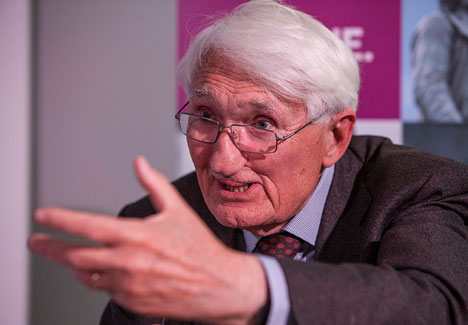
Photo: Európa Pont. Source:
Flickr
Pragmatism and historicism were involved in the development of this detranscendentalized concept of reason just as much as phenomenology, philosophical anthropology and existential philosophy. I myself would grant a certain precedence to language, communicative action and the horizon of the lifeworld (as the background context of all processes of communication). The media in which reason is embodied, i.e. history, culture and society, are symbolically structured. The meaning of symbols, however, must be shared intersubjectively. There is no private language and no private meaning that can be understood only by a single person. This precedence of intersubjectivity does not mean, however, that – to return to your question – to some extent subjectivity would be absorbed by society. The subjective mind opens a space to which everyone has privileged access from the perspective of the first person. This exclusive access to the evidence of one’s own experiences may not, however, belie the structural correlation between subjectivity and intersubjectivity. Every additional step in the process of the socialization of a person, as they grow up, is simultaneously a step towards individuation and becoming oneself. Only by externalization, by entering into social relationships can we develop the interiority of our own person. Only by marching in step with the communicative entanglement in social networks does the subjectivity of the «self», i.e. of a subject that assumes relationships to itself, deepen.
MF: During the course of the 1980s you began a long-term debate with Anglo-Saxon philosophy, both on the front of political philosophy (Rawls, Dworkin) and on the front of the philosophy of language (Searle, Putnam, Rorty, Brandom, etc.). How would you characterize the contribution of the diverse Anglo-Saxon schools of thought to the awareness that philosophy has of itself and of its own limits?
JH: In political theory, for which you mention the names of John Rawls and Ronald Dworkin, the gap between continental philosophy, dominant in France and Germany, and Anglo-Saxon philosophy was never as pronounced as it was in the philosophy of language or in the philosophy of science, the two core areas of analytical philosophy. In all these fields I learned a lot from my collaboration and friendship with American colleagues, who belonged to the pragmatic school of thought in the widest sense – above all the connection of a fallibilist mentality with a non-defeatist concept of discursive reason. It certainly helped to be able to refer to a common background. Via the Emersonian Transcendentalism of the early nineteenth century, American pragmatism is namely also rooted in German traditions – in Schiller, in German idealism, in Goethe’s view of nature, etc. If you’re asking in general about the contribution of the Anglo-Saxons to the self-understanding of philosophy and the necessary limits of post-metaphysical thinking, however, then it’s necessary to differentiate more. Today, a deep split runs through analytical philosophy itself.
The hard, scientistic core of the analytical philosophy was always alien to me. Today, it comprises colleagues who take up the reductionist Programme of the Unified Sciences from the first half of the twentieth century under somewhat different assumptions and more or less regard philosophy as a supplier for the cognitive sciences. The advocates of what we might call «scientism» ultimately view only statements of physics as capable of being either true or false and insist on the paradoxical demand of perceiving ourselves exclusively in descriptions of the natural sciences. But describing and recognizing oneself are not the same thing: decentring an illusionary self-understanding requires recognition on the basis of a different, improved description. Scientism renounces the self-reference required to be present in every case of re-cognition. At the same time, scientism itself utilizes this self-reference performatively – I mean the reference to us as socialized subjects capable of speech and action, and who always find themselves in the context of their lifeworlds. Scientism buys the supposed scientification of philosophy by renouncing the task of self-understanding, which philosophy has inherited from the great world religions, though with the intention of the enlightenment. By contrast, the intention of understanding ourselves exclusively from what we have learnt about the objective world leads to a reifying description of something in the world that denies the self-referential application for the purpose of improving our «self»-understanding.
MF: In view of an increasing distrust of the promises of democracy, and confronted with what you call the «colonization of the lifeworld» by the logic of the market, what is philosophy still capable of in this respect? To what extent is philosophy quite rightly still part of the emancipation project of the Enlightenment?
JH: As I said, philosophy, which, by the way, in its platonic origins constituted something of a religious world view, similar to Confucianism, inherited the important, even vital task of self-understanding, albeit with the intention to enlighten the self-understanding of man in a rational way, i.e. on the basis of improved knowledge about the world, including us as something in this world. I would like to expand on this sentence in two respects.
Under premises of post-metaphysical thinking, philosophy today, unlike myths and religions, no longer has the power to create a world view of its own – in the sense of an image of the world as a whole. It navigates between religion and the natural sciences, social sciences and humanities, culture and art, in order to learn and to dissolve illusions. No more, but also no less than this. Today, philosophy is a parasitic enterprise feeding on foreign learning processes. But it is precisely in this secondary role of a reflexive connection to other, already extant forms of the objective mind that philosophy can critically take into account everything we know or think we know. «Critical» means «with the intention to enlighten». This curious ability to lead to a decentred view of the world and of ourselves, by the way, was acquired by medieval Christian philosophy during the course of long-lasting discussions about «faith and knowledge». Philosophy can enlighten us regarding an illusionary self-conception by making us aware of the meaning that an increase in knowledge about the world has for us. In this way, post-metaphysical thinking is dependent on scientific progress and new, culturally available perspectives on the world, without itself becoming another scientific discipline, though it remains an academic activity pursued in the scientific spirit. Within universities philosophy has established itself as a subject, but it belongs to the scientific expert culture without assuming the exclusively objectifying perspective of a discipline that is defined by the focus on a methodically limited subject area. On the other hand philosophy, unlike religion, which is rooted in the cult of religious communities, must fulfil the task of rationally improving the self-understanding of mankind through arguments alone that, according to their form, are permitted to lay fallible claim to universal acceptance.
I furthermore regard the function of self-understanding as vital, for this was always coupled with a socially integrative function. This was the case as long as religious world views and metaphysical doctrines stabilized the collective identities of religious communities. But even after the end of the «Age of World-Views», the pluralized and individualized self-understanding of citizens retains an integrative element in modern societies. Since the secularization of state authority, religion can no longer meet the requirement of legitimizing political rule. As a result, the burden of integrating citizens shifts from the level of social to the level of political integration, and this means: from religion to the fundamental norms of the constitutional state, which are rooted in a sharedpolitical culture. These constitutional norms, which secure the remainder of collective background consent, draw their persuasive power from the repeatedly renewed philosophical argumentation of the rational law tradition and political theory.
Today, however, the increasingly high-pitched appeal by politicians to «our values» sounds ever emptier – alone the confusion of «principles», which require some kind of justification, with «values», which are more or less attractive, irritates me beyond all measure. We can see our political institutions being robbed more and more of their democratic substance during the course of the technocratic adjustment to global market imperatives. Our capitalist democracies are about to shrink to mere façade democracies. These developments call for a scientifically informed enlightenment. But none of the pertinent scientific disciplines – neither economics nor political science or sociology – can, in and of themselves, provide this enlightenment. The diverse contributions of these disciplines have to be processed in the light of a critical self-understanding. Since Hegel and Marx it is precisely this that is the task of critical social theory, which I continue to regard as the core of the philosophical discourse of modernity.










 Users Today : 239
 Total Users : 35501761
 Views Today : 1328
 Total views : 3627224