Page 1025 of 2502
1 1.023 1.024 1.025 1.026 1.027 2.502

Educación y liderazgo global

Por: Carlos Corredor Pereira.

Educación y liderazgo global

Para que los otros miembros de la OCDE nos reconozcan eventualmente como pares, debemos propiciar profundos cambios en nuestra manera de ver nuestra realidad y nuestras potencialidades.

Colombia es un país muy rico, pero tiene una población pobre, con dirigentes pobres de miras, con estadistas pobres de ideas, con políticos que no ven más allá de ganancias personales inmediatas dentro de un plan de desarrollo cortoplacista, con inversionistas que quieren recuperar su inversión en un año o menos e inmerso en una cultura de la pobreza, como la describió Oscar Lewis en su clásico libro, Los hijos de Sánchez. Y, sin embargo, ahora pertenece al selecto grupo de la Organización para la Cooperación y el Desarrollo Económico (OCDE), cuyo objetivo es coordinar las políticas económicas y sociales de sus 36 Estados miembros.  Muestra de esa cultura de la pobreza de miras y cortoplacismo, son precisamente las múltiples críticas que recibió el Gobierno anterior por haber solicitado y haber sido admitido en este club de naciones avanzadas.

Para que los otros miembros de la OCDE nos reconozcan eventualmente como pares, debemos propiciar profundos cambios en nuestra manera de ver nuestra realidad y nuestras potencialidades y comenzar por una condición sin la cual será imposible nuestro verdadero desarrollo económico y social: la educación para el Siglo XXI.

Hace poco el expresidente Barack Obama nos mostraba en un foro que se llevó a cabo en Bogotá, que la ruta hacia el futuro pasa primero que todo por la educación, desde la primera infancia hasta la universidad, y nos presentó  ejemplos como el de Singapur, con un 100% de alfabetismo. Esta cifra tenemos que compararla con Colombia en donde, no solamente podríamos hablar de analfabetismo absoluto sino analfabetismo funcional, es decir, el analfabetismo de quienes leen hilvanando palabras sin entenderlas, condición que no es ajena a ciertos exponentes de las más altas dignidades del Estado que la comparten con un buen sector del público general. En el caso de las universidades, el analfabetismo funcional se demuestra en los resultados de lectura crítica en las pruebas Saber Pro y a nivel del colegio, en las pruebas Saber 11. Obama también presentaba el caso de Finlandia, donde los maestros no solo tienen el respeto y la admiración de toda la sociedad, sino que sus sueldos son comparables a los de las más altas dignidades del Estado. Diferencias notables con Colombia, pero que si las reconocemos son diferencias que podrían ser metas a superar en el futuro.

Casi al mismo tiempo, en Boston la canciller alemana, Angela Merkel proponía en su discurso a los nuevos graduandos de Harvard que no podían aceptar nada sin el beneficio de la crítica y de la duda. “Nuestras libertades no se nos dieron gratis ni la democracia es algo que nos hayan regalado. Tampoco se nos ha dado gratis la paz ni la prosperidad… pero si tumbamos los muros que nos limitan, si tenemos el coraje de salirnos del constreñimiento de nuestras costumbres para abrazar nuevos comienzos, entonces, todo será posible… cualquier cosa que pueda parecer escrita en mármol o que parezca inalterable, ciertamente puede cambiar”.  Y terminó diciendo a los graduandos: “Salgan y tumben las paredes de la ignorancia y la estrechez mental porque nada va a permanecer en la forma como está hoy”.

En su entrega de junio de 2018 editorializaba Scientific American: “Conocimiento es poder” y decía que para muchos el conocimiento acerca del mundo natural era supeditado a sus creencias personales. Y continuaba: “Educar a ciudadanos globales es la misión más importante de las universidades… tenemos una obligación de confrontarlos con la realidad y obligarlos a cambiar sus creencias cuando chocan con la objetividad de los hechos”.

Surgen estas reflexiones al terminar un semestre académico en los colegios y  universidades y al prepararnos para uno nuevo. Y nos preguntamos: ¿cómo podremos prepararnos para las carreras que aún no existen, cuando el sistema de aseguramiento de la calidad del Ministerio de Educación parecería estar diseñado para mantener las mismas condiciones de la universidad napoleónica que han regido por décadas y que se consagraron en la Ley 30 de 1992, desmembrada pero aún vigente?

En un mundo en el que se espera que los profesionales cambien de carrera varias veces durante su ejercicio para adaptarse a las condiciones nuevas del mercado y a las coyunturas y tendencias globales, ¿tenemos la capacidad y resiliencia para afrontar los cambios desde el punto de vista legal y desde la misma universidad?

En el Espacio Europeo de Educación Superior (EEES), en el que el pregrado dura tres años, hay por lo menos 10 tipos de maestrías, de las cuales sólo dos, la de investigación y la de profundización, existen en Colombia y hay varias que permiten que quienes se formaron en una profesión en pregrado puedan cambiar legalmente y ejercer otra carrera en posgrado. ¿Será posible que en nuestro país se pueda hacer algo semejante en el cercano futuro? Existen muchos ejemplos en países avanzados para superar los retos del cambio acelerado basado en el conocimiento, ¿será que nosotros seguiremos a la zaga, sin siquiera buscar el cambio?

Fuente del artículo: https://www.laopinion.com.co/columna-de-opinion/educacion-y-liderazgo-global-179256#OP
Comparte este contenido:

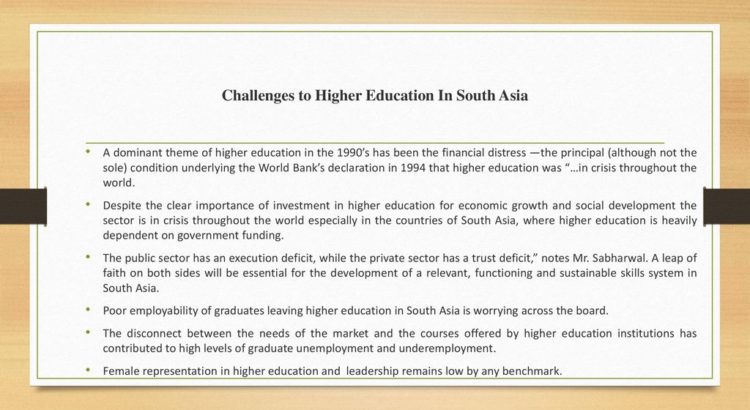
Higher education challenges in South Asia

By: Muhammad Murtaza Noor.


The southern region of the Asian continent is highly populated, diverse in nature and homeland for almost a quarter of the world population. Geographically diversity led to a variety of educational system based on national priorities. The Hollings Centre for International Dialogue assembled over fifty senior higher education leaders in Istanbul, Turkey, to comprehend the higher education dynamics of this highly populated region of the world. Importantly, delegates attending this meeting were both from South Asia as well as across the globe. The intended outcomes of four days deliberations and discussions were comprehending the higher education landscape in the region and how global partners can assist in a variety of areas related to the higher educational development of this region. The primary focus of this group was on curriculum development and reform, quality assurance, accreditation, e-learning, distance education, and building external relations with various stakeholders. The writer had an opportunity to participate in this group of academician as a member of Pakistani delegation and also shared ongoing efforts of Pakistani higher education in the areas selected for deliberations.

There was a consensus among the participants about the commonality of challenges in higher education sector not only in the South Asian region but also globally. These challenges need immediate attention, effective strategy, and collaborations inside and outside the countries. Exchange of ideas, expertise, and learning from best practices in the higher education sector, can be much helpful in addressing these common challenges in a more effective way.

South Asia is the most populous and the most densely populated geographical region in the world, with more than 1.891 billion people. It has a bulging youth population with more than 600 million under 18 years and accounts for around 25% of the world’s population and is one of the world’s fastest growing region, with growth rates approaching 7.0 percent in 2019. On average, one million people are added to the workforce each month, and the expected trend is escalating almost in the next decade. Collectively more than 1,375 higher education institutions exist in the region. Also, South Asia‘s industry and service sector are growing and creating jobs that require skilled human resources. To meet these growing challenges corroborating with population growth, there is dire need to strengthen higher education sector through increasing financial allocations, facilitating innovations, equipping youth with knowledge & essential skills and bringing higher education sector at par with international standards.

The delegates felt a need for a well-established, properly-regulated tertiary education system supported by technology like Open Educational Resources (OERs) and distance education modalities could increase access, equity, quality, and relevance, and narrow the gap between what is taught at tertiary education institutions and what economies and societies demand. The provision of tertiary education should be progressively free, in line with existing international agreements.

The speakers and panelists emphasized the student-centric higher education policies. They were of the view that universities should provide quality education, required institutional resources, incentives, and facilities for active participation in extra-curricular activities to the students at the campuses. The students also need to be equipped with essential skills of leadership, teamwork, communication, critical thinking as well as problem-solving so that they may come up to the expectations of the community, society, and industry. The importance of role of universities was also highlighted in peace-building within the country and across the region.

The higher education institutions of the Southern Asia region should ensure a systematic approach for providing accessible and effective programs and services designed to provide opportunities for enrolled students to be successful in achieving their educational goals. The institutions should offer student services, including physical and mental health services, appropriate to their mission and the needs and intended purposes of their students.

It was also discussed that being hub of ideas, innovation, and knowledge-creation, universities’ vital role need to be reinforced in inculcating the values of responsible citizenship, leadership, peace, tolerance, harmony, pluralism, and co-existence among the youth. It will only be possible through ensuring academic, financial, administrative autonomy of the universities and academic freedom at the university campuses. Too much regulation has also adversely affected innovations and creatively in the higher education sector of South Asia. The concerned higher education bodies should play a facilitative and supportive role towards universities instead of becoming intrusive one. Following the best international practices, there is also dire need to separate the functions of quality assurance, ranking, and funding in the higher education sector. Accreditation process in South Asian higher education sector, should not be complicated, lengthy, and time-consuming. The higher education quality assurance and accreditation bodies should be autonomous so that these critical bodies may perform their functions independently without any external interference. To increase access to higher education, which is still very low as compared to even other Asian countries, South Asian countries need to encourage the role of the private sector and public-private sector partnerships.

Another critical common issue which was identified by the participants was employability challenge which is being faced by a large number of graduates of most South Asian higher education institutions due to a mismatch between the market & universities and disparity within and among the universities. It was suggested that close liaison should be created between academia & industry, and necessary modifications should be made in the curriculum along with equipping the students with essential soft skills.

The role of qualified and trained faculty was highlighted in effective functioning of universities. It was recommended that maximum investment should be made in the area of faculty development and pre-service as well as in-service trainings should be made mandatory in order to train the faculty in modern teaching and research techniques.

Under the 17 Sustainable Developments Goals (SDGs) adopted by United Nations (UN), now it is the responsibility of the respective countries to ensure equal access for all women and men to affordable and quality technical, vocational and tertiary education including universities. In this regard, South Asian countries would have to take immediate effective steps through prioritizing education and providing required funds & support for equipping youth with required knowledge and skills. At the same time, they also need to learn from regional/ international experiences and best practices in higher education sector through creating close collaborations and exchange of faculty/higher education leadership.

Source of the article: https://nation.com.pk/18-Jun-2019/higher-education-challenges-in-south-asia

Comparte este contenido:

Por el derecho a la educación

Por: Circe Camacho.


Pude corroborar de primera mano en el Cendi de Monterrey la dedicación y atención de un gran equipo de profesionales

Recientemente visité el Centro de Desarrollo Infantil (Cendi) 1 Felipe Ángeles del Frente Popular Tierra y Libertad, en la ciudad de MonterreyNuevo León.

Sobre estos espacios, primero quiero comentarles que la lista para ser aceptado es muy larga, debido a que es un proyecto psicopedagógico muy completo; reconocido por garantizar una educación y desarrollo integral para la niñez, pues no solamente cuidan a los hijos de madres trabajadoras durante la jornada laboral, también ofrece servicios educativos y asistenciales para menores desde los 45 días de nacidos hasta los cinco años 11 meses de edad; servicios que permiten prepararlos para la vida familiar, social y académica, antes de ingresar al preescolar que forma parte del mismo sistema.

Durante este recorrido que les platico pude corroborar de primera mano la dedicación y atención de un gran equipo de profesionales y especialistas, como trabajadores socialespedagogosdentistasmédicospsicólogos y psicoterapeutas, todos enfocados en mejorar la calidad de vida de todos los infantes y de las familias de sectores vulnerables de la población a quienes atienden.

Al día siguiente de esta visita, participé en la junta anual de padres de familia de los Cendi, lo que me permitió conocer más sobre las historias de vida que son tocadas por este proyecto, además de conocer los resultados del mismo.

Las respuestas de madres y padres fue clara: tienen aquí una oportunidad a su alcance que les ofrece mucho más que cuidar a sus hijos mientras trabajan. La labor de todos los médicos y especialistas involucrados permite crear verdaderos espacios formativos dentro de un marco afectivo, en el que los padres de familia también participan y aprenden.

A este beneficio debemos sumar que los Cendi nos permiten garantizar el derecho a la educación y al desarrollo integral, cuidando que también sea de calidad y completo.

Estoy convencida del papel de la educación –de todo tipo– en la transformación de las sociedades, por lo que debemos reconocer y reforzar esfuerzos como el que realizan los Cendi, y con mayor razón ahora que vivimos el momento histórico de un Gobierno emanado de la voluntad popular y con una clara visión humanista.

Recordemos que hace no muchos años, en el mejor de los casos, las madres trabajadoras podían aspirar a contar con el servicio de guardería seguras en las que pudieran cuidar a sus hijos durante la jornada laboral.

Ahora, en todo el país, es posible tomar mejores decisiones para nuestras niñas y niños, sin que el factor económico sea el único a considerar, y esa es la mejor forma de ejercer un derecho.

Porque si bien la educación es un derecho, también es la base para exigir todos los demás derechos que tenemos.

Y esta es una de las razones por las que soy parte del Partido del Trabajo.

Fuente del artículo: https://heraldodemexico.com.mx/opinion/por-el-derecho-a-la-educacion/

Comparte este contenido:

The Global Refugee Forum and the case for education


In 2016, at the height of the European refugee crisis, the United Nations General Assembly unanimously adopted the New York Declaration for Refugees and Migrants. The declaration was hailed as the foundation of a new approach by the international community to large movements of refugees and migrants, as well as to protracted refugee situations.

The adoption of the declaration launched a two-year process that delivered the Global Compact on Refugees. It provides a blueprint for governments, international organizations, and other stakeholders to ensure that host communities get the support they need and that refugees can lead productive lives.

“The Global Refugee Forum provides a once-in-a-lifetime opportunity to set a plan to close the refugee education gap, delivering quality education to the world’s 9 million refugee children and improving the quality of education of their host community peers.”

The next step is for concrete pledges at the first-ever Global Refugee Forum — hosted by UNHCR this December in Geneva — to support the compact’s implementation.

The forum’s results will be a critical test of the international community’s commitment to the new ways of working envisaged by global compact. Failure to back the practical hospitality and policy commitments of the countries hosting large refugee populations will call into question the credibility of the compact’s promises and put wider humanitarian reform efforts at risk.

The excellent work of host countries, together with growing support for education in crises, means there is a real opportunity to ensure every refugee child has the chance to go to school. The compact promises to minimize the time refugee children spend out of education, with a target of no longer than three months after arrival in the country in which they have sought protection.

The case for education for refugees is clear: it’s the chief concern for refugee children and their parents. Speaking in Berlin on the urgent need to expand access to schooling for refugees, U.N. refugee chief Filippo Grandi said, “I have worked for refugees for 35 years and there is one constant message I hear from them — they want education, even before food.”

Refugees know that education provides the building blocks needed to recover, to create new lives in their host countries, and to gain vital knowledge and skills to take back to their country of origin, should they have the opportunity to return.

But the majority of refugee children face the double jeopardy of losing both their homes and their right to go to school.

Eighty-five percent of the world’s refugees live in developing countries, which face big challenges in delivering education to their own populations. Unsurprisingly when refugees do have access to school, the education they receive is often low quality.

It doesn’t have to be this way. The Global Refugee Forum provides a once-in-a-lifetime opportunity to set a plan to close the refugee education gap, delivering quality education to the world’s 9 million refugee children and improving the quality of education of their host community peers in the process.

How we can secure the future of school-aged refugees

This time last year we launched our call for a global refugee education action plan. It showed that we could deliver quality universal pre-primary, primary, and secondary education to the world’s refugees with just $11.9 billion in international assistance over five years.

While this looks like a lot of money, it is in fact a little more than two days of global military spending, which currently stands at $4.8 billion per day. For $1 million per day, we could secure the future of 7.5 million school-aged refugees.

“We must start by asking refugee hosting countries what they need and working out how we can get it to them.”

To do this, we need to clearly set out what refugee hosting countries need and secure pledges and contributions against those needs.

Without an agreed statement of needs, the Global Refugee Forum runs the risk of soliciting pledges of support, however worthy, which do not address the most critical needs on the ground.

In order to reduce the risk of existing funding being re-pledged, we must also establish the baseline of available financing and support, ensuring that new pledges are genuinely additional.

A global plan, based on need, would act as an advocacy tool, crowding in government, philanthropic, corporate, and civil society support. It would assist in developing and coordinating a global response that can be adequately monitored and hold stakeholders accountable for delivering.

In short, if the Global Refugee Forum is to achieve its goal, we need to ensure that new, tangible pledges are made in support of the education-related commitments in the global compact and that these align with agreed priority needs.

Education Cannot Wait’s replenishment in September is the perfect staging post, where donors will have the opportunity to support ECW’s innovative multi-year education plans, the majority of which will be in refugee hosting countries. These plans are the perfect instrument for agreeing what’s needed, providing catalytic funding, and then aligning financing.

Source of the article: https://www.devex.com/news/opinion-the-global-refugee-forum-and-the-case-for-education-95144


Comparte este contenido:

Pide Solalinde atender educación de niños migrantes como sujetos, no como objetos

Por: Laura Poy Solano.

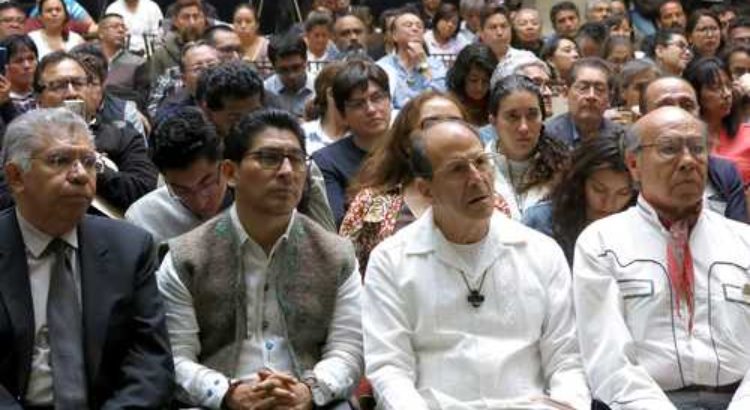
Frente a una educación comprada, amenazada, manipulada y orientada a la producción capitalista se debe buscar la revolución de las conciencias, afirmó Alejandro Solalinde, sacerdote y activista por los derechos humanos, quien destacó que este proceso debe comenzar por la recuperación de los referentes creados por los pueblos originarios y de sus culturas.

Al inaugurar el primer Congreso Nacional de Alternativas y Transformación Educativa, convocado por la Red de Universidades Alternativas, también recordó la llegada de miles de niños migrantes que buscan un mejor futuro, por lo que demandó atender sus necesidades educativas desde su propia realidad como sujetos y no como objetos.

Pidió reconocer la riqueza cultural y las experiencias que traen consigo los migrantes, en particular, dijo, las mujeres, quienes se dice, son las últimas en migrar, pero en su caminar van recogiendo las raíces de sus pueblos y las traen consigo. Podemos aprender mucho de ellos, porque representan la riqueza del mundo.

En el encuentro, Javier López Sánchez, titular de la Dirección General de Educación Indígena (DGEI), señaló que desde la mirada de los pueblos indígenas se demanda una educación integral y con una mirada holística que recupere la sabiduría ancestral y reconozca que en el lenguaje, la puerta para entender de formas diferentes el mundo.

Frente a profesores, investigadores y activistas sociales reunidos en la sede del Senado en la calle de Xicoténcatl, destacó que la propuesta educativa indígena plantea una construcción comunitaria del saber, donde es esencial el contacto con el otro. En la filosofía maya tzeltal –indicó– se proponen tres pasos fundamentales: saber estar y saber ser; saber el saber, y saber hacer, a fin de impulsar los principios de la sabiduría y el buen vivir.

Por su parte, Hugo Aboites, profesor-investigador de la Universidad Autónoma Metropolitana y ex rector de la Universidad Autónoma de la Ciudad de México, destacó que todo proyecto educativo alternativo ha sido resultado de las luchas sociales y la construcción colectiva. El sistema educativo mexicano fue, en su momento, un proyecto alternativo emanado de la Revolución mexicana, lo que permitió que a través del normalismo rural los hijos del pueblo educaran a los hijos del campesino y del obrero.

Pedro Hernández, integrante de la dirigencia nacional de la Coordinadora Nacional de Trabajadores de la Educación, recordó la lucha que por años han impulsado los maestros para alcanzar una transformación educativa, y que entre otros saldos, dijo, dejó profesores reprimidos y encarcelados injustamente, además de pérdidas de vidas. Llamó a mantener el diálogo y reconocer los proyectos alter­nativos que se han construido desde las escuelas, que es desde donde se genera la verdadera transformación de la educación.

Comparte este contenido:

For effective regulation of the country’s education system

By: Anurag Behar.


Scepticism of India’s draft National Education Policy should be suspended until it is implemented

This is the second column in the series, Glimpses Of The Draft National Education Policy (NEP). The draft NEP has received widespread responses, ranging from thoughtful endorsement and insightful critique to good-faith criticism. Some of this is in the public domain, but a lot more seems to be happening in group consultations, feedback to the human resource development ministry, etc. The final policy will be richer for all this. I am extracting some of the salient features of the NEP, with the intent to address some of the issues raised in these responses, but specific knowledge of the responses is not necessary to read through these points.

The NEP is a clear and strong endorsement of the public education system. It envisions high-quality, equitable and universal education—in and through the public education system. This is as applicable to higher education as to school education (age 3-22 roughly). Public-spirited, not-for-profit private institutions will certainly have a role in the Indian education system. However, it is the obligation of the state to provide high-quality education, and all efforts shall be aligned with this goal.

Government spending on public education must rise from current 10% of national public expenditure to 20% in 10 years. These numbers are rough estimates that indicate the direction and scale of the change required. The NEP is what the name says. It is education policy and cannot substitute the government’s fiscal policy and financial strategy. The NEP highlights the financial needs of education and does not dwell on where the money will come from, which is the business of the state.

The Right to Education Act (RTE), 2009, remains a key bulwark of school education—especially in the context of the strong reaffirmation of the state’s obligation and centrality of public education. If anything, its importance becomes deeper and broader, since the extension of the RTE from age 3 to 18, from the current 6 to 14, is envisioned as a key to enabling early-childhood-education and secondary education. The NEP explicitly endorses the continuation of Continuous Comprehensive Evaluation and the No Detention Policy in schools, taking a stand against the recent (past two years) legislative and other actions that dilute or eliminate these educationally important steps. It also directs action on the stopping of misuses and malpractices, including of 12(1)(c), for example, seeking exemption from the RTE by claiming “minority status», inflating student numbers, misrepresenting the socio-economic background of students, etc. It also calls for improvement of the RTE based on a comprehensive review of the experience of its implementation in the past decade, particularly on the matter of being responsive to local infrastructure needs without compromising safety, security and a wholesome learning environment.

“India» and “Indian» are integrated in many parts of the NEP. Some of these matters are: Indian languages, Indian literature, Indian art, Indian music, Indian knowledge systems, Indian history and context, etc. How could it be otherwise? After all, this is an education policy for India. Especially when it doesn’t do all this at the cost of ignoring the “global/modern». I can appreciate the apprehensions of some: “Is there more to this?» If the NEP text is read with an open mind, it becomes clear that there is nothing more to it than an important and valid commitment to know, understand and value our own society. The NEP takes a clear stand for a scientific temper, critical thinking and associated capacities, and for our constitutional values.

The NEP has the vision to transform the regulation and governance of the education system. Three of the key underpinning principles for this transformation are: transparent public disclosure, maximal empowerment and autonomy for institutions, and separation of roles and powers of regulation, operations, standard-setting, etc. While these principles are common to higher and school education, their manifestations are different. School education would be regulated by a newly created quasi-judicial “State School Regulatory Authority», based on a robust accreditation system, and the states’ Directorate of School Education (or Public Instruction) will only be responsible for running and improving the public schooling system. An illustrative implication of this is, Block Education Officers will have no regulatory powers; they will be responsible only for running and improving public schools. This “accreditation system» is based on, and thus empowering of, local institutions such as peer schools, school management committees and panchayats.

I have had the privilege of a ringside view of the evolution of the NEP. That gives me confidence that the draft will be enriched and revised by the constructive responses to it. Some of those responses will be the topic of the third piece in this series. I have also seen negative reactions to it. Many of these are born of a deep scepticism that committees can do their work unhindered and uninfluenced. Clearly, the final test of any policy is in its implementation, but it is important to suspend such judgement and disbelief. The NEP offers ample energy for that optimism.

Source of the article: https://www.livemint.com/

Comparte este contenido:

Aquiles contra el Mineduc

Por: Pablo Ortúzar.

La educación es una labor social y política. Ella es el medio por el cual nuestra humanidad adquiere forma, carácter y contenido. Es el principal vehículo de la cultura. Y ya que el rol educador le cabe en primer lugar a la familia, los expertos educacionales, los funcionarios del Mineduc y los teóricos del currículum no tienen autoridad alguna para decir a los ciudadanos que estos asuntos no nos competen.

La mera existencia de un currículum nacional, de hecho, tiene mucho más que ver con decisiones políticas que con razones pedagógicas. La homogeneización cultural de la población es uno de los mecanismos fundamentales de dominación de los Estados nacionales. Luego, debemos asumir también que la disputa por la configuración de dicho currículum es, aunque no abiertamente partidista, política e ideológica. Esto, porque ella está motivada, en lo principal, por proyectos de sociedad y de país, y no por conocimientos expertos asibles solo por algunos especialistas. Cuando se discute sobre qué deberían saber todos los chilenos y cómo deberían aprenderlo se está discutiendo, en realidad, sobre lo que Chile es y debería ser.

Por supuesto, existe en paralelo a este debate una realidad educacional mucho más concreta. La vida cotidiana de estudiantes, profesores y establecimientos. Un mundo cargado de inercia. Por eso a veces parece ocioso discutir si tal ramo debería llamarse de una forma u otra, considerando lo resistentes que son los hechos a las disquisiciones de papel. Pero lo cierto es que estos esquemas generales pueden tener efectos de largo plazo, abriendo o cerrando la puerta a distintas posibilidades. Aunque los contenidos sean, al principio, iguales, es distinto estudiar “ciencias naturales” que “ciencias para la ciudadanía”.

Pero no solo la configuración de cada ramo abre y cierra opciones, sino que el esquema general del currículum impone una visión de mundo. Nuestro modelo actual, con su enorme cantidad de ramos sobre asuntos parciales, obedece, por ejemplo, al modelo profesionalizante que reemplazó al currículum clásico, considerado elitista. Así, de una formación anclada en las “artes liberales”, sostenida en los clásicos griegos, romanos y judeo-cristianos, pasamos a una orientada al civismo y la industria.

Asumiendo todo esto, creo que la situación crítica de la educación chilena exige no solo discutir públicamente sobre si historia debería ser o no un ramo obligatorio, sino derechamente sobre si tiene sentido mantener el modelo profesionalizante de organización del saber, por un lado, y la facultad del Estado para imponer un currículum kilométrico, por otro.

El principal producto de nuestro sistema educacional actual son analfabetos funcionales, poco productivos y sin sentido histórico. Una versión degradada de los ya degradados especialistas sin espíritu y hedonistas sin corazón que imaginó Max Weber como producto de la modernidad. ¿No es quizás el momento de evaluar lo que estamos haciendo, e imaginar un futuro donde, en vez de tribus de encapuchados balbuceantes, el latín y el griego, junto con todos los clásicos de ambos idiomas, retomaran el sitial civilizatorio que les corresponde en nuestras aulas y espíritus?

Fuente del artículo: https://www.latercera.com/opinion/noticia/aquiles-contra-el-mineduc/710908/

Comparte este contenido:
Page 1025 of 2502
1 1.023 1.024 1.025 1.026 1.027 2.502