Page 1631 of 2504
1 1.629 1.630 1.631 1.632 1.633 2.504

La autoridad del profesor.

Por: Francisco J. Lopez Rodriguez.

Qué sería una sociedad sin, policías, sin semáforos, sin normas de tráfico, sin leyes? Sería un caos, una jungla, un campo de batalla, una morgue, imposible la vida. Se pueden imaginar qué sería un Centro de enseñanza, sin autoridad y con adolescentes sin sentido de la responsabilidad, ni respeto. Se ha hablado y se habla mucho de las leyes educativas. En teoría todas pretenden mejorar el sistema educativo. La realidad es muy distinta, se ha degradado y no hay forma de hacer una Ley que pretenda dos principios básicos: la calidad del sistema educativo y el respeto dentro de la comunidad educativa. Digo respeto y convivencia en los Centros. Me parece muy bien que haya interlocutores en el sistema: padres, profesores y alumnos, pero cada uno en su sitio, juntos sí, revueltos, no.

El profesorado será autoridad lo dice la Ley Orgánica para la Mejora Educativa (Lomce). ¿Es necesario que se regule un principio natural? Pues sí. Esta sociedad, que hemos creado todos y que está mediatizada, ha prostituido la autoridad y la disciplina en las aulas. En una tertulia de una cadena de radio se hizo una entrevista a una profesora que había sido vejada, insultada y agredida por un alumno. Dicha profesora tuvo que pedir la baja por depresión y soportar la poca comprensión, en especial, por los padres del alumno en cuestión.

En un momento determinado tuve que llamar a un padre por el comportamiento díscolo de su hija, manifestándole que había infringido las normas elementales de convivencia y había vejado al profesor. Le manifesté los hechos y le dije que el profesor es una autoridad en clase y como tal tiene competencias para tomar decisiones ante situaciones incomodas y comportamientos que hacen imposible impartir docencia El progenitor me contestó que «desde cuando el profesor es una autoridad en clase».

Estamos volviendo a ciertos planteamientos que afloraron en el primer tercio del siglo veinte con las organizaciones anárquicas. Son caldo de cultivo para incluir a toda la masa descontenta. Sus principios son revolucionarios, lucha por el poder y no sometimiento a ninguna autoridad. Había un dicho que decía: “la letra con sangre entra”. Estábamos ante el castigo físico. Sometimiento a vejaciones al alumno: los coscorrones, ponerse de rodillas etc. etc. Eran situaciones para afrontar el respeto y el orden. Hoy nadie pide eso. Hoy ningún profesor va a rescatar viejos modos. Por cierto, algunos estados americanos y, en ciertos colegios británicos, están aplicando castigos físicos. Pero ¿qué está pasando con la disciplina en las aulas? Hoy, impartir una clase a determinados colectivos, es una odisea, una tragedia, un esfuerzo titánico y, solo los aguerridos, lo pueden hacer si no desesperan. Los alumnos no tienen disciplina, insultan al profesor, no respetan a nadie, pretenden hacer lo que les viene en gana. No toman interés por formarse, con frecuencia odian y detestan ciertas materias, les importa un rábano la cultura. Dicen que para qué quieren la lengua, la historia, sociales y si eso no les sirve para nada, que lo único que les importa es aquellas materias que no son objeto de estudio ni de esfuerzo. Esto es verdad. También es cierto que es una minoría, pero la realidad es que la minoría hace imposible mantener el orden, la disciplina y un aprovechamiento académico.

Hoy un profesor tiene coartada su libertad. Les voy a contar una anécdota vivida hace unos cuantos años. Una alumna provocadora, rebelde, de las que no quiere estudiar, de la que no da un palo al agua. En clase su comportamiento era detestable. El profesor la echa de clase. La alumna, que sabe mucho de derechos, va a inspección, dice al de turno que le han expulsado de clase. El inspector se presenta en el Centro y dice al profesor que tiene que admitirla. Para expulsarla es necesario abrir un expediente. Reunir al Claustro de profesores, nombrar un instructor, hacer pliego de cargos, proponerla a la administración para su expulsión, con la salvedad que mantiene todos los derechos en el Centro y, al final, alguien decide o no que se le expulse, mientras tanto, la mantienes en clase, hace lo que quiere, se ríe del profesor y el docente a j.. y a aguantarse. Esto fue un hecho real. Así no se puede impartir una clase ni imponer disciplina. En materia de disciplina los centros tienen que tener suficiente autonomía y los profesores suma autoridad para tomar las medidas oportunas, puntuales. Que la clase sea un ambiente de trabajo y, quien lo perturbe, se tomen las medidas oportunas y disciplinarias para corregir los defectos y poder crear un ambiente educativo con el objetivo de formar y afrontar el reto de la enseñanza con interés y eficacia.

No estamos proponiendo el abuso. Tampoco se propone la dictadura educativa. Los límites del profesor están en el respeto al alumno y lo que determine el Código civil y el penal. ¿Por qué no se legisla de una manera proporcional? Hay muchos políticos y sindicatos que saldrían al encuentro y Asociaciones de padres porque lo primeros fogonazos que lancen? serán que no se respetan los derechos y hay que tener contentos a una masa que no quiere estudiar, que les importa un rábano todo, que no quieren que se les mande, que detestan la autoridad, que no quieren disciplina.

Hay que empezar por el principio y ese principio, es la familia, Si esta falla, si los hijos quedan a merced el ambiente, si no se impone autoridad y los padres, para contentar a sus hijos avivan y azuzan el conflicto apoyando a sus vástagos, flaco favor estamos haciendo a la enseñanza.

Puede ser que alguien se levante contra estas formas y las tache propias de un facha o dictador, pero les digo que, si en la familia hay disciplina y respeto, se prolongará en el centro educativo y los profesores serán depositarios de ese mensaje y lo recogerán para proseguir una educación en el respeto. Ahora bien, si se sigue sin dar autoridad a los profesores, esta sociedad educativa no va a funcionar y la autoridad del profesor quedará degradada.

Fuente: http://www.diariodeleon.es/noticias/opinion/autoridad-profesor_1180746.html

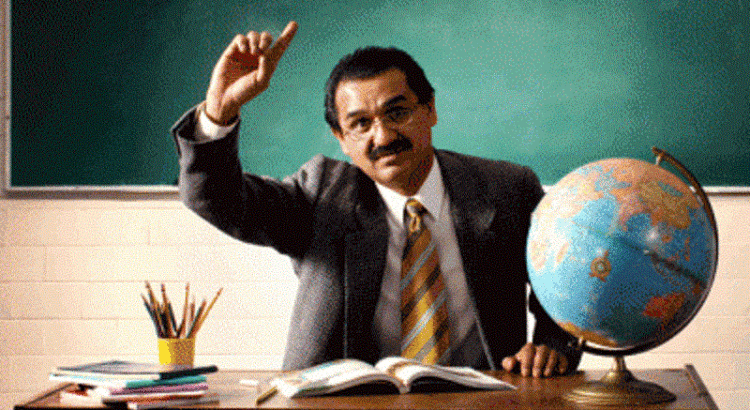
Imagen: http://juanvelarde.blogia.com/upload/20090916114833-profesor.gif

Comparte este contenido:

Olimpiada del conocimiento: presente y evocación

Por:

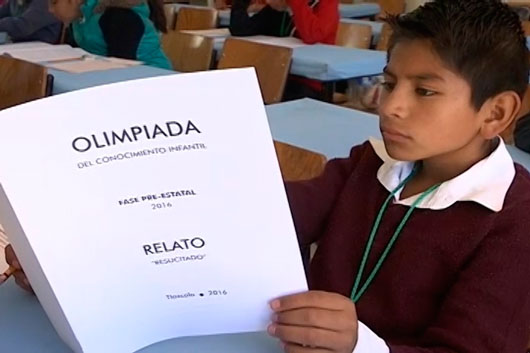
Como ya es tradición, el mar­tes 8, el presidente Peña Nieto convivió con los niños ganadores de la Olimpiada del Conocimiento Infantil. La ce­remonia en Los Pinos se denomina Convi­vencia Cultural. En ésta, el Presidente y el secretario de Educación Pública, festejan a los niños más aplicados del país.

Hace unos años comentaba con una colega el valor de ese ceremonial. Ella pensaba que no debería existir, que lo ideal sería que todos los niños se desem­peñaran bien, que todos caminaran al mismo ritmo, que no hubiera diferencias, que todos fueran destacados.

Es un ideal imposible de alcanzar, pienso. Cuando se quiere emparejar el desempeño de los estudiantes de mane­ra artificial, por lo general es hacia aba­jo. Recuerdo de mis años de primaria, cómo nos incomodaban los niños apli­cados, más si eran niñas. Quizá no lo re­conocíamos como envidia, pero pienso que eso era lo que sentíamos; nos burlá­bamos de ellos y no pocas veces eran el blanco de la inquina de los más ganda­llas. “Aquí todos somos iguales”, parecía ser la consigna. Pero en el fondo siempre hemos rendido culto al individualismo.

El ritual de la Convivencia Cultural en­comia dos tendencias que para algunos son antípodas. Por una parte, es un reco­nocimiento al esfuerzo de niños y maes­tros por hacer bien su labor. A los primeros por su dedicación al estudio, cumplir con horarios y tareas y, en consecuencia, obte­ner buenas calificaciones. A los segundos, por poner atención —a veces demasia­da— a los niños que sobresalen.

Por otra parte, es un incentivo —“son un ejemplo”, les dijo el secre­tario de Educación Pública, Aurelio Nuño— para seguir por esa ruta, una invitación a ser mejores. Es un aplauso a la noción de competencia, a ser di­ferentes al resto de sus compañeros. Destacar, parece decir el mensaje del ceremonial, es una virtud.

Para mí no hay contradicción. No es cierto que todos seamos iguales. Hay diferencias en comprensión, lucidez, tiempo dedicado al trabajo (el holgazán existe), esfuerzo individual y, claro, en capital cultural. Quienes tienen más ven­tajas de origen disfrutan de mayores po­sibilidades de sobresalir.

No niego que haya una restricción de clase social. Las desigualdades sociales y culturales se reproducen. Por décadas, en la ceremonia que ideó Jaime Torres Bodet a comienzos de los 60, sólo eran premiados niños de clase media. Pero buena parte de esa clase migró a la es­cuela privada. Hoy, pienso, en las áreas urbanas (no en las marginales) hay cierta homogeneidad en el origen de clase so­cial de los alumnos.

En los años 90, si no me equivoco, gracias a la insistencia del entonces sub­secretario de Educación Básica, Olac Fuentes Molinar, se instituyó que en es­tas olimpiadas se incluyeran categorías y se seleccionara a los niños que obtu­vieran los mejores desempeños en edu­cación indígena (bilingüe y bicultural), en los cursos comunitarios del Consejo Na­cional de Fomento Educativo (los pobres entre los pobres) y en Telesecundaria. No es el paraíso, pero es un reconocimien­to a la pluralidad social y, sin que se les mencione, a los rezagos que padece el sistema educativo mexicano.

Para un niño de 12 años, entrar a Los Pinos era un verdadero privilegio. Me re­fiero a los tiempos de presidencialismo exacerbado y con una población menor a la tercera parte de lo que tenemos hoy. Quien saludaba al Presidente —y tenía la foto dándole la mano para demostrar­lo— se trasmutaba en una celebridad, más aún si provenía de una ciudad pe­queña. Eran foco de adulaciones y de orgullo de su familia y maestros de su escuela, aunque también había quie­nes los envidiaban más que antes de la premiación.

Hoy, quizá nada más sus familias fes­tejen los 15 minutos de gloria de los cam­peones de esta olimpiada. ¡Pero de que lo merecen, lo merecen!

Fuente del Artículo:

Olimpiada del conocimiento: presente y evocación

Comparte este contenido:

Personas con discapacidad, sin respaldo de políticas públicas: UAM

Por:

La lucha de casi ocho millones de personas con alguna discapacidad –que conforman el segundo grupo minoritario de la población en México, después de los indígenas– carece de políticas públicas que atiendan de manera suficiente y con respeto de los derechos humanos las necesidades de ese sector, advirtió el maestro Andrés Moctezuma Barragán, profesor-investigador del Departamento de Economía de la Universidad Autónoma Metropolitana (UAM).

Al dar a conocer el proyecto La ventana arte incluyente refirió que la intención es crear un espacio para promover la inclusión social de hombres y mujeres en esa condición y hacer visibles el problema y la cultura al respecto, mediante talleres de diseño de carteles y materiales, de artes escénicas y visuales, video, radio y edición, entre otros.

La iniciativa –desarrollada por un grupo de artistas y ciudadanos interesados en promover un mundo incluyente que considere a aquellos con capacidades diferentes– propone que desde las disciplinas visuales, principalmente, creadores trabajen para hacer visible la problemática social e impulsar la solidaridad y la inserción moral.

También busca provocar la reflexión y la concientización sobre las numerosas situaciones de exclusión social que sufre dicho segmento de la sociedad y las cuales magnifican sus circunstancias.

Por ello es necesario considerar que se trata de “una minoría que es numerosa” y muchas veces no visible por encontrarse recluida, “ya sea por no sentirse aceptada socialmente o por no contar con las mismas oportunidades que los demás”, por lo que hay que convocar a acciones que contribuyan a la aceptación social.

Moctezuma Barragán indicó que La ventana arte incluyente, propuesta instituida como Asociación Civil, nació de la relación con ilustradores catalanes que trabajan en centros para débiles visuales y auditivos, con síndrome de Down, discapacidad intelectual y dificultades de movilidad, entre otras características.

Fuente del Artículo:

Personas con discapacidad, sin respaldo de políticas públicas: UAM


Comparte este contenido:

Ajedrez en tablero de damas: educación y productividad, las piezas que no encajan

Por: Marcelo Norambuena

La productividad como problema público, y por ende factible de abordar desde lo político, es un tema que se ha instalado en la agenda mediática, siendo utilizado en mayor o menor grado por todos los sectores políticos como elemento programático –a veces más latente que manifiesto- , convirtiéndolo ineludiblemente en un tema país.

Pero ante cualquier intento retórico, si vamos a hablar de productividad, mejor partamos por el dato duro. El Informe 2016 de la Comisión Nacional de la Productividad señala que entre 1990 y 2000 la productividad de la economía chilena creció en promedio un 2,3% por año, mientras que en el período que va desde 2001 hasta 2015 sólo lo hizo en un 0,1%. Es decir, la fuerza laboral chilena no ha logrado aumentar su capacidad de producir más con los mismos recursos. La evidencia indica que la productividad se estancó en los últimos 10 años, mientras que diversos estudios señalan que este fenómeno es el principal factor que incide en la desaceleración de la economía. Esta situación ha generando sospechas de que Chile esté entrando en la llamada “trampa de los ingresos medios”, concepto que alude al fenómeno de estancamiento permanente observado en muchos países en vías de desarrollo, los cuales quedan a medio camino entre la pobreza y la prosperidad.

¿Qué ha ocurrido entonces con la fuerte inversión hecha en educación en los últimos 25 años? ¿Cómo es posible que la productividad se estancara, cuando entre 1990 y 2016 la cantidad de estudiantes en educación superior pasó de casi 250 mil a más de 1,2 millones? ¿No se supone que invirtiendo en capital humano, la productividad se incrementa?

Grandes preguntas, pero para avanzar en éstas, mejor volvamos a los datos. Aquí aprovecho de señalar los resultados del “Segundo estudio de Competencias Básicas de los trabajadores chilenos” elaborado en 2013: un 44% de la población adulta en Chile no entiende lo que lee, un 42% no es capaz de redactar documentos y un 51% no es capaz de realizar todas las operaciones matemáticas básicas. Aún peor, tales cifras son relativamente transversales a todos los niveles de educación. Y como si se tratara de un tiro de gracia, estos datos son prácticamente idénticos a los de la primera medición en 1998.

Estos resultados son un balde de agua fría al paradigma de potenciar la formación terciaria como estrategia para impulsar el desarrollo. En Chile existe una fuerte sobreestimación del impacto de la inversión en Educación Superior en el desarrollo económico del país –muy internalizada por la sociedad, los privados y el Estado-, alimentado por la convicción de que individuos con mayor capital humano serán más productivos, lo que repercutirá en un mejor desempeño global de la economía.

Estos resultados son un balde de agua fría al paradigma de potenciar la formación terciaria como estrategia para impulsar el desarrollo. En Chile existe una fuerte sobreestimación del impacto de la inversión en Educación Superior en el desarrollo económico del país –muy internalizada por la sociedad, los privados y el Estado-, alimentado por la convicción de que individuos con mayor capital humano serán más productivos, lo que repercutirá en un mejor desempeño global de la economía. En otras palabras, se trata de una lógica neoliberal en la que se atribuye al individuo el éxito o fracaso del desarrollo económico, lógica bajo el cual no es infrecuente enjuiciar a amplios sectores sociales respecto al desempeño de la economía. En honor a los resultados, nada perdemos escuchando otras opiniones.

El economista surcoreano Ha-Joon Chang comparte la idea de que el desarrollo de la economía de un país depende esencialmente en hacer que sus ciudadanos mejoren sus habilidades productivas, pero indica además que necesariamente debe existir una matriz productiva que de soporte: elemento minimizado (si no ausente) en el discurso técnico neoliberal chileno. La combinación de ambos factores facilita la mejora de capacidades para organizarse en emprendimientos innovadores con el fin de satisfacer la matriz productiva –que normalmente está dominada por grandes conglomerados-, generando así un proceso de transformación de ésta. Agrega además que la evidencia internacional sindica a la actividad manufacturera como el sector económico que realmente potencia el aprendizaje de los habitantes de un país. Sólo de este modo se producen cambios en la economía, no añadiendo mayor capital humano en función de la matriz productiva ya existente, sobre todo si ésta es de carácter extractivo y enfocado a las materias primas como lo es en Chile.

Complementando lo anterior, el cientista político estadounidense Ben Ross Schneider asocia la baja productividad de los países latinoamericanos –incluyendo a Chile-, a la existencia de grandes conglomerados familiares que monopolizan la economía, en el contexto de lo que denomina “Capitalismo Jerárquico”. Si bien no considera negativa la existencia de grandes conglomerados –es más, tienen una gran y positiva incidencia en la labor de expandir las operaciones productivas-, sí considera dañino el mudus operandi de los grupos latinoamericanos, más propensos a la manipulación del mercado (generalmente mediante prácticas corruptas) y al monopolio, que a la inversión en nuevas tecnologías y la innovación para mejorar su productividad. Esta dinámica provoca que las grandes empresas prefieran dedicarse a la explotación de materias primas (normalmente bajo “reglas del juego” convenientemente “acordadas” con el poder político), en lugar de investigar y desarrollar bienes de mayor valor agregado. Su consecuencia inmediata es la proliferación de puestos laborales de baja cualificación, mal remunerados y con largas e improductivas jornadas para paliar la “improductividad”, como si de un sarcasmo se tratara. Todo en contraste con los reducidos puestos laborales de mayor cualificación, especializados y de mejor paga, cuyos accesos no tienden a caracterizarse por la meritocracia precisamente.

Este fenómeno explicaría la crisis que viven los profesionales recién egresados en nuestro país –incluyendo aquellos que cuentan con postgrados-, dado que existe un “excesivo” número de ellos en un mercado caracterizado por la poca cantidad de plazas laborales que requieren alta cualificación. En otras palabras, el exceso de individuos altamente calificados en una matriz productiva de corte primario, sólo producirá altos niveles de desempleo y precariedad laboral entre éstos, no un mejor desempeño global de la economía.

Si nuestro objetivo es dar forma a una conexión entre la gigantesca inversión en educación ya hecha y el desarrollo real del país, entonces es imperativo cambiar las reglas del juego que dan forma al capitalismo jerárquico chileno. Son nuestros técnicos y profesionales -sobre todo los recién egresados y provenientes de los sectores más vulnerables-, quienes se están convirtiendo en los grandes perdedores de la expansión de la matrícula de educación superior y su desconexión con el sistema económico chileno, haciendo inevitable que vean sus legítimas aspiraciones frustrarse ante la cruda realidad de un país que no los necesita.

Fuente del Artículo:

http://www.elmostrador.cl/noticias/opinion/2017/08/14/ajedrez-en-tablero-de-damas-educacion-y-productividad-las-piezas-que-no-encajan/

Comparte este contenido:

OP-ED: Restoring Free Tuition fees. Why Education Is The Great Equalizer

By John Horgan

Premier of British Columbia,

Education is the great ePqualizer. It opens the door to a good-paying job, and a secure future. We need to give help, hope and opportunity to people who want to get a basic education to learn the skills they need to join the workforce and build a better life for themselves and their families.

That journey starts with opening the doors to adult basic education and English language learning. These programs should be within reach for everyone, from new Canadians and recent immigrants, to students preparing for university and adult learners upgrading their skills for work.

The previous government put up barriers to a basic education when they introduced tuition fees for Adult Basic Education and English Language Learning in 2015. Fees were set by each institution, but could cost up to $1,600 per semester of full-time studies, which is the same as the average cost for an arts and science degree program.

Many people could not afford to pay these new tuition fees. As a result, enrolment in Adult Basic Education and English Language Learning programs dropped 35% from more than 10,000 students a year to just under 6,700 students a year.

We cannot afford to shut thousands of people out of opportunity. Families can’t afford it. And B.C.’s economy can’t afford it. Our long term economic growth depends on an educated and skilled workforce.

 This is why our government is removing the roadblocks to education by eliminating tuition for adult basic education and English language learning starting September 1, 2017. This change will open the doors to tens of thousands of British Columbians to upgrade their education and skills each year.

By investing in education and opportunity for people, we are making a long-term investment in our economy and our future.

We will continue to make changes that give families relief from high costs and fees, and invest in better services that give people help and hope for a better life.

Source:
Lea más en http://thelinkpaper.ca/?p=64475#GFWP3vYdcKTqe4c0.99

Comparte este contenido:

The United States’ War on Youth: From Schools to Debtors’ Prisons

By: Henry A. Giroux

If one important measure of a democracy is how a society treats its children, especially poor youth of color, there can be little doubt that American society is failing. As the United States increasingly models its schools after prisons and subjects children to a criminal legal system marked by severe class and racial inequities, it becomes clear that such children are no longer viewed as a social investment but as suspects. Under a neoliberal regime in which some children are treated as criminals and increasingly deprived of decent health care, education, food and  housing, it has become clear that the United States has both failed its children and democracy itself.

Not only is the United States the only nation in the world that sentences children to life in prison without parole, the criminal legal system often functions so as to make it more difficult for young people to escape the reach of a punishing and racist legal system. For instance, according to a recent report published by the Juvenile Law Center, there are close to a million children who appear in juvenile court each year subject to a legal system rife with racial disparities and injustices. This is made clear by Jessica Feierman, associate director of the Juvenile Law Center in her report «Debtors’ Prison for Kids? The High Cost of Fines and Fees in the Juvenile Justice System.» In an interview with the Arkansas Times, Feierman said:

Racial disparities pervade our juvenile justice system. Our research suggests that we can reduce those disparities through legislative action aimed at costs, fines, fees, and restitution … In every state, youth and families can be required to pay juvenile court costs, fees, fines, or restitution. The costs for court related services, including probation, a «free appointed attorney,» mental health evaluations, the costs of incarceration, treatment, or restitution payments, can push poor children deeper into the system and families deeper into debt. Youth who can’t afford to pay for their freedom often face serious consequences, including incarceration, extended probation, or denial of treatment — they are unfairly penalized for being poor. Many families either go into debt trying to pay these costs or forego basic necessities like groceries to keep up with payments.

According to the report, sometimes when a family can’t pay court fees and fines, the child is put in a juvenile detention facility. Such punitive measures are invoked without a degree of conscience or informed judgment as when children are fined for being truant from school. In her article in Common Dreams, Nika Knight pointed to one case in which a child was fined $500 for being truant and because he could not pay the fine, «spent three months in a locked facility at age 13.» In many states, the parents are incarcerated if they cannot pay for their child’s court fees. For many parents, such fines represent a crushing financial burden, which they cannot meet, and consequently their children are subjected to the harsh confines of juvenile detention centers. Erik Eckholm has written in The New York Times about the story of Dequan Jackson, which merges the horrid violence suffered by the poor in a Dickens novel with the mindless brutality and authoritarianism at the heart of one of Kafka’s tales. Eckholm is worth quoting at length:

When Dequan Jackson had his only brush with the law, at 13, he tried to do everything right. Charged with battery for banging into a teacher while horsing around in a hallway, he pleaded guilty with the promise that after one year of successful probation, the conviction would be reduced to a misdemeanor. He worked 40 hours in a food bank. He met with an anger management counselor. He kept to an 8 p.m. curfew except when returning from football practice or church. And he kept out of trouble. But Dequan and his mother, who is struggling to raise two sons here on wisps of income, were unable to meet one final condition: payment of $200 in court and public defender fees. For that reason alone, his probation was extended for what turned out to be 14 more months, until they pulled together the money at a time when they had trouble finding quarters for the laundromat.

Not only do such fines create a two-tier system of justice that serves the wealthy and punishes the poor, they also subject young people to a prison system fraught with incidents of violent assault, rape and suicide. Moreover, many young people have health needs and mental health problems that are not met in these detention centers, and incarceration also fuels mental health problems.

Suicide rates behind bars «are more than four times higher than for adolescents overall,» according to the Child Trends Data Bank. Moreover, «between 50 and 75 percent of adolescents who have spent time in juvenile detention centers are incarcerated later in life.» Finally, as the «Debtors’ Prison for Kids Report» makes clear, kids are being sent to jail at increasing rates while youth crime is decreasing. The criminal legal system is mired in a form of casino capitalism that not only produces wide inequalities in wealth, income and power, but it also corrupts municipal court systems that are underfunded and turn to unethical and corrupt practices in order to raise money, while creating new paths to prison, especially for children.

Debtors’ prisons for young people exemplify how a warfare culture can affect the most vulnerable populations in a society, exhibiting a degree of punitiveness and cruelty that indicts the most fundamental political, economic and social structures of a society. Debtors’ prisons for young people have become the dumping grounds for those youth considered disposable, and they are also a shameful source of profit for municipalities across the United States. They operate as legalized extortion rackets, underscoring how our society has come to place profits above the welfare of children. They also indicate how a society has turned its back on young people, the most vulnerable group of people in our society.

There is nothing new about the severity of the American government’s attack on poor people, especially those on welfare, and both political parties have shared in this ignoble attack. What is often overlooked, however, is the degree to which children are impacted by scorched-earth policies that extend from cutting social provisions to the ongoing criminalization of a vast range of behaviors. It appears that particularly when it comes to young people, especially poor youth and youth of color, society’s obligations to justice and social responsibility disappear.

Modeling Schools After Prisons

We live at a time in which institutions that were meant to limit human suffering and misfortune and protect young people from the excesses of the police state and the market have been either weakened or abolished. The consequences can be seen clearly in the ongoing and ruthless assault on public education, poor students and students of color. Schools have become, in many cases, punishment factories that increasingly subject students to pedagogies of control, discipline and surveillance. Pedagogy has been emptied of critical content and now imposes on students mind-numbing teaching practices organized around teaching for the test. The latter constitutes both a war on the imagination and a disciplinary practice meant to criminalize the behavior of children who do not accept a pedagogy of conformity and overbearing control.

No longer considered democratic public spheres intended to create critically informed and engaged citizens, many schools now function as punishing factories, work stations that mediate between warehousing poor students of color and creating a path that will lead them into the hands of the criminal legal system and eventually, prison. Under such circumstances, it becomes more difficult to reclaim a notion of public schooling in which the culture of punishment and militarization is not the culture of education. Hope in this instance has to begin with a critical discourse among teachers, students, parents and administrators unwilling to model the schools after a prison culture.

Many schools are now modeled after prisons and organized around the enactment of zero tolerance policies which, as John W. Whitehead has pointed out, put «youth in the bullseye of police violence.» Whitehead argues rightfully that:

The nation’s public schools — extensions of the world beyond the schoolhouse gates, a world that is increasingly hostile to freedom — have become microcosms of the American police state, containing almost every aspect of the militarized, intolerant, senseless, overcriminalized, legalistic, surveillance-riddled, totalitarian landscape that plagues those of us on the «outside.»

Not only has there been an increase in the number of police in the schools, but the behavior of kids is being criminalized in ways that legitimate what many call the school-to-prison pipeline. School discipline has been transformed into a criminal matter now handled mostly by the police rather than by teachers and school administrators, especially in regard to the treatment of poor Black and Brown kids. But cops are doing more than arresting young people for trivial infractions, they are also handcuffing them, using tasers on children, applying physical violence on youth, and playing a crucial role in getting kids suspended or expelled from schools every year.

The Civil Rights Project rightly argues that public schools are becoming «gateways to prisons.» One estimate suggests that a growing number of young people will have been arrested for minor misbehaviors by the time they finish high school. This is not surprising in schools that already look like quasi-prisons with their drug-sniffing dogs, surveillance systems, metal detectors, police patrolling school corridors, and in some cases, police systems that resemble SWAT teams.

While there has been a great deal of publicity nationwide over police officers killing Black people, there has been too little scrutiny regarding the use of force by police in the schools. As Jaeah Lee observed in Mother Jones, the «use of force by cops in schools … has drawn far less attention [in spite of the fact that] over the past five years at least 28 students have been seriously injured, and in one case shot to death, by so-called school resource officers — sworn, uniformed police assigned to provide security on k-12 campuses.»

According to Democracy Now, there are over 17,000 school resource officers in more than half of the public schools in the United States, while only a small percentage have been trained to work in schools. In spite of the fact that violence in schools has dropped precipitously, school resource officers are the fastest growing segment of law enforcement and their presence has resulted in more kids being ticketed, fined, arrested, suspended and pushed into the criminal legal system.

In 2014 over 92,000 students were subject to school-related arrests. In the last few years, videos have been aired showing a police officer inside Spring Valley High School in Columbia, South Carolina throwing a teenage girl to the ground and dragging her out of her classroom. In Mississippi schools, a student was handcuffed for not wearing a belt, a black female student was choked by the police, and one cop threatened to shoot students on a bus.

Neoliberalism is not only obsessed with accumulating capital, it has also lowered the threshold for extreme violence to such a degree that it puts into place a law-and-order educational regime that criminalizes children who doodle on desks, bump into teachers in school corridors, throw peanuts at a bus, or fall asleep in class. Fear, insecurity, humiliation, and the threat of imprisonment are the new structuring principles in schools that house our most vulnerable populations. The school has become a microcosm of the warfare state, designed to provide a profit for the security industries, while imposing a pedagogy of repression on young people.

According to the US Department of Education Office for Civil Rights, a disproportionate number of students subject to arrests are Black. It states: «While black students represent 16% of student enrollment, they represent 27% of students referred to law enforcement and 31% of students subjected to a school-related arrest.»

Too many children in the Unites States confront violence in almost every space in which they find themselves — in the streets, public schools, parks, and wider culture. In schools, according to Whitehead, «more than 3 million students are suspended or expelled every year.» Violence has become central to America’s identity both with regards to its foreign policy and increasingly in its domestic policies.  How else to explain what Lisa Armstrong revealed in The Intercept: «The United States is the only country in the world that routinely sentences children to life in prison without parole, and, according to estimates from nonprofits and advocacy groups, there are between 2,300 and 2,500 people serving life without parole for crimes committed when they were minors.»

The predatory financial system targets poor, Black and Brown children instead of crooked bankers, hedge fund managers, and big corporations who engage in massive corruption and fraud while pushing untold numbers of people into bankruptcy, poverty and even homelessness. For example, according to Forbes, the international banking giant HSBC exposed the US financial system to «a wide array of money laundering, drug trafficking, and terrorist financing … and channeled $7 billion into the U.S. between 2007 and 2008 which possibly included proceeds from illegal drug sales in the United States.» Yet, no major CEO went to jail. Even more astounding is that «the profligate and dishonest behavior of Wall Street bankers, traders, and executives in the years leading up to the 2008 financial crisis … went virtually unpunished.»

Resisting Criminalization of School Discipline and Everyday Behavior

Violence against children in various sites is generally addressed through specific reforms, such as substituting community service for detention centers, eliminating zero tolerance policies in schools, and replacing the police with social workers, while creating supportive environments for young people. The latter might include an immediate stoppage to suspending, expelling and arresting students for minor misbehaviors. Legal scholar Kerrin C. Wolf has proposed a promising three-tier system of reform that includes the following:

The first tier of the system provides supports for the entire student body. Such supports include clearly defining and teaching expected behaviors, rewarding positive behavior, and applying a continuum of consequences for problem behavior. The second tier targets at-risk students — students who exhibit behavior problems despite the supports provided in the first tier — with enhanced interventions and supports, often in group settings. These may include sessions that teach social skills and informal meetings during which the students «check in» to discuss how they have been behaving. The third tier provided individualized and specialized interventions and supports for high-risk students — students who do not respond to the first and second tier supports and interventions. The interventions and supports are based on a functional behavior assessment and involve a community of teachers and other school staff working with the student to change his or her behavior patterns.

Regarding the larger culture of violence, there have also been public demands that police wear body cameras and come under the jurisdiction of community. In addition, there has been a strong but largely failed attempt on the part of gun reform advocates to establish policies and laws that would control the manufacture, sale, acquisition, circulation, use, transfer, modification or use of firearms by private citizens. At the same time, there is a growing effort to also pass legislation that would not allow such restrictions to be used as a further tool to incarcerate youth of color. In short, this means not allowing the war on gun violence to become another war on poor people of color similar to what happened under the racially biased war on drugs. And while such reforms are crucial in the most immediate sense to protect young people and lessen the violence to which they are subjected, they do not go far enough. Violence has reached epidemic proportions in the United States and bears down egregiously on children, especially poor youth and youth of color. If such violence is to be stopped, a wholesale restructuring of the warfare state must be addressed. The underlying structure of state and everyday violence must be made visible, challenged and dismantled.

The violence waged against children must become a flashpoint politically to point to the struggles that must be waged against the gun industry, the military-industrial-academic complex, and an entertainment culture that fuels what Dr. Phil Wolfson describes in Tikkun Magazine as «fictive identifications» associated with «murderous combat illusions and delusions.» Violence must be viewed as endemic to a regime of neoliberalism that breeds racism, class warfare, bigotry and a culture of cruelty. Capitalism produces the warfare state, and any reasonable struggle for a real democracy must address both the institutions organized for the production of violence and the political, social, educational and economic tools and strategies necessary for getting rid of it.

Americans live at a time in which the destruction and violence pursued under the regime of neoliberalism is waged unapologetically and without pause. One consequence is that it has become more difficult to defend a system that punishes its children, destroys the lives of workers, derides public servants, plunders the planet and destroys public goods.  Americans live in an age of disposability in which the endless throwing away of goods is matched by a system that views an increasing number of people — poor Black and Brown youth, immigrants, Muslims, unemployed workers and those unable to participate in the formal economy — as excess and subject to zones of social and economic abandonment. As Gayatri Spivak rightly observes, «When human beings are valued as less than human, violence begins to emerge as the only response.» At issue here is not just the crushing of the human spirit, mind and body, but the abandonment of democratic politics itself. Violence wages war against hope, obliterates the imagination, and undermines any sense of critical agency and collective struggle.

Sites of Resistance

Yet, resistance cannot be obliterated, and we are seeing hopeful signs of it all over the world. In the US, Black youth are challenging police and state violence, calling for widespread alliances among diverse groups of young people, such as the Movement for Black Lives (M4BL), worker-controlled labor movements,  the movement around climate change, movements against austerity and movements that call for the abolition of the prison system among others. All of these are connecting single issues to a broader comprehensive politics, one that is generating radical policy proposals that reach deep into demands for power, freedom and justice. Such proposals extend from reforming the criminal legal system to ending the exploitative privatization of natural resources. What is being produced by these young people is less a blueprint for short-term reform than a vision of the power of the radical imagination in addressing long term, transformative organizing and a call for a radical restructuring of society.

What we are seeing is the birth of a radical vision and a corresponding mode of politics that calls for the end of violence in all of its crude and militant death-dealing manifestations.  Such movements are not only calling for the death of the two-party system and the distribution of wealth, power and income, but also for a politics of civic memory and courage, one capable of analyzing the ideology, structures and mechanisms of capitalism and other forms of oppression. For the first time since the 1960s, political unity is no longer a pejorative term, new visions matter and coalitions arguing for a broad-based social movement appear possible again.

A new politics of insurrection is in the air, one that is challenging the values, policies, structure and relations of power rooted in a warfare society and war culture that propagate intolerable violence. State violence in both its hidden and visible forms is no longer a cause for despair but for informed and collective resistance. Zygmunt Bauman is right in insisting that the bleakness and dystopian politics of our times necessitates the ability to dream otherwise, to imagine a society «which thinks it is not just enough, which questions the sufficiency of any achieved level of justice and considers justice always to be a step or more ahead. Above all, it is a society that reacts angrily to any case of injustice and promptly sets about correcting it.»

It is precisely such a collective spirit informing a resurgent politics within the Black Lives Matter movement and other movements — a politics that is being rewritten in the discourse of critique and hope, emancipation and transformation. Once again, the left has a future and the future has a left.

Source:

http://www.truth-out.org/news/item/38044-america-s-war-on-youth-from-schools-to-debtors-prisons
Comparte este contenido:

El aprendiz del siglo XXI

Por: Javier Tourón

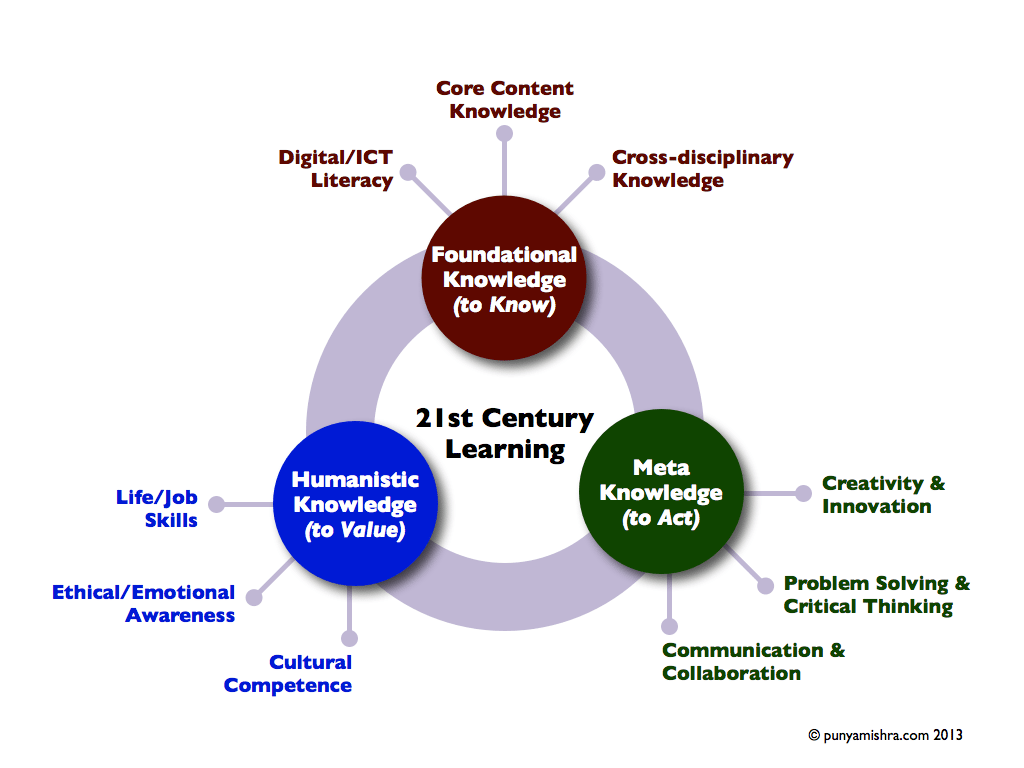
‘Los tres dominios cognitivos para el aprendiz del siglo XXI’ es un post que apareció recientemente en el blog TeachThought y que me han autorizado a reproducir aquí, lo que les agradezco. El gráfico fue presentado originalmente por punyamishra.com. Tiene mucha relación con los temas tecnológicos de los que venimos hablando y la modificación de las escuela que es imprescindible, a mi juicio, para que nuestros estudiantes se puedan enfrentar con éxito al desarrollo social y a su propio desarrollo personal.
21stcenturylearning-synthesis

Los tres grandes dominios cognitivos para el estudiante del siglo 21 serían...

1. Conocimientos fundamentales (saber)

Alfabetización Digital / TIC, Conocimientos de materias básicas, conocimiento interdisciplar.
 

2. El conocimiento humanístico (valorar)

Vida/destrezas para el trabajo, conciencia ética / emocional, Competencia Cultural
 

3. Meta Conocimiento (actuar)

La creatividad y la innovación, resolución de problemas y el pensamiento crítico, la comunicación y la colaboración
 

Uso de este modelo en la clase

La forma más sencilla de utilizar este tipo de modelo en la clase es considerarlo como una especie de marco para la planificación, ya sea en una unidad, lección o actividad. De esa manera, se podría tratar de tener un equilibrio entre los tres ámbitos de conocimiento, o una unidad muy enfocada al conocimiento humanístico (un estudio novedoso sobre la novela Matar a un ruiseñor, por ejemplo), mientras que otra unidad de aprendizaje basado en proyectos se centra en la metacognición.
 
Pero desde un nivel más amplio y quizás más subjetivo, este gráfico puede servir como un recordatorio simple de que nuestro trabajo como profesores debe ayudar a los estudiantes a entender cómo conocer, valorar y actuar independientemente a pesar de que la mayoría de estos dominios parece que van más allá de las herramientas comunes de evaluación en el aula .
 
La gran idea de todo aprendizaje puede entonces comenzar con el conocimiento, lo que conduce a la valoración, que informa a la acción en las comunidades pertinentes.
 
Pues nada que añadir, excepto que el tipo de profesor que necesitaremos para ayudar a estos aprendices del siglo XXI, tiene que ser un aprendiz como ellos y disponer de tiempo para interactuar con sus alumnos, más allá de «simplemente» impartir unas lecciones siendo eternamente un «sage on the stage«. ¿No nos suena esto al modelo de aprendizaje invertido frente al tradicional?

Fuente: http://www.javiertouron.es/2013/08/el-aprendiz-del-siglo-xxi.html

Comparte este contenido:
Page 1631 of 2504
1 1.629 1.630 1.631 1.632 1.633 2.504