USA / April 22, 2018 / Democracy Now
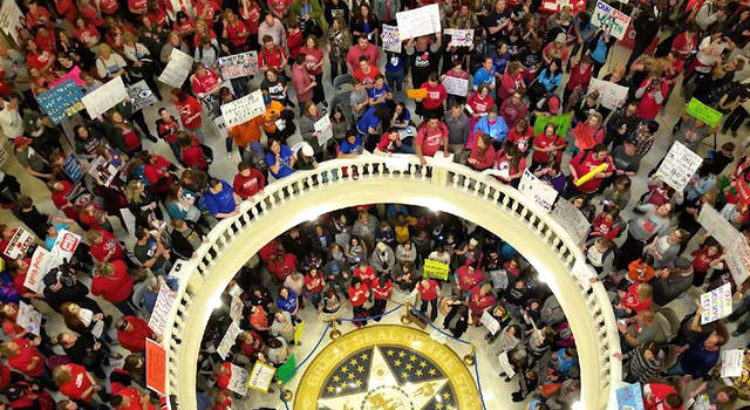
In the continuing teachers’ rebellion sweeping the U.S., dozens of Oklahoma teachers have completed a 7-day, 110-mile march from Tulsa to the state capital Oklahoma City. Public schools across Tulsa and Oklahoma City remain closed as thousands of teachers continue their strike for education funding into a ninth day. The strike comes as the Supreme Court is considering Janus v. AFSCME, a case that could deal a massive blow to public unions nationwide—and as President Trump is successfully appointing right-wing judges to federal courts, reshaping the judiciary for decades to come. We continue our conversation with Corey Robin, a professor of political science at Brooklyn College and the Graduate Center of the City University of New York. Robin calls the conservative movement “weak and incoherent” and the Democratic Party “a gutted machine,” and says labor organizing like the teachers’ revolt are the “real resistance” in the U.S. today.
Transcript
AMY GOODMAN: This is Democracy Now!, democracynow.org, The War and Peace Report. I’m Amy Goodman, with Nermeen Shaikh, as we continue with our guest, from Paul Ryan to what’s happening around the country in the conservative movement and those that are challenging it. Nermeen?
NERMEEN SHAIKH: Well, in Oklahoma, dozens of teachers have completed a 7-day, 110-mile march from Tulsa to the state capital Oklahoma City, where they will now meet with lawmakers to demand they pass legislation to fund education in Oklahoma. Public schools across Tulsa and Oklahoma City remain closed as thousands of teachers continue their strike into its ninth day.
AMY GOODMAN: Our guest Corey Robin recently wrote on Facebook, “In West Virginia, Oklahoma, Kentucky, and Arizona, we’re seeing the real resistance, the most profound and deepest attack on the basic assumptions of the contemporary governing order. These are the real midterms to be watching, the places where all the rules and expectations we’ve come to live under, not just since Trump’s election but since forever, are being completely scrambled and overturned.”
Professor Corey Robin, can you talk more about these teacher rebellions? I mean, you had the stoppage in Kentucky. You had West Virginia, and they won. You have now—you have now Oklahoma and then Arizona. We’re talking about Trump land here.
COREY ROBIN: I think it’s really important for a couple of reasons. Beyond the specific issues of teacher pay and classrooms and quality of public education, which is in such a parlous state, what these teachers are really doing is raising the question about the low-taxes, low-public-services politics that we have been living with in this country for a very long time.
I just want to bring this back for an historical analogy. If we went back to 1978—and this is why the midterm question is important—if you had looked at the midterm elections in 1978, you would have seen that the Democrats were still firmly in control of the House of Representatives, in the House, and the Senate, and in control of many state legislatures across the country. You would had very little inkling, just looking at the midterms, of the very profound right-wing counterrevolution that was coming in two years, in the election 1980. If, however, you had looked at what happened in California with Proposition 13, which was a public ballot initiative that basically made it very difficult to raise taxes anymore, there you would have have seen the future of American politics for the next half-century.
Likewise today, I think if you’re looking at what’s happening in Oklahoma, really, as you said, in the heart of Trump country, these teachers are saying—are saying something that is such a challenge to the Republican Party about taxes and spending, but also to the Democratic Party. I think it’s very important. Democrats have been terrified of being tagged as the tax-and-spend party, really since Walter Mondale. And what are these—and the only times Democrats are willing to raise taxes is to deal with the deficit or the debt. What are these teachers saying? They’re saying raise the capital gains tax, not to cut the debt or the deficit, not to be good government people, but instead to deliver vital public services that the public needs and wants. And I think that’s the real challenge that they’re posing.
AMY GOODMAN: I mean, this is such an astounding story that’s happening in Oklahoma. You have schools that are only operating four days a week, because they don’t have enough money for the fifth day, and the teachers don’t have enough money to teach for the fifth day, because they need second and third jobs. We had a teacher who taught—what—for 20 years, and so had her husband, and her husband, on his day off, he sells his own blood products.
COREY ROBIN: I mean, it’s horrible. But in a way, it’s just a very extreme version, I think, of what happens in a lot of states. I mean, I teach at the City University of New York. It used to be one of the crown jewels of the city and of the state. It has also been—systematically been underfunded and defunded, by both Republicans and Democrats alike. This is a national problem. What’s so amazing is that it’s being confronted in the place where you would think there would be the most support for it. And not only are they doing this—
AMY GOODMAN: You’re talking about Governor Cuomo, Democratic Governor Cuomo, here in New York.
COREY ROBIN: Yes, Democratic governor. And going way back to his father, as well, defunded CUNY, but—Mario Cuomo. But in Oklahoma, you know, these teachers are doing this, and they’ve got—it’s amazing to me, is that they’ve got overwhelming public support with what they’re doing.
NERMEEN SHAIKH: Well, has there been any precedent, is there any precedent, for this number of teachers’ strikes, or even public sector workers, in general, in the U.S.?
COREY ROBIN: I think, oh, there definitely have—I mean, public sector workers have really been in the forefront for the last 50 years—
NERMEEN SHAIKH: Right.
COREY ROBIN: —of leading strikes. In the 1970s, particularly women and people of color were in the vanguard of a lot of these efforts, in organizing public sector workers. And, in fact, one of the reasons you could say that the Republican right has been so—pushing so hard on this Janus decision, which would basically make it very hard for public sector unions, the Supreme Court decision, is precisely because they feel like that’s the last bastion of unionized workers, and they are workers that tend to be, compared to the rest of the workforce, overwhelmingly women and people of color.
AMY GOODMAN: And this is why judges are so important right now, and as you have Mitch McConnell saying, “The fight should be in the Senate. We’re going to lose the House,” he said—
COREY ROBIN: Yes.
AMY GOODMAN: —apparently this weekend, according to The Washington Post, that the fight is around the judiciary. And they are packing these courts.
COREY ROBIN: Yeah.
AMY GOODMAN: I mean, they do take this extremely seriously, for anyone who thinks that President Trump isn’t getting anything accomplished.
COREY ROBIN: I mean, this has been very clear from the early part of the Trump administration. They were—they bungled so many other things. But the one thing that, from the get-go, they knew how to do was to get the courts, the judges appointed. In fact, he’s been appointing judges at a faster rate than Barack Obama did, I think faster than George W. Bush did. But that tells you something, though, I think, not about the strength of the conservative movement and the Republican Party, but about its weakness. McConnell is very clear about this: “If we can just hold on to the Senate, we can have a lock on the courts, not just the Supreme Court, but the courts, for 30 to 40 years.” And remember, the judges they appoint, these are people who are, you know, in their fifties, in their forties, who will be with us for a very, very long time.
AMY GOODMAN: I mean, you have this judicial nominee, Vitter, Wendy Vitter—
COREY ROBIN: Yes.
AMY GOODMAN: —who worked for the archdiocese in Louisiana, who, when confronted by Senator Blumenthal yesterday about whether she supports this landmark Supreme Court decision, Brown v. Board of Education, challenging desegregation, she demurred. She said she wouldn’t say.
COREY ROBIN: Yes. Well, this is their—this is the big strategy all the conservative justices and nominees have been pioneering, really going back to Judge Bork in the 1980s, which is: Say nothing, make no statements whatsoever about your points of view. And you can present yourself as if you’re—you know, remember, Clarence Thomas said he had no opinion whatsoever on Roe v. Wade. He had never—he claimed he had never even had a conversation about Roe v. Wade, even though he was in law school when Roe v. Wade was decided. So this is a long-standing strategy, to say nothing about what your opinions are, and to get you in that way.
AMY GOODMAN: And you have Stephen Reinhardt now, who has just died, 9th Circuit Court of Appeals, a huge deal, was the last of President Jimmy Carter’s federal judicial appointees. Trump can now remake the 9th Circuit.
COREY ROBIN: Yeah. I mean, and this is—and this is really the goal. I mean, it’s been really astonishing, again, given the dysfunction and the disorganization that we’ve seen throughout this administration, their inability to pursue things on so many fronts, but when it comes to this, this is something that they’ve been very focused on, you know, almost maniacally so.
NERMEEN SHAIKH: Well, can you talk about, Corey, the rise of someone like Bernie Sanders and all the movements—the Occupy Wall Street movement, Black Lives Matter—in the context of what you were saying earlier, that these strikes are geared towards not just Republicans, or opposed not just Republican policies, but also Democrat policies?
COREY ROBIN: Yeah. So, you know, the—as I’ve said, the conservative party—the conservative movement in the Republican Party is quite weak, I think, and in part the reason why it’s so weak is because conservatism, you know, as a historical project, really was overwhelmingly successful. The fundamental target of conservatism, number one, was the labor movement, and, compared to what—the heyday of American labor, completely succeeded in destroying it. And the second target was the black freedom struggle, and they were very successful in destroying that struggle, as well. So, conservatism, I think we have to realize, has been very successful.
And what you’re seeing now, I think, on the left, in both Occupy, Bernie Sanders, the teacher strikes, Black Lives Matter, is a growing confrontation, within the left, a growing reckoning of how successful, in fact, conservatism has been, and how feckless and ineffective the Democratic Party and traditional liberalism has been in opposing this. And I think, frankly, the real story in American politics right now is not so much what’s happening with the Republican Party and the conservative movement, which, as I’ve said, is, by any historical measure, quite weak and incoherent, precisely because it was so victorious over the last several decades. I think the real story, the real question is: Is there going to be a force on the left, not just movements in the street, but an organized force that’s able to tip this house of cards over?
AMY GOODMAN: So, talk about that further, what exactly you mean, where you feel the Democratic Party is failing right now.
COREY ROBIN: Well, I mean, first of all, you can just look at the numbers. I mean, Bernie Sanders pointed this out in Mississippi the other day and got actually attacked for it. But the fact of the matter is, over the last 10 years the Democrats have lost nearly a thousand legislative seats. That’s, I think, the highest proportion of seats lost under a Democratic—a two-term Democratic president since at least maybe Dwight David Eisenhower. I mean, it’s—you oftentimes lose seats, but the proportions were just tremendous. And the Democratic Party as a whole is really a kind of gutted machine. I mean, the mere fact, I might say, that Bernie Sanders was able to get as far as he did in those primaries tells you how weak and sort of structureless and rudderless the Democratic Party is.
But I think the real question is, on the left: Do you have an ideology, a theory, a kind of set of accounts, similar, frankly, to what Ronald Reagan did in 1980 or FDR did in 1932? These are these two great realignment presidents—”great” not in the sense that I support Reagan, but, you know, powerful. And what they did was articulate a really profound, completely countervailing set of ideas and institutions, and were able to shatter the existing dispensation. I think that’s the question that’s on the table and that Bernie is sort of slowly pushing towards.
AMY GOODMAN: Well, Corey Robin, we thank you for this very interesting discussion, one we will continue, professor of political science at Brooklyn College and Graduate Center of the City University of New York, author of The Reactionary Mind: Conservatism from Edmund Burke to Donald Trump.
A very happy birthday to—a landmark birthday to Anna Özbek!
https://www.democracynow.org/2018/4/12/corey_robin_striking_teachers_are_real






 Users Today : 149
 Total Users : 35493177
 Views Today : 160
 Total views : 3611980