Europa/Alemania/25 Abril 2018/Fuente: Prensa Latina
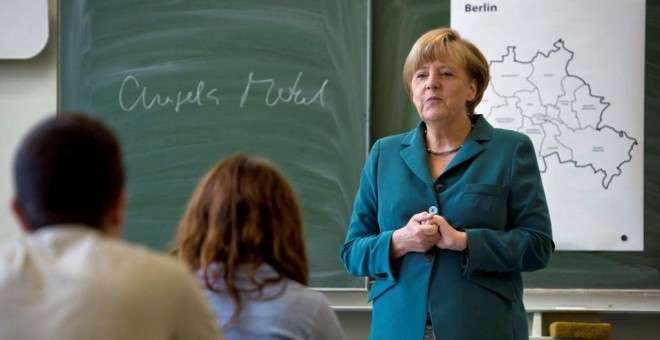
La canciller federal alemana, Angela Merkel, instó hoy a las jóvenes del país a estudiar carreras técnicas o científicas, mientras les recordó que estas profesiones tienen gran salida laboral.
En su habitual video-mensaje de los sábados, la mandataria resaltó que ella estudió física y lo hizo con gran alegría, pues con ‘una profesión de este tipo tendrán muy buenas posibilidades de trabajo’.
Merkel lamentó que aún muchas jóvenes en este país tengan prejuicios hacia materias como física, matemática y las carreras de ingeniería o las técnicas, en tanto optan por carreras consideradas tradicionalmente femeninas.
Por este motivo destacó la importancia del llamado Girls’ Day o Día de las Chicas, una iniciativa a nivel nacional que tendrá lugar el 26 de abril.
En esa ocasión, empresas, universidades y centros de investigación invitan a alumnas, a partir del quinto grado de educación, de 10 años de edad, a sus instalaciones para mostrarles las posibilidades que ofrece una carrera técnica o científica.
Asimismo, en 2011 quedó instaurado el Boys’Day o Día de los Chicos para que los jóvenes se familiaricen con profesiones asociadas históricamente con el rol femenino, como la de maestro o enfermero.
En prácticas laborales relacionadas con el sector social, por ejemplo, están empleados más mujeres que hombres.
El 8 de marzo, la canciller alemana reconoció los avances en el país en temas relacionados con la igualdad de género durante las últimas décadas, sin embargo insistió en la necesidad de impulsar más el trabajo contra la discriminación.
Merkel resaltó el Día Internacional de la Mujer como una oportunidad para valorar lo logros obtenidos por este grupo poblacional y llamó a la población a continuar la lucha por sus derechos.
Anteriormente, la líder germana recibió el Premio Internacional de Igualdad de Género de Finlandia, que incluye una dotación de 150 mil euros para reforzar iniciativas de equidad.
Con motivo de ese galardón, la mandataria denunció las deficiencias evidentes aún en el empoderamiento político y económico de las mujeres en el mundo.
Recordó que la igualdad entre ambos sexos es uno de objetivos principales de la Agenda 2030 para el Desarrollo Sostenible.
Europa/Alemania/26 Abril 2018/Fuente: El espectador
El 50% de la fuerza laboral de Alemania ha sido criada en el modelo educativo de la «Formación Profesional Dual», que está en el país germano desde hace dos siglos.
Cuando los niños cumplen once años, los profesores de los colegios alemanes, dividen a los niños en tres grupos según su velocidad de aprendizaje y sus notas.
Los más aventajados van al gymnasium, que los conduce al bachillerato y luego a la Universidad. A los otros dos grupos se les educa para oficios más técnicos.
Aunque parece una distopía similar a la película de culto Gattaca (1997) en donde los niños son separados en castas por inteligencia superior, salud, etc., no es ciencia ficción. Es el modelo educativo que ha regido en Alemania desde el siglo XIX, y aparentemente funciona muy bien.
De acuerdo con El País de España, estas divisiones no son tajantes. Los padres tienen la opción de elegir el recorrido académico del niño (que recordemos, tiene 10 años), independientemente de lo que digan sus profesores.
Los otros dos grupos, el realschule y el hauptschule, son escuelas de nivel medio que los adolescentes finalizan cuando tienen 16 y que los forman para profesiones técnicas. Los módulos se llaman “Formación profesional” y “Formación Profesional Dual”, y a vuelo de pájaro, consiste en compaginar dos años de estudios con prácticas en una empresa.
No es que los niños que van al realschule o al hauptschule (que traducirían algo como escuela secundaria) pueden presentar la prueba para entrar a cualquier universidad alemana, pero no a los 18, sino a los 21 (después de matricularse en una extensión del bachillerato que dura 3 años).
Parece un modelo organizado, sin embargo, no restrictivo, pues les permite a todos entrar en la universidad. ¿Qué es exactamente lo que funciona en este modelo educativo, que tiene una tasa de deserción escolar del 10%, comparada con una del 11% en la Unión Europea, y un 30.7% en Colombia?
Según El País, «no se puede afirmar que el sistema educativo alemán es eficiente por su tasa de abandono escolar, porque otros países como Polonia que emplean un modelo comprensivo, en el que los estudiantes permanecen juntos hasta los 16 años, tienen indicadores más bajos (un 5,3%)», señala Enric Prats, profesor del departamento de Teoría e Historia de la Educación de la Universidad de Barcelona. Desde el punto de vista pedagógico, explica Prats, se desconoce cuál es la mejor edad para dividir a los niños en función de sus capacidades y del recorrido académico que encaja con cada uno.
En países como España, el modelo “FP Dual”
De acuerdo con algunos expertos consultados por el diario español, el sistema educativo alemán funciona porque se empalma con el sector empresarial, de modo que los niños que están “destinados” al estudio tienen asegurada una plaza para ese oficio, y los que están llamados a aprender oficios tienen un espacio en el mundo laboral. Otros consideran que condiciona las expectativas que los niños tienen sobre sí mismos. La desigualdad académica significa menos en un sistema organizado así. Las condiciones socioeconómicas y de origen de las familias en las que crecen los niños también juegan un papel.
De cualquier manera, el modelo educativo alemán parece estar funcionando. La tasa de desempleo para jóvenes menores de 25 años fue de 6.2% para 2017, y según el gobierno federal alemán, el 50% de la fuerza laboral alemana se educó bajo ese modelo. Según El País, el 68% de los alumnos de FP Dual consiguen un contrato una vez que finalizan el programa.
España/24 de abril de 2018/Fuente: https://www.libremercado.com
El Ministerio de Educación ha publicado recientemente el anuario Las cifras de la educación en Españasobre el curso académico 2015-2016 que incluye un apartado con diversas estadísticas internacionales sobre los resultados de los alumnos, la tasa de abandono escolar o el gasto en Educación a partir de fuentes como la Asociación Internacional para la Evaluación del Rendimiento Educativo o Eurostat y que muestra un panorama con áreas importantes de mejora.
Abandono escolar y exceso de universitarios
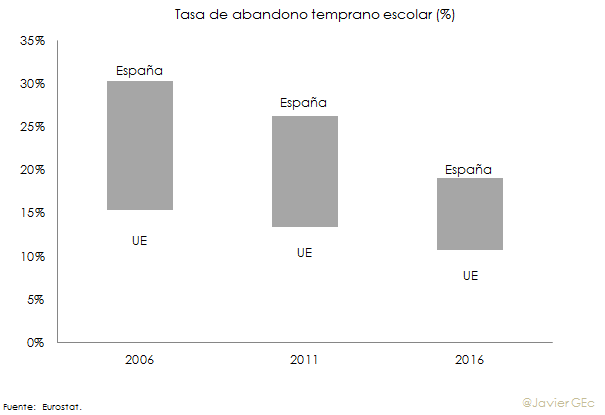
España ha sufrido históricamente una tasa de abandono -definida como la proporción de la población de 18 a 24 años que no ha completado la Educación Secundaria- superior a la media de la Unión Europea. Antes de la crisis afectaba al 30%, el doble que el promedio de la UE. Desde entonces, dicha tasa ha descendido en toda Europa, por lo que en 2016, si bien había descendido en España hasta el 19%, seguía siendo el doble del de la UE. Además, la posición relativa ha empeorado: mientras que en 2006 Portugal y Malta tenían una tasa superior, diez años después únicamente la segunda, y por unas décimas, estaba en una peor situación en 2016.
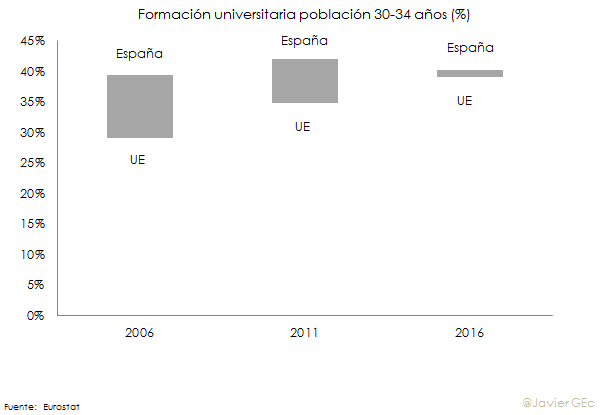
Otro indicador que la UE toma como referencia de los sistemas educativos es el porcentaje de población de 30 a 34 años con formación superior. En este aspecto, el sistema español obtiene un registro superior a la media, reduciéndose eso sí el diferencial favorable a España desde 10 puntos porcentuales en 2006 a casi converger en 2016 en el 40%.
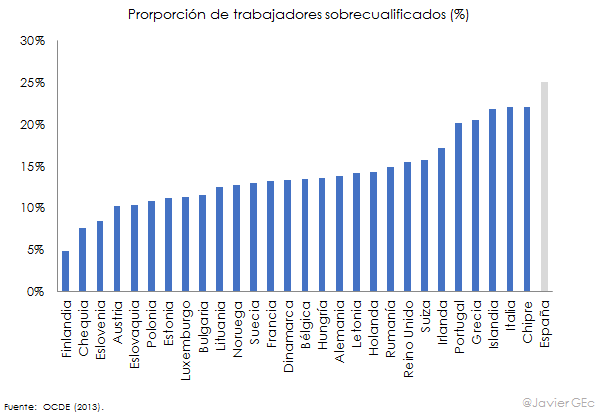
Esa convergencia se ha producido tras un continuo crecimiento en la UE y un estancamiento en España, que en su caso tiene sentido dado la elevada sobre cualificación del trabajador español, cuya tasa es la mayor de la OCDE. El hecho de que uno de cada cuatro trabajadores desempeñe una función por debajo de su formación puede ser una señal de que el número de universitarios es excesivo para la demanda del mercado laboral, por lo que, en ese contexto, una elevada ratio de población con formación superior puede no considerarse un factor positivo.
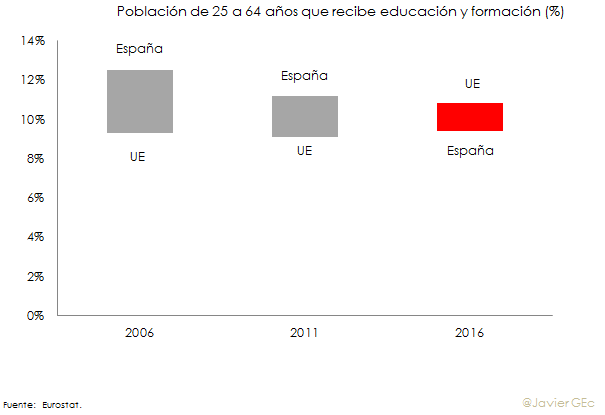
Por último, una tercera referencia es la población que recibe algún tipo de formación y, en este caso, los resultados tampoco invitan al optimismo, puesto que el diferencial favorable español se ha revertido recientemente.
Gasto relativamente bajo
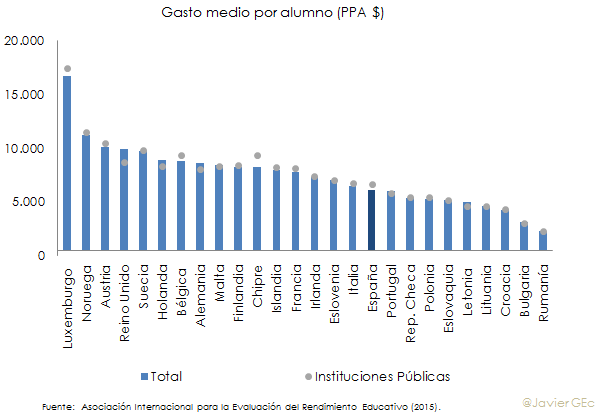
El gasto -aunque mejor habría que hablar de inversión por el retorno futuro que genera- por alumno medido en términos equivalentes de poder adquisitivo es de 6.173 euros y se sitúa en la parte medio-baja, por detrás de Italia (6.503 euros por alumno) y, especialmente, de Francia o Alemania (7.783 y 8.599 euros respectivamente). Con un nivel de gasto inferior se sitúan los países del Este de Europa y Portugal.
El bajo gasto en España se explica por el reducido gasto en las etapas previas a la Universidad, dado que en la formación de grado Superior se sitúa en la media (posición 14 de 28 países). Otro aspecto a destacar es que el gasto por alumno es mayor en la enseñanza pública que en la concertada privada, cuando lo normal en el resto de países es lo contrario, posiblemente debido, entre otros motivos, a que la concertada y privada está más extendida en España para la Educación Primaria y Secundaria.
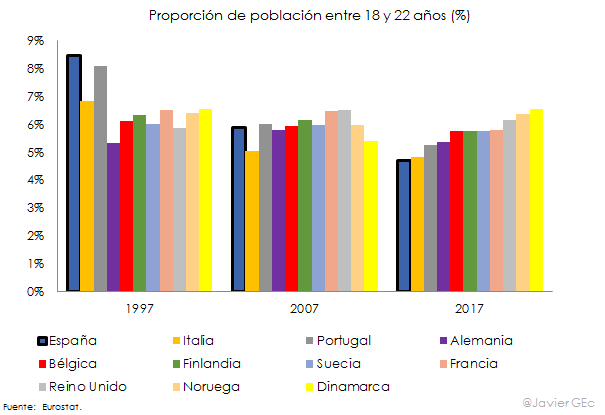
Otro parámetro de medición, como es el gasto público sobre el PIB, sí se sitúa entre los más bajos de la UE (posición 19 de 23 países), si bien, en este caso, hay que considerar el factor demográfico. En España, el peso de la población en edad de 18 a 22 años es el cuarto menor sobre 34 países europeos y, lo que es más preocupante, es un 45% menor al de hace 20 años: mientras en 1997 la proporción de población joven en España era superior a la de Reino Unido, Francia, Alemania o Suecia, en 2017 es inferior al de todos estos países.
Bajo rendimiento escolar
Mientras que existe un factor demográfico preocupante por el envejecimiento de la población, el rendimiento de los estudiantes tampoco ofrece noticias nada positivas. La IEA (Asociación Internacional para la Evaluación del Rendimiento Educativo) elabora los proyectos TIMSS en materia de números (Matemáticas y Ciencias) y PIRLS en comprensión lectora, que son, junto a PISA, los más conocidos de evaluación internacional de la calidad de los sistemas educativos.
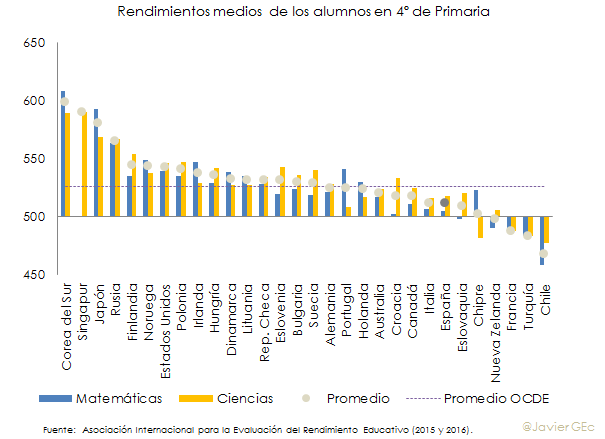
Los resultados de los alumnos de 4º de primaria se encuentran por debajo del promedio de la OCDE, y sobre un total de 30 países los estudiantes españoles ocupan la posición 24. En esta clasificación, los mejores resultados son para tres países asiáticos -Corea del Sur, Singapur y Japón-, seguidos de Rusia, países nórdicos -Finlandia y Noruega- y Estados Unidos. Entre los países con peores resultados están Francia, Turquía y Chile.
Resultados muy mejorables
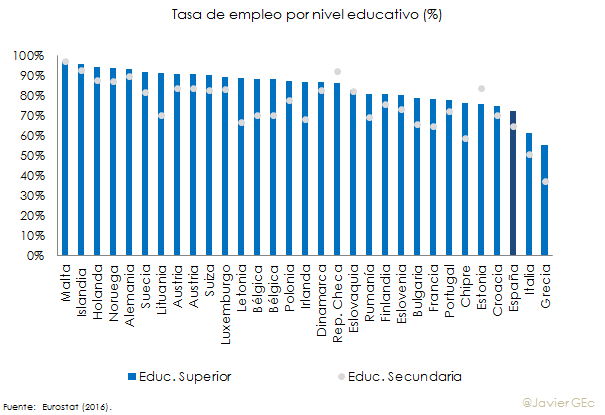
En el entorno europeo, el sistema educativo español se caracteriza por una tasa de abandono escolar muy alta, un rendimiento bajo de sus estudiantes, un gasto moderado y una elevada proporción de universitarios que provoca una frecuente sobre cualificación y una tasa de empleo entre los trabajadores con formación superior que únicamente es menor en Italia y Grecia.
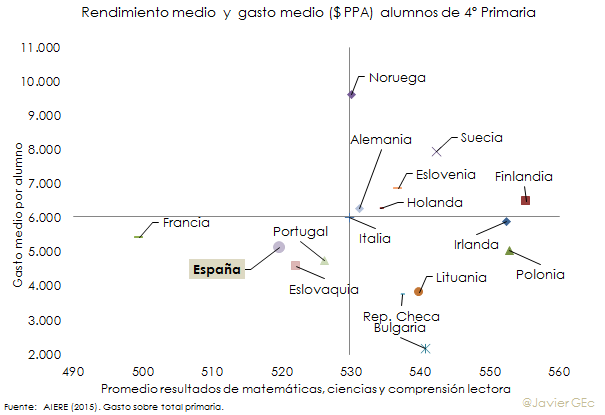
En cuanto al gasto, que incluye tanto el público como el concertado y privado, podría incrementarse con el objetivo de mejorar el rendimiento y, de esta forma, situarse en el cuadrante superior derecho del siguiente gráfico junto a Suecia, Alemania u Holanda.
En definitiva, existen datos que muestran un sistema educativo en España que no funciona del todo bien. Una posible solución, aunque no la única, es un incremento del gasto por alumno, quizá no tanto en número de profesores, puesto que el promedio de alumnos por profesor en España es de 12,6 vs 14,2 en la OCDE, sino en sus medios, en las fases anteriores a la Educación Superior, así como un replanteamiento sobre cuál es la demanda del mercado laboral -estudiantes con una Formación Profesional más adaptada a las necesidades de las empresas antes que universitarios-.
Alemania/24 de abril de 2018/Fuente: https://www.lanacion.com.ar/
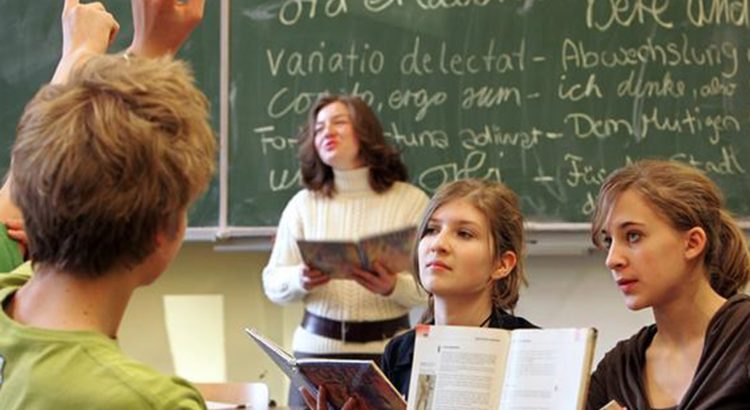
En Alemania, cuando los chicos y las chicas cumplen once años, el sistema educativo los divide en tres grupos de acuerdo a sus notas y de su velocidad de aprendizaje. Un grupo será el que continúe con su formación en el gymnasiumpara luego pasar al bachillerato y preparase para el acceso a la Universidad, mientras que el resto estudiará profesiones más técnicas.
Si bien no es un concepto nuevo (se implantó en 1969) y cada uno de los 16 estados federados alemanes tiene su propia normativa educativa, esta modalidad causa polémica ya que los chicos y las chicas son aún muy pequeños y eso marcará su futuro. Detlev Flottmann, director del colegio público Astrid Lindgren, en la localidad de Marienfeld, señaló al diario El País que «lo ideal sería que todos permaneciesen juntos hasta los 16 años para que los más inteligentes motivasen a los más rezagados. Pero los buenos se relajarían y no llegarían a los niveles de excelencia requeridos».
Según detalla, en función de las notas, los profesores generan un informe y ahí se determina si el estudiante continuará en el camino a la Universidad o irán a realschule o hauptschule, escuelas de nivel medio que finalizan con 16 años y en donde estudian profesiones más técnicas. Si bien dichos alumnado puede postularse para ingresar a la Universidad, lo pueden hacer recién a los 21 años en vez de a los 18.
Alemania tuvo una tasa de abandono escolar del 10,1% en 2015, inferior a la media europea que se situó en el 11% según datos de Eurostat. «No se puede afirmar que el sistema educativo alemán es eficiente por su tasa de abandono escolar, porque otros países como Polonia que emplean un modelo comprensivo, en el que los estudiantes permanecen juntos hasta los 16 años, tienen indicadores más bajos», señala Enric Prats, profesor del departamento de Teoría e Historia de la Educación de la Universidad de Barcelona.
Desde el punto de vista pedagógico, explica Prats, se desconoce cuál es la mejor edad para dividir a los niños en función de sus capacidades y del recorrido académico que encaja con cada uno.
El modelo, aunque criticado, en números es exitoso. ¿La clave? Su sistema de orientación académica que sabe identificar en qué tipo de estudios encaja cada alumno y alumna. «En España sería un fracaso absoluto. Es una cuestión de cultura: cuando tienen ocho años ya saben que se tomará la decisión y se preparan para ello», sostiene Prats y nombra al país hispano ya que tiene una tasa de abandono escolar del 20%.
Por su parte, Carmen Pellicer, presidenta de la Fundación Trilema -centrada en la difusión de nuevas pedagogías- y coautora del Libro Blanco de la Profesión Docente, considera que ese sistema condiciona las expectativas del alumnado y que puede mermar su autoestima. «Van a vivir durante toda su vida en una sociedad diversa y la escuela tiene que prepararles para ello, la desigualdad no puede ser el precio a pagar por la eficacia académica», sostiene.
Otra de las cifras que destacan el éxito de este sistema es la baja tasa de desempleo juvenil entre los menores de 25 años que es, en Alemania, de un 6,2% en 2017, mientras que, la española, está en 37,4%-. El Gobierno alemán señala que la Formación Profesional Dual es clave en la obtención de ese resultado.
España/ 24 de abril de 2018/Por: Europa Press/Fuente: https://www.20minutos.es
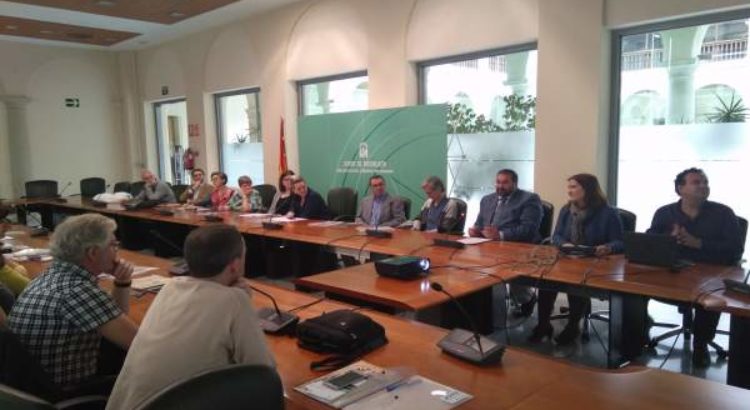
La sede de la Junta de Andalucía en Granada ha acogido una reunión de docentes de diversos países europeos interesados por el modelo educativo andaluz en ámbitos como las metodologías innovadoras para motivar la enseñanza en prisiones.
El delegado de Educación de la Junta en Granada, Germán González, mantuvo un primer encuentro con un grupo de docentes procedentes de Lituania, Noruega y Bélgica que llegan a la provincia para intercambiar prácticas educativas innovadoras que «motiven a la población reclusa en centros penitenciarios», como el de Albolote o el Centro de Inserción Social Matilde Cantos, cuyos alumnos «se hallan matriculados en el Centro de Educación Permanente Concepción Arenal».
«El objetivo final es mejorar los niveles de titulación y promoción en el marco de un modelo educativo inclusivo y adaptado a las características de este alumnado, aumentando así las posibilidades de inserción social y laboral tras el periodo de internamiento», ha explicado Germán González en una nota de prensa.
Ha destacado la dimensión internacional y el carácter innovador del Concepción Arenal, que, con este proyecto, «da continuidad a los realizados en cursos anteriores con prisiones suizas, potenciando aspectos como la aplicación de nuevas tecnologías en el ámbito penitenciario, o la adaptación lingüística de internos extranjeros, así como otros aspectos pedagógicos y organizativos».
Asimismo, ha acudido a la Delegación de Educación un grupo de docentes checos interesados en la incidencia de la escuela en el desarrollo social y cultural de Europa, atendiendo a aspectos como «la educación ambiental, el desarrollo sostenible, la interculturalidad, la acogida lingüística de alumnado inmigrante».
González ha agradecido a la delegación checa su interés por exportar a su país elementos del sistema educativo andaluz, «cuya incidencia en el desarrollo social es crucial, a través de un sistema inclusivo que potencia la educación en valores constituyéndose como una importante herramienta de transformación basada en la equidad y la creación de oportunidades para toda la ciudadanía».
UNESCO/ 24 de abril de 2018/Fuente: https://es.unesco.org
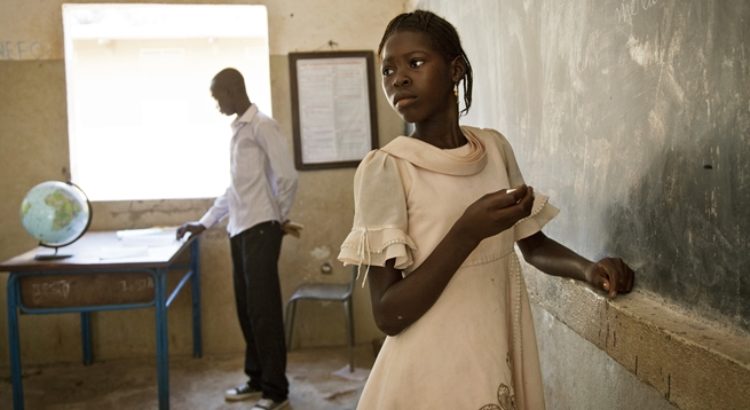
El violento intento de asesinato perpetrado contra una adolescente pakistaní y activista pro educación de las niñas, Malala Yousafzai, inspiró la creación del Fondo Malala de la UNESCO para el derecho de las niñas a recibir educación. El fondo, que forma parte de la Alianza Mundial para la educación de las niñas y mujeres «Una vida mejor, un futuro mejor», fue creado en 2012 con el objetivo de ampliar el acceso de las niñas a una educación de calidad sensible a las cuestiones relativas al género, así como de garantizar entornos de aprendizaje seguro, en particular en los países afectados por conflictos y desastres. La República Islámica de Pakistán aportó una contribución inicial de 10 millones de dólares estadounidenses y, a partir de 2014, el Grupo CJ se convirtió en uno de sus mayores contribuyentes del Fondo, al igual que otros coloboradores.
Objetivos del fondo
El Fondo brinda apoyo en la implementación de programas holísticos que tienen por objeto:
Ampliar el acceso a la educación para las niñas y mujeres, especialmente aquéllas a las que es más difícil llegar y que han sido afectadas por conflictos y desastres.
Mejorar la calidad y el papel de la educación, garantizando que el contenido, las prácticas de enseñanza, los procesos y entornos de aprendizaje sean sensibles al género
Reforzar la política y la capacidad para garantizar entornos de aprendizaje seguros
Ejemplos
Camboya
La UNESCO refuerza las capacidades de lectoescritura de 1,760 jóvenes trabajadoras del sector textil en 22 fábricas de ropa en Phnom Penh y Siem Reap con miras a mejorar su calidad de vida. Se han elaborado materiales didácticos para facilitar la implementación sostenible de programas de lectroescritura en algunas fábricas a lo largo de Camboya.
Egipto
La UNESCO refuerza las habilidades en lectoescritura de 600 mujeres y niñas, así como las competencias necesarias para la vida en cuestiones de salud, modos de subsistencia y participación ciudadana mediante 12 Centros de Aprendizaje Comunitarios (CLCs por sus siglas en inglés). Asimismo, puso en marcha y concluyó un programa de formación de formadores con 124 instructores y monitores de lectoescritura en seis provincias.
Mauritania
A la vez que la UNESCO amplía la educación y desarrolla las oportunidades y la adquisición de competencias de 300 niñas y mujeres por conducto de los CLC, promueve la reincersión en la enseñanza formal de educandos que han abandonado la escuela a fin de mejorar su poder adquisitivo y situación socioeconómica.
Mozambique
La UNESCO está enfrascada en empoderar y mejorar las capacidades de lectoescritura de los padres y tutores en aras de contribuir al aprendizaje de los niños y al desarrollo de sus habilidades. Más de 50 técnicos (las mujeres representan el 42 por ciento) han recibido una formación en materia de desarrollo de las capacidades de lectoescritura en el ámbito familiar y ha elegido a más de 580 beneficiarios (las mujeres representan 95 por ciento) y 18 maestros de lectoescritura. Trece cursos utilizan programas regulares de lectoescritura que favorizan a unos 475 estudiantes (las mujeres representan el 71 por ciento).
Nepal (Proyecto I)
La UNESCO garantiza el desarrollo de las capacidades de más de 160 directores de escuelas en materia de presupuesto, liderazgo y gestión escolar sensibles a las cuestiones de igualdad de género, y garantiza el empoderamiento de unas 100 niñas y mujeres a las que permite desarrollar habilidades para generar los ingresos adecuados en el plano local, y las pone en relación con los programas de búsqueda de empleo.
Nepal (Proyecto II)
La UNESCO mejora la calidad y garantiza la pertinencia en materia de educación de las niñas en los seis distritos más afectados por el terremoto de Nepal, mediante cursos de formación impartidos a 600 proveedores de servicios educativos, en el marco de la enseñanza compatible con las cuestiones de igualdad de género. De este modo, refuerza las capacidades de 100 escuelas y CLC en asesoramiento de las niñas, así como la formación de más de 1,000 mujeres y adolescentes con miras a que desarrollen aptitudes generadoras de ingresos.
Pakistán
Desde 2014, el Programa UNESCO para el derecho de las niñas a la educación apoya los esfuerzos de Pakistán para aumentar el acceso y mejorar la calidad de la educación primaria de 40,000 niñas en nueve regiones en el plano nacional y provincial, mediante el fortalecimiento de capacidades y por conducto de intervenciones específicas en el ámbito institucional y comunitario, y en particular en las comunidades marginadas. Se espera que 60,000 miembros de la comunidad se conviertan en defensores de la educación de las niñas. Además, 600 maestros recibirán capacitación en una enseñanza multigrado y en aprendizaje basado en la actividad, y 35 funcionarios locales de educación mejorarán su capacidad de liderazgo y de gestión educativa.
República Unida de Tanzania
La UNESCO amplía el número de contextos de aprendizaje seguro, promueve el empoderamiento de las niñas y trabaja para vencer la resistencia de las comunidades con respecto a la educación de las niñas. Más de 5,000 niñas han sido beneficiadas mediante la creación de 60 contextos seguros, y se consultó a más de 400 líderes comunitarios, religiosos y tradicionales en aras de definir las cuestiones fundamentales que repercuten en la educación de las niñas. Se reconocieron veinte líderes (entre los que figuran imames) como los paladines en problemáticas tales como el matrimonio infantil y el embarazo precoz. Asimismo, cuarenta directores, docentes y funcionarios educativos de distritos recibieron una formación pedagógica afín a las cuestiones de igualdad con miras a promover la inclusión de las niñas.
Viet Nam
La UNESCO incorpora las cuestiones de género en la planificación, gestión y provisión de servicios en el sector educativo y respalda, mediante intervenciones en los medios de comunicación, los cambios en las normas de género. El Ministerio de Educacion y Formación ha implementado un Plan de Acción para la igualdad de género en el sector educativo para el período 2016-2020. Cincuenta profesionales (8 hombres y 42 mujeres) pertenecientes a 18 agencias de medios de comunicación adquirieron nuevas competencias para mejorar los aspectos de comunicación relativos a las cuestiones de igualdad de género. Asimismo, 49 estudiantes de escuelas secundarias (29 niñas y 20 niños) aumentaron sus capacidad como jóvenes periodistas en la realización de reportajes sobre las problemáticas relativas al género. Los responsables de elaborar planes de estudio y manuales (34 hombres y 70 mujeres) reforzaron la capacidad de integrar las cuestiones de género en sus programas y libros de texto.
Nigeria
La UNESCO trabaja con miras a crear contextos de aprendizaje seguro y de paz en las regiones afectadas por conflictos violentos y secuestros en las escuelas. Más de 100 escuelas de primaria, secundaria básica y secundaria superior resultaron favorecidas por los talleres impartidos en materia de medidas de seguridad, y recibieron, además, materiales educativos, y en particular, 2,000 carpetas de seguridad escolares.
Guatemala
La UNESCO está ampliando la educación de más de 500 niñas, adolescentes y mujeres indígenas en el altiplano occidental de Guatemala. El proyecto también tendrá beneficios más amplios a largo plazo, llegando a 40,000 escuelas, más de 1 millón de estudiantes guatemaltecas y 650,000 adolescentes y mujeres jóvenes indígenas en todo Guatemala.
Contacto
Para obtener información adicional o contribuir al Fondo Malala de la UNESCO para el derecho a la educación de las niñas, puede escribir a: gender.ed@unesco.org
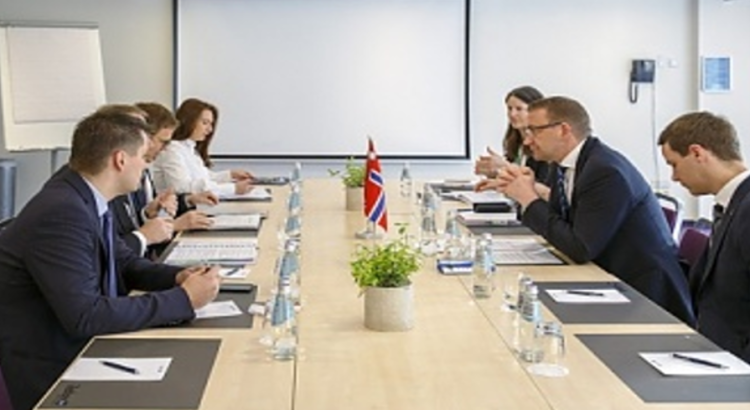
Latvia and Norway have the potential for expanding cooperation on start-ups, innovation, education and tourism, Latvian Economics Minister Arvils Aseradens (Unity) said while meeting with Roy Angelvik, the Norwegian State Secretary of the Ministry of Trade, Industry and Fisheries, on April 23rd, reports LETA.
LETA was told at the Economics Ministry that the meeting between Aseradens and Angelvik dealt with bilateral cooperation as well as possibilities of expanding this cooperation.
«Latvia appreciates the successful regional and economic cooperation with Norway. Moreover, our countries share the same values and goals – to develop the Baltic and Nordic countries as an affluent and secure region of Europe in the long term,» Aseradens said during the meeting.
Both Angelvik and Aseradens noted that it is important to both countries to develop cooperation on start-up businesses and innovation. At the same time, officials also voiced interest in developing educational cooperation, including professional education, particularly by developing joint study and student exchange programs.
Aseradens praised existing Latvian-Norwegian cooperation on the regional level, stressing the need to move towards closer Baltic-Nordic regional integration, especially in areas like energy, innovation, construction and green technology. The minister also thanked Norway for its contribution to the Baltic region’s security.
Aseradens also noted the significance of Norway Grants program, which has helped deepen bilateral toes and find new cooperation opportunities, including for Latvia’s SMEs to develop innovative, environmentally-friendly products, technologies and services. Norway Grants have supported 102 projects, as well as helped create 126 new jobs and develop 40 environmentally-friendly products and technologies.
Aseradens indicated that many Latvian construction companies are operating in the Norwegian market and that it is therefore important to align the two countries’ construction standards and requirements.
Angelvik, on his part, said that Norway wants to develop more expensive cooperation with Latvia on tourism, which is essential for the region’s further development.
After the meeting with Angelvik, Aseradens opened the Norwegian-Latvian business forum which had brought together more than 300 entrepreneurs from Norway, Norwegian entrepreneurs already doing business in Latvia, as well as Latvian entrepreneurs interested in building business contacts with Norwegians or starting a business in Norway.
As reported, the Norwegian-Latvian business forum has been organized as part of the visit of Crown Prince Haakon and Crown Princess Mette-Marit of Norway to Latvia.
OtrasVocesenEducacion.org existe gracias al esfuerzo voluntario e independiente de un pequeño grupo de docentes que decidimos soñar con un espacio abierto de intercambio y debate.
¡Ayúdanos a mantener abiertas las puertas de esta aula!


 Users Today : 87
 Total Users : 35490784
 Views Today : 120
 Total views : 3604188