Page 1794 of 6820
1 1.792 1.793 1.794 1.795 1.796 6.820

Nueva jornada de huelga y movilizaciones en Francia

Nueva jornada de huelga y movilizaciones en Francia

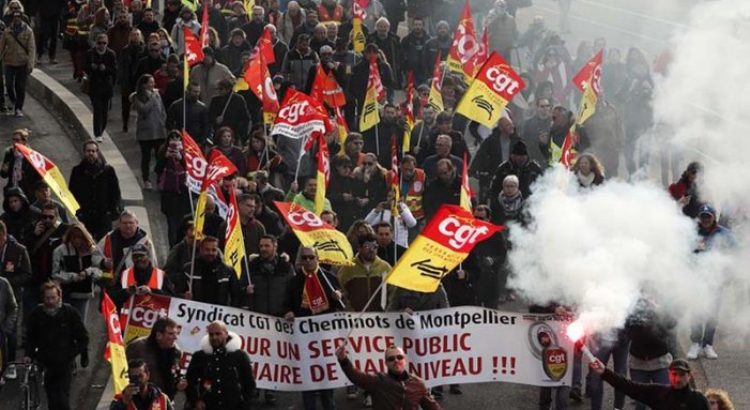
Trabajadores de trenes, buses, metro y aviones, además de los trabajadores de la educación y sectores de empresas privadas, así como las refinerías, se plegaron a la huelga contra la reforma laboral de Macron paralizando el país desde hace casi una semana, mientras se prepara para este martes una nueva jornada de movilización y huelga nacional convocada por las centrales sindicales CGT-FO y otros sindicatos. El pasado jueves 5, día de inicio de la huelga se manifestaron hasta 1.500.000 personas en las calles de todo el país.

Seguiremos toda la jornada en vivo y directo con nuestros corresponsales en diferentes ciudades de Francia.

16:15 – La juventud salió con fuerza en las principales ciudades

En las principales ciudades lo novedoso es una mayor movilización de jóvenes y estudiantes. En Toulouse estudiantes universitarios se vienen movilizando contra la precariedad de los estudios y la precariedad de la vida.
En la Asamblea General de estudiantes, trabajadores y docentes de la universidad Mirail, los profesores votaron renovar la huelga hasta el viernes y llamaron a todos los sectores a reagruparse en una asamblea interprofesional (intersectorial, sin importar el sindicato o sector al que pertenezcan).

Video insertado

15:30 – Miles de trabajadores y estudiantes se movilizan en Francia

Estudiantes parisinos bloquearon los colegios y fueron reprimidos por la Policía. Pasado el mediodía llegaron el centro de París donde se juntaron con trabajadores ferroviarios y del metro. Especial para La Izquierda Diario, informan Josebine y Homa, militantes de Pan y Rosas Francia.

Video insertado

15:10 – Marcha y asamblea docente en Toulouse

En Toulouse comenzó la marcha con docentes y ferroviarios. Se desarrollaron asambleas de profesores y estudiantes. En la mañana de este martes una asamblea de 270 docentes votó continuar la huelga. #greve10decembre
Informan Eufi y Julien, especial para red La Izquierda Diario.

Video insertado

Los ferroviarios combativosde París: «seguiremos hasta tirar abajo esta reforma de Macron»

El diario francés Liberatión informa del clima combativo en una asamblea de los ferroviarios en la Gare du nord, una de las estaciones de trenes más grandes de París.

«Emmanuel Macron, te vamos a joder con tu reforma», «¡Y son ardientes, y son ardientes, los ferroviarios!» Los empleados de la SNCF llegaron al centro de la Gare du Nord al mediodía cantando y bailando, decididos a calentar y a poner un poco de brillo en el movimiento social. El resto del día promete una marcha importante por las calles de París, ya que en ausencia de transporte público, tendrán que caminar bastante hasta el inicio de la manifestación, situado en la plaza Vauban. No lo suficiente para desalentar a los trabajadores ferroviarios después de una asamblea general realizada en 45 minutos cronometrados. La prolongación de la huelga hasta el miércoles no fue objeto de debate, ni tampoco lo fue la consigna: la retirada total del proyecto de reforma de las pensiones dirigido por Jean-Paul Delevoye.

«No caeremos en la trampa de la división y las negociaciones por ramas o cualquier otra cosa», resume Karim. Anasse Kazib, activista de Sud Rail, apoya: «Hoy tenemos que meternos en la cabeza que podemos ganar y que lo lograremos entrando en un movimiento duro. «¡No hay forma de que la burocracia sindical se coma este movimiento de la base!» Gauthier, delegado de la FO, quiere «presionar» a los «minoritarios» maquinistas que siguen trabajando. «Mercenarios que quieren romper la huelga», dice.>>

14:10 – Los docentes ya están en la marcha

Los trabajadores y trabajadoras de la educación ya llegaron a la movilización de este martes en París.
Esta mañana una asamblea general de docentes de Montreuil Bagnolet, en la periferia de París, votó por unanimidad renovar y continuar la huelga.

13:50 – Trabajadores de la empresa de electricidad endurecen la huelga

Los huelguistas de la empresa de electricidad francesa (EDF) de Cordemais, en Loire Atlantique, ocupan la sala de control de una planta evitando el inicio de 2 unidades de producción. La huelga se endurece!

La semana pasada la empresa limitó y supervisó el ingreso y egreso del personal para evitar que los huelguistas tomen las instalaciones. Este lunes los trabajadores se adelantaron y tomaron algunas de las salas de control de la planta de energía Cordemais en Loire Atlantique, para garantizar que este martes se cumpla la paralización.

Además los trabajadores votaron la extensión de la huelga y ocupación de la planta hasta el jueves.

13:30 – La huelga general se siente con fuerza, mientras comienzan las movilizaciones

Trenes, aviones, abogados, camioneros, ferroviarios, recolectores de la basura, bomberos, trabajadores de emergencia, de las refinerías y de la empresa de electricidad, taxistas, chalecos amarillos, maestros, de los correos… Francia se está movilizando contra la reforma de las pensiones de Macron #GreveGenerale
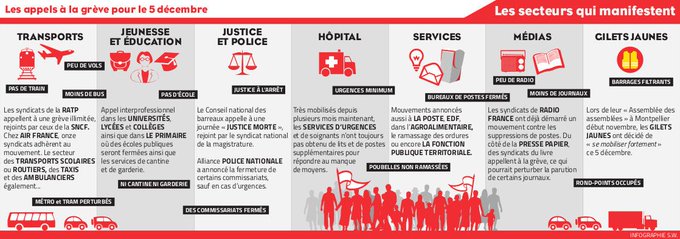
Ver imagen en Twitter

Jornada de movilizaciones

Comenzaron las manifestaciones en varias ciudades de Francia: Vannes, Rennes, Saint-Etienne, Châtellerault, Tours, Bayonne, Limoges, Guéret, Avignon, Privas, Bourges, Caen y Lille.

12:50. 150.000 personas marchan en Marsella

Muy numerosa la manifestación en esta ciudad francesa, en un cortejo que ha comenzado a las 11:30 y aún no termina.

12:10. Ferroviarios París votan prolongar la huelga.

Los huelguistas ferroviarios de la Estación Norte de París (Gare du Nord) han votado hace instantes la prolongación de la huelga hasta lograr tirar abajo el plan de contrarerforma de las pensiones del gobierno de Macron.

12:00. Estudiantes secundarios son gaseados por la policía en Lille

11:30. Comienzan manifestaciones en Havre, Rennes y otras ciudades

Los combativos portuarios de Le Havre se unen a los manifestantes al inicio de la marcha en esa ciudad, considerada «capital de la huelga» en años anteriores.

11:15. Refinerías paralizadas

Siete de las ocho refinerías francesas están bloqueadas hoy, según la CGT.

Se esperan manifestaciones masivas desde las 12 horas

Se espera que cientos de miles de personas vuelvan a manifestarse este martes contra el proyecto de reforma de las pensiones de Macron. La huelga se mantiene masiva en el transporte público en Francia, particularmente en la región de Île-de-France, así como en otros sectores, incluida la educación nacional y las refinerías.

El gobierno francés anunciará medidas concretas este miércoles

El ministro de gobierno francés Edouard Philippe presentará este miércoles el «conjunto del plan del Gobierno» para la reforma de las pensiones. Hasta ahora no se conocen las medidas concretas del plan. El ejecutivo podría renunciar a algunas medidas, para intenar así dividir a los sindicatos y desarticular la huelga general que comenzó el pasado 5 de diciembre. También informan algunos medios que podría aumentar los salarios de los profesores y renunciar a medidas rápidas de recortes para equilibrar las cuentas. Estos anuncios serán estudiados por los huelguistas, pero el reclamo de los sectores más combativos es «ninguna negociación» y que se anule el plan completo de reforma de las pensiones.

10:20. París. La policía interviene en un piquete de huelga

Profesores, estudiantes, trabajadores de los autobuses bloquean la salida de coches desde la madrugada. La huelga del transporte sigue firme.

10:00: Olivier Besancenot (NPA): «Queremos luchar por una vida después del trabajo».

Consultado por el medio Bourdin Direct, Olivier Besancenot, portavoz del Nuevo Partido Anticapitalista (NPA) consideró que era mejor pasar «unos días de penurias que tener una jubilación miserable», una frase muy utilizada para referirse a esta huelga. Agregó que habría que «luchar por una vida después del trabajo».

9:50. Profesores y estudiantes participan de piquetes para bloquear salida de autobuses.

9:30. Las escuelas secundarias bloqueadas por los estudiantes

La mayoría de las escuelas secundarias (lycées) están siendo bloqueadas por los estudiantes esta mañana. Así ocurre con el importante Liceo Hélène Boucher, cerca de la Plaza Nation en París.

9:20. El transporte en París paralizado

Nueve líneas de metro están totalmente paralizadas en la capital de Francia, los trenes de cercanías funcionan solo en una de cada tres líneas (según informa la propia empresa) y solo una cuarta parte de los autobuses circula. En varios sectores ya se votó continuar la huelga hasta el miércoles y otros hasta el viernes. Es una dura huelga contra el gobierno de Macron y su plan de contrarreforma del sistema de pensiones. Hoy nos encontramos en la sexta jornada de huelga total del transporte en las principales ciudades de Francia.

Las autoridades de tráfico han informado que se acumulan más de 380 km de congestión en las autopistas en los alrededores de París por el aumento de circulación de coches.

8:50. Piquetes de los trabajadores ferroviarios

Desde las 5 am los trabajadores ferroviarios realizan piquetes en los centros de mantenimiento técnico para impedir la salida de los trenes de alta velocidad.

8:00. Portuarios bloquean puerto de Marsella

Los trabajadores portuarios están bloqueando las instalaciones del puerto comercial más importante de Francia desde la madrugada del martes.

7:00. Desde los piquetes de huelga

Alejandra Gómez, corresponsal de Izquierda Diario, informa en directo desde los piquetes de huelga al sur de París. Los huelguistas bloquean un depósito de salida de buses, con el apoyo de trabajadores de otros sectores como los del servicio de Estadísticas y censos, y jóvenes estudiantes que se han acercado de madrugada para ofrecer apoyo.

La huelga se mantiene firme desde el pasado 5 de diciembre. Este martes se esperan grandes movilizaciones.

Fuente de la Información: https://www.laizquierdadiario.com/DIRECTO-Arranca-nueva-jornada-de-huelga-y-movilizaciones-en-Francia
Comparte este contenido:

México: Desigualdad, el principal problema del sistema educativo

· La Mtra. Sylvia Schmelkes habló de la importancia de atender con pertinencia y calidad a los diferentes sectores de la población

· Explicó que atenderlos con equidad significa darles más y diferente

· El propósito del Faro Educativo del INIDE es servir de observatorio para la política pública en materia educativa en el país

La vicerrectora académica de la IBERO, la Mtra. Sylvia Schmelkes, señaló que la desigualdad es el principal problema del sistema educativo nacional, por lo cual es importante atender con pertinencia y calidad a los diferentes sectores poblacionales, en particular, a aquellos con los que no se ha cumplido cabalmente el derecho a acceder, permanecer y aprender en la escuela.

En la inauguración del evento Política, evaluación y mejora educativa en México: prioridades y debates, Schmelkes recordó que recientemente México reformó el artículo 3° constitucional, se modificó la Ley General de Educación y se elaboraron leyes secundarias para la mejora continua de la educación y para el servicio docente, por lo que como ciudadanos preocupados por el avance educativo del país es importante que la nueva reforma educativa se traduzca en políticas públicas y programas que permitan asegurar una mayor equidad educativa.

“Me refiero a los grupos poblacionales que viven en condiciones de marginación del servicio educativo. Los habitantes de zonas rurales, sobre todo los de comunidades pequeñas, atendidos por escuelas comunitarias o por escuelas multigrado. La población indígena, tanto la que vive en comunidades rurales como en zonas urbanas; las personas con discapacidad; los hijos e hijas de jornaleros agrícolas migrantes; los niños y niñas de la calle; así como la población que vive en zonas de alta marginación”, explicó.

Añadió que atenderlos con equidad significa darles más y diferente a los sectores más desfavorecidos: en la formación de docentes mejor capacitados y motivados, de infraestructura digna, equipamiento suficiente, escuelas accesibles, de materiales didácticos adecuados y pertinentes, de mecanismos de participación comunitaria respetuosos, esto significa transformar el paradigma de distribución de los recursos de manera que efectivamente se destine más a quien lo necesita.

“Estamos convencidos de que la equidad en la educación es condición para la equidad social y económica; que la educación es la vía legítima por excelencia a la permeabilidad social. Los documentos legales y paradigmáticos de esta administración quieren eso mismo, al menos declarativamente así es. Habrá que analizar si su traducción en políticas educativas es congruente con estas declaraciones y si los recursos destinados a su desarrollo son en los hechos suficientes”, añadió Schmelkes.

Enfatizó que desde la IBERO nos interesa el diálogo y la discusión argumentada en torno a propuestas de política educativa que permitan avanzar en estos propósitos.

Asimismo, reconoció que el propósito de Faro Educativo del Instituto de Investigaciones para el Desarrollo de la Educación (INIDE), entidad que organizó el evento, es servir de observatorio para la política pública en materia educativa en el país. Recordó que este análisis se da desde una universidad donde el tema de la educación es un tema central tanto para la formación de cuadros como para la investigación.

Fuente de la Información: https://desdepuebla.com/2019/12/09/desigualdad-el-principal-problema-del-sistema-educativo-vicerrectora/

Comparte este contenido:

Políticas Educativas son revisadas por UNESCO

Con el fin de alcanzar la meta planteada en el objetivo 4 de la Agenda de Desarrollo Sostenible (ODS), el Gobierno de Honduras y la Organización de las Naciones Unidas para la Educación, la Ciencia y la Cultura (UNESCO) presentaron y entregaron ayer los hallazgos del “Informe de Revisión de Políticas Educativas de Honduras”.

El propósito principal de esta revisión es ayudar a las autoridades a fortalecer el sistema de educación y contribuir a desarrollar las capacidades para alcanzar las metas del Objetivo 4 de los ODS, que manda “garantizar una educación inclusiva, equitativa y de calidad y promover oportunidades de aprendizaje durante toda la vida para todas las personas”.

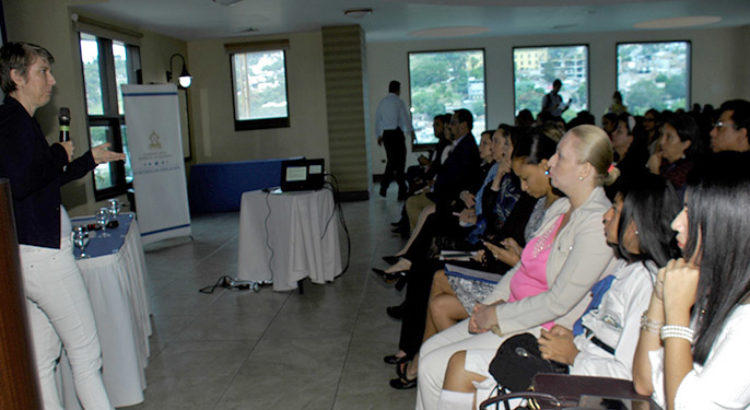
El evento estuvo presidido por la directora de la Oficina Multipaís de la UNESCO, Esther Kuish Laroche; por el secretario de Educación, Arnaldo Bueso; y la subsecretaria de Cooperación Internacional, Norma Cerrato.

Asimismo participaron la representante del Programa Mundial de Alimentos y Coordinadora Adjunta de las Naciones Unidas, Judith Thimke, además de representantes de las universidades de Honduras, el Consejo Nacional de Educación y funcionarios de la Secretaría de Educación (Seduc), docentes, educandos y Cancillería entre otros.

Fuente de la Información: https://www.latribuna.hn/2019/12/10/politicas-educativas-son-revisadas-por-unesco/

Comparte este contenido:

PISA doesn’t define education quality, and knee-jerk policy proposals won’t fix whatever is broken

Since the OECD’s Programme for International Student Assessment (PISA) began in 2000, published results have sent commentators and politicians in some countries into meltdown. The release of the 2018 test results last week was no exception.

Out of 79 participating countries and economies in 2018 Australia came equal 11th (with countries including NZ, UK and US) in reading (in 2015 it was 12th); equal 13th (with countries including US, UK and Germany) in science (in 2015 it was tenth); and equal 24th (same as the OECD average, and NZ and Russia) in maths (in 2015 it was 20th).

The Daily Telegraph claimed Australian schools “are failing”. The Australian bemoaned Australia had “plunged in global rankings”; and business leaders told Australian educators to “lift your game”.

According to education minister Dan Tehan, “alarm bells should be ringing”. Tehan claimed he would raise the issue with state and territory ministers for education at the Education Council meeting in Alice Springs this week.

In particular, Tehan said he wanted to “take a chainsaw to the curriculum” and “put literacy and numeracy back to the heart” of it.

There are two striking features of the reactions to the PISA results. First, it seems broadly accepted PISA defines educational quality when it only tests three subject areas and the methodology itself is questionable.

And second, the results inevitably produce a flurry of policy responses, none of which have been specifically tested as a means to improve our PISA scores.

There are serious problems with PISA scores

PISA has seemingly become the arbiter of education quality in Australia and around the world. When the results are released, the numbers are broadly accepted as accurate measures of the quality of the world’s education systems.

This ignores the chorus of concerns growing for years about PISA’s serious methodological problems which test a stratified sample of 15 year olds in three curriculum areas.

These same concerns were raised by 100 educational researchers around the world in a public letter to the Director of PISA at the OECD in 2014.

Some such concerns relate to the problems of making an international test neutral when it is converted to many different languages and cultures. Other concerns come from educational statisticians and researchers who argue the validity and reliability of the tests themselves are at best dubious and at worst render the league tables “useless”.

There are also issues with the sampling process. Some participating countries only include certain parts of the country or exclude more schools and students from the tests than others. This clearly makes it more difficult to compare countries.

Mainland China is an example. For instance, when Shanghai finished top in each of the three domains in the 2012 PISA tests, Tom Loveless from the Brookings Institute in Washington argued the students tested weren’t representative of the students in the city.

He wrote Shanghai’s PISA-tested students didn’t include thousands from poor rural areas whose parents had moved to the city in search of work.

The OECD’s Education Director Andreas Schliecher, admitted to the UK’s House of Commons Education Select Committee that, in fact, only 73% of students were represented in the Shanghai province’s sample of students in the 2012 test.

Loveless’ also analysed the recent results, which were reported in the Washington Post. He noted the four Chinese provinces participating in 2018 (Beijing, Shanghai, Jiangsu and Zhejiang) did significantly better than the four (Beijing, Shanghai, Jiangsu and Guangdong) that participated in 2015.

Loveless wrote “the typical change in a nation’s scores is about ten points. The differences between the 2015 and 2018 Chinese participants are at least six times that amount…”. He hypothesised this had something to do with the change in provinces selected for testing.

These and other problems with PISA’s methodology suggest it is foolhardy to accept the test results as precise readings of educational quality in any country, or for ranking countries.

Knee-jerk policy fixes will only take us backward

The other feature of the reaction to PISA results is the litany of policy proposals to fix the problems PISA has supposedly unearthed.

Minister Tehan confined his strategies to “stripping back” the “crowded” Australian curriculum and focusing on “the basics”, as well as fast tracking professionals from other fields into teaching.

But there is no obvious link between the PISA results and the strategies proposed and certainly no analysis of what information PISA offered to support them. Even if PISA data are taken seriously, we are obliged to investigate the reasons for educational outcomes before designing policies to address the problems.

And although PISA only tests three areas of the curriculum, the strategies proposed apply to the whole curriculum and, it seems, to the whole of schooling.

Minister Tehan should explain what part of the PISA data convinced him that the Australian curriculum should be pared back to “the basics”. And if that data exists, why should it apply to every other area of the curriculum apart from the three areas tested by PISA: maths, science and reading?

Or is PISA simply being used as a convenient vehicle for introducing favoured policy positions?

I am not suggesting some of the PISA data cannot usefully contribute to the ongoing effort to enhance the quality of Australian education. There is a strong case to be made for sharing educational ideas and practices with other countries.

But superficial, knee-jerk readings of international standardised test data are more likely to impede than advance quality improvement.

The meeting of the Education Council this week could use the opportunity to do two things when they reach the agenda item on PISA.

First, it could set in train a process for achieving national agreement about an approach to educational accountability which goes beyond the simplistic reliance on standardised tests. This would start with the purposes of accountability, including supporting schools to enhance education quality, and aim to provide the community with rich information about educational progress.

Inevitably new approaches would mean broadening our evidence options. These should be both qualitative as well as quantitative. They should also support teachers in their work rather than impose time consuming form-filling. And they should be based on trust in the professional expertise of our teachers.

Second, the Education Council should institute a review of PISA which might consider the flaws in the testing regime, and ways to overcome these. This might help ensure policy, media commentary and research based on PISA results would acknowledge the limitations of the tests and be more tentative about using PISA as the sole arbiter of what constitutes quality in education.

These two steps would help break the destructive cycle of the release of PISA tests results every three years, followed by the barrage of criticising educators and the work of schools, as well as a flurry of political, ideologically pre-determined policy proposals.

After all, it is somewhat ironic that the policy makers who for so long have enforced a standardising educational policy regime, simply double down on it when their own standardising measures have deemed such policies to have failed.

Australia needs a new education narrative, and work on it should start this week at the Education Council.

Fuente de la Información: https://theconversation.com/pisa-doesnt-define-education-quality-and-knee-jerk-policy-proposals-wont-fix-whatever-is-broken-128389


Comparte este contenido:

The Every Student Succeeds Act Is Working, Education Leaders Tell Congress

Exactly four years after the Every Student Succeeds Act became law, a group of state and local education officials, teachers’ unions, and others are telling Congress that they’ve made great progress under the law and that it could lead to significant advances in addressing the achievement gap between different groups of studnets and in improving schools.

The coalition’s letter to Congress, dated Tuesday, emphasizes that while major changes ESSA initiated are just now beginning to take root, K-12 leaders have worked hard to make sure more people have been engaged in the shift to the new law and that schools have the support they need from districts and states. They also say ESSA is being reflected in the new focus schools are putting on «improving student well-being» and giving them greater opportunities for achievement. Schools are changing what it means to be ready for life after high schools, and moving beyond traditional data based on outcomes to focus more on what can be done to improve learning opportunities for students. 


«Collectively, we believe we’ve built a stronger foundation for American education under ESSA and are eager to continue to build partnerships among our constituents resolutely focused on elevating our education systems toward equity and excellence,» states the letter.

The  letter’s signatories include AASA, the School Superintendents Association, the American Federation of Teachers, the Council of Chief State School Officers, the National Conference of State Legislatures, the National Education Association, the National PTA, and others.

The message to Capitol Hill represents a clear signal that key supporters of ESSA when Congress wrote and passed the bill that became law in 2015 remain behind it. Both Democrats and Republicans, as well as teachers’ unions and state and local administrators, pushed to craft a compromise that returned more power over decisions involving school improvement, teacher evaluations, and more. And even though ESSA’s authorization technically expires Tuesday—the same date as the letter—no one expects that lawmakers will take up reauthorizing the law any time soon.

Not everyone has been on board with this relatively rosy take on how ESSA’s going, however. During the Trump administration, for example, many congressional Democrats and civil rights groups have repeatedly expressed their acute concern that U.S. Secretary of Education Betsy DeVos has approved several state plans that flout the law. They’ve said DeVos has let states off the hook by not holding them accountable on issues such as identifying the right schools as needing improvement, and ensuring that schools are sufficiently transparent on mandated annual report cards.

In the same vein, some have also worried that DeVos simply isn’t interested in monitoring states’ work under ESSA. Early in 2017, Congress passed and President Donald Trump signed legislation revoking ESSA accountability rules put in by the Obama administration that would have put notable requirements on states under the law.

Tuesday’s letter was addressed to the four principal federal lawmakers for K-12 policy: Sen. Lamar Alexander, R-Tenn., the chairman of the Senate education committee; Sen. Patty Murray, D-Wash., the top Democrat on the Senate committee; Rep. Bobby Scott, D-Va., the chairman of the House education committee; and Rep. Virginia Foxx, R-N.C., the top Republican on the House committee.

Fuente de la Información: http://blogs.edweek.org/edweek/campaign-k-12/2019/12/essa-working-education-leader-coalition-tells-congress.html


Comparte este contenido:

Education is the key to climate survival

Italy and Mexico have announced bold new educational plans as response to the growing climate and environmental crisis.

Two pioneering countries have committed to stepped-up climate and environmental education in order to equip a new generation with the knowledge, awareness and skills needed to navigate the emerging challenges of the 21st century.

Italy and Mexico, speaking at a press conference at COP25 in Madrid, urged other countries to follow suit in order to make strong, environmental education a world-wide phenomenon.

They proposed Earth Day in April next year as one of a series of milestones in 2020, where like-minded nations could announce higher ambition on climate and environmental education.

The plan is to have a critical mass of countries committed to the environmental and climate education agenda by the time of the UN climate conference (COP26) taking place in Glasgow, UK in November.

Italy’s Minister of Education, Innovation and Research Lorenzo Fioramonti said: “Young people are demanding that governments take climate change far more seriously. There are many areas of society where we must act, and act with increased ambition; compulsory education on these topics needs to be a key part of this national and international response to the big issues of our time”.

The Italian Education Minister said that Earth Day 2020 represents one of the key moments in this important year to recognize the centrality of climate and environmental education including through  ‘Teach-Ins’ as one way of raising awareness among the young.

He said he hoped other countries would take the same opportunity to mark Earth Day’s 50th anniversary and the birth of the environmental movement.

Teach-ins, in which students organise debates and propose solutions to environmental challenges, was a key feature of the first Earth Day where over 20 million young people and citizens protested in 1970, triggering in the process new laws and action by the then US administration.

Vice Minister of Global Affairs in Mexico’s Ministry of Foreign Affairs Martha Delgado said her country has now incorporated mandatory environmental education into Mexico’s constitution as the first step in a new comprehensive plan.

“Mexico is now committed to mandatory environmental education at home, but we are also committed to promoting environmental education internationally. The challenges we are facing are national but also global. Young people everywhere need the knowledge to fully respond to what is unfolding on in our world,” he said.

“Great transformations can only be achieved through knowledge, awareness and the sense of collaboration. We are convinced that environmental education is the route to meeting Sustainable Development Goals, an essential tool to fight the climate crisis and can prompt a profound cultural change to contribute to our planet’s sustainability,” said Vice-Minister Delgado.

President of the Earth Day Network Kathleen Rogers said environmental literacy has been at the core of Earth Day since its inception in 1970 but that governments had not gone far enough.

“Young people, through movements such as Fridays for Future, have been asking governments to tell the truth about the climate and environmental emergencies that we are now facing—‘telling the truth’ needs to happen in schools and universities, and needs to happen now,” she said.

Rogers said while globally climate and environmental education exists across the spectrum, from decades of formal implementation to continued exclusion of the topic as a whole, it is time to make these critical subjects compulsory and to link them to civic education so that students will develop both the knowledge and the civic skills they need to fully engage in the solutions to climate change.

“These are the core elements of transforming our societies so that a new, far better informed and active generation can emerge to ensure governments truly respond to the challenges of our time,” she said.

Executive Secretary of the UN Framework Convention on Climate Change (UNFCCC) Patricia Espinosa welcomed the announcements of Italy and Mexico as a key contribution to realising the aims of the Paris Climate Change Agreement.

Under the Agreement governments are looking to enhance their Nationally Determined Contribution (NDC) in 2020 as contribution to climate action but also the Sustainable Development Goals.

From Madrid and COP25, focus will also be on the Congregation for Catholic Institutes of the Holy See, which has chosen Earth Day 2020 as a preparatory meeting for the Global Compact on Education that Pope Francis will launch on May 14th.  It aims to promote a global commitment that also teaches new generations respect for humankind and nature.

Earth Day Italia is working together with the Italian Ministry for the Environment and the Festival for Sustainable Education to support this initiative.

Fuente de la Información: https://www.spatialsource.com.au/government-policy/education-is-the-key-to-climate-survival

Comparte este contenido:

Why the profit motive fails in education

The Morrison government’s waiving of almost A$500 million in dodgy vocational education and training debts holds many lessons about the nature of education and public services being provided by for-profit enterprises.

The debts were collected by about 38,000 students unwittingly locked into federal VET FEE-HELP loans by dodgy for-profit education providers. Thousands more complaints seeking to have debts waived have yet to be processed.


Read more: A new national set of priorities for VET would make great social and economic sense

One of the lessons from the disastrous mix of public funding and private profits in the VET sector is that policymakers infatuated with the dogma of “reform” are incapable of learning from experience.

That’s true of both sides of politics.

Victorian reforms

A brief history of the “most disastrous education rort in Australia’s history” illustrates the point.

The story begins in about 2008.

Historically, vocational education and training was the domain of the government-run Technical and Further Education (TAFE) colleges. To create an expanded demand-driven sector, the Labor government of John Brumby in Victoria made two key “reforms”.

One was to open up the TAFE system to private-sector competition. The other was to shift costs to students, through a fee loans scheme similar to the one federal Labor introduced to fund university education expansion.

These reforms were embraced by Brumby’s Liberal successor, Ted Baillieu, who severely cut TAFE funding, and by both Liberal and Labor federal governments.

How not to reform

But what Victoria provided, in the words of education policy researcher Leesa Wheelahan, was “a great template in how not to reform vocational training”.

As Wheelahan noted in 2012, problems emerged almost immediately. For-profit providers enticed students (and therefore the money flowing from the government) with sweeteners such as “free” iPads. Diplomas requiring 600 hours of work were granted on the basis of 60 hours. And so on.


Read more: Victorian TAFE chaos: a lesson in how not to reform vocational education


In an essay published in 2013, I wrote: “Attempts by for-profit firms to enter (what they perceive as) education markets have almost invariably ended either in failure or in fraudulent exploitation of public subsidies.”

But the Victorian template was embraced federally first by the government of John Howard, which extended the Higher Education Loan Program to VET, and then those of Kevin Rudd and Julia Gillard.

It grew even more under Tony Abbott, increasing at triple-digit rates between 2012 and 2015, until evident problems forced government action. The Australian National Audit Office’s scathing assessment of the scheme in 2016 led to it being scrapped.

Examples of failure

Policymakers could have learned not only from the initial failures of VET reform but from examples of for-profit education at all levels.

Australian universities have dabbled unsuccessfully with the for-profit tertiary model exemplified by the University of Phoenix. It and other for-profit universities have been accused of rorting federal education funding provided for military veterans, by spending 15% or less of the fees received on instruction.

It’s perhaps a good thing that Australian universities rooted in the traditions of public education have routinely failed with for-profit ventures such as as Melbourne University Private. It closed in 2005 after losing an estimated A$20 million over the previous seven years.

At the level of school education, the US has plenty of failed experiments. One is Edison Schools, which at its peak in the early 2000s had hundreds of school contracts. It has since lost the great majority due to not delivering on promises.


Read more: Do we want for-profit schools in Australia?


In the realm of early child education, Australia’s for-profit child-care operators funded by government subsidies have a similarly problematic record. The similarities include using the types of lures pioneered by shonky operators in the VET sector – enticing parents (and their federal subsidies) with offers of “free” iPads and gift cards.

The limits of market liberalism

The failures of for-profit education reflect both the specific characteristics of education that make a market model inappropriate and more fundamental failings of market liberalism.

Students, by definition, don’t know enough to be informed consumers. Whether the course is good or bad, they are unlikely to be repeat customers. In these circumstances, relying on consumer choice and competition between providers is a recipe for superficial, low-quality courses and exploitation.


Read more: Jobs are changing, and fast. Here’s what the VET sector (and employers) need to do to keep up


As centuries of experience has shown, only the dedication and professional ethos of teachers can ensure high-quality education. Reliance on incentives and markets is inconsistent with that ethos.

The broader problem with the reform agenda is that for-profit businesses paid to provide public services are more tempted to make profits by exploiting loopholes in the funding system than by innovating or providing better services.

This point is apparently yet to sink in with agencies such as the Productivity Commission, which remains enthusiastic about applying “increased competition, contestability and informed user choice” to human services “to improve outcomes for users, and the community as a whole”.

Fuente de la Información: http://theconversation.com/why-the-profit-motive-fails-in-education-128091

Comparte este contenido:
Page 1794 of 6820
1 1.792 1.793 1.794 1.795 1.796 6.820