España / 27 de marzo de 2019 / Autor: FeliciCultura / Fuente: Youtube
Publicado el 17 oct. 2016
Fuente: https://youtu.be/EE84Z5rAnrA
ove/mahv

España / 27 de marzo de 2019 / Autor: FeliciCultura / Fuente: Youtube
Publicado el 17 oct. 2016
Fuente: https://youtu.be/EE84Z5rAnrA
ove/mahv

España / 27 de marzo de 2019 / Autor: AprendemosJuntos / Fuente: Youtube

Este 24 de marzo se cumple un año de la siembra del maestro José Antonio Abreu, destacado músico venezolano y quien concibió el Sistema Nacional de Orquestas y Coros Juveniles e Infantiles de Venezuela, que en la actualidad va rumbo al niño dos millones de la mano del presidente de la República Bolivariana de Venezuela, Nicolás Maduro.
A propósito de esta fecha el Jefe de Estado exaltó este domingo en su cuenta de la red social Twitter @NicolasMaduro el legado y genialidad del músico venezolano.
Nacido en la ciudad de Valera, estado Trujillo, el 7 de mayo de 1939, Abreu fungió como Embajador para la Paz y de Buena Voluntad de la Organización de las Naciones Unidas para la Educación, la Ciencia y la Cultura (Unesco) por el impacto social y cultural de su obra, especialmente en aquellos países empeñados en bajar los niveles de pobreza, analfabetismo, marginalidad y exclusión en su población infantil y juvenil.
Abreu, quien falleció el 24 de marzo de 2018, también fue el artífice de un modelo de educación musical y de inclusión social, modalidad que ha sido replicada en más de 70 países de los cinco continentes: Europa, América, Asia, África y Oceanía, reseña una nota de prensa de la Fundación Musical Simón Bolívar publicada en su sitio web.
Con este novedoso modelo, creado hace 44 años y conocido como el Sistema Nacional de Orquestas y Coros Juveniles e Infantiles de Venezuela (El Sistema), se han incorporado a El Sistema 1.012.077 niños, niñas y jóvenes, provenientes de estratos sociales de bajos recursos económicos.
Con esta práctica individual y colectiva de la música, la creación de núcleos y centros académicos del país, esta organización cultural se convirtió en una plataforma sobre la cual se preparan ciudadanos integrales bajo el concepto de una cultura de paz y de justicia.
En la actualidad cuentan con 443 núcleos y 1.704 módulos que son atendidos por 5.021 docentes, además con una red de 1.722 agrupaciones orquestales, 1.426 coros, 694 agrupaciones de Alma Llanera y 266 de música popular y de otros géneros.
En 1975 fundó la Orquesta Sinfónica Juvenil Juan José Landaeta, que posteriormente se denominó Orquesta Sinfónica de la Juventud Venezolana Simón Bolívar, antecesora de la hoy reconocida Sinfónica Simón Bolívar de Venezuela.
Su legado continúa creciendo con las diversas actividades que se realizan en el Centro Nacional de Acción Social por la Música, mientras en los mismos terrenos en los que concibió el denominado Complejo Social y Cultural Simón Bolívar se levanta el Centro de Formación Académica para avanzar en el crecimiento profesional de los maestros que laboran en esas instituciones.
En paralelo se afinan los detalles para consolidar la Universidad Nacional de la Música José Antonio Abreu, que seguirá brindando el conocimiento que cultivó para abrir venturosos caminos a la juventud venezolana.
Fuente de la noticia: http://vtv.gob.ve/siembra-jose-antonio-abreu/

Asia/ Japan/ 25.03.2019/ Source: japantoday.com.
Prime Minister Shinzo Abe told an international women’s conference in Tokyo on Saturday that Japan will support developing countries in providing «high-quality» education to 4 million women by 2020.
Abe said improving access to education is important for sustainable economic development and that he will propose accelerated efforts to provide better education opportunities to women at the meeting of the Group of 20 major countries which Japan will host in June.
«As the G-20 president, I would like to confirm with other G-20 leaders our determination to create a world where all can have access to at least 12 years of high-quality education,» he told the meeting of Women20, a G-20 engagement group which makes policy recommendations to the major economies.
Nobel Peace Prize laureate Malala Yousafzai also attended the conference and called for investments in women’s education.
To create a world where «all women and girls can shine, where women are driving innovation» and taking seats in governments and businesses, leaders must invest in girls’ education, Malala said.
«If we invest in girls today, a future beyond our imagining is possible,» she said.
In the event, W20’s Japanese representatives handed Abe a communique demanding that G-20 member countries take action to close the gender gap for the sake of economic growth and fair and sustainable development.
The communique requested G-20 member countries to present a mid-term report at the next G-20 summit in Osaka on a commitment made at the 2014 G-20 summit in Brisbane, Australia to reduce the gender gap in labor force participation by 25 percent by 2025.
The recommendation also urged use of new technologies including artificial intelligence to «ensure no women is left behind,» while calling on G-20 leaders to take measures to promote participation of women in the field of digital technologies, science, engineering, arts and mathematics.
The first W20 summit was held in Istanbul in 2015 to promote social advancement of women in the G-20 member states and to strengthen their economic power.
The W20 Japan event was concurrently held with the fifth World Assembly for Women, hosted by the Japanese government with the aim of realizing «a society where every woman can shine.»
Despite the Abe government’s push for female empowerment, Japan lags behind many other advanced economies in the social and economic advancement of women.
In 2013, Abe requested all listed companies to have at least one woman on their board as part of an effort to achieve the goal of having at least 30 percent of leadership positions in every sector of society occupied by women by 2020.
After the request, the number of female board members more than doubled from 630 in 2012 to around 1,700 in 2018. But the rate of female occupation of board seats remains low at around 4 percent, according to the Cabinet Office.
Source of the notice: https://japantoday.com/category/politics/japan-to-support-education-for-4-mil.-women-in-developing-countries
Oceania/ New Zealand/ 25.03.2019/ Source: www.journalnow.com.
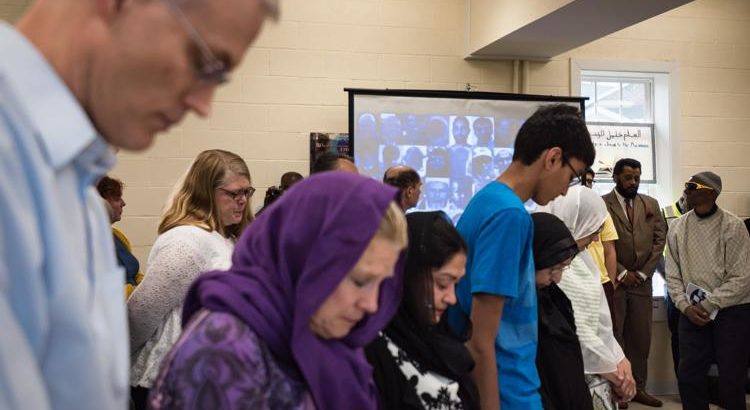
Guests and members stand to observe a moment of silence on Sunday at Annoor Islamic Center in Clemmons. More than 350 people attended the gathering.
Guests and members gather outside the Annoor Islamic Center in Clemmons on Sunday. Speakers at the event discussed ways to end intolerance in the wake of two deadly attacks on mosques in New Zealand that left 50 people dead. Imam Khalid Griggs said Islamophobia is present, and the best way to get rid of it is through education.
Nine days after a man fatally shot 50 people at two mosques in New Zealand, the greater Forsyth community gathered at a Clemmons mosque and discussed what could be done to squelch intolerance.
For some, the discussion was intensely personal.
Noor Shehata, now a freshman in college, recalls when she was a seventh-grader in social studies learning about Sept. 11.
“The teacher said he’d hate to be a brown Muslim who owned a restaurant the next day (after 9/11),” Shehata recounted. “I was a brown Muslim, and my dad owned a restaurant. All eyes in the class went to me.”
She said it was difficult to experience that from someone in a leadership position as a 13-year-old.
“Muslims are forced to grow up much earlier, they know what a terrorist is earlier,” Shehata said.
She learned to develop a filter of herself, looking at how she might appear through others’ eyes.
Imam Khalid Griggs said Islamophobia is present, and the best way to get rid of it is through education. He urged the approximately 350 people in attendance to take a stand against racism in all forms and come together as one against it.
“If we don’t come together as brothers and sisters, we will die as fools,” he said in a reference to a Martin Luther King Jr. quote.
Juana Rhili, an educator, challenged everyone in attendance to share knowledge of the Muslim religion with five other people within the next week.
“We are all, ‘One person, under God,’ and one person can make a change,” she said, referencing the Pledge of Allegiance. “We know these (shootings) will continue to happen unless we change the mindset.”
Others provided additional knowledge of Islam, including that the true message of the religion is peace, people of all nationalities are Muslim, and Muslims are against suicide.
The North Carolina division of the FBI recognized how important connections with the Muslim community are, working for more than four years to strengthen them, said Timothy Stranahan, assistant special agent in charge. Today, there’s a network of about 45 imams across the state the FBI keeps in contact with in the event something happens.
Aladin Ebraheem, with the Annoor Islamic Center in Clemmons where the gathering was held, said that trust is valuable.
He teared up discussing the mass shooting in New Zealand, but knew the community would get through it.
“That individual might have been successful in taking lives, but he failed miserably in intimidating, and the biggest proof is all of you being here,” Ebraheem told the crowd.
“This is not foreign to any of us. Just a few months ago, we were at a Jewish temple, showing support for almost the same thing,” he said, referencing the Tree of Life shooting at a synagogue in Pittsburgh in October 2018, in which 11 people were killed.
Hana Hariri, who has a young daughter, said more discussions like this need to occur in the community. She said last year, her daughter was called a terrorist because of her faith. She’s also called, “the others.”
“We need to educate more about Islam,” Hariri said. “Education, even in school, and tell kids that Islam is a religion, not terrorism like ISIS. We’re relieved that the FBI is helping.”
Source of the notice: https://www.journalnow.com/news/local/islamic-leaders-education-the-key-to-ending-intolerance/article_86ebe7a3-0664-50a0-8382-ca1cc9f0931a.html#1
Africa/ Egypt/ 25.03.2019/ By: Al-Masry Al-Youm/ Source: ww.egyptindependent.com.
First year high school students in Egypt found themselves overwhelmed on Sunday after they were unable to take their experimental exams on the Education Ministry’s new electronic platform throughout 26 governorates due to technical failure.
The Education Ministry initiated a new High school system this year, where students would take exams online using tablets and SIM cards provided by the government free of charge.
Only those in the Red Sea governorate were able to take the Arabic language test on Sunday. A large number of students in Cairo, Giza and the rest of the governorates said they could not open the examination platform because of the schools’ poor Internet connection and failure to activate the tab.
Speaking to Al-Masry Al-Youm, Education Minister Tarek Shawki said that over 2 million people visited the electronic exam platform for first year students of the new system, despite the fact that it is currently designed to only accommodate 600,000 students.
Schools in Cairo and Giza made early leave for all first grade students at 12 pm yesterday after they were unable to download the Arabic language exam due to the exam platform’s inability to download the exam even after 3 hours.
The ministry published photographs of some of the students taking the Arabic language exam via the tablets, which included the showing students how to access the electronic exam platform, which was designed by the Pearson company.
Source of the notice: https://ww.egyptindependent.com/egypts-new-electronic-high-school-system-fails-at-first-test/


 Users Today : 595
 Total Users : 35519712
 Views Today : 1088
 Total views : 3702563