El sindicato STEILAS criticó ayer al departamento foral de Educación por la gestión del último curso, el 2017-18, recién finalizado. En concreto, la central cuestionó la nueva normativa de contratación temporal de personal docente, los plazos apurados en la OPE de Secundaria y FP (el proceso se está celebrando) y que el año académico haya finalizado sin haberse cerrado el pacto educativo. Por ello, STEILAS pidió a Educación que el próximo curso “se ponga las pilas” para implementar las medidas recogidas en el acuerdo programático.
Por todo ello, STEILAS calificó con un suspenso al departamento. La central lamentó las dilaciones en la negociación del pacto educativo, que recoja mejoras en la red pública.
En cuanto a la contratación, por un lado, el sindicato lamentó, a través de un comunicado, que la última normativa para regular la contratación de personal interino una oposiciones y listas y recupere las listas preferentes (de aprobados sin plaza). Y, por otro, sobre la OPE que ahora se celebra con 325 plazas en Secundaria y FP, afirmó que ha habido “confusión” en el proceso y eso ha puesto los “nervios a flor de piel” entre las personas aspirantes.
ESTUDIAN LA DENUNCIA DE CSIFTambién a raíz de la OPE, CSIF adelantó ayer que está preparando recursos administrativos dirigidos a Educación para que la Secretaría General Técnica revise las actuaciones realizadas cuando personas aspirantes entregaron la presentación (el día 20). El sindicato cuestiona por qué hubo aspirantes que pudieron subsanar errores en la misma y por qué no hay un listado sobre quiénes lo hicieron.
El sindicato reclamó que se revisara esta situación para garantizar su “seguridad jurídica”. Y ayer, en una nota, apuntó que Alta Inspección de la Delegación del Gobierno ha remitido estas actuaciones para su valoración al Ministerio de Educación, así como a Recursos Humanos e Inspección, dentro del departamento foral de Educación. – D.N./Efe
Fuente de noticia: http://www.noticiasdenavarra.com/2018/06/30/sociedad/navarra/steilas-reclama-a-educacion-que-se-ponga-las-pilas
América del Sur/Brasil/02.07.18/Fuente: virtualeduca.org.
Fue en el marco del Encuentro Internacional Virtual Educa, en Brasil, donde habló de velar para que la tecnología sea una herramienta central para el aprendizaje
Positivo BGH pidió que la tecnología sea una herramienta “fundamental” para aprender, en la última edición del Encuentro Internacional Virtual Educa, uno de los eventos más importantes sobre innovación y tecnología aplicadas a la educación.
Bajo el lema de “Educación para transformar la sociedad en un espacio único multicultural“, el encuentro tuvo lugar en la ciudad de Bahía, en Brasil, donde reunió a compañías del sector y representantes gubernamentales de América Latina y África.
Allí, el Global Sales Director en Positivo BGH, Sebastián Fischer, disertó ante varios representantes de diferentes empresas del sector y funcionarios, y enfatizó la importancia avanzar con la “Educación 4.0”, estimulando el concepto “aprender haciendo”, es decir, hacer que los alumnos aprendan a programar a través de experiencias, proyectos y pruebas.
“Como líderes en el desarrollo de productos y soluciones especialmente pensadas para el sector educativo, tenemos la obligación de impulsar este tipo de encuentros, y velar para que la tecnología se transforme en una herramienta fundamental para el aprendizaje de las actuales y futuras generaciones“, destacó Fischer.
Además de los speakers, Positivo BGH aprovechó para realizar algunos talleres hands on y distintas experiencias para que los participantes pudieran probar sus soluciones de tecnología educativa.
Positivo BGH cuenta con varias de estas soluciones, incluyendo Inventura, VC.Maker, MicroBIT, Embajadores de Innovación. Están enfocadas en generar ambientes educativos que estimulen la innovación, la programación y la colaboración. Y sobre todo –destaca la firma– mucha “mano en masa”.
Fuente de la noticia: http://virtualeduca.org/mediacenter/positivo-bgh-pidio-mas-manos-en-la-masa-en-la-educacion-tecnologica/
América del Sur/Chile/02.07.18/Fuente: www.adnradio.cl.
Los foráneos matriculados en magíster, no obstante, disminuyeron: desde 5.724 alumnos en 2014a 3.397 en 2017.
Un informe elaborado por el Servicio de Información de Educación (SIES) reveló que 29.312 extranjeros estudian en las instituciones de educación superior chilenas.
Según consigna El Mercurio, de dicho total, 20.150 estudiantes están matriculados en un programa completo de título o grado de especialización.
El análisis del Ministerio de Educación (Mineduc) arrojó además que la mayoría de los extranjeros en nuestro país está inscrito en una universidad (62,2%), con preferencia en carreras ligadas a las ciencias sociales y derecho.
De la cifra, asimismo, el 90% proviene de Latinoamérica y el Caribe, mientras que sólo el 3,2% es originario de Europa.
En cuanto a estudiantes de intercambio, el 40% son del Viejo Continente y 21,1% de Norteamérica. Hubo en total 9 mil alumnos en esta condición.
Respecto a foráneos matriculados en magíster, hubo una disminución: desde 5.724 alumnos en 2014 a 3.397 en 2017.
Fuente de la noticia: http://www.adnradio.cl/noticias/nacional/mineduc-29312-extranjeros%C2%A0estudian-una-carrera-en-chile/20180701/nota/3768879.aspx
On 1 July the threshold falls by more than $10,000, so if you earn at least $45,000 you’ll start repaying your loan
From Sunday, thousands of students and graduates across the country will have to start paying off their debts earlier than expected.
In the coming financial year, which starts on 1 July, anybody earning $52,000 or more a year will have to start paying off their student debts, which for most domestic and undergraduate students is known as the Higher Education Contribution Scheme (Hecs).
And that’s just the first stage of changesbecause the government announced plans to lower the repayment threshold further to $44,999 in the budget. The bill locking in that change was expected to pass the Senate this week but has now been delayed until parliament resumes in August.
Given the bill has not passed before the start of the 2018-19 financial year, the full reduction in the threshold will likely not apply until 1 July 2019.
When do I have to pay it back?
Under changes made in 2016, from 1 July 2018 people earning more than $51,956 will have to start paying back student debts.
If and when the Coalition bill passes, you will have to start paying your debt once you earn $45,000 or more a year,with a likely start date of 1 July 2019.
For the 2017-18 tax return, you will only pay your debt if you have a taxable income of more than $55,874.
Importantly, it’s not just graduates who are affected – you have to start paying your student debt as soon as you hit the income threshold, even if you are still studying.
You also still have to pay your debt if you’ve moved overseas. This used to be a loophole – worth $20m-$30m a year in lost revenue – but it was closed in 2016.
How much do I have to pay?
The amount you pay rises as you make more money.
Under the new rules, those on the lowest bracket (more than $44,999 but less than $51,957) will have to pay 1% of their total income. For someone earning $45,000 before tax – or $865 a week – it would be $8.60 a week.
Those earning between $51,957 and $58,379 will have to pay 2%, and so on, rising to a maximum of 10% for those over $131,989.
It’s important to note that you pay a percentage of your total income – not a percentage of your debt.
The move will generate $345.7m in savings until 2020-21. Previously, any extra contributions you made offered you an extra discount on your debt, but this policy has been repealed.
Your total debt should be included on your tax return, and can be viewed on the MyGov website. You can also contact the ATO to ask for updates.
As well as Hecs, it includes other related debts like Fee-Help (for full-fee paying students), Vet Fee-Help (for vocational colleges), OS-Help (for when you study overseas or are on exchange) and SA-Help (when you take a loan to pay your $149 student services amenity fee).
How long do I have?
A Hecs debt is effectively an interest-free loan. Rather than charging you money, the government indexes your debt to the consumer price index – the amount goes up every financial year, but by not more than the rate of inflation, so the effective change is zero.
This means it shouldn’t cost you more to pay off your Hecs over a long time, and there is no time limit to pay it off.
The yearly indexation only applies to debts older than 11 months, and it happens every 1 June.
However, the government’s changes have also created a new a lifetime cap on all Hecs loans of $104,440 – starting on 1 January 2019. Previously there was only a cap on postgraduate, full-fee and vocational loans. The cap is higher for those studying medicine, dentistry or veterinary science ($150,000)
Only loans taken out after 1 January 2019 will count towards the cap – so existing debts do not.
Can I reduce or cancel my debt?
If you are a nurse, midwife or teacher, or a maths, statistics or science graduate, you may be eligible for the Hecs-Help benefit, which will reduce your Hecs debt.
The scheme was cancelled by the government on 1 July 2017. However, because you have two years to lodge a tax return, if you were eligible in the 2016-17 financial year, you can still claim it until 30 June 2019.
If you were eligible in the 2015-16 financial year, you have until Sunday to claim it.
Eligibility criteria are quite complex, so check with the Study Assist websiteand the Australian Taxation Office.
If you failed a subject, or had to withdraw from a subject due to illness or other circumstances, you can apply to your university or education provider to have the debt for that subject cancelled.
If you withdrew after the census date without a special circumstance, you still have to pay the Hecs debt for that subject. You also can’t cancel the debt for a subject if you successfully completed it.
En el abecedario, la Educación de la A a la Z, en la emisión 35, en huellas de maestros, recordaremos a Héctor Abad Gómez y, en el palabrero continuaremos nuestro análisis de la Educación en la coyuntura política. en la nota informativa el informe de la OCDE 2016 la Educación en Colombia.
España / 1 de julio de 2018 / Autor: Redacción / Fuente: Europa Press
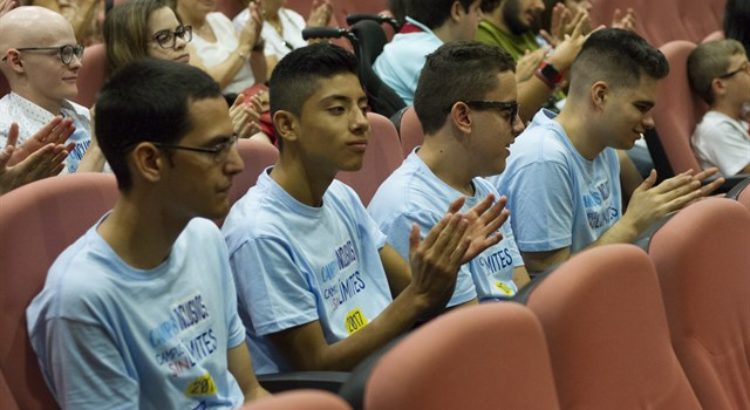
Un total de 16 universidades de ocho comunidades autónomas participan en la séptima edición del programa ‘Campus Inclusivos, Campus Sin Límites’ organizados por Fundación ONCE, Fundación Repsol y el Ministerio de Educación y Formación Profesional para reducir el abandono escolar temprano de los estudiantes con discapacidad.
El primer campus estival comienza este próximo domingo 1 de julio en la Universidad Complutense de Madrid. También durante el mes de julio se celebrarán en las universidades de Alcalá de Henares (Madrid), Jaén, Almería, Granada, Murcia, Politécnica de Cartagena, Burgos, León, Salamanca, Valladolid, San Jorge de Zaragoza y Extremadura, mientas la universidades de Málaga, Castilla-La Mancha y Navarra los preparan para el mes de septiembre.
Según ha informado Fundación ONCE, estos campus ofrecen a los participantes «la posibilidad de vivir y conocer la experiencia universitaria de primera mano en estancias de hasta diez días» durante el verano con actividades de divulgación académica y oferta cultural y de ocio, así como orientación académica.
En el programa participan jóvenes con discapacidad del último curso de Educación Secundaria Obligatoria, de Bachillerato y del Ciclo Medio de Formación Profesional, aunque también está abierto a estudiantes que tengan necesidad de apoyo educativo o que se encuentren en riesgo de exclusión social, aunque no tengan discapacidad.
«Con este programa se pretende favorecer una educación inclusiva para todos y contribuir a que las universidades puedan dar respuesta a la diversidad del alumnado», apuntan desde Fundación ONCE. Además, la iniciativa sirve también para ayudar a que las universidades participantes comprueben su grado de adecuación a las necesidades de estudiantes con discapacidad.
En las últimas seis ediciones de ‘Campus Inclusivos, Campus Sin Límites’ han participado 22 universidades españolas y más de 600 alumnos con y sin discapacidad. Los jóvenes interesados en participar pueden enviar un correo electrónico a Inmaculada Requena (irequena@fundaciononce.es) para recibir más información.
United States / July 1, 2018 / Author: Katrina Schwartz / Source: KQED
Teaching grade-level content to students who have just arrived in the United States and whose English skills are limited is a difficult task. High school-level content specialists especially have little training on how to integrate language acquisition into their content. Often teachers deal with that by either dumbing down the curriculum to make it linguistically simpler or alternating between lessons focused on language and those about content.
Teachers in San Francisco were looking for better ways to teach their newcomer students the English skills they need, without losing a focus on the complex content all students should be learning. To do that, they looked to adopt some of the strategies of the Writing Is Thinking Through Inquiry(WITsi) work being done in New York City with the general education population.
Nell Scharff Panero developed the WITsi strategies and has been working with New York Renewal schools to implement them. As she watched teachers having some success, she realized the same strategies could be powerful for English learners. She has been working with language specialists to adapt the strategies for that population.
“Teachers are so responsive to this work,” said Amy Gottesfeld, a supervisor in San Francisco’s Multilingual Pathways Department. “They’re finding it hugely helpful and successful in terms of giving them concrete ways to integrate language into their content.”
San Francisco Unified School District is starting small, bringing together sheltered pathway teacher cohorts from seven high schools around the district. Together they look closely at student writing, share lesson ideas, and try to deepen their own understanding of the English Language and how to teach it through content.
“Given these strategies that support language, that support writing, without having to sacrifice the focus on content has felt liberating to people,” Gottesfeld said.
The program is intentionally set up around cohorts at each school so that teachers can collaboratively build the WITsi strategies into every class, regardless of content area. One activity asks students to write sentences using “but, because and so” correctly. These small conjunctions are powerful language markers that students often use incorrectly.
But when the science teacher is using “but, because, so” sentence routines to help students understand relationships in an ecosystem, while in the next room the history teacher is using the same structures to help students identify the effects of colonialism, it reinforces writing and thinking for students. And, it means students are getting explicit language development help throughout the school day, not only during their legally required English Language Development time.
“I was like, oh, this is what I’ve been missing,” said Anne Ryan, a history teacher in the sheltered language pathway for newcomers at Thurgood Marshall High School in San Francisco. She first learned about some of the strategies through an exchange with the Internationals Network for Public Schools in New York, whose teachers have become standouts in developing language alongside content. She was trying to use some tips she picked up at a conference on her own when SFUSD announced the current pilot. She jumped at the chance for more formal training on the strategies.
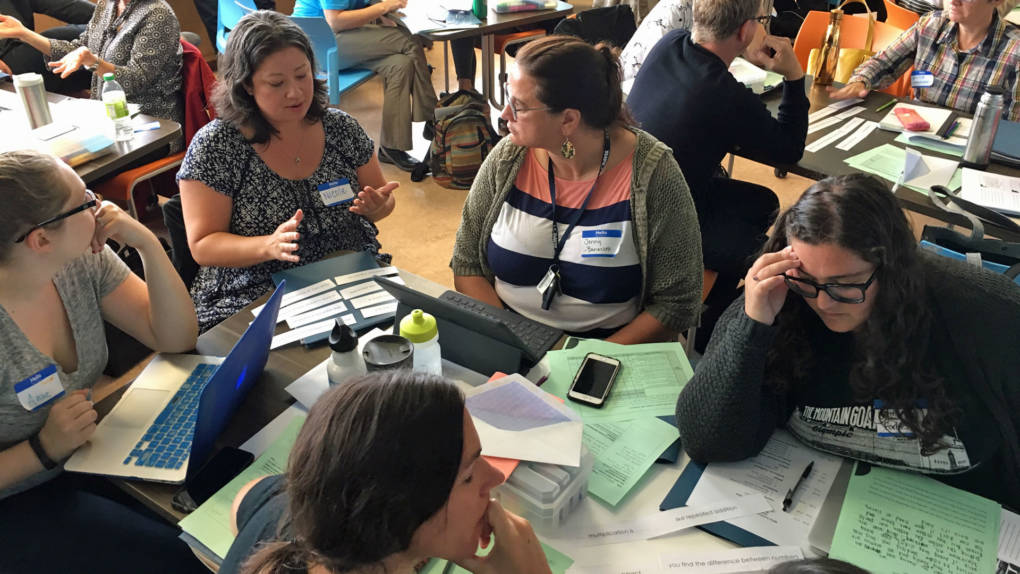
Teachers in Thurgood Marshall High School’s sheltered language pathway collaborate during a professional development training about how to teach thinking through writing. (Courtesy Amy Gottesfeld/SFUSD)
“I think that non-English Language Development and English teachers, a lot of us still have nervousness around how to really develop English and writing skills in our classroom,” Ryan said. “But it really is our responsibility as well. I think doing the WITsi has made that responsibility feel lighter and feel effective.”
Bringing instruction down to the level of the sentence forces the teacher to carefully identify the most important information she wants her students to learn that day, and build sentence-level activities around the main content goal. This practice often leads to more effective instruction, in addition to helping students build their language skills.
WITsi work in New York City Renewal schools with the general education population has uncovered similar sentence-level misunderstandings in high school student writing. In those cases, it’s often hard for high school teachers to accept that they have to go back and teach the basic building blocks of good sentence writing, then paragraphs, and finally essays. They feel that their students should already have those skills.
But with newcomer students, teachers are hungry for anything that will help them make their curriculum more accessible to students who don’t have language skills yet, but desperately need them. All of these strategies should be used in conjunction with the most important content of the day. The idea is to marry the linguistics with subject mattercontent at every step to make the language relevant, while helping students learn the content.
SEVEN BASIC WRITING STRATEGIES
1. Sentence boundaries: These activities are designed to help students understand what a sentence is and what it is not.
In the process, teachers can identify the parts of a sentence: noun, verb, object, but more than the grammar, these activities use content to discuss what makes a sentence. How can one tell if something is a fragment, or a run-on? Activities include matching different parts of a sentence to either make a complete sentence or repair a fragment. Or, teachers might ask students to sort sentences into fragments, complete sentences and run-ons.
“But again all the sorting that you’re doing is around the content that you’re studying,” Gottesfeld said. So, if the lesson focus is Alexander Hamilton, all the sorting and matching is related to his historical contributions. The dual approach is the most important part of all these strategies.
2. Recognizing different sentence types like statements, questions, exclamations or commands.
This includes helping students look for clues — does the sentence start with a question word, for example? While it may seem simple to a native speaker, expressing the content using various types of sentences can dramatically change meaning, an important concept for students to understand. Also, focusing explicitly on questioning helps empower English learners as question askers throughout the curriculum and in other learning settings.
3. Working with the coordinating conjunctions “but, because and so” to help students elaborate on their sentences.
Many students, even ones who speak English, don’t have a firm grip on the differences these words signal. “But, because, so” activities might start off with matching sentence stems to sentence ends based on the conjunction, and gradually become more difficult, ending with giving a student the three bases and having them complete the sentence.
This is often a favorite with teachers and students because it begins to open the door to more analytical thinking. Knowing how to use these conjunctions is not only a language rule, it indicates the student’s ability to think comparatively, to explain, to make connections.
4. Subordinating conjunctions
Subordinating conjunctions are an important way English speakers vary sentences structure and express complicated relationships between things. They’re also tricky for non-native English speakers, and deserve explicit introduction. Words that signal time and position are powerful expressions of analytical thinking. When teachers introduce subordinating conjunctions within a content lesson, it gives students more ways to express complex ideas and improves sentence fluency.
5. Sentence combining
Activities in this sequence include giving students two sentences and asking them to use a variety of techniques to combine them into one. Scaffolds might include giving students a word bank or conjunctions to choose from, while the most complex version might ask students to write a sentence with an independent and dependent clause on Alexander Hamilton that uses a conjunction. A core goal of these activities is to use relevant content to help students reduce redundancy in their writing by combining sentences. It’s also an opportunity to work on syntax within the context of content objectives. Students are motivated by the desire to be understood.
6. Appositives
Appositives are a language structure that allows the writer to rename a noun. This is another explicit language structure that makes student writing more interesting, specific and nuanced. But rather than making it a disconnected grammar lesson, teachers can use activities about their content that incorporate appositive practice.
Many English learners also struggle to follow the chain of references in texts with unknown words, so explicitly teaching about appositives can help with reading comprehension as well.
7. Sentence expansion with descriptors
In these activities students ask students to expand on a simple, unelaborated sentence by asking them to answer a series of questions aimed at teasing out details. A typical simple sentence might be, “Alexander Hamilton helped establish it.” The teacher then writes questions to identify the information that would elaborate this sentence: What did he establish? Why did he establish it? How did he do it? Who helped him? Once students have identified all these details, they rewrite or “expand” the unelaborated sentence into a much improved one that includes those details. This guided process helps model the way English sentences are constructed and is a precursor to revision.
“The ‘Writing as thinking’ presents somewhat of a sequence to introducing these strategies and approaches,” Gottesfeld said. “That feels new and clearly makes sense” to many teachers in the sheltered language pathways.
And when students have these clear sentence-level building blocks, practice them regularly, and understand the way they function to express ideas, teachers can use them in the most complex process of all: parallel revision.
“We know that revision is critical for the writing process to support students in developing good writing,” Gottesfeld said. Parallel revision is a more structured way to help students revise their writing. Teachers might write “elaborate” next to a thought in a student’s paragraph and suggest the student think about the “but, because, so” strategy to carry out that elaboration. This practice can also make peer revision more useful, grounding the discussion in specific strategies the kids know well through prior practice.
“It puts the kid in a position where they have to think about language that they know and try to apply it,” said Joanna Yip, a former teacher in the Internationals Network who helped design the materials and activities SFUSD teachers are using. “It is an absolutely necessary component for kids who are learning the language.” Through parallel revision students begin to truly appropriate the language and transfer the piecemeal sentence-level work into paragraphs and even essays.
Yip said this systematic approach to language construction that WITsi offers is fairly new to many English language teachers, especially ones who see themselves foremost as content specialists and secondarily as teachers of English. Rather than chunking out the steps of writing a paragraph and asking students to follow instructions, parallel revision requires students themselves to do the thinking about which strategy responds to the teacher’s feedback.
Yip said a lot of English language teachers are well versed in using language frames, sentence starters, vocabulary work and scaffolding larger pieces of writing. They regularly use the cycle Pauline Gibbons champions, in which teachersbuild up background knowledge jointly as a class before asking students to do it on their own. “That’s all good and necessary,” Yip said, “but the one missing piece to those approaches tends to be there isn’t explicit instruction on how to build sentences.”
And keeping these strategies tightly tied to the content makes the language lessons useful to students. Too often when teachers try to focus on the nuts and bolts of language, they end up delivering a disconnected lesson on grammar that students don’t transfer to the writing they do in each content area.
“If they have opportunities to do this kind of work that is appropriate for their phase of language development, then over time they will gain that momentum as students,” Yip said. “When they feel supported in doing it, it’s a rigorous task, but a task they can manage.” She said it’s unreasonable to ask a student who has been in the country for three months to write an essay. And without carefully scaffolding writing strategies, that student may never get to the essay writing level.
A TEAM EFFORT
Evelyn Sulem is just finishing up her second year of teaching high school history. She said teaching in the sheltered language pathway isn’t a highly coveted position, so it often falls to newer teachers. But she enjoys watching the incredible progress her students make and plans to continue teaching newcomer students, especially now that she feels she has a few more tools and a supportive group of colleagues.
“I have definitely seen a massive progress in the level of English and in the level of content knowledge,” Sulem said about using the WITsi strategies. She meets with colleagues from other content specialties who also teach newcomers once a week. They share strategies and try to sync up their curriculum to reinforce vocabulary, concepts and language structures.
“We try to bring forth the vocabulary in all the disciplines,” Sulem said. Through this intensive WITsi work, she has also become more aware of the different English levels in her classroom. She is now carefully building more scaffolds into her lessons, using WITsi strategy variants to support her students to understand the history content. For example, students might complete the activities in their home language, or discuss the content with a partner in their home language before trying to use their English to write down thoughts..
“We teach history in a workshop style,” Sulem said. The social studies department at Lincoln wants to build students into critical thinkers who can analyze history. They try not to lecture from the front of the room, and have de=emphasized memorization. That’s even more important when students don’t understand the lecture anyway. “We don’t give any lectures, but we engage students with simple text which has history content,” Sulem said.
Sulem is grateful the WITsi work has given her more tools to reach her newcomer English learners, but she admits the work is very difficult. Many of her students arrived in the U.S. with interrupted educations, and their writing skills in a home language aren’t strong either.
“It makes me think about my own teaching practice in a different way,” Sulem said. “Students need visuals and need to be informed about the same theme in three different ways: speaking, writing and visually.”
And because she teaches a few sections of general education students, Sulem is applying tactics that work with her newcomers to all her classes. She thinks teaching English learners has made her a more creative teacher, helping her to guide kids to an analytical understanding of history using multimodal forms of learning. And when she can see a student is struggling to express a complex idea in their writing, she’s got more linguistic supports to help them get there.
*This piece has been edited to reflect that the WITsi strategies build on ideas originally developed by Judith Hochman.
OtrasVocesenEducacion.org existe gracias al esfuerzo voluntario e independiente de un pequeño grupo de docentes que decidimos soñar con un espacio abierto de intercambio y debate.
¡Ayúdanos a mantener abiertas las puertas de esta aula!







 Users Today : 105
 Total Users : 35509352
 Views Today : 122
 Total views : 3637007