Page 3856 of 6792
1 3.854 3.855 3.856 3.857 3.858 6.792

África/Whose record is it anyway? Musical ‘crate digging’ across Africa

África/Nigeria/Septiembre del 2017/Noticias/https://theconversation.com/

Legendary UK Radio DJ, the late John Peel used to play Zimbabwe’s The Bhundu Boys on his shows. A lot. Throughout the mid-80s, their jit-jivewould appear alongside Mancunians The Fall’s post-punk and Einstürzende Neubauten’s German industrial noise.

If Peel liked a band, he really championed them. And he really loved The Bhundu Boys. Peel was in tears the first time he saw them play live. The Bhundu Boys got their name from young guerrillas who supported the liberation army that fought for Zimbabwean independence. Between 1981 and 1984 they had four number ones on the local hit parade.

Touring the UK in 1986, they became stars of a new “World Music” scene. The term had been dreamt up by DJs like Charlie Gillett

The Bhundus didn’t feature on this tape but they became stalwarts of a scene in the UK that included African stars like Nigerian Sunny Adé, Zimbabwean Thomas Mapfumo and Youssou N’Dour from Senegal. This “scene” lies on a continuum of Western consumption of African music from 1960s’ exotica to the contemporary trend for African reissue vinyl and its attendant compilation culture.

This continuum has been lying on the margins of Western music consumption since the early 1960s, when Herb Alpert’s Tijuana Brass Sounds brought (what was marketed as) the music of Mexico to urban American and the UK. Arguably the first of many Western producers/musicians to export sounds and rework them for a domestic market, exotica was an early example of the culture of listening to music from “somewhere else”.

As producers, musicians and labels have had more access to old vinyl and to new digital technology, the opportunities of reissues and compilations have proliferated. And so the sounds of Ethiopian jazz, of Nigeria in the 1970s and of Mali’s Griot culture have become staples in a reinvigorated “World Music” culture reliant on reissue and compilation.


Nigeria’s King Sunny Ade & His African Beats performing ‘Me Le Se’.

Addiction, compulsion, obscurity and desire pepper this continuum, which has, at its centre, discomforting tensions around neo-colonialism and control. A fascinating podcast by the radio programme Afropop Worldwide has suggested that the latest urge to buy up African vinyl and to compile generically and geographically determined compilations is yet one more (white) western scramble for Africa. Are reissue labels like StrutAnalog Africa and Luaka Bop guilty of such a scramble? Or does this story have a number of different plot lines, not all of them hitched to neo-colonial narratives?

Space-disco musician

The trend in reissues manifested for me in the face of Nigerian space-disco musician, William Onyeabor, which appeared on my Twitter timeline a couple of years ago. Everyone I followed was raving about him. I clicked, listened and downloaded. Then I saw a documentaryabout him and wrote an academic piece that riffed off the idea of “raiders”. I linked the craze for Onyeabor to the phenomenon around the film “Searching for Sugarman”, which focused on the “missing” 70s folk rocker, Sixto Rodriguez.

Fuente:

https://theconversation.com/whose-record-is-it-anyway-musical-crate-digging-across-africa-83458

Imagen https://lh3.googleusercontent.com/7w5_2s_kXk-PdvGF84M0xIFCSx2f93LYaoqfG_ILc69h4LLqKesR9LCqEFQVD8pAJ6tShA=s85

Comparte este contenido:

Argentina: 3000 becas para carreras de formación docente prioritarias

América del Sur/Argentina/red.infd.edu.ar

Compromiso Docente busca prestigiar la docencia y apoyar el ingreso y egreso de más jóvenes con buen desempeño académico y compromiso con la profesión

El Instituto Nacional de Formación Docente, dependiente del Ministerio de Educación de la Nación, lanzó este año la nueva línea de becas “Compromiso Docente” para estudiantes de las carreras más requeridas por el sistema educativo de cada provincia. El objetivo es prestigiar e impulsar la opción por la docencia y también cubrir las necesidades de docentes titulados en todas las aulas.

La directora del Instituto Nacional de Formación Docente, Cecilia Veleda, se refirió a la convocatoria y destacó: “Un docente tiene en sus manos la posibilidad de transformar las vidas de miles de niños, jóvenes y adultos. Por eso buscamos jóvenes con un interés específico en la profesión y buen desempeño académico”. En agosto, 3000 estudiantes destacados de todo el país han sido seleccionados entre más de 12 mil candidatos a partir de sus calificaciones y entrevistas donde se indagó las motivaciones que los llevaban a optar por la docencia.

Esta beca está orientada a los ingresantes y estudiantes avanzados de las carreras prioritarias de cada provincia, como por ejemplo los profesorados de Biología, Física, Matemática, Química e Inglés. Cada becario percibirá, durante toda su cursada, un pago mensual que oscilará entre el 50% y 70% del salario inicial docente vigente. Se trata de un monto escalonado, que dependerá del año en el que se encuentre el estudiante, y será establecido según el porcentaje de materias aprobadas. La beca los acompañará hasta finalización de la carrera. “La docencia es una de las profesiones más importantes para el futuro del país y muchos jóvenes así lo interpretan con pasión. El sistema educativo los necesita”, concluyó Cecilia Veleda.

Fuente: http://red.infd.edu.ar/articulos/3000-becas-para-carreras-de-formacion-docente-prioritarias/

Comparte este contenido:

The Liberian Government’s school privatisation program exposed

Africa/Liberia/PrensaIE

Resumen: Una copia filtrada del informe gubernamental encargado de investigar el programa de Escuelas de Colaboración para Liberia ha concluido que no puede funcionar «con presupuestos sostenibles y niveles de personal y sin efectos secundarios negativos en otras escuelas». El borrador confidencial del borrador, publicado en una publicación de Liberia , también encontró que el primer año de las escuelas de asociación para Liberia (PSL) «no era tan rentable como otros programas en países en desarrollo evaluados». El costo a largo plazo del programa «sigue siendo alto en comparación con los programas que producen efectos comparables en otros lugares», entre ellos Ghana y Kenya. «La subcontratación de nuestro deber más sagrado a compañías de educación sin fines de lucro como Bridge ha sido expuesto como un experimento privado muy costoso», dijo Fred van Leeuwen, secretario general de Educación Internacional (EI).

En enero de 2016, en un movimiento polémico, el Gobierno de Liberia anunció su intención de externalizar su sistema de educación primaria y preescolar a un actor corporativo con fines de lucro con sede en Estados Unidos, Bridge International Academies (BIA). Tras una considerable oposición a esta medida sin precedentes, el Gobierno concibió el programa PSL, en el que ocho actores operarían 93 escuelas en el primer año. El Ministerio de Educación, bajo la dirección del Ministro de Educación, George Werner, decidió aumentar el número de escuelas a 202 en el proceso, a pesar de que el PSL estaría sujeto a una evaluación rigurosa a través de un ensayo controlado aleatorio (RCT) el segundo año del proyecto. «Las conclusiones negativas de este informe pueden explicar la prisa del ministro para ampliar el programa de privatización, más que duplicarlo, seis meses en el» juicio «y antes de la publicación del informe contrario a las garantías de que no lo haría», dijo Mary Mulbah, Presidenta de la Asociación Nacional de Docentes de Liberia (NTAL). El informe muestra que cualquier mejora en los resultados de los estudiantes se logró gracias al aumento de la financiación entre 100 y 2.000 por ciento más que las escuelas públicas, incluyendo un 37 por ciento más de maestros.


A leaked copy of the Government commissioned report investigating the Partnership Schools for Liberia programme has concluded that it cannot work “with sustainable budgets and staffing levels, and without negative side effects on other schools.”

The confidential draft summary, released in a Liberian publication, also found that the first year of the Partnership Schools for Liberia (PSL) “was not as cost-effective as other programs in developing countries evaluated”. The long-term cost of the programme “remains high compared to programs yielding comparable effects elsewhere”, including Ghana and Kenya.

“Outsourcing our most sacred duty to unaccountable for-profit education companies like Bridge has been exposed as a very costly private experiment” said Fred van Leeuwen, General secretary, Education International (EI).

In January 2016, in a controversial move, the Government of Liberia announced its intention to outsource its primary and pre-primary education system to a US-based for-profit corporate actor, Bridge International Academies (BIA). Following considerable opposition to this unprecedented move the Government conceived the PSL program, where eight actors would operate 93 schools in the first year.

Despite claiming that PSL would be subject to a rigorous evaluation through a Randomized Control Trial (RCT), six months into the trial, the Ministry of Education, under the leadership of Education Minister George Werner, decided to increase the number of schools to 202 in the project’s second year.

“The negative findings of this report may explain the minister’s rush to expand the privatisation program, by more than doubling it, six months into the ‘trial’ and prior to the release of the report contrary to assurances that he would not do so” said Mary Mulbah, President of the National Teachers Association of Liberia (NTAL).

The report shows that any improvements in student outcomes were achieved on the back of increased funding ranging between 100 to 2,000 percent more than public schools, including 37 percent more teachers.

“What is most disturbing is that in many instances the improved student outcomes were achieved by pushing out students from schools on the “trial” denying children access to their local schools. In some cases this has  resulted in children being left out of school” added Mulbah.

Bridge International Academies, the government’s preferred private operator, is the subject of particular criticism in the report.

As one of eight actors participating in the pilot program, Bridge International Academies was desperate to show that its model for school management is the future of education. Unfortunately for Bridge, the facts and figures are in and it doesn’t look good for the company bankrolled by the likes of Pearson, the World Bank, DfID, Bill Gates and Facebook’s Mark Zuckerberg.

The report, detailing the progress of the PSL, pulls few punches when taking a closer look at Bridge’s financial operations, behaviour and lack of sustainability.

Under the PSL, the Liberian Government matches its investment per pupil, which is currently $50 USD, and hands it over to the private contractor to independently manage its public schools to see if this model presents a sustainable method to improving its education system. However, when it comes to Bridge the numbers just don’t add up.

According to the report, Bridge has spent an average of $1,052 USD per pupil, shattering any possibility that its own financial model is sustainable. With its billionaire funders footing the bill, Bridge has gone to any length to try and convince the public that it has the answer to quality education.  Yet, compared to other providers, student gains at Bridge managed schools were not as cost effective.

Bridge also saw a decrease in enrolments. When it came to ensuring education for all students, Bridge found a way to skirt the rules. Not having to abide by the same contractual obligations as the other pilot participants, Bridge quickly moved to cap class sizes in its schools, pushing out thousands of students. In addition to pushing out students, Bridge also purged 74 percent of existing teachers from classrooms.

This behaviour, all under the supervision of Education Minister Werner, reveals the desperate unethical measures that Bridge is prepared to undertake in order to sell its failed ideology to unsuspecting students, parents and business partners.

The government report vindicates the demand of National Teachers’ Association of Liberia (NTAL) and civil society organisations that the government immediately abandon the PSL program.

The study has shown that Liberia must look within to improve its education system rather than selling it off to highest bidder who does not have free, quality public education at its core. If sustainability and a quality education system that serves all children is the goal, then Minister Werner and Bridge have failed its most important test.

Fuente: https://www.ei-ie.org/en/detail/15334/the-liberian-governments-school-privatisation-program-exposed

Comparte este contenido:

Venezuela: Trabajadores educativos recibieron charla sobre el Plan de Parto Humanizado

Venezuela/Septiembre de 2017/Autor: Pablo Duarte/Fuente: MPPE

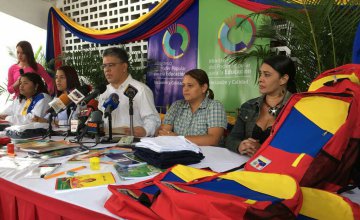
Como parte del avance del Plan Nacional de Parto Humanizado en nuestro país, este miércoles se realizó una charla relacionada con este tema para “crear conciencia sobre la importancia del parto en la vida de las personas”, según lo informó la viceministra de Educación Inicial y Primaria del Ministerio del Poder Popular para la Educación, Gisela Toro.

Esta actividad contó con la participación de un grupo de docentes y miembros del equipo de trabajo del Viceministerio de Educación Inicial y Primaria del MPPE, así como varias madres integrales que atienden a los niños y niñas en los Centros de Educación Inicial (CEI).

“En el taller se brindó información teórica y estamos trabajando en la elaboración de distintos materiales conjuntamente con el ministerio del Poder Popular para la Mujer y el ministerio del Poder Popular para la Salud”, informó la viceministra Toro.

La funcionaria indicó que la idea de estas actividades es lograr que las personas entiendan que el embarazo es “algo maravilloso y que las mujeres en edad para salir embarazadas tienen derechos que les otorga la legislación venezolana”.

La viceministra señaló que entre esos derechos está la potestad de decidir, entre otros aspectos, cómo desean dar a luz y bajo qué circunstancias.

“Ya las mujeres no tienen que parir como lo diga el médico ni como lo decida la clínica o el hospital. Pueden exigir si desean dar a luz en cuclillas o en compañía de algunos familiares. Como institución debemos ayudar a la gente a tomar conciencia sobre la importancia del parto.

 El embarazo y el parto de una mujer son elementos de vital importancia porque conllevan al nacimiento de un miembro más de la sociedad. Cuando veamos a una mujer embarazada debemos respetarla, ayudarla y apoyarla si así lo requiere”, explicó Lara.

Fuente: http://me.gob.ve/index.php/noticias/86-noticias-2027/septiembre/3283-trabajadores-educativos-recibieron-charla-sobre-el-plan-de-parto-humanizado


Comparte este contenido:

India: The point of good education is to have a good life

India/Septiembre de 2017/Fuente: The Hindu

Resumen: El tema del cónclave de este año fue «Pedagogía de Educación Superior y Aprendizaje de la Nueva Era». En el evento participaron varios académicos, profesionales corporativos y directores de destacadas escuelas de Delhi y la Región de la Capital Nacional. Satya Narayan R., fundador de CL Educate, dijo: «Es importante que a los niños se les enseñe la meta habilidad de aprender. La investigación muestra que 6 de 10 puestos de trabajo en 2025 aún no se conocen. Con el tiempo habrá un cambio en la tecnología y es importante que los estudiantes aprendan la habilidad de adaptarse a ella «. La primera mesa redonda tuvo Jyoti Gupta, el director de la Escuela Pública de Delhi Ghaziabad; Vijay Datta, director de la Escuela Moderna Barakhamba Road; Anuj Bhasin, el Comisionado de Comercio, Educación, Gobierno de Canadá; y Poonam Devdutt, director de la Escuela de Estudios Empresariales de la Universidad Shobhit de Meerut; como panelistas.

The Hindu in School and CL Educate organised the Knowledge Conclave 2017 at The Park hotel here on Thursday.

The theme for this year’s conclave was “Higher Education and New Age Learning Pedagogy’. A number of academicians, corporate professionals and principals of prominent schools in Delhi and the National Capital Region spoke at the event.

Change in technology

Satya Narayan R., the founder of CL Educate, said, “It is important that children are taught the meta skill of learning. Research shows that 6 of 10 jobs in 2025 are not yet known. With time there will be a change in technology and it is important that students learn the skill of adapting to it.”

The first panel discussion had Jyoti Gupta, the principal of Delhi Public School Ghaziabad; Vijay Datta, the principal of Modern School Barakhamba Road; Anuj Bhasin, the Trade Commissioner, Education, Government of Canada; and Poonam Devdutt, the director, School of Business Studies, Shobhit University Meerut; as panellists.

The discussion on “Institutions and Schools: Area for Collaboration” saw the panellists emphasise the importance of linkage between schools and universities.

“Institutions of higher education and schools need to be connected to develop skills which will make them employable. The point of good education is to have a good life. I have my doubts whether we are producing happy children despite concentrating on improving efficiency,” said Dr. Devdutt.

Emphasising the importance of vocational courses, Dr. Datta said, “As educators, we need to develop respect for labour work. A shoemaker who is doing his job well is as important to the nation’s strength as the Prime Minister. It is important that we recognise this fact.”

“In foreign countries, equal importance is given to vocational courses as well as academic courses. The Central Board of Secondary Education [CBSE] and Delhi University [DU] should sit together and charter a course that will help students. It is important to have an upward linkage,” said Ms. Gupta. The keynote address on “New age technologies for education” was delivered by Ritu Gupta, director, marketing, consumer and small business, Dell India.

Fuente: http://www.thehindu.com/news/cities/Delhi/the-point-of-good-education-is-to-have-a-good-life/article19639352.ece

Comparte este contenido:

Nueva Zelanda: Four new charter schools announced by govt

Nueva Zelanda/Septiembre de 2017/Fuente: RNZ

Resumen:  El Gobierno Nacional ha anunciado cuatro nuevas escuelas charter, incluyendo la primera en la Isla Sur y Gisborne. El subsecretario de Educación David Seymour dijo que abriría en 2019. Incluyen un puesto avanzado de Christchurch de la escuela militar de la vanguardia de Auckland y una High School secundaria para los niños desde los años nueve a 11 en Gisborne, Tūranga Tangata Rite. Este último sería dirigido por Te Runanga o Turanganui a Kiwa, que representa los intereses de Rongowhakata, Ngai Tāmanuhiri y Te Aitanga a Māhaki. También habrá una escuela secundaria bilingüe maorí para ir con la escuela primaria dirigida por la Manukau Urban Māori Authority en South Auckland y City Senior School, una escuela de la ciudad de Auckland con un enfoque en ciencia, tecnología, ingeniería, matemáticas y artes.

The National government has announced four new charter schools, including the first in the South Island and Gisborne. Under-secretary of education David Seymour said they would open in 2019.

They include a Christchurch outpost of Auckland’s Vanguard Military School, and an iwi-run junior high school for children in years nine to 11 in Gisborne, Tūranga Tangata Rite.

The latter would be run by Te Runanga o Turanganui a Kiwa, which represents the interests of Rongowhakata, Ngai Tāmanuhiri and Te Aitanga a Māhaki.

There will also be a Māori bilingual secondary school to go with the primary school run by the Manukau Urban Māori Authority in South Auckland, and City Senior School, an inner-city Auckland school with a focus on science, technology, engineering, maths and arts.

There are currently 10 charter or partnership schools, with two more scheduled to open next year.

Mr Seymour said the announcement could not be delayed until after the election because the schools needed time to set up.

«The number of applications that we have and the number of partnership schools that are now over-subscribed shows there is a need for this and why shouldn’t we get some more opened,» he said.

Asked if the schools were being set up in areas that needed more schools, Mr Seymour said that would be proven by parental demand.

«These schools get paid for the number of students that choose to attend them and whether or not there’s a need for them is up to those students and parents.»

He was confident the schools would survive any change of government that might follow this month’s general elections, noting strong Labour Party connections to two of the schools and general support for the schools among Māori.

«I think they would be mad to do anything to these schools because fundamentally, they are succeeding academically,» he said.

Teacher unions were critical of the announcement.

Post Primary Teachers Association president Jack Boyle said Ministry of Education figures showed only 59.7 percent of charter school leavers from charter schools left with NCEA level 2 or above last year, compared to a system-wide figure of 80.3 percent.

«Opening charter schools is not going to raise the achievement of our children. It’s not going to close any gaps. It’s not going to level any playing fields. The only thing charter schools do successfully is reward mediocrity by using scarce education money to prop up private owners,» he said.

Educational Institute president Lynda Stuart said the money spent on charter schools should be spent on support for children with special needs.

Fuente: http://www.radionz.co.nz/news/national/338911/four-new-charter-schools-announced-by-govt


Comparte este contenido:

Rusia: One and a half kilos of technologies: Rostec begins to introduce electronic textbooks Source : https://realnoevremya.com/articles/1772-some-schools-in-russia-being-equipped-with-tablets

Rusia/Septiembre de 2017/Autor: Aleksander Shakirov/Fuente: Real Noevrenya

Resumen: El 1 de septiembre, el proyecto comenzó en cuatro municipios de la provincia de Sverdlovsk, incluyendo Ekaterimburgo y Nizhny Tagil. Como director general de NCEO Konstantin Kozlov informó a RBK, el proyecto cubrirá 350 grupos-participantes (más de 10.000 estudiantes de la escuela) y más de 700 maestros. En el marco del programa, la NCEO planea distribuir 8.000 tabletas, que están destinadas a sustituir todos los libros de texto de los estudiantes, incluidos libros y libros. La tableta se hace en forma de un libro. Una pantalla es usual, la otra es de papel electrónico. En la pantalla en color, los alumnos verán diferentes presentaciones, videos y otros archivos multimedia. La pantalla con papel electrónico no es perjudicial para la visión del niño, Kozlov señaló.

The national centre of electronic education (controlled by Rostec) launches a pilot project for equipping schools in Sverdlovsk Oblast with dual-screen tablets. The projects will concern more than 10,000 pupils and can become another step in transferring of school education to digital format. Its creators plan to introduce tablets nation-wide. However, it is predictably faces the financial problem. Read the details in the material of Realnoe Vremya.

1,5 kilos of technologies

On 1 September, the project started in four municipalities of Sverdlovsk Oblast, including Yekaterinburg and Nizhny Tagil. As director general of NCEO Konstantin Kozlov reported to RBK, the project will cover 350 groups-participants (more than 10,000 school students) and more than 700 teachers. In the framework of the programme, the NCEO plans to give out 8,000 tablets, which are intended to substitute all student textbooks, including workbooks and books.

The tablet is made in the form of a book. One screen is usual, the other is of electronic paper. On the colour screen, the pupils will watch different presentations, videos and other media files. The display with electronic paper is not harmful for child vision, Kozlov noted.

The tablet operates on Android, the weight is 1,5 kilos, the size of each screen is 10 inches. The creators plan to reduce the weight of the device. The NCEO has already spent 300 million of own funds for the pilot project realisation. In the framework of the project, it is also planned to monitor important indicators (progress in studies, readiness of teachers to new introductions and so on), after which there may appear a model of electronic education building that will cover all the regions of Russia.

The Russian development of Chinese production

The assembly of the tablet was conducted in the Chinese plant Foxconn, the world largest contract producer of electronics (in particular, they assemble iPhone, iPad, Amazon Kindle, Nintendo and Xbox). The NCEO highlights that the school tablets is the Russian development, its serial production will be on the industrial capacities of Rostec.

The assembly of the tablet was conducted in the Chinese plant Foxconn. Photo: vistanews.ru

The device is estimated at more than 30,000 rubles. In the future it will cost less than 20,000 rubles. »Two thousand rubles is not the price of educational tablet that will allow to implement them widely in schools,» believes chief analyst at Mobile Research Group Eldar Murtazin. »For such price it is possible to buy even a computer. What is more, it has more advantages,» said Murtazin to RBK. For the same reason, the initiative won’t be interesting for the Ministry of Education, Murtazin believes. »Besides, the concept of dual screen proved itself to be unsuccessful,» said the expert.

The head of the project HalalGuide Ayrat Kasimov holds the opposite point of view. According to him, the future belongs to such projects:

»We ourselves go to work only with a smartphone, not a pack of books. These tablets, as I understand it, have LED screens, that means that they are not harmful for children vision and will be a perfect solution,» told Kasimov to Realnoe Vremya. »I think it is acceptable to pay 30,000 rubles once in 11 years of education. If only the tablets have a guarantee for the whole period of education. I think, all expenditures for the purchase of tablets will eventually fall on the shoulders of parents anyway. Not all families, especially with many children, can afford it. But in general, I am for such introductions – the educational process will go faster. At the same time, it is important for children to develop motor skills. Perhaps, additionally they should introduce some lessons of sculpting to compensate the time children work with tablets.»

According to Ayrat Kasimov, the future belongs to such projects. Photo: incrussia.ru

The only problem is money

»From the point of view of the price for the tablet, it is quite adequate,» said director of IT park Anton Grachyov, who commented on the news to Realnoe Vremya. »Personally I saw the prototype of the tablet two years ago. The question is in other: will the regional and federal ministries of education have money for this? Or municipalities. I think every municipality will define itself if they have money for it. But if they have federal support, then why not.»

According to the head of IT Park, the experience of the Kazan IT academy shows that children better absorb information while playing.

»This certainly will work together with an interactive board. A teacher is writing something on the board and it immediately appears on the screens of the pupils. Here it is more important not the tablet itself, but software and content,» said Grachyov.

Anton Grachyov believes that this will certainly work together with an interactive board. Photo: Oleg Tikhonov

Having a choice

According to Associate Professor at the Institute of Pedagogy and Psychology of the Kazan Federal University Galina Aleksandrova, the scientific research for harmfulness of the use of tablets by students has not been conducted yet:

»Such introduction without preliminary research I consider to be wrong,» says Aleksandrova. It is a different story that these devices become a usual part of our life, and maybe it is teh reason for the idea that it is more economical. As for the comprehension of information, there is no definite answer. Many people use electronic devices and feel themselves great, other people use books. It all depends on personal preferences. I consider it wrong to introduce only one form. Every person has the right to choose the form convenient personally for them for information presentation,» told to Realnoe Vremya the associate professor.

Fuente: https://realnoevremya.com/articles/1772-some-schools-in-russia-being-equipped-with-tablets

Comparte este contenido:
Page 3856 of 6792
1 3.854 3.855 3.856 3.857 3.858 6.792