Page 4579 of 6731
1 4.577 4.578 4.579 4.580 4.581 6.731

UNICEF: «Los países ricos han sabido invertir en la infancia»

UNICEF/28 de marzo de 2017/Fuente: http://elcomercio.pe

«Invertir en la infancia no es invertir en el futuro, es invertir en el presente», afirma representante de UNICEF.

En el Perú cerca del 21,8% de la población viven en situación de pobreza,  lo que afecta a alrededor de 3 millones 410 mil niños, niñas y adolescentes, según cifras del Fondo de las Naciones Unidas para la Infancia (Unicef por sus siglas en ingles).

Juan José Almagro, vicepresidente del Comité Español de Unicef, es enfático al señalar que es necesario que los países inviertan no sólo en educación, o políticas de sanidad, sino también en erradicar la pobreza y la desigualdad.

«Fundamentalmente a nivel regional se invierte mucho en educación o políticas de sanidad, o en colaborar con estos programas. Ahora eso se ha abierto de forma tal que en América Latina los problemas que se plantean son mayores», detalla, tras destacar los avances que se han registrado en varios países de América Latina y el Caribe.

INVERTIR EN LA INFANCIA
El premio Nobel de economía, James Heckman, indicaba que invertir U$1 dólar en un niño o niña durante sus primeros cinco años tiene un retorno social de hasta U$17. Ya que es algo que permanecerá en él durante toda la vida.

Aunque esa perspectiva no es algo que atraiga a Almagro, el representante de Unicef indica que la inversión en la infancia es la clave del desarrollo de una nación.

«Los países de Europa invirtieron en la educación, la infancia, el cuidado materno, mil cosas. Invertir en la infancia no es invertir en el futuro, es invertir en el presente», dice.

Para él, los principales actores de esta inversión son el sector público y las empresas, que en su opinión tienen la responsabilidad de colaborar por la importancia que tienen.

«Cada vez más empresas están desarrollando políticas orientadas a la infancia», expresa. Se destaca por ejemplo a la Fundación Slim, que logró subir el número de registros de nacimiento en México, al financiar el desarrollo de una campaña nacional. O a Milicom, que trabaja para erradicar la pornografía infantil

«Pero también hay firmas que se aprovechan del trabajo infantil», agrega. En efecto, muchas marcas de renombre han sido denunciadas por trabajar con fabricas que usan a niños como fuerza de trabajo. Una de ellas es la cadena de ropa H&M, que en diciembre pasado fue denunciada por dos periodistas suecos.

«La irresponsabilidad puede costar todo, si se mide en términos de reputación o en términos económicos ¿Recuerda a Rana Plaza de Bangladesh? Esa es una clarísima muestra de que el hacer las cosas mal cuesta bastante», finaliza.

EL DATO
Un estudio de Unicef sostiene que si el mundo no aborda el tema de la inequidad, en el año 2030: 167 millones de niños vivirán en la extrema pobreza, 69 millones de niños menores de 5 años morirán entre 2016 y 2030, y 60 millones de niños en edad de asistir a la escuela primaria seguirán sin escolarizar.

Fuente de la Noticia:

http://elcomercio.pe/economia/mundo/unicef-paises-ricos-han-sabido-invertir-infancia-noticia-1977532

Comparte este contenido:

España supera la media europea de personas con depresión

España/28 de marzo de 2017/Fuente: Redacción Médica

El 6,8 por ciento de la población adulta perteneciente a los países de la Unión Europea padece depresión y España está dentro de los diez países que superan esa media, aunque en su caso se encuentra ligeramente por encima (6,9 por ciento). Así lo ha presentado en un informe de Eurostat con datos correspondientes a 2014 donde, además, destaca que las mujeres (7,9 por ciento) tienen más síntomas depresivos que los hombres (5,5 por ciento).

Por países, Hungría se sitúa a la cabeza con un 10,5 por ciento de su población deprimida y le siguen Portugal (10,4 por ciento) y Suecia (9,0 por ciento). En la República Checa (3,2 por ciento) y Eslovaquia (3,5 por ciento) estos síntomas depresivos son menos comunes entre sus ciudadanos.

Los niveles de educación también están vinculados y, como señala el informe, los niveles más altos en educación están vinculados a tasas más bajas de depresión, ya que la tasa para la población con Educación Primaria o Secundaria es más del doble que la de la población con una educación superior a estos niveles.

Según Eurostat, también existe cierta correlación entre los ingresos y los síntomas depresivos: en todos los países las personas con ingresos más bajos suelen presentar con mayor frecuencia síntomas depresivos.

De acuerdo con la Organización Mundial de la Salud, la depresión es la principal causa de discapacidad en el mundo.

Fuente de la Noticia:

https://www.redaccionmedica.com/secciones/psiquiatria/espana-supera-la-media-europea-de-personas-con-depresion-1224

Comparte este contenido:

UNESCO presentó manual para ayudar a periodistas tratar al terrorismo

UNESCO/28 de marzo de 2017/

La UNESCO presentó hoy un manual dirigido a los periodistas para ayudarles a tratar los temas de terrorismo pero evitando convertirse en cajas de resonancia de sus objetivos, entre los que destacan los de dividir las sociedades y enfrentar a unos grupos con otros.

“El peligro real del terrorismo es que el miedo y la sospecha desencadenen una nueva oleada de nacionalismo y de populismo, y que las libertades que tanto nos ha costado alcanzar se sacrifiquen en nombre de una venganza ciega”, indica en el prólogo del documento el subdirector general de la UNESCO para la comunicación y la información, Frank La Rue.

Insiste en que hay que ser “particularmente críticos ante cualquier respuesta que participe en la campaña de los actores violentos y que ocasione sus propias víctimas, elevadas a la categoría de mártires para promover el reclutamiento de terroristas”.

Para el responsable de la comunicación y la información de la Organización de Naciones Unidas para la Educación, la Ciencia y la Cultura, los terroristas quieren “dividir la sociedad en dos” con una polarización de los ciudadanos para provocar “la represión, la discriminación y la discordia”.

Su voluntad es convencer de que “sus predicciones de persecución generalizada eran correctas y atraer a nuevos adeptos a su causa violenta”.

El manual, disponible en línea, consta de 110 páginas en las que se examina la naturaleza del terrorismo y los desafíos que plantea para los periodistas, en particular el de presentar informaciones equilibradas “sobre un asunto tan cargado emocionalmente”.

A partir de ejemplos recientes, en él se abordan cuestiones como el tratamiento de las víctimas, la forma de abordar los rumores o cómo dar cuenta de las investigaciones de las autoridades, pero también las entrevistas a terroristas y la información de los procesos en que son juzgados.

También se dedica un capítulo a la seguridad de los propios informadores, y en especial los secuestros de que pueden ser objeto.

Fuente de la Noticia:

https://www.el-carabobeno.com/unesco-presento-manual-ayudar-periodistas-tratar-al-terrorismo/

Comparte este contenido:

Yemen: 500.000 niños en peligro de muerte

Yemen/ 28 de marzo de 2017/

Desde hace dos años, Arabia Saudí libra una guerra aérea en Yemen, con apoyo de varios países occidentales. El conflicto en el país se ha agudizado. Sobre todo los niños se ven afectados por la pobreza y el hambre.

En la mira de los bombarderos

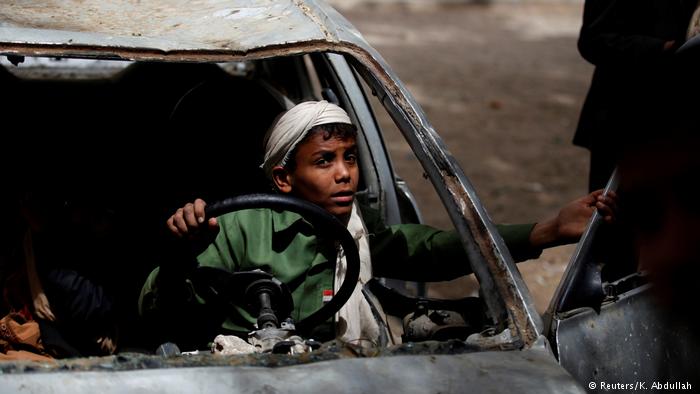
El orfanato en el que vive este joven se encuentra junto a un presunto arsenal de municiones en la capital yemení, Saná. Por ello, la coalición militar liderada por Arabia Saudí lanza regularmente bombas contra este objetivo. Desde hace dos años lucha contra los rebeldes hutíes, que han formado un gobierno opositor.

Huida masiva

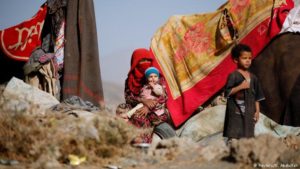
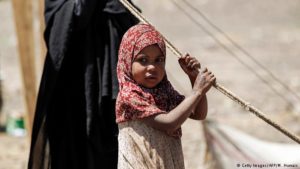
Por miedo a los bombardeos, muchas familias han huido al campo. Esta madre y sus dos hijos viven en el campamento de refugiados de Dharawan. No obstante, también ahí hay escasez de alimentos, medicamentos y otros artículos. En total, unos 1,4 millones de niños han emprendido la huida.

Enfermos por desnutrición

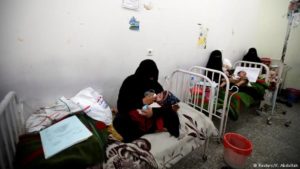
En Yemen se sufre, sobre todo, una severa escasez de alimentos. Según UNICEF, la agencia humanitaria de la ONU para los niños, más de 460.000 menores sufren desnutrición aguda.

Una generación sin educación

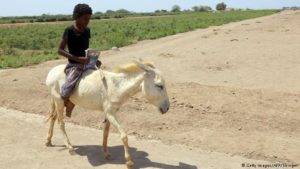
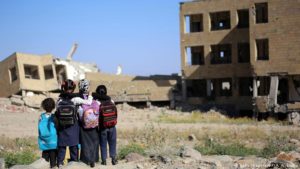
Para la mayoría de los niños yemeníes, el camino a la escuela es peligroso y largo. Este joven en la ciudad portuaria de Al Hudayda por lo menos todavía tiene una escuela a la que puede asistir, a la que va en burro. Alrededor de dos millones de niños no reciben educación básica en Yemen.

Las bombas destruyen futuros

Los combates y ataques aéreos han destruido alrededor de 1.600 edificios escolares. Pero incluso en aquellos lugares privilegiados donde todavía hay escuelas, muchos niños no pueden asistir a clase porque tienen que trabajar para contribuir al sustento de la familia.

Evitar una catástrofe

UNICEF advierte que, de cara a la extrema pobreza, muchos padres están desesperados y permiten que cada vez más niños sean reclutados por las milicias. Con la esperanza de que las niñas tengan un futuro mejor, muchas son casadas a una edad muy temprana. La agencia de la ONU hace un llamado a la comunidad internacional para evitar una hambruna en Yemen.

La lucha por el poder

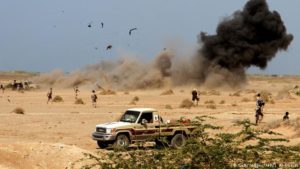
Lo que en 2013 comenzó como un conflicto entre rebeldes hutíes y partes del ejército yemení se ha convertido en una guerra de dimensiones internacionales. Desde 2015, cazas sauditas lanzan ataques aéreos. En su lucha contra los rebeldes hutíes, Arabia Saudí es apoyada por Estados Unidos, Francia y Gran Bretaña. (VT/JOV).

Fuente de la Noticia:

http://www.dw.com/es/yemen-500000-ni%C3%B1os-en-peligro-de-muerte/g-38141308

Comparte este contenido:

Google busca pasantes para trabajar en Australia

Australia/28 de marzo de 2017/Fuente: Universia

La propuesta es por unas 10 o 14 semanas de duración y llevará a los estudiantes a vivir una experiencia formativa única junto a un gigante de la tecnología mundial.

Australia es uno de esos países que aparecen continuamente en el horizonte de los jóvenes españoles. A la hora de elegir un país para estudiar fuera, los españoles son los europeos que solicitan más visados para estudiar en Australia, y en cuanto a trabajo este destino también se lleva a unos cuantos miles de españoles cada año gracias a sus constantes ofertas de trabajo con remuneraciones que no se encuentran fácilmente en España.

Es que, vivir en Australia es sinónimo de calidad de vida y de cultura, de encontrarse con estudiantes internacionales a cada paso y de aprender una amplia variedad de idiomas con solo transitar sus calles, entre los que destaca fundamentalmente el inglés. Sus bajos índices de desempleo y la solidez de su sistema educativo lo posicionaron dentro de los 15 mejores países para vivir en 2017 de acuerdo a la U.S. News & World Report y dentro de los 4 mejores países para trabajar en 2016 según la OCDE.

Australia, paraíso del desarrollo científico y la innovación tecnológica, alberga una amplia cantidad de grandes empresas del mundo entre las que destaca Google. La sede que la compañía posee en Sydney es uno de los destinos más solicitados por los trabajadores de Google a la hora de buscar nuevos horizontes y solicitar puestos en el extranjero. Y a esa misma sede irán quienes resulten seleccionados para este nuevo programa de pasantías que organiza el gigante de internet.

Estas prácticas de negocios en Google Australia están disponibles para estudiantes que demuestren poseer capacidades de análisis eficaces y la capacidad para tratar con los clientes de la empresa asistiéndolos para que puedan sacar el máximo provecho de los productos que ofrece Google. Por lo tanto, serán valoradas positivamente las habilidades interpersonales, la vocación por el servicio al cliente, capacidad para gestionar proyectos y comunicarse efectivamente.

Para estas pasantías no se necesitan conocimientos técnicos específicos pues lo que se busca es contratar a estudiantes capaces de arrojar luz sobre las necesidades de los propios clientes de los productos de Google en diversas áreas. Durante las 10 o 14 semanas que dure la pasantía los estudiantes tendrán un tutor asignado, por lo que todas sus dudas técnicas podrán ser resueltas de forma personalizada.

Requisitos mínimos para apuntarse

  • Encontrarse cursando una licenciatura, maestría o doctorado en informática o un campo vinculado.
  • Capacidad para desarrollar y entender estrategias de desarrollo.
  • Capacidad de análisis y organización.
  • Interés en la creación y análisis de productos.
  • Excelentes habilidades de comunicación escrita y oral.
  • Habilidades para interactuar con clientes.

¿Cómo apuntarse?

Los interesados deben apuntarse a estas pasantías antes del viernes 19 de mayo mediante el formulario de aplicación. Deberán enviar su hoja de vida, incluyendo en ella el nivel del grado que cursa, la fecha que prevista para su graduación y la disponibilidad que posee el candidato para realizar las prácticas.

El currículum vitae debe ser enviado preferentemente en inglés y en formato PDF junto a la hoja de vida. En esta oportunidad no es necesario enviar una carta de presentación.

Fuente de la Noticia:

http://noticias.universia.es/practicas-empleo/noticia/2017/03/27/1150901/google-busca-pasantes-trabajar-australia.html
Comparte este contenido:

Young Ghanaian Trailblazer Urges Women to Pursue STEM Careers

Ghana/28 th March 2017/Source: All Africa

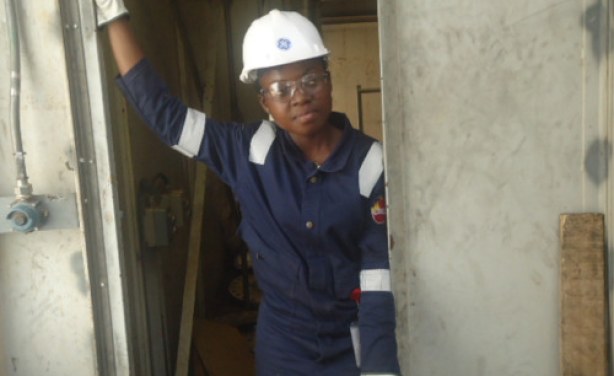
A young Ghanaian engineer, who constantly had to justify her passion for science to everyone she came across, believes that if young women are firm in their beliefs, they will  succeed. Leticia Oppong currently works for GE in power services as a field service and technical advising specialist for power plant control systems. She believes that having more women in STEM  roles will result in increased creativity, and innovation as products, and services delivered will be informed by the perspectives of a diverse workforce.

Leticia said that girls who have an interest in STEM (science, technology, engineering and mathematics) careers will be inspired to follow in the  footsteps of other successful women in STEM and should therefore be exposed to more female role models in these fields.

When asked about her experience in a male-dominated field, Leticia admitted that there have been occasional instances of prejudice. “Some people see you on site and immediately assume that as a woman, you don’t have what it takes to execute the job. Working with such people can get frustrating.” Leticia also found that some sites, understandably, did not have female washrooms and because she would have to share with the guys, she had to find ways of managing this.

“My  home country is Ghana, however, I’m part of the Sub-Saharan African pool of  field service engineers covering assignments within Africa and globally, as the  need arises.” Leticia initially joined GE in 2013 as an intern with the power services team in Ghana, where during the one-year internship, she was sent to selected sites to work with field teams and to also provide administrative support to various businesses in the GE Ghana office.

“My  interest in engineering had been solidified some time after junior high school. I developed an interest in taking apart electronic devices to figure out how they work and to try to fix them. My father is an electrical engineer and I watched him work around the house. That certainly played a part because  I wanted to fix things like he did.”

Growing up, Leticia knew she wanted to be a scientist. “There was an educational programme on TV that I watched quite a lot as a child. It was called The Know-How Show.” She was fascinated by the scientific illustrations on the show and this sparked a curiosity that led her to read a book about a power blackout. In the book, there was a picture of a woman in full safety gear on a utility pole. “I remember  thinking, ‘that’s what I want to do when I grow up’.”

“My father was against me moving into the engineering field from the start. He said a woman had no future in engineering and suggested I study pharmacy. I had to explain to him why I wanted to do engineering. He finally gave in  after we consulted a lecturer who convinced him that there was room for women  in engineering.”

“My career at GE is fairly young and I’m still being mentored. So far, I’ve had the opportunity to attend some university career fairs to share my story with young people who have an interest in the field and hopefully, to inspire them  to stay on course. I plan to continue doing this and to take on younger female engineers as I progress further.”

Leticia studied electrical/electronic engineering at the Kwame Nkrumah University of Science and Technology, Ghana’s premier institution for the study of engineering. Following her studies, her first training was at the Energy Learning Centre in Niskayuna where she completed the entry-level training for Mark VIe Control Systems. As part of her training, Leticia did on-the-job training for six months on sites in the United States and Nigeria, also attending a leadership training course in South Africa.

“So far, I’d say my first job was the biggest. I was assigned to support on an upgrade job at a site in Japan for two months. The job scope included working on a 9F.03 gas turbine unit with DLN 2.6+ and model-based control, and  it was technology I had no experience with. It was challenging adjusting to the culture of the people, especially overcoming the language barrier. Thank God, I pulled through and it was a success.”

“I love field work, but there will come a time when I have to make a change so I can grow in my career. When that time comes, I will opt for a role where I can still support the execution of field jobs with the experience I’ve  garnered.”

To other young women experiencing difficulty in convincing their parents of the viability of a career in science, Leticia advises them to make a case for what they want. “It’s not easy, but it is possible. Don’t lose your passion or your faith. There is an increasing need for innovative solutions in energy and other infrastructure sectors. A STEM career gives you a chance to be at the forefront of breakthroughs in science and technology that will change our world.”

Source of the news:
http://allafrica.com/view/group/main/main/id/00050534.html
Comparte este contenido:

Teachers Tell Of Death Threats, Sexual Pestering at Kenyan School

Kenyan/March 28, 2017//Source: All Africa

«It’s no longer about my job, it’s about my life. That is all I have to fight for,» 28-year-old teacher Ancellah Cherotich Kessio told this Capital FM reporter when they met for the first time about three weeks ago.

As she recalled the incident, she explained that she found it prudent to give her employer time to handle the matter since she had reported it to the Teachers Service Commission (TSC).

Kessio joined Uhuru Secondary School, Nairobi as a History and CRE teacher in 2015.

But little did she know that she had landed herself into a worrying step in her teaching career as a member of the Teachers Service Commission (TSC).

After the initial encounter, Kessio came back to us because her life was in her words, «in danger.»

She was in tears and she had a headache.

Before the interview we had to give her painkillers and allow her time to calm down.

She gave us a note that was delivered to her by the school messenger last Tuesday.

«DEAR ANCELLAH CHEROTICH KESSIO. ATTENTION: DROP ALL CASES WITHIN ONE WEEK OR ELSE ……………. (). Yours faithfully 0000000,» the short note reads.

Tuesday’s incident was continuation of escalating intimidation that began in 2015.

It all began when the then Deputy Principal Juma Duncan asked her for a coffee date, an offer she kindly turned down on countless occasions.

In August 2015 she warned him that if he continued, she would let his wife know.

But the response she got left her terrified.

Capital FM News saw a text message sent from Juma to Kessio on August 22, 2015.

«I SWEAR IN THE MIGHTY NAME OF GOD I WILL KILL YOU. YOU CNT ESCAPE, TRUST YOU ME.»

The Principal later called explaining that he could not remember and did not understand how the message left his phone to her phone.

Since it was during the holidays, she kept cool and hoped the threats would subside by the time schools re-opened.

In September 2015, Juma became the Principal.

«He didn’t stop calling me to his office.»

He even promised to promote her to head the Humanities Department if she accepted to become his girlfriend.

But she refused.

Kessio also refused to take Sh2,000 he offered and requested her to accompany him to Mombasa.

The Principal, Kessio recalled kept on telling her; «you look tempting, you look sexy» on the many occasions he ran into her within the school compound.

After he realised Kessio would not give in, he resorted to using students in her class to malign and disparage her.

«He told them that the notes I used to teach them were college notes and they were not authentic and that he had slapped me with them. How I got to know – some of the students came to me and asked me; ‘Mwalimu, how can you be slapped in this compound and we don’t know, how can you condone to be beaten up’,» she recalled as she fought back her tears.

She confronted him during a meeting attended by the Dean of Studies after Juma alleged that she had not taught well.
«I finally got the opportunity to ask him, ‘what is it do you want from me?»

But that did not stop the intimidation.

On September 19, 2016 she wrote to TSC requesting for a transfer but for fear that the principal would revenge, she stated that her reason for the transfer was over distance to the school.

«The transfer did not go through. I was told I am under the five-year rule. The principal brought the letter to me and sarcastically told me ‘you are not going anywhere’.»

«Imagining more years with him, I didn’t think I would survive, I started looking for other avenues like going for study leave,» she recalled she couldn’t qualify again because of the five-year rule.

«My life at Uhuru has been so difficult such that if you are not threatened you are intimidated, if you are not intimidated, children are laughing at you because the principal has this habit of discussing teachers with students.»

On scrutinising the Kenya Certificate of Secondary Education (KCSE) examination results 2016, we realised performance of students in the subjects she teaches, History was third and CRE was fourth in the school rank.

After all the drama, she hoped 2017 would be a better year.

But it was until he ran into her at the assembly ground that Kessio knew the war was far from over.

He told her she looked sexy and asked; «Have you ever tasted a Luo?»

Capital FM News is in possession of a letter sent by Kessio to TSC dated March 1, 2017.

Referenced as, ‘Sexual harassment, threats and a difficult working environment’ Kessio wrote «I wish to lodge a complaint of sexual harassment by the Principal, Uhuru Secondary School, Mr Juma Duncan. I have been intimidated and harassed and I no longer have an ounce of energy to fight back.»

Throughout the letter, she narrated a trail of incidents in which Juma made sexual advances and upon refusal he resorted to intimidation, death threats and embarrassment.

Capital FM News is in possession of minutes of several meetings held at the school – some to discuss issues raised with the Education County Office and TSC over the sexual harassment complaints and others to accuse Kessio of sullying the name of the school.

«I know what will happen if I move out of here. If my life is to end but I will want to say something, if saying no to someone, keeping your dignity as a woman is wrong, then I am ready for that death, at least go down that I protected my dignity,» she said as she broke down into tears.

«I cannot even speak about my fear, I even fear my own shadow, I walk looking back if someone is following me, I have nightmares, I have one that is recurring that someone is trying to suffocate me. I have been going to sessions of therapy.»

Kessio, a mother of one has been a frequent hospital client.

Her weight dropped from 50 kilos to 40 kilos.

Capital FM News has a medical report from a doctor recommending counselling sessions.

Provisional diagnosis showed that she has ‘clinical depression’.

According to records from a counselling centre in Nairobi, she has so far attended four sessions.

Kessio’s sexual harassment case at Uhuru Secondary School is not the only one filed at the TSC.

The second case concerns Biology and Agriculture teacher Mary Karimi Muhia who still has marks of assault on her thigh and head.

According to a P3 form filed at Buruburu Police station, it was recorded that Karimi was assaulted by the three teachers after she was summoned by the Deputy Principal to his office on February 23, 2017.

The Investigating Officer at Buruburu Police station confirmed the case was under probe; «we are investigating we cannot comment further.»

The moment she entered the office, three teachers attacked her trying to snatch a phone in which she had recorded students confessing that the school Principal had coerced them to lie that she had given them an examination leakage.

It was the phone they also thought she had recorded evidence of sexual harassment by the principal.

«Madam (name withheld) who was standing grabbed my hair plucking my braids which were only two days old. She shouted saying, Karimi, today people will collect you at the morgue, release your phone or else I kill you, I must get all the recordings, video, tapes and photos that you have been taking.»

This happened as a third teacher held her to allow the first madam to injure her.

And as the beating continued, there was suddenly an excruciating pain on her thigh.

The teacher after plucking off her hair pierced her thigh with a sharp object.

«I saw death with my own eyes. I screamed louder calling their names, asking – why are you killing me.»

During that commotion the Principal entered the office and joined the gang that was roughing her up.

«Mr Juma hit me against the office table hurting my ribs. He then stepped backward and closed the door,» she recalled even the insults that accompanied her during the gruelling attack.

The hair that was plucked off was picked up and thrown at her telling her; «you stupid fool, today is your end.»

At that moment she was again hit with a paper punch and a stapler and she was again asked to surrender all the evidence she had against Juma.

They were still searching for her phone which she had hidden in her bra then in her inner wear.

She got help after a different teacher went to the ‘slaughter house’ to respond to the distress call that she begged him to call a female colleague.

«I wanted her to at least come and dress me. I was dirty and bleeding and my panty was down. As I moved out in the presence of students who were taking lunch and workers all over to see what was happening. Many thought I had been raped. There was blood coming from my thigh entering my shoe, I was limping,» she narrated.

Karimi’s attack this year was triggered by an incident that happened two years after she joined the school in 2012.

«Juma started his sex advances in 2014. He used to tell me you are the prettiest woman that I have ever seen. At first I told him thank you.»

«I realised when we are passing on corridors Mr Juma wanted we meet head on collision, I used to run away from him. The sexual advances were several. He would tell me ‘you look yummy’, in 2014, 2015 he didn’t stop telling me ‘you are sexy’.»

On September 20, 2014, Juma threw a science party meant to celebrate her birthday. But she didn’t show up.

«The following Monday he called me to his office and asked me, ‘Karimi, I want you to explain me why you let me down’,» she said she had a family birthday party.

«And so he asked me,» ‘Have you ever tasted a Luo?’

«And I told him, Sir, is a Luo a meal in any of the hotels?»

«Then I told him, even if God eroded the earth, you and me were left, nothing can happen. And from that particular day, he now declared war on me,» she explained as she broke down into tears.

Whenever there were office meetings, he resorted to embarrassing and threatening her.

At some point, the Principal had conspired with the Guidance and Counselling teacher to slap her so that she could fight back.

But because she knew of the witch-hunt she did not fight back.

The threats went as far as hiding her Kenya Revenue Authority forms and her pay slips.

Students in her class, one day told her that Juma had told them to lie that she had given them an exam leakage, a confession she recorded and handed over to TSC.

Students also wrote a letter in Caps protesting Juma’s consistent persuasion that they lie to fix their class teacher.

«BUT THERE IS SOMETHING THAT WE FEEL IT IS NOT RIGHT THE WAY THE PRINCIPAL THREATS YOU TEACHERS AND US. TOO WE ARE AFRAID TO TELL HIM BECAUSE HE WILL VICTIMISE US,» the letter read.

Capital FM News has a letter she wrote to TSC reporting sexual harassment by the Principal and asking for a transfer.

Last Tuesday she received a letter like the one sent to Kessio telling her to drop her classes or else…
«Today I have come here to let the world know that it could be the end of me. If I leave this door and I am killed it is Duncan Juma.»

At that point she broke down and we had to give her time to recover.

«It has affected my family. I feel weak, I feel pain all over, I have acidity that I never had. I feel I am just a shell of my old self. If I am killed, may justice prevail and my younger sisters who will come to that school they will be salvaged,» she cried.

All the two teachers want now is justice because the headmaster has threatened to make their lives hell for embarrassing him with the allegations they make.

They are appealing to TSC to transfer them and also investigate the Principal.

Capital FM News spoke to Juma on Thursday.

«Those things are under investigations by TSC I think TSC has done their part, I don’t want to comment.»

But about five minutes later he called back saying he was innocent. Capital FM News also asked him why he didn’t report the physical attack meted on Karimi at the Deputy Principal’s office.

TSC Principal Administrative Officer – Child Protection, Gender and Disability Zipporah Musengi told Capital FM News; «We have the cases and we are doing the appropriate investigations.»

The Nairobi County Education Office also confirmed it had received the complaints from Kessio and Karimi and that investigations were ongoing.

But as the processes take longer, the two women are scared for their lives as they pay several visits to doctors and counsellors.

Karimi is currently on sick leave.

 Source of the news:

http://allafrica.com/stories/201703240345.html
Comparte este contenido:
Page 4579 of 6731
1 4.577 4.578 4.579 4.580 4.581 6.731