Saltar al contenido principal
Page 11 of 144
1 9 10 11 12 13 144

Kenya: School heads to ensure next year’s candidates return to school

Africa/Kenya/25-10-2020/Author:Muraya Kamunde/Source: www.kbc.co.ke

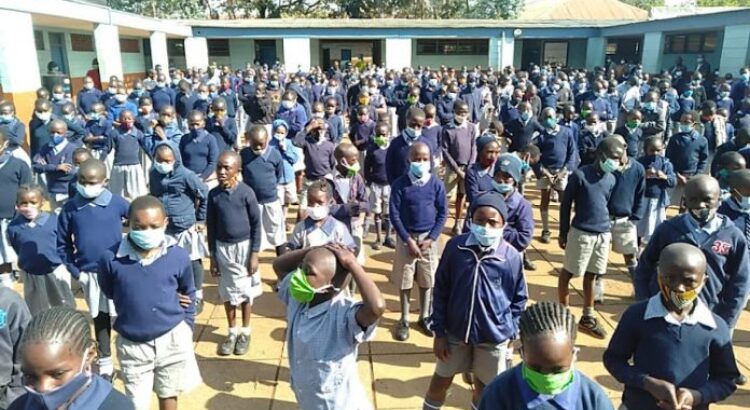
All school heads in the country have been tasked to ensure that all students who sit for their KCPE and KCSE exams next year return to school.

University Education and Research Principal Secretary Amb. Simon Nabukwesi who was on weeklong visit to several learning institutions in Nyanza and Western Kenya regions to assess the learning progress observed that some learners had failed to report to their respective schools.

School Principals in the affected institutions cited pregnancies as some of the reasons to why some female students failed to turn up as they were nursing their babies whereas a few male students had engaged in business and absconded class.

The PS asked school heads to liaise with their parents and guardians to ensure all students return to school.

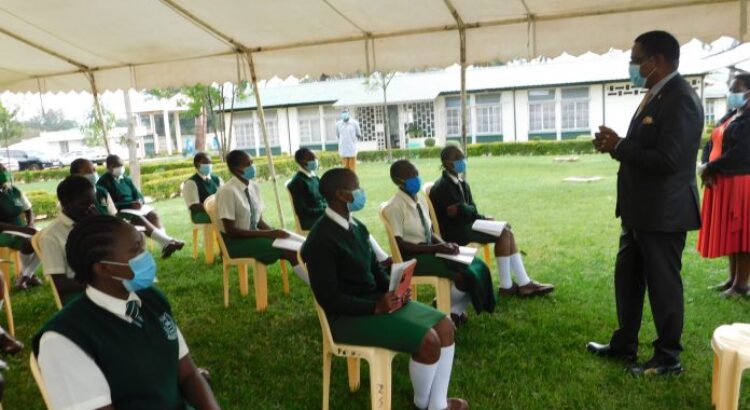
The University Education PS said the Government is concerned about the safety, hygiene and health of both learners and teachers and is currently monitoring the progress of the partial school re-opening in all counties to ascertain that the Covid-19 measures and protocols have been adhered to.

“Covid-19 pandemic is here with us but our lives have to continue, I urge you to observe the required protocols such as social distancing, frequent hand washing, wearing of face masks to avoid getting infected,”  he said.

The PS noted that public institutions had challenges but assured the school Heads that the Government is doing its best to ensure funds are availed to aid in the expansion of facilities and purchase of Covid-19 prevention requirements.

Source and Image: https://www.kbc.co.ke/school-heads-to-ensure-next-years-candidates-return-to-school/

Comparte este contenido:

Kenya: COVID-19: Bottlenecks as schools implement phased re-opening

Africa/Kenya/18-10-2020/Author: Nicholas Kigondu/Source: ww.kbc.co.ke

More learners reported back to school on Tuesday following the reopening of primary and secondary schools for Grade 4, class 8 and Form four learners amid safety concerns.

 In-person learning resumed on Monday across the country with learners facing extended learning schedules as teachers strive to recover lost time and regularize the national academic calendar that was disrupted by the coronavirus pandemic.

A spot check however reveal that a section of private schools are yet to resume learning as they struggle to comply with strict protocols issued by the ministry of health and meant to contain the spread of the virus.

The suspension of learning saw private schools hit hard by economic meltdown witnessing closure of some schools that depended on school fees for survival.

At the Narok County Academy, the management was Tuesday busy putting its house in order as it prepares to usher in learners on Wednesday.  School’s director Elizabeth Ntutu says they have already put in place elaborate measures in line with directives issued by the government.

Narok County Academy Director Elizabeth Ntutu says the school has complied with all directives issued by the ministry of health

Narok county Director of Education Philip Wambua says 95 percent of class eight and form four candidates in Narok County have reported back to school. Most of those yet to report back to school said to be pregnant girls who fell pregnant during the long holiday occasioned by the Covid-19 pandemic.

At the Thika School for the Blind in Kiambu County, only 11 pupils have so far reported, a situation blamed on financial constraints.

According to the school’s head Margaret Njuguna, parents at the school   have suffered harsh economic Covid-19 shock waves and had only started to heal when the Ministry of Education announced resumption of learning.

In announcing the phased re-opening of schools, education cabinet secretary George Magoha issued an 11-week school calendar for the learners for their second and third terms that will see learners break for just a week during the December holiday.

The learners will break for the end of their second terms on 24 December and resume learning on 4 January to kick off the third term. And in a departure from the past, the revised school calendar has not made provision for mid-term.

Magoha opted for a phased reopening, giving priority to the pioneer Competency Based Curriculum (CBC) class, he Kenya Certificate of Primary Education (KCPE) and Kenya Certificate of Secondary Education (KCSE) exam candidates, who will now sit their tests in March and April next year.

The decision to reopen schools in phases followed advise from the education task-force committee on Covid-19 with the education ministry saying it will monitor the situation before making a decision on when learning for the rest of the learners in primary and secondary schools will resume.

Source and Image: https://www.kbc.co.ke/covid-19-bottlenecks-as-schools-implement-phased-re-opening/

Comparte este contenido:

Zizek: Covid crisis sparked fear of communism & China’s rise as superpower. But best way to prevent communism is to FOLLOW China

By: Slavoj Zizek

Across the world, the establishment is aware of the radical social consequences of the coronavirus pandemic. That’s why we’re seeing leaders introduce strategies and thinking that could be interpreted as fascist in principle.

story picked up by the UK media at the end of September passed almost unnoticed. As The Guardian reported, “The government has ordered schools in England not to use resources from organizations which have expressed a desire to end capitalism. Department for Education guidance issued on Thursday for school leaders and teachers involved in setting the relationship, sex and health curriculum categorized anti-capitalism as an ‘extreme political stance’ and equated it with opposition to freedom of speech, anti-Semitism and endorsement of illegal activity.”

As far as I know, this was the first time such an explicit order had been given; nothing like this happened even in the darkest periods of the Cold War. One should also note the words used: “a desire to end capitalism.” Not an intention, a plan, a program, but simply a desire – a term which can be applied to almost any statement (“True, you didn’t say it, but it’s what you desire…»).

Plus, of course, there was the (now usual) addition of “anti-Semitism,” as if a desire to end capitalism is in itself anti-Semitic. Are the authors aware that their prohibition is in itself anti-Semitic: it implies that Jews are in their essence capitalist?

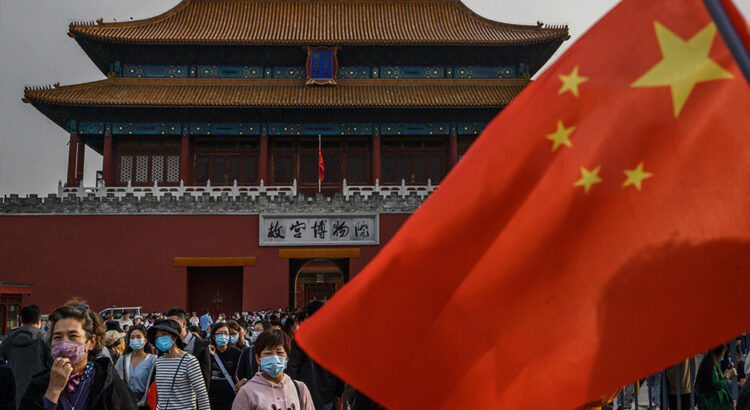
Why this sudden panic reaction to communism? Is it fear that the pandemic, global warming and other social crises may provide an opportunity for China to assert itself as the only remaining superpower? No, China is not today’s Soviet Union; the best way to prevent communism is to follow China. While the Soviet Union was the external enemy, the threat to liberal democracies today is internal, from the explosive mixture of crises that beset our societies.

Let’s take an extreme but clear example of how the ongoing pandemic pushed our societies in the direction of what we associate with communism, and for some even the worst part of it.

In his Logiques des mondes, Alain Badiou elaborated on the idea of the politics of revolutionary justice at work from the ancient Chinese ‘legists’ through Jacobins to Lenin and Mao. It consists of four moments: voluntarism (the belief that one can “move mountains,” ignoring “objective” laws and obstacles), terror (a ruthless will to crush the enemy), egalitarian justice (its immediate brutal imposition, with no understanding for the “complex circumstances” which allegedly compel us to proceed gradually), and, last but not least, trust in the people.

Does the ongoing pandemic not require us to invent a new version of these four features?

Voluntarism: Even in countries where conservative forces are in power, decisions are taken which clearly violate “objective” laws of the market, like the state directly intervening in industry, distributing billions to prevent hunger or for healthcare measures.

Terror: Liberals are correct in their fears. Not only are states forced to enact new modes of social control and regulation, but people are even solicited to report family members and neighbors who hide their infection to the authorities.

Egalitarian justice: It is commonly accepted that the eventual vaccine should be accessible to everybody, and that no part of the world population should be sacrificed to the virus – the cure is either global or inefficient.

Trust in the people: We all know that most of the measures against the pandemic only work if people follow the recommendations. No state control can do the work here.

But much more important than this is the partial socialization of economy imposed by the pandemic. Such a socialization will become even more urgent with the ongoing rise in infections. This is how one should also interpret the ‘fascist’ tendencies of Trump and other populists. As Walter Benjamin said long ago: “Behind every fascism, there is a failed revolution.”

These ‘fascist’ tendencies signal that the establishment is silently aware of the radical social consequences of the pandemic. The establishment acts preventively by trying to quash them before they acquire full political form.

Although it is too simple to dismiss Trump as a fascist, the danger he embodies is even worse than outright fascism. From my youth, I remember a classic East German joke: Richard Nixon, Leonid Brezhnev and Erich Honecker confront God, asking him about the future of their countries. To Nixon, he answers: “In 2050, the US will be communist.” Nixon turns around and starts to cry. To Brezhnev, he says: “In 2050, the Soviet Union will be a Chinese province.” After Brezhnev also turns around and starts to cry, Honecker finally asks: “And how will it be in my beloved GDR?” And God turns around, and starts to cry…

We can easily imagine a version of the same joke if Trump and those similar to him prevail in our world. Putin, Chinese President Xi Jinping and Donald Trump confront God with the same question. To Putin, God answers: “Russia will be controlled by China,” so Putin turns around and starts to cry. To Xi, God answers: “Mainland China will be dominated by Taiwan,” so Xi does the same. When Trump finally asks the same question, God turns around and starts to cry…

What we are getting today – not only in China – is the combination of strong authoritarian states with wild capitalist dynamics. The most efficient form of capitalism today is what Henry Farrell called “networked authoritarianism”: if a state spies on people enough and allows machine-learning systems to incorporate their behavior and respond to it, it is possible to provide for everyone’s needs better than a democracy could. Here, Xi, Putin and Trump are joining hands.

Two conclusions impose themselves here, a short-term one and a long-term one. The short-term one is that the task of (whatever remains of) the radical left is now, as Alexandria Ocasio-Cortez pointed out, to save our “bourgeois” democracy when the liberal center is too weak and indecisive to do it. ‘Shame on them; we have now even to fight their battles!’

Obsessed by Trump’s provocative eccentricities, liberals miss the key point, developed by Michael Sandel: Trump is not a dictator, he only plays one on television, and we should not play along as his supporting cast. This is what we do when we criticize him as some kind of fascist, instead of focusing on his failures which he obfuscates by his dictatorial excesses and provocations. His typical strategy is to provoke the liberal ire which attracts wide attention and then, out of sight of the public at large, enforce measures which limit workers’ rights, etc.

And the second conclusion? During the protests that erupted in Chile in October 2019, there was graffiti on a wall which read, “Another end of the world is possible.”. This should be our answer to an establishment obsessed by apocalyptic scenarios. Yes, your old world is coming to an end, but the options envisaged by you are not the only ones: another end of the world is possible.

Source and Image: https://www.rt.com/op-ed/502825-china-communism-covid-follow/
Comparte este contenido:

Time to re-open schools in Eastern and Southern Africa, UNICEF

Africa/27-09-2020/Author: Beth Nyaga/Source: www.kbc.co.ke

UNICEF has called on governments, parents and teachers across Eastern and Southern Africa to urgently and safely re-open schools, as the costs of continued school closures escalate across Eastern and Southern Africa.

While there are encouraging reports that 13 out of 21 countries in Eastern and Southern Africa have returned children to classrooms, with an additional four having set return dates, countries such as Kenya – with a huge student population – are still to decide on whether they will reopen schools this year, compounding the threats which out-of-school children face.

UNICEF’s call to safely re-open schools follows scientific evidence which shows children are not super-spreaders of COVID-19, and are the least affected by COVID-19 in the region, with a mere 2.5 per cent of COVID-19 cases attributed to children of school-going age (5-18 years, WHO).

“Much effort was spent at the start of this pandemic reminding all of the dangers of COVID-19 and necessary precautions,” said Mohamed Malick Fall, Regional Director for UNICEF Eastern and Southern Africa. “Things have evolved – we now know greater dangers for children lie by being outside the classroom. That message needs to be heard.”

Across this region, of the nearly 65 million children remaining out of school, around one in two are not reached by any form of learning.

Meanwhile, violence has spiked. Across the region, millions of children continue to miss what was their one nutritious meal of the day.

“Seven months into the pandemic, we must be very clear about the gravity of this crisis: we are at risk of losing a generation,” said Fall. “We see lost learning, rising violence, rising child labour, forced child marriages, teen pregnancies and diminished nutrition. A generation of children is at risk, and at the most critical time in our continent’s history.

“We are at a time of unprecedented population growth,” continued Fall. “If this expanded workforce can receive quality learning at school, the potential for increased production could sustain an economic boom to drastically reduce poverty in Africa – where currently 70 per cent of sub-Saharan Africa’s people live on less than US$ 2/day.”

It can be done. Safely re-opening schools by the beginning of October this year will give scholars a full term and vastly reduce learning losses.

A third term for learners presents the last chance to recoup learning losses for 2020 and avert the dangers of permanent school drop-outs.

Re-opening will also reduce losses incurred by both parents and governments.

Critically, there is growing regional and global practice showing that safe school re-opening can be done with political will and community commitment.

Most countries in Eastern and Southern Africa have seen the rationale of a phased return to schools, starting with exam classes in countries such as Botswana, Eritrea, Eswatini, Madagascar, Somalia, Zambia, and recently Malawi and Zimbabwe.

Bigger countries with larger COVID-19 caseloads and higher student populations – such as South Africa – have reopened schools for all grades since the end of August.

“UNICEF is here to support countries, and share working practices on safely re-opening schools; examples that can be applied to our context,” said Fall.

Source and Image: https://www.kbc.co.ke/time-to-re-open-schools-in-eastern-and-southern-africa-unicef/
Comparte este contenido:

Kenya: Magoha faults individuals who failed to implement laptop project

Africa/Kenya/16-08-2020/Author: Sarafina Robi/ Beth Nyaga/Source: www.kbc.co.ke

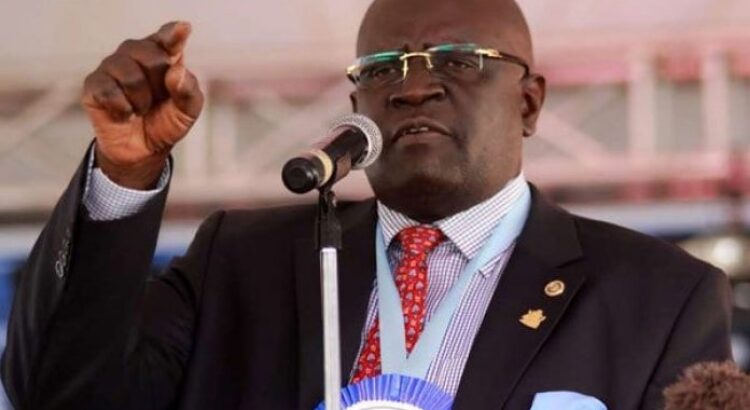
Education Cabinet Secretary Professor George Magoha has faulted individuals who failed to implement the Government’s laptop project that would have salvaged the current situation.

Magoha who was attending the start of a two-day stakeholders meeting on university reforms challenged institutions of higher learning to invest in online classes and address challenges of funding.

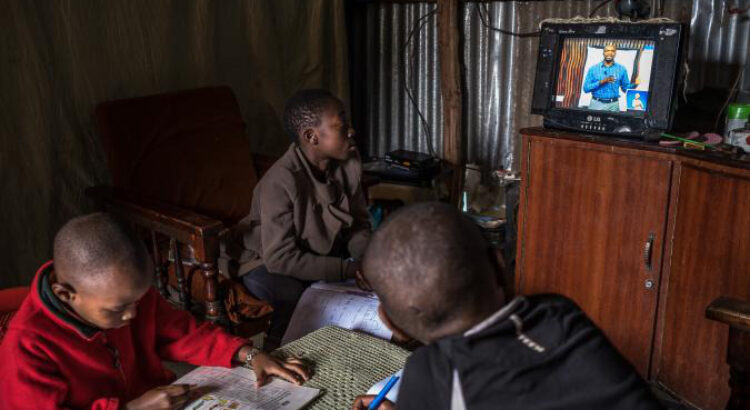
It is at this meeting that the Education CS took a swipe at individuals who he says failed to ensure the implementation of laptops for all school-going children which would have come in handy in ensuring learning continues as the nation battles the pandemic.

At the same time, he challenged universities to invest in virtual learning to ensure learning continues.

Magoha also took issue with what he termed as the flawed funding formula for Universities calling on the stakeholders to deliberate on sustainable financing of the institution as opposed to over-reliance on government financing.

He also called for greater autonomy at universities even as he hailed the move by 70 per cent of universities to adopt key COVID 19 measures as advised by the ministry.

Also Read  President Kenyatta commissions construction of hospitals in informal settlements

This comes after two days after the CS announced that 3000 private schools are set to benefit from a Ksh7 billion concessional loan from the government to support infrastructural development in readiness for schools reopening in January.

The loan is to be availed at an interest rate of between 2.5 and 3.5% will support areas like installation of ICT systems to ensure learning continues during the phased reopening of schools.

The loan will also be availed at an interest rate of between 2.5 and 3.5% and will be dependent on the absorption rate of an institution.

Also Read  Revenue debate to continue as Senate adjourns to Thursday

To ensure social distancing during learning, schools will be expected to construct extra classrooms with availed funds.

Schools that will get the money will also be expected procure sanitary and hand-washing stations to ensure the highest levels of hygiene.

With schools expected to reopen in January, the government funds are also expected to cater to ICT infrastructure in readiness for a phased reopening.

Source and Image: https://www.kbc.co.ke/__trashed-14/

Comparte este contenido:

Lessons to be learned from Scottish exam fiasco: Protesting can change results… and the SNP are absolutely bulletproof

By: Damian Wilson

A plan to downgrade 124,000 school exam results has been reversed in Scotland in the face of a massive outcry. Is this a precedent for unpopular results in future? And how shambolic do the SNP have to be before they lose support?

Timing is everything in politics and no one is more aware of that today than Scotland’s under-fire education secretary John Swinney. After days of protests by school students and teachers, which led to a reversal of the decision to downgrade 124,000 exam results, Swinney faces the humiliation of a no-confidence motion in the devolved parliament.

But it’s not game over for him yet, thanks to the increasingly tight grip the Scottish National Party (SNP) has on politics north of the border.

Thanks to the coronavirus pandemic, which slammed school doors shut five months ago, exam grades needed some careful consideration to ensure the entire academic year was not wasted.

In Scotland, the idea was to use teacher estimations of final grades which the Scottish Qualifications Authority (SQA) would then run through a moderation algorithm for adjustment, using the previous performances of each particular school.

Even the class idiot could see what was about to happen here: schools that struggled in the past would be deemed to be still struggling, while those that enjoyed success would be considered as continuing on an upward trajectory. The disastrous outcome led to 124,000 exam results being downgraded, affecting 76,000 pupils.

What this looked like to those studying for their all-important Higher – the Scottish equivalent of the A-Levels – was that those pupils in deprived areas were marked down by 15.2 percent on the grades their teachers had calculated, while the wealthiest pupils suffered downgrading of only 6.9 percent.

The student protest signs said it all: “Judge my work, not my postcode.”

A full U-turn on the decision means that teacher estimates of grades will now be used. But for the SNP, a centre-left party that ostensibly promotes social democracy, this is an unnecessary shambles, reinforcing a divisive ‘us-and-them’ sentiment across Scottish society and setting a messy precedent.

No wonder Scottish Labour went for the jugular with its no-confidence motion. But even that is doomed to fail, for which the education secretary will be grateful.

YouGov’s latest opinion poll predicts the SNP is headed for a landslide election win next May, with 57 percent of those polled planning to support Nicola Sturgeon’s nationalists and a massive 53 percent supporting independence.

Both figures are the highest yet recorded by the polling organisation on these issues, and are indicative of the huge support that Sturgeon commands.

While these figures are impressive, it is the support of just six people that will save Swinney’s skin.

The half dozen Green members of the Scottish Parliament have said they will oppose tomorrow’s no-confidence motion proposed by Scottish Labour and supported by the Scottish Conservatives and Lib Dems, and along with Swinney’s SNP colleagues, that will be enough to ensure his survival for now.

And while a successful no-confidence motion can certainly end a political career, it’s the Scottish government’s hugely unpopular approach to deciding upon academic grades which caused the totally avoidable shambles in the first place.

Sturgeon announced on March 18 that schools in Scotland were to shut and were unlikely to open again before the end of summer, so surely there should have been a clear, fair approach to deciding how academic grades would be awarded from that point?

Instead, the horrifically unjust “computer says no” method that was used blew up in the government’s face.

While Downing Street faces its own issues with exam grades and looks set to follow Scotland’s lead in allocating grades, lucky Prime Minister Boris Johnson has managed to sidestep this particular steaming pile of mess that Sturgeon ploughed straight through.

How the SNP ever allowed the SQA to convince them it was acceptable is a mystery, and should form a question on any future politics exams. The claims that a skewed set of results this year would affect results in future years is typical nonsense.

It demonstrates the unhealthy political preoccupation with statistics, even when granting them primacy messes with people’s lives. A school pupil’s successful grades or an uptick on a statistician’s graph?

A second question could look at how despite the obvious unfairness of the botched plan, to which they have now held up their hands, the SNP still manages to thrive on seemingly bulletproof public support.

Class, discuss.

Source and Image: https://www.rt.com/op-ed/497823-exam-results-snp-protests-scotland/

Comparte este contenido:

American university students are coddled, thin-skinned snowflakes, and social media is to blame

By: Robert Bridge

The explosion of ‘cancel culture’ and the social justice mindset on college campuses across the US was inspired by social media, where the idea of creating digital ‘safe spaces’ without ‘trolls’ has invaded the real world.

For those born around 1995, this column will likely be filed away under the heading: ‘Aging Generation X-er with No Clue Rails against Evils of Social Media.’ And I suppose there may be some truth to that claim. After all, the greater part of my life – like that of many other people – was spent without access to handheld technologies and the endless apps, add-ons and what-nots. The reason is not because I lived on an island, or was born among the Amish, but because such technologies were not around in my time. In other words, the youth of Generation X was more defined by Alexander Graham Bell than Steve Jobs.

Today, the ‘reality’ for those born after 1995 – the so-called ‘Generation Z’ – is radically different from those born just a decade earlier, since they have had an intimate relationship with the Internet practically since birth. It would be naïve to think this age demographic – many of whom were nurtured on social media – would reach adulthood with the same set of attitudes, values, and worldview as their predecessors. What’s shocking is just how different they really are.

Starting in 2014, just as Generation Z was entering college, a strange new phenomenon began surfacing on campuses across the country. Students, who are traditionally the staunchest defenders of free thought and the least likely to be prudes, began tossing around vague concepts carried over from the internet, such as ‘safe spaces,’ ‘microaggressions,’ and ‘getting triggered.’

A 2014 article in The New Republic shed an early light on this encroaching mentality: “What began as a way of moderating internet forums for the vulnerable and mentally ill now threatens to define public discussion both online and off,”wrote Jenny Jarvie. “The trigger … signals not only the growing precautionary approach to words and ideas in the university, but a wider cultural hypersensitivity to harm and paranoia about giving offense.”

But instead of adjusting their sails for the approaching tsunami of tears, universities broke with a thousand-year-old academic tradition, allowing the feelings and emotions of misguided adolescents to supersede the wisdom and reasoning of the educators. In fact, the world of academia not only failed to stop the flood, but, due to its own extreme liberal bent, helped to aggravate the strife by blaming the perceived ills of the world on some select bogeymen. More often than not these were dead white guys, members of a clan known as ‘the patriarchy’ that thrives today on its so-called ‘white privilege.’ Thus, college campuses are now riddled with angst and activism to the point that even the rules of English grammar and mathematics have become suspect.

Perhaps the greatest casualty from this radical makeover, however, is the trust that had been cultivated over the centuries between student and teacher. Professors today are hypersensitive to the grim fact that they may lose their job for doing or saying something ‘offensive’ that violates the rules of politically correctness. At the same time, many colleges are now extremely hesitant about inviting controversial speakers to their campus for fear of ‘triggering’ their students and inciting protests.

The intellectual bubble that now encapsulates the college campus mirrors the reality on social media, where users have a strong tendency to mingle with only those individuals who share their worldview. Whenever some annoying outsider with a different opinion attempts to ‘troll’ them, canceling that person and their alternative views is as easy as ‘unfriending’ them. Meanwhile, there is a certain status and feeling of moral superiority that comes from ‘canceling’ some heretic that has fallen afoul of political correctness.

In the 2018 book ‘The Coddling of the American Mind’, Greg Lukianoff, the president of the Foundation for Individual Rights in Education, and Jonathan Haidt, a social psychologist, argue that the digital constructs of ‘safe spaces’ have done far more harm than good.

“Social media has channeled partisan passions into the creation of a “callout culture,” Lukianoff and Haidt argue. “New-media platforms and outlets allow citizens to retreat into self-confirmatory bubbles, where their worst fears about the evils of the other side can be … amplified by extremists and cyber trolls intent on sowing discord and division.”

According to Lukianoff and Haidt, Generation Z’s fierce aversion to controversial and even shocking information means that college campuses have become “more ideologically uniform,” thereby hindering the ability of “scholars to seek truth, and of students to learn from a broad range of thinkers” as historically has been the case at university.

The problem with allowing cancel culture to take root on social media and the university in the first place is that American society is now confronted with a mammoth weed on its front lawn. And while most people agree it is a problem, at the very least an eyesore, those who propose solutions risk being canceled themselves.

Last month, for example, 150 public figures, including Noam Chomsky, Salman Rushdie and JK Rowling attracted anger and ridicule after they signed a letter that called out ‘cancel culture.’ In part, the letter warned that the “restriction of debate, whether by a repressive government or an intolerant society, invariably hurts those who lack power and makes everyone less capable of democratic participation.”

Not only were these left-leaning signatories extremely late to the game, they themselves have been accused of attempting to silence voices, mostly conservative ones, they did not agree with. Others, like Jennifer Finney Boylan, actually apologized to the mob for endorsing the milquetoast proposals put forward in the letter.

The tragic irony is that Western civilization, which was constructed on the free flow of ideas, is no longer capable of even pointing out problems without attracting scorn and derision. Such a repressive atmosphere, endorsed by ideologues that listen only to the voices inside their own heads, is severely threatening future progress. If this dangerous new tendency is not confronted head on and brought under control, it will be Western civilization itself that eventually finds itself ‘canceled’ due to its inability to evolve.

Source and Image: https://www.rt.com/op-ed/496957-us-university-social-media/

Comparte este contenido:
Page 11 of 144
1 9 10 11 12 13 144
OtrasVocesenEducacion.org