Page 98 of 144
1 96 97 98 99 100 144

Kenya Among the Leaders in Using ICT in the Classroom in Africa

Kenya/14.05.2018// From: allafrica.

Abu Dhabi — East Africa is leading Africa in terms of integration of technology in the education sector.

Warren Fleur, Microsoft’s Regional Manager, Education Industry Sub Saharan Africa, says Kenya is leading the pack, followed by Rwanda. He spoke to Capital Business on the sidelines of the ongoing Bett MEA summit in Abu Dhabi at the United Arabs Emirates.

Describe to us the status of integration of technology in Kenya and the rest of the continent

It is a mixed bag where we are seeing substantial innovations in some parts of the continent while other places are seen to be lagging behind.

In Kenya with the digital literacy learning programme, we are seeing not just technology being used in the classroom, but also more broadly where there are programmes to support and sustain such innovations to make them more meaningful. These include activities such as modernizing the curriculum, teacher-training on the application of the programme or introducing digital content.

There is also Rwanda which is following in the footsteps of Kenya. There are however countries that are really lagging behind on the continent.

How does the continent compare with the rest of the world, for instance, UAE and the larger Middle East?

It is an unfair comparison considering we are a much larger population and have more intractable issues with infrastructure for example, so it is quite unfair. There, however, are similar challenges that include modernizing the curricula and applying new approaches towards teaching. Use of innovation in the classroom will definitely help them overcome these challenges. It will be about using technology in a way that will attract and spark innovation in the students. Teachers need to inspire this in students as it is being seen at the UAE. Africa could learn this from schools in the UAE.

What are Microsoft showcase schools and how many are there in Kenya?

Microsoft showcase schools are spaces where not only are there great teaching practices but also the application of technology to support innovative approaches towards learning. We consider them to be a holistic delivery of change; new teaching practices, new ways of using content, new ways of using virtual technology and new ways of collaborating with schools around the world.

Currently, there are about forty showcase schools around the continent and about seven in Kenya.

Why do parents, schools and society need to accept the new norm of having technology in the education system?

As we approach the third decade of the millennium, we need to prepare the students of the ever-changing world. We cannot begin to imagine what the class of 2030 will be doing in terms of technology or the kind of jobs they will have created. This is why we need to encourage them to integrate technology into their education.

Describe to the modern student

The modern student across Africa is rich, collaborative, thinks differently and has a computation mindset. He also thinks about problem-solving in unique ways. Africa is inherently a problem-solving part of the world and this student is the one looking for a solution where they use technology.

From: http://allafrica.com/stories/201804240348.html.

Comparte este contenido:

How A People-First Culture Is Transforming Education In India

Por: forbes.com/Laura Garnett

Since 2005, when he became president and later CEO of HCL Technologies, Vineet Nayar has led a remarkable turnaround that saw the company triple its revenues and income growth. He wrote about this in his book, Employees First, Customer Second. The value-based leadership simultaneously resulted in the company being ranked by Hewitt Associates as the Best Employer in India and by BusinessWeek among the top five most influential companies in the world.

Nayar is now trying to transform the education of India’s children. He’s taking on a huge goal, and I’ve always admired his focus on people. I wanted to sit down with him and talk about his current work with his own fund and figure out how he plans to transform education.

Laura Garnett: What is the problem that you’re trying to solve and what is your goal?

Vineet Nayar: In India, government-led primary school education systems suffer from a myriad of issues, not only preventing families from sending their children to these schools but also affecting the learning outcomes for those 144 million children who attend. Most children in grade 5 can’t do basic math or construct simple sentences in English.

 Sampark Foundation was founded with a belief that “frugal innovation,” along with relentless execution in partnership with the government, can drive large scale change in learning outcomes. Our goal is to design and implement frugal innovation ideas that will transform learning outcomes for 20 million children studying in 200,000 rural government schools by 2025, at less than $1 per child per annum. As of today, we have touched the lives of 7 million children across 76,000 schools.

Garnett: How did you come up with the Innovative ideas that you speak about?

Nayar: While many educational change initiatives are in-flight in India currently, we realized they have not been able to deliver impact because they are either sub scale or resource intensive, or they ignore the ground realities surrounding these kids. For example, you can’t just solve this problem by giving away iPads to children in an environment that lacks electricity.

We believe that for any long-lasting change to happen it has to be driven by practical and sustainable solutions that are frugal but at a large scale. Our area of investment and focus was on design thinking and coming up with frugal innovation ideas (low on resources, high on impact) and leveraging them to deliver a comprehensive, multi-fold improvement in learning outcomes that can be sustained.

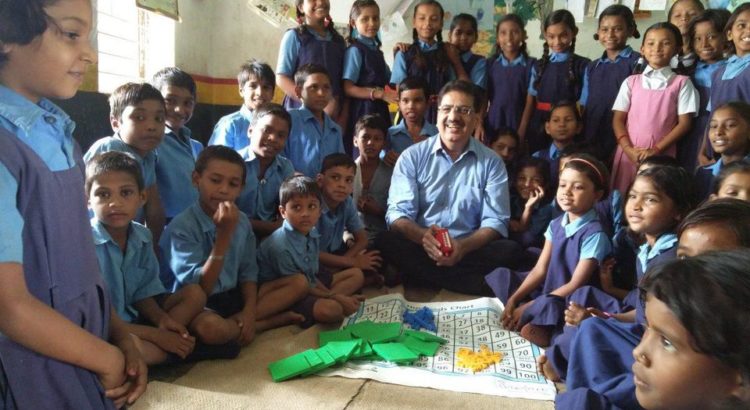
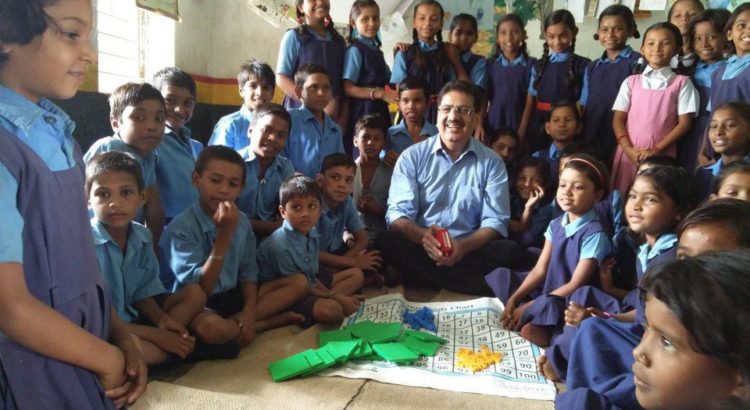
This led to Sampark Smart Shala: a learning-outcome focused, frugal innovation-led initiative that uses audio technology, a voice mascot called “Sampark Didi,” toys, folklore, board games and teacher training modules combined with rigorous monitoring in collaboration with state governments.

Garnett: What allowed you to have these innovative ideas?

Nayar: Our design thinking was inspired by three ideas. The first came from an unlikely source: Bollywood! Going to a movie in an Indian village is an open-air three-hour deeply immersive experience of life enacted through dance, songs and dramatic scripts. We asked ourselves – could we bring that experience to the classroom too?

The second came from watching people in villages charge cell phones using their bicycles. Could this battery drive an audio device with a big speaker that could be used in a class? And the third inspiration came from Teaching Learning Materials (TLM’s). Students retain 70% of what is said in the first 10 minutes of class and only 20% of what is said in last 10 minutes. Adding visual aids and stories increases retention by 250% even in the last 10 minutes.

Garnett: How are these ideas making an impact on your goal?

Nayar: The results have been nothing short of magical – a 56% increase in learning outcomes measured through an independent assessment study. This is also now a case study at the Harvard Business School, showcasing how frugal innovation can create large scale social impact.

Garnett: How are you bringing people first customer second to your foundation and how does it operate?

*Fuente: https://www.forbes.com/sites/lauragarnett/2018/05/08/how-a-people-first-culture-is-transforming-education-in-india/#134b06435ef2

Comparte este contenido:

EEUU: Lessons learned from the Arizona teachers strike

Por: peoplesworld.org/08-05-2018

The weeklong strike by Arizona teachers ended in a pretty handsome victory for teachers and supporters.  They won a 19 percent salary increase over three years which is quite something for hard working teachers grown accustomed to tiny raises, if any, that never kept up with the cost of living.

Yet some are criticizing the educators for ending the strike before winning every one of their demands. They are not understanding how important was the victory that the teachers and their allies actually did win.

To understand the magnitude of the victory it’s important to look at what educators are up against.  You may have noticed that when teachers strike, which isn’t often, they usually walk out in the fall when classes begin.  First days of school in the fall get more attention, when teachers, students, and staff are knuckling down for the school year.  Teachers’ unions have had time to prepare for job actions over the summer and everybody is more energetic.

This latest wave of teacher strikes, however, took place late in the school year precisely because it wasn’t a narrowly planned action.  Arizona teachers reacted spontaneously, inspired by teachers’ strikes in West Virginia, Oklahoma, and other states.  The main organizers formed a loose online organization called Arizona Educators United which grew like a prairie fire.  It was joined by the two teachers’ unions, parents, students, school boards, the labor movement, and the public at large.  It was a lesson about the need to be creative and always look for new ways to advance the struggle.

In Tucson on May Day,  thousands celebrated International Workers’ Day with a massive rally and march down to the State Building in solidarity with the striking educators.  With strong support from the Pima Area Labor Federation, teachers, and community supporters and all wearing red in solidarity it looked like a real May Day.  To many it was a lesson about the workers’ holiday, labor history and the importance of international solidarity.

The large concessions won by teachers and the promised infusion of more money into schools is a huge reversal from years of neglect and severe cuts in school funding.  The Arizona Republicans, who control the legislature and all statewide offices, haven’t merely cut and slashed education. They have been out to destroy public education.

Since public schools are such a basic part of American democratic tradition they couldn’t just abolish the schools outright without a public outcry.  Instead they have been weakening public education by supporting private school vouchers, and contracting out education through use of charter schools.  They figured if they damaged schools enough the public might eventually agree to replacing the schools with state subsidized private and charter schools.  Their main weapon has been large tax cuts to the rich, draining funds from education and that was another lesson learned.  When they ended the strike teachers began a petition campaign for a ballot initiative to tax the rich to fund future education.  Hundreds of thousands learned who the enemy of education is and where the funding must be found.

I worked for a decade in Arizona schools and was an active member of the American Federation of Teachers.  Our union local’s president was a Reagan Republican, and many of the school employees were quite conservative with no experience or knowledge of trade unionism.  In my school most were not union members.

The strike movement has changed that.  Now teachers have learned the importance of organization and unity, and the need to fight back if they want to save public education.  It was another lesson learned, one about the importance of allying with parents, students, and their communities for a broader front against the right wing.

Most importantly, Arizonans learned that small struggles by local unions for small concessions, while important, are not enough.  They learned that working people need to get political and take on the corporate class and their right-wing puppets in the streets, in the legislature and governor’s mansion. Yes, it’s important to win concessions, even small ones, but they will take them back unless we organize and strengthen our peoples’ coalitions.  It’s important to defeat the ultra-right in the November elections.  These struggles are where working people learn about class struggle and, hopefully, where they will eventually learn about the need to abolish capitalism once and for all.

So aside from winning some good economic concessions our teachers and the public also gained a class struggle education which, together with the new organizational forms, will strengthen us for the battles ahead. We have nothing to lose but our chains.

*Fuente: https://www.peoplesworld.org/article/lessons-learned-from-the-arizona-teachers-strike/

Comparte este contenido:

UK: Welsh education being used for propaganda, says UKIP AM

UK/May 08, 2018/Source: http://www.bbc.com

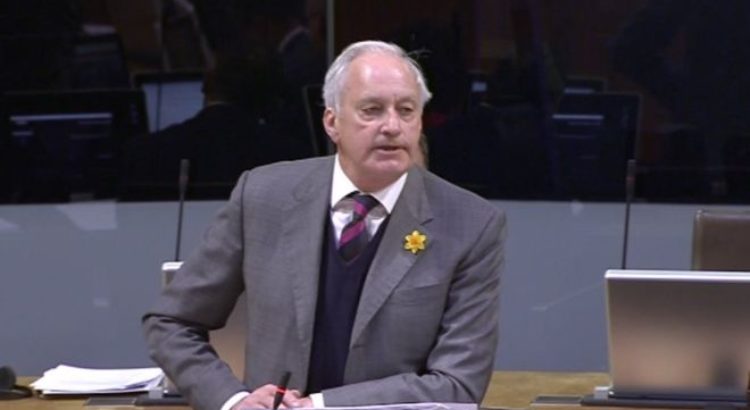
Wales’ education system is being used as a tool of propaganda, UKIP’s Welsh leader has alleged.

Neil Hamilton claimed that parts of the Welsh Baccalaureate on topics like inequality are being taught from a «centre-left disposition».

He said there was a «potential danger» that teachers may be biased, suggesting they may favour the Labour party.

First Minister Carwyn Jones said he saw no examples of «bias» in the curriculum.

The UKIP Wales leader said the qualification included a «global citizen challenge which deals with issues such as cultural diversity, fair trade, future energy, inequality and poverty».

«These are all highly political topics which need to be taught in a balanced way if education is not to degrade itself into mere propaganda,» Mr Hamilton told First Minister’s Questions in the Senedd.

He said he had seen the materials being used in teaching the courses which are all, he claimed, «from a centre-left disposition».

The comment drew heckles from other AMs.

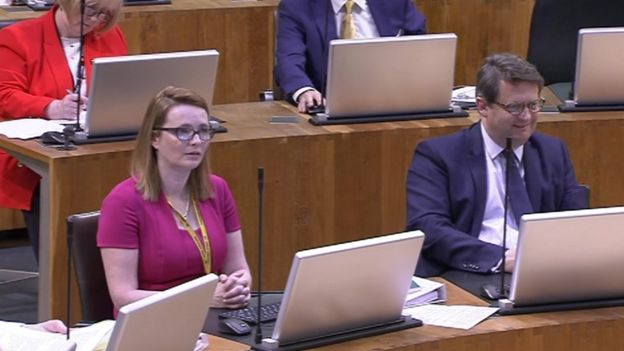
Kirsty Williams
Image captionEducation Secretary Kirsty Williams looked on aghast as Neil Hamilton made his claims

«The false indignation coming from the other side proves the point I’m trying to make here,» Mr Hamilton replied, «that because they control the education system it is being used as a tool of propaganda.»

Mr Hamilton said the «mindset of a teacher is very important» and, quoting polling figures suggesting many secondary school teachers vote Labour, he said: «Even if bias is subconscious it must be regarded as a potential danger».

‘Revisionism’

But the first minister said «anything is centre-left» from Mr Hamilton’s perspective, alleging that he had supported the now-repealed Section 28 law that had banned local authorities from intentionally promoting the acceptability of homosexuality.

Mr Jones said: «We prefer balance. He wants right-wing revisionism.»

«I trust our teachers, bluntly, and I trust our students to able to think critically for themselves,» he told Mr Hamilton.

«There will be different views on how to address inequality, different views on how to address poverty.

«Nevertheless they are hugely important issues that I think every young person needs to think about.

«But I’ve seen no examples at all of any kind of bias being introduced into the curriculum.

«For my perspective I think it is hugely important that our students do have the ability to go beyond academic subjects because I think it makes them more rounded individuals when they do think more critically and more widely.»

Source:

http://www.bbc.com/news/uk-wales-politics-44038903

Comparte este contenido:

How A People-First Culture Is Transforming Education In India

India/May 08, 2018/By: Laura Garnett /Source: https://www.forbes.com

Since 2005, when he became president and later CEO of HCL Technologies, Vineet Nayar has led a remarkable turnaround that saw the company triple its revenues and income growth. He wrote about this in his book, Employees First, Customer Second. The value-based leadership simultaneously resulted in the company being ranked by Hewitt Associates as the Best Employer in India and by BusinessWeek among the top five most influential companies in the world.

Nayar is now trying to transform the education of India’s children. He’s taking on a huge goal, and I’ve always admired his focus on people. I wanted to sit down with him and talk about his current work with his own fund and figure out how he plans to transform education.

Laura Garnett: What is the problem that you’re trying to solve and what is your goal?

Vineet Nayar: In India, government-led primary school education systems suffer from a myriad of issues, not only preventing families from sending their children to these schools but also affecting the learning outcomes for those 144 million children who attend. Most children in grade 5 can’t do basic math or construct simple sentences in English.

Sampark Foundation was founded with a belief that “frugal innovation,” along with relentless execution in partnership with the government, can drive large scale change in learning outcomes. Our goal is to design and implement frugal innovation ideas that will transform learning outcomes for 20 million children studying in 200,000 rural government schools by 2025, at less than $1 per child per annum. As of today, we have touched the lives of 7 million children across 76,000 schools.

Garnett: How did you come up with the Innovative ideas that you speak about?

Nayar: While many educational change initiatives are in-flight in India currently, we realized they have not been able to deliver impact because they are either sub scale or resource intensive, or they ignore the ground realities surrounding these kids. For example, you can’t just solve this problem by giving away iPads to children in an environment that lacks electricity.

We believe that for any long-lasting change to happen it has to be driven by practical and sustainable solutions that are frugal but at a large scale. Our area of investment and focus was on design thinking and coming up with frugal innovation ideas (low on resources, high on impact) and leveraging them to deliver a comprehensive, multi-fold improvement in learning outcomes that can be sustained.

This led to Sampark Smart Shala: a learning-outcome focused, frugal innovation-led initiative that uses audio technology, a voice mascot called “Sampark Didi,” toys, folklore, board games and teacher training modules combined with rigorous monitoring in collaboration with state governments.

Garnett: What allowed you to have these innovative ideas?

Nayar: Our design thinking was inspired by three ideas. The first came from an unlikely source: Bollywood! Going to a movie in an Indian village is an open-air three-hour deeply immersive experience of life enacted through dance, songs and dramatic scripts. We asked ourselves – could we bring that experience to the classroom too?

The second came from watching people in villages charge cell phones using their bicycles. Could this battery drive an audio device with a big speaker that could be used in a class? And the third inspiration came from Teaching Learning Materials (TLM’s). Students retain 70% of what is said in the first 10 minutes of class and only 20% of what is said in last 10 minutes. Adding visual aids and stories increases retention by 250% even in the last 10 minutes.

Garnett: How are these ideas making an impact on your goal?

Nayar: The results have been nothing short of magical – a 56% increase in learning outcomes measured through an independent assessment study. This is also now a case study at the Harvard Business School, showcasing how frugal innovation can create large scale social impact.

Garnett: How are you bringing people first customer second to your foundation and how does it operate?

Nayar: Since Sampark Foundation is a small not-for-profit organization, it has barely 100 people, or ‘Sparks’ as we call them. In this model, it is the government schoolteachers who are the front-line workers in the value zone, the classroom. Therefore, following the EFCS principles, our role is to enthuse, encourage and empower them. So, we set our eyes on enhancing the teacher’s power to teach and bring excitement into the classroom through Sampark Smart Shala.

Our 100 Sparks travelled over 15,000 kilometers within 100 days into remote interiors of the country to help train 100,000 teachers each year on the use of Sampark Smart Shala teaching aids to bring excitement back into the classroom and drive significant transformation in learning outcomes. The one thing that brings a smile to my face is the fact that the impact and learning outcome has been achieved by enthusing the teachers, empowering them with the teaching aids, encouraging and mentoring them through helplines and periodic training sessions – and most importantly, by transferring the ownership of change to them. This is employee-first at its best.

Garnett: What is your biggest challenge now and how can people that read this that want to help, get involved?

Nayar: The biggest challenge now for us is if we should focus on higher grade levels with the 7 million children already in the program in the existing four states, or should we add more children to the grade 1-3 program by scaling up to more states. Doing both could break the back of operations, and there is a limit to how far our resources can take us. Our foundation is inviting new ideas, new approaches, new and frugal ways to improve learning levels which will help us go the extra mile and provide a path for millions of children studying in government-funded primary schools to see the light at the end of the dark tunnel.

Source:

https://www.forbes.com/sites/lauragarnett/2018/05/08/how-a-people-first-culture-is-transforming-education-in-india/2/#2898c849303d

Comparte este contenido:

India: Primary Problem. Gujarat’s Dismal School Education System

India/May 08, 2018/by RITU SHARMA/ Source: http://indianexpress.com

Last month, the Gujarat government wrapped up its eighth edition of evaluation of government primary schools, Guntosav. The findings of the National Achievement Survey, released by the Centre’s HRD Ministry in January, overall paint a dismal state of school education in Gujarat.

Despite the Gujarat government’s claim of improving the quality of education, the situation on the ground is very different. With the state facing criticism for failing to do a lot, the findings of the National Achievement Survey (NAS), released by the Centre’s HRD Ministry in January, shows that the state has a lot of catching up to do.

The survey, which was conducted in all the 33 districts of the state interviewing over 1.25 lakh students, shows a consistent decline in the learning levels of students in mathematics, language and science from Class III to Class VIII in the government school system — both government schools and government-aided schools. The drop in the overall learning levels being sharp in all the three subjects.

For instance, the response level of students fell from 65 to 47 per cent in mathematics, 71 per cent to 64 per cent in language and 68 to 52 per cent in science subjects.

The dismal state of the primary education in Gujarat could be gauged from the NAS findings. For example, in Class III, 41 per cent of students could not read and write numbers up to 999. The situation worsens as one interviews students from higher classes. For instance, more than half of the 41,393 Class VIII students (53 per cent) could not solve problems on daily life situations involving addition and subtraction of fractions and decimals and nearly 7 out of 10 students (69 per cent) could not calculate the surface area and volume of a cuboidal and cylindrical object.


While 4 out of 10 students of Class V could not read and write numbers bigger than 1000 being used in their surroundings, 56 per cent of Class VIII students could not interpret division and multiplication of fractions.
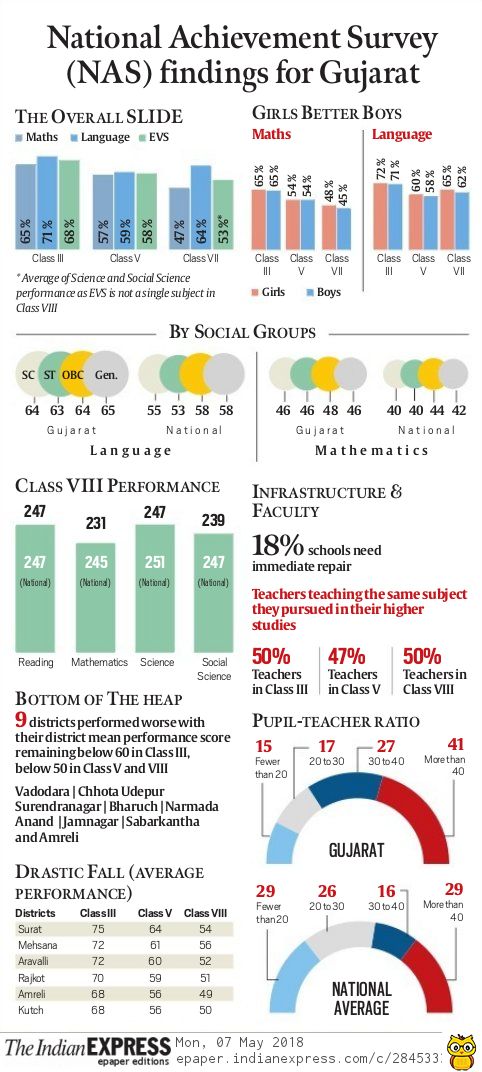
Faring even low in social science, only 27 per cent Class VIII students were able to describe the functioning of rural and urban local government bodies and 91 per cent failed to justify judicious use of natural resources. However, when it came to issues related to caste, women, social reforms, 63 per cent students could analyse them. At the same time more than half of the Class VIII students failed to apply knowledge of Fundamental Rights to find about their violation in a given situation.

The good news from the survey was the performance of girls performing marginally better than boys. However, when it comes to gender enrolment ratio — percentage of eligible girl population (in the age group of 18 to 23 years) pursuing higher education — Gujarat is in the bottom heap of eight states with poor GER ratio. [See What after school?]

NAS vis-à-vis Gunotsav

While the state government claims of improving the quality of school education through its own Gunotsav surveys, lakhs of students failed to write simple sentences in their mother tongue, Gujarati. As reported by The Indian Express earlier, the Gunotsav VI results revealed that despite attempts being made to improve performance of the students, the state’s average could reach only 53.4 per cent — same as the last Gunotsav V.

Even as the state government claims that in the last seven years, schools under Grade A category has increased from 5 to 2,100, the NAS findings show a geographically skewed performance of schools.

For Class VIII, four districts scored a mean average of below 50 in the NAS. While Bharuch scored 44, two districts from Saurashtra — Amreli and Jamnagar — scored 29 and 48, respectively. The tribal districts of Sabarkantha and Narmada scored 48 and 46, respectively.

In Bharuch, the district with lowest performance learning outcomes, only 25.41 per cent students could solve problems related to daily life situations involving rational numbers, 26.13 per cent could calculate surface area and volume of a cuboidal and cylindrical object, 27.10 per cent could generalise properties of addition, subtraction, multiplication and division of rational numbers through patterns and 30.48 per cent could solve problems related to conversion of percentage to fraction and decimal and vice versa.

However, if the performance of Class III, V and VIII are taken together, then nine of the total 33 districts make it to the bottom of the heap. They are Vadodara, Chhota Udepur, Surendranagar, Bharuch, Narmada, Anand, Jamnagar, Sabarkantha and Amreli. (See box)

For the government, the solace from the NAS findings is that the government schools have performed marginally better than grant-in-aid schools across the three subjects as well as classes. For instance, in Class III, the learning level of students in government schools in environment science is 68, compared to 63 of grant-in-aid schools, 72 against 69 in language and 65 against 61 in mathematics. In Class V, the performance gap in science was 10 per cent, maths 12 per cent and language 7 per cent with government school students faring better than grant-in aid schools. Similarly, in Class VIII, the highest gap is in social science where 54 per cent students of government schools could perform exercises compared to 46 per cent students of in grant-in-aid schools.

These numbers may be comforting for the government, but the NAS surveys and the government’s own reports point to poor school infrastructure and need for better quality teachers.

According to the government’s own data, a large number of posts of teachers and principals are lying vacant in government schools. In the residential schools in the tribal districts, the figure is staggering — over one-third teachers’ posts are lying vacant.

The state government runs several categories of residential schools — Eklavya Girls Residential schools, Adarsh Nivasi Shala, Model schools and Ashram Shalas in the 14 tribal districts of the state. But poor facilities in such affect the education. For instance, the government has spent over Rs 6.5 lakh to improve English among the students in one tribal district of Dang. But the same district has the highest percentage of vacant posts (47.3 per cent) among the seven tribals districts, according to the government’s reply in the last Assembly session.

The NAS too has found poor pupil-teacher ratio in the state. According to it, 41 per cent of schools in Gujarat has pupil-teacher ratio of above 40. Nationally, the percentage of such schools is only 29 per cent. Similarly, while the healthy pupil-teacher ratio of fewer than 20 is found in 29 per cent of schools annually, it is only 15 per cent in Gujarat.

The survey also found that 47 per cent of the 2,630 teachers taught students of Class V the same subject they pursued during their higher studies. It also found that 18 per cent of school buildings were in need of urgent repair.

Fee regulation quagmire

In all these years, the crumbling school infrastructure and the declining standard of education in government and government-aided schools have led to a boom in the number of private schools in the state. Though the number of government schools stands at 44,000, the state currently has over 16,000 private schools — 9,300 primary, 3,800 secondary and 3,100 higher secondary schools.

The increase in demand of private schools also led to a surge in the fees. With parents finding it difficult to pay high fees, the government last year passed a law to regulate the school fees. The Gujarat Self Financed Schools (Regulation of Fees) Act is aimed at fixing the annual fees at Rs 15,000 for primary eduction, Rs 25,000 for secondary and higher secondary (non-Science). However, the law has not been implemented till now in full due to numerous litigations and political slugfest over it.

“Trying to have some control over private schools in a way is good, but its political misuse made schools and education sector lose its dignity,” Gujarat Self Financed School Management Federation general secretary Bharat Gajipara.

The federation claims that the schools are ready to fix the fee at Rs 15,000 for the primary classes, but the state government should also lay down specific guidelines. “For instance, there needs to be guidelines on how much fans a classroom should have; how many children should be in a class; how many teachers among other things. We are ready not to collect extra fees, the government can keep that but give our teachers salaries and the expenses incurred by the school,” Gajipara says.

Even the parents are not happy with the turn of the events. “We have lost faith on all fronts in the last one year. More than any good, the fee regulation Act has harmed everybody,” says Amit Panchal, one of the parents spearheading the protests for over an year now. “The stricter implementation of the Act could be one measure to safeguard affordable quality education but for a long-term solution, the state government needs to improve its government as well as grant-in-aid schools. To counter the burgeoning fee demand of private schools, there is a necessity to raise an alternate affordable education system, which in this case are government and grant-in-aid schools,” says Sukhdev Patel, founder of Waali Swaraj Manch, a parents’ outfit.

Govt’s defence

The state government, however, blames the “falling standards of primary education” on the landmark Right to Education Act and its no detention policy. The law which was enacted by the previous UPA government at the Centre has been consistently opposed by BJP-led government in the state, demanding the rules to be revoked for the last two years.

“In the NCERT meeting with the Human Resource Development Minister Prakash Javadekar, I had categorically stated that until the Right to Education Act’s provision for no holding back a student till Class VIII is done away with, the quality of primary education will deteriorate,” says Education Minister Bhupendrasinh Chudasama said.

But the government’s own measures to improve quality of education by introducing NCERT books has led to criticism. Some of the government’s policies like making Gujarati compulsory till Class VIII in all boards in a phased manner has led to a resentment among schools as well as parents. “The new lot of vidyasahayaks (primary teachers) is very talented and intelligent. I am sure with the energy and dedication, the government school students will be at par with any good private school,” Chudasama promises.

http://indianexpress.com/article/education/hardlook-state-of-education-in-gujarat-part-ii-5166122/
Comparte este contenido:

Liberia to Hold Education Summit

Liberia/May 8, 2018/ Source: http://inprofiledaily.com

The Ministry of Education has disclosed plans to hold an education summit with the aim of harnessing collective efforts to provide quality education.

The event is expected to be held May 21-25, 2018, at the Booker Washington Institute (BWI) in Kakata City, Margibi County.

“This landmark event hosted by Minister of Education, Prof. Dr. Ansu  D. Sonii Sr., will bring together over 300 education specialists, policy makers, parents, business and community leaders, teachers as well as others with an interest in seeing the Liberian education system succeed,” the ministry said in a press release issued on Friday.

According to the release, President George Manneh Weah will open the ‘internationally significant event’ by highlighting the government’s vision for education as a key pillar of its’Pro-Poor Agenda’ and outlining his government’s approach to working alongside key stakeholders and experts to give Liberian children the best possible start in life.

Partners such as the Global Partnership for Education (GPE), the World Bank and USAID, among others, are expected to make presentations at the event.

The release continued: “Education is a priority for the new administration, which has recognized that robust change is needed to improve the life chances of Liberians and contribute to the sustained development of Liberia or the benefit of everyone.”

Objectives of the summit are: to present findings from key assessments of the education sector (ESA, other reports from the sector); present the “Pro-Poor Agenda” perspectives for quality education in Liberia;      identify workable solutions that contribute to an improved education system;               Present the rationale for increments in allocation to the education sector in the national budget; and                obtain shared commitments for education advancement in Liberia.

It further explained that the summit will be divided into two sessions. The first two days will provide opportunities for key stakeholders to review the education sector, provide independent perspectives of the status of the sector, and develop consensus around a shared vision for the improvement of the education system in Liberia. The last three days will concentrate entirely on the Joint Education Sector Review (JESR) and the development of an operational plan for implementation of the sector plan, which will assess implementation progress at both the county and national levels against planned activities and targets outlined in the Getting to Best Education Sector Plan (G2B ESP) and will outline forward-looking recommendations.

At the same time, the ministry said it anticipates that tangible steps can be agreed during the Summit to begin to make improvements in education that the Liberian people wish to see.

Speaking ahead of the summit, Minister Sonii said: “In order to build on previous gains and learn from existing challenges, we have undertaken a wide range of engagement with stakeholders and a nation-wide assessment of schools. This has provided us with first-hand information about the issues affecting education in Liberia today.”

Minister Sonii added that this ground-breaking summit builds on the commitment they have shown to finding the right solutions to give all Liberians the start in life that will help them and Liberia prosper in the years to come. By bringing together a broad range of partners, stakeholders and independent experts in the education sector, he elucidated that they aim to build a consensus on essential priorities to fast-track reform of the education sector.

Source:

http://inprofiledaily.com/index.php/2018/05/07/liberia-to-hold-education-summit/

Comparte este contenido:
Page 98 of 144
1 96 97 98 99 100 144