Page 3410 of 6179
1 3.408 3.409 3.410 3.411 3.412 6.179

Docentes argentinos divididos por el caso de Santiago Maldonado

América del Sur/Argentina/publimetro.cl

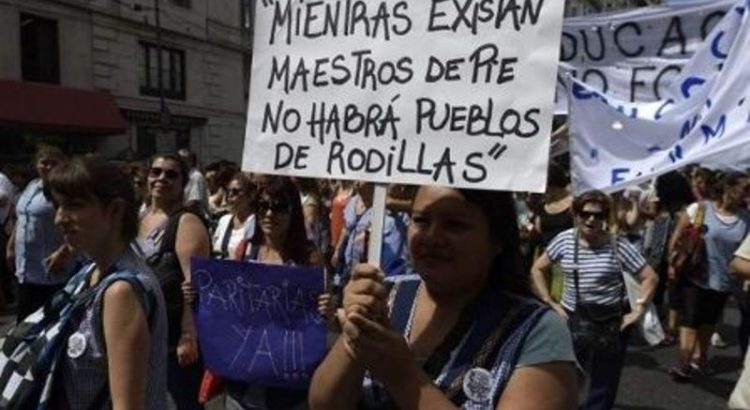
La polémica por la desaparición del argentino Santiago Maldonado durante una protesta mapuche, ocurrida hace un mes, llegó a los colegios del país después de que sindicatos de profesores difundieran material didáctico sobre el caso, lo que generó una fuerte discusión entre una dividida opinión pública.

La Confederación de Trabajadores de la Educación (Ctera), que agrupa a la mayoría de los gremios docentes del país, elaboró cuadernillos para que en las escuelas se debata sobre desapariciones forzadas y, en concreto, se informe sobre el caso del joven de 28 años, visto por última vez en una manifestación de la comunidad Lof Cushamen en la localidad de Esquel, provincia de Chubut (sur).

El material lleva el título «¿Dónde está Santiago Maldonado?», lema repetido en multitud de ocasiones por organismos de derechos humanos, dirigentes de la oposición y sociedad civil durante el último mes para reclamar por un caso que ha conmocionado a la opinión pública y que ha llegado incluso a la Organización de las Naciones Unidas, que instó al Estado a que lo localice.

El joven desapareció mientras participaba en una protesta de la comunidad mapuche Lof Cushamen que fue reprimida con balas de plomo y goma por un centenar de efectivos de la Gendarmería argentina, fuerza policial a la que un gran número de organizaciones culpan de la desaparición, responsabilidad que extienden al Gobierno, que mientras pide prudencia y respetar la investigación judicial.

Esta división ha llegado a las redes sociales, donde multitud de comentarios con la etiqueta #ConMisHijosNo rechazan el material y acusan a Ctera de manipular y querer «adoctrinar» a los alumnos, una postura que se ha replicado en la plataforma Change.org con la iniciativa «No a la politización de Santiago Maldonado en las escuelas!!!!», que cuenta ya con 30.700 firmas.

Mientras, otros aprovechan la misma etiqueta para apoyar desde Facebook y Twitter la iniciativa y defender que es parte de la lucha por «memoria, verdad y justicia», consigna emblemática del movimiento de derechos humanos para conmemorar a las víctimas de la última dictadura cívico-militar (1976-1983) y recordar a los 30.000 desaparecidos que dejó este, según sus estimaciones.

«No sé por qué se asombran y se escandalizan algunos medios. La tarea de educar es importante, los chicos tienen que saber y nunca más un desaparecido en democracia», es «una barbaridad» defendió el Secretario de Prensa de CTERA Alejandro Demichelis, en declaraciones a Radio LU14.

En ese sentido, defendió que la decisión de lanzar estos cuadernillos «no es partidaria» y solo busca discutir en las escuelas la desaparición forzada de personas y «crear conciencia» por el caso de Maldonado, ya que, a su juicio, es una «barbaridad» que se desconozca su paradero.

Por su parte, el ministro de Educación del país, Alejandro Finocchiaro, calificó de «canallada» la campaña de Ctera porque consideró que «utiliza» a los alumnos y los profesores no pueden decirles «qué es lo que tienen que pensar».

«Ese cuadernillo es un panfleto ideológico de un gremio kirchnerista que le pidió a sus afiliados que los distribuyan en las escuelas para operarlo con los alumnos», criticó en declaraciones a la agencia estatal Télam, antes de insistir en que no se puede entregar material pedagógico en las escuelas que no haya sido aprobado por las «autoridades» educativas.

Este viernes, el reclamo de las organizaciones políticas y sociales llegará a las calles de Buenos Aires con una movilización para reclamar la aparición del joven.

Fuente: https://www.publimetro.cl/cl/noticias/2017/08/31/docentes-argentinos-divididos-caso-santiago-maldonado.html

Comparte este contenido:

EEUU: Illinois Plans to Use Tax Credits to Send Thousands of Students to Private Schools

América del Norte/EEUU/blogs.edweek.org

Resumen:  Los legisladores de Illinois han aprobado el primer programa de elección de escuelas privadas del estado, uniéndose a casi otros 30 estados que usan dinero público o incentivos del gobierno para ayudar a los estudiantes a pagar la matrícula de la escuela privada. Tales programas se han convertido en algo de la política educativa du jour del presidente Donald Trump y su secretaria de educación, Betsy DeVos.  El programa utilizará créditos fiscales para alentar a la gente a donar dinero para que los estudiantes de bajos y medianos ingresos asistan a escuelas privadas. Las becas de crédito tributario, como suelen llamarse estos programas, también han sido vistas por la administración Trump como un posible modelo para un programa nacional de elección de escuelas privadas.


Illinois lawmakers have passed the state’s first private school choice program, joining nearly 30 other states that either use public money or government incentives to help students pay for private school tuition.

Such programs have become something of the education policy du jour under President Donald Trump and his education secretary, Betsy DeVos.

Folded into the larger overhaul of Illinois’ education funding formula, the program will use tax credits to encourage people to donate money for low- and middle-income students to attend private schools.

Tax-credit scholarships, as such programs are generally called, have also been eyed by the Trump administration as a possible model for a nationwide private school choice program.

Illinois’ program was one of the more controversial elements in the debates over the funding formula, as my colleague Daarel Burnette II wrote on the State EdWatch blog:

«After years of political wrangling that divided the state both politically and regionally, Illinois’ Senate Tuesday gave the green light to a new school funding formula, that provides poor and rural districts with more money and expands tax credit scholarships. Republican Gov. Bruce Rauner said he will soon sign it into law.

«… Over the last several weeks, the House, Senate, and governor have been at a standoff over two key portions of the funding formula: how much money the state would provide Chicago Public Schools to pay down its ballooning teacher pension costs, and whether the funding formula would allow for tax-credit scholarships. The compromise provides for both.»

The tax-credit scholarship program will expire after five years if lawmakers do not renew it.

Fuente: http://blogs.edweek.org/edweek/charterschoice/2017/08/illinois_plans_to_use_tax_credits_to_send_thousands_of_students_to_private_schools.html

Comparte este contenido:

Holanda: Far-right protesters lock doors of Muslim school on first day of term

Europa/Holanda/dutchnews.nl

Resumen: Los manifestantes de extrema derecha han colgado imágenes de cabeza de muerte desde las puertas de una escuela primaria islámica en Leiden cuando los niños regresaron de las vacaciones de verano. Los profesores que llegaron a la escuela IBS Er-Risèlèh descubrieron el lunes que se había puesto una cerradura de bicicleta en las puertas del edificio y una nota referente a los ataques terroristas en Europa. «Tenemos que abordar el problema por las raíces», dijo. La escuela dijo que había reportado el incidente a la policía. «Hemos tratado de mantenerlo de nuestros alumnos, pero pudieron ver que no podían entrar en los cobertizos de bicicletas», dijo una portavoz a Omroep West . «Estamos profundamente conmocionados por esto. No sabes lo que está pasando en la cabeza de la gente. Muchos de nuestros colegas se sienten inseguros y no hemos visto ninguna policía revisar la zona.


Far-right protesters have hung death’s-head images from the doors of an Islamic primary school in Leiden as children returned from the summer holiday. Teachers arriving at the IBS Er-Risèlèh school on Monday found a bicycle lock had been put on the doors of the building and a note referring to terrorist attacks in Europe. ‘We need to tackle the problem by the roots,’ it said. The school said it had reported the incident to the police.

‘We have tried to keep it from our pupils, but they could see that they couldn’t get into the bicycle sheds,’ a spokeswoman told Omroep West. ‘We’re deeply shocked by this. You don’t know what’s going on in people’s heads. A lot of our colleagues feel unsafe and we haven’t seen any police checking the area.’ Pegida Nederland posted pictures on Twitter of the incident, which it described as a ‘protest action’ carried out by ‘people from Leiden’.

Fuente: http://www.dutchnews.nl/news/archives/2017/08/far-right-protesters-lock-doors-of-muslim-school-on-first-day-of-term/

Comparte este contenido:

Canada: How Might BC Schools Tackle Racism?

América del Norte/Canada/thetyee.ca/By Katie Hyslop

Resumen: Con el aumento de la retórica racista, The Tyee pregunta a los maestros y abogados cómo ayudar a los estudiantes a luchar. En un artículo publicado en The Tyee la semana pasada, la profesora de educación de la Universidad de Columbia Británica, Michelle Stack, pidió a sus colegas educadores blancos que hablaran con sus estudiantes sobre el racismo: «Tenemos que negarnos a minimizar la opresión a pesar de la tentación de hacerlo. La supremacía blanca es real y hace daño inconmensurable. ¿Qué enseñamos a nuestros hijos? ¿Aprenden sobre la supremacía blanca y el racismo y maneras de luchar contra ella? » El racismo es parte del legado de la Columbia Británica, desde su fundación en tierras de las Primeras Naciones sin terminar hace más de 150 años. Ese legado se enseña en el programa de kindergarten hasta el 12º grado de la provincia, incluyendo las escuelas residenciales y la Scoop de los sesenta , el impuesto sobre la cabeza de China , los campamentos de internamiento japoneses y los cientos de inmigrantes sij a bordo del Komagata Maru. Pero si usted habla con los estudiantes de BC y los maestros, ellos le dirán que el racismo no es sólo en el pasado. Ellos lo oyen en silbidos insultos en los pasillos, ya través de estereotipos planteados en clase. Lo ven en las mesas de almuerzo dividido por raza y cultura.


With the rise in racist rhetoric, The Tyee asks teachers and advocates how to help students fight back.

In an op-ed published on The Tyee last week, University of British Columbia education professor Michelle Stack called on her fellow white educators to talk to their students about racism:

Racism is part of the legacy of British Columbia, from its founding on unceded First Nations land more than 150 years ago. That legacy is taught in the province’s kindergarten to Grade 12 curriculum, including residential schools and the Sixties Scoop, the Chinese head tax, Japanese internment camps, and the hundreds of Sikh migrants aboard the Komagata Maru denied entry to the province.

But if you talk to B.C. students and teachers, they’ll tell you racism isn’t just in the past. They hear it in hissed slurs in the halls, and through stereotypes raised in class. They see it in the lunch tables divided by race and culture.

With the current climate in the U.S. (and Donald Trump in the White House), racist rhetoric has found its way back into the mainstream discourse. BC Teachers’ Federation president Glen Hansman says the way that schools address racism must change to reflect that.

“We also have the responsibility as a union — and the Ministry of Education, working with school boards, too — to make sure that we are equipping teachers properly to be able to have these conversations in schools, and we’re still not there yet,” he said.

‘1980s approach to multiculturalism’

So what supports do B.C. teachers have to provide anti-racism education?

Five years ago, the BC Teachers’ Federation’s Committee for Action on Social Justice released “Show Racism the Red Card,” an anti-racism teaching resource.

Based on a similar program in the United Kingdom, the “lesson aid” includes background information for teachers on anti-racism education, as well as sample lesson plans for kindergarten to Grade 12. The resource is available online for free, though Hansman acknowledges it needs to be updated.

The union also provides its own anti-racism workshops for teachers, including how to teach from an anti-oppression framework; making schools racism-free for Indigenous students; and deconstructing racist myths.

But access to the workshops is limited for teachers who live outside of B.C.’s urban hubs, and cuts to school districts’ professional development budgets means there is little or no support in some districts for anti-racism professional development.

“All teachers have a bit of understanding about how to do anti-racist pedagogy in the classroom based on their own school experience or what they received in teacher education training,” Hansman said. “But we can’t just rest on our laurels about what we encountered 20 years ago.”

Since the mass shooting at a Quebec City mosque earlier this year, the union has received pushback from the public and some teachers who believe the best way to address racism is to be “colour-blind” and not talk about it at all, Hansman said.

That’s a “1980s approach to multiculturalism,” he added. “It negates the very real lived experience of students from marginalized groups, including racialized groups. It also nullifies that differences that people are proud of.”

Using privilege for good

Annie Ohana makes the conscious choice to deconstruct racism in her classes. Ohana, who teaches social science, law and social justice, and is the Aboriginal teacher advisor at L.A. Matheson Secondary in Surrey, B.C., starts every school year with a class discussion about privilege.

“We absolutely start with white privilege, male privilege, etc. But there’s many different forms of privilege: education, citizen, heterosexual — there’s tons,” she said. It’s not about making students feel bad, she said, but exploring how they can use their privileges to help others.

Ohana, who helped organize the counter-protest to the anti-Muslim rally planned for Vancouver this month, exposes her students to voices and perspectives not found in most textbooks. For example, when discussing the First World War she doesn’t just focus on European experience but also that of the one million Indian soldiers who fought alongside the British.

A big part of Ohana’s approach to anti-racist education is disrupting students’ comfort zones, she said. That can be as simple as changing the seating plan so students work with different people. It also means being open to dialogue on students’ viewpoints, even when they disagree with her own.

“Everybody can have an opinion and can have it heard. They need to be ready to be challenged — not in a violent way, but a way that is respectful of other people,” she said.

“If somebody says, ‘I’m against Islam because the Qu’ran advocates for violence,’ for example, if other students would like to counter that and break that down, we’re going to do so in a safe space.”

That doesn’t mean it’s safe to spread hate in Ohana’s class, though. “You’re not allowed to point fingers. You’re not allowed to swear at another person or insult them,” she said. “You are in a school and there are rules to follow.”

Diversity in the classroom

Education isn’t just the domain of teachers, however. The Tyee reached out to anti-racist advocates and community groups for their thoughts on how schools should address racism.

One of those advocates is Jessie Kaur Lehail, co-founder of the Kaur Project, which takes its name and focus from the stories of Sikh women in B.C. who have adopted Kaur as a middle or last name.

Lehail shows students in the classes she’s visited the differences and similarities between the women featured in the Kaur Project, and the students’ own lives.

“It really doesn’t matter what background these women are, they just showcase that we’re all humans and we all have trials and tribulations. They’re just socially and culturally different on some levels,” she said. “And it’s an opportunity for understanding, to learn something new, and also to have empathy for other people.”

Lehail, who spoke at last month’s counter-protest and has visited Ohana’s classes, says it’s important for teachers and schools to address racist incidents. But they could be proactive, too, and tackle these issues before anything happens.

“Ensure that non-Caucasian voices, ideas, authors and thoughts are included [in your lessons]. It’s important to have Indigenous voices, women’s voices, people of colour, to show that there is diversity,” she said, adding this shouldn’t be limited to books but include people from the community, bringing them into the classroom.

Wendy Addo of Black Lives Matter-Vancouver agrees, advocating for schools to develop ongoing relationships with B.C.’s black and Indigenous communities.

But the first step towards creating an anti-racist school environment, she says, is schools and districts asking themselves what they’re doing to make their schools safe for students of colour, where their voices and viewpoints are respected.

“Is there an accessible and swift path to recourse for students who have been the victims of racism within the school and/or the school community? Is the school fostering a culture of accessibility and accommodation for [English Language Learning] students and a culture of accommodating and respecting non-white cultural practices in the school and community?” Addo wrote in a Facebook message to The Tyee.

Addo wants the curriculum to include lessons about white privilege, supremacy, and fragility, as well as the historic and current impacts of colonialism on people of colour.

“[Students] need to learn a critical perspective on the police, the military and contemporary and historic land occupation,” she wrote. “They need to learn often erased and neglected parts of our history such as the histories of genocide, forced eviction and slavery in Canada, and the histories of Indigenous and African-Canadian communities — their struggles and their resistance.”

Learning from the past

Addo isn’t advocating for a total erasure of the old, Eurocentric curriculum. Instead, she says that teachers should use it as a critical thinking lesson on how historical narratives can cover up other people’s histories in favour of a white supremacist narrative.

Edward Liu, an anti-racism advocate from Richmond who helped organize a protest against the anti-Chinese flyers that appeared in his city last November, echoed Addo’s assessment of the white-centric provincial history that was taught to many British Columbians.

“The history of B.C. gives the impression that it was the European colonists who built the province single-handedly. People from other ethnic groups were just some sort of supporting actors that helped the white colonists,” Liu wrote in an email to The Tyee.

“For instance, the Chinese were more than railroad workers who just appeared in the early 1880s; they were one of the major contributors to many of the interior communities in southern B.C. area, even before B.C. joined Canada.”

The multicultural social service organization S.U.C.C.E.S.S. is no stranger to community discussions on racism. After those anti-Chinese flyers appeared in Richmond mailboxes last fall, the organization held a community forum to discuss racism against newcomers.

While recognizing some school districts may already be doing this work, Winnie Tam, director of strategic communications and marketing at S.U.C.C.E.S.S., suggested that districts develop comprehensive policies on inclusion and anti-racism, including how teachers, students and parents can report and followup on racist incidents at school.

Tam also echoed Hansman’s recommendation that teachers, as well as school administrators, receive anti-racism and inclusion training, while providing age appropriate programming for students, and settlement support for newcomer families and kids.

The Tyee reached out to the First Nations Education Steering Committee and the Urban Native Youth Association for their thoughts on what schools should do to battle racism, but did not hear back by press time.

However, an early 2000s FNESC document provides suggestions from the BC Aboriginal Education Partners Committee — a working group made up of FNESC, teachers, provincial government representatives and school administrators — on tackling racism against Indigenous students.

Suggestions included educating and hiring more Indigenous teachers; building support and awareness for Indigenous-focused courses like First Peoples 12; educating teachers on Indigenous issues; and including students in the development of anti-racism programs.

More than a decade later progress has been made, but work still needs to be done.

“Certainly the auditor general’s report on the experience of Aboriginal youth in schools should have been a wake-up call for the entire sector,” said Hansman, referring to a 2015 report — released more than a decade after FNESC’s anti-racism suggestions — highlighting the “racism of low-expectations” that brings down the Indigenous youth graduation rate.

“One of the solutions to that has to be making space for students’ voices to come to the fore,” said Hansman. “Actually listening to what they’re saying and not minimizing their experiences.”

*Correction, Aug. 28. A caption accompanying the cover photo for this story today previously misidentified the subjects.  [Tyee]

Fuente: https://thetyee.ca/News/2017/08/28/BC-Schools-Tackle-Racism/

Comparte este contenido:

French student union raises alarm over rising costs

Francia/Agosto de 2017/Fuente: The World University Ranking

Resumen:  Los estudiantes franceses se enfrentan a aumentos por encima de la inflación en su costo de vida, particularmente en las principales ciudades universitarias, ha advertido el sindicato nacional de estudiantes del país.El aumento de los costos se producen a medida que el gobierno está reduciendo los subsidios de alquiler, incluso para alrededor de 800.000 estudiantes, informó The Local. El próximo año académico los costos estudiantiles aumentarán un 2,1 por ciento, según el Sindicato Nacional de Estudiantes de Francia, triplicarán la tasa de inflación, y mucho más que en 2015 y 2016. En las principales ciudades estudiantiles de París, Lyon, Estrasburgo, Angers y Rennes, tanto los costes de alquiler como de transporte están subiendo. El sindicato advirtió que el alquiler representa el 53 por ciento del presupuesto de los estudiantes, informó la salida. En Grenoble, Limoges, Perpignan y Chambéry se produjeron aumentos particularmente grandes de más del 4 por ciento. En París, el alquiler subió un 2,2 por ciento y el transporte aumentó un 2,4 por ciento. El sindicato quiere que se aplique un tope de alquiler a las principales ciudades y ciudades universitarias, informó The Local. Desde febrero se ha aplicado un tope en Lille, donde las rentas del próximo año están ligeramente por debajo.

French students are facing above-inflation rises in their cost of living, particularly in major university cities, the country’s national student union has warned.

Rising costs come as the government is cutting back on rental subsidies, including for around 800,000 students, reported The Local.

This coming academic year student costs are set to rise 2.1 per cent, according to the National Union of Students of France, triple the rate of inflation, and significantly more than in 2015 and 2016.

In the major student cities of Paris, Lyon, Strasbourg, Angers and Rennes, both rent and transport costs are going up.

The union warned that rent accounts for 53 per cent of students’ budget, the outlet reported. There were particularly big rises of above four per cent in Grenoble, Limoges, Perpignan and Chambéry.

In Paris, rent was up 2.2 per cent and transport increased by 2.4 per cent.

The union wants a rent cap to be applied to major university cities and towns, The Local reported. Since February a cap has been applied in Lille, where rents this coming year are marginally down.

Student registration fees and university restaurant prices have been frozen, but the union said this was not enough, and called for students to be exempted from council tax and be given discounted public transport.

The UK’s National Union of Students has also raised the alarm about rising rental costs for students, arguing that rising prices are resulting in a «social cleansing of working-class students from education».

Fuente: https://www.timeshighereducation.com/news/french-student-union-raises-alarm-over-rising-costs

Comparte este contenido:

Successful Australian Education Fair in Hyderabad

Australia/Agosto de 2017/Fuente: The Hans India

Resumen: IDP Education India, el proveedor líder de servicios de colocación de estudiantes organizó la feria de educación australiana en Hyderabad en Taj Krishna recientemente para estudiantes que aspiran a obtener una educación superior en Australia. La feria distribuida en 15 ciudades reunió a universidades prominentes e institutos educativos de Australia bajo un mismo techo. Más de 650 estudiantes visitaron la feria.

IDP Education India, the leading student placement service provider organised the Australian education fair in Hyderabad at Taj Krishna recently for students aspiring to pursue higher education in Australia. The fair spread across 15 cities brought together prominent universities and educational institutes from Australia under one roof. Over 650 students visited the fair.

Piyush Kumar, Country Director, India – IDP Education said, “IDP seeks to provide a platform to aspiring students to come and have a face-to-face interaction with the university representatives and get answers to all their queries related to studying in Australia. 34 Australian institutions have participated in the fair. It is a FREE platform for all students to gauge their prospects, apply directly to the institution of their choice and get first hand information on courses, scholarships etc.”

“Australian education has always attracted Indian students for its quality and the availability of post study work opportunities make it even more attractive. Also 20 out of 34 Australian universities feature in world’s Top 400 Times Higher Education Rankings” added Kumar.

In addition to meeting the institutions, the qualified students also got application fee waivers and scholarships. The scholarships can range from a fee bursary to a 50% scholarship of tuition fee for select students. Students were advised to bring along their educational certificates in original along with photocopies. One can also visit the IDP office to pre-register for priority processing and detailed counseling with trained & experienced Australia counselors.

Fuente: http://www.thehansindia.com/posts/index/Hans/2017-08-31/Successful-Australian-Education-Fair-in-Hyderabad/323186

Comparte este contenido:

Sudáfrica: Zuma studying report into feasibility of fee-free higher education

Sudáfrica/Agosto de 2017/Fuente: News 24

Resumen:  El presidente Jacob Zuma está estudiando el informe final de la comisión que investiga la viabilidad de una educación y capacitación gratuitas en Sudáfrica, dijo el jueves la Presidencia. «El presidente de la comisión, el juez Jonathan Heher, presentó el informe al presidente en su residencia Genadendal en Ciudad del Cabo», dijo el portavoz Bongani Ngqulunga en un comunicado. Después de estudiar el informe y sus recomendaciones, Zuma lo pondría a disposición del público. La comisión se estableció después de que los estudiantes universitarios de todo el país se embarcaron en una violenta protesta a nivel nacional de Honor Debe Caer hacia el final de 2015.

President Jacob Zuma is studying the final report of the commission investigating the feasibility of fee-free higher education and training in South Africa, the Presidency said on Thursday.

«The chairperson of the commission, Judge Jonathan Heher, presented the report to the President at his Genadendal residence in Cape Town,» spokesperson Bongani Ngqulunga said in a statement.

After studying the report and its recommendations, Zuma would make it available to the public.

The commission was established after university students from across the country embarked on a violent nationwide Fees Must Fall protests toward the end of 2015.

They were demanding free education following the proposed 2016 fee increments.

A number of students were arrested during the protests which saw some university infrastructure being damaged and torched.

Fees Must Fall activist Mcebo Dlamini is one of the students whose case is still pending.

He faces charges of violating a court order, public violence, assault, theft, and damage to property.

He briefly appeared at the Johannesburg Magistrate’s Court on Tuesday and his case was postponed to September 7.

By April 2016, the department of higher education said the protests had resulted in over R300m in damages.

The department’s minister, Blade Nzimande, revealed in Parliament that 14 universities had submitted damage reports.

Zuma established the commission in January 2016, with an expectation to complete its task within eight months.

«However, after the amendment of its terms of reference, the commission was granted an extension to complete its work by June, 30, 2017,» Ngqulunga said.

Zuma expressed his gratitude to Heher and all members of the commission for the work done «that ensured the successful conclusion of the work of the Commission.

«He all the witnesses and stakeholders in higher education for their contribution and participation in the commission,» he said.

Fuente: http://www.news24.com/SouthAfrica/News/zuma-studying-report-into-feasibility-of-fee-free-higher-education-20170831

Comparte este contenido:
Page 3410 of 6179
1 3.408 3.409 3.410 3.411 3.412 6.179