Page 170 of 622
1 168 169 170 171 172 622

Documenting the expansion of tertiary education in Ethiopia (Part II)

By: Kumlachew Fantahun.

As an educationalist with an intimate knowledge of the inner workings of the system, none could be more aware of the aptness or otherwise of the many criticisms levelled at the curriculum’s lack of relevance to the concrete reality of Ethiopian life. Dr. Aklilu readily admits the education inevitably suffered from the inbuilt problems of a curriculum that was imported wholesale and not sufficiently tailored to local needs and concerns, something those who took it upon themselves to closely observe the educational system, Ethiopians and foreigners alike, have never failed to mention. A case in point is an article written by expatriate staff member in an issue of a publication of the university with the title, ‘Know thyself’ in which the author castigates  the alien nature of the lessons by pointing out the irony of Ethiopian youth having to study the eating habits of Europeans!

With the defensiveness expected of one among those running the system, Dr. Aklilu points out that tailoring university education, with its metropolitan provenance, to the specificities of developing country with its own needs and context was bound to take considerable time. Stressing the efforts the university administration made to ethiopianise the curriculum, he says, somewhat apologetically, “Establishing a complex system such as a university in an Ethiopian setting, which after all had no prior experience of tertiary education, is a challenging task. In a situation where most of the staff members are expatriates and all the textbooks are imported, I think it would be uncharitable to expect the institution to assume Ethiopian identity overnight.” (p. 323) He then goes on to discuss at length measures taken, often against odds, to ethiopiainize the curriculum, focusing on  the training of qualified Ethiopian staff, the launch of the university service program, and the establishment of research institutes.

He devotes an entire chapter (chapter 7) to the university service program, a scheme launched by university administration to familiarise students to the problems and realities of their society.  The program required every student to spend one academic year serving local communities before graduation. According to another Ethiopian educationalist, Dr. Mulugeta  Wodajo, what forced  the university to design the program was the marked tendency of the curriculum to be ’’theoretical and remote from the harsh realities of a poor nation.’’  He adds, “The excessive dependence on foreign teaching materials and foreign textbooks as the medium of instruction further alienates the youth from their social and cultural milieu.”

Tracing the inception of the program to a letter written by a faculty member, Mesfin Woldemariam (later professor), to the president Lij Kassa Woldemariam, Dr. Aklulu discusses the challenges the proposal met before it was accepted. As for himself, he says it was a cause he found close to his heart and one that he enthusiastically embraced and helped promote. The proposal, however, was not greeted by every faculty members. There were other challenges as well; lack of cooperation on the part of receiving organizations, shortage of funds, and student militancy, which he singles out as a major problem that threatened to disrupt the program. As student activism picked momentum, students assigned to teaching in various parts of the country, found it an excellent opportunity to win high school students over to their cause, so much so that the ministry of education found itself increasingly  inimical  to the idea of having university students teach in the provinces for fear of having younger minds infected with their dangerous ideas. With regard to the goal of opening the eyes of the students to the’’ harsh realities of Ethiopian society’’, it appears the program was quite successful, in fact very much so, contributing as it did, as Professor Bahru Zewde reminds us in his book, The Quest for Socialist Utopia: The Ethiopian Student Movement, C. 1960-1974 (Eastern Africa) “to the radicalization of the students in ways that the university or government authorities had scarcely foreseen.’’(p. 95)

Dr. Aklilu, quite naturally, chooses to limit himself to enumerating the positive outcomes of the program from the perspectives of the authorities and the way it managed to achieve, to a large measure, the goals intended for it. He quotes a study in which 87 percent of the 324 students who completed the program expressed satisfaction at the enlightenment they received as a result of participating in the program. He quotes many statements by the students, to the effect that they returned to the campus armed with better insights into problems of their country and thankful for a richly rewarding experience.

Concerning the training of Ethiopian staff members, Dr. Aklilu mentions, with pride, measures taken to upgrade promising Ethiopian members of staff by sending them abroad for further study. As the scheme was pursued in earnest, considerable gains were made in due course, so that   within ten years of its establishment, the university college could boast 62 Ethiopians serving on the staff, out of the total of 182, quite an achievement considering all the instructors   were exclusively expatriates initially. After ten years, i.e, 1972-3, their number rose to 308 (56.5 percent of the total).

Another noteworthy development in the Ethiopianization of the curriculum was the establishment of various research institutes, such as the Institute of Ethiopian Studies; Development studies, Science Technology; and Education. In this connection, Prof. Bahru writes, corroborating the idea, of a “conscious attempt to inject Ethiopian material into the curriculum with the number of courses dealing with Ethiopia growing over the years.” Citing as case point “the establishment of what came to be known as the Ethiopian collection in the College Library..   ..  [which] eventually became the library of Institute of Ethiopian Studies when it was established in 1963.

The final chapter deals with the thorny issue of the student movement, which the author believes, given its earth-shaking consequences it left in the history of the nation, merits to be studied from every angle, encouraging those who passed through the tumultuous years to give their respective perspectives, citing Hiwot Tefera’s Tower in the Sky as undertaking worthy of emulation.

Naturally Dr. Aklilu is quite unequivocal in his  denunciation of the stridency of student militancy for wreaking havoc on the university  and for the disruption it caused in the teaching learning process, mincing no words in excoriating what he regards as the excesses and un-called for misadventures  of the radicals, particularly the group known as the crocodiles. Interestingly, Professor Paulos tells us in his book cited above that Dr. Aklilu was trusted by the students, including the radicals. Coming from one of the radicals, this testimony seems to testify to the integrity of the person, who it appears, while in no way brooked student subordination, was nevertheless able to earn their trust.

Yet as a loyalist to the monarch whom he almost unqualifiedly reveres, some of his perspectives on the events of the day are bound to be at variance with authors who wrote on the movement, such as Balsvik, Bahru and Paulos.

This comes out clearly in his discussion of the poetry recitals during the College Day which led to the abolishing of the boarding system.

According to Prof. Bahru, the College Day was an event which “generally took place towards the end of the academic year, started in the mid-1950s principally as a day of sport activities. Gradually, however, the poetry contest became its definite feature.”

The poetry recital component which began in 1959, and which the Emperor deigned to grace with his presence and attended by thousands of Addis Ababa residents, increasingly came to be used by the students as opportunity to air their thinly veiled criticism of the regime.

The 1961 poetry recital, with the winning poem Tamiru Feyissa’s, The Poor Man Speaks, proved a turning point in irrevocably turning the already tense relation between the students and the regime for the worse. The reading of the incendiary poem with its depiction of the misery of the poor was not to settle well with the monarch.

Prof. Bahru elaborates, “The emperor was far from amused at what he heard. The unpleasant evocation of poverty by winning poet came to be regarded as a breach of imperial protocol, with fateful consequences for the next College Day and beyond.”

The government retaliated by abolishing the boarding system, giving economic reasons as pretext but in actuality in an attempt to weaken the force of students whose living together in the campus could prove potential  threat  to the system. They were thus scattered and made to live in the neighborhoods, their protests and grumblings achieving little.

However, after the elapse of some years, the government found itself having to rethink its decision, and eventually restored the boarding system gradually in 1968. The reason, according to Professor Paulos, was because “the decision turned out to be, in the eyes of the regime, counterproductive, since the students who were scattered all over the city started transmitting progressive ideas to the masses among whom they lived. This was much more dangerous.’’

Dr. Aklilu, looking back, admits the decision of the board of the university to be have been ill-thought of, short-sighted, and lacking in a sense of proportion. However, the reasons he gives for the restoration of the boarding system do not, unsurprisingly, tally with those of other writers mentioned above. According to him, what made the university reverse its move was, “the less than wholesome effects living off campus created for the students to, particularly the health and moral harms it exposed them to”, citing unhygienic conditions ,risk of contagious diseases and frequent conflicts with tenants.

As staunch defender of the ancient regime and an ardent admirer of the deposed Emperor, it should not come as a surprise that he should bitterly criticize the student movement for “hurling the nation into turmoil of untold magnitude.” Not all readers are expected to sympathize with the apologetic tone of the book. Yet for those who feel the country would have been better off without militancy of the “ingrate students who bit the hand that fed them,” the book is definitely a welcome treat.

Divergence of views aside, the author should be lauded for chronicling the history of an institution that nurtured him and, whose development, in turn, he took part in shaping, and importantly for writing it in Amharic.

Source of the review: https://www.ethiopiaobserver.com/2018/10/22/documenting-the-expansion-of-tertiary-education-in-ethiopia-part-ii/
Comparte este contenido:

A billion youths in Africa will be unemployable

Por: Aliko Dangote. 

It is time for an entrepreneurial and knowledge revolution in Africa. Only a properly educated workforce and entrepreneurial class will have the skills and drive to thrive as new technologies change the nature of work, leisure, the environment and society — and tackle our continent’s most pressing problems.

Many people in Africa and beyond share this view. When French President Emmanuel Macron visited Nigeria in July, he offered a bold prediction: if Africa’s youngest entrepreneurs worked hard and innovated, he said, they would change their countries and transform the world.

Similarly, when Facebook’s Mark Zuckerberg visited a co-creation hub in Lagos in 2016, he was impressed by the “energy” of the country’s youthful innovators — the social entrepreneurs, tech companies and investors who are collaborating to solve some of Nigeria’s toughest problems.

But that energy can go only so far without education.

Indeed, although Macron and Zuckerberg are right to be inspired by Africa’s youth, the entrepreneurial and knowledge revolution that is needed to ensure a prosperous future for the continent can happen only if there is also an education revolution. Simply put, we need to get all of Africa’s children in school, so that the next generation of entrepreneurs has the skills it needs to succeed.

Africa faces huge challenges in reforming its education sector. Although access to education has expanded dramatically over the past 25 years, and more boys and girls are in classrooms than ever before, many young people are still not learning what they need to in order to thrive now and in the future.

If current trends continue, by 2050 about a third of Africa’s one billion youths will lack basic proficiency in maths, reading and other skills and subjects. Millions will be unemployable and unproductive.

Today’s educational shortcomings weaken Africa’s development capacity. According to the World Economic Forum, Africa needs another one million university-trained researchers to tackle its most pressing health, energy and development problems.

But educating those scientists and potential entrepreneurs is an uphill battle. Technology has transformed the modern workplace, but curricula, modes of learning and instruction and teacher quality continue to lag. Even good schools exhibit a gap between the skills students need — such as critical thinking and problem solving — and what they are being taught. Unless such shortcomings are addressed, Africa’s future workforce will be unable to lead the type of change many are expecting.

To be sure, Africa is not facing this challenge alone. According to a 2016 report by the International Commission on Financing Global Education Opportunity (the education commission), where I serve as a commissioner, by 2030, more than 800-million children — half the world’s school-age population — will graduate or drop out of school without the skills required to secure a decent job. This is a global learning crisis and it demands a global solution.

One of the biggest obstacles to improving education quality is financing. Today, only 10% of official development assistance funds education programmes in poor countries. Clearly, that share needs to increase. But even an increase in international funding levels will not be enough to ensure that every child in every school is learning. To accomplish that, we need new approaches to support education and new mechanisms to solicit and deliver financing.

For several years, I have joined colleagues from around the world in government, civil society and the private sector to help the education commission to find funding solutions.

Our big innovative idea is to create an international finance facility for education, which pools donor funds to make it easier to secure loans from multilateral institutions such as the World Bank and the African Development Bank. It also seeks to help lower-middle-income countries to get credit at favourable rates and avoid the debt trap of high-interest loans. By leveraging $2-billion in donor guarantees, the facility will make $10-billion in grants and concessional funding available to the some of the world’s most challenged countries.

But change needs to start at home. The facility will succeed only if African countries increase their domestic spending on education. On average, the poorest countries spend just 3% of their national budgets on schooling, whereas middle-income countries spend an average of 4%. Our data indicate that those figures will need to increase to 5% or 6% to make a lasting difference. Although investment in physical infrastructure such as roads and railways is critical, investment in young minds is equally or more important.

It costs about $400 a year to educate a school-age child in Africa. That is a fortune for a poor family struggling to make ends meet. But for governments in Africa and around the world, it is a small price to pay to train the creators of future prosperity. After all, as Nelson Mandela said: “Education is the most powerful weapon which you can use to change the world.” — © Project Syndicate

Source of the article: https://mg.co.za/article/2018-10-05-00-a-billion-youths-in-africa-will-be-unemployable

Comparte este contenido:

Gobiernos en África no responden a necesidades de los jóvenes, según informe

Redacción: La Vanguardia

El progreso de los gobiernos en África no ha respondido en la última década a las expectativas y necesidades de una creciente población compuesta principalmente por jóvenes, señala hoy el Índice Ibrahim de Gobernanza Africana (IIAG) de 2018.

«A pesar del fuerte crecimiento del PIB (producto interior bruto) en los últimos diez años, África no ha generado oportunidades económicas para su población juvenil en auge», recoge el informe divulgado hoy por la Fundación Mo Ibrahim en Dakar.

Las islas Mauricio, Seychelles y Cabo Verde encabezan la lista en cuanto al buen desempeño de sus gobiernos, mientras que Sudán del Sur y Somalia son los países del continente donde es peor, detalla el texto.

El documento destaca un avance en la gobernanza global del continente, donde un 71, 6 % de los ciudadanos han visto una mejora en este parámetro en la última década, un hecho que, sin embargo, no alcanza las expectativas de la población, especialmente en el terreno económico y de la educación.

«Los jóvenes de África necesitan esperanza, perspectivas y oportunidades, por lo que sus líderes deben acelerar la creación de empleos para mantener el progreso», dijo el millonario sudanés y líder de la fundación, Mo Ibrahim, en un comunicado.

Una de las mayores preocupaciones es la educación, ya que ha empeorado en la mitad de los países del continente en los últimos cinco años.

Según el informe, la calidad de la educación está empeorando para más de la mitad de los jóvenes africanos, lo que dificulta también su acceso al mundo laboral.

La población africana se ha incrementado en un 26 % en la última década y cerca de un 60 % de los habitantes del continente tienen una edad inferior a los 25 años.

«África cuenta con una amplia fuerza de trabajo juvenil capaz de transformar el continente, pero esta oportunidad está a punto de ser desperdiciada. Este es el momento de actuar», concluye el empresario sudanés.

Creada en 2006, la fundación está encabezada por el magnate de las telecomunicaciones sudanés y trata de promover el buen gobierno y el desarrollo en África.

Fuente: https://www.lavanguardia.com/politica/20181029/452633022472/gobiernos-en-africa-no-responden-a-necesidades-de-los-jovenes-segun-informe.html


Comparte este contenido:

El estado de la docencia en el mundo, según reporte de la OECD

Prensa ITESMX

La Organización para la Cooperación y el Desarrollo Económicos (OCDE), analiza la actualidad de la docencia en su reporte Panorama de la educación 2018; señala un desequilibrio de género mundial en los distintos niveles educativos. Por otro lado, identifica el exceso de alumnos y largas jornadas en aulas en América Latina.

Desequilibrio de género en la docencia

La mayoría de docentes de nivel primaria son mujeres, sin embargo, la mayoría de docentes de los niveles terciarios son hombres. Las mujeres constituyen casi toda la fuerza laboral docente en el nivel preescolar, mientras que representan menos de la mitad en el nivel terciario.

En la mayoría de los países el promedio de edad de los docentes es de 50 años. A nivel primaria la media es de 44 años; cabe señalar que el promedio de edad aumenta a mayor nivel educativo.

Muchos alumnos en aulas en América Latina

El organismo de cooperación internacional, compuesto por 37 estados, devela que el promedio mundial de alumnos por clase en escuelas públicas y privadas a nivel primaria es de 20,5. En países de América Latina como Chile hay más de 30 estudiantes por aula en instituciones privadas, y en instituciones públicas de Colombia, Brasil y México se promedian 25 alumnos.

A su vez, los países de la OCDE promedian 15 estudiantes por maestro en educación primaria, 13 estudiantes por maestro en educación secundaria y 15 estudiantes por maestro en educación superior. Fuera del rango adecuado, en Chile se estima que hay 31 alumnos por docente.

Largas jornadas de instrucción y mucha responsabilidad

Según los reglamentos oficiales, los maestros de escuelas públicas deben enseñar un promedio de 784 horas en primaria y 703 horas en secundaria. Al menos en el nivel secundario, los profesores de Costa Rica, Chile, Colombia y México imparten clase entre 1000 y 1250 horas anuales.

Especialistas del reporte señalan que algunas de las actividades obligatorias que realizan los profesores son: preparación de la clase, corrección de tareas, comunicación con padres, actividades administrativas en la escuela, trabajo conjunto con colegas y supervisión de estudiantes en recesos.

Por otro lado, algunas instituciones les piden a docentes ser consejeros y mentores de estudiantes, realizar más horas de trabajo cubriendo vacantes, organizar actividades culturales con alumnos y ejecutar trabajos especiales.

Fuente: https://observatorio.itesm.mx/edu-news/el-estado-de-la-docencia-en-el-mundo-segun-reporte-de-la-oecd?utm_source=Observatorio+de+Innovaci%C3%B3n+Educativa&utm_campaign=e20b0871ae-EMAIL_CAMPAIGN_2017_02_24_COPY_01&utm_medium=email&utm_term=0_667d8bc4cf-e20b0871ae-235811017

Comparte este contenido:

Angola, ébola, educación…

África/Angola/01 Noviembre 2018/Fuente: News.un

Decenas de miles de niños deportados a la fuerza a la República Democrática del Congo necesitan ayuda, el Consejo de Seguridad adopta una resolución sobre el ébola.

Miles de niños retornados de Angola necesitan ayuda

Decenas de miles de niños que Angola devolvió a la fuerza a la República Democrática del Congo (RDC) necesitan ayuda urgente, dijo el martes el Fondo de las Naciones Unidas para la Infancia (UNICEF).

Escuchamos al portavoz de la agencia, Christophe Boulierac.

«UNICEF estima que entre los retornados hay más de 80,000 niños, y estos niños necesitan asistencia humanitaria inmediata”.

Los pequeños hacen parte de un grupo de al menos 300.000 personas que han llegado a la región de los Kasais, una zona afectada por la violencia y sin servicios públicos, después de ser sacados de Angola a comienzos de octubre.

Algunos jóvenes tuvieron que salir de ese país apresuradamente, tras los esfuerzos oficiales para reformar la industria minera de diamantes, que facilitaba la violencia étnica y la destrucción de los hogares de trabajadores migrantes congoleños.

«Hay una crisis de desnutrición muy grave en Kasai y estos niños se encuentran en una situación muy grave, muy mala”.

El Consejo de Seguridad adopta resolución sobre el ébola

OMS / Lindsay Mackenzie
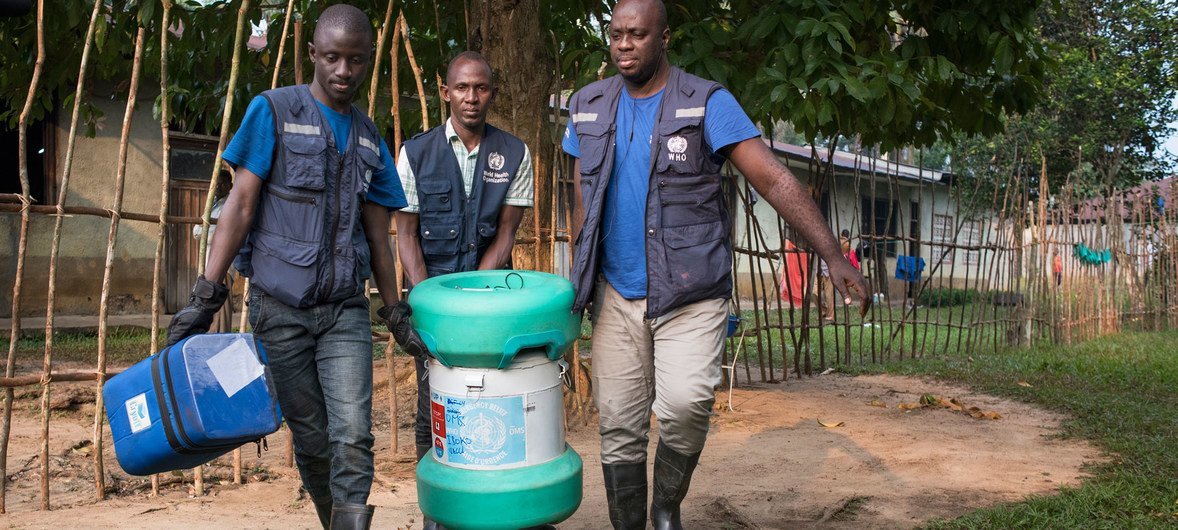
Miembros de un equipo de vacunación contra el ébola de la OMS en el pueblo de Bosolo, República Democrática del Congo.

El Consejo de Seguridad adoptó por unanimidad una resolución sobre el brote de ébola en la República Democrática del Congo.

El texto, introducido por Etiopía y Suecia, destaca que el brote está relacionado con la situación de seguridad del país, y expresa una profunda preocupación porque esta misma situación es la que impide la respuesta y contención del virus.

La resolución destaca la importancia de un apoyo internacional continuo, incluido el financiero, para controlar el brote y alienta a la República Democrática del Congo a mejorar la transparencia y la precisión de los informes sobre el estado de la epidemia.

Además, toma nota de la evaluación de la Organización Mundial de la Salud de que el virus podría propagarse a Uganda, Rwanda, Sudán del Sur y Burundi. En el documento también se condena a los grupos rebeldes por poner en riesgo al personal de salud.

El ébola se desató en Kivu del Norte e Ituri en agosto. Según la OMS, al 23 de octubre había 212 casos confirmados y 35 probables de ébola, incluidas 124 muertes verificadas.

Fuente: https://news.un.org/es/story/2018/10/1444612

Comparte este contenido:

Un plato de comida significa dos días de ingresos en Sudán del Sur: La pobreza en el mundo, un efecto de la injusticia.

Por: Sergio Ferrari. 

Con los alimentos malgastados se podría alimentar a 800 millones de personas
Una de cada diez personas en el planeta tierra sufre en 2018 el impacto de la pobreza extrema, según las cifras oficiales de los organismos internacionales. Y si bien en los últimos 25 años, mil millones de seres humanos escaparon de esa categoría, la realidad cotidiana en muchas regiones aporta señales preocupantes de retrocesos significativos.

Acabar con la pobreza no es una cuestión de caridad sino de justicia, enfatizaron las Naciones Unidas esta tercera semana de octubre en ocasión del Día Internacional para la Erradicación de la Pobreza, que se conmemoró el 17. Reflexión aun más actual al celebrarse este año el 70 aniversario de la Declaración Universal de los Derechos Humanos y cuando se reactualiza el debate sobre los Objetivos de Desarrollo Sostenible, el primero de los cuales intenta terminar con este flagelo.

Según las estadísticas de la ONU, 700 millones de seres humanos viven por debajo de la línea de pobreza, lo que significa que cuentan con menos de 1,90 dólares estadounidenses por día. Sin embargo, acotan las mismas, serían 1300 de millones las personas que padecen de “pobreza multidimensional”, concepto que contabiliza el acceso a los servicios básicos esenciales para llevar una vida digna. Factor aún mas preocupante: la mitad de las *víctimas* son menores de 18 años.

El drama del costo de un plato de comida

Un mismo plato de comida, casera, simple pero nutritiva, elaborada con ingredientes semejantes, que asegura un tercio de las calorías diarias necesarias de una persona, cuesta en Nueva York 1,20 dólares estadounidenses, es decir el 0.6% del ingreso diario promedio. Sin embargo, en Sudán del Sur, representaría más de dos días de ingresos. Es decir, como si un habitante de Nueva York tuviese que pagar unos 350 dólares por ese menú.En Nigeria, para ese mismo tipo de alimento, se debe destinar el ingreso de más de un día. En tanto en Colombia, Guatemala o Bolivia, un menú de esa naturaleza representaría entre el 2 y el 2,7 % del ingreso promedio diario. Así lo señala “Contando los frijoles: el costo real de un plato de comida en todo el mundo, 2018” que acaba de publicar el Programa Mundial de Alimentos de la ONU (PAM). Los principales afectados, según el estudio, son los países en conflicto o que sufren diversos factores de inestabilidad.

Causas y factores de la pobreza

Para Antonio Guterres, secretario general de la ONU en su mensaje oficial del 17 de octubre, los conflictos armados, los desastres naturales y las desigualdades crecientes aparecen como obstáculos para el combate contra este lastre. Y llamó a “una globalización justa que produzca oportunidades para todos y que garantice que el desarrollo tecnológico impulsará esfuerzos por erradicar la pobreza”.

Conceptos que comparten, parcialmente, organizaciones no gubernamentales (ONG) internacionales, que profundizan aún más, sin embargo, la reflexión sobre causas y factores de la pobreza.

“La pobreza es una epidemia que afecta a millones de personas en nuestro planeta”, enfatiza Oxfam Intermón que desde años prioriza su acción en esta temática. Para la ONG, son 1.400 millones de personas las que sufren pobreza extrema y casi 900 millones padecen hambre, y no tienen acceso al agua potable y a otros servicios básicos como la salud y la educación.

En la pedagogía de dicha ONG, el contenido, sin embargo, es más contundente. En su sitio web, Oxfam subraya que antes de explicar cuáles son las causas de la pobreza en el mundo , es importante clarificar entre factor y causa . “Las causas son situaciones que llevan al desarrollo de la pobreza , mientras un factor puede mantener estas condiciones de pobreza durante largo tiempo dado que no permiten una solución”, explica.

“ Diferentes instituciones han estudiado las causas de la pobreza. Sin embargo, hay que tener en cuenta que cada territorio y situación es diferente, con lo cual hablar de la casuística general es más que complejo”, subraya. Y se lanza a analizar los factores que favorecen el mantenimiento de este flagelo.

Entre ellos, el modelo comercial multinacional, con el desarrollo de grandes corporaciones que usan recursos y manos de obra barata en países en riesgo de pobreza, empobreciéndoles aún más. La corrupción, que sustrae recursos esenciales que deberían estar destinados para las áreas sociales. Sin subestimar el impacto del cambio climático y las enfermedades y epidemias. Otros factores: el despilfarro de los alimentos, que implica que con las mal gastadas 1.300 millones de toneladas de productos se podría alimentar a 800 millones de personas que padecen hambre; la discriminación de género; los conflictos armados y el crecimiento exponencial del número de habitantes en el planeta. Sin embargo, según la misma ONG, uno de los factores más preocupantes, sigue siendo, el desinterés de los países desarrollados por acabar con la pobreza.

Fuente: http://rebelion.org/noticia.php?id=247991

Comparte este contenido:

HRW denuncia los abusos sexuales a adolescentes en colegios de África

Redacción: TN 8/31-10-2018

Adolescentes en Senegal sufren explotación y abusos sexuales por profesores y otros miembros del personal docente en escuelasde educación secundaria, denuncia un informe publicado hoy por Human Rights Watch (HRW).

El documento, de 85 páginas, relata las prácticas abusivas por docentes que ofrecen a las niñas dinero, buenas notas, comida, móviles o ropa a cambio de mantener relaciones sexuales.

«Un día el profesor me pidió ir a su casa y al llegar allí me ofreció dinero. Cuando le dije que no, se volvió desagradable y dijo que no me iba a poner buenas notas», explica Aïssatou, de 16 años, cuyo nombre real no ha sido desvelado para su protección.

El informe se basa en entrevistas realizadas a más de 160 niñas, así como a 60 padres, educadores, psicólogos y activistas en cuatro regiones de Senegal, donde son las propias adolescentes las que denuncian los abusos sufridos por los docentes.

Este es el caso de Fanta, quien ahora tiene 23 años y cuenta cómo mantuvo una relación con su profesor a la edad de 16 años.

Como consecuencia de esa relación, quedó embarazada y se vio obligada a abandonar la escuela para siempre por la discriminación de la administración y el resto de estudiantes.

«Mis compañeros de clase sabían que iba con él, también mis profesores, pero nadie dijo nada», lamenta Fanta.

Las niñas también denuncian otras formas de acoso por los maestros, quienes utilizan un lenguaje inapropiado en la clase y hacen constantes referencias a su cuerpo y la ropa que llevan.

«Senegal ha reconocido que la violencia sexual es un problema grave en sus escuelas, pero muchos maestros se salen con la suya y aún se toleran los delitos sexuales», lamentó la investigadora de derechos de la infancia de HRW y autora del informe, Elin Martínez.

Frente a esto, el país africano ha tomado medidas para combatir la violencia sexual en las escuelas secundarias con el fin de que más niñas accedan y permanezcan en las mismas.

Algunos centros cuentan ya con políticas de tolerancia cero contra estas prácticas y han creado espacios seguros donde las niñas puedan denunciarlibremente los abusos.

«Le digo a mis alumnas que si algún profesor que les pide favores, deben acudir a la comisaría a presentar cargos», indicó la profesora de secundaria Lalia Mané.

Estas medidas no se ven replicadas, sin embargo, en todas las escuelas, ya que no existe una política nacional para combatir el acoso sexual en los centros.

Además, algunas niñas tampoco se atreven a denunciar por temor a ser culpadas, la vergüenza y la falta de sistemas que garanticen su confidencialidad.

«El Gobierno de Senegal quiere ver a las niñas lograr éxitos educativos, pero para ello tiene que terminar con la cultura del silencio en cuanto al abuso y mandar un mensaje inequívoco de que es intolerable», concluyó Martínez.

Fuente: https://www.tn8.tv/mundo/459895-hrw-denuncia-abusos-sexuales-adolescentes-colegios-africa/

Comparte este contenido:
Page 170 of 622
1 168 169 170 171 172 622