Page 285 of 622
1 283 284 285 286 287 622

Sudáfrica: South African universities need to rethink how they invest their millions

África/Sudáfrica/Agosto del 2017/Noticias/https://theconversation.com/

Universities are no longer simply institutions of learning. Over the past 50 years, they have also become important players in global financial markets. They have become institutional investors.

Universities have to decide what to do with the pension fund contributions of their staff. They also receive large monetary donations from alumni and other private donors. This money – millions, sometimes billions of dollars – goes into university investment funds. These can be managed internally or delegated to investment managers.

Harvard University in the US has the biggest endowment fund in the world with USD$32.7 billion, while university endowment funds in the UK hold between £2.5 million and £1 billion. Pension funds in the US and UK are even more substantial. For example, the California University pension fund boasts more than USD$70 billion.

University funds in southern Africa are much smaller, but some are still significant. According to our calculations, the universities with the largest endowments are all in South Africa, with the top five representing a little less than USD$1 billion collectively. The pension funds of the top 10 universities in the region come to around USD$3,6 billion.

The question of how universities choose to invest all this money is increasingly coming under scrutiny. In the US, Europe, Australia and New Zealand universities’ pension funds and endowment funds are starting to align their investment portfolios with the social concerns of their students and staff.

Putting assets to work for a better world

In the 1970s student and staff activists at US universities put serious pressure on their managements to stop investing in companies involved in the Vietnam war or, later on, in apartheid South Africa.

Today climate change is the issue that’s increasingly dominating the activist agenda on university campuses. Since 2012, 350.org, a climate change activist movement, has been pushing for total disinvestment from fossil fuels – with some significant victories . Student activists in the US have also called successfully for disinvestment from prisons.

In 2005 the UN established a responsible investment coalition called the Principles for Responsible Investment. Signatories pledge to invest according to six principles, aiming to achieve long-term sustainable investment returns and benefits for society as a whole. So far over 1000 investment managers have signed up, making it the biggest coalition of this kind in the world.

A few academic institutions have signed up too. Harvard’s USD$35 billion University Endowment Scheme joined in 2014. And at least four retirement funds, endowment funds or foundations linked to tertiary education institutions in the US and Europe signed up this year. As was the case with Harvard, this has often happened under pressure from student activists.

Progress at South African universities

So far no universities in South Africa or Africa have signed the principles. But there are signs that the idea of responsible investment is starting to gain some traction – especially within the heightened activism at South African universities.

For example, the South Africa fossil free disinvestment campaign has made significant progress at the University of Cape Town. After a four-year campaign, the university’s convocation of alumni and students this year voted to support a motion to disinvest from fossil fuels.

The Rhodes Must Fall movement also brought the issue of workers’ exploitation into focus. It accused leadership at the University of Cape Town of having blood on its hands for being invested in Lonmin at the time of the Marikana Massacre.

This was closely followed by nationwide Fees Must Fall protests. Protesters called on government to provide free education for all. In doing so, they challenged the idea that universities should operate as businesses according to free market principles. They also challenged the role of the university in society by calling for decolonisation of the institution.

Since then the University of Cape Town’s council has agreed to design a responsible investment policy. This makes it the first known Southern African university to do so.

Paradigm shift

For this movement to truly take off in Southern Africa’s universities, there needs to be a paradigm shift at the level of university management.

As stressed by the University of California, becoming a responsible investor is not about giving up on financial returns. Rather it’s about finding ways to achieve these while addressing societal challenges and opportunities. A responsible investor can decide to disinvest from environmentally and socially harmful sectors, but also to support new investment opportunities such as renewable energy.

An institutional investor that takes its responsibility towards future generations seriously should reflect on its values to take informed decisions on how financial returns can be better achieved. Fortunately it’s becoming easier to do this thanks to a surge in innovative investment strategies and funds that seek to achieve both good financial returns and positive social impacts. The African Investing for Impact Barometer – a research project that we run for the Bertha Centre for Social Innovation and Entrepreneurship at the UCT Graduate School of Business – charts the rise of opportunities like this and shows that impact investing on the continent is booming.

This trend, combined with activism, can persuade universities to become more proactive, creative and responsible investors.

Student and staff activists have clearly begun to interrogate the links between social and environmental issues and their universities’ investment choices. For university management, these questions present an opportunity to think about how their investment portfolios can be used address the social concerns of their students and staff. Universities – being both institutional investors and places of education – can ultimately find improved investment solutions that create a more sustainable future for the generations of learners to come.

Fuente: https://theconversation.com/south-african-universities-need-to-rethink-how-they-invest-their-millions-81306

Imagen: https://lh3.googleusercontent.com/oOHtvbKOtVstXaSILz8k5IUnf6HxdcznBCg46Av-iOEgmQVQPkxJb79kDV0EnZ071aV-pg=s85

Comparte este contenido:

As by Fire – The end of the South African university

Africa/Agosto de 2017/Fuente: University World News

Resumen:  El fin de la universidad sudafricana principalmente  busca las causas profundas y subyacentes que explicaron las prometedoras pero también devastadoras protestas estudiantiles de 2015-16 en muchos de los principales campus universitarios del país. Las protestas estudiantiles son normales en Sudáfrica, pero esto fue diferente. Las protestas normales vienen en breve y los ciclos estacionales, se limitan sobre todo a los campus históricamente negros ya los antiguos politécnicos (technikons, ahora fusionados y retitulados universidades de la tecnología), y no son generalmente violentos. Comenzando con protestas contra la alienación cultural entre los estudiantes negros y el personal en los antiguos campus blancos (las llamadas protestas de los «RáfagasMustFall» comenzando en la Universidad de Ciudad del Cabo) y luego las exclusiones financieras de los estudiantes pobres (el llamado levantamiento #FeesMustFall empezando en la Universidad De los Witwatersrand), las universidades sudafricanas descendieron a una crisis sin precedentes.

I wrote As by Fire: The end of the South African universityprimarily to search for the deep, underlying causes that explained the promising but also devastating student protests of 2015-16 on many of the leading university campuses in the country.

Student protests are normal in South Africa but this was different. The normal protests come in brief and seasonal cycles, are mostly limited to historically black campuses and the former polytechnics (technikons, now merged and renamed universities of technology), and are generally not violent.

Beginning with protests against cultural alienation among black students and staff on former white campuses (the so-called #RhodesMustFall protests starting at the University of Cape Town) and then financial exclusions of poor students (the so-called #FeesMustFall uprising starting at the University of the Witwatersrand), South African universities descended into an unprecedented crisis.

An unfolding crisis

At first, starting in March 2015, the protests were largely peaceful and non-violent, and also enjoyed significant support from the broader community.

In quick succession prominent symbols of alienation came down, from the Rhodes statue at Cape Town to the bust of apartheid leader HF Verwoerd at the University of Stellenbosch. Universities across the country engaged in seminars and symposia on pressing subjects such as the transformation of the professoriate and decolonisation.

Then the second wave of protests shifted towards free higher education from October 2015 onwards and again there was broad support for the student struggle as the action spread from campuses to the Union Buildings in Pretoria where President Jacob Zuma had gathered student leaders and university vice-chancellors to figure out how to stem the tide of protests.

The president’s announcement of a zero-percent fee increase for the next year (2016) seemed to ease tensions on campuses.

But then as the new academic year started the protests took a serious turn for the worse. A largely leaderless movement, modelled on youth protests in other parts of the world, created opportunities for all kinds of new formations.

Protests on and around campuses turned violent and buildings of several major universities went up in flames, university leaders were attacked and humiliated, classes were regularly disrupted, roads onto campuses blocked, shantytowns erected and on one campus a worker died as a consequence of the protests.

The violent disruptions went on and on. Some universities closed for weeks, others for longer. Several campuses shifted to online learning in a desperate attempt not to lose the academic year. International universities stopped sending their students to some of the leading South African campuses.

Middle-class students started to look at overseas options for study as did some professors for work. Students from other African universities started to express concern about coming to South Africa for studies – a cheaper and nearer option for quality higher education than Europe or the United States.

What was going on?

Proxy for deeper concerns

The conclusions drawn from As by Fire are important for understanding the future prospects of higher education in South Africa.

It was clear that in many ways the campus protests were a proxy war for deeper concerns about the South African transition. The promise of democracy in 1994 did not deliver and this generation of post-apartheid students were angry and anxious about what this meant for their futures.

On campus the costs of higher education was one place in which they experienced severe hardship. Unable to meet the immediate (tuition fees) and broader social costs of university studies (accommodation, food, travel, family support, deferred income), a campus was the right place for young men and women to express their outrage that life had not improved under the illusory rainbow nation.

What the students rightly protested was the systemic character of the crisis in higher education, and this was the single most important contribution of the protest movement.

Lost in the fire

But something else was lost in the fire, so to speak. As the protests turned violent over extended periods of time, something much more fundamental had shifted in campus cultures that speak to the future of South African universities.

For one, violence and disruption had threatened to become the new normal on campuses. A lull in protests was often short-lived until the next crisis. Losing precious teaching time was now normal but also more visible as regular reports revealed the constant disruptions happening especially on black and merged university of technology campuses on any number of issues, from insourcing workers to the provision of more student accommodation.

What was also revealed was the extent of the welfarisation of the South African university; that is, the extent to which the university was now seen as a place to demand a range of support services outside of the longstanding duty of a place of higher learning – teaching, research and public service. Now routine student demands include sanitary pads and condoms alongside after-hours transportation and food services.

More and more the public university was seen as another government department and the officials tending them as officials of the state. The traditional notion of a university was now itself under threat.

Silencing and exclusion

Another cultural shift on campuses with potentially devastating consequences for universities is the closing down of space for dissent. That is, dissent from the dominant – though certainly not majority – student voice.

During the protests, and since then, criticism of the new orthodoxy (violence, disruption and even decolonisation) is met with immediate reprisal, from the drowning out of alternative voices to outright threats.

Some professors consciously avoid campus seminar topics in which they offer support but also criticism of the direction of the protest movement. Many students simply do not show up at events where the content and the atmosphere discourage not only voice but even presence – as with the disruption of a speech by Kenyan writer Ngugi wa Thiong’o in which the black students insisted that he not continue until the white people in the hall left.

These new patterns of silencing and exclusion merit a courageous study of its own but the implications for open, democratic and inclusive higher education are very serious.

Threats to university excellence

By taking a comparative perspective on what was happening in South Africa, it also became clear that the pressures changing post-apartheid universities were exactly the same that levelled the most promising post-colonial universities from Kenya and Uganda to Zimbabwe. Those factors included chronic instability and underfunding by the government.

For South Africa’s elite English campuses, the protests demonstrated that the appropriate frame of reference for these institutions was not the Oxbridge system but the post-colonial African university.

In the medium to long term, these campuses might well become mass-based training colleges for the poor going through the routines of what post-secondary institutions normally do but having lost the intellectual vitality, critical independence and world-class scholarship that rates these universities among the best in the world.

Which brings me to perhaps the main reason for writing As by Fire– to warn against this trend and to push back against what some already see as inevitable.

Fuente: http://www.universityworldnews.com/article.php?story=2017082408304974

Comparte este contenido:

Cuba amplía colaboración educacional con Sudáfrica y Trinidad y Tobago

Cuba/24 agosto 2017/Fuente: Sputnik Mundo

Un acuerdo entre Cuba y Sudáfrica sobre servicios en la esfera educativa y la reciente confirmación de becas a universitarios de Trinidad y Tobago evidencian la voluntad de la isla de ampliar la cooperación en este campo, informó la cancillería de la nación antillana.

El entendimiento rubricado en Pretoria en noviembre de 2016 entró en vigor de acuerdo con lo pactado, por lo cual sus cláusulas ya rigen la cooperación en educación básica y la contratación de especialistas cubanos del Ministerio de Educación por el Departamento de Educación Básica del país africano, informó el sitio de la cancillería cubana.

Por otra parte, la semana pasada, el ministro de Educación de Trinidad y Tobago, Anthony García, agradeció a Cuba el otorgamiento de becas de medicina para estudiantes de ese país.Garcia encabezó junto al embajador cubano en ese país, Guillermo Vázquez, la ceremonia de entrega de las plazas pactadas, realizada en la sede de su cartera.

Ante los alumnos próximos a partir para formarse en la Escuela Latinoamericana de Medicina (ELAM), ubicada a unos 25 kilómetros al oeste del centro de La Habana, el titular trinitense señaló a los educandos la importancia del momento histórico que viven y que deben sentir orgullo por su selección.

Vázquez, por su parte, reafirmó el compromiso de Cuba con el Caribe, la permanencia en el tiempo del programa de becas y otros proyectos de colaboración.

Ante viceministros, directores, funcionarios del Ministerio de Educación y familiares de los estudiantes, el diplomático resaltó la vigencia de la declaración de la V Cumbre Cuba-Comunidad del Caribe, efectuada en La Habana en diciembre de 2014.El embajador se refirió al ejemplo desde el punto de vista de la solidaridad del líder de la Revolución cubana, Fidel Castro, creador de la ELAM, plantel que ya graduó más de 28.500 médicos de 103 países.

Según las fuentes, durante la velada los estudiantes rubricaron el Código de Ética de los discípulos de la ELAM.

Unos 10.000 alumnos de 55 países, de los cuales el 75% son hijos de obreros y campesinos, se forman en la ELAM, donde además se preparan becarios de 104 comunidades originarias de América Latina, reseña el portal enciclopédico cubano Ecured.

Fuente: https://mundo.sputniknews.com/sociedad/201708221071758281-esfera-educativa-becas-cuba/

Comparte este contenido:

OIT subraya negativos pronósticos para empleo juvenil en África Subsahariana

África Subsahariana/24 agosto 2017/Fuente: Prensa Latina

 Los jóvenes en África subsahariana son un sector en expansión, sin garantías de empleo decente debido al retraso educativo y la falta de oportunidades en economías con escasa diversificación, advirtió hoy la OIT.
A juicio de la Organización Internacional del Trabajo (OIT), las tasas de desocupación resultan relativamente bajas en la actualidad, pero en los próximos 15 años unos 375 millones de habitantes de la región tendrán edad laboral.

Para 2050, el segmento poblacional de 15 a 24 años de edad en África Subsahariana representará el 30 por ciento de todos los jóvenes del mundo, lo que plantea un sinnúmero de retos.

El experto Bruno Losch, codirector del Centro para el Estudio de las Innovaciones en materia de Gobernanza de la University of Western Cape (Sudáfrica), evaluó el tema en entrevista publicada por la OIT en su página web.

Un problema fundamental es que entre el 80 y el 90 por ciento de la población activa en África subsahariana sigue trabajando en actividades informales, ‘una consecuencia de cambios estructurales con efecto limitado sobre la transformación económica’, observó.

Gran parte de la población activa, agregó, labora en la agricultura, y en empresas familiares; el trabajo asalariado formal es escaso y está relacionado sobre todo con los servicios, mientras las manufacturas representan menos del cinco por ciento.

Para el economista, otro asunto clave es ‘la escasa capacidad de absorción de la creciente población activa en estas economías insuficientemente diversificadas’.

En los próximos dos decenios, las empresas familiares y la agricultura seguirán desempeñando un papel importante en África subsahariana; es decir, numerosas personas estarán vinculadas a faenas que proporcionan hoy ingresos inestables y bajos, con acceso limitado o nulo a la protección social.

El desafío, indicó el especialista, consiste en hacer más productivas y rentables las granjas, las actividades ajenas al sector agrícola y las empresas familiares, a fin de mejorar el panorama del empleo.

Entre las dificultades de mayor envergadura, figura también la instrucción cultural: en estos momentos, casi el 20 por ciento de los niños en edad de cursar la escolaridad primaria no lo hace, y la tasa de alfabetización de los jóvenes es del 75 por ciento (en 2015), muy por detrás de otras regiones, comentó.

La mayoría de los países también muestran un retraso evidente en educación secundaria; en Asia oriental y sudoriental, ejemplificó, entre 70 y 80 por ciento de los jóvenes de 15 a 24 años de edad terminaron el ciclo básico de la enseñanza secundaria; mientras en el África subsahariana la proporción es de 20 a 35 por ciento.

Otra prioridad, estimó, sería idear sistemas innovadores de capacitación y desarrollo de las calificaciones que adecuaran más el perfil de los jóvenes que buscan empleo a las necesidades de los mercados laborales.

Fuente noticia: http://www.prensa-latina.cu/index.php?o=rn&id=108995&SEO=oit-subraya-negativos-pronosticos-para-empleo-juvenil-en-africa

Fuente imagen: http://www.wanafrica.com/wp-content/uploads/Empleo-juvenil-africa.jpg

Comparte este contenido:

Prohibir que madres asistan a la escuela no reducirá el embarazo adolescente en Tanzania

Tanzania/24 agosto 2017/Fuente: Global Voices

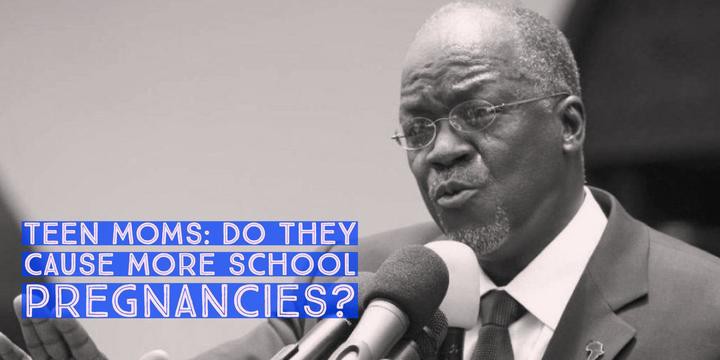
Sin embargo, el presidente tanzano John Magufuli sí lo cree.

El presidente tanzano John Magufuli ha pedido que se prohíba el regreso a la escuela de madres adolescentes una vez que hayan dado a luz.

En una manifestación en Chalinze, pequeño pueblo en la región oriental de Pwani, el presidente Magufuli reconvino a las ONG en Tanzania por alentar a las madres adolescentes a regresar a la escuela, y afirmó que estaban “terminando el país” y llevando a un estado de “decadencia moral” en Tanzania:

El presidente agregó que se debería prohibir a las madres adolescentes que asistan a primaria o secundaria que regresen a clases una vez que hayan dado a luz:

Quiero decirles a ellas y a las ONG también que durante mi gobierno, a ninguna niña que haya dado a luz se le permitirá volver a la escuela.

Luego, el presidente dijo que las madres adolescentes podrían asistir a otros lugares si querían recibir educación, como Autoridad Vocacional Educativa y de Capacitación, o incluso emprender la agricultura.

El anuncio encendió la indignación en medios sociales, y los tanzanos empezaron a usar la etiqueta #ArudiShule [de vuelta a la escuela] para criticiar la decisión, sobre todo considerando que más de 8,000 niñas tanzanas abandonan la escuela por quedar embarazadas, según un informe de Human Rights Watch.

Entonces, la pregunta es: ¿las madres escolares influyen en el comportamiento reproductivo de otras estudiantes?

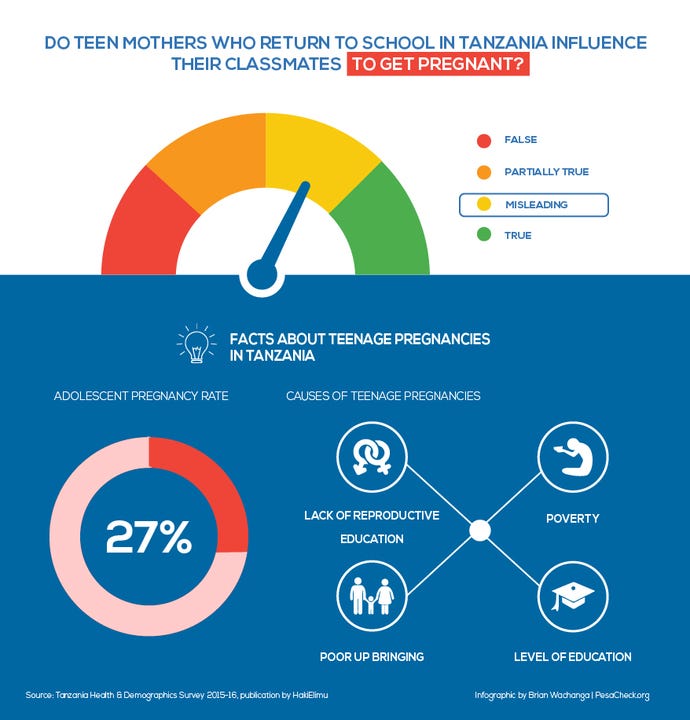
PesaCheck investigó al respecto, con datos de la iniciativa ciudadana Twaweza, y encontró que la afirmación del presidente Magufuli es engañosa por las siguientes razones:

¿Las madres escolares influyen en el comportamiento reproductivo de otras estudiantes? El amarillo indica que la mayoría lo considera engañoso. El índice de embarazo adolescente llega al 27%.

¿Las madres escolares influyen en el comportamiento reproductivo de otras estudiantes? El amarillo indica que la mayoría lo considera engañoso.

Causas de embarazo adolescente

Según la Investigación de Salud y Demografía de Tanzania (THDS) 2015–16 el índice de embarazo adolescente en Tanzania es considerablemente alto, llega al 27%. ¿Qué factores contribuyen con esta cifra?

Una publicación de HakiElimu encontró que la opinión de los ciudadanos sobre las principales causas de embarazo adolescente incluyen bajos ingresos. La publicación afirma que cerca del 31% de los encuestados (que incluye padres y las propias adolescentes) creen que la pobreza es un factor clave, pues las difíciles situaciones económicas hacen que los padres promuevan el matrimonio de sus hijos pues no pueden satisfacer las necesidades básicas de sus niñas.

El informe de THDS también muestra que las fertilidad varía con los niveles económicos, y disminuye en hogares con mayores ingresoso. Los hogares más prósperos también registran más edad en el primer alumbramiento, lo que significa que es más probable que en los hogares más pobres haya madres de menos edad, probablemente en edad escolar.

Corrobora este hecho un informe de UNICEF que muestra que una de seis jóvenes entre 15 y 19 años está casada en Tanzania. Estas chicas quedan afectadas psicológicamente, lo que significa que muchas no pueden regresar a la escuela una vez que se retiran.

Otro factor en la publicación de HakiElimu fue “crianza deficiente y los deseos personales de las propias muchachas”. Encontraron que algunos padres no están al tanto de la crianza de sus hijos. Otro hallazgo fue la falta de educación reproductiva que ayude a los adolescentes a entender totalmente la pubertad. “Muchos padres en las aldeas no hablan con sus hijas que están en la pubertad”. La información de TDHS 2015 muestra que más de la mitad de las mujeres que tienen experiencia sexual antes de los 16 años.

El informe de HakiElimu también encontró que otro factor es la visión de la sociedad de una madre adolescente está en estar casada y ser madre.

El informe de TDHS 2015–16 muestra que los índices de fertilidad se relacionan con el nivel de educación. Afirma que las mujeres sin educación tienen 3.3 veces más hijos que las mujeres con educación secundaria. Las adolescentes sin educación tienen cinco veces más probabilidades de criar hijos comparadas con mujeres con educación secundaria o superior. Tal como afirma el informe de UNICEF (p.12), TDHS 2010 encontró que para la mayoría de chicas que da a luz cuando “aún son niñas” en realidad ya no están en la escuela.

¿Las madres escolares influyen en los embarazos adolescentes?

Según THDS, Zanzíbar tiene un índice significativamente bajo de embarazos adolescentes, un 8% comparado con Tanzania. Zanzíbar planteó una política de regreso a la escuela en 2010 como medida para reducir la deserción escolar. Kenia está entre Tanzania y Zanzíbar con 18% de embarazos adolescentes. En ambos lugares, las madres escolares van a la escuela y la fertilidad adolescente es mucho menor.

Por lo tanto, la afirmación de que las madres que estudian y regresan a la escuela influirán en otras alumnas lo que aumentará los embarazos adolescentes es engañosa. La mayoría de investigaciones en torno alembarazo adolescente lo atribuye a factores económicos y la actitud de la comunidad y la crianza de las hijas.

¿Quieres que verifiquemos los datos que un político u otra figura pública haya dicho sobre finanzas públicas? Llena este formulario, o contáctanos y te ayudaremos a asegurarte que no te estén engañando.

Este informe fue escrito por Mwegelo Kapinga, consultora de desarrollo, escritora y becaria de PesaCheck. Mwegelo trabajó antes en Twaweza East Africa como analista de investigación. Las infografías son del becario de PesaCheck Brian Wachanga, Keniano especialista en tecnología e interesado en visualización de información. Este informe fue editado por el editor general de PesaCheck Eric Mugendi.

PesaCheck, cofundado por Catherine Gicheru, es la primera iniciativa de verificación de información de África Oriental. Busca ayudar a que el público separe verdad de ficción en declaraciones públicas sobre las cifras que dan forma a nuestro mundo, con especial énfasis en pronunciamientos sobre finanzas públicas que dan forma a los llamados ‘Objetivos de Desarrollo Sostenible’ o ODS en servicios públicos, como salud, desarrollo rural y acceso a agua y desagüe. PesaCheck también prueba la veracidad de los informes de los medios. Para saber más sobre el proyecto, visita pesacheck.org.

Fuente: https://es.globalvoices.org/2017/08/22/prohibir-que-madres-asistan-a-la-escuela-no-reducira-el-embarazo-adolescente-en-tanzania/

Comparte este contenido:

Reduce JHS subjects to 6 — Education directors

23 de agosto de 2017 / Fuente: https://citifmonline.com

The Conference of Directors of Education (CODE) has advocated the reduction of the number of subjects studied at the various levels of basic education.

It suggested that while pupils in the kindergarten and lower primary should study only numeracy, literature and physical education, those in upper primary and students in junior high school (JHS) should be made to study six subjects, instead of nine.

In a communique issued at the end of the 24th annual conference of CODE at Abesim, near Sunyani, last Saturday, the conference expressed the view that the use of chalk had outlived its usefulness in schools and, therefore, suggested that blackboards should be replaced with whiteboards and markers provided for use by teachers.

The communique, signed by the National President and the National Secretary of CODE, Mrs Margaret Frempong-Kore, and Mr Isaac Nsiah Edwards, respectively, did not assign any reasons for the proposal to the educational authorities to reduce the number of subjects being studied at the basic level.

However, in an interview, Mrs Frempong-Kore explained that at the Kindergarten and lower primary levels, the major problem now was literacy and numeracy.

“By the time that the child leaves the lower primary, if he cannot read, he cannot grasp other subjects taught at Upper Primary and the JHS levels,” she said.

She further explained that the conference also wanted the subjects taught at the upper primary and the JHS levels to be reduced from nine to six because there was a challenge about reading currently.

Justifying the contention of CODE for the subject to be reduced, Mrs Frempong-Kore said  the subjects had to be reduced to enable the pupils to concentrate on the basics of the subjects they would pursue at the senior high school (SHS) level. “With the low level of reading, studying nine subjects gets the students rather confused,” she added.

Free SHS policy

The CODE, in its communique issued at the end of  its meeting, said as much as CODE supported the free SHS policy, “we recommend an increase in advocacy through the distribution of hard copies of guidelines on the policy”.

It also called for the timely payment of all subsidies in relation to the programme to prevent delayed payments during its implementation, a feature that was associated with the National Health Insurance Scheme (NHIS), the Ghana School Feeding Programme (GSFP), the progressively free SHS and the Capitation Grant.

It also expressed concern over the lack of textbooks and, in some cases, inadequacies in the provision of teaching and play materials and called for an immediate solution to the problem.

Pre-school education

“There is a big deficit in the supply of furniture at the basic level,” the communique stated, and suggested that the award of contract for the production and distribution of furniture should be done at the district level to ensure quality,  appropriateness and timely delivery.

“We are suggesting that the construction of new primary schools should have kindergartens attached, while the training of early childhood education teachers should be encouraged by increasing the quota for study leave,” it said.

TVET courses

The communique recommended that facilities at Technical and Vocational Education and Training (TVET) institutions should be redesigned and improved to attract females and persons with disability.

“Effective inputs such as government of Ghana grants, vehicles, residential and office accommodation, as well as office equipment, should be made available to the education directorates for effective delivery of directors’ mandate,” it said.

It said CODE supported the licensing of teachers by the National Teaching Council to improve on teachers’ professional competence, but recommended that there should be more education on the issue.

Fuente noticia: https://citifmonline.com/2017/08/22/reduce-jhs-subjects-to-6-education-directors/

Comparte este contenido:

Kenia: Varsity council blocked from meeting room as wrangles rage

Kenia / 23 de agosto de 2017 / Por: OUMA WANZALA / Fuente: http://www.nation.co.ke/

Leadership wrangles at the University of Nairobi intensified Friday when the newly appointed council was forced to conduct its first meeting outside the chambers.

The new council led by the chairman Dr Timothy Kiruhi found the doors of the chambers closed and was forced to conduct the meeting at a lounge since the university closed for elections.

Vice-Chancellor Peter Mbithi is the Secretary of the Council and is usually told by council chairman to invite members to meetings.

The development came a day after a case was filed at the High Court by activist Thadayo Obanda in an attempt to stop the meeting with Deputy Vice-chancellor Prof Isaac Mbeche swearing an affidavit to support barring of the new council members from conducting the meeting.

APOLOGIES

On Friday, Dr Kiruhi narrated how they were locked out of the chambers after arriving at the institution at 7am for a special council meeting as all staff, including those he said he  had spoken with, were away from the office and were not picking their calls.

“The VC was also unreachable,” said the new chairman adding that two of the council members had sent apologies though they had been consulted about the Special Council meeting, which was meant to update the council members on the status of the university and also how they can best support the VC and his team.

“The council was able to find a lounge where we held a fruitful meeting. We are hopeful that the inhibitions which the council has experienced since appointment will soon be behind us so that we can contribute towards the good governance and prosperity of UoN,” said Dr Kiruhi.

Education Cabinet Secretary Fred Matiang’i has since stepped in to end the impasse and is scheduled to meet the University Chancellor Dr Vijo Ratansi on Monday.

NEW COUNCIL

In the affidavit, Prof Mbeche argued  that the previous council members of the university who were in office prior to the appointment of the new council are deemed to be in office pending the hearing and determination of the suit.

In the court papers, Prof Mbeche stated that the calling of the meeting that was held Friday was wilful and deliberate disobedience of the court order issued on March 22.

“The interested party is aggrieved by the aforesaid disobedience of the court order since the vice-chancellor   of the university was served with the aforesaid order which contains a penal notice and the vice-chancellor has a duty to ensure compliance with the court order.”

“A court order once issued is meant to be obeyed. Hence, the orders sought herein ought to be granted so as to safeguard the rule of law which is fundamental in the administration of justice,” added Prof Mbeche through Ngatia and Associates.

The council led Dr Kiruhi was re-appointed via Special Gazette Notice dated August 7 by Dr Matiang’i after his earlier appointment in March was quashed by High Court Judge George Odunga for failure to follow the law.

Fuente noticia: http://www.nation.co.ke/news/education/University-of-Nairobi-council/2643604-4062990-i34ef4z/index.html

Comparte este contenido:
Page 285 of 622
1 283 284 285 286 287 622