Page 226 of 396
1 224 225 226 227 228 396

Prepárate hoy, paga después: una startup quiere cambiar el paradigma de la educación superior

America del Norte/EEUU/Observatorios ITESM-MX

La educación superior se está enfrentando a muchos desafíos, uno de los más críticos que enfrenta es la deuda que los estudiantes tienen que liquidar después de graduarse. Con el costo de la matrícula en aumento y el valor del grado universitario en decaimiento (sólo el 18% de los estudiantes que comienzan una licenciatura terminan en 4 años), cada vez menos estudiantes creen que una educación universitaria vale la pena el costo.

Una startup con sede en San Francisco quiere reimaginar la educación superior ofreciendo una alternativa a la universidad libre de deudas y con tan solo 1 año de duración. MissionU es un programa que ofrece «una educación de clase mundial que prepara a los estudiantes para los trabajos de hoy y mañana» sin cobrar por adelantado.

MissionU solo recibe dinero una vez que los estudiantes tengan un trabajo con un salario de al menos $50,000 dólares. El programa funciona así: los estudiantes aportan el 15% de sus ingresos durante 3 años después de que termine el programa.

Después de fundar Pencils of Promise, una organización sin fines de lucro que ha construido más de 400 escuelas en todo el mundo, Adam Braun, CEO y co-fundador de MissionU, decidió cambiar el paradigma de la educación superior después de presenciar la lucha de su esposa para pagar más de $100.000 en préstamos estudiantiles. «La deuda estudiantil es la única deuda de los Estados Unidos que no puede ser descartada a través de la bancarrota. Está contigo para siempre», escribeBraun en el sitio web de MissionU.

A diferencia de las universidades tradicionales o las escuelas en línea, MissionU fue diseñada para «habilitar» a los estudiantes a través de un programa inmersivo, colaborativo y acelerado donde los estudiantes ponen en práctica lo que han aprendido trabajando en proyectos reales.

A pesar de que MissionU no tiene un campus tradicional y la mayoría de sus cursos son en línea, los estudiantes están obligados a vivir a menos de 50 millas de la ciudad base del programa para atender reuniones ocasionales.

Además, MissionU cree que el compromiso de una universidad con sus alumnos no debe terminar en la graduación. Los estudiantes cuentan con un programa de apoyo de seis semanas de duración que les ayuda a pasar el proceso de entrevistas a través de capacitación, orientación y negociación salarial.

La primera generación de MissionU iniciará clases a partir de septiembre de 2017 en San Francisco, California y se centrará en análisis de datos e inteligencia de negocios. De acuerdo a Campus Technology, de 4,500 solicitantes, la primera generación admitió a tan sólo 25 estudiantes. Las solicitudes para enero del 2018 ya están abiertas.

Fuente: https://observatorio.itesm.mx/edu-news/2017/6/12/preprate-hoy-paga-despus-una-startup-quiere-cambiar-el-paradigma-de-la-educacin-superior

Comparte este contenido:

Estados Unidos: Anuncian subvención para granjas escolares

Estados Unidos/Junio de 2017/Fuente: El Mañana

El Departamento de Agricultura de los Estados Unidos anunció los proyectos seleccionados para recibir subvenciones anuales para proyectos escolares diseñados para aumentar la producción de alimentos locales servidos en las escuelas. Pharr-San Juan-Alamo ISD es uno de los 65 proyectos elegidos en todo el país, para recibir fondos por un total de 44 mil 646 dólares para conectar mejor las cafeterías de la escuela y los estudiantes con los agricultores y ganaderos locales.

“Aumentar la producción de alimentos en las granjas en las escuelas de los Estados Unidos es una ganancia para todos”, dijo Cindy Long, administradora adjunta de Programas de Nutrición Infantil del Servicio de Alimentos y Nutrición del USDA, que administra los programas de comidas escolares del Departamento.

La funcionaria precisó que los proyectos de granjas escolares fomentan hábitos alimenticios saludables entre los niños en edad escolar, y las economías locales se nutren, también, cuando las escuelas compran a los productores locales.

Este dinero apoyará una amplia gama de actividades, desde capacitación, planificación y desarrollo de asociaciones hasta creación de nuevos artículos de menú, establecimiento de cadenas de suministro locales, pruebas de sabor para niños, compra de equipo, plantación de jardines escolares y organización de excursiones a las operaciones agrícolas.

“Hemos estado dando grandes pasos para educar y alentar a nuestros estudiantes a comer frutas y verduras frescas, esta donación nos ayudará a expandir nuestras asociaciones locales y aumentar el consumo de bienes locales”, dijo Imelda Palacios, directora de Nutrición Infantil en PSJA ISD.

Según el censo del USDA Granjas Escolares de 2015, las escuelas con programas fuertes de granjas escolares informan una reducción en el desperdicio de alimentos y la mayor disposición de los estudiantes a probar nuevos alimentos como frutas y verduras.

PSJA ISD ofrece comidas saludables a los estudiantes durante todo el año, ya que el distrito también participa en el programa de comida de verano de USDA, que se prolonga hasta mediados de agosto.

Fuente: https://www.elmanana.com/anunciansubvencionparagranjasescolares-3798877.html

Comparte este contenido:

Estados Unidos: Desigualdades raciales y falta de fondos en educación preocupan a padres de niños latinos y afroamericanos

Estados Unidos/15 junio 2017/Fuente:el-observador

Las percepciones de los padres sobre las disparidades raciales en la escuela, siguen siendo fuertes a la hora de evaluar el éxito del sistema educativo estadounidense en la formación de niños afroamericanos y latinos. Así lo revela la segunda encuesta “La Nueva Mayoría en el Sistema Educativo” publicada por el Fondo Educativo de la Conferencia de Liderazgo sobre Derechos Civiles y Humanos (LCEF en inglés).

La encuesta explora cómo los padres de familia ven el impacto del sistema de educación federal en el progreso de sus hijos “sobre quienes tienen altas expectativas de formación y para quienes esperan un fuerte rigor académico”, dijo Wade Henderson, presidente y director ejecutivo del LCEF en una teleconferencia organizada por New America Media a finales de mayo.

Entre los hallazgos más importantes de la encuesta está el hecho de que existe un abrumador sentimiento de desigualdad racial en el financiamiento escolar. No hay suficiente presupuesto para educar a niños latinos y afroamericanos en las escuelas públicas donde ellos componen la inmensa mayoría. Los padres y miembros de familia de estudiantes cuyos maestros son, en su mayoría, blancos están más propensos a creer que las escuelas “no hacen un esfuerzo suficiente” para educar a sus hijos.

Destacan la falencia de maestros bien equipados y con formación de alta calidad, que traten justamente a sus estudiantes, y que les faciliten oportunidades para tomar clases que los reten en sus propios conocimientos.

Los estados no han respondido lo suficiente a las necesidades de estos padres y las políticas federales tampoco reflejan lo que ellos necesitan para la educación de sus hijos”, agregó Wanderson.

La encuesta se conoce en momentos en que a nivel estatal se están preparando los planes educativos para cumplir con el Every Student Success Act (ESSA), la ley antecedida por la política No Child Left Behind desarrollada a través de serios esfuerzos bipartidistas durante el gobierno de Barack Obama. Aprobada en 2015, la ESSA permite a los estados una mayor flexibilidad para adaptar las estrategias de educación de acuerdo a la población a la que sirven.

Los estados deben informar cómo gastan el dinero que reciben para el rubro educativo y en quién, de acuerdo con las regulaciones federales”, dijo por su parte Liz King, directora de políticas educativas de LCEF. “Hay que abrir los los procesos de toma de decisiones a las familias de raza negra y latina”, añadió.

La encuesta se realizó telefónicamente por la firma Anzalone Liszt Grove Research a 1200 padres de niños latinos y afroamericanos en todo el país, quienes están vigorosamente involucrados en la crianza de sus hijos de edades entre 5 y 18 años. El 30% de los participantes latinos fueron entrevistados en español.

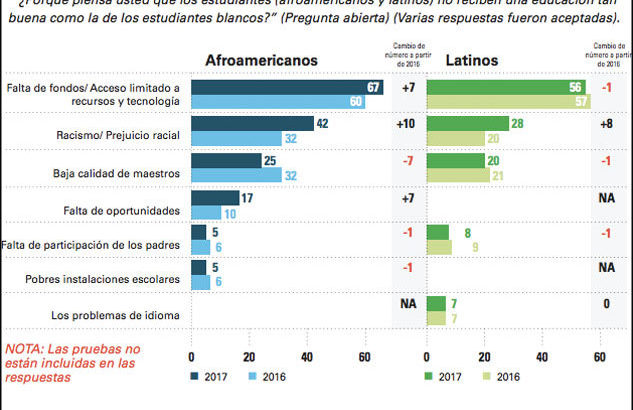
Matt Hogan, socio de la firma reconoció que muy pocos de los padres encuestados estaban familiarizados con ESSA. Pero en comparación con la encuesta del año pasado, sí hay un aumento en la creencia de que el racismo en el sistema educativo está teniendo un impacto negativo en la vida de sus hijos. “El 42% de los padres afroamericanos entrevistados piensa que sus hijos no reciben una educación tan buena como la de los estudiantes blancos por prejuicio racial o racismo”, agregó Hogan.

Entre los latinos esa cifra es menor, 28% y en general, las actitudes con respecto al sistema educativo han mejorado entre los padres y familias hispanas. Aunque ellos reconocen las desigualdades raciales, el 75% cree que las escuelas públicas estadounidenses hacen un buen trabajo en preparar a los estudiantes para el éxito en el futuro. Una escasa mayoría (52%) cree que la educación que los estudiantes latinos reciben en el país es tan buena como la que reciben los estudiantes blancos. Este porcentaje aumenta si los padres latinos no asistieron a escuelas en Estados Unidos.

Recordando que recientemente se celebró el 63 aniversario de la decisión de la Corte Suprema de Brown v. la Junta de educación, que terminó con la segregación de las escuelas en Estados Unidos, los expertos esperan que los resultados de la encuesta no solo permitan construir mejores políticas públicas y asignación de recursos, sino coaliciones para lograr metas educativas federales. Más aún en medio de los recortes que ha prometido la nueva administración de Donald Trump y los planes en los que la diversidad en la educación no parece prioritaria.

“Hay que corregir la inequidad institucional”, agregó Wanderson. “No importa si es Betsy DeVos en la posición de Secretaria de Educación, o alguien más. El estándar de responsabilidad por la participación federal sigue siendo el mismo y esperamos que esta administración cumpla con sus obligaciones”, puntualizó.

Fuente: http://el-observador.com/2017/06/14/desigualdades-raciales-y-falta-de-fondos-en-educacion-preocupan-a-padres-de-ninos-latinos-y-afroamericanos/

Comparte este contenido:

Estados Unidos: DeVos: Criticism of her position on discrimination ‘hurtful’

Estados Unidos / 14 de junio de 2017 / Por: Gregory Wallace y Grace Hauck / Fuente: http://www.kitv.com/

Education Secretary Betsy DeVos said Tuesday that criticism of her position on discrimination in schools is «hurtful» and «couldn’t be further from the truth.»

«I think discrimination in any form is wrong and I have said before and I’ll say again, the department is committed to ensuring that every child has a safe and nurturing environment,» DeVos said during a question-and-answer session after her address to the National Alliance for Public Charter Schools.

DeVos did not, however, wade into the issue that has prompted the criticism: her repeated refusal to say specifically whether she believes federal funding should be withheld from non-public schools that discriminate.

She said at a recent Senate hearing that discrimination on the basis of sexual orientation is «unsettled» law and a matter for Congress and the courts to address rather than her department. Those questions came after an earlier hearing ?in May when DeVos was criticized for declining to tell lawmakers whether federal funding for state-run voucher programs would be pulled from private schools that discriminate in admissions.

DeVos has previously voiced her opposition to discrimination and said federal law would apply to all schools receiving federal funds while declining to be more specific.

Speaking to an audience of charter school educators and supporters Tuesday, DeVos urged them to keep innovating rather than becoming another complacent generation of education bureaucrats.

«Charters are not the one cure-all to the ills that beset education,» DeVos said, adding. «I suggest we focus less on what word comes before ‘school’ — whether it be traditional, charter, virtual, magnet, home, parochial, private or any approach yet to be developed — and focus instead on the individuals they are intended to serve.»

Fuente noticia: http://www.kitv.com/story/35653964/devos-criticism-of-her-position-on-discrimination-hurtful

Comparte este contenido:

Las lagunas en los datos sobre los niños en instituciones de atención pueden llevar a pasar por alto a los más vulnerables, dice UNICEF

Ginebra/Nueva York /14 de junio de 2017 / Fuente: https://www.unicef.org

Al menos 2,7 millones de niños viven en los centros de atención residencial, pero esto es sólo la punta del iceberg, según un estudio

Al menos 2,7 millones de niños viven en centros residenciales en todo el mundo, según las nuevas estimaciones de UNICEF. Sin embargo, es probable que las cifras publicadas hoy en la publicación Child Abuse & Neglect sean sólo la punta del iceberg, ya que se ha encontrado que en la mayoría de los países hay amplias lagunas en la recopilación de datos y la precisión de los registros.

“En las residencias de atención, como las instituciones o los orfanatos, los niños que ya son vulnerables debido a la separación de sus familias corren un mayor riesgo de sufrir casos de violencia, abuso y daños en su desarrollo cognitivo, social y emocional a largo plazo”, dijo Cornelius Williams, Director Asociado de Protección de la Infancia en UNICEF. “La prioridad es mantener a los niños fuera del cuidado residencial y con sus familias, especialmente en los primeros años”.

La nueva estimación de UNICEF se basa en datos de 140 países. Se encontró que en Europa Central y Oriental se registraba la tasa más alta en todo el mundo, con 666 niños por cada 100.000 habitantes que viven en centros de atención residencial, más de 5 veces el promedio mundial de 120 niños por cada 100.000 habitantes. Los países industrializados y la región de Asia oriental y el Pacífico presentan la segunda y tercera tasa con 192 y 153 niños por cada 100.000, respectivamente.

El estudio de UNICEF hace hincapié en que muchos países todavía carecen de un sistema funcional para producir cifras exactas sobre el número de niños que reciben cuidados alternativos. En muchos países, los registros oficiales sólo captan una pequeña fracción del número real de niños que viven en centros de acogida, y los niños que se encuentran en centros privados no suelen contar.

“Es fundamental que los gobiernos mantengan una lista más exacta y completa de todas las instalaciones de atención residencial existentes, así como que realicen recuentos sistemáticos y completos de los niños que viven en estas instalaciones para ayudar a reforzar los registros oficiales”, dijo Claudia Cappa, coautora del estudio. “De esta manera podremos medir la amplitud del problema y trabajar con los gobiernos para responder con eficacia”.

La investigación muestra que algunos de los principales factores de riesgo que dan lugar a que los niños sean colocados en centros de cuidado residencial incluyen la ruptura familiar, los problemas de salud, la deficiencia o desigualdad de los servicios sociales, la discapacidad y la pobreza.

UNICEF pide a los gobiernos que reduzcan el número de niños que viven en centros de acogida, evitando la separación de la familia cuando sea posible y buscando hogares para los niños en centros de atención familiar como los hogares de guarda. También se necesita una mayor inversión en programas comunitarios de apoyo familiar, dijo UNICEF.

###

Notas para los editores:

El artículo en Child Abuse & Neglect está disponible de forma gratuita hasta el 31 de agosto de 2017.

Fuente noticia: https://www.unicef.org/spanish/media/media_96099.html

Comparte este contenido:

Trump Versus Comey: The Politics of Lawlessness, Lying and Fake News

by Henry A. Giroux
Contributing editor

Donald Trump’s firing of James Comey as the director of the FBI has caused a firestorm around the country, but for the wrong reasons. Rather than see Trump’s actions as another example of the unraveling of a lawless and crooked government, the mainstream press largely focused on the question of whether Trump or Comey are lying. Even worse, the debate in some quarters has degenerated into the personal issue and question of whose side one is on regarding the testimony.  Testifying before a Senate Intelligence Committee, Comey claimed that in meetings with the president, Trump had not only asked him if he wanted to keep his job, but also demanded what amounted to a loyalty pledge from him. Comey saw these interventions as an attempt to develop a patronage relationship with him and viewed them as part of a larger attempt to derail an FBI investigation into National Security Adviser Michael Flynn’s links to Russia. What Comey implies but does not state directly is that Trump wanted to turn the FBI into the loyal arm and accomplished agent of corrupt political power.

Comey also stated that he did not want to be alone with the president, going so far as to ask Jeff Sessions, the Attorney General to make sure in the future that such meetings would not take place because he did not trust Trump.  Comey also accused Trump of lying about the FBI being in disarray, slandering him, and misrepresenting the reasons for his firing.  And most importantly, Trump had possibly engaged in an obstruction of justice. In fact, Comey was so distrustful of Trump that he took notes of his exchanges with him and leaked the content of some of the memos to a friend at Columbia University who passed on the contents to a reporter at The New York Times. Comey stated outright he leaked the information because he thought Trump would lie about their conversations and that he wanted to prompt the appointment of a special counsel.

Suffering from what appears to be malignant narcissism and a pathological contempt for the truth, Trump has tweeted that Comey’s testimony had vindicated him and that Comey was a liar and a leaker. Of course, Trump made no mention of the fact that Comey leaked non-classified information because he did not trust anyone at the Department of Justice, especially since it was  led by Trump’s crony, Jeff Sessions. Since it goes without question that Trump is a serial liar, there is a certain irony in Trump accusing Comey, a lifelong Republican and highly respected director of the FBI, of lying. As Mehdi Hasan, appearing on Democracy Now, observes:

            From a political point of view, we know that one of the biggest flaws in Donald Trump’s presidency, his candidacy, his ability to be president, is that he’s a serial fabricator. Now you have the former top law enforcement officer of this country going in front of the Senate, under oath, saying he—that, you know, “Those are lies, plain and simple,” he said, referring to Trump’s description of his firing. He said, “I was worried he would lie.” He says, “I was worried about the nature of the man.” …And there was a quite funny tweet that went viral last night, which said, you know, “Trump is saying he’s a liar. Comey is saying Trump’s a liar. Well, who do you believe? Do you believe an FBI director who served under two—who served under three presidents from two parties? Or do you believe the guy who said Obama was born in Kenya? And, you know, that’s what faces us today.” [1]

Let’s be clear. Trump is a salesman and a bully. He constantly assumes the macho swagger of a loud TV used car salesman in an annoying commercial while at the same time, as Rebecca Solnit observes, he bullies facts and truths as well as friends and acquaintances. He is obsessed with power and prides himself on the language of command, loyalty, and humiliation. His biggest fear is that the United States still retains the memory of a real democracy.

Trump cannot be trusted because he not only infects political discourse with a discourse of hate, bigotry, and lies, but also because he has allowed an ideology to take over the White House built on the use of a species of fake news in which the truth is distorted for ideological, political, or commercial reasons. Under the Trump administration, lying and fake news have become an industry and tool of power. All administrations and governments lie, but under Trump lying has become normalized, a calling card for corruption and lawlessness, one that provides the foundation for authoritarianism.

A democracy cannot exist without informed citizens and public spheres and educational apparatuses that uphold standards of truth, honesty, evidence, facts, and justice. Under Trump, fake news has become a weaponized policy for legitimating ignorance and civic illiteracy. Not only has Trump lied repeatedly, he has attacked the critical media, claimed journalists are enemies of the American people, and argued that the media is the opposition party. There is more at stake here than the threat of censorship or the normalization of lying, there is also an attack on traditional sources of information and the public spheres that produce them. Trump’s government has become a powerful disimagination machine in which the distinction between fact and fiction, reality and fantasy are erased. Trump has democratized the flow of disinformation and in doing so has aligned himself with a culture of immediacy, sensationalism, and theater where thoughtful reading, informed judgments, and a respect for the facts disappear. Trump’s propagation of fake news as a way to discredit facts, if not thinking itself, operates in the service of violence because it infantilizes and depoliticizes the wider public creating what Viktor Frankl has called in a different context, “the mask of nihilism.”[2]  Trump capitalizes on a digital culture of immediacy and short attention spans in which complexity collapses in a barrage of tweets and the need for a narrative that offers a sense of consistency, a respite from fear, and a vision of the future in which people no longer experience a sense of invisibility.

Trump’s attack on Comey goes beyond a personal insult and act of egregious lying if not an obstruction of justice, it is also a register of his attempt to discredit criticism and the shared public reality among institutions that is central to a democracy. In an age in which the dissolution of public goods and the public sphere have been underway since the late 1970s, Trump attempts to both depoliticize and bind the American people through a kind of dystopian legitimacy in which words no longer matter and anything can be said functions largely to undermine the capacity for truth telling and political speech itself.  Under the Trump regime, consistent narratives rooted in forms of civic illiteracy and a deep distrust of the truth and the ethical imagination have become the glue of authoritarian power. All of which is reinforced by a disdain for measured arguments, an embrace of the spectacle, and an alignment with a banal theater of celebrity culture. In this context, rumors are more important than truth telling and in this theater of the absurd society loses its auto-immune system as a safeguard against lies, corruption, and authoritarianism. In a culture of short attention spans, Trump provides the lies and theater that offer up a tsunami of misrepresentations and values in which thinking is done by others, power is exercised by a ruling elite, and people are urged to dispense narrating their  own experiences and give up their ability to govern rather than be governed. Trump offers his followers a world in which nothing is connected, diversion functions as theater, destabilized perceptions reinforce a politics that turns into a pathology and community becomes dystopian, unconnected to any viable democratic reality.

Roger Berkowitz in a brilliant analysis of Trump and his followers that draws upon the work of Hannah Arendt argues that his supporters don’t care about his lies or immunity to facts. What they prefer is a consistent narrative of a reality in which they are a part. Berkowitz is worth citing at length. He writes:

The reason fact-checking is ineffective today — at least in convincing those who are members of movements — is that the mobilized members of a movement are confounded by a world resistant to their wishes and prefer the promise of a consistent alternate world to reality. When Donald Trump says he’s going to build a wall to protect our borders, he is not making a factual statement that an actual wall will actually protect our borders; he is signaling a politically incorrect willingness to put America first. When he says that there was massive voter fraud or boasts about the size of his inauguration crowd, he is not speaking about actual facts, but is insisting that his election was legitimate. ‘What convinces masses are not facts, and not even invented facts, but only the consistency of the system of which they are presumably part.’ Leaders of these mass totalitarian movements do not need to believe in the truth of their lies and ideological clichés. The point of their fabrications is not to establish facts, but to create a coherent fictional reality. What a movement demands of its leaders is the articulation of a consistent narrative combined with the ability to abolish the capacity for distinguishing between   truth and falsehood, between reality and fiction.[3]

As important as the Trump-Comey affair is, it runs the risk of both turning politics into theater and reinforcing what Todd Gitlin refers to as Trump’s support for an “apocalyptic nationalism, the point of which is to belong, not to believe. You belong by affirming. To win, you don’t need reasons anymore, only power.”[4] Trump values loyalty over integrity and he lies in part to test the loyalty of those who both follow him and align themselves with his power. The Trump-Comey affair must be understood within a broader attack on the fundamentals of education, critical modes of agency, and democracy itself.  This is especially important at a time when the United States is no longer a functioning democracy and is in the presence of what Zygmunt Bauman and Leonidas Donskis refer to as “the emergence of modern barbarity.”[5]  Trump’s discourse of lies, misrepresentations, and fakery give new meaning to what it means to acknowledge that education is at the center of politics because it is crucial in the struggle over consciousness, values, identity, and agency. Ignorance in the service of education targets the darkness and reinforces and thrives on civic illiteracy. Trump’s fake news machine is about more than lying, it is about using all of the tools and resources for education to create a dystopia in which authoritarianism exercises the raw power of ignorance and control.

Artists, educators, young people, and others need to make the virtue of truth-telling visible again. We need to connect democracy with a notion of truth-telling and consciousness that is on the side of economic and political justice, and democracy itself. If we are going to fight for and with the powerless, we have to understand their needs, speak to and with them in a language mutually understandable, and create narratives in which they can both identify themselves and the conditions through which power and oppression bear down on their lives. This is not an easy task, but nothing less than justice, democracy, and the planet itself are at risk.


[1] Amy Goodman, “Is the President a “Serial Fabricator”? Fired FBI Director Comey Says Trump Repeatedly Lies,” Democracy Now (June 9, 2017). Online: https://www.democracynow.org/2017/6/9/is_the_president_a_serial_fabricator

[2] Tom McWilliam, “Death of the Word?,” Arena Magazine, Issue No. 134, (April/May 2015), 41.

[3] Roger Berkowitz, “Why Arendt Matters: Revisiting “the Origins of Totalitarianism”,” Los Angeles Review of Books, [March 18, 2017].Online: https://lareviewofbooks.org/article/arendt-matters-revisiting-origins-totalitarianism/

[4] Todd Gitlin, “The Management of Unleashed Insanity,” CommonDreams (March 17, 2017). Online: http://www.commondreams.org/views/2017/03/17/management-unleashed-insanity

[5] Zygmunt Bauman and Leonidas Donskis, Liquid Evil (London: Polity, 2016), p. 79.

Source:

http://ragazine.cc/2017/06/henry-giroux-trump-vs-comey/

Comparte este contenido:

EEUU: Trump’s education cuts aren’t ‘devastating,’ they’re smart

EEUU/13 june 2017/By:Williamson M. Evers and Vicki E. Alger/Source:http://www.latimes.com

It’s the end of the world as we know it – at least that’s what some people would have us believe about President Trump’s education budget.

It’s “a devastating blow to the country’s public education system,” according to National School Boards Assn. CEO Thomas Gentzel. More like a “wrecking ball,” says Lily Eskelsen García, president of the National Education Assn. teachers’ union. No, it’s a veritable “assault on the American Dream,” insists John B. King Jr., former Obama administration secretary of education.

Such hyperbole is reminiscent of the early 1980s, when President Reagan’s opponents battled his administration’s education cuts, and it’s about as inaccurate today as it was back then.

Trump wants to reduce the U.S. Department of Education’s discretionary budget by $9.2 billion, from $68.3 billion to $59.1 billion. Close to two-thirds of that reduction (63%) comes from eliminating programs that are duplicative or just don’t work.

The administration is proposing a 10% cut in TRIO programs and a cut of almost a third in GEAR UP programs. GEAR UP and TRIO (which despite the name consists of nine programs) are supposed to help at-risk students who hope to go to college, but who might not make it.

At the behest of the Education Department, the Mathematica Policy Research Group studied a TRIO program and found weaknesses, which it first reported in 2004. The final report found “no detectable effects” on college-related outcomes, including enrollment and completion of bachelor’s or associate’s degrees. In a striking acknowledgement that these programs don’t hold up under scrutiny, lobbyists for the programs got Congress to ban the Education Department from setting up control-group evaluations of TRIO and GEAR UP.

Another sign of dysfunction is that — despite a demonstrable lack of success — grants to run TRIO and GEAR UP programs almost always get renewed. For example, in California, 82% of those who had grants in 2006 to manage this “no detectable effects” TRIO program still had those grants a decade later.

The K-12 programs proposed for elimination in the Trump budget are similarly ineffective.

Dynarski worked at the U.S. Department of Education during the Clinton administration and directed the 21st Century Community Learning Centers’ national evaluation while he was a researcher at Mathematica Policy Research. The three evaluations published between 2003 and 2005 concluded that the achievement of participating students was virtually the same, but their behavior was worse, compared with their peers who weren’t in the program.

Another program deservedly put on the chopping block is the School Improvement Grant (SIG) program. Enacted in 2001 as part of President George W. Bush’s No Child Left Behind Act, this program gave poorly performing schools fistfuls of cash to turn themselves around and raise student achievement. Turned out the SIG program was more buck than bang — lots more.

Total SIG program funding under the Bush administration was less than $126 million. Regular annual appropriations skyrocketed during Obama’s presidency, starting at $526 million. They remained near or north of a half billion dollars throughout his administration, totaling more than $7 billion to date — including a one-time infusion of $3 billion in American Recovery and Reinvestment Act funding.

The Obama administration publicly revealed the SIG program’s colossal failure on Jan. 18, 2017, just hours before President Obama’s appointees departed. According to the final evaluation by the American Institutes for Research and Mathematica Policy Research for the Education Department, SIG had “no significant impacts” on math achievement, reading achievement, high school graduation, or college enrollment across school and student subgroups.

Commenting on the evaluation, Andrew R. Smarick, a former U.S. deputy assistant secretary of education, called SIG “the greatest failure in the history of the U.S. Department of Education.” Seven billion dollars in taxpayer money was spent, and the results were the same, as Smarick put it, “as if this program had never existed.”

Cutting costly, ineffective government programs isn’t the end of the world. It’s part of “[our] moral duty… to make our government leaner and more accountable,” as Trump stated during a budget meeting in February. His budgetary effort to cut waste includes the Education Department for good reason.

Williamson M. Evers is a research fellow at Stanford University’s Hoover Institution and a former U.S. assistant secretary of education for planning, evaluation and policy development. Vicki E. Alger is a research fellow at the Independent Institute. Evers was the leader of and Alger a member of the Trump transition’s agency review for the U.S. Department of Education.

Source:

http://www.latimes.com/opinion/op-ed/la-oe-evers-alger-trump-education-cuts-good-20170612-story.html


Comparte este contenido:
Page 226 of 396
1 224 225 226 227 228 396