Saltar al contenido principal
Page 1644 of 1686
1 1.642 1.643 1.644 1.645 1.646 1.686

EE.UU: How Philadelphia schools’ vast effort to rid water of lead went under the radar

TheGuardian/10 de abril de 2016/Jessica Glenza

Resumen: En Filadelfina desde hace 10 años se ha llevado a cabo un extenso proyecto para tratar de eliminar el plomo de los sistemas de agua de las escuelas, luego que los distritos escolares tuvieron conocimiento de esta contaminación se han realizado pruebas en 300 escuelas de la cuidad. Se han invertido $ 5 millones para probar 20.000 fuentes de agua, lo preocupante es que pocas personas conocen del proyecto por lo que se ha tenido que identificar con tinta de aerosol: “no beber” en muchos grifos de casi todas las escuelas. Cabe destacar, que en 1993 la Agencia de Protección Ambiental de Estados Unidos del distrito de Filadelfia sabían que agua estaba contaminada con plomo, pero no fue sino hasta 1999 cuando se vieron obligados en hacer la prueba a casi 300 escuelas. Para el año 2000 las autoridades encontraron que el 57% de las escuelas superaban el límite federal de la contaminación por plomo, sin embargo, la información no fue jamás publicada en internet ni otros medios sino se mantuvo escondida. La consecuencia es que hoy en día existen niños con niveles de plomo en la sangre superiores a los 5 microgramos por decilitro.  Los expertos estiman que una vez que el niño llega a 10 microgramos de plomo por una décima parte de un litro de sangre, podría haber perdido hasta 7,4 puntos de CI. El plomo en el agua es un contaminante que nadie puede ver. La medición de plomo en el agua, la detección en la sangre, es una propuesta muy difícil porque el plomo en la sangre tiene una vida media de aproximadamente un mes.

Noticia original:

After the Philadelphia school district failed to tell the public about lead contamination in school water for as long as six years, officials in the city undertook one of the largest remediation programs in the nation to try to get the lead out.

But with $5m spent and 20,000 water sources tested, few people know about the project, why it left spray painted “do not drink” signs above taps in nearly every school, or why the Philadelphia school district continues to struggle to provide students with access to water.

Now, as school districts from Newark, New Jersey to Flint, Michigan shut down water fountains amid lead contamination concerns, one of America’s oldest cities shows how difficult it can be to remove lead from the water children drink.

As early as 1993, according to water scientists and the US Environmental Protection Agency, the Philadelphia district knew that the water could be contaminated with lead. But it wasn’t until 1999 that the district was forced by the EPA to test the water in nearly 300 schools.

If children started in kindergarten the same year the Philadelphia school district found out about the lead contamination, they could have been well into middle school by the time officials did something about it. Hundreds of thousands of students, now adults in their 20s and 30s, could have been exposed to the potent neurotoxin for years.

The program, made legally binding in an agreement between the school district and health department in December 1999, would become one of the largest programs to remove lead plumbing from a school ever undertaken in the US. It took ten years to complete the promised repairs, which removed lead-tainted water fountains throughout the district. Even so, many classroom and bathroom faucets remain labelled “do not drink”, a warning that most may not know was prompted by lead contamination concerns.

Initial tests of district water, around the year 2000, found lead spikes as high as 16,000 parts per billion, more than three times the EPA’s legal definition of hazardous waste.

That particular sample came from a bathroom faucet at William Cramp elementary school, a predominantly Latino school in north-east Philadelphia. A drinking water fountain tested in the same school had lead levels of 300 parts per billion, 15 times the federal standard for schools of 20 parts per billion.

A sign reads ‘do not drink from sinks’ at the JB Kelly school.


At the JB Kelly school, ‘do not drink’ is spray-painted over a sink.. Photograph: Courtesy Jerry Roseman


At Samuel Gompers elementary, a largely African American school in the city’s north-west corner, initial tests showed that water fountains leached 25 times the allowable limit of lead in water – 500 parts per billion.

After the EPA stepped in and large-scale testing began in 2000, officials found 57% of schools exceeded the federal lead contamination limit. Around 17% of schools had lead contamination levels more than five times the legal limit. Researchers concluded: “Drinking water from school buildings may be a significant source of lead exposure for children in their formative years of development.”

But the data that came from this program remains unpublished – despite the Philadelphia school district’s legal obligation to put the results on the internet for parents, teachers and students (and scientists). Instead, lead contamination results from the 292 buildings tested remain stashed in the general counsel’s office, available upon request, and sent out when parents or teachers complain about water quality today.

Most likely, only a small group of administrators working to complete the terms of the agreements the EPA forced – two consent decrees with the city’s health and water departments – knew the extent of the program. Even those involved in environmental health, such as an expert with the city’s teachers union, knew about the program only in a general sense.

“Large reports were put together for each school but they were not very well distributed, so people have no idea,” said Jerry Roseman, an environmental health watchdog for the Philadelphia Federation of Teachers. Roseman has worked in Philadelphia schools since 1985.

“For instance, I was not very aware that there were any lead-in-water issues” in the 1990s, Roseman said. “You know, there are a lot of sources of lead in Philadelphia schools that are more significant than the lead in water, and we focused on that, and actually still are a lot – but lead in water is an issue.”

Even today, more than 10% of Philadelphia children tested for lead in their blood have levels greater than 5 micrograms per deciliter, the level the Centers for Disease Control and Prevention cites as a concern. Experts estimate that once a child reaches 10 micrograms of lead per one-tenth of a liter of blood, they could already have lost up to 7.4 IQ points. Lead exposure is also linked to delinquency and difficulty learning. Lead contamination in water is believed to contribute 20% of all the lead children are exposed to, though some studies suggest it could be higher.

Yanna Lambrinidou, a professor at Virginia Tech who has worked with fellow water scientist Marc Edwards to help uncover lead contamination in Flint, Michigan, said: “[It’s] easier to not know, to keep exposing people.

“Lead in water is a contaminant that nobody can see. Measuring lead in water, detecting it in blood, is a very, very difficult proposition because lead in blood has a half-life of about a month, so if a child is not tested at the right time after exposure you’re not even going to find it, and then the health effects are – many times – subtle and almost impossible to connect to a causal association back to a specific exposure.

“It’s the perfect contaminant to keep exposing children to without any accountability, because nobody can find and do anything,” she said.

In Philadelphia, the problem has been chronic and intractable. The city set up “lead court” to try to abate old homes of lead paint, but lead court inspectors don’t test water for lead. The CDC only has data on Philadelphia’s lead problem dating back to 2004, but at least one study from the 1990s suggests just how pervasive the problem was.

Pediatricians tested 817 children younger than 6 for lead exposure, in 1992. About 68% had blood lead levels higher than 10 micrograms per deciliter.

“This is the highest reported prevalence within a US pediatric clinic population,” researchers wrote, calling on public health officials to do more in view of the “extremely high prevalence” Though the problem has been persistent in the city, just over a quarter of the city’s children are tested for lead exposure, according to state data.

High lead levels in school drinking water, and a desire not to publicize the contamination, is hardly unique to Philadelphia.

The EPA holds just 10,000 schools and daycares of the nation’s roughly 600,000 accountable for testing their water. The EPA assumes that the rest, which use water provided by local utilities, should be safe based on the test results of those water systems.

Baltimore, Maryland found that up to 20% of school water fountains might be contaminated in 1991, when the district took many out of service. Ten years later, the father of a child who suffered lead poisoning, and pushed to have faucets turned off in the first place, found many of the same fountains were returned to service. A teacher blew the whistle on the district, and the public found out about the problem in 2003.
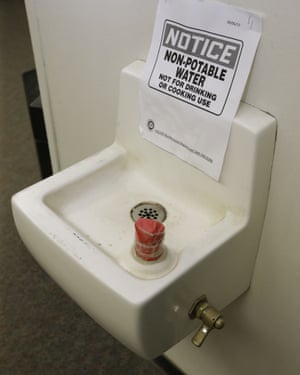
water photo


‘This is not just a Philly problem’: Tape covers the spout and a sign warns students not to use this water fountain at Foothill Intermediate School in Loma Rica, California. Photograph: Rich Pedroncelli/AP


School districts in Seattle, Washington and Camden, New Jersey also failed to notify the public of possible lead contamination, according to Edwards. In April,
Newark, New Jersey shut off drinking fountains when it found lead contamination as much as 20 times the legal limit. New Jersey politicians have considered a bill to force all of the state’s schools to test water, but so far have provided no funding to change plumbing if lead is found.

“This is not just a Philly problem; this is not just a Flint problem,” said Patterson. “This is an old city problem, old cities with lack of funding problem.”

In Philadelphia, EPA spokesperson David Sternberg said school district officials knew in the “early” 1990s that the water could be contaminated with lead. Edwards’ own investigation, published in 2009, put that year at 1993. But no one told Philadelphians until late 1999, when the EPA became aware of lead tests and demanded the data from the school district.

According to the same paper by Edwards, the Philadelphia school district refused to allow the EPA into buildings to take water samples, and told the federal agency they would need a “search warrant” for testing.

“A source [had] ‘unofficially’ provided lead-in-water test results to the EPA,” Edwards concluded.

“We immediately began attempts to get the data from the school district,” said Sternberg. “When EPA finally got the data in 1999 and saw high levels of lead in ten of the 23 locations sampled, we began discussions with the Philadelphia School District.”

The EPA attempted to force the district’s hand, asking it to test of all of its taps, but the district initially refused. That’s when the EPA threatened Philadelphia schools with an emergency order, called Section 1431 of the Safe Drinking Water Act. The agency only issues about six nationally each year for a wide range of water issues. The EPA eventually backed down in December 1999, when city officials pledged to oversee the schools.

What emerged from discussions would become one of the largest-scale water fountain testing and replacement regimes, perhaps ever.

The Philadelphia school district’s 10-year experiment to rid its drinking water of lead contamination included testing and replacing bubblers and fountains, and spray painting “do not drink” signs over bathroom faucets with high lead levels, which remain there today. The district permanently disconnected some fountains.

Bathroom and classroom faucets were not replaced, under the rationale that these were “hand-washing stations” whose water was not meant to be potable.

“This is the largest, and amongst the best, large-scale remediation programs in the country,” said Edwards, citing Seattle as the other top example.

The data collected by the project is also likely some of the most thorough. But despite orders that Philadelphia schools post results on the internet, it was never done.

“We have to get better at that,” said Francine Locke, the school’s environmental director who administered the program during its last few years. Now, the data is a bungled mess, Locke said, and the only accessible data from a roughly $5m project are final reports for schools, clearing each one of responsibility to further test or remediate anything.

Locke said the district intends to test some “representative” schools in the future, though there are no firm timelines or plans currently in place. The district may place the results of its ten-year testing program online, though there is not a timeline for that project, either.

drinking water in a laboratory


Drinking water samples are collected at a Fairfield, New Jersey laboratory. Photograph: Richard Drew/AP


But even now, after years of testing and remediation, Philadelphia’s students may not have safe water to drink.

A fourth-grade student at William Cramp elementary, the same school where a bathroom faucet had 16,000 parts per billion of lead, told Philly.com in January that there were no functioning fountains in the school – just faucets in the nurse’s office, administration office and gym.

“Some of the water fountains look like they’re kind of toilets. They’re porcelain and they’re filthy. Sometimes there’s trash in them; sometimes the water color and smell is not good,” said Roseman. “It’s so prevalent, and so long term and consistent that we don’t hear that much about it, but it is a real issue.”

Fuente: http://www.theguardian.com/environment/2016/apr/10/philadelphia-school-drinking-water-lead-contamination-testing-epa
 

Comparte este contenido:

México: Jóvenes mexicanos y japoneses diseñan estrategias contra delitos

Centro América/México/Abril 2016 /Fuente Entorno Inteligente /Autor: El Informador

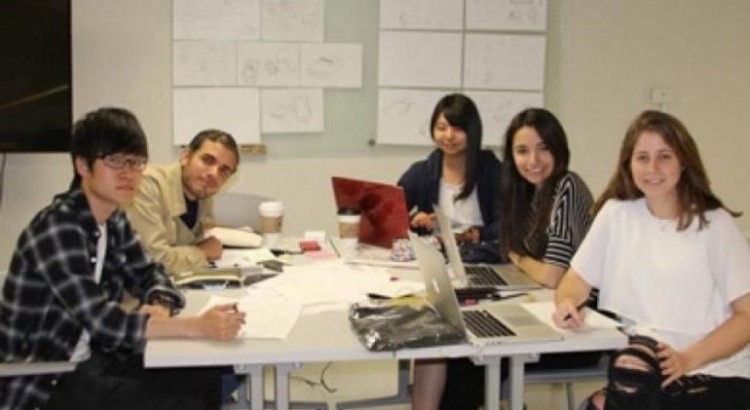
Alumnos del Tecnológico de Monterrey y de la Universidad Chiba de Japón participan en un proyecto especial para desarrollar productos destinados a la prevención de delitos. El Instituto Tecnológico y de Estudios Superiores de Monterrey ( ITESM ) señaló que el objetivo es generar propuestas de diseño que ayuden a disminuir la problemática de la inseguridad en México y en Japón.

El proyecto, que aún se encuentra en etapa conceptual, consiste en desarrollar productos relacionados con sistemas de seguridad para disminuir crímenes como extorsiones telefónicas, robo a autos o a casa-habitación.

La directora de la carrera de Licenciado en Diseño Industrial (LDI) del ITESM, Valeria Loera, indicó que «lo que se pretende con esta colaboración es llegar a un concepto sólido, evaluable por autoridades, diferentes personas y expertos, y obviamente intentar llevarlo lo más lejos que se pueda».

Desde inicio de marzo, apuntó, se comenzó con dicha colaboración, en la que también participan alumnos y profesores de la Universidad de Monterrey, y a través de la cual estudiantes de la Institución viajaron al país asiático para conocer su perspectiva de la tecnología.

En tanto, añadió, jóvenes japoneses trabajaron en el campus local del ITESM con el fin de estar más cerca de la problemática en este país. «Están en el proceso de diseño de tecnologías de reconocimiento de movimiento y aplicaciones móviles, entre otros productos, todo vinculado a un sistema de seguridad más amplio donde interviene la comunidad y las autoridades», explicó Valeria Loera.

Por su parte, la estudiante Lucía García comentó que para los alumnos, el encontrar una gran diferencia cultural entre los mexicanos y japoneses les ayudó a conceptualizar mejor sus propuestas.

«El input que le dimos a los japoneses fue sobre el contexto de la gente y la forma de vida, y lo que ellos nos dieron fue sobre tecnología y metodologías de diseño», expresó.

A su vez, Nana Kakuta, estudiante japonesa, comentó que fue una experiencia retadora comenzar desde cero en abordar los temas de la inseguridad, ya que así pueden tener una visión diferente del problema. El proyecto, llamado «Design against crime», es a cinco años y éste fue un primer acercamiento entre ambas instituciones de educación superior.

Fuente de noticia: http://www.entornointeligente.com/articulo/8206886/MEXICO-Joacute;venes-mexicanos-y-japoneses-disentilde;an-estrategias-contra-delitos-06042016

Fuente de la imagen:http://radio79mx.com/wp-content/uploads/2016/04/800×532-DE_IN103099_1-770x439_c.jpg


Comparte este contenido:

Pide Secretaría de Educación de Michoacán a CNTE, no Realizar más paros de Labores

México/ 08 abril 2016/ Autor: Erick Juárez Pineda. Educación Futura. Fuente: http://insurgenciamagisterial.com/

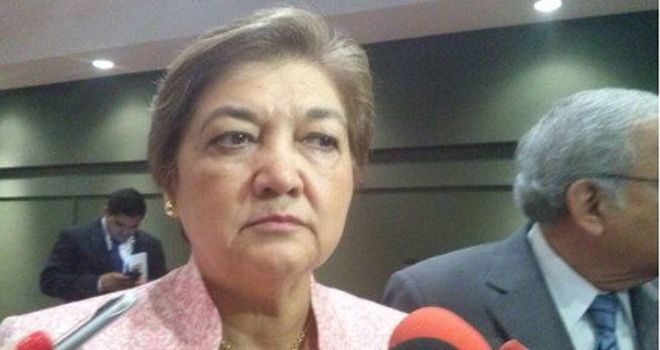
Silvia Figueroa Zamudio, titular de la Secretaría de Educación de Michoacán, exhortó a la Coordinadora Nacional de Trabajadores de la Educación (CNTE) a no realizar manifestaciones y paros de labores en la entidad, pues “el tiempo perdido no se recupera”.
En el marco del llamado de la CNTE para realizar marchas, bloqueos y paros de labores en todo el país, la funcionaria local dijo que estas medidas representan un atentado para la educación y el futuro en el estado, lo cual reprochó e invitó a que no se prolongue.
El llamado de la Secretaría será siempre el llamado a no suspender clases, cualquier tiempo perdido es tiempo perdido, eso no se recupera, es mentira que después reponemos las fechas, esas fechas jamás se recuperan y los paros siempre van en afectación para las niñas, los jóvenes y señoritas del estado de Michoacán.
Respecto al porcentaje de cumplimiento del calendario escolar, Figueroa destacó que se ha cumplido cabalmente, “pues se ha tenido cuidado de abrir fechas nuevas ante las suspensiones”, pero descartó dar un porcentaje estimado de su cumplimiento.
“Por ello, reitero el llamado a la cordura y la conciencia de la CNTE para evitar que se pierdan más clases a consecuencia de las movilizaciones y paros laborales constantes que este grupo efectúa en rechazo a la evaluación docente”.

Fuente original de la noticia: 

Pide Secretaría de Educación de Michoacán a CNTE, no realizar más paros de labores

Fotografía: quadratin

Fuente de la Noticia:

Pide Secretaría de Educación de Michoacán a CNTE, no realizar más paros de labores

Comparte este contenido:

Radical Politics in the Age of American Authoritarianism: Connecting the Dots

The United States stands at the endpoint of a long series of attacks on democracy, and the choices faced by many in the US today point to the divide between those who are and those who are not willing to commit to democracy. Debates over whether Donald Trump is a fascist are a tactical diversion because the real issue is what it will take to prevent the United States from sliding further into a distinctive form of authoritarianism.

The willingness of contemporary politicians and pundits to use totalitarian themes echoes alarmingly fascist and totalitarian elements of the past. This willingness also prefigures the emergence of a distinctive mode of authoritarianism that threatens to further foreclose venues for social justice and civil rights. The need for resistance has become urgent. The struggle is not over specific institutions such as higher education or so-called democratic procedures such as elections but over what it means to get to the root of the problems facing the United States and to draw more people into subversive actions modeled after both historical struggles from the days of the underground railroad and contemporary movements for economic, social and environmental justice.

If progressives are to join in the fight against authoritarianism in the US, we all need to connect issues.

Yet, such struggles will only succeed if more progressives embrace an expansive understanding of politics, not fixating singularly on elections or any other issue but rather emphasizing the connections among diverse social movements. An expansive understanding such as this necessarily links the calls for a living wage and environment justice to calls for access to quality health care and the elimination of the conditions fostering assaults by the state against Black people, immigrants, workers and women. The movement against mass incarceration and capital punishment cannot be separated from a movement for racial justice; full employment; free, quality health care and housing. Such analyses also suggest the merging of labor unions and social movements, and the development of progressive cultural apparatuses such as alternative media, think tanks and social services for those marginalized by race, class and ethnicity. These alternative apparatuses must also embrace those who are angry with existing political parties and casino capitalism but who lack a critical frame of reference for understanding the conditions for their anger.

To read more articles by Henry A. Giroux and other authors in the Public Intellectual Project, click here.

What is imperative in rethinking the space of the political is the need to reach across specific identities and stop mobilizing exclusively around single-issue movements and their specific agendas. As the Fifteenth Street Manifesto Group expressed in its 2008 piece, «Left Turn: An Open Letter to US Radicals,» many groups on the left would grow stronger if they were to «perceive and refocus their struggles as part of a larger movement for social transformation.» Our political agenda must merge the pedagogical and the political by employing a language and mode of analysis that resonates with people’s needs while making social change a crucial element of the political and public imagination. At the same time, any politics that is going to take real change seriously must be highly critical of any reformist politics that does not include both a change of consciousness and structural change.

If progressives are to join in the fight against authoritarianism in the United States, we all need to connect issues, bring together diverse social movements and produce long-term organizations that can provide a view of the future that does not simply mimic the present. This requires connecting private issues to broader structural and systemic problems both at home and abroad. This is where matters of translation become crucial in developing broader ideological struggles and in fashioning a more comprehensive notion of politics.

There has never been a more pressing time to rethink the meaning of politics, justice, struggle and collective action.

Struggles that take place in particular contexts must also be connected to similar efforts at home and abroad. For instance, the ongoing privatization of public goods such as schools can be analyzed within the context of increasing attempts on the part of billionaires to eliminate the social state and gain control over commanding economic and cultural institutions in the United States. At the same time, the modeling of schools after prisons can be connected to the ongoing criminalization of a wide range of everyday behaviors and the rise of the punishing state. Moreover, such issues in the United States can be connected to other authoritarian societies that are following a comparable script of widespread repression. For instance, it is crucial to think about what racialized police violence in the United States has in common with violence waged by authoritarian states such as Egypt against Muslim protesters. This allows us to understand various social problems globally so as to make it easier to develop political formations that connect such diverse social justice struggles across national borders. It also helps us to understand, name and make visible the diverse authoritarian policies and practices that point to the parameters of a totalitarian society.

There has never been a more pressing time to rethink the meaning of politics, justice, struggle, collective action, and the development of new political parties and social movements. The ongoing violence against Black youth, the impending ecological crisis, the use of prisons to warehouse people who represent social problems, and the ongoing war on women’s reproductive rights, among other crises, demand a new language for developing modes of creative long-term resistance, a wider understanding of politics, and a new urgency to create modes of collective struggles rooted in more enduring and unified political formations. The American public needs a new discourse to resuscitate historical memories and methods of resistance to address the connections between the escalating destabilization of the earth’s biosphere, impoverishment, inequality, police violence, mass incarceration, corporate crime and the poisoning of low-income communities.

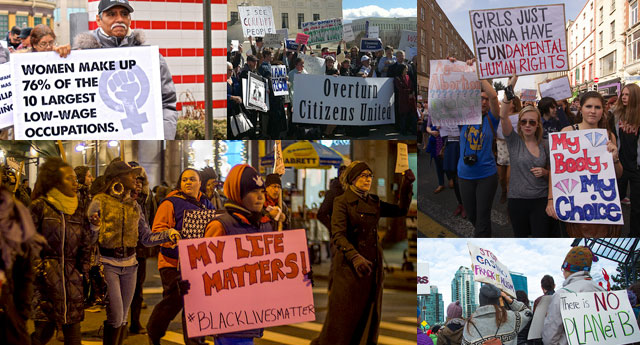
Not only are social movements from below needed, but also there is a need to merge diverse single-issue movements that range from calls for racial justice to calls for economic fairness. Of course, there are significant examples of this in the Black Lives Matter movement (as discussed by Alicia Garza, Keeanga-Yamahtta Taylor andElizabeth Day) and the ongoing strikes by workers for a living wage. But these are only the beginning of what is needed to contest the ideology and supporting apparatuses of neoliberal capitalism.

The call for broader social movements and a more comprehensive understanding of politics is necessary in order to connect the dots between, for instance, police brutality and mass incarceration, on the one hand, and the diverse crises producing massive poverty, the destruction of the welfare state and the assaults on the environment, workers, young people and women. As Peter Bohmer observes, the call for a meaningful living wage and full employment cannot be separated from demands «for access to quality education, affordable and quality housing and medical care, for quality child care, for reproductive rights and for clean air, drinkable water,» and an end to the pillaging of the environment by the ultra-rich and mega corporations. He rightly argues:

Connecting issues and social movements and organizations to each other has the potential to build a powerful movement of movements that is stronger than any of its individual parts. This means educating ourselves and in our groups about these issues and their causes and their interconnection.

In this instance, making the political more pedagogical becomes central to any viable notion of politics. That is, if the ideals and practices of democratic governance are not to be lost, we all need to continue producing the critical formative cultures capable of building new social, collective and political institutions that can both fight against the impending authoritarianism in the United States and imagine a society in which democracy is viewed no longer as a remnant of the past but rather as an ideal that is worthy of continuous struggle. It is also crucial for such struggles to cross national boundaries in order to develop global alliances.

Democracy must be written back into the script of everyday life.

At the root of this notion of developing a comprehensive view of politics is the need for educating ourselves by developing a critical formative culture along with corresponding institutions that promote a form of permanent criticism against all elements of oppression and unaccountable power. One important task of emancipation is to fight the dominant culture industry by developing alternative public spheres and educational institutions capable of nourishing critical thought and action. The time has come for educators, artists, workers, young people and others to push forward a new form of politics in which public values, trust and compassion trump neoliberalism’s celebration of self-interest, the ruthless accumulation of capital, the survival-of-the-fittest ethos and the financialization and market-driven corruption of the political system. Political responsibility is more than a challenge — it is the projection of a possibility in which new modes of identification and agents must be enabled that can sustain new political organizations and transnational anti-capitalist movements. Democracy must be written back into the script of everyday life, and doing so demands overcoming the current crisis of memory, agency and politics by collectively struggling for a new form of politics in which matters of justice, equity and inclusion define what is possible.

Such struggles demand an increasingly broad-based commitment to a new kind of activism. As Robin D. G. Kelley has recently noted, there is a need for more pedagogical, cultural and social spaces that allow us to think and act together, to take risks and to get to the roots of the conditions that are submerging the United States into a new form of authoritarianism wrapped in the flag, the dollar sign and the cross. Kelley is right in calling for a politics that places justice at its core, one that takes seriously what it means to be an individual and social agent while engaging in collective struggles. We don’t need tepid calls for repairing the system; instead, we need to invent a new system from the ashes of one that is terminally broken. We don’t need calls for moral uplift or personal responsibility. We need calls for economic, political, gender and racial justice. Such a politics must be rooted in particular demands, be open to direct action and take seriously strategies designed to both educate a wider public and mobilize them to seize power.

The left needs a new political conversation that encompasses memories of freedom and resistance. Such a dialogue would build on the militancy of the labor strikes of the 1930s, the civil rights movements of the 1950s and the struggle for participatory democracy by the New Left in the 1960s. At the same time, there is a need to reclaim the radical imagination and to infuse it with a spirited battle for an independent politics that regards a radical democracy as part of a never-ending struggle.

None of this can happen unless progressives understand education as a political and moral practice crucial to creating new forms of agency, mobilizing a desire for change and providing a language that underwrites the capacity to think, speak and act so as to challenge the sexist, racist, economic and political grammars of suffering produced by the new authoritarianism.

The left needs a language of critique that enables people to ask questions that appear unspeakable within the existing vocabularies of oppression. We also need a language of hope that is firmly aware of the ideological and structural obstacles that are undermining democracy. We need a language that reframes our activist politics as a creative act that responds to the promises and possibilities of a radical democracy.

Movements require time to mature and come into fruition. They necessitate educated agents able to connect structural conditions of oppression to the oppressive cultural apparatuses that legitimate, persuade, and shape individual and collective attitudes in the service of oppressive ideas and values. Under such conditions, radical ideas can be connected to action once diverse groups recognize the need to take control of the political, economic and cultural conditions that shape their worldviews, exploit their labor, control their communities, appropriate their resources, and undermine their dignity and lives. Raising consciousness alone will not change authoritarian societies, but it does provide the foundation for making oppression visible and for developing from below what Étienne Balibar calls «practices of resistance and solidarity.» We need not only a radical critique of capitalism, racism and other forms of oppression, but also a critical formative culture and cultural politics that inspire, energize and provide elements of a transformative radical education in the service of a broad-based democratic liberation movement.


May not be reprinted without permission of the author

Comparte este contenido:

México. Diputados podrían acudir a la SCJN por Reforma Educativa

México/08 abril 2016/Autor: Roberto José Pacheco. Excelsior/ Fuente: http://insurgenciamagisterial.com/

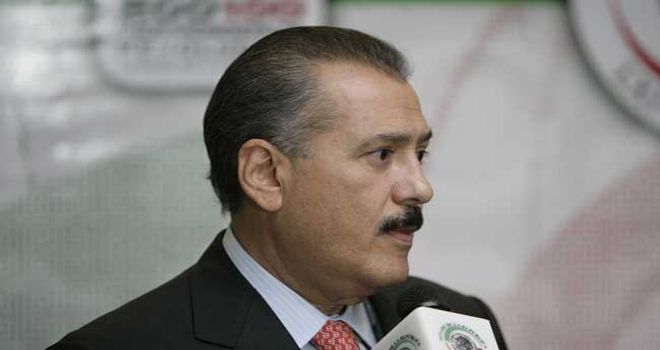
Manlio Fabio Beltrones afirmó que las propuestas o iniciativas de los congresos locales en torno a la reforma constitucional en materia de educación que no se ajusten al espíritu en esta materia, podrían ser confrontadas en la Corte.

Las propuestas o iniciativas de los congresos locales en torno a la reforma constitucional en materia de educación que no se ajusten al espíritu en esta materia, podrían ser confrontadas por la vía de la controversia constitucional en la Suprema Corte de Justicia, advirtió el coordinador del grupo parlamentario del PRI en la Cámara de Diputados, Manlio Fabio Beltrones Rivera.

“Obviamente si una ley local transgrede el espíritu de la reforma constitucional en materia de educación, la Cámara de Diputados procederá a una controversia constitucional en la Corte, porque esos son los mecanismos legales que nos hemos dado en la sociedad civilizada para dialogar y encontrar acuerdos”, sostuvo Beltrones Rivera.

En conferencia de prensa, el político sonorense puntualizó que existe la disposición de la cámara baja de recibir y estudiar las diversas iniciativas y propuestas de los congresos locales, con el objetivo de enriquecer la reforma constitucional en materia educativa.

“Que nadie se asuste porque un congreso local ejerza su derecho de iniciativa o que nadie se escandalice porque existan grupos de la sociedad que se muestren inconformes y que a través de la ley o de una reforma legal o una iniciativa específica, intente corregir a lo que sus intereses convenga”, señaló.

De esta manera se pronunció el coordinador parlamentario del tricolor en torno a las anunciadas manifestaciones de algunos grupos de maestros provenientes de Oaxaca, Guerrero y Chiapas, en rechazo a la reforma educativa recién promulgada.

Abundó el político sonorense que las inquietudes hasta ahora planteadas, pueden ser legítimas, aunque en algunas entidades no se hayan procesado adecuadamente.

En contraparte, comprometió que aquellos congresos locales que en ejercicio de su facultad de iniciativa decidan realizar aportaciones para la construcción de la legislación secundaria, serán bienvenidas y tomadas en consideración para el enriquecimiento del quehacer legislativo.

“Nosotros estaremos prestos, más que prestos, a recibir esas iniciativas si provienen de algún congreso local, a estudiarlas a profundidad, a salvaguardar el espíritu que contiene la reforma al tercero constitucional y con eso tener la mejor de las leyes secundarias en materia de educación, que saque al país adelante, con calidad”, finalizó.

Fuente original: http://www.excelsior.com.mx/nacional/2013/04/04/892235

Fotografía: ntrzacatecas

Fuente citada:

Diputados podrían acudir a la SCJN por reforma educativa

Comparte este contenido:

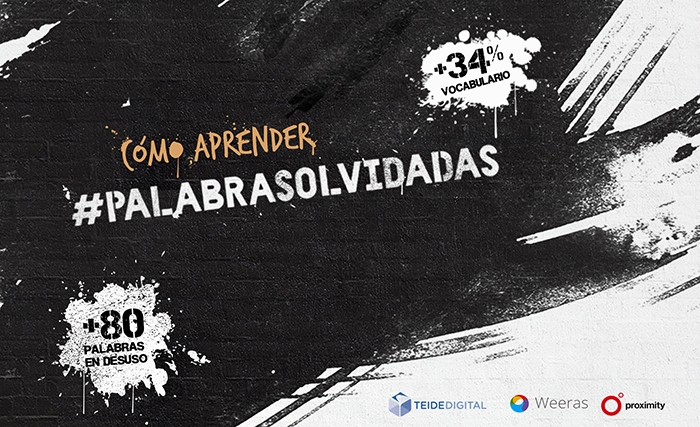
Las «Palabras Olvidadas» de Proximity se cuelan en la educación

La agencia de publicidad Proximity, en colaboración con el humorista y youtuber El Mora, desarrolla un rap educativo que incluye 44 palabras en desuso y contribuye a incrementar el vocabulario de los jóvenes hasta un 18%.

Jueves, 07 de abril 2016/Fuente: http://interactivadigital.com/

Hace unos meses, la agencia Proximity nos advertía del empobrecimiento de la lengua. Al parecer, un adulto utiliza solo 2.000 de las 94.000 palabras del diccionario español. Sin embargo, hay un sector de la población que sufre un empobrecimiento todavía más severo: según los expertos, los jóvenes solo utilizan 240 de las 94.000 palabras.

Para hacer frente al primer dato, Proximity lanzó La Tienda de #PalabrasOlvidadas, una tienda online en la que se podían comprar palabras en desuso a cambio de un simple compartir en las redes sociales. La excelente acogida recibida por esta iniciativa -los autores comentan que el uso de palabras olvidadas en RRSS se ha incrementado en un 44%- llevó a esta agencia de comunicación a buscar la forma de consolidar este enriquecimiento de la lengua. Y qué mejor manera que introducirlo en el sistema educativo.

El rap permite vincular contenidos educativos a la vida real de los adolescentes

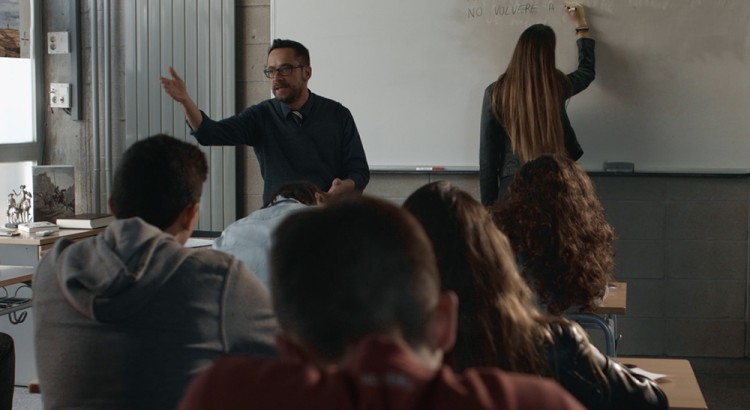
Tal y como resaltan varios estudios, la forma de expresión rítmica del rap facilita la retención, de la misma forma que lo hacían las mnemotécnicas utilizadas antaño, por ejemplo, para memorizar las preposiciones. Asimismo, el rap permite vincular los contenidos lectivos a la vida actual con temas que los estudiantes conocen.

Esta es la razón de que este rap titulado “Cómo rapear con #PalabrasOlvidadas” hable de móviles (Mamotreto: el móvil chungo que heredaste de tu padre / Manjar: un huevo frito que al mojarlo es un desmadre), de Facebook (Triquiñuela: de camino a casa dos chicles de menta / Turulato: cuando en Facebook a tu propia madre aceptas) y de selfies (Ubérrimo: los selfies, que los haces a montones).

Otra de las virtudes del rap es que invita a la reflexión y despierta el sentido crítico. Y en eso no se queda corto este rap, que habla abiertamente de la corrupción (Quedo: como quedo por mucho que nos hurten / Retahíla: un ejemplo… Taula, Púnica y la Gurtel), de la emancipación antes de los 30(Entelequia: irse de casa antes de cumplir los treinta / Fetén: que de milagro te devuelvan en la renta) y de algunos valores educativos imprescindibles en esta franja de edad, como elrechazo a las drogas (Si te ofrecen farla, coca, pollo… diles que Nanay) o los métodos anticonceptivos (Vástago: si quieres evitarlo usa condones).

El proyecto «Palabras Olvidadas» ya está en el sistema educativo.

Una iniciativa que pretende abrir de nuevo un debate ya recurrente: la necesidad de renovar los métodos de enseñanza y adaptarlos a la edad de los estudiantes a los que van dirigidos. Por ello, se han escogido “métodos alternativos de enseñanza”, como el rap cantado por el humorista y youtuberAlfonso Martínez alias “El Mora”, y con una serie de actividades prácticas  asociadas al rap en forma de ebook de la mano de la editorial Teide, una de las pioneras en contenidos digitales y en buscar nuevas forma de enseñanza más didácticas. Y es que, aprovechando las virtudes de este estilo musical para la enseñanza, consiguen introducir un total de 44 palabras en desuso en la letra de la canción. Garantizando así que todos aquellos alumnos que se aprendan la letra incrementen su vocabulario en un 18% y que aquellos que también realicen las actividades, lo incrementen hasta en un 34%.

 Para ver el vídeo haga click en el enlace:

Fuente de la noticia y de la foto:

http://interactivadigital.com/proximity-introduce-su-proyecto-de-palabras-olvidadas-en-la-educacion/

Comparte este contenido:
Page 1644 of 1686
1 1.642 1.643 1.644 1.645 1.646 1.686
OtrasVocesenEducacion.org