Page 684 of 1685
1 682 683 684 685 686 1.685

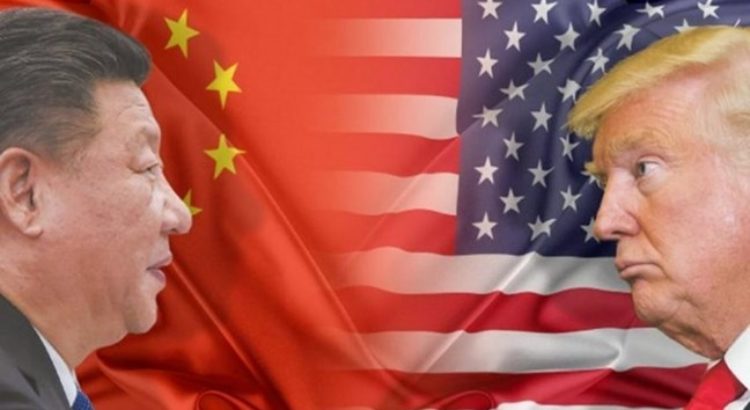
La guerra comercial entre EEUU y China expresa los problemas del capitalismo mundial

Por: Julio C. Gambina 

El viernes 6/7/2018 EEUU impuso aranceles a las importaciones provenientes de China por 34.000 millones de dólares. La inmediata respuesta china fue de réplica y por el mismo importe.

La escalada proteccionista amenaza a multiplicar ese monto por varias veces, trascendiendo la relación bilateral y afectando al propio capitalismo como sistema mundial.

Es EEUU contra China, pero también EEUU contra Europa, o Canadá y México, o sea, contra todos los países del sistema mundial en aras de recomponer a favor de Washington las relaciones económicas bi o multilaterales.

Desde las relaciones internacionales se teme porque nadie tiene el poder de confrontación de EEUU, o de éste y de China.

EEUU tiene el poder del dólar, con capacidad de emitir a voluntad, aun siendo ello relativo, del mismo modo que suma poder bélico y cultural e intenta la supremacía tecnológica en tiempos contemporáneos.

China se sostiene en un gigantesco superávit comercial y financiero, especialmente en bonos del Tesoro de EEUU, junto a su ampliada capacidad de gasto bélico y de desarrollo tecnológico de última generación.

La batalla por el dominio tecnológico está en el centro de la discusión comercial, monetaria y productiva, a lo que debe sumarse la capacidad de disuasión bélica y la influencia mediático cultural.

Esta situación de confrontación descoloca la lógica aperturista y liberalizadora inspirada desde el mentiroso ideario neoliberal, que supone la no intervención estatal, desmentida desde una gigantesca participación de cada Estado Nación en el sustento de los intereses de los capitales de origen en sus territorios.

La realidad es que esos intereses privados se negocian en los organismos internacionales, gestionados por funcionarios de los Estados Nacionales en favor de los capitales privados. El Estado es el mecanismo de lobby del capital privado. En el ámbito nacional el Estado regula los intereses del capital contra el conjunto social y en el ámbito mundial cada Estado defiende a los capitales nacionales en función de su capacidad negociadora en el sistema mundial.

Sin el Estado Nación, los capitales privados no pueden imponer sus necesidades como reglas del sistema mundial.

Trump y su proteccionismo descoloca a los organismos internacionales y a sus mentores ideológicos, contraponiendo sus propuestas contra el sentido común neoliberal construido por cuatro décadas luego de la crisis de los setenta.

Quedan descolocados organismos, funcionarios e intelectuales de la lógica “globalizadora”, sea el FMI, la OMC, o aquellos que remiten a la corriente principal del pensamiento económico “liberal” (o neo-liberal), los que influyen en la Academia, los Medios de Comunicación y muy especialmente en los gobiernos de derecha, en expansión en varios territorios del planeta.

Existe entonces incertidumbre tras décadas de un discurso “aperturista y liberalizador”, que con el cuantioso déficit comercial estadounidense, principalmente con China, desnudó sus límites.

¿No era que la apertura resulta beneficiosa para todos los países?

El triunfo de Trump se explica por los votos del descontento con la globalización, por el efecto del cierre de empresas y su impacto en el empleo y la crisis urbana de territorios antiguamente progresistas, sea Detroit como capital del automóvil, u otras ciudades fantasmas y/o desaparecidas, o disminuidas rutas que explicaron el progreso de antaño, caso de la Ruta 66 en EEUU.

Por eso, Trump hizo campaña y asumió bajo la presidencia de EEUU sustentando la consigna “America First”, lo que suponía una crítica a la liberalización operada e impulsada por casi cuatro décadas desde EEUU, entre Reagan (1981-1989) y Obama (2009-2017). En la lectura de Trump y sus votantes, EEUU perdió con la globalización, en la desindustrialización y pérdidas de empleo.

Pero atención que en ese mismo tiempo histórico operó la modernización de China, iniciada en 1978 por Deng Xia Ping, para transformar al país ya hace unos años en la “fábrica” del mundo, adueñándose del primer lugar en la producción y exportación de bienes materiales del sistema mundial. Aquí la lectura es de ganancia con la globalización.

Es curioso observar como los promotores de la globalización hacen un balance negativo sobre las consecuencias en su territorio, y a la inversa, la emergencia china se presenta como sostén de la continuidad de la globalización.

La liberalización de la economía mundial bajo discurso hegemónico “neoliberal”, ensayado bajo dictaduras genocidas en el sur de América desde 1973, facilitó la libre circulación de capitales que transitoriamente resolvió el problema de rentabilidad del capital estadounidense, europeo y japonés ante las fuertes caídas de fines de los sesenta y comienzos de los setenta, recolocando sus inversiones en otros territorios “emergentes”, especialmente China.

Un nuevo orden emergió ante los problemas del capitalismo mundial en los 60/70, que era aún un mundo bipolar que proyectaba en el imaginario social global la posibilidad de ir más allá del capitalismo y por ende se imponía cultural e ideológicamente demostrar las ventajas del libre cambio en el nuevo tiempo de transnacionalización de la economía mundial, contra cualquier propuesta de orden anticapitalista.

Esos flujos de inversión se orientaron principalmente hacia Asia y el Medio Oriente, petróleo mediante para este caso.

China fue el gran receptor de inversiones externas, bajo la soberanía del Estado gobernado por el Partido Comunista, lo que suponía la gestión soberana del orden económico bajo la dirección del Estado Nación. Entre otras cuestiones, los gobernantes de China no enajenaron la propiedad del suelo y establecieron normas restrictivas a la lógica universal del capital.

El flujo de capitales hacia China se constituyó en un gigantesco stock para la acumulación y reproducción ampliada del capital, no solo en China, sino en el ámbito mundial. El capital del Estado chino se agigantó en ese periodo y con esa lógica.

Pero en ese proceso, China creció en la producción material y por ende en la oferta comercial global, con capital estatal y privado, muy especialmente en contra del papel de EEUU, al tiempo que se constituía en el principal financista con su excedente económico, del déficit fiscal y comercial de EEUU. China es el mayor tenedor de bonos del tesoro de EEUU.

Con esa acumulación material, China se presenta últimamente en la disputa monetaria. Su moneda actúa contra la antigua hegemonía del dólar lograda desde Bretton Woods en 1944. Son cuantiosos los convenios comerciales bilaterales acordados en los últimos años con moneda China, el yuan.

Orden y desorden en el capitalismo

El interrogante es si EEUU bajo gobierno Trump o sucesivos con la misma orientación, si la política interna estadounidense así lo indicara (crecimiento económico mediante o baja del desempleo), podrá revertir la situación estructural gestada por décadas de liberalización, a contramano del origen “proteccionista” que llevó a las colonias independizadas en 1776 a crecer y transformarse hacia 1945 en la potencia hegemónica del orden imperialista.

Vale la mención histórica ya que Inglaterra se había constituido en potencia hegemónica baja la consigna liberal del libre comercio, la libre competencia y el libre cambio. Es una concepción ideológica sustentada en pensamiento clásico de la nueva ciencia emergente: la Economía Política, con Adam Smith y su “Acerca de la Riqueza de las Naciones” hacia 1776, o David Ricardo y su magna obra de 1817 “Principio de Economía Política y Tributación”.

La traducción de ese ideario en el nuevo país fue a contramano del libre comercio y se sustentó en un renovado proteccionismo para la industrialización y las finanzas desde un nacionalismo propio (algo similar ocurrió en Alemania). El ideólogo de ese accionar fue Alexander Hamilton, uno de los padres fundadores y el primer Secretario del Tesoro del gobierno de George Washington.

El proteccionismo originario de Hamilton es el antecedente histórico de una política económica que colocó a EEUU en la línea de sucesión de la hegemonía imperialista, único caso de esa evolución desde su inicio colonial. EEUU como Gran Bretaña, luego de su consolidación como potencia industrial y financiera promovió junto al proteccionismo para su territorio y capitales, la más amplia apertura del resto del mundo.

Así se construyó el mundo capitalista desde 1945, inundando de dólares el sistema mundial para declarar la inconvertibilidad del dólar en 1971 rompiendo todos los acuerdos sustentados al fin de la segunda guerra mundial. El mundo capitalista se desbarató entonces, pero EEUU consolidó su poder económico, militar y cultural.

¿Podrá consolidarse ahora desbaratando las relaciones internacionales construidas por décadas?

La impunidad de la política exterior del imperialismo estadounidense es una constante desde su histórica hegemonía, incluso desde antes (expansión territorial histórica contra México, por ejemplo).

Con la caída de la URSS se validó el imaginario para la libre circulación del capital bajo hegemonía estadounidense, lo que encontró límites en varios procesos en curso, donde China es uno de los más destacados, no el único.

Entre otros puede registrarse la re-emergencia de Rusia en el sistema mundial, especialmente por razones militares y diplomáticas.

Puede también considerarse en otro plano el proceso de cambio político en Nuestra América a comienzos del Siglo XXI, lo que provocó la contraofensiva de las clases dominantes en curso, vía golpes blandos y fuerte batalla ideológica cultural para recomponer la agenda de la restauración liberalizadora.

Más allá del capitalismo

Se escuchan voces críticas a la guerra comercial desatada por EEUU, que pareciera defienden el orden capitalista vigente desde los setenta y ochenta bajo el discurso neoliberal.

Como si el accionar actual del EEUU gobernado por Trump fuera contrario a un bienestar deseado gobernado por la experiencia previa.

No se comprende que el accionar previo, de Reagan a Obama era la forma asumida de la supremacía estadounidense (neoliberal) y que ahora con Trump se asume una nueva etapa (¿proteccionista?) para renovar y recrear la dominación estadounidense.

El efecto social negativo en materia de mayor explotación y depredación de bienes comunes operó con la propuesta de liberalización de la economía en tiempos aperturistas y tratados de libre comercio y bilaterales en defensa de las inversiones, como ahora con el proteccionismo de Trump.

Por eso Nuestra América debe recomponer una estrategia de integración regional alternativa a las demandas e intereses de las transnacionales y las principales potencias de la dominación contemporánea.

Ni aquel orden liberal fue favorable a los explotados y empobrecido, ni esta búsqueda proteccionista lo será para la amplia mayoría de la sociedad.

La guerra comercial y monetaria es por la dominación y la aspiración debiera ser por constituir la lucha por la emancipación social.

Por eso, la discusión debe ir más allá y pensar en la crítica del orden contemporáneo, incluido el desorden generado desde la guerra comercial o monetaria, parte de procesos de confrontación ideológica o bélica que el panorama mundial devuelve.

Ni el pensamiento hegemónico ni el poder real imaginan ese horizonte más allá del capitalismo, que solo puede estar en la capacidad social de criticar nuestro tiempo para transformar la realidad en favor de las necesidades sociales insatisfechas. Todo un desafío social e intelectual.


Julio C. Gambina, Presidente de la Fundación de Investigaciones Sociales y Políticas, FISYP

visitá mi blog www.juliogambina.blogspot.com
Comparte este contenido:

The Slow and Fast Assault on Public Education

By: HENRY A. GIROUX

Since Donald Trump’s election in November 2016, there have been few occasions to feel hopeful about politics. But now we are witnessing a proliferation of causes for hope, as brave students from Parkland, Florida, and equally courageous teachers throughout the United States lead movements of mass demonstrations, walkouts, and strikes.

The United States is in the midst of a crisis of values, ethics, and politics. It has been decades in the making, produced largely by a neoliberal system that has subordinated all aspects of social life to the dictates of the market while stripping assets from public goods and producing untenable levels of inequality. What we are now living through is the emergence of a new political formation in which neoliberalism has put on the mantle of fascism.

The assault on public education, the slow violence of teacher disenfranchisement, and the fast violence of guns can only be understood as part of a larger war on liberal democracy.

Amidst this cataclysm, public schools have been identified as a major threat to the conservative ruling elite because public education has long been integral to U.S. democracy’s dependence on an informed, engaged citizenry. Democracy is predicated on faith in the capacity of all humans for intelligent judgment, deliberation, and action, but this innate capacity must be nurtured. The recognition of this need explains why the United States has, since its earliest days, emphasized the value of public education at least as an ideal. An education that teaches one to think critically and mediate charged appeals to one’s emotions is key to making power accountable and embracing a mature sense of the social contract.

Now, as our public schools are stretched to their breaking, their students and teachers are leading the call for a moral awakening. Both argue that the crisis of public schooling and the war on youth are related, and that the assaults on public schooling can only be understood as part of a larger war on liberal democracy.

No one movement or group can defeat the powerful and connected forces of neoliberal fascism, but energized young people and teachers are helping to open a space in which change looks more possible than at any time in the recent past. The Parkland students have embraced a grassroots approach and teachers are following their lead. Both are primed for action and are ready to challenge those eager to dismantle the public education system. They recognize that education is a winning issue because most Americans still view it as a path through which their children can gain access to decent jobs and a good life. The usual neoliberal bromides advocating privatization, charter schools, vouchers, and teaching for the test have lost all legitimacy at a moment when the ruling elite act with blatant disregard for the democratizing ethos that has long been a keystone of our society.

All of the states in which teachers have engaged in wildcat strikes, demonstrations, and protests have been subject to the toxic austerity measures that have come to characterize the neoliberal economy. In these states, teachers have faced low and stagnant wages, crumbling and overfilled classrooms, lengthening work days, and slashed budgets that have left them without classroom essentials such as books and even toilet paper—necessities that, in many cases, teachers have purchased themselves with their paltry salaries. It is significant that teachers have refused to confine their protests to the immediate needs of their profession or the understandable demand for higher wages. Rather, they have couched these demands within a broader critique of the war on public goods, calling repeatedly for more funding for schools in order to provide students with decent conditions for learning.

Likewise, students protesting gun violence have contextualized their demands for gun control by addressing the roots of gun violence in state violence and political and economic disenfranchisement. Refusing to be silenced by politicians bought and sold by the NRA, these students have called for a vision of social justice rooted in the belief that they can not only challenge systemic oppression, but can change the fundamental nature of an oppressive social order. They recognize that they have not only been treated as disposable populations written out of the script of democracy, they also are capable of using the new tools of social media to surmount the deadening political horizons preached by conventional media outlets and established politicians.

The attack on public education is one side of the neoliberal ledger. The other side is the explosion of the punishing state with its accelerated apparatuses of incarceration and militarization.

What is so promising about the student-led movement is that not only is it exposing the politicians and gun lobbies that argue against gun control and reframe the gun debate while endangering the lives of young people, they have also energized millions of youth by encouraging a sense of individual and collective agency. They are asking their peers to mobilize against gun violence, vote in the midterm November elections, and be prepared for a long struggle against the underlying ideologies, structures, and institutions that promote death-dealing violence in the United States. As Charlotte Alter pointed out in TIME:

They envision a youth political movement that will address many of the other issues affecting the youngest Americans. [Parkland student leader David] Hogg says he would like to have a youth demonstration every year on March 24, harnessing the power of teenage anger to demand action on everything from campaign-finance reform to net neutrality to climate change.

This statement makes clear that these young people recognize that the threat they face goes far beyond the gun debate and that what they need to address is a wider culture of cruelty, silence, and indifference. Violence comes in many forms, some hidden, many more spectacularized, cultivated, valued, eroticized, and normalized. Some are fast, and others are slow, and thus harder to perceive. The key is to address the underlying structures and relations of power that give rise to this landscape of both spectacular gun violence and the everyday violence experienced by the poor, people of color, the undocumented, and other “disposable” people. The attack on public education and the rights and working conditions of teachers is one side of the neoliberal ledger. The other side is the explosion of the punishing state with its accelerated apparatuses of containment, militarized police, borders, walls, mass incarceration, the school-to-prison pipeline, and the creation of an armed society. These issues need to be connected as part of a wider refusal to equate rapacious, neoliberal capitalism with democracy.

The Parkland student movement and the teacher walkouts have already advanced the possibilities of mass resistance by connecting the dots between the crises that each group is experiencing. The “slow violence” (to borrow Rob Nixon’s term) of teacher disenfranchisement needs to be understood in relation to the fast violence that has afflicted students, both of which arise from a state that has imported the language of perpetual war into its relationship with its citizens. As Judith Levine points out, every public sphere has been transformed into a virtual war zone, “a zone of permanent vigilance, enforcement, and violence.”

In the face of this, the need is for disruptive social movements that call for nothing less than the restructuring of U.S. society. In the spirit of Martin Luther King, Jr., this means a revolution in values, a shift in public consciousness, and a change in power relations and public policies. The Parkland students and the teachers protesting across the nation are not only challenging the current attacks on public education, they also share an effort in constructing a new narrative about the United States—one that reengages the public’s ethical imagination toward developing an equitable, just, and inclusive democracy. Their protests point to the possibility of a new public imagination that moves beyond the narrow realm of specific interest to a more comprehensive understanding of politics that is rooted in a practice of open defiance to corporate tyranny. This is a politics that refuses “leftist” centrism, the extremism of the right, and a deeply unequal society modeled on the iniquitous precarity and toxic structures of savage capitalism. This new political horizon foreshadows the need to organize new political formations, massive social movements, and a third political party that can make itself present in a variety of institutional, educational, social, and cultural spheres.

The teacher and student protests have made clear that real change can be made through mass collective movements inspired by hope in the service of a radical democracy.

What the teacher and student protests have made clear is that change and coalition-building are possible, and that real change can be made through mass collective movements inspired by hope in the service of a radical democracy. This is a movement that must make education central to its politics and be willing to develop educational spheres which listen to and speak to the concrete problems that educators, students, minorities of color and class, and others face in a world moving into the abyss of tyranny.

The long-term success of the movements begun by the teachers and students will likely hinge on whether they connect with wider struggles for minority rights, economic justice, and social equality. If they open to a vision of shared struggle, they may find their way to a radical democratic recuperation that benefits all people whose needs are being sacrificed on the altar of neoliberal fascism. What we have learned from the student and teacher demonstrations is that politics depends “on the possibility of making the public exist in the first place” and that what we share in common is more important than what separates us. At a time when tyranny is on the rise and the world seems deprived of radical imagination, such courageous acts of mass resistance are a welcome relief and hopeful indicator of an energetic struggle to secure a democratic future.

Source:

https://bostonreview.net/education-opportunity/henry-giroux-slow-and-fast-assault-public-education

Comparte este contenido:

México: Igualdad de Género en la Educación

América del Norte/México/10.07.18/Por César Acosta Amaya/Fuente: www.noticiasdelsoldelalaguna.com.mx.

La Secretaría de Educación, a través de la Subsecretaría de Educación en la Región Laguna Durango, ha implementado el programa de Fortalecimiento de la Igualdad de Género, con el objetivo de diseñar e instrumentar acciones que permitan la transversalidad de las perspectivas de igualdad de género, derechos humanos y erradicación de la violencia de género en el sector educativo estatal.

El programa contempla acciones que favorezcan la igualdad de género en documentos normativos que regulan los procesos educativos de la educación básica, media superior y superior, como son planes y programas de estudio, contenidos curriculares, materiales educativos, así como sensibilización del personal docente y administrativo de las instituciones de educación inicial, básica, media superior y superior.

Una de las metas establecidas en el proyecto para la Institucionalización de las Perspectivas de Género es la formación y capacitación en perspectiva de género al año 2022, 1,450 Enlaces de Género, enlaces que deberán obtener la certificación correspondiente.

A partir del inicio del ciclo escolar 2018-2019, se realizarán actividades que permitan la actualización de reglamentos escolares, acuerdos de convivencia y códigos de ética con perspectivas de igualdad de género, derechos humanos y erradicación de violencia de género.

Será implementado también el Sistema Automatizado de Registro de Casos de Violencia Escolar y Laboral de Género, sistema que dará cuenta de la incidencia de violencia y permitirá generar acciones preventivas.

Se realizarán campañas de difusión para promover una cultura institucional basada en el respeto a los derechos humanos, igualdad de género y erradicación de la violencia de género y se desarrollarán estudios para la elaboración de los diagnósticos de las situaciones de discriminación y violencia de género en el Sistema Educativo Estatal.

El subsecretario de Educación en la Región Laguna Durango, Cuitláhuac Valdés Gutiérrez, destacó que estas acciones se realizan con la participación de los directores, docentes y personal de apoyo y asistencia a la educación de las instituciones ubicadas en los once municipios de la jurisdicción de esta Subsecretaría.

Cabe destacar que las matriculas en las escuelas de la Región Laguna actualmente son muy similares entre hombres y mujeres, anteriormente la cantidad de hombres que estudiaban era mayor.

En nivel preescolar se cuenta con 424 escuelas, el universo total de estudiantes es de 23,557, de los cuales 12,185 son hombres y 11,372 mujeres; en primaria son 518 escuelas con 71,353 alumnos, 36,267 son hombres y 35,086 mujeres; en secundaria hay 185 escuelas, del universo total de alumnos que son 31,017, son 15,701 hombres y 15,306 mujeres y en Bachillerato hay 80 escuelas con 25,101 estudiantes, de los cuales 12,282 son hombres y 12,819 mujeres. Estas cifras reflejan mayor equidad de género cuando se trata de educación.

Fuente de la noticia: https://www.noticiasdelsoldelalaguna.com.mx/local/igualdad-de-genero-en-la-educacion-seed

Comparte este contenido:

What may be missing in our education system

By The Royal Gazette

A great deal has changed in recent decades, in educating our young people to meet various challenges along the path of life. Most would agree that there have been major strides in technology and teaching techniques, designed to better equip students for a changing world with emphasis on knowledge needed for success. Nothing wrong with that, except in the process, it would appear that some traditional values have faded.

In the modern world today, where much of life rumbles along at a maddening pace, even commenting on this aspect of our educational system could be frowned upon as being out of step with education in today’s world. Education officials are confronted with a wide range of complex issues these days, and obviously officials strive to provide the best for students. However, no educational system is perfect, and there are always problems that require input from parents and community leaders, in trying to uphold values such as discipline and respect.

In Bermuda today, just as it is in many countries, the impact of illegal drugs and the consumption of alcohol by some young people, has been a problem that threatens the vulnerable, in addition to creating additional problems for parents and teachers, and eventually the community.

It is a situation that has challenged every government.

It should be noted that our teaching professionals are to be commended for their daily contribution in classrooms throughout the island, a task too often taken for granted.

With numerous changes in teaching from the way it was decades ago, it is also worth noting that it is still crucial for students to learn the true meaning of why discipline, respect, and a commitment to being a good citizen, are values that never change.

Our schools are generally thought of as learning centres for all there is to know about how to be successful. But these days in many countries, values such as discipline and respect have diminished with an increase in negative behaviour patterns.

Many of Bermuda’s heroes will never have their names flashed across the television screens, or in banner newspaper headlines. Yet these were the people who diligently toiled against enormous hardships and social injustices, to help steer Bermuda towards a society where decency, respect, and truth formed the pillars of society.

Yes, they knew the importance of economic success, but they also knew without values, success would be shallow.

Bermuda needs to take a deep look at itself in the area of values, because without them, our future will be up for question. While the Government cannot solve all community problems, they must be seen and heard to do everything possible to avoid a gradual slide to an “anything goes” society, where respect for others is shoved under the bus. This is a growing concern throughout our communities.

If our young people are influenced by the notion that what is popular gains more attention than what is right, the next generation will face even bigger challenges. Education involves far more than academics.

We often hear of things being different today, but when essential values are bypassed, as being outdated, or no longer relevant, seeds are being planted for a weakened society with the door open for potential civil chaos.

Discipline and respect were very much a part of our education system years ago, and with Bermuda being a religious community, it was normal for most schools to have a brief moment of devotion, prior to starting the school day.

Much has changed. Today, families seldom sit together at meal times to discuss matters of interest. The home should be the setting where education begins.

Instead, swallowed up in a world of cyberspace activity, there is little time for one-on-one family conversation. Some might say this is just a part of modern society.

We hear often that more financial investment should be made to enhance our educational system, and while that is positive, a real concern should be about what values have faded from the system, when it comes to discipline and respect for strong values.

Students of today are expected to be leaders of tomorrow, but they will only be successful if armed with solid values and a commitment to making Bermuda a safe and peaceful island. Bermuda must make use of all of its resources to protect values for future generations.

It is a challenge bigger than politics, and success will depend on how well we all work together for the good of the community.

Comparte este contenido:

México: Enrique Graue presenta a AMLO propuestas de UNAM para mejorar educación

América del Norte/México/10.07.18/Fuente: www.elsoldepuebla.com.mx.

En este primer acercamiento, el rector reconoció la victoria en el ámbito local de Claudia Sheinbaum, de quien dijo “es muy cercana a nosotros y vamos a colaborar

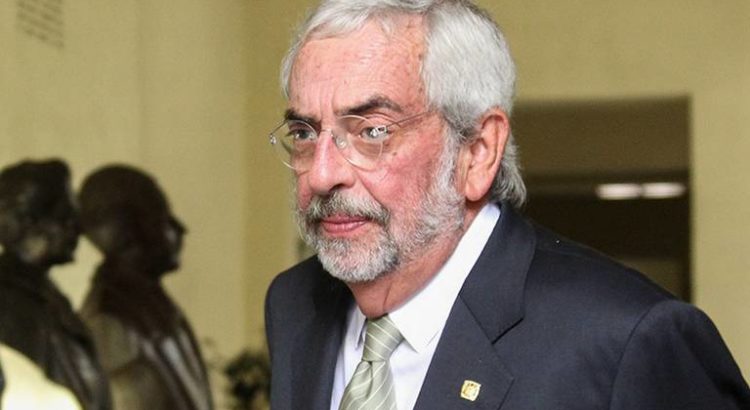
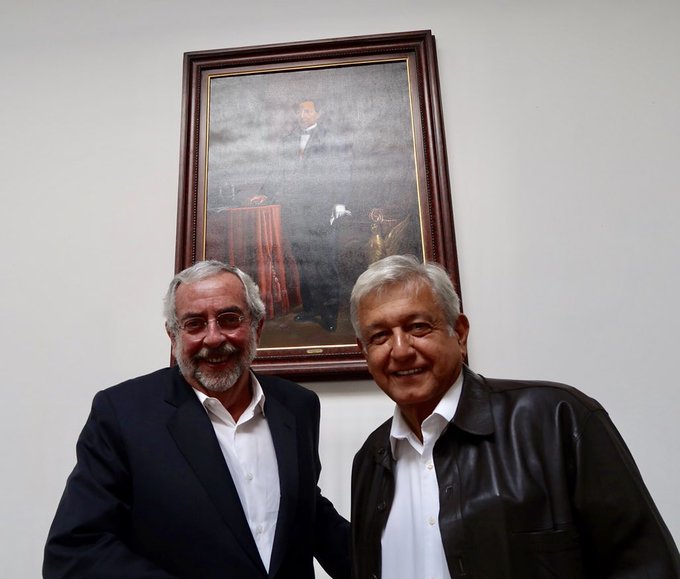
El rector de la UNAM, Enrique Graue, se reunió con el candidato ganador de la elección presidencial, Andrés Manuel López Obrador, para dialogar sobre las contribuciones de la máxima casa de estudios del país al próximo Plan Nacional de Desarrollo.

En entrevista a su llegada a las oficinas ubicadas en la colonia Roma, puntualizó que “México espera muchísimo de este gobierno y ahí hay un ánimo generalizado de cambio. Espero un México esforzado, honorable, trabajando por el desarrollo”.

Ver imagen en Twitter
Indicó que además de acudir a felicitar al candidato presidencial por su victoria, fue también a “presentarle las propuestas que la Universidad hace para el Plan Nacional de Desarrollo, tanto en temas prioritarios del país como en lo que tenemos en relación a educación, ciencia, tecnología e innovación”.

Graue Wiechers manifestó que se trata de 10 temas que se desarrollaron en documentos trabajados de manera conjunta con universidades públicas y los centros de investigación del país.

En este, el primer acercamiento con el candidato presidencial triunfador, Graue también reconoció la victoria, en el ámbito local, de Claudia Sheinbaum, de quien dijo “es muy cercana a nosotros, es una gente de primera, vamos a colaborar”.

A su salida del encuentro, Graue Wiechers indicó que se trabaja en un plan para analizar cómo aumentar la capacidad en educación superior, que si bien no podría hacerse de inmediato, “sí hay que hacer un proyecto para crecerla y es lo que presentaremos”.

En el breve encuentro, en que consideró haber tenido “la mejor de la recepciones”, por la sencillez del ganador de la elección presidencial, mencionó que la próxima reunión entre ambos sería una vez que éste sea designado presidente electo.

El rector de la Universidad Nacional Autónoma de México (UNAM) manifestó que López Obrador “entiende muy bien la Universidad” y se congratuló de que nueve de los personajes que han sido propuestos para integrar el próximo gabinete federal procedan de esta casa de estudios.


Fuente de la noticia: https://www.elsoldepuebla.com.mx/mexico/politica/rector-enrique-graue-presenta-a-amlo-propuestas-de-unam-para-mejorar-educacion-1822354.html?token=807494996

Comparte este contenido:

Reimagining the School Day

By Meg Benner

Introduction

The minutes and hours of the school day are critical to build knowledge, foster student motivation, and drive student outcomes. To make the most of precious instructional time, teachers must first develop engaging lessons that meet the various needs of students. This requires teachers to collaborate, plan, and reflect outside of instructional time. Effective school schedules maximize the time teachers spend with their students but also recognize teachers’ additional responsibilities beyond instructional time. Unfortunately, not enough schools successfully balance these priorities.

Teachers in the United States spend far more time engaged in active instruction than teachers in other high-performing countries.1 Based on self-reported data, teachers in the United States spend 27 hours teaching out of 45 hours of work per week.2 Compare this with teachers in Singapore, who teach for only 17 hours per week, or teachers in Finland, who teach for a total of 21 hours per week.3 Schools in these countries prioritize time for planning and collaboration, recognizing that developing and executing lessons take time and preparation.4 According to a recent analysis of more than 140 school districts, the average length of a U.S. teacher’s workday is 7.5 hours.5 In another analysis of more than 120 school districts, the most common length of time allotted for planning was 45 minutes per day.6 In this short time, teachers must grade student work, plan for future lessons, engage with families, and complete necessary paperwork. As a result, teachers have little time to plan or collaborate with peers.7

The squeeze for time to plan lessons and complete other administrative tasks shapes a school’s professional environment and, ultimately, affects the quality of instruction. In a recent survey from the American Federation of Teachers, one of teachers’ two most cited “everyday stressors” was time pressure.8 As teachers are largely separate from other educators during instruction, lack of time for collaboration can be very isolating. More than half of lower secondary school teachers in the United States report that they do not teach jointly or observe other teachers.9 Such practices can improve teaching quality by granting teachers opportunities to receive feedback on their lesson execution and infuse new best practices into their repertoire.

In addition, providing teachers with more time to plan and attend to other responsibilities throughout the school day creates systematic opportunities to support new teachers and stretch more seasoned teachers—increasing the likelihood of teacher retention. During this structured planning time, new teachers should receive the coaching and personalized training they need to maximize their effectiveness and meet their professional goals. Meanwhile, experienced teachers can pursue leadership roles or coach new teachers.

Fortunately, schools can look to several promising models to change their typical schedules. The Center for American Progress compiled five of these innovative school schedules. Some of these schedules have already been implemented in schools across the country to improve instruction and ensure that teachers have ample time to teach, prepare, and develop their craft. CAP has also included teachers’ ideas for alternatives to the traditional school day model.

While each example schedule varies, there were similarities in how school leaders and teachers at each school reimagined the use of time. These innovative schedules all included:

  • Additional time for planning and collaboration
  • Flexible instructional blocks to differentiate content to student need
  • Opportunities for small group instruction or student-directed learning

Innovative school schedules: Example schedules from schools across the country

Guilmette Elementary School, Lawrence, Massachusetts

What’s different about this schedule?

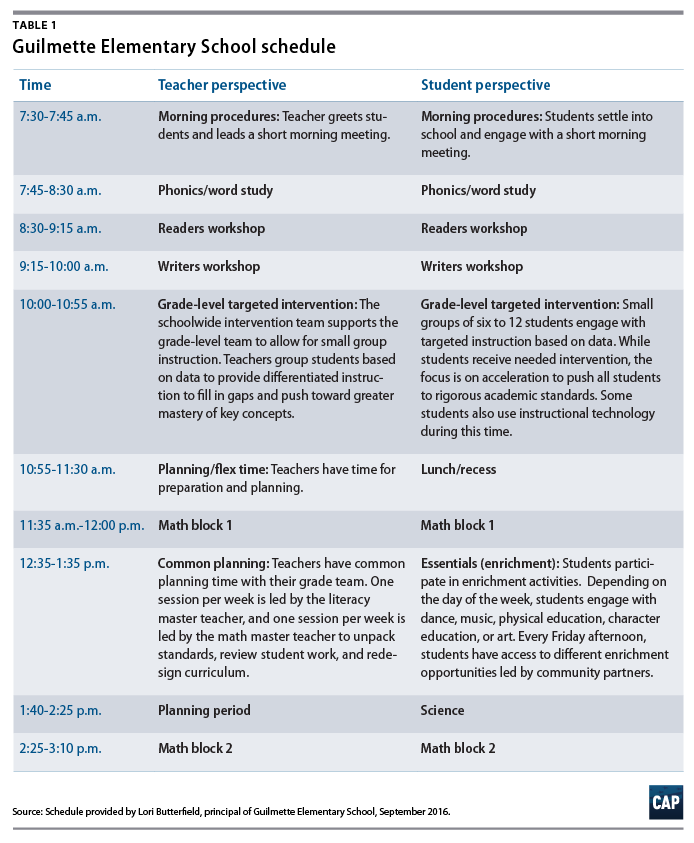
Guilmette Elementary School in Lawrence, Massachusetts, added more than 260 hours of instructional time to the school year and built in common planning time by extending the school day and strategically aligning grade team schedules. The schedule also allows for targeted intervention and enrichment opportunities for all students. (see Table 1) Students follow a similar schedule on Mondays through Thursdays. On Fridays, students participate in high-quality enrichment programming from noon to 2:30 p.m., which is led by community partners. These enrichment activities include art, music, yoga, and cooking. Teachers participate in professional development and planning at that time.10

Operations and cost

The extra instructional hours are a significant cost. The district’s teacher contract provides teachers with a stipend of $2,500 per year for added hours that is distributed evenly across their paychecks. Moreover, the quality of the enrichment programs offered on Friday is dependent on the community partners that teach the programs. Guilmette has worked to find high-quality, affordable partners.11

Outcomes

In the four years since Guilmette has implemented the new schedule, its English language arts and math proficiency scores have steadily improved; since 2013, Guilmette outperformed other elementary schools in the district. More information is available on the school’s report card.12

Objectives

  • Add 260 or more instructional hours each school year
  • Provide collaborative planning time for teachers
  • Create added opportunities for enrichment and targeted intervention that focuses on acceleration

Achievement First Greenfield middle school schedule, New Haven, Connecticut

What’s different about this schedule?

Greenfield schools, which are a part of the Achievement First network, designed a schedule that leverages four modalities of learning: self-directed learning; small group learning; large group instruction, and immersive expeditions.13 Students engage in daily self-directed learning to build responsibility and differentiate the pace of their learning. During this time, students use independent work or technology to review new concepts and move through mastery of content at their own pace. Students also participate in small group learning in sections of 14 to 16 students to dig into specific topics and receive individual feedback. Larger group instruction is reserved for seminars, debates, and experiments.

Every eight weeks, students engage in immersive expeditions for one to two weeks that explore a specific issue and apply skills to the real world. Expeditions such as creating a play, television show, or movie allow them to use writing, improvisation, and teamwork skills to bring stories to life. For example, in the expedition “Make your story come to life,” students write and produce scenes or short plays to be performed by other actors. They engage with a professional theater company for storytelling workshops and go on behind-the-scenes tours.14

Interactive digital learning is a key element of the Greenfield model. A cloud-based Personalized Learning Platform, or PLP, takes the place of traditional textbooks. Students use a laptop to access their online self-directed content, track progress toward their goals, and take assessments to demonstrate mastery of concepts. This system minimizes teachers’ work and increases transparency of student progress. Teachers or students do not need to input results to track progress; the platform does it automatically. Teachers, students, and families can log in to access student progress anywhere with an internet connection. It also helps the school communicate with parents and families.15

Every teacher is responsible for leading one instructional area—either humanities, math, science, writing, or social studies. This specialization allows teachers to focus on achieving ambitious results in their content area. A yearly pacing calendar identifies where students must perform at every point in the year in order to be on track with these ambitious outcomes. Teachers use pacing reports each day to determine where students are performing relative to the bar and to adjust their instruction in ways that will maximize the number of students who are on and ahead of pace.16

In addition, Greenfield differentiates teachers’ roles and schedules to allow for specialization, planning, and life balance.17 This includes collaborative planning time for all teachers, differentiated coaching, and professional development, as well as growth opportunities based on teachers’ skills and experience. Greenfield also offers a staggered teaching schedule for more experienced teachers.

Within each grade, students are organized into goal teams of 10 to 12 students and assigned a goal coach. These teams meet daily in order to set and reflect on academic, life habit, or enrichment goals; deepen relationships with the goal coach and other goal team members; and build habits of success. Within goal teams, students are paired off with another student, called a running partner. These pairs provide mutual support and accountability to one another as they strive for ambitious short- and long-term goals. Goal teams are led by a goal coach who is a staff member in the school. The goal coach works closely with one goal team to build community and to be a primary support for each student and running partner pair.18

Operations and cost

The ongoing operation of this schedule is not more costly than other schedules that Achievement First operates in its network. Core to Achievement First’s mission is to operate with the same public dollars as traditional district schools in the geographies where it operates.19

Outcomes

The Greenfield schools piloted the model in kindergarten and middle school grades, all of which saw proficiency exceed or equal the scores of other Achievement First schools in Connecticut after just one year. Kindergartners exceeded 90 percent proficient rates in reading, and 60 percent of students demonstrated at least 75 percentile growth in math. For middle school grades, average scores on English language arts weekly quizzes ranked first or second in the overall Achievement First Connecticut network. Fifth grade math scores exceeded the network average, but sixth grade scores were below the average.20For more information on socioemotional growth, review the Achievement First’s Greenfield Schools Year 1 Pilot.21

Objectives

  • Allow for accelerated, differentiated academics through four modalities of learning: self-directed learning time; small group learning; large group learning; and immersive expeditions
  • Build in time for enrichment
  • Foster habits of success in all kids, including curiosity, personal growth, empathy, gratitude, drive, and teamwork
  • Emphasize the importance of student, family, and staff motivation
  • Differentiate teacher roles based on experience and create more time for planning for all instructional staff
  • Reduce turnover by finding ways to accommodate senior teachers who need more flexible schedules

Generation Schools secondary schedule, Brooklyn, New York

What’s different about this schedule?

Generation Schools Network’s secondary school model creates up to 30 percent more learning time than traditional public schools in New York City and provides opportunities for differentiated instruction. It also reduces student-to-teacher ratios and overall teacher workloads to facilitate the development of supportive teacher-student relationships.22

Furthermore, teachers have more time for collaboration and professional development. All teachers, as part of their approximately 180-day work year, participate in a one- to two-week Summer Institute dedicated to collaborative planning in preparation for the school year.23 In addition, grade teams have two weeks of professional collaborative time staggered throughout the year when their students are in intensives. This is in addition to the collaborative time that teachers have every day.24

To reduce teacher workload and increase instructional time, the Generation Schools Network differentiates instructional roles—foundation, studio, and intensive teachers. This allows the school to build on a wider range of teachers’ strengths and to design roles and responsibilities that help teachers be effective and reduce turnover. In addition, it reduces teachers’ student load. Teachers have 75 or fewer students daily compared with their peers in New York City traditional public high schools, who often teach 150 students daily.25 The model organizes teachers into grade level teams and a college and career intensives team. The college and career intensives team rotates from grade to grade over the course of the year, spending a month with students exploring college and career pathways. Teachers on that designated grade team are not responsible for students that month and can use that time for collaboration and breaks. By staggering teacher breaks, Generation Schools Network expands the instructional year for students without increasing the number of working days for teachers.26

Every student also has a differentiated schedule that fits their needs. Students participate in extended foundation courses—including interdisciplinary courses on humanities or science, technology, engineering, and math, or STEM—which teach required subjects for all students as well as have various studio courses based on their interests. Studio courses include art history, physical education, art, foreign languages, or advanced sciences.27

Operations and cost

Generation Schools’ model reconfigures the same number of staff members who are employed in a conventional school model so that each school can offer much more planning time to teachers and instructional time to students without increasing staff costs, which are a majority of a school’s budget. Depending on how districts budget, this type of schedule may require additional costs for maintenance or transportation.28

Outcomes

Generation Schools Network has improved student achievement and graduation rates. Brooklyn Generation School, or BGS, has improved attendance, course completion, and graduation rates. At 69 percent, the four-year graduation rate at BGS has matched that for the city overall—70 percent—and outperformed schools with a similar demographic of students. These achievements are especially remarkable, as 85 percent of BGS’ students enter high school behind or significantly behind. In addition, 100 percent of the 2016 graduating class was accepted into college—many receiving multiple admissions and significant financial aid to make the opportunity real.29

Objectives

  • Increase instructional time for all students and opportunities to differentiate instruction
  • Reduce student-to-teacher ratios and overall teacher workloads to facilitate the development of supportive teacher-student relationships
  • Integrate collaborative planning time for teacher teams

Model school schedules designed by teachers

Model elementary school schedule

Created by Lexie Woo, fourth and fifth grade teacher in Queens, New York

What’s different about this schedule?

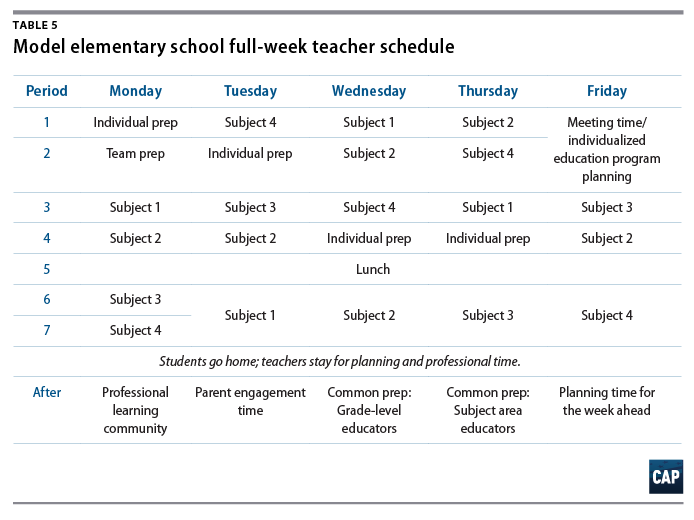
This schedule allows educators the opportunity to improve their instruction through strategic collaboration with colleagues, additional planning time, and ongoing feedback from administrators.

The timing of instructional blocks rotates to diffuse the negative impact of time-sensitive factors, such as tardiness, early dismissals, fatigue, medication use, and attention span. In addition, each subject has a double instructional block once per week, providing time for innovative educational practices, including multidisciplinary learning; project-based learning; and science, technology, engineering, art and design, and math, or STEAM, and STEM. This allows students to engage in a more self-directed and autonomous educational experience, growing as independent thinkers and doers.

With this dynamic schedule, teachers can select preferred preparation times, allowing teachers to shape their day to fit their working style. In other words, teachers can deliver instruction at the height of their energy.30

Objectives

  • Create more teacher planning time and develop more opportunities for teachers to receive feedback on their instruction
  • Allow teachers to self-select preparation periods to ensure that the timing works for their teaching and working styles
  • Offer double instructional blocks for each subject throughout the week
  • Rotate the timing of instructional blocks

Model high school schedule

Created by Crischelle Navalta, high school teacher in Donna, Texas; Jillian Harkins, high school teacher in New Haven, Connecticut; Mary Kreuz, high school teacher in Toledo, Ohio; Megan Williams, eighth grade teacher in Washington, D.C.; and Amanda Zullo, high school teacher in Saranac Lake, New York

What’s different about this schedule?

This schedule strategically minimizes teachers’ workloads to ensure that they have time to build their content expertise. In addition, teachers have additional time apart from active instruction to collaborate with their content team, plan independently, or assume a leadership position.31

Objectives

  • Reduce instructional load by ensuring that teachers teach no more than two different course subjects, and limit teaching time to only 60 percent of a teacher’s day
  • Build in approximately 40 percent of the day for conference time, leadership roles beyond the classroom, common planning time with content or grade team, and professional development

Conclusion

Tasked to deliver differentiated, high-quality instruction that prepares students for the social and academic challenges in college and beyond, schools must push their thinking on how they allocate time throughout the school day. Innovative school schedules should meet diverse student needs and ensure that all teachers are primed to deliver engaging, rigorous content. As this issue brief demonstrates, various models already exist to accomplish these goals. As schools across the country reimagine their school day schedules, they will be most successful if they customize the use of time to meet content needs rather than adapting content to fit a fixed schedule.

Meg Benner is a Senior Consultant at the Center for American Progress. Lisette Partelow is the Director of K-12 Strategic Initiatives at the Center.

Endnotes

  1. Organisation for Economic Co-operation and Development, “Education at a Glance 2014: OECD Indicators” (2014), Table D4.1, available at http://www.oecd.org/edu/Education-at-a-Glance-2014.pdf
  2. Organisation for Economic Co-operation and Development, “TALIS 2013 Results: An International Perspective on Teaching and Learning” (2014), Table 6.12, available at http://www.istruzione.it/allegati/2014/OCSE_TALIS_Rapporto_Internazionale_EN.pdf.
  3. Ibid.; Organisation for Economic Co-operation and Development, “Programme for International Student Assessment (PISA): Results from PISA 2012” (2012), available at http://www.oecd.org/pisa/keyfindings/PISA-2012-results-US.pdf
  4. Ibid. 
  5. National Council on Teacher Quality, “The NCTQ Teacher Trendline: A snapshot of district-level teacher policies from NCTQ’s Teacher Contract Database” (2016), available at http://us1.campaign-archive2.com/?u=c9b11da2ceffae94e1dc196f6&id=0c8870e3fa&e=a225322446
  6. National Council on Teacher Quality, “The NCTQ Teacher Trendline: A snapshot of district-level teacher policies from NCTQ’s Teacher Contract Database” (2015), available at http://www.nctq.org/commentary/article.do?id=186
  7. Linda Darling-Hammond, Ruth Chung Wei, and Alethea Andree, “How High-Achieving Countries Develop Great Teachers” (Stanford, CA: Stanford Center for Opportunity Policy in Education, 2010), available at https://edpolicy.stanford.edu/sites/default/files/publications/how-high-achieving-countries-develop-great-teachers.pdf
  8. American Federation of Teachers, “Quality of Worklife Survey” (2015), available at http://www.aft.org/sites/default/files/worklifesurveyresults2015.pdf
  9. Organisation for Economic Co-operation and Development, “Country Note: Results From TALIS 2013: United States of America” (2013), available at http://www.oecd.org/unitedstates/TALIS-2013-country-note-US.pdf
  10. Personal communication from Lori Butterfield, principal, Guilmette Elementary School, September 2016 to January 2017. 
  11. Ibid. 
  12. Massachusetts Department of Elementary and Secondary Education, “2015 Massachusetts School Report Card Overview: Gerard A. Guilmette,” available at http://profiles.doe.mass.edu/reportcard/SchoolReportCardOverview.aspx?linkid=105&orgcode=01490022&fycode=2015&orgtypecode=6 (last accessed January 2017). 
  13. Achievement First Greenfield, available at http://www.afgreenfieldschools.org/ (last accessed January 2017). 
  14. Personal communication from Jennifer Lindsay, project director, Achievement First Greenfield, October 2016 to January 2017. 
  15. Personal communication from Lindsay; Deborah Sawch, “A Case Study of Achievement First’s Greenfield Schools Year 1 Pilot” (Achievement First Greenfield and Transcend Education, 2016), available at https://static1.squarespace.com/static/55ca46dee4b0fc536f717de8/t/57b7688aff7c50e4a7e9cc60/1471637645702/AF+Greenfield+Year+1+Pilot+Case+Study+2016.pdf
  16. Ibid. 
  17. Ibid. 
  18. Ibid.; Sawch, “A Case Study of Achievement First’s Greenfield Schools Year 1 Pilot.” 
  19. Personal communication from Lindsay. 
  20. Sawch, “A Case Study of Achievement First’s Greenfield Schools Year 1 Pilot.” 
  21. Ibid. 
  22. Personal communication from Jonathan Spear, co-founder and former chief learning officer, and Wendy Loloff Piersee, chief executive officer, Generation Schools Network, July to August 2016. 
  23. Wendy Loloff Piersee, “Staying Focused: Using the Data to Support West Generation Academy Students,” Generation Schools Network, August 20, 2014, available at http://generationschools.org/education-non-profit-blog-generation-schools/2014/08/20/staying-focused:-using-the-data-to-support-west-generation-academy-students/
  24. Personal communication from Spear and Piersee. 
  25. Ibid. 
  26. Ibid. 
  27. Ibid. 
  28. Ibid. 
  29. Ibid. 
  30. Personal communication from Lexie Woo, fourth and fifth grade teacher, Queens, New York, July 2016. 
  31. Personal communication from Crischelle Navalta, high school teacher, Donna, Texas; Jillian Harkins, high school teacher, New Haven, Connecticut; Mary Kreuz, high school teacher, Toledo, Ohio; Megan Williams, eighth grade teacher, Washington, D.C.; and Amanda Zullo, high school teacher, Saranac Lake, New York, July 2016. 

Source of the article: https://www.americanprogress.org/issues/education-k-12/reports/2017/02/23/426723/reimagining-the-school-day/

Comparte este contenido:
Page 684 of 1685
1 682 683 684 685 686 1.685