EEUU/March 27, 2018/BY JAMES WALKER/Source: http://www.digitaljournal.com
Apple is said to be preparing a low-cost iPad for launch at a rare education-focused event next week. The company will make a revived push into classroom devices after losing ground to strong competition from Microsoft and Google.
Education software
According to a report from Bloomberg today, Apple will launch a «lost-cost iPad» for teachers and students during its event at the Lane Technical College Prep High School in Chicago next week. It comes as Apple recommits to education devices with its first dedicated event since 2012.
The device will be a new lower-cost version of Apple’s entry-level 9.7-inch iPad. Apple is also developing specialised classroom software to improve the iPad’s usability in schools. Further details on the as-yet unannounced device are currently scarce. Insiders who spoke to Bloomberg said they could not disclose more information because of the private nature of the plans.
9.7-inch iPad Pro
Apple
The launch will see Apple make a bold re-entry into the education market. Over the past couple of years, education PC makers have become highly competitive. The industry is currently led by Microsoft’s Windows 10 and Google’s Chrome OS platforms, both of which have recently launched new education software experiences and upgraded school-oriented hardware.
Throughout the increasingly fierce battle between Microsoft and Google, Apple has so far remained on the sidelines. The rising dominance of Chrome OS, coupled with Microsoft’s renewed efforts to promote Windows 10, now seems to have prompted Apple to take action. The cheaper iPad may help it to regain its lost ground in the classroom, particularly in the U.S. market where it has struggled to compete with low-cost Chrome OS products.
Tablet convenience
It’s of note that Apple seems to be choosing the iPad as the device to spearhead its new education strategy. For years, the company has promoted the iPad as a more modern alternative to traditional PCs. Apple frequently cites advantages including the device’s portability, light weight and responsiveness as key reasons for consumers to choose one over a regular PC.
Apple may now be taking this message into classrooms. With Microsoft and Google still predominantly focused on laptops and convertibles, Apple could try to sell schools on the promise of touchscreen tablets. iPads might be simpler to distribute to students and easier to carry during the day.
Apple MacBook Pro (2016)
Apple
With Apple also expected to unveil a new entry-level MacBook, the company seems to be waking up to the computing needs of schools. While MacBooks are still popular with college students, Apple’s failure to launch more low-end devices has made them uncommon in the classroom.
Next week’s event could debut a renewed focus on education PCs, which can only be positive for teachers and students. With Microsoft, Google and now Apple now aggressively competing for classroom dominance, schools have more hardware to choose from and increasingly sophisticated software platforms. Soon, all three major ecosystems may have compelling hardware options and dedicated learning experiences, helping to digitally transform the education sector.
Canada/March 27, 2018/By: ROSE O’LEARY/Source: https://www.theglobeandmail.com
Executive director, Canadian School of Natural Nutrition.
With the increasing demand for work-life balance, a great company culture and a flexible working schedule, many young Canadians are moving toward starting their own business.
Based on a recent study from Intuit Canada, the software company behind TurboTax and Quick Books, Michael Shulman of Yahoo Finance Canada determined that nearly half of Canada’s work force will be self-employed by 2020.
It is important that education in Canada adapts to meet these changing trends. Specialty post-secondary education programs provide the skills, tools and certifications required to fulfill these changing demands and for students to begin a successful career.
In addition to providing the skills for these new careers, there are many benefits of enrolling in specialty education programs with small class sizes and flexible learning schedules. The primary benefit is that students can obtain the tools, credibility and support they need to start their new career within a relatively short period of time.
For example, in 1994, the late Danielle Perrault, founder of the Canadian School of Natural Nutrition (CSNN), identified the need for a specialty holistic nutrition program taught in the classroom. Today, approximately 8,800 students have graduated from CSNN’s specialty Natural Nutrition diploma program, resulting in numerous entrepreneurs merging the worlds of self-employment and alternative medicine.
Tools: Those looking for a new career now – not later – may want to consider a specialty education program that provides them with the necessary tools and certification. A specialty education diploma program may not provide the traditional status of a degree; however, it does provide the knowledge and tools needed to start practicing tangible skills that will be used in the work force. This is very different from a four-year degree program that may additionally require graduation from a master’s program or an internship program before a career is able to begin.
Credibility: Finding the specialty education program that provides the necessary education, tools and certification to be credible is crucial in launching a new successful career. Certifications are only credible if students’ knowledge and skills have been adequately tested and screened with board exams. For example, in the holistic nutrition industry, the public looks to see that an author of a book or article is certified and has a designation from a reputable specialty education program before trusting what is written about nutrition and health. And holistic nutrition practitioners must be certified to obtain insurance in their private holistic nutrition practices. This could be true of any entrepreneurial industry where consumers are trusting individuals, relying on internet searches and word-of-mouth referrals for services.
Networking: As is true in any new career, those new to an industry benefit if they have continued support after graduating and access to those with industry experience. When researching specialty education programs, search for schools that offer these levels of support because, even with excellent skills training, some graduates may lack confidence in navigating a new industry.
The mandate of provincially regulated private career colleges is to provide the skills and tools graduates need to acquire jobs and self-employment opportunities. As a result, many specialty education programs have job boards for their graduates and work collaboratively with their alumni associations and industry associations that help graduates navigate the industry and find ways of attracting new clientele. The goal is to collectively help graduates be successful in their budding careers.
Canadians have a lot of choice when it comes to educational programs and careers, especially if entrepreneurship is desired. As new industries and careers emerge, and as the employment trend increasingly moves toward self-employment, specialty programs may be the right step to gain the tools, credibility and network needed to reach career goals.
Executives, educators and human resources experts contribute to the ongoing Leadership Lab series.
De acuerdo a la Convocatoria del Estado de México sobre el Concurso de Oposición para el Ingreso a la Educación Básica, ciclo Escolar 2017-2018, quien desee contender por una plaza docente de Matemáticas en Educación Secundaria, deberá contar con título en la carrera normalista de Educación Secundaria con Especialidad en Matemáticas o bien en alguna carrera universitaria como Robótica, Mecatrónica o Estadística Industrial, por mencionar algunas. Entonces, aquel joven que busque prepararse para enseñar la asignatura en este nivel educativo tendrá dos vías: una carrera normalista o una carrera universitaria. ¿Cuál le convendrá más? En términos de preparación pedagógica, no hay duda que la primera; en términos de oportunidades de trabajo, la segunda es la opción más favorecedora. Dicho coloquialmente, al estudiar la carrera de Robótica un joven estaría “matando dos pájaros de un tiro”, pues además de tener la posibilidad de ejercer en industrias, empresas o centros de investigación, podrá, aunque no sea su especialidad, desempeñarse como docente del nivel educativo mencionado.
El artículo 24 de la Ley General de Servicio Profesional Docente (LGSPD) establece que el perfil de ingreso para los profesores de Educación Básica “corresponderá al académico con formación docente pedagógica o áreas afines que correspondan a los niveles educativos, privilegiando el perfil pedagógico docente de los candidatos; también se considerarán perfiles correspondiente a las disciplinas especializadas de la enseñanza”. Así pues, aunque es entendible que un joven que desea prepararse para profesor, en vez de elegir una carrera normalista, elija una universitaria, alguien interesado en la calidad del servicio educativo probablemente se haría preguntas como las siguientes: ¿En qué momento un estudiante de la licenciatura de Robótica o Mecatrónica tiene acercamientos con la didáctica de las Matemáticas? ¿Qué le enseñan sus maestros sobre teorías del aprendizaje? ¿Cuándo se le explica la relevancia de la evaluación formativa? ¿Cuándo se le habla sobre las características físicas y cognitivas de los niños y los adolescentes? ¿Cuándo tiene la posibilidad de practicar en un grupo escolar?
Si bien la presencia de profesionistas con poca o nula formación pedagógica no es un fenómeno desconocido en las escuelas mexicanas, la situación anterior ha sido aceptada por la LGSPD, promulgada en septiembre de 2013. Aunque el abandono oficial a las Escuelas Normales, el desprestigio público de la figura del docente y la represión a estudiantes normalistas (rurales sobre todo) son factores de peso, a partir de la LGSPD la matrícula normalista se ha desplomado de manera alarmante. Recientemente, un estudio de Medrano, Ángeles y Morales (2017) ha revelado que para el ciclo escolar 2015-2016 se presentó el número más bajo de alumnos normalistas en casi medio siglo (44 años); tan solo en los primeros cuatro ciclos escolares del sexenio del presidente Peña Nieto, la matrícula normalista ha tenido una disminución de casi 20%, situación que no obedece a la contracción de la población infantil y juvenil esperada para los próximos años, pero sí a los factores que se mencionaron anteriormente, entre los que destaca la apertura de las plazas docentes a licenciados no normalistas.
Lo establecido en el artículo 24 de la LGSPD no sólo trae consecuencias negativas para las Escuelas Normales, sino también para la Educación Básica y el magisterio como gremio. Si lo que se desea es incrementar la calidad del servicio que se ofrece en las escuelas de Educación Básica, no parece adecuado abrir las puertas a profesionistas que únicamente tienen una preparación “afín”, y no especializada, para estar a cargo de un grupo escolar. En cuanto a las afectaciones al gremio, la entrada de profesores que no comparten un origen, que carecen de una identidad profesional docente, que ven a la docencia como una opción secundaria a su proyecto laboral, sin duda será un terreno propicio para embestidas que pretendan acelerar la de por sí creciente desprofesionalización del magisterio, algo que, en cambio, sería más difícil con un cuerpo magisterial conformado por integrantes que valoran su profesión y la ven como un proyecto de vida: ¿defenderá igual la dignidad de la profesión docente quien encontró esta ocupación como una alternativa que quien desde joven sintió la vocación por estar en las aulas?
La disminución de la matrícula normalista, además de generarse por el hecho de que un universitario tenga pase a los exámenes de ingreso al servicio profesional docente, posiblemente se intensificará en un futuro, pues, tal como se establece en el documento Aprendizajes clave para la formación integral. Plan y programas de estudio para la educación básica, las universidades “deberán construir la oferta académica [docente] de la que ahora carecen” (SEP, 2017, p. 42). Ante esto, un eventual enfrentamiento entre universidades y escuelas normales sería totalmente disparejo: en cuanto a tamaño, por ejemplo, mientras las primeras concentran a más del 90% del estudiantado superior, las segundas apenas alcanzan un escaso 3%; aunado a lo anterior, se agregan las diferencias en presupuesto, infraestructura, personal y cuerpos académicos, entre otras, a favor de las universidades. Así pues, dadas las condiciones actuales y la proyección a futuro, no es descabellada la posibilidad de que las universidades tomen la batuta de la formación docente, llevando a las Normales a un plano secundario, si no es que a su extinción.
Mientras la Ley General del Servicio Profesional Docente permita el ingreso al servicio de profesionistas con perfiles semiespecializados o ajenos a la labor docente, no se podrá esperar una recuperación de la matrícula normalista. Si lo que la Reforma Educativa buscaba era precisamente incrementar la calidad de la educación, entonces es incomprensible que se consienta que los nuevos maestros puedan contar únicamente una formación “afín” a la labor educativa, y no exigir, en cambio, una preparación especializada para esta tarea. Así pues, se quiere una educación de calidad, pero contradictoriamente se da pie a que los nuevos docentes sean egresados de escuelas que no privilegian la preparación pedagógica. Es comprensible que los jóvenes, al momento de elegir una carrera, dada la difícil situación económica por la que atraviesa el país, privilegien los aspectos económicos y de versatilidad laboral, en detrimento, en este caso, de la especialización en la labor docente.
En suma, el artículo 24 de la ley en cuestión representará quizá la concreción de un proceso de debilitamiento sistemático que apunta hacia la extinción de las Escuelas Normales. Restó valor a la formación normalista, afectando así no sólo la matrícula, sino la relevancia social de estas instituciones. Transmitió la idea de que la labor docente es tan sencilla que hasta un profesionista con escasas o nulas nociones pedagógicas puede desempeñarla. En tauromaquia, la puntilla es un pequeño puñal que se que se emplea para quitar la vida de los toros derrotados y moribundos, que previamente han sido torturados físicamente, pero se aferran a la vida. Se emplea cuando la estocada propinada por el torero, si bien generó un daño severo, no fue suficiente para matar al toro, por lo que se hace necesario el uso de esta arma para lesionar órganos nerviosos relacionados con la respiración y el latido cardiaco de la bestia. ¿Algo similar pudiera representar, a mediano plazo, el artículo 24 de la LGSPD?
REFERENCIAS
DIARIO OFICIAL DE LA FEDERACIÓN. Ley General del Servicio Profesional Docente. México: autor, 2013.
MEDRANO, V., ÁNGELES, E. y MORALES, M. La educación normal en México. Elementos para su análisis. México: INEE, 2017.
SEP. Aprendizajes clave para la educación integral. Plan y programas de estudio para la educación obligatoria. México: autor, 2017.
Si las reformas son bien ejecutadas y profundas, pueden lograr que México crezca a tasas más elevadas, con mayores niveles para la población.
Pregunta (P): Hablaba de esta idea reformista, -reforma del Estado-, en la Reforma Educativa, sería bueno que leyera la oposición este pensamiento liberal para que…
Secretario de Educación Pública, Otto Granados Roldán (OGR): Sería muy bueno, harían muy bien en reflexionar de una manera mucho más sosegada, más profunda y más intensa la significación política que han tenido las reformas de estos años y de esa manera que podemos, en efecto, nutrir, enriquecer el debate que viene en los próximos tres meses.
P: ¿Y en cuanto a cultura? Estaban unidas la SEP-Cultura
OGR: Claro, acuérdese que en esos años no existía el Conaculta siquiera, era una Subsecretaría de Cultura, y entonces de ahí dependía todo lo que tiene hoy tiene la Secretaría de Cultura.
P: ¿Qué proponía?
OGR: Varias cosas, por ejemplo, se hicieron, -usted recordará-, toda la serie de lecturas mexicanas, el programa que dirigía un periodista precisamente, Miguel López Azuara, desde publicaciones de la SEP; luego todo el Programa Nacional de Bibliotecas que dirigió muy exitosamente Ana María Magaloni en esos años; un gran trabajo en materia de culturas populares, en fin, era una vertiente cultural muy rica en términos de política pública.
P: Hablaba de esta revolución y también de estas reformas en educación ¿hoy está vigente ese pensamiento?
OGR: Por supuesto, si ustedes analizan algunos de los fragmentos que yo cité de Reyes Heroles, los procesos de reforma son un continuo a lo largo de la historia mexicana como lo son ahora, es decir, la posibilidad de que México pueda crecer a tasas más elevadas, dotar de mayores niveles de bienestar a su población dependerá, depende fuertemente, de que estas reformas instrumentadas a lo largo de estos años tengan continuidad, profundización, una buena ejecución como me parece que lo muestra muy claramente la historia mexicana, y el caso de Reyes Heroles es un ejemplo, en ese sentido, de continuidad robusta y buena para el país.
P. Por último, el tiempo electoral, hay muchos programas de la Secretaría que son sociales como las escuelas comunitarias, todo eso, ¿hay algún programa para blindar, para no provocar, digamos, alguna sanción?
OGR: Sí, por supuesto, hay dos instrumentos, primero la Ley, tenemos restricciones muy específicas que marca la legislación electoral, algunas interpretaciones que han derivado de éstas por parte de las autoridades electorales que vamos a seguir, desde luego, de manera muy puntual.
Hay que recordar que en materia electoral hay algunos sectores que tienen que continuar, uno de ellos, que menciona la propia ley es el del sector educativo, nosotros tenemos que seguir trabajando en, por ejemplo, los temas de la modernización de las escuelas; la distribución de los libros de texto; la campaña de inscripciones; los programas de formación continua para los maestros, en fin, coas que ustedes conocen muy bien y eso no puede parar porque son partes sustantivas de la reforma educativa.
P: ¿Qué es lo que sí podría parar?
OGR: Pues lógicamente lo que dice la ley en términos de promociones de otro tipo, pero la Secretaría tiene programas muy institucionales y la Reforma Educativa tiene componentes muy claros, de tal manera, que vamos a seguir en esa dirección.
Siempre, desde que tengo uso de razón, en el seno familiar se nos inculcó como regla básica de convivencia social el respeto a los mayores, a los menores y por supuesto a todas las personas en general, sin importar su condición social.
El mismo patrón se refrendó en muchos amigos y conocidos que solían repetir el modelo aprendido al momento de interactuar con otras personas, con una que otra excepción pero de manera extraordinaria.
Al entrar a una casa ajena, en una entrevista de trabajo o incluso en las relaciones cotidianas un gesto de respeto lo representaba el saludo inicial dependiendo la hora del día.
Son reglas básicas de buenos modales que no deberían de perderse a menos claro, que se desconozcan o no hayan sido instruidas.
Aun así, en las condiciones más adversas cada ser humano aprende a desarrollar el mejor comportamiento posible en la sociedad.
Hasta los animales que son “irracionales e instintivos” nos han dejado constancia que es posible la avenencia entre iguales o distintos.
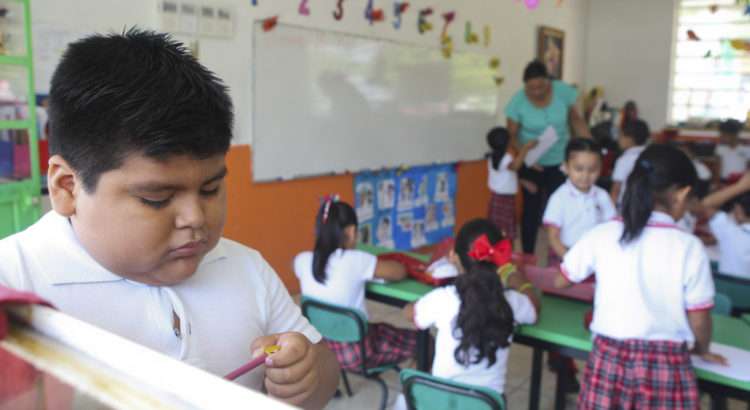
Y lo anterior solo es una pequeña y breve introducción para abordar una referencia a la fotografía que se convirtió en un episodio viral en el ámbito estatal, nacional y posiblemente internacional en la que se observa a un grupo de niños, de una escuela primaria, del Municipio de Jalapa, Tabasco, arrodillados y portando pancartas en las que se leen “agradecimientos a un diputado”.
Ese legislador en mención fue José Mollinedo Zurita quien “donó” dos equipos de aire acondicionado al mencionado centro escolar.
Lo que no está mal, aunque en la Secretaría de Educación no se vea muy bien por el incremento que genera en el gasto por concepto del aumento en el consumo de energía eléctrica y que la dependencia tiene que pagar. Pero esa es otra historia.
El legislador salió a aclarar el malentendido –aunque de manera tardía- al admitir que nada tuvo que ver con la posición que esos niños adoptaron en la ceremonia oficial.
Cualquiera que sea la explicación no justifica el haber permitido semejante acto en el que los pequeños son los menos culpables porque solo acataron una instrucción para postrarse ante el legislador y las autoridades en ese momento, pero, los adultos –autoridades educativas y Mollinedo Zurita- si son plenamente corresponsables por avalarlo.
El hecho es una vergüenza que deja muy mal una vez más a los políticos de Tabasco y exhibe a niños inocentes. Lo que nos lleva a varios cuestionamientos:
¿Para que sirven tantas ceremonias del “Congreso de los niños” o “niño legislador por un día” o las visitas de alumnos al máximo recinto legislativo de Tabasco?
¿Y los derechos de los niños?
¿Cuál es la profesión del diputado?
Lo único que podría decirse en defensa de este legislador es que en diversas escuelas de ese municipio es ampliamente reconocido por los apoyos otorgados.
Que la lección de lo que no debe hacerse sirva para su familia, porque su hermana, la ex diputada local Ana Karen Mollinedo fue funcionaria de la Secretaría de Educación en la actual administración y ahora compite para la diputación federal, mientras que la mamá de ambos: María del Carmen Zurita fue designada la candidata a la alcaldía de Jalapa.
La educación comienza en casa…
CONTORNO
La forzosa cooperación para combatir la inseguridad
En el Fraccionamiento las Rosas del Municipio de Centro la delincuencia parece imparable, pocos son los que han librado un encuentro con los delincuentes y eso provocó que ante la convocatoria de la Secretaría de Seguridad Pública para reforzar una estrategia conjunta tuviera una increíble participación ciudadana.
EEUU/March 27, 2018/By Grant McPherson Staff Writer/Source: http://leader.mainelymediallc.com
Residents have numerous questions regarding profiency-based diploma program
State officials attended a Scarborough board of education meeting to discuss where the state was in its implementation of proficiency-based diplomas as well as the challenges they face, but residents still have many questions.
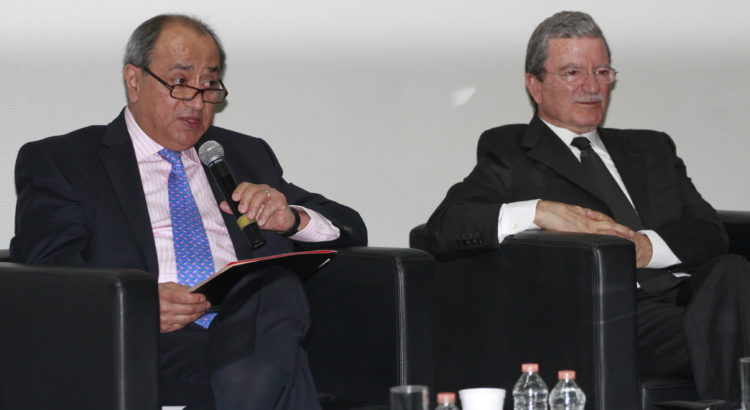
Maine Department of Education Chief Academic Officer Paul Hambleton and Sen. Brian Langley (Dist. 7), chairman of the Education and Cultural Affairs Committee, spoke before board members, school staff and the public Thursday, March 15 and answered questions about what kind of regulations the state was considering.
Following a state mandate, ninth graders at Scarborough High School must demonstrate they have mastered skills in eight different educational areas in order to graduate. Residents are concerned how the new grading system will affect their children’s chances of being accepted to colleges and universities.
Hambleton, who taught English and special education before joining the department of education, said he’s heard both concerns and success stories from around the state regarding the transition. He spoke before the Education and Cultural Affairs Committee and asked for clarification from the legislature about what the definition of “proficient” should be.
“The struggle I was having was in one particular area of the law,” Hambleton said. “It describes the diploma as something that is awarded when a student reaches proficiency in all eight areas and my challenge with that after talking to colleges is if we take that at straight face value, we were concerned about the way we were setting it up was going to result in a lot of kids not being able to meet that bar.”
Hambleton has been back and forth in discussion with the legislature about amendments to the law, which could look similar to aspects of the No Child Left Behind Act and Every Student Succeeds Act, the latter a reauthorization of the 50-year-old Elementary and Secondary Education Acts.
“Now the question is, what does a diploma mean,” Hambleton said. “The other moving piece is what do we expect kids to be able to do by the time they graduate high school? Do we want to create a statewide definition for all students in all eight areas before they exit high school? That’s been our challenge. Where is that model and where do we land on that? What are we expecting all kids in the state to be able to do regardless of zip code? How do we help all kids get there without creating a barrier that will trip kids up? That’s essentially where we are now, finding that sweet spot.”
Over the next couple weeks, Hambleton said he would work with the legislature and his department to try and answer some of those questions.
Langley spent 27 years teaching culinary arts at the Hancock County Technical Center in Ellsworth before his time in the legislature and was present when the proficiency-based diploma bill was introduced. He said that a proficiency based grading system is not a mandate of the new law and local school districts are free to implement it, create a hybrid system or keep a numerical method of grading.
Langley said he doesn’t know how many schools have chosen a proficiency based grading system, but that eight high schools in Maine will graduate students this year with performance-based diplomas.
The law took effect Jan. 1, 2017 and Langley said as long as the state legislature continues to turn over every few years there will continue to be amendments to the law. However, he is hopeful the changes will be beneficial in the long-term.
“It’s been difficult for those whom the system has always worked for,” Langley said. “They will continue to say it still works. I spent my career working with castaway kids. When they had been given up on they would end up in my program. With a grading system of one through four for a perfect blueberry pie taste, they could begin making one when they compare themselves against a standard and not someone else’s work.
“Most school systems already have proficiency based (models). In kindergarten through second grade, a report card shows if a student can tell time to a quarter of the hour, count to 10 and recite the alphabet.”
Langley said the legislature would wait for an amendment to the law from the department of education or possibly choose to delay further implantation by a year. While not originally planning to attend the Scarborough Board of Education’s meeting, he said he felt obligated when he heard a municipality was discussing how to implement its own methods.
“It’s nice to see so many people out for a school board meeting,” he said. “From my perspective it’s hard and people are very concerned about what’s best for their kids. A lot of school systems have trouble finding enough people to serve on the school board. You will develop thick skin working through the issues and come out better for it.”
Scarborough resident Jeannine Uzzi said while she supports the transition to proficiency-based education, making sure colleges and universities understand students’ transcripts is critical.
“I have no philosophical issue, but the fact of the matter is the onus is on the district to replace the familiar transcript with narrative data and it will take a lot of hard work upfront before the switch to a different grading system,” she said. “Proficiency-based education will not disadvantage students in terms of learning, it should be an advantage. There need to be resources put into recreating how we grade assessments and how teachers are trained. The town has to invest money to support changes.”
Maria Connolly, another resident, was less enthusiastic about the change. She said the discussion about proficiency based education has only caused more anxiety for her children, who are considering private school to ensure a better chance at being accepted to the college or university of their choice.
“You have the future of our children in your hands,” she said. “We want you to leave a legacy of positivity for them. I regret I didn’t get involved in the discussion sooner. I regret my 13-year-old son came up to me at the beginning of the school year asking to go to Cheverus for the rest of his high school career because he was unhappy with the grading system. As a 13-year-old he was worried about the impact on himself. If a 13-year-old saw the writing on the wall, then you as the board of education and superintendent should have.”
The ongoing crisis of democracy has two markers: The erasure of memory and the politics of disposability.
In the age of Donald Trump, history neither informs the present nor haunts it with repressed memories of the past. It simply disappears.
This seems especially true regarding the current cult of violence, guns and domestic terrorism.
Such violence is not only evident in the horrors of early fascist and Nazi regimes, but also in the massacre of Vietnamese infants and children at My Lai , and in the guns turned repeatedly on children in the United States, most recently in Florida.
An estimated 188 shootings have occurred at U.S. schools and universities since 2000. There will be no escape from mass violence in the U.S. until it is placed within a broader historical, economic and political context to address the totality of forces that produce it.
Focusing merely on mass shootings or meaningless gun-control laws does not get to the root of the systemic forces that produce America’s love affair with violence and the ideologies and criminogenic institutions that produce it. Historical and social amnesia in fact facilitates America’s addiction to violence.
This is especially troubling when the “mobilizing passions” of a fascist past now emerge in a stream of hate, bigotry, lies and militarism that are endlessly circulated at the highest levels of the Trump administration and in powerful conservative media such as Fox News, Breitbart News and conservative talk radio stations.
These right-wing media stalwarts have been joined by newcomers like Clear Channel and Sinclair Broadcast Group.
And so the politics of disposability, in which the well-being of citizens, democratic ideals and the social contract are tossed away, is no longer the discourse of marginalized extremists. It’s now trumpeted daily by the conservative media machine and exists at the highest levels of government.
America is watching and listening, and so too is Trump himself. His tweets often make reference to actual fake news, and not just the stories he labels as such because they fail to fawn over him:
Thank you to @foxandfriends for the great timeline on all of the failures the Obama Administration had against Russia, including Crimea, Syria and so much more. We are now starting to win again!
The politics of disposability is increasingly evident not so much in rise of mass shootings in the United States but in the fact that they are getting deadlier, especially as they involve the maiming and killing of children.
Seventeen people, most of them teens, are now dead at the hands of a 19-year-old shooter armed with an AR-15 assault rifle at Marjory Stoneman Douglas High School in Parkland, Fla. They won’t be the last to die. The question is not if, but when, in a society that has turned malignant with violence.
Violence is indeed a cancer metastasizing through American society. The proliferation and sales of guns as both an industry and form of entertainment is at the heart of such violence. The profits from weapons of war and death are now a more important investment than investing in the safety, security and lives of young people.
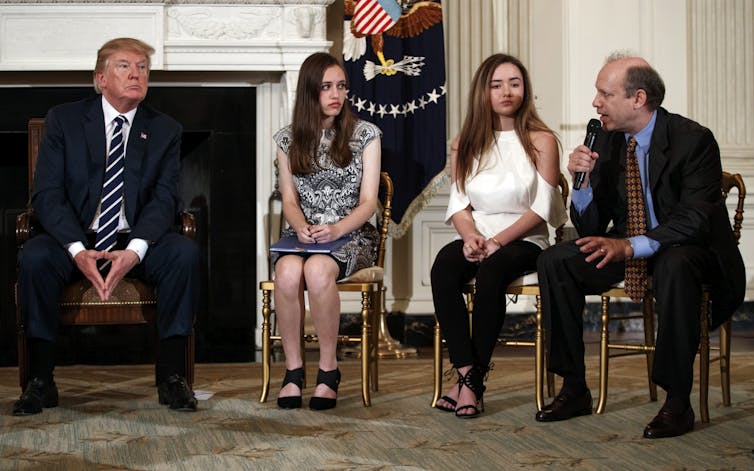
The logic of disposability and the war culture it legitimates was on display recently as Trump listened to the impassioned testimony of parents and children who have seen their children and friends killed in gun shootings.
President Donald Trump listens to Florida high school students and one of their parents as they issue a plea for tougher gun laws at the White House on Feb. 21, 2018.(AP Photo/Carolyn Kaster)
He responded by advocating for teachers to be armed and trained to have concealed weapons. Instead of confronting the roots of violence in America, he followed the NRA line of addressing the epidemic of violence, mass shootings and the ongoing carnage with a call for more guns. He normalized the insane logic that mass violence can be met with more violence.
“A teacher would have shot the hell out of the gunman before he knew what happened,” Trump said at the annual CPAC conference.
Trump, who was the recipient of US$30 million in campaign funds from the NRA, channels its head, Wayne LaPierre, who calls for more armed teachers. LaPierre trades in fear-mongering, mistrust and even Cold War rhetoric, calling gun control advocates “socialists.”
Trump and LaPierre have no interest in preventing school shootings. On the contrary, they want to “prepare for shootings” by turning schools into war zones.
This logic is breathtaking in its moral depravity, its refusal to get to the root of the problem and its unwillingness even to advocate for the most minor reforms such as banning assault rifles, making illegal the sale of high-capacity ammunition magazines and expanding background checks.
There are 300 million guns in the United States and since the 2012 mass murder of 20 children and six teachers at Sandy Hook Elementary School, hundreds more children have died of gun violence.
There is no defence for putting the policies of the NRA ahead of the lives of children.
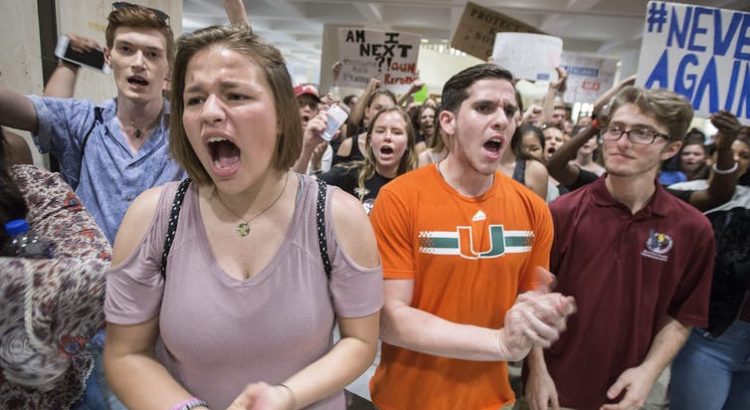
Criminal acts often pass for legislative policies. How else to explain the Florida legislature voting to refuse to even debate outlawing assault weapons while students from Marjory Stoneman Douglas High School sat in the gallery and watched this wretched and irresponsible act take place?
How else to explain that the U.S. House of Representatives, seemingly reduced to an adjunct of the NRA, voted to pass a law that would allow individuals to carry concealed weapons across state lines?
These are the people who have the blood of thousands on their hands. The power of money in politics has morphed into a form of barbarism in which financial gain and power have become more important than protecting the lives of America’s children.
Children no longer have a safe space in America, a country saturated in violence as a spectacle sport, its citizens routinely brutalized by repeated deadly acts of domestic terrorism followed by the criminal inaction of their elected representatives.
Any defence for the proliferation of guns, especially those designed for war, is, in fact, criminal. It’s political corruption, a government in the hands of the gun lobby, and a country that trades in violence at every turn in order to accrue profits at the expense of the lives of innocent children.
This is how the logic of disposability works. This is how democracies die.
Children have more moral courage
And this debate is not simply about gun violence, it is about the rule of capital and how the architects of violence accrue enough power to turn the machinery of death and destruction into profits while selling violence as a commodity.
Violence is both a source of profits and a cherished national ideal. It is also the defining feature of a toxic masculinity so perfectly personified by Trump, pussy-grabber-in-chief.
Gun reform is no substitute for real justice and the necessary abolition of a death-dealing and cruel economic and political system that is the antithesis of democracy.
What are we to make of a society in which young children have a greater sense of moral courage and social responsibility than the zombie adults who make the laws that fail to invest in and protect the lives of present and future generations?
First step: Expose their lies, make their faces public, use the new media to organize across state lines, and work like hell to vote them out of office in 2018.
Hold these ruthless walking dead responsible and then banish them to the gutter where they belong. At the same time, imagine and fight not for a reform of American society but a restructuring along the lines of a truly democratic order.
OtrasVocesenEducacion.org existe gracias al esfuerzo voluntario e independiente de un pequeño grupo de docentes que decidimos soñar con un espacio abierto de intercambio y debate.
¡Ayúdanos a mantener abiertas las puertas de esta aula!








 Users Today : 481
 Total Users : 35519004
 Views Today : 745
 Total views : 3701286