Page 1882 of 2734
1 1.880 1.881 1.882 1.883 1.884 2.734

Leer, escribir, hablar y escuchar.

Reconociendo los avances, claramente puede decirse que la eficiencia de la escuela para producir una alfabetización crítica de la población es manifiestamente mejorable.

Por: F. Javier Merchán Iglesias.

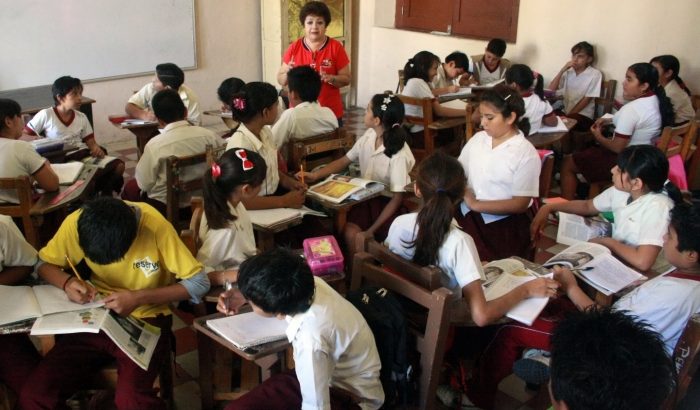
Hay un gran consenso entre los docentes a la hora de señalar a la lectura comprensiva, la expresión oral y escrita o el cálculo y razonamiento, como los principales problemas que dificultan la adquisición de conocimiento por parte de los alumnos. A este respecto, por cierto, también hay consenso en considerar que las denominadas pruebas Escala, que desde hace varios años realiza por estas fechas la Consejería de Educación para comprobar el nivel de competencia del alumnado, son perfectamente prescindibles: no nos dicen nada que no sepamos y realmente contribuyen poco a la solución de los problemas que se pretenden detectar. Su persistencia no se justifica por su utilidad.

El caso es que, al margen ahora de la supuesta virtualidad de las pruebas, sin necesidad de ellas, los docentes saben que las deficiencias en estos recursos instrumentales son la pieza clave que explica el fracaso académico de muchos alumnos y la ralentización del logro en la adquisición de conocimientos, y saben que en este asunto estamos lejos de alcanzar las metas deseables y esperables. Reconociendo los avances producidos en los últimos cincuenta años, claramente puede decirse que la eficiencia de la escuela para producir una alfabetización crítica de la población, es manifiestamente mejorable.

Entre otros objetivos, la sociedad encomienda al sistema educativo promover en los alumnos la capacidad de razonamiento, así como la adquisición de conocimientos que ayuden a entender y discernir sobre el mundo social y material. Para ello resulta imprescindible el manejo de los códigos de la comunicación con los que se expresa y transmite la cultura, es decir, entender lo que se lee, explicar lo que se quiere decir, entender lo que se oye y razonar sobre lo que queremos saber; sin ese dominio, es mucho más difícil el ejercicio de la ciudadanía y la adquisición de conocimiento.

Se dice que el actual modo de vida de los jóvenes es un pesado hándicap para formar en habilidades que requieren una disposición muy diferente. Sin embargo, habiendo mucho de cierto en ello, tal cosa no puede ser una excusa o justificación, pues hoy el encargo de la sociedad es el de alfabetizar a esos niños y jóvenes, no a los de hace 50 años.

Ahora bien, no es menos cierto que la actual estructura de la escolarización, con sus horarios rígidos, asignaturas cerradas, gestión muy burocratizada, exámenes convencionales… lejos de aportar la solución, está convirtiéndose en parte del problema. Siendo el conocimiento un asunto complejo, la institución escolar tiende a simplificarlo. Transmitiendo a los alumnos la idea de que saber consiste meramente en reproducir lo que otros saben, el texto no se lee, se copia; las ideas no se escriben, se imprime lo que otro ha escrito. Si miramos los libros de texto y buena parte de las rutinas que se practican en el aula, las llamadas actividades no consisten realmente en pensar sobre una pregunta o problema, sino en buscar la página en la que se encuentra la respuesta. Generalmente los alumnos no estudian, es decir, no trabajan sobre un problema de conocimiento, sino que preparan exámenes. Y los exámenes, ya se sabe, no son exactamente un recurso para dar cuenta del conocimiento que se tiene sobre un asunto, sino para reproducir lo más fielmente posible lo que el profesor les dijo o lo que consta en los apuntes tomados de internet o en las páginas del libro de texto. En realidad, cuando, por ejemplo, se pregunta por las causas de la revolución industrial, la pregunta es dime las cuatro causas de la revolución industrial que te dije ayer. De esta forma, leer, escribir, hablar, escuchar y pensar, son tareas que acaban siendo prácticamente actividades extraescolares.

Se habla mucho del fracaso escolar refiriéndose al rendimiento de los alumnos, pero quizás sea más importante pensar sobre el fracaso de un sistema que en los albores del siglo XXI funciona de la misma forma que en el siglo XIX. Contengamos la irrefrenable tendencia a señalar culpables -generalmente, se dice, los docentes-. Vale más analizar los problemas y tomar nota de las múltiples experiencias que se vienen sucediendo en España y en otros países. A este respecto tanto en los medios de comunicación generales como en los profesionales se viene dando cuenta de tendencias prometedoras que, inequívocamente, pasan por cambios significativos en la estructura actual de la escolarización. Cambios de calado que no pueden producirse de la noche a la mañana pero que son viables si se establecen objetivos y estrategias. Para estos cambios es necesario apelar a la política, a la política educativa y a otras, pues, por sí solas, las escuelas y los profesores carecen de los recursos que requiere su reforma. Esperemos, por cierto, que el pacto educativo no sea el parto de los montes.

Fuente: http://www.diariodesevilla.es/opinion/tribuna/Leer-escribir-hablar-escuchar_0_1147985303.html

Imagen: https://image.slidesharecdn.com/expolineamientoscurriculares-120426145451-phpapp01/95/expo-lineamientos-curriculares-14-728.jpg?cb=1335452219

Comparte este contenido:

Desigualdad a la luz de Saber 11, exministra Parody.

Consecuencias de haber negociado todo con las Farc bajo el interés del Gobierno y no del Estado.

Por: Daniel Mera Villamizar.

En octubre de 2015, la entonces ministra de Educación celebro que “hemos logrado un sacudón a la calidad de la educación; los resultados de Saber 11 muestran la respuesta de los estudiantes frente al programa de becas Ser Pilo Paga”. De aguafiestas, anote que “el sistema responde por todos los estudiantes”, no solamente por los pilos, y que para un “entendimiento público más fidedigno” se necesitaban otros datos básicos, que el MEN tampoco ofreció en 2016.

Pues bien: aquí están algunos de esos datos y ratifican la enorme desigualdad educativa que se esconde detrás del promedio nacional del puntaje global en Saber 11, la estadística favorita para seguir engañándonos. Es como si a nadie le importara el promedio del quintil inferior o del 60 % de la mitad. Como si la distancia entre el quintil inferior y el superior no entrañara un reto mayúsculo de política pública, con variables de rural y urbano, y nivel socioeconómico.

En 2015, calendario A, el promedio global fue 250 (sobre 500); el del 20 % inferior, 191;  el de los quintiles 2, 3 y 4, 246; y el del quintil superior, 321.

Debería consternar un poco ese promedio de 191, que cerca de 120.000 bachilleres salgan con tan bajas competencias académicas. La entonces ministra vendió un “sacudón a la calidad”; así que es de suponer que observó una mejoría respecto de 2014. No fue el caso del quintil inferior, que bajó de 196 a 191 (en 2016 se movió a 194), ni del 60 % de la mitad, que bajó de 247 a 246. El único que subió fue el quintil superior, de 315 a 321 (versus 349 de calendario B). De hecho, el puntaje promedio de los colegios oficiales bajó levemente de 245 en 2014 a 244 en 2015. Sin embargo, “sacudón…”.

Si nos importan los 120.000 bachilleres del quintil inferior, ¿qué hacer? Una acción que este Gobierno prometió a partir del Plan Nacional de Desarrollo 2014-2018, artículo 200, fue cerrar brechas; y en educación uno de los indicadores es el promedio del resultado en la prueba de matemáticas de Saber 11, a nivel municipal, con línea base de 2014 y metas en 2016 y 2018. Otro indicador relacionado es el porcentaje de cobertura neta en educación media. Planeación Nacional, DNP, estableció la brecha y el nivel de esfuerzo para superarla, y trata de realizar seguimiento.

¿Quiénes son los responsables del esfuerzo? He ahí la cuestión. Se requería un acuerdo sectorial entre DNP y el Ministerio para redirigir inversiones hacia cada uno de los cuatro indicadores en educación para cierre de brechas. Ya no se hizo ese acuerdo sectorial y muy pocos se hicieron. No hubo una política pública para cierre de brechas en educación. No es sexy hablar de los perdedores o los condenados en ruedas de prensa. Pero así como un país con aspiraciones no debe cometer la torpeza de desperdiciar el talento que ha sobrevivido a la desigualdad, tampoco puede éticamente ignorar a los que no podrán evitar el 20 % inferior.

Fuente: http://www.elespectador.com/opinion/armas-coca-e-interes-nacional-columna-698775

Imagen: https://1.bp.blogspot.com/-3Z62EtVFHTU/V8v8fCvVk0I/AAAAAAAANEo/7nWW63L2Tzcs3Siczw0nCBlsswPK1m6QwCLcB/s400/Lwo%2BParodya%2Beducativa.jpg

Comparte este contenido:

Educación, familia y genética

Por: Pablo Pardo

Ahora que se han terminado las clases, una idea para pensar de aquí a septiembre: un estudiante pobre tiene 4,1 veces más posibilidades de repetir curso que uno rico. Como explica Soledad Bos, del Banco Interamericano de Desarrollo (BID), «en los resultados de PISA, el factor más importante que influye en educación, es el socioeconómico».

Precisamente, el dato sobre el peligro de repetir es del Informe PISA, el archifamoso estudio sobre educación en 72 países que hace la OCDE, el think tank oficial de los que teóricamente son los países más ricos del mundo (y alguno al que había meter en el grupo para pagarle favores, como Turquía, por ser miembro de la OTAN en plena la frontera con la Unión Soviética, o México, por firmar un acuerdo de libre comercio con EEUU).

Según la OCDE, los «estudiantes ricos» son aquéllos cuyas familias están en el 20% más alto de ingresos, y los «pobres», los que se encuentran en el 20% más bajo. Y el estatus socioeconómico explica un 13% de las diferencias educativas de PISA.

Eso no se debe solo a que el dinero permite comprar cosas (en este caso, educación), sino, también, modos de vida. En palabras de Bos, «tener ingresos altos no solo significa poder acceder a mejor educación, incluyendo clases particulares. Implica también que el estudiante tiene un buen lugar para estudiar en la casa, y unos padres con tiempo libre para ayudarle».

Jonathan Guryan y Erik Hurst, de la universidad de Chicago, y Melissa Kearney, de la de Maryland, afirman que, en EEUU, «los padres consideran invertir en sus hijos como un bien de lujo, más valorado que la tradicional producción del hogar [o sea, las tareas domésticas] o el entretenimiento». Pasar tiempo con la progenie es, hoy en día, un lujo.

Así que la educación, en cierto sentido, se hereda. «Si un padre viene de un entorno educativo con un estándar educativo alto, él va a poner más alto el listón para sus hijos», explica Bos. En su opinión, la educación de los padres puede ser el elemento más importante, al menos en «en América Latina, donde los alumnos que llegan a niveles de excelencia en la prueba PISA lo consiguen por el apoyo de los padres, no por los sistemas educativos en la región».

Claro que esta importancia de la educación de los padres y del entorno familiar también puede limitar el impacto del nivel económico y de la falta de inversión en educación (permitir darle la vuelta a la tortilla. Por una parte, está el hecho de que, como recuerda el BID en su análisis de PISA, «un pequeño porcentaje de estudiantes pobres logra resultados positivos, lo que demuestra que todos, más allá de sus circunstancias, pueden lograr el éxito en la escuela».

El problema es que ese «pequeño porcentaje» de estudiantes que alcanzan la excelencia es, realmente, muy pequeño. Apenas entre el 0,5% y el 1% de los estudiantes de Latinoamérica alcanzan los niveles que PISA considera «de excelencia». En España, el porcentaje es del 5%. En Singapur, el 20%. La excelencia es importante porque, según Bos, «estas personas son las que son más proclives a generar innovación».

Todo esto pulveriza la tesis del columnista de The Wall Street Journal Charles Murray en su archicontrovertido libro The Bell Curve, de 1994, y en otros ensayos, en los que afirmaba que «es casi seguro» que «la población que está bajo la línea de la pobreza en EEUU tiene una configuración genética significativamente diferente de la de la población que está por encima del umbral de la pobreza».

Vamos, que los pobres son genéticamente tontos y vagos. Murray, al menos, tuvo la deferencia de no explicar a sus lectores que normalmente las personas creemos que somos más ricas y más inteligentes de lo que somos. Y es, probablemente, también se le pueda aplicar a él. La soberbia no es el pecado original por mera casualidad, y no parece que se vea muy afectado por el nivel socioeconómico y educativo las familias. Todos la tenemos.

Fuente del Articulo:

http://www.elmundo.es/economia/macroeconomia/2017/06/26/594fe76aca474104118b45dc.html


Comparte este contenido:

La autoevaluación en la escuela permitirá mejorar la calidad de la educación: Sylvia Schmelkes

Por: Erick Juárez Pineda

Una buena escuela es capaz de mitigar el peso de los factores socioeconómicos y culturales, y de hacer una diferencia. Para lograrlo, debe tener liderazgo académico, trabajo en equipo, cultura de la planeación y la evaluación, atención al clima propicio para el aprendizaje y relación con la comunidad, destacó Sylvia Schmelkes del Valle, consejera de la Junta de Gobierno del Instituto Nacional para la Evaluación de la Educación, en su ponencia La autoevaluación en la escuela, ante docentes y alumnos de la Benemérita y Centenaria Escuela Normal Oficial de Guanajuato.

En el marco del primer aniversario de la Red Estatal de Cuerpos Académicos y Grupos de Interés de las Escuelas Normales Públicas del Estado de Guanajuato (Red CAEN), Schmelkes del Valle señaló que la autoevaluación escolar cobra sentido en el marco de la autonomía para planear en función de la realidad de cada escuela, puesto que la evaluación sirve para mejorar.

Indicó que los centros escolares requieren autonomía para planear a partir de un diagnóstico de sus problemas y de las necesidades educativas del contexto, planeación que debe ser colegiada, monitoreada y evaluada; en este marco la autoevaluación es una actividad central.

La escuela al centro, dijo la consejera del INEE, tiene como ventajas la adopción de un enfoque que le da centralidad a lo pedagógico, impulsa la planeación estratégica traducida en una ruta de mejora y promueve prácticas docentes, participación responsable y rendición de cuentas.

Precisó que la autoevaluación de los centros escolares es una estrategia integral para valorar el proceso y los resultados educativos de la comunidad escolar, así como la efectividad con que la escuela gestiona los recursos disponibles en su contexto, en torno a una visión compartida centrada en altas expectativas de aprendizaje para los alumnos. La autoevaluación en la escuela permitirá mejorar la calidad y la equidad de la educación que ofrece, concluyó.

Por otra parte, el INEE realizó el taller Autoevaluación, evaluación formativa y evidencias, impartido a docentes de escuelas normales de la entidad, por la jefa de proyecto del equipo de la Junta de Gobierno de este organismo autónomo, Eva Hamilton Vélez.

Fuente del Artículo:

La autoevaluación en la escuela permitirá mejorar la calidad de la educación: Sylvia Schmelkes

Comparte este contenido:

Los adolescentes de hoy en día están teniendo sexo más seguro, gracias a la educación eficaz

Por: Steve Williams*

El CDC ha publicado un nuevo informe  que demuestra que menos adolescentes están informando de la actividad sexual. Y, alentador, cuando tienen relaciones sexuales, la mayoría de estos jóvenes están usando protección.

Tirando de datos de la  Encuesta Nacional de Crecimiento Familiar para los adolescentes varones y mujeres entre las edades de 15 y 19, funcionarios de los CDC intentaron medir las tasas de actividad sexual y hábitos anticonceptivos. La ventana de investigación abarca desde 2011 hasta 2015 y también incorpora información seleccionada de otros recursos nacionales de datos, incluyendo la Encuesta Nacional de Varones adolescentes 1995, para dar contexto y la comparación de las tendencias actuales.

En curso desde 1988, esta investigación anual es crucial, ya que da a los funcionarios la posibilidad de medir la proporción de adolescentes que tienen relaciones sexuales y, lo más importante, cómo están protegiendo su salud.

Sabemos que los EE.UU. tienen una tasa de embarazo adolescente muy superior al de las naciones similares, a pesar de que ha disminuido considerablemente en los últimos años. Y al igual que otras naciones occidentales, los EE.UU. está luchando contra las ITS y sus complicaciones de salud resultantes.

En este informe, los investigadores encontraron que la actividad sexual de los adolescentes es en realidad una tendencia descendente.

Entre 2011 y 2015, poco más del 42 por ciento de las adolescentes que nunca se casaron – alrededor de cuatro millones – y el 44 por ciento de los adolescentes varones que nunca se casaron – 4,4 millones – informaron de que habían participado en el acto sexual. Las tendencias a largo plazo parecen corroborar que las cifras de 2011-2015 representan una disminución significativa en las tasas de adolescentes que reportan tener relaciones sexuales.

Este no fue el aspecto más interesante de esta investigación, sin embargo. Otro hallazgo clave fue que las mujeres jóvenes están utilizando cada vez más los anticonceptivos para proteger su salud sexual y evitar el embarazo.

Adolescentes mujeres que usan anticonceptivos en su primera relación sexual reportado subió de 74,5 por ciento en 2002 a 81 por ciento en el período 2011-2015. adolescentes varones que no han experimentado el mismo aumento en el uso del condón, pero esa tasa se ha mantenido relativamente estable en casi el 77 por ciento entre 2011 y 2015 – abajo de algunos puntos de la cerca de un 80 por ciento entre 2006 y 2010.

En la era de aplicaciones de enganche en línea que pueden facilitar fácilmente encuentros sexuales en la primera reunión, otro aspecto sorprendente a emerger de los datos es que son relativamente pocos los adolescentes reportan tener relaciones sexuales con alguien que no se habían visto antes, a tan sólo dos por ciento de niñas y siete por ciento de los varones. Será interesante ver si esta tendencia cambia cuando los investigadores examinan retrospectivas para el período 2016-2020 dentro de unos años.

El informe incluye algunos resultados alarmantes, sin embargo. Por ejemplo, entre las formas más populares de control de la natalidad fue “retirada” o “marcha atrás”.

Como Planned Parenthood y cada clínica de renombre salud sexual que se hará constar, esto no es un método fiable para la prevención del embarazo, y no hace nada para prevenir las ITS. La popularidad del método ineficaz entre los adolescentes puede estar vinculada a la falta de educación sobre salud sexual – algo que los expertos dicen que es clave para prevenir el embarazo en adolescentes y enfermedades de transmisión sexual.

Nicole Cushman, de la educación y la formación organización respuesta sexual, caracteriza a estos hallazgos para la CNN como positivo y un testimonio de jóvenes responsables:

Estos nuevos datos realmente confirma la continuación de las tendencias que hemos estado viendo desde hace muchos años en la salud sexual de los adolescentes. Mi mensaje para llevar de estas tendencias a lo largo de los años es que los jóvenes están haciendo un gran trabajo en la toma de decisiones responsables sobre su salud sexual. Creo que realmente muestra que cuando dotar a los jóvenes con el conocimiento y las habilidades para proteger su salud sexual, que son capaces de tomar decisiones mejores para ellos.

Cushman pone de relieve la urgente necesidad de dotar a los jóvenes con el asesoramiento preciso y libre de prejuicios sobre la salud sexual. Por ejemplo, el informe de los CDC señala que “Las estimaciones de prevalencia sugieren que uno de cada cuatro adolescentes sexualmente activos tiene una ETS, como la clamidia o el virus del papiloma humano (VPH),” los cuales pueden tener graves repercusiones para la fertilidad adulta.

Por otra parte, las personas LGBTQIA a menudo no reciben la educación que necesitan para tomar decisiones informadas sobre la salud sexual, llevando a algunos a involucrarse en comportamientos sexuales de riesgo que puede significar contraer el VIH y otras infecciones.

El principal mensaje de este informe es la siguiente: Si damos a los jóvenes las herramientas que necesitan con el fin de tomar decisiones informadas, la mayoría va a actuar de manera responsable.

Depende de nosotros, entonces, reconocer que la educación sexual apropiada para su edad debe ser financiado a través de los programas de abstinencia fallidos a nivel nacional, estatal y local. El hecho de no hacerlo le permite a nuestros hijos hacia abajo y los expone a riesgos de salud sexual que son fácilmente evitables.

Crédito de la imagen: Elizabeth Tsung / Unsplash

Fuente del Artículo:

http://www.care2.com/causes/todays-teens-are-having-safer-sex-thanks-to-effective-education.html

* Steve Williams, es un apasionado defensor de los derechos Trans (LGBT) Lesbianas, Gay, Bisexuales y, los derechos humanos, el bienestar animal y la reforma de salud. Es un autor, poeta y periodista ciudadano publicada, y guionista de juegos de ordenador, películas y series web.

Comparte este contenido:

How the cloud has changed education and training

by Ben Dickson

A few years ago, the cloud was a promise to reduce costs of IT and improve flexibility and scaling by providing on-demand computing, storage and services to every organization.

Today, the cloud is a ubiquity we take for granted. We expect every file, every service and digital asset we have to be available across all our devices everywhere we go, at any time of the day.

The omnipresence of the cloud has streamlined and transformed quite a number of domains, including education. Today, thanks to cloud computing, education and training has become more affordable, flexible and accessible to millions of people and thousands of businesses.

Here’s a look at how cloud-based education has changed things for the better.

Lower software and hardware costs

One of the problems schools and training departments in organizations have constantly struggled with is to keep up with hardware, software and IT staff costs and complexities. In contrast, the cloud has been offering low-cost, subscription-based model that can support more companies and organizations.

Microsoft<a href='https://index.co/company/Microsoft' data-index='' target='_blank' class='idc-hasIcon'></a> Office

The elegance of the cloud is that the user only requires little more than a browser and an internet connection. This is a welcome shift from the need to manually install and update applications on every single computer in a department.

In the past years, solutions such as Google’s suite of educational tools have provided schools with a free access to general classroom tools such as word processors, spreadsheets and presentation software. Cloud applications such as Google Docs allow students to easily collaborate on assignments in an easy-to-use environment.

Microsoft has also made its move to the cloud, providing subscription-based access to the cloud version of its popular Office suite, which it offers for free to students and teachers.

Virtual classrooms

One of the interesting developments in the space has been the advent of virtual classrooms in the cloud. Virtual cloud classrooms provide teachers with a paperless way to set up classes and courses, distribute material and assignments, and track and grade student progress from their desktop browser or smartphone.

On-premise virtual classroom software have existed for a while, but their installation and deployment came with heavy technical and financial requirements. In recent years, established companies such as Blackboard have started offering cloud-based services, making it possible for more schools and institutions to enroll.

Bigger tech corporations are also entering the space. Google launched its Classroom app as part of G Suite for Education in 2014 and Microsoft released its own Classroom last year. Both solutions revolve around providing a unified environment to better use office cloud apps in managing classes.

Virtual training labs

Cloud platforms can be a boon to professional education. For instance, IT training is traditionally associated with large investments in hardware and complex setup costs. However specialized cloud platforms have provided a flexible, cost-effective and easy-to-deploy alternative.

One example is CloudShare, a provider of cloud-based virtual machines, which enables companies to setup virtual training labs for their training sessions. With CloudShare, trainers can create any number of VMs of various operating systems in a virtual class environment, assign them to students, monitor their use and actively assist students when needed.

The use of cloud computing and virtual classes in IT training brings huge benefits by cutting back hardware costs and complexity while  providing an interactive experience that is not possible in legacy classroom settings. It also benefits companies that need to train staff and employees across the world by sparing them additional traveling and trainer fees.

Better access to education and training

By 2025, the global demand for higher education will double to approximately 200 million students per year, mostly from emerging economies. Elsewhere, the disruption of the economy and employment landscape by artificial intelligence is increasing demand for professional training in various fields.

But thanks to cloud-based education, more and more people can now attend academic and professional courses. In recent years, we’ve seen the emergence of massive open online courses (MOOCs) platforms, which provide easy and affordable (sometimes free) access to knowledge and training.

In 2012, Stanford University professors Andrew Ng and Daphne Koller founded Coursera, a cloud platform that offers online courses, specializations, and degrees in a variety of subjects, including data science, computer science, engineering and medicine. Aside from Stanford, other top universities such as Princeton, University of Michigan and Penn State University are now using the platform to offer their programs to students worldwide.

Applicants can enroll for courses, specialization certificates or full higher education degrees. As of 2017, the platform offers more than 2,000 courses and has more than 24 million registered users worldwide.

edX, a platform similar to Coursera created by Harvard University in collaboration with the Massachusetts Institute of Technology, added high school education to its platform in 2014 to help people across the world get access to secondary education.

Tech corporations have launched their own education platforms to give access to knowledge and education in specific fields. One example is IBM’s Big Data University, a free platform that aims to put more people into data science and machine learning jobs and now has more than 400,000 signed up users.

Cloud-based learning platforms offer anyone with an internet connection classrooms, lectures, course material and a seamless environment where they can learn at their own pace and work on assignments and projects on any device and anywhere they go.

Where do we go from here?

With such huge amounts of data being collected and processed in the cloud, the next step of cloud education is the integration of artificial intelligence in the process. AI algorithms can assist both teachers and students in the learning process, finding pain-points in the teaching process and lending a hand where learners are struggling. Most major vendors have either taken their first steps or are now considering integrating AI-powered tools in their training solutions.

We’ve already seen acceleration and enhancements in education and training thanks to the cloud. What will come next can be even more exciting.

Source:

https://thenextweb.com/contributors/2017/06/26/cloud-changed-education-training/#.tnw_Hustl4H2

Comparte este contenido:

Thinking Dangerously: The Role of Higher Education in Authoritarian Times

By Henry A. Giroux, Truthout

What happens to democracy when the president of the United States labels critical media outlets as «enemies of the people» and disparages the search for truth with the blanket term «fake news»? What happens to democracy when individuals and groups are demonized on the basis of their religion? What happens to a society when critical thinking becomes an object of contempt? What happens to a social order ruled by an economics of contempt that blames the poor for their condition and subjects them to a culture of shaming? What happens to a polity when it retreats into private silos and becomes indifferent to the use of language deployed in the service of a panicked rage — language that stokes anger but ignores issues that matter? What happens to a social order when it treats millions of undocumented immigrants as disposable, potential terrorists and «criminals»? What happens to a country when the presiding principles of its society are violence and ignorance?

What happens is that democracy withers and dies, both as an ideal and as a reality.

In the present moment, it becomes particularly important for educators and concerned citizens all over the world to protect and enlarge the critical formative educational cultures and public spheres that make democracy possible. Alternative newspapers, progressive media, screen culture, online media and other educational sites and spaces in which public pedagogies are produced constitute the political and educational elements of a vibrant, critical formative culture within a wide range of public spheres. Critical formative cultures are crucial in producing the knowledge, values, social relations and visions that help nurture and sustain the possibility to think critically, engage in political dissent, organize collectively and inhabit public spaces in which alternative and critical theories can be developed.

At the core of thinking dangerously is the recognition that education is central to politics and that a democracy cannot survive without informed citizens.

Authoritarian societies do more than censor; they punish those who engage in what might be called dangerous thinking. At the core of thinking dangerously is the recognition that education is central to politics and that a democracy cannot survive without informed citizens. Critical and dangerous thinking is the precondition for nurturing the ethical imagination that enables engaged citizens to learn how to govern rather than be governed. Thinking with courage is fundamental to a notion of civic literacy that views knowledge as central to the pursuit of economic and political justice. Such thinking incorporates a set of values that enables a polity to deal critically with the use and effects of power, particularly through a developed sense of compassion for others and the planet. Thinking dangerously is the basis for a formative and educational culture of questioning that takes seriously how imagination is key to the practice of freedom. Thinking dangerously is not only the cornerstone of critical agency and engaged citizenship, it’s also the foundation for a working democracy.

Education and the Struggle for Liberation

Any viable attempt at developing a democratic politics must begin to address the role of education and civic literacy as central to politics itself. Education is also vital to the creation of individuals capable of becoming critical social agents willing to struggle against injustices and develop the institutions that are crucial to the functioning of a substantive democracy. One way to begin such a project is to address the meaning and role of higher education (and education in general) as part of the broader struggle for freedom.

The reach of education extends from schools to diverse cultural apparatuses, such as the mainstream media, alternative screen cultures and the expanding digital screen culture. Far more than a teaching method, education is a moral and political practice actively involved not only in the production of knowledge, skills and values but also in the construction of identities, modes of identification, and forms of individual and social agency. Accordingly, education is at the heart of any understanding of politics and the ideological scaffolding of those framing mechanisms that mediate our everyday lives.

Across the globe, the forces of free-market fundamentalism are using the educational system to reproduce a culture of privatization, deregulation and commercialization while waging an assault on the historically guaranteed social provisions and civil rights provided by the welfare state, higher education, unions, reproductive rights and civil liberties. All the while, these forces are undercutting public faith in the defining institutions of democracy.

This grim reality was described by Axel Honneth in his book Pathologies of Reason as a «failed sociality» characteristic of an increasing number of societies in which democracy is waning — a failure in the power of the civic imagination, political will and open democracy. It is also part of a politics that strips the social of any democratic ideals and undermines any understanding of education as a public good and pedagogy as an empowering practice: a practice that can act directly upon the conditions that bear down on our lives in order to change them when necessary.

As Chandra Mohanty points out:

At its most ambitious, [critical] pedagogy is an attempt to get students to think critically about their place in relation to the knowledge they gain and to transform their world view fundamentally by taking the politics of knowledge seriously. It is a pedagogy that attempts to link knowledge, social responsibility, and collective struggle. And it does so by emphasizing the risks that education involves, the struggles for institutional change, and the strategies for challenging forms of domination and by creating more equitable and just public spheres within and outside of educational institutions.

At its core, critical pedagogy raises issues of how education might be understood as a moral and political practice, and not simply a technical one. At stake here is the issue of meaning and purpose in which educators put into place the pedagogical conditions for creating a public sphere of citizens who are able to exercise power over their own lives. Critical pedagogy is organized around the struggle over agency, values and social relations within diverse contexts, resources and histories. Its aim is producing students who can think critically, be considerate of others, take risks, think dangerously and imagine a future that extends and deepens what it means to be an engaged citizen capable of living in a substantive democracy.

What work do educators have to do to create the economic, political and ethical conditions necessary to endow young people and the general public with the capacities to think, question, doubt, imagine the unimaginable and defend education as essential for inspiring and energizing the citizens necessary for the existence of a robust democracy? This is a particularly important issue at a time when higher education is being defunded and students are being punished with huge tuition hikes and financial debts, while being subjected to a pedagogy of repression that has taken hold under the banner of reactionary and oppressive educational reforms pushed by right-wing billionaires and hedge fund managers. Addressing education as a democratic public sphere is also crucial as a theoretical tool and political resource for fighting against neoliberal modes of governance that have reduced faculty all over the United States to adjuncts and part-time workers with few or no benefits. These workers bear the brunt of a labor process that is as exploitative as it is disempowering.

Educators Need a New Language for the Current Era

Given the crisis of education, agency and memory that haunts the current historical conjuncture, educators need a new language for addressing the changing contexts of a world in which an unprecedented convergence of resources — financial, cultural, political, economic, scientific, military and technological — is increasingly used to exercise powerful and diverse forms of control and domination. Such a language needs to be self-reflective and directive without being dogmatic, and needs to recognize that pedagogy is always political because it is connected to the acquisition of agency. In this instance, making the pedagogical more political means being vigilant about what Gary Olson and Lynn Worsham describe as «that very moment in which identities are being produced and groups are being constituted, or objects are being created.» At the same time it means educators need to be attentive to those practices in which critical modes of agency and particular identities are being denied.

In part, this suggests developing educational practices that not only inspire and energize people but are also capable of challenging the growing number of anti-democratic practices and policies under the global tyranny of casino capitalism. Such a vision demands that we imagine a life beyond a social order immersed in massive inequality, endless assaults on the environment, and the elevation of war and militarization to the highest and most sanctified national ideals. Under such circumstances, education becomes more than an obsession with accountability schemes and the bearer of an audit culture (a culture characterized by a call to be objective and an unbridled emphasis on empiricism). Audit cultures support conservative educational policies driven by market values and an unreflective immersion in the crude rationality of a data-obsessed market-driven society; as such, they are at odds with any viable notion of a democratically inspired education and critical pedagogy. In addition, viewing public and higher education as democratic public spheres necessitates rejecting the notion that they should be reduced to sites for training students for the workforce — a reductive vision now being imposed on public education by high-tech companies such as Facebook, Netflix and Google, which want to encourage what they call the entrepreneurial mission of education, which is code for collapsing education into training.

Education can all too easily become a form of symbolic and intellectual violence that assaults rather than educates. Examples of such violence can be seen in the forms of an audit culture and empirically-driven teaching that dominates higher education. These educational projects amount to pedagogies of repression and serve primarily to numb the mind and produce what might be called dead zones of the imagination. These are pedagogies that are largely disciplinary and have little regard for contexts, history, making knowledge meaningful, or expanding what it means for students to be critically engaged agents. Of course, the ongoing corporatization of the university is driven by modes of assessment that often undercut teacher autonomy and treat knowledge as a commodity and students as customers, imposing brutalizing structures of governance on higher education. Under such circumstances, education defaults on its democratic obligations and becomes a tool of control and powerlessness, thereby deadening the imagination.

The fundamental challenge facing educators within the current age of an emerging authoritarianism worldwide is to create those public spaces for students to address how knowledge is related to the power of both self-definition and social agency. In part, this suggests providing students with the skills, ideas, values and authority necessary for them not only to be well-informed and knowledgeable across a number of traditions and disciplines, but also to be able to invest in the reality of a substantive democracy. In this context, students learn to recognize anti-democratic forms of power. They also learn to fight deeply rooted injustices in a society and world founded on systemic economic, racial and gendered inequalities.

Education in this sense speaks to the recognition that any pedagogical practice presupposes some notion of the future, prioritizes some forms of identification over others and values some modes of knowing over others. (Think about how business schools are held in high esteem while schools of education are often disparaged.) Moreover, such an education does not offer guarantees. Instead, it recognizes that its own policies, ideology and values are grounded in particular modes of authority, values and ethical principles that must be constantly debated for the ways in which they both open up and close down democratic relations, values and identities.

The notion of a neutral, objective education is an oxymoron. Education and pedagogy do not exist outside of ideology, values and politics. Ethics, when it comes to education, demand an openness to the other, a willingness to engage a «politics of possibility» through a continual critical engagement with texts, images, events and other registers of meaning as they are transformed into pedagogical practices both within and outside of the classroom. Education is never innocent: It is always implicated in relations of power and specific visions of the present and future. This suggests the need for educators to rethink the cultural and ideological baggage they bring to each educational encounter. It also highlights the necessity of making educators ethically and politically accountable and self-reflective for the stories they produce, the claims they make upon public memory, and the images of the future they deem legitimate. Education in this sense is not an antidote to politics, nor is it a nostalgic yearning for a better time or for some «inconceivably alternative future.» Instead, it is what Terry Eagleton describes in his book The Idea of Culture as an «attempt to find a bridge between the present and future in those forces within the present which are potentially able to transform it.»

One of the most serious challenges facing administrators, faculty and students in colleges and universities is the task of developing a discourse of both critique and possibility. This means developing discourses and pedagogical practices that connect reading the word with reading the world, and doing so in ways that enhance the capacities of young people to be critical agents and engaged citizens.

Reviving the Social Imagination

Educators, students and others concerned about the fate of higher education need to mount a spirited attack against the managerial takeover of the university that began in the late 1970s with the emergence of a market-driven ideology, what can be called neoliberalism, which argues that market principles should govern not just the economy but all of social life, including education. Central to such a recognition is the need to struggle against a university system developed around the reduction in faculty and student power, the replacement of a culture of cooperation and collegiality with a shark-like culture of competition, the rise of an audit culture that has produced a very limited notion of regulation and evaluation, and the narrow and harmful view that students are clients and colleges «should operate more like private firms than public institutions, with an onus on income generation,» as Australian scholar Richard Hill puts it in his Arena article «Against the Neoliberal University.» In addition, there is an urgent need for guarantees of full-time employment and protections for faculty while viewing knowledge as a public asset and the university as a public good.

In any democratic society, education should be viewed as a right, not an entitlement. Educators need to produce a national conversation in which higher education can be defended as a public good.

With these issues in mind, let me conclude by pointing to six further considerations for change.

First, there is a need for what can be called a revival of the social imagination and the defense of the public good, especially in regard to higher education, in order to reclaim its egalitarian and democratic impulses. This revival would be part of a larger project to, as Stanley Aronowitz writes in Tikkun, «reinvent democracy in the wake of the evidence that, at the national level, there is no democracy — if by ‘democracy’ we mean effective popular participation in the crucial decisions affecting the community.» One step in this direction would be for young people, intellectuals, scholars and others to go on the offensive against what Gene R. Nichol has described as the conservative-led campaign «to end higher education’s democratizing influence on the nation.» Higher education should be harnessed neither to the demands of the warfare state nor to the instrumental needs of corporations. Clearly, in any democratic society, education should be viewed as a right, not an entitlement. Educators need to produce a national conversation in which higher education can be defended as a public good and the classroom as a site of engaged inquiry and critical thinking, a site that makes a claim on the radical imagination and builds a sense of civic courage. At the same time, the discourse on defining higher education as a democratic public sphere would provide the platform for moving on to the larger issue of developing a social movement in defense of public goods.

Second, I believe that educators need to consider defining pedagogy, if not education itself, as central to producing those democratic public spheres that foster an informed citizenry. Pedagogically, this points to modes of teaching and learning capable of enacting and sustaining a culture of questioning, and enabling the advancement of what Kristen Case calls «moments of classroom grace.» Moments of grace in this context are understood as moments that enable a classroom to become a place to think critically, ask troubling questions and take risks, even though that may mean transgressing established norms and bureaucratic procedures.

Pedagogies of classroom grace should provide the conditions for students and others to reflect critically on commonsense understandings of the world and begin to question their own sense of agency, relationships to others, and relationships to the larger world. This can be linked to broader pedagogical imperatives that ask why we have wars, massive inequality, and a surveillance state. There is also the issue of how everything has become commodified, along with the withering of a politics of translation that prevents the collapse of the public into the private. This is not merely a methodical consideration but also a moral and political practice because it presupposes the development of critically engaged students who can imagine a future in which justice, equality, freedom and democracy matter.

Such pedagogical practices are rich with possibilities for understanding the classroom as a space that ruptures, engages, unsettles and inspires. Education as democratic public space cannot exist under modes of governance dominated by a business model, especially one that subjects faculty to a Walmart model of labor relations designed «to reduce labor costs and to increase labor servility,» as Noam Chomsky writes. In the US, over 70 percent of faculty occupy nontenured and part-time positions, many without benefits and with salaries so low that they qualify for food stamps. Faculty need to be given more security, full-time jobs, autonomy and the support they need to function as professionals. While many other countries do not emulate this model of faculty servility, it is part of a neoliberal legacy that is increasingly gaining traction across the globe.

Third, educators need to develop a comprehensive educational program that would include teaching students how to live in a world marked by multiple overlapping modes of literacy extending from print to visual culture and screen cultures. What is crucial to recognize here is that it is not enough to teach students to be able to interrogate critically screen culture and other forms of aural, video and visual representation. They must also learn how to be cultural producers. This suggests developing alternative public spheres, such as online journals, television shows, newspapers, zines and any other platform in which different modes of representation can be developed. Such tasks can be done by mobilizing the technological resources and platforms that many students are already familiar with.

Teaching cultural production also means working with one foot in existing cultural apparatuses in order to promote unorthodox ideas and views that would challenge the affective and ideological spaces produced by the financial elite who control the commanding institutions of public pedagogy in North America. What is often lost by many educators and progressives is that popular culture is a powerful form of education for many young people, and yet it is rarely addressed as a serious source of knowledge. As Stanley Aronowitz has observed in his book Against Schooling, «theorists and researchers need to link their knowledge of popular culture, and culture in the anthropological sense — that is, everyday life, with the politics of education.»

Fourth, academics, students, community activists, young people and parents must engage in an ongoing struggle for the right of students to be given a free formidable and critical education not dominated by corporate values, and for young people to have a say in the shaping of their education and what it means to expand and deepen the practice of freedom and democracy. College and university education, if taken seriously as a public good, should be virtually tuition-free, at least for the poor, and utterly affordable for everyone else. This is not a radical demand; countries such as Germany, France, Norway, Finland and Brazil already provide this service for young people.

Accessibility to higher education is especially crucial at a time when young people have been left out of the discourse of democracy. They often lack jobs, a decent education, hope and any semblance of a future better than the one their parents inherited. Facing what Richard Sennett calls the «specter of uselessness,» they are a reminder of how finance capital has abandoned any viable vision of the future, including one that would support future generations. This is a mode of politics and capital that eats its own children and throws their fate to the vagaries of the market. The ecology of finance capital only believes in short-term investments because they provide quick returns. Under such circumstances, young people who need long-term investments are considered a liability.

Fifth, educators need to enable students to develop a comprehensive vision of society that extends beyond single issues. It is only through an understanding of the wider relations and connections of power that young people and others can overcome uninformed practice, isolated struggles, and modes of singular politics that become insular and self-sabotaging. In short, moving beyond a single-issue orientation means developing modes of analyses that connect the dots historically and relationally. It also means developing a more comprehensive vision of politics and change. The key here is the notion of translation — that is, the need to translate private troubles into broader public issues.

Sixth, another serious challenge facing educators who believe that colleges and universities should function as democratic public spheres is the task of developing a discourse of both critique and possibility, or what I have called a discourse of educated hope. In taking up this project, educators and others should attempt to create the conditions that give students the opportunity to become critical and engaged citizens who have the knowledge and courage to struggle in order to make desolation and cynicism unconvincing and hope practical. Critique is crucial to break the hold of commonsense assumptions that legitimate a wide range of injustices. But critique is not enough. Without a simultaneous discourse of hope, it can lead to an immobilizing despair or, even worse, a pernicious cynicism. Reason, justice and change cannot blossom without hope. Hope speaks to imagining a life beyond capitalism, and combines a realistic sense of limits with a lofty vision of demanding the impossible. Educated hope taps into our deepest experiences and longing for a life of dignity with others, a life in which it becomes possible to imagine a future that does not mimic the present. I am not referring to a romanticized and empty notion of hope, but to a notion of informed hope that faces the concrete obstacles and realities of domination but continues the ongoing task of what Andrew Benjamin describes as «holding the present open and thus unfinished.»

The discourse of possibility looks for productive solutions and is crucial in defending those public spheres in which civic values, public scholarship and social engagement allow for a more imaginative grasp of a future that takes seriously the demands of justice, equity and civic courage. Democracy should encourage, even require, a way of thinking critically about education — one that connects equity to excellence, learning to ethics, and agency to the imperatives of social responsibility and the public good.

History is open. It is time to think otherwise in order to act otherwise.

My friend, the late Howard Zinn, rightly insisted that hope is the willingness «to hold out, even in times of pessimism, the possibility of surprise.» To add to this eloquent plea, I would say that history is open. It is time to think otherwise in order to act otherwise, especially if as educators we want to imagine and fight for alternative futures and horizons of possibility.

HENRY A. GIROUX

Henry A. Giroux currently holds the McMaster University Chair for Scholarship in the Public Interest in the English and Cultural Studies Department and the Paulo Freire Distinguished Scholar in Critical Pedagogy. His most recent books are America’s Addiction to Terrorism (Monthly Review Press, 2016) and America at War with Itself (City Lights, 2017). He is also a contributing editor to a number of journals, including Tikkun, the Journal of Wild Culture and Ragazine. Giroux is also a member of Truthout’s Board of Directors. His website is www.henryagiroux.com.

Source:

http://www.truth-out.org/opinion/item/41058-thinking-dangerously-the-role-of-higher-education-in-authoritarian-times

Comparte este contenido:
Page 1882 of 2734
1 1.880 1.881 1.882 1.883 1.884 2.734