Page 1679 of 6821
1 1.677 1.678 1.679 1.680 1.681 6.821

CLADE: Sociedad civil de Perú celebra reglamentación de la educación privada

América del Sur/ Perú/ 18.02.2020/ Por: Samuel Grillo /  Fuente: redclade.org.

Nuevo decreto del Ministerio de Educación peruano cierra escuelas privadas ilegales y apunta hacia la reglamentación de este tipo de institución

La Plataforma por la Educación, coalición de la sociedad civil en la cual forma parte la Campaña Peruana por el Derecho a la Educación (CPDE), publicó un pronunciamiento, a propósito de la emisión del Decreto de Urgencia (DU) nº002 del Ministerio de Educación (MINEDU). El decreto anuncia el cierre de cientos de escuelas ilegales que ofrecían servicios a familias de escasos recursos en el país.

También expresa la intención del MINEDU de regular el funcionamiento de las escuelas privadas, las cuales en el país, según Madeleine Zúñiga, coordinadora de la CPDE, son muchas y muy diversas, pasando por los colegios religiosos y también los promovidos por consorcios de bancos y otros actores con fines de lucro.

En su pronunciamiento, la Plataforma por la Educación saluda la decisión del Ejecutivo de actuar contra la extendida informalidad que existe en el sector de la educación privada en el país. “De este modo, el Estado peruano ejerce su rol de garante del derecho a la educación, afirmando a la educación como un servicio de interés público, cuya calidad le corresponde regular, tanto si se ofrece en instituciones de gestión estatal como de gestión privada”, subraya la declaración pública.

Según la Plataforma por la Educación, desde la promulgación de la Ley de Promoción de la Inversión en Educación (DL 882), se  observa un acelerado crecimiento de instituciones educativas privadas de características muy distintas y con fines de lucro en el país. Su espectro va desde aquellas de bajo costo y mala calidad, hasta las que son de excelente calidad pero a un costo altísimo.

La Plataforma insta al MINEDU para que mantenga informada a la población sobre la reglamentación del Decreto, en la que se especificarán los mecanismos para su implementación, señalando con precisión a qué tipo de instituciones educativas privadas afectarán las medidas que disponga.

“El MINEDU debe tener muy en cuenta la gran diversidad de escuelas privadas para regular equitativamente su funcionamiento y a la vez frenar el lucro que ha convertido a la educación en una mercancía, siendo un factor más de segregación, de segmentación social. El pronunciamiento demanda velar por la calidad de la educación pública y privada, pero solo una educación pública de calidad podrá detener la migración de las familias a las escuelas privadas al alcance de sus bolsillos, y en búsqueda de una supuesta mejor calidad”, afirma Madeleine Zúñiga.

Fuente de la noticia: https://redclade.org/noticias/peru-sociedad-civil-celebra-reglamentacion-de-la-educacion-privada/

Comparte este contenido:

China to relax its internet restrictions for 100,000 students hit by Australia’s coronavirus travel ban

Asia/ China/ 18.02.2020/ Source: www.theguardian.com.

China has agreed to relax its internet restrictions, after lobbying from the higher education sector, so international students can study online while they are banned from Australia during the coronavirus outbreak.

Currently more than 100,000 Chinese students, who already have Australian student visas and were planning on commencing their studies this month, are stranded outside of Australia as a result of the government’s 14-day travel ban from mainland China.

On Wednesday, Australia’s Global Reputation Taskforce – an emergency council of universities and education providers – met with education minister Dan Tehan and trade minister Simon Birmingham to discuss how they could limit the potential $8bn hit to the economy.

Phil Honeywood, the chair of the taskforce, told Guardian Australia the ministers had secured new pathways for online courses – which would let isolated students keep their Australian enrolments.

But he warned that a visa approval freeze means Australia could “absolutely lose out” to competitors as Chinese students could easily “go down the road” and obtain student visas for the US, the UK or Canada instead.

The government has not yet announced if the travel ban will be extended by another fortnight, but education providers are “not optimistic” and preparing for the worst.

Honeywood, who is also the head of the International Education Association of Australia, said internet restrictions would be lifted for students, so they could reach university portals for lecture recordings and slides, among other sites.

“There have been challenges over many years with online learning into China but the Chinese government has acknowledged that a more effectual arrangement is appropriate because of the isolation,” he said.

“We’ve been able to make good progress on online learning options into China. There have been really worthwhile negotiations with the Chinese embassy. A number of platforms have been agreed to to deliver online courses to students who are offshore still.

“Not all courses will be suited to online delivery. There will be issues with which units of study can be provided, for what period of time. [But] it is definitely a better situation than we were facing a couple of weeks ago.”

But the universities are concerned that new visa delays, combined with the travel ban, mean Australia could lose out to other countries.

New student visa approvals have been frozen by the department of home affairs since 1 February, even for students who have already been accepted by Australian universities.

Acting immigration minister Alan Tudge confirmed to the Australian that the department was “not finalising applications for individuals currently in mainland China” due to “enhanced border measures”.

International students contributed $34bn to the Australian economy last year. Australia’s main competitors for Chinese students, Canada, the US and the UK run on a different academic year, starting in September, meaning they are less disrupted by the coronavirus outbreak this year.

“The issue we have got is visas allegedly bring processed but not approved,” Honeywood said.

“A bird in the hand is worth two in the bush. If you’re a student, and you can’t get an Australian student visa to travel, any time you can go down the road to the Canadian embassy or the US embassy and they are still happily approving visas.

“Chinese students, even if they can’t travel to Australia now, once they have been given a student visa to come and study in Australia, they can once the virus is contained.

“But because no visas have been approved, they are thinking ‘How long is this going on for? Even when the virus is contained, I can’t come to Australia to study because of the whole visa process. I’ll go to Canada and the UK and delay my start date.’”

Honeywood said education minister Tehan was working with immigration minister Tudge “to get some clarification about what might be possible in that visa approval space”.

Meanwhile, individual universities are also offering alternate course schedules for affected students. Melbourne’s Monash University has already pushed back the start date of its semester by a week, while the ANU in Canberra has announced a semester during the traditional winter break to allow Chinese students to catch up on courses.

Other universities, such as the University of New South Wales, have recently changed to a trimester system, and are encouraging students to defer their enrolment to the next trimester, which starts around the beginning of June.

Honeywood said the universities “have to abide by the chief medical officer’s determination” on the length of the travel ban, but that Australia’s higher education sector was uniquely vulnerable to the delay.

“More than other study destination country, we are caught by geographic location and the fact that our academic year starts at the start of the calendar year,” he said.

“Whereas our main competitors, like Canada, the US and UK, their academic year doesn’t start until later, in September. They aren’t faced with a large influx of Chinese students wanting to commence studies until later this year. Australia and New Zealand are in a particular set of circumstances which no other competitor study destinations have.”

Source of the notice: https://www.theguardian.com/world/2020/feb/13/china-to-open-up-its-internet-for-100000-students-hit-by-australias-coronavirus-travel-ban

Comparte este contenido:

Egypt’s Mama Maggie nominated for 2020 Nobel Prize

Africa/ Egypt/ 18.02.2020/ Source: egyptindependent.com.

Several national and international institutions and bodies, including the Canadian Parliament, have nominated Egypt’s Magda Gobran, better known as Mama Maggie, for the 2020 Nobel Prize, according to an official announcement made by the Egyptian Ministry of Emigration and Egyptian Expatriates Affairs, on Thursday, February 13.

Canadian MP Garnett Genuis nominated Mama Maggie in recognition of her constant commitment and dedication to serving illiterate and poor women throughout Egypt.

She was previously nominated for the Nobel Peace Prize in 2012.

Mama Maggie has been honored for her humanitarian work by many prestigious organizations and international officials.

In March 2019, First Lady Melania Trump and Secretary of State Mike Pompeo honored her among ten women at the International Women of Courage Awards ceremony in Washington, DC. The ceremony was held to celebrate ten women from various countries who have shown exceptional courage and strength while driving noticeable change in their societies in the realms of social justice, human rights, peace, women’s empowerment, and gender equality, according to a statement.

Moreover, Mama Maggie is the only Egyptian to have received the Arab Hope Makers award granted by Emirates Vice President Sheikh Mohammed bin Rashid Al Maktoum.

Known as the “Egyptian Mother Theresa,” Mama Maggie is a Coptic Orthodox Christian who left her career as a professor at The American University in Cairo for a life of devotion working as a servant of Egypt’s Coptic church to improve the lives of underprivileged Egyptians, especially those of women and children.

Known as the founder of the charitable organization “Stephen’s Children,” Mama Maggie began her journey visiting the slums of Hay El Zabaleen in Moqattam during Easter to distribute food and clothes among the families there. Raised by a middle-class family, Gobran was shocked by the misery she saw.

She decided to establish the non-governmental organization Stephen’s Children with a clear vision: “To help save lives, bring hope, and restore dignity to underprivileged children and young people,” according to the organization’s official website.

The organization’s efforts are mainly concentrated within Egyptian slums with the aim of building strong relationships with the people who live there.

One of the organization’s main purposes is to help children by providing young people with early, elementary, and secondary education along with necessary vocational skills.

Stephen’s Children has a branch in nearly every Egyptian governorate. At each branch, well-trained volunteers facilitate the delivery of blankets, meals, medical supplies and other necessities. The organization also offers high-quality support services and counseling to disadvantaged people across Egypt’s governorates.

The organization has successfully launched nearly 100 community education centers where basic education and literacy classes are available for all ages.

In the more than 100 community education centers founded by Stephen’s Children, children receive free basic education and adults attend literacy classes. These resources aim to provide them the tools they need to earn a living wage and lift themselves out of poverty.

In 2017, Egypt’s illiteracy rate stood at 25.7 percent, according to figures from the Central Agency for Public Mobilization and Statistics (CAPMAS), with women making up the majority.

According to the 2017 figures, the rate of illiteracy among young people (15-24 years) was only 6.9 percent, compared to a much higher 63.4 percent recorded among the elderly (60 years or older). Upper Egypt has recorded the highest illiteracy rates in recent years, with around 30 percent of the population of Beni Suez governorate illiterate as of 2017.

Meanwhile, Egypt’s Central Agency for Public Mobilization and Statistics (CAPMAS) announced in November 2019 that the percentage of Egyptians living below the poverty line increased during the 2017/2018 fiscal year to 32.5 percent, compared to 27.8 percent in 2015: an increase of 4.7 percent.

According to a CAPMAS survey addressing income and expenditures in 2017/2018, the average total expenditure of families increased to LE51,000 annually, compared with LE36,000 in 2015.

In a 2015 survey, about 27.8 percent of the Egyptian population was living below the poverty line, an income of LE5,787.9 annually and LE482 monthly.

Source of the notice: https://egyptindependent.com/egypts-mama-maggie-nominated-for-2020-nobel-prize/

Comparte este contenido:

UK universities issue health warnings over travel to China

By: Sally Weale.


UK universities with links to China have issued warnings to staff and students travelling to and from areas affected by the coronavirus, urging anyone with symptoms to seek medical advice.

With concern growing about the spread of the virus, universities in the UK are keeping a check on staff who have recently returned from Wuhan, the city at the centre of the outbreak, as well as Chinese students who come from affected areas, many of whom will be concerned about loved ones at home.

China has become an increasingly important partner in UK higher education in recent years, with 120,000 Chinese students enrolled in UK universities last year and numerous partnerships and collaborations between universities in the UK and China.

Nine UK institutions have partnerships with Wuhan University in Hubei Province in central China, among them Dundee University which runs an architecture course in collaboration with Wuhan.

In an email to students, the university urged anyone who had travelled to affected areas and was suffering symptoms to contact their GP by phone, avoid crowded places and alert the people they live with.

Dr Jim McGeorge, university secretary and chief operating officer at Dundee, also warned students to take care if receiving packages from areas where the virus is present, especially if a package contains food items. Experts believe the virus has come from animals, possibly seafood.

In the case of the Dundee-Wuhan university partnership, Chinese students complete their first four years of study in Wuhan, and come to Dundee for their fifth and final year, often choosing to remain in the Scottish city to complete their master’s degree.

A statement from the university said: “There are currently 34 students from the programme in Dundee, having arrived in September 2019. There have been no health concerns raised among that group but we will continue to monitor the situation closely.”

The Chinese architecture students are among 900 students from China currently on the Dundee campus, of which 104 matriculated in January with a further 48 due to arrive later this month or next. The university confirmed that five members of staff returned from a visit to Wuhan last week, but there were no current health concerns.

The University of Glasgow, meanwhile, has a partnership with the Zhongnan University of Economics and Law in Wuhan. A total of 23 Chinese students are in the final two years of their degree in the school of mathematics and statistics. “We can confirm that all our Chinese students on this programme are currently studying at the university and in good health,” a spokesperson said.

Aberdeen also has a partnership with Wuhan University. “The university is aware of five members of staff who have visited Wuhan during the outbreak, four of whom returned to the university three or more weeks ago,” a spokesperson said. “The remaining member of staff has a non-teaching role and is working from home as a precautionary measure.”

Newcastle University hosts around 300 students who have links with Hubei province. “We are writing to them all to remind them to follow the health protection advice and to offer support to any student concerned about themselves or loved ones,” a spokesperson said. The university has also arranged a special health advice event for students arriving from China in the last month, to ensure they register with a doctor.

“In line with Foreign and Commonwealth Office advice, the university is advising that staff and students don’t travel to this area,” a spokesperson said.

Since the cap was lifted on the number of students able to study at UK universities in 2015, the sector has worked hard to increase recruitment from China. According to the most recent data, published by the Higher Education Statistics Agency, the number of Chinese students studying in UK higher education institutions exceeded 120,000 for the first time last year, a 13% increase on the previous year and up from fewer than 90,000 in 2014/15.

Liverpool University has one of the biggest Chinese student populations. It too has issued guidance to any student currently in or planning to travel to China in the immediate future. A statement on the university website said: “We would advise our students to avoid travelling to Wuhan if possible and follow basic hygiene rules including regular hand washing; maintain good personal hygiene; avoid visiting animal and bird markets, avoid people who are ill with respiratory symptoms [and] seek medical attention if you develop respiratory symptoms within 14 days of visiting Wuhan, either in China, or on return to the UK.”

Birmingham University also confirmed that students from a range of partner universities in Wuhan City are currently studying in the city. A spokesperson said those students would have travelled to the university months ago and the risk of infection was low.

Source of the article: https://www.theguardian.com/education/2020/jan/23/uk-universities-issue-health-warnings-over-travel-to-china-coronavirus

Comparte este contenido:

Argentina: Provincias activan rounds docentes y buscan ahuyentar gatillo y huelgas

América del Sur/ Argentina/ 18.02.2020/ Por: Silvina Kristal/ Fuente: www.ambito.com.

Las negociaciones tienen un anclaje marcado por incertidumbres nacionales (sin paritaria federal resuelta, ni presupuesto ni pautas macroeconómicas) y por el sostenido retroceso de los recursos propios. Crece el lote de distritos que explora esquivar subas por inflación, en línea con la Casa Rosada.

sólo poco más de dos semanas del inicio de clases previsto para el 2 de marzo en buena parte del país, arrancó la grilla de negociaciones de los gobernadores con los gremios docentes locales, en un escenario signado por la falta de pautas nacionales, la apuesta -en un número creciente de distritos- a esquivar la aplicación de la cláusula gatillo, y la estrechez de cuentas, potenciada por el sostenido retroceso de las recaudaciones provinciales.

Se trata de una pulseada clave, porque marcará el ritmo para el resto de las discusiones de sueldo con los gremios. Un buen resultado, o al menos consensos mínimos, permitirán garantizar un normal inicio del ciclo lectivo, sin huelgas.

El calendario de rounds con los maestros incluye, entre otras paradas:

  • este jueves, la primera reunión de la Comisión Técnica Salarial bonaerense en el distrito que gobierna Axel Kicillof; el primer encuentro de la ministra de Educación porteña, Soledad Acuña, con los sindicatos (sobre condiciones laborales, aunque podría incluír un apartado salarial), y el del gobierno del misionero Oscar Herrera Ahuad;
  • el viernes, el debut de la paritaria con los maestros santafesinos en el distrito del peronista Omar Perotti, la negociación con la santacruceña Alicia Kirchner y la reanudación de la discusión docente con la administración del chubutense Mariano Arcioni, y
  • el lunes, la pulseada del sector con dos gobiernos peronistas: del chaqueño Jorge Capitanich (este jueves será recibido en Buenos Aires por el ministro de Educación, Nicolás Trotta) y el sanjuanino Sergio Uñac.

Un creciente número de gobernadores advirtió en los últimos días que exploran ofertas salariales que esquivarán la aplicación de la cláusula gatillo. Ello, en línea con el posicionamiento de la administración de Alberto Fernández de alentar acuerdos cortos -de corte probablemente trimestral- con sumas fijas, para evitar subas automáticas atadas a la inflación por su impacto indexatorio de la economía.

Esto ya lo dijo el Presidente: en Argentina no hay más cláusula gatillo”, sentenció en las últimas horas sin medias tintas el peronista tucumano Juan Manzur, tras una protesta de estatales por la suspensión de esa herramienta.

La ministra de Educación porteña, Soledad Acuña, disparará hoy la paritaria con los docentes locales. Será sobre condiciones laborales, aunque podría incluir un apartado salarial.

La ministra de Educación porteña, Soledad Acuña, disparará hoy la paritaria con los docentes locales. Será sobre condiciones laborales, aunque podría incluir un apartado salarial.

En sintonía, la ministra de Trabajo de Kicillof, Mara Ruiz Malec, planteó en las últimas horas la necesidad de trabajar en la “salida del gatillo” y remarcó que “no están dadas las condiciones o los datos para cerrar un acuerdo largo”.

Y desde Santa Fe, la titular de la cartera educativa, Adriana Cantero, enfatizó que “la cláusula gatillo es una metodología, pero no es la única”. “Vamos a analizar otras formas de actualizar sueldos”, agregó la funcionaria de Perotti.

En el caso bonaerense, la cita con los maestros será este jueves en La Plata, a las 15 (condiciones laborales) y 16.30 (salarios), pero sin presencia a priori de ministros ni de secretarios generales.

En el primer encuentro del pasado lunes, el Frente de Unidad Docente Bonaerense (FUDB) trazó un primer guiño, aunque atado a resultados. “Planteamos que queremos un mecanismo que, se llame cláusula gatillo o como se llame, permita que los docentes le ganemos a la inflación”, dijo el titular de Suteba, Roberto Baradel.

Pero en buena parte de los distritos los gremios anticiparon que, a priori, pretenden que se mantenga la aplicación del gatillo, al que ven como una conquista para defender el poder adquisitivo de sus salarios.

El telón de fondo es incómodo: está signado por las urgencias de cuentas de los gobernadores, en el marco de un sostenido retroceso de la recaudación por el enfriamiento de la actividad económica.

Además se suma la ausencia de pautas nacionales clave, ligadas a:

  • la aún irresuelta paritaria docente federal (que definirá el piso salarial de los maestros a nivel país, y el nivel de transferencias nacionales para sostener ese punto de partida),
  • la falta de un presupuesto nacional 2020 aprobado (con la consecuente incertidumbre en torno a los parámetros macroecómicos para este año y el nivel de remesas a las provincias) y
  • el interrogante en torno a cómo se resolverá la negociación por la deuda externa argentina, vital para la salud de las arcas nacionales.

“Esperamos la paritaria nacional; hay conversaciones, pero la paritaria marcará los posibles aumentos”, aseguró el gobernador de Corrientes, el radical Gustavo Valdés. Y advirtió: “La recaudación de enero tuvo una merma de $ 400 millones, por eso miramos los números con preocupación”.

Fuente de la noticia: https://www.ambito.com/ambito-nacional/paritaria-docente/desafio-provincias-activan-rounds-docentes-y-buscan-ahuyentar-gatillo-y-huelgas-n5082567

Comparte este contenido:

Canada: What you should know about this week’s teacher strikes

North America/ Canada /18.02.2020/ Source: www.cbc.ca.

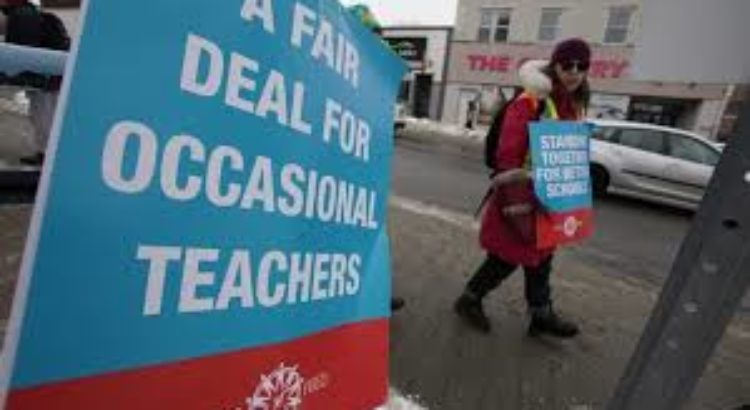
Over two million students will be out of class this Friday as Ontario’s four largest teacher unions plan to hold a joint one-day strike if there is no progress in contract talks with the provincial government.

The unions that will participate in Friday’s strike are the Elementary Teachers’ Federation of Ontario (ETFO), the Ontario Secondary School Teachers’ Federation (OSSTF), the Ontario English Catholic Teachers’ Association (OECTA) and the Association des enseignantes et des enseignants franco-ontariens (AEFO).

Classes are also cancelled on Monday for Family Day. At the moment, no strikes have been announced for Tuesday through Thursday.

Negotiations at a standstill

Contract negotiations between the Progressive Conservative government and the education unions have largely stalled with several major issues unresolved, including the role of seniority in hiring practices, class sizes, funding for students with special education needs and mandatory e-learning.

The unions are also asking for around two per cent in annual salary increases, while the government won’t budge beyond offering one per cent.

It passed legislation last year capping wage hikes for all public sector workers at one per cent for three years. The teachers’ unions and several others are fighting the law in court, arguing it infringes on collective bargaining rights.

See below for a list of eastern Ontario school closures for the upcoming week. Make sure to visit your school board’s website for the most up-to-date information.


Monday Feb. 17

Schools will be closed for Family Day.

Friday Feb. 21

Ottawa-Carleton District School Board

All OCDSB schools will be closed.

Extended Day programs and all Community Use of School permits will also be cancelled.

Ottawa Catholic School Board

All OCSB schools will be closed, unless an agreement is reached between the province and OECTA. All bus and van transportation will also be cancelled.

Before- and after-school programs will be cancelled for the day, although all Ottawa Catholic Child Care Corporation Toddler and Preschool programs and all EarlyOn Centres will be open and will operate according to their regular hours.

Community Use of Schools programming is not affected by the one-day provincial strike.

Catholic District School Board of Eastern Ontario 

All CDSBEO elementary and secondary schools will be closed to students.

Parents who have children that attend child care or before- and after-school care programs in CDSBEO facilities should contact their individual provider for details during the strike.

Upper Canada District School Board

All UCDSB students will have the day off as schools are closed.

Parents and guardians whose children attend a child-care facility at a UCDSB school should contact their child-care provider with any questions.

Boards across the province have cancelled classes on Friday, as teachers take part in an Ontario-wide one-day strike. (Raphael Tremblay/CBC)

Renfrew County District School Board

All elementary and secondary schools will be closed.

Child-care facilities may continue to operate. Parents and guardians should contact their operator to confirm whether they will remain open and if they’ll have additional child-care spaces during strike days.

Community-use bookings will continue as usual.

Limestone District School Board

All elementary and secondary schools will be closed, and students in Grades 9 to 12 should not attend school. This includes students in co-op and those attending dual credit and programs at St. Lawrence College.

Literacy and Basic Skills, Adult ESL and Teacher Assisted Self-Study programs will also not run.

Extra-curricular activities, field trips and all sports sanctioned by the Kingston Area Secondary Schools Athletic Association will be cancelled.

Hastings-Prince Edward District School Board 

Classes are cancelled for all students.

Algonquin and Lakeshore Catholic District School Board 

All ALCDSB schools will be closed to students.

Conseil des écoles publiques de l’Est de l’Ontario

Classes and school transportation will be cancelled.

Before- and after-school programs for toddlers, preschoolers and children ages four to 12 will not operate.

For daycare services operated by a third party, parents and guardians should contact the child-care service to check if they will remain open. Programs for infants, toddlers and preschoolers offered by third-party partners will be open.

Conseil des écoles catholiques du Centre-Est 

All classes will be cancelled.

Daycare centres for preschool children will remain open, except for l’Académie catholique Notre-Dame and l’École élémentaire catholique L’Envol, both of which will be closed.

Parents of school-aged children who require child care should contact their provider to learn if those centres will remain open.

All EarlyON Centres will be closed with the exception of:

  • l’École élémentaire catholique Jean-Robert-Gauthier.
  • l’École élémentaire catholique Des Voyageurs.
  • l’École secondaire catholique Béatrice-Desloges.
  • le Centre scolaire catholique Jeanne-Lajoie.

Source of the notice: https://www.cbc.ca/news/canada/ottawa/school-strikes-third-week-february-1.5464875

Comparte este contenido:

Exministra de Educación de Perú: «El gobierno va a seguir respaldando el enfoque de igualdad de género»

América del Sur/ Perú/ 18.02.2020/ Fuente: rpp.pe.

Flor Pablo Medina, hasta ayer titular de la cartera de Educación, descartó que su separación del cargo haya sido motivada por la crisis política originada por una reunión entre representantes de Odebrecht, ministros y funcionarios peruanos.

«Estos cargos son políticos y desde que uno ingresa pone su cargo a disposición y siempre la posibilidad de seguir o no está sujeta a decisión del presidente y del premier. Eso es un poco lo que ha pasado. Como explicó el presidente, han querido hacer una recomposición del gabinete de cara a lo que viene con la instalación del nuevo Congreso«, aseveró en Nada Está Dicho por RPP Noticias.

También, negó que tenga que ver con un posible rechazo al enfoque de igualdad de género de parte de grupos conservadores en el nuevo Parlamento. Es más, aseguró que la administración de Martín Vizcarra continuará «respaldando» esta política.

«Creo que no va por ahí, hay una política que hemos aprobado, está el currículo nacional… Si esa hubiese sido la situación, mi retiro hubiera sido antes. Creo que el enfoque ha sido respaldado, es una política de Estado y estoy convencida que este Gobierno va a seguir respaldando esa educación integral y ciudadana«.

La exministra rechazó, además, haber realizado un trabajo deficiente. «Estábamos haciendo un buen trabajo, hay razones de orden de evaluación política [para mi separación]…. Tengo la tranquilidad de que mi salida no fue por hacer un mal trabajo», expresó.

Renuncias y cambios en el Gabinete

El último jueves, todos los integrantes del Gabinete Ministerial que preside Vicente Zeballos pusieron sus cargos a disposición en medio del escándalo generado por el caso Gasoducto Sur.

Alrededor del mediodía se conoció que la titular de la cartera de Justicia y Derechos Humanos, Ana Teresa Revilla, renunció poco después de la imprevista destitución de Jorge Ramírez del cargo de procurador ad hoc del caso Lava Jato y de la salida de Juan Carlos Liu Yonsen del portafolio de Energía y Minas. Ambos cuestionados por participar de una reunión con representantes de la compañía Odebrecht.

Horas después, el ministro de Transportes y Comunicaciones, Edmer Trujillo, también presentó su renuncia. Se desconoce hasta el momento las razones.

Por la noche, se conoció que los nuevos titulares de las tres carteras, además del portafolio de Educación, jurarían ante el presidente Vizcarra en un ceremonia en Palacio de Gobierno. Martín Benavides, titular de la Superintendencia Nacional de Educación Superior Universitaria (SUNEDU), asumió el sector que dejó Flor Pablo.

Fuente de la noticia: https://rpp.pe/peru/actualidad/flor-pablo-exministra-de-educacion-el-gobierno-va-a-seguir-respaldando-el-enfoque-de-igualdad-de-genero-noticia-1245817

Comparte este contenido:
Page 1679 of 6821
1 1.677 1.678 1.679 1.680 1.681 6.821