Saltar al contenido principal
Page 2974 of 6815
1 2.972 2.973 2.974 2.975 2.976 6.815

Libro: Las Prácticas sociales del lenguaje en contextos de tradición indígena. El objeto de conocimiento antes de ser objeto de enseñanza.

Por: Diseño del sur. 23-05-2018

“La lectura de este libro nos invita a tomar conciencia de nuestra propia realidad social, re-encontrarnos con nuestra cultura, descolonizar nuestras mentes y abrir nuestro corazón. En sus páginas podemos encontrar algunas pistas o propuestas de cómo mirar y pensar nuestra cultura desde fuera y desde dentro, con el fin de ser capaces de observar, escuchar, registrar nuestras prácticas sociales del lenguaje: entender los códigos y reglas tácitas que le dan forma a nuestras interacciones sociales; descubrir los juegos simbólicos ocultos que le dan sentido pleno a nuestro discurso; comprender el porqué de la forma como hablamos, sus formatos; los propósitos que los rigen y las vitales funciones que cumplen, así como sus enseñanzas” (Eleuterio Olarte Tiburcio, p. 8)
Graciela Quinteros y Yolanda Corona (Coordinadoras) (2013) Las prácticas sociales del lenguaje en contextos de tradición indígena. El objeto de conocimiento antes de ser objeto de enseñanza. Universidad autónoma metropolitana.

Libro completo: practicas_sociales

Todo diseño del sur: https://goo.gl/4pJu9f

Fotografía: diseño del sur

Fuente: https://www.facebook.com/disenodelsur/photos/a.630673973675735.1073741830.606928462716953/1259906560752470/?type=3&theater

Comparte este contenido:

EEUU: Students inspire hope for bright future

By Brandon Butler/ duboiscountyherald.com/ 23-05-2018

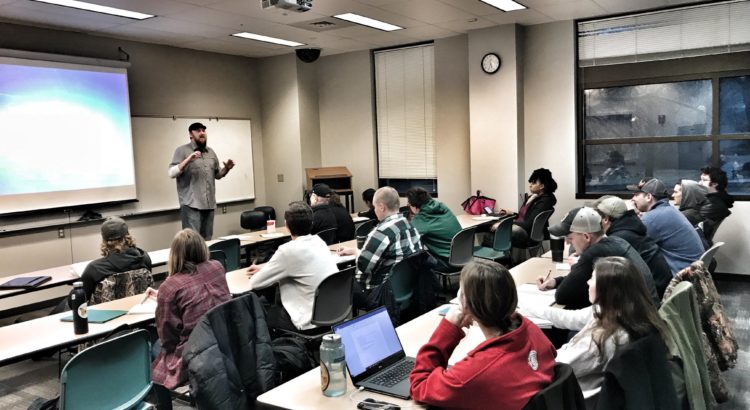
My first semester as an adjunct instructor ended last week. I taught a class I created called Communications in Natural Resources. It was an experience I’ll treasure forever. Over the course of 15 weeks, I came to realize if my students are a reflection of their generation, the future of our natural world is good hands.

I spend a lot of time talking and writing about topics relating to the outdoors, specifically fish and wildlife. Most of the time, I am not an expert on the subject. While I may know a little about a lot of things, it’s people who know a lot about one thing who communicators like me use as sources for stories. Unfortunately, too often, the expert sources are poor communicators. They possess incredible knowledge. Yet struggle to deliver what they know to the general public in a way that makes it relevant to the masses.

As a member of a Natural Resources Advisory Council, I have come to know and respect some of the challenges of higher education leadership. During a meeting last year, I was asked if I saw any opportunity to improve the curriculum. I suggested we do a better job of teaching these brilliant young minds how to tell their stories. I was empowered to create a curriculum and teach it.

To begin with, I examined beliefs I feel justified the need for this class. Number one being; no matter what your job is, communication is important. And the more prepared you are to offer input on the efforts of your work the more likely you are to build support for what it is you do and care about. Also, as far as personal advancement, if you become known as someone who can both complete the work and communicate the outcomes, you are much more valuable to the business, agency or organization you’re part of. Who would remember the revolutionary work of Aldo Leopold had he not written a “Sand County Almanac?”

I broke the course down into lessons about different communication platforms and had guest lecturers discuss their expertise. We covered magazine writing, letters to the editor and opinion pieces in newspapers, television and radio interviews, social media, websites, photography, public speaking and more.

Communication is critical in conservation, and not all citizens gather information in the same ways. Agencies have to communicate across the many different platforms from which the public consumes information. Through out the semester, guest speakers emphasized the importance of communications in all natural resource professions, the students listened and learned.

One great guest lecturer was my buddy Nathan McLeod who hosts a morning radio show. McLeod talked about how much he values natural resources and enjoys sharing messages of conservation with his listeners, but finds guests often struggle with the rapid fire pace of a radio interview. He wants guests on his show to talk conservation, but needs them to be fun and personable, and to talk in a way most people can relate to.

“Leave the rocket science at home,” McLeod said. “Give them the elevator speech. Quickly explain to listeners why this important and why they should care. Tell them how it impacts them personally.”

At the end of the class, students were paired into four groups with the assignment of building and implementing a communications plan around a natural resources topic of concern. The four topics they selected and worked on were: Open New State Parks, Reintroductions of Wildlife Species, Wildflowers in Urban Settings and The Effects of Climate Change on Wildlife. You can see the minds of tomorrow have their priorities.

I hope my students gained a better understanding of how important it is to communicate scientific knowledge in a way most citizens can understand. Our natural world faces incredible challenges requiring the support of the public to address and fix. Once these students are in professional roles, if I did my job, they will try a little harder to share their expertise.

See you down the trail…

*Fuente: https://duboiscountyherald.com/b/column-students-inspire-hope-for-bright-future

Comparte este contenido:

The Future of Higher Education Is Social Impact

How can we transform the university research enterprise to enhance its social impact?

Over the last decade, universities have faced steady criticism for elitist practices such as political bias, hoarding wealthy endowments, and providing insufficient economic returns for students. In light of this, institutions that turn their attention to serving the public good may be best poised to thrive and deliver lasting value. Some universities are embarking on innovations to support social engagement among students, and initiating university-wide efforts to educate students for social impact. These ideas rightly aim to prepare public-minded leaders for the future. But a powerful innovation is also available for the present: reshaping incentives within the university to support faculty research that responds to real-life challenges.

Typically, researchers are insulated from the criticisms of pundits and politicians who question whether universities deserve the status and privileges they enjoy. University faculty operate within a system that rarely asks them to prove their value to a broader public. Rather, academics are rewarded for developing and testing theories, and publishing findings in books and journals in their fields. Their charge is to generate knowledge, and many do so prolifically. But unlike in engineering and medicine, where transferring new knowledge into workable technology is often regarded as the ultimate professional accomplishment, such “tech transfer” is uncommon in the social sciences. Despite innovation in the content of research, research institutions in the social sciences have not been innovative when it comes to ensuring that the outside world uses research. Yet such innovation may be the key to social impact, and thus demonstrating the value of research to those who question its worth.

Some writers argue that social science research fails to break into the mainstream because it is not sufficiently timely, relevant, or accessible—and that is no doubt part of the story. But studies about the use of research paint a more complex picture. More than any quality of the evidence itself, it turns out that the quality of relationships between producers and consumers of evidence, as well as the intermediaries who knit evidence producers and consumers together, is at the heart of increasing research use in policy and practice. Universities do not typically reward faculty for the time and effort needed to build and nurture these relationships, but doing so would be a transformative step in increasing the positive social impact of academic research.

Relationships between producers and consumers of evidence are at the heart of increasing research use in policy and practice. (Photo by Tanya Braganti for the William T. Grant Foundation)

The idea that universities should foster relationships with and respond to their communities is not new. The University of Wisconsin-Madison, where I taught for three decades, has long promoted the notion that “the boundaries of the university are the boundaries of the state,” meaning that the university should produce knowledge that promotes a thriving social, cultural, political, and economic life across the state. While this notion persists, it has lately battled with a competing view among leading members of state government, who believe the primary role of the university is to prepare workers for the state’s labor market. Meanwhile, other large universities are making progress in developing and incentivizing the types of relationship-building that can improve and strengthen communities outside of campus. Rice University, for example, has adopted as one of its main goals to “engage Houston and empower its success,” proclaiming, “We will engage Houston as a focus and partner for research and education, leveraging our broad expertise on critical urban issues to be a driving force in enabling Houston’s success as a 21st-century metropolis.” Among the specific efforts supported by the university is the Houston Education Research Consortium (HERC), a partnership between the university and the Houston Independent School District that conducts research aimed at addressing the challenges of educating Houston’s urban population. Since 2013, HERC has provided 25 research reports to the district on topics such as English learners and school choice, the effectiveness of the district’s pre-kindergarten program, and predictors of high school dropout, and others. The district has used these reports its decisionmaking. Partnerships of this sort help strengthen communities by growing their human and social capital, while also brandishing the value of the university to the state and city: HERC and its parent organization have attracted considerable philanthropic support from civic-minded allies who support the university’s local engagement.

Without support at the institutional level, most university researchers have little professional incentive to participate in such partnerships or address questions more in line with local contexts. It is time for this to change. To spur such action and provide an example for universities across the nation, my colleagues and I at the William T. Grant Foundationrecently launched a grants competition for universities willing to re-think their incentive structures, and reward engaged scholarship and research-practice partnerships. TheInstitutional Challenge Grant program calls on universities to partner with a public agency or nonprofit, develop a joint research agenda, provide research fellows to execute the research, and build the capacity of the agency to use evidence from research in its decisionmaking. In addition, the grant asks that the university propose new ways to support and reward faculty members who participate in this type of work. For example, universities might provide teaching releases or summer salary, or count the influence of research on policy and practice in career advancement decisions.

After receiving bids from 41 institutions, in April we awarded the first grant to Cornell University, which is working in partnership with the Cornell Cooperative Extension of Tompkins County to address the opioid crisis in upstate New York, particularly the increasing rate of child maltreatment that has accompanied rising opioid addiction. Researchers will evaluate two evidence-based interventions based in the judicial and child welfare systems, and help providers develop effective responses to the problems they confront. Even before applying for the grant, Cornell had taken steps to engage its local community through auniversity initiative that fosters research and other activities with community partners. The current work will push the university even further in thinking about how to develop an infrastructure in which faculty are rewarded for participating in partnerships and conducting research that responds to community concerns.

Professors Laura Tach (foreground) and Rachel Dunifon of Cornell University and Anna Steinkraus (background) of Cornell Cooperative Extension of Tompkins County plan their partnership. (Photo courtesy of Cornell University)

Ultimately, pursuing positive social impact by harnessing the talent and knowledge of university faculty can turn around perceptions of the value of higher education. But faculty will need to become more fully engaged in directly responding to real-world problems. As currently structured, universities offer few rewards for researchers who participate in partnerships primarily designed to improve policy and practice. Reorienting incentives in the university—not to diminish theory-driven, internationally renowned studies, but to enhance the value and visibility of work that provides answers for those who confront the daily challenges of today’s world—can go a long way toward making the change possible.

*Fuente: https://ssir.org/articles/entry/the_future_of_higher_education_is_social_impact

Comparte este contenido:

Education trade unions enhancing gender equality in and through education Published: 15 May 2018

By: csee-etuce.org/23-05-2018

Addressing all aspects of gender equality in education and the teaching profession is essential, especially promoting gender equality through social dialogue and collective bargaining with a focus on increasing salaries and decent working conditions, concluded participants of the ETUCE Conference on “Enhancing gender equality in and through education” on 7-8 May 2018 in Baku, Azerbaijan.

The Conference was organised with the support of the ETUCE member organisation in Azerbaijan, the Independent Trade Union of Education Workers of the Azerbaijan Republic (AITUCEW). Minister of Education of the Republic of Azerbaijan Jeyhun Bayramov and President of Azerbaijan Trade Unions Confederation Satar Mohbaliyev addressed participants highlighting the importance of providing equal opportunities for men and women in education and socio-economic system of the Republic of Azerbaijan.

The Conference provided the opportunity for trade unions representatives from more than 15 countries to exchange experience and ideas on how education trade unions can address challenges for gender equality in education and the teaching profession, in particular in Central and Eastern European countries. Members from Poland, Tajikistan, Belarus, Bulgaria, Azerbaijan, Romania, Georgia, and Kazakhstan presented trade unions’ good practices looking at how to overcome gender stereotypes, enhance the representation and participation of women in decision-making in all education sectors, and make the teaching profession more attractive to both men and women.

European Director Susan Flocken highlighted that gender equality is one of the top priorities in ETUCE’s work: “ETUCE promotes gender equality within the teaching profession and seeks to provide education trade unions and education personnel with the knowledge and tools necessary to enhance gender equality in and through education in their national, regional and local contexts and to address new challenges for gender equality arising from technological, economic, and social changes in our societies”.

Participants also learned about gender mainstreaming actions and gender equality standards of the Council of Europe, presented by Dr Anne Nègre, Vice-President in charge of Equality of the Conference of INGOs in the Council of Europe. Gender equality challenges and their solutions in education system and in the society of the Republic of Azerbaijan were also presented by Jamilya Sattarova, President of the Republican Committee of the Trade Union of Cultural Workers of Azerbaijan.

During smaller working group sessions the conference participants discussed concrete education trade union activities aimed to promote a gender sensitive approach in education, challenge gender stereotypes in education and society as a whole, and overcome gender segregation among different education sectors and subjects.

*Fuente: https://www.csee-etuce.org/en/news/archive/2569-education-trade-unions-enhancing-gender-equality-in-and-through-education

Comparte este contenido:

La OCDE aboga por «conectar» universidades y mercado laboral para no generar «rebeldía» en jóvenes

OCDE/ 22 de mayo de 2018/Fuente: http://www.europapress.es

El secretario general de la Organización para la Cooperación y el Desarrollo Económicos (OCDE), Ángel Gurría, ha apostado por «poder conectar» los sistemas de la educación superior con el mercado laboral para evitar que los jóvenes sufran «frustración», que les lleve a la «rebeldía», tras terminar su formación y encontrarse con un panorama «con muy pocas oportunidades». Según sus palabras, esa falta de acceso a un puesto de trabajo tiene como resultado «frustración», «rebeldía» e incl …

Según sus palabras, esa falta de acceso a un puesto de trabajo tiene como resultado «frustración», «rebeldía» e incluso «rechazo a la democracia», pues esa «fragmentación» a nivel económico «provoca fragmentación de nivel social o político».

En esta línea, ha puesto como ejemplo los resultados que registraron la consulta para el ‘Brexit’ en Reino Unido, las elecciones en Estados Unidos, o «los siete meses para formar gobierno en Holanda, cinco en Alemania».

Incluso, Ángel Gurría, durante su intervención en la inauguración del Encuentro Universia en Salamanca, ha hecho referencia a los últimos resultados en las elecciones italiana o la «mayor fragmentación en cuanto a la voluntad electoral» en España. El secretario general de la OCDE, ya en alusión a la Universidad de Salamanca y a los asuntos a tratar en Universia, ha reseñado que «cada universidad es distinta, es diferente, es original, es única, pero las claves del éxito o del fracaso de las universidades tienen muchos elementos comunes».

Sobre esos aspectos que comparten las instituciones académicas, Ángel Gurría ha puesto de relieve los modelos de financiación; los sistemas de rendición de cuentas, con «más autonomía pero siempre más necesidad y obligación de rendir cuentas»; o los modelos de gobernanza y de selección del profesorado, con sistemas «abiertos y transparentes».

«Las universidades son las fábricas de habilidades, competencias y destrezas de nuestros jóvenes», ha apuntado el representante de la OCDE durante la apertura del encuentro Universia, al que asisten más de 600 rectores y representantes de universidades de 26 países diferentes.

Fuente de la Noticia:

http://www.europapress.es/sociedad/educacion-00468/noticia-ocde-aboga-conectar-universidades-mercado-laboral-no-generar-rebeldia-jovenes-20180521134033.html


Comparte este contenido:

ONU: Un fondo de 10.000 millones de dólares para alcanzar la educación universal

ONU/ 22 de mayo de 2018/Fuente: http://www.onunoticias.mx

El Secretario General de las Naciones Unidas, António Guterres, ha recibido este viernes a los embajadores de la juventud de la organización TheirWorld, acompañados por enviado especial de las Naciones Unidas para la Educación Mundial, Gordon Brown, declaró que “actualmente, no se pone suficiente énfasis en la educación universal ni en la financiación para educadores, servicios ni para el futuro de los niños”.

El titular ha manifestado el apoyo de la Organización a la propuesta de creación de un Servicio Financiero Internacional para la Educación, un mecanismo de inversión para cumplir con estos objetivos, que ha sido respaldada por el Banco Mundial y los bancos de desarrollo regional.

Fuente de la Noticia:

http://www.onunoticias.mx/un-fondo-de-10-000-millones-de-dolares-para-alcanzar-la-educacion-universal/

Comparte este contenido:

Argentina: La nueva Marcha Federal Educativa

Argentina/22 de mayo de 2018/Fuente: Internacional de la Educación

En el aniversario de la Marcha Blanca, los docentes se movilizan

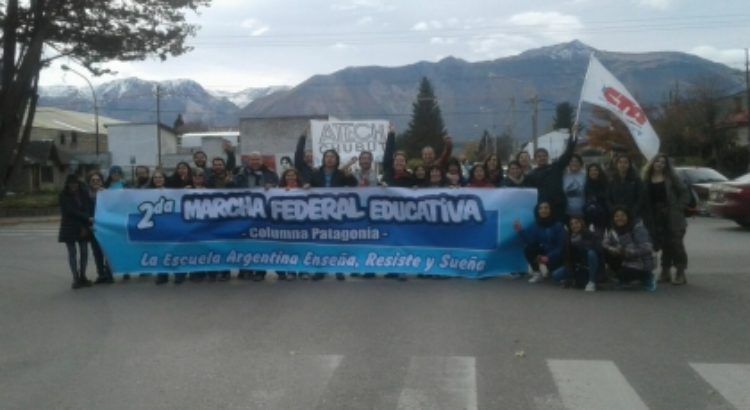
Sonia Alesso, Secretaria General de la Confederación de Trabajadores de la Educación de la República Argentina (CTERA), afiliada a la Internacional de la Educación América Latina, escribe sobre la Marcha Federal Educativa, que recorre las provincias argentina a partir de hoy lunes 21 de mayo y llegará a Buenos Aires el próximo 23 de mayo.

A 30 años de la histórica Marcha Blanca que irrumpió en la Capital llenando las calles de guardapolvos blancos de maestras y maestros de todo el país, este 23 de Mayo marchamos nuevamente en la 2º Marcha Federal Educativa.

Llegarán las columnas de las regiones más alejadas: Noroeste (NOA), Nordeste (NEA), Patagonia, Cuyo y Metropolitana. Miles de kilómetros recorridos por maestros y maestras, reclamando Paritaria Nacional Docente, resolución de los conflictos provinciales, no al cierre de los Institutos Superiores, nueva Ley de Financiamiento Educativo, no a los techos salariales que pretende imponer el Gobierno Nacional.

Porque no queremos nuevamente al FMI ordenando recetas de ajuste y hambre para las trabajadoras y trabajadores, ni para las personas jubiladas.

Marcha Federal Educativa

Marcharán a nuestro lado los estudiantes, la comunidad educativa, los papás y mamás, porque no nos resignamos a que la educación sea una mercancía.

El 23 de Mayo llegarán a Buenos Aires las columnas que recorrieron cada rincón de nuestra Argentina.

Con más de 100 actos en todo el país, desde las grandes ciudades hasta los pueblos más pequeños.

Esta marcha se viene construyendo en cada rincón de esta hermosa patria, viene de las montañas del norte argentino, de nuestros lagos patagónicos, del norte profundo de nuestra patria, de las escuelas rurales y de islas, a decir que no nos vamos a callar, que vamos a seguir luchando.

Y viene con nuestra identidad docente pintada en los muros de las carteleras de las escuelas, cantada en canciones, recitada en viejos poemas, recorriendo las calles en lo que llamamos “Pongamos la Escuela en Asamblea”, en las  jornadas que desde el 14 al 18 llevamos adelante en todo el país para terminar el 23 en Plaza de Mayo.

Esta marcha es también un homenaje a la lucha incansable del Magisterio Argentino. A 30 años de la Marcha Blanca, uno de los hitos de la lucha de CTERA, que significó la irrupción nacional de miles de maestros y maestras que exigíamos Paritaria Nacional y Financiamiento Educativo.

Porque no estamos dispuestos a asistir pasivamente a la destrucción de la Educación Pública, a su desfinanciamiento, a la falta de escuelas, a la falta de inversión educativa.

No estamos dispuestos a ver pasivamente cómo nuestros niños y niñas vuelven a los comedores escolares en todo el país.

Por eso esta Marcha Federal Educativa es esperanza y lucha por la defensa de la educación al servicio del pueblo. Porque, como cantamos en cada marcha. la escuela pública Enseña, Resiste y Sueña.

La educación está en peligro. De todos y todas dependen su presente y su futuro.

Fuente de la Noticia:

http://www.ei-ie-al.org/noticias/argentina-la-nueva-marcha-federal-educativa

Comparte este contenido:
Page 2974 of 6815
1 2.972 2.973 2.974 2.975 2.976 6.815
OtrasVocesenEducacion.org