Page 10 of 44
1 8 9 10 11 12 44

Inglaterrra: Teaching assistants could take industrial action

Fuente: tes.com / 8 de junio de 2016

GMB union to consult on a campaign against the ‘dismantling’ of terms and conditions

Teaching assistants in England are to be consulted by the GMB union over a campaign of action in a row about terms and conditions – a move that raises the prospect of coordinated industrial action by teachers and other staff.

The annual conference of the GMB in Bournemouth agreed to support efforts to retain «hard-fought» terms and conditions of school staff, including a campaign of industrial action if necessary.

The NUT teaching union is balloting its members over strike action against threats from academisation, deregulation of pay and funding cuts.

‘We will not stand by’

The GMB union said schools continued to be privatised, leading to the threat of cuts to the terms and conditions of staff. It is campaigning against schools being turned into academies.

An agreed motion read: «We will not stand by and let this Tory agenda dismantle our members’ terms and conditions brick by brick, class by class, where schools will be left with no alternative but to compete against one another.»

Enlace original: https://www.tes.com/news/school-news/breaking-news/teaching-assistants-could-take-industrial-action


Comparte este contenido:

Universities should ask whether their academics work too much

Fuente: Times Higher Education / 8 de junio de 2016

Scholars say they feel overwhelmed by demands, but there is scandalously little evidence on whether long hours make any sense for knowledge workers, finds David Matthews

Since I started reporting on research last summer, I’ve been surprised by how evidence-lite major bits of science policy seem to be.

For example, last November, I analysed the new Francis Crick Institute in London, a £700 million biomedical “superlab”. Its radically flat organisational structure and high levels of scientific freedom are based not on reams of experimental data on researcher productivity, but (at least in part) on the personal experiences of the chief executive, Sir Paul Nurse, in leading other institutions.

Read more: The Francis Crick Institute: science and serendipity 

Of course this isn’t to say the Crick won’t be a huge success, or that Sir Paul’s experiences aren’t useful guides. But, as I was told by Julia Lane, a professor of practice at New York University’s Center for Urban Science and Progress, “one of the things that gives one pause is that scientists don’t apply the scientific method to their own activities”.

This quote came to mind as I was writing an analysis that asks: how many hours a week should an academic work? It’s clear that faculty, particularly in the US, are putting in hours well above average (one recent study suggested 61 a week, including 10 on the weekend). Some are working even longer, as suggested by a recent blog that argued “you do not need to work 80 hours a week to succeed in academia”.

The research on optimum working hours is pretty patchy, particularly for knowledge workers (and if readers know of any relevant papers, please let me know). But there was nothing I could find that suggests someone toiling 80 hours a week can be as productive as a colleague doing half that, and plenty of research showing long hours leads to accidents and illness (see the conclusion of this paper).

Most gobsmacking of all was an ethnographic study of 100-hour-a-week Wall Street bankers by Alexandra Michel, a former Goldman Sachs employee herself, and now a professor at theUniversity of Pennsylvania.

Some of the quotes from bankers struggling to overcome the physical limits of their bodies in a never-ending work culture could have come straight from Patrick Bateman. Others are much more tragic.

‘‘I totally believe in mind over matter. There are no such things as physical needs. Tell me one physical need and I can tell you a culture in which they have controlled it,” one banker told Michel.

‘‘I fell on my way to a meeting. The leg changed color and I had pain but I chose not to think about it until after the meeting,” explained another. Her leg was broken in two places.

By year six, the latter banker had developed multiple new allergies, suffered from joint and back pain, heart problems and ovarian cancer, and had numerous unshakable colds and flu. Work forced her to miss the funeral of a beloved grandfather. ‘‘I feel like the creative juices are just gone,” she said. But she was still socialised by the bank’s culture: ‘‘I work hard because this work is who I am.’’

Academics can’t be blamed for overwork any more than can these bankers. Many surely feel trapped in a culture that lionises hyper-long hours, with anything else seen as a lack of commitment (Michel told me working at the weekend is seen as a “badge of honour” for faculty.)

Instead, it should be up to universities as employers to measure how long their faculty are working, and test whether there is any basis for them to work 50, let alone 80, hours a week.

You wouldn’t expect a Wall Street bank to do this. But the academy is supposed to adhere to higher standards of evidence. Understanding whether the nine-to-five (which is, after all, a hangover from the Fordist era of manufacturing) makes any economic or social sense in a knowledge economy strikes me as one of the most pressing research questions of our time.

Comparte este contenido:

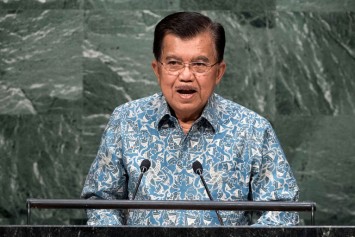
Los educadores indonesios hallan a un aliado en el Vicepresidente

Fuente: Internacional de la educación / 8 de Junio de 2016

Tras reunirse con el Vicepresidente del país, los líderes del sindicato de docentes Persatuan Guru Republik ya cuentan con un representante político que les apoya en su lucha para reforzar la profesión docente y un sistema educativo de calidad.

El Vicepresidente de Indonesia ve en el sindicato educativo un socio estratégico del gobierno para mejorar la educación
«Docentes y entornos y sistemas educativos deben coexistir en armonía porque son los principales activos educativos y se ayudan mutuamente en su desarrollo», afirmó el Vicepresidente indonesio Jusuf Kalla en el evento «Diálogo educativo: educación nacional y mejora del papel del sindicato Persatuan Guru Republik de Indonesia (PGRI) ante el cambio» celebrado en Yakarta el pasado 27 de mayo.
Después de recordar que la sociedad está exigiendo una mejora en la calidad docente, reconoció que, por otra parte, los propios docentes luchan por mejorar sus condiciones laborales. Kalla destacó que, como organización profesional, el PGRI debería seguir apoyando la mejora de la calidad de los docentes y el sistema educativo nacional. También reafirmó que el gobierno aún considera al PGRI un socio estratégico necesario para el progreso educativo. El PGRI debería hacer patentes sus logros con respecto al fomento de la mejora de la calidad docente y la educación nacional.
En cuanto a los docentes, Kalla explicó que se debe tratar de forma inmediata el problema de su distribución desigual. La educación, cuya gestión se delegó en su día al gobierno regional, tendría que regularse para que los docentes puedan trasladarse de una zona a otra, primero en el ámbito provincial y luego en las propias ciudades.
PGRI: mejorar la calidad de los docentes y la educación
La Presidenta interina del PGRI, Unifah Rosyidi, destacó que, como organización profesional docente, el PGRI sigue trabajando para mejorar la calidad de los docentes y la educación.
Puntualizó, además, que el Vicepresidente «está muy preocupado por la educación y reconoce la importancia de la sinergia existente entre el gobierno, los docentes y los directores de centros escolares. Si los avances en la educación son un indicador del progreso nacional, el estándar será un docente cualificado y entregado».
El PGRI es un socio estratégico del gobierno; los docentes y directores de todos los niveles están comprometidos con la mejora de la calidad de la educación nacional, los educadores y los estudiantes, remarcó.
Además de indicar que hay que llevar a cabo un análisis completo de la situación de los docentes, detalló que la escasez en el número de profesores se da principalmente en la educación primaria y que la autoridad para aumentar los salarios de los docentes reside en los gobiernos locales. Explicó que existe una disposición para proteger a la profesión docente mediante el establecimiento de un «salario mínimo del docente profesional».
Por otra parte, añadió, el PGRI exige una protección legal para dicha profesión «dado que muchos docentes que han intentado castigar a sus alumnos están cumpliendo condena en la cárcel». El sindicato está convencido de que dichos profesores no tenían intención de hacer daño a sus alumnos. Además, el PGRI tiene un compromiso para fomentar que los docentes cambien sus métodos educativos hacia un sistema apropiado para el desarrollo de los niños y respetuoso con ellos.
IE: PGRI, una organización profesional de docentes centrada en la educación pública de calidad para todos
«En nombre de la Oficina regional de Asia-Pacífico de la Internacional de la Educación (IE), queremos felicitar al PGRI, así como a sus comités nacionales y provinciales, y a usted por iniciar un diálogo muy fructífero con el Vicepresidente de la República de Indonesia», manifestó Bala Singh, Coordinadora regional de la IE para Asia-Pacífico en un mensaje que envió a Unifah Rosyidi el 31 de mayo.
Por otra parte, destacó que el «gesto de amabilidad del Vicepresidente del país al iniciar un diálogo con el PGRI en su sede» supone una «señal positiva» para el sindicato, sobre todo con el fin de poner de manifiesto varios de los problemas a los que se enfrentan los docentes, además de sus exigencias, como la escasez de personal, la profesionalidad de los docentes, los contratos, la ausencia de reconocimiento de su condición laboral y la falta de protección salarial. Añadió que la IE apoya «la lucha del PGRI para convertirse en una organización de docentes profesional y su compromiso por ofrecer una educación pública de calidad para todos a través de la designación de docentes profesionales con cualificaciones de renovación frecuente y unas condiciones laborales decentes».

Comparte este contenido:

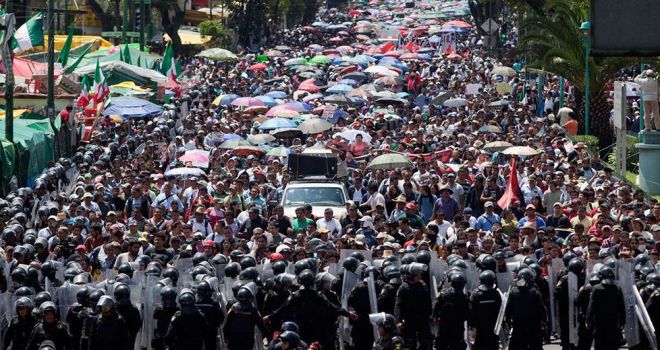
México: Brutal represión a maestros en Chiapas (VÍDEO).

Fuente: Insurgencia Magisterial / 7 de Junio de 2016

Así reprime el sargento Nuño a maestros hoy en Chiapas.

Cualquiera que ve estas imágenes podría pensar que es Libia, Palestina, Siria o Israel en conflicto religioso o de territorio.

Es México, es Chiapas, es el estado más pobre de la patria mexicana defendiendo con heroísmo el carácter público de la educación.

Puede verse también como la sociedad civil es víctima del uso indiscriminado de bombas de gases lacrimógenos.

Fuente: https://www.facebook.com/pavelguevarae/posts/1119480408095815

https://youtu.be/H7I_Pw1DMCc


Comparte este contenido:

Ofsted issues warning about education in the East Midlands

Fuente: www.gov.uk / 7 de junio de 2016

Educational provision for thousands of children in the East Midlands is distinctly second division, Ofsted warns.

Low standards in schools across the East Midlands region of England are exposing the educational fault line dividing the nation, Ofsted’s Chief Inspector said today.

Sir Michael Wilshaw highlighted figures showing the East Midlands as the worst performing region in the country on a range of key indicators.

He blamed a culture of complacency and a lack of clear accountability for the poor educational performance of towns and cities across the region and across all phases.

Sir Michael made his comments on the same day that Ofsted’s Regional Director for the East Midlands, Chris Russell, published an open letter to all those responsible for education in Northamptonshire. In the letter, he sets out his deep concerns about the low standards of achievement across the county.

Chris Russell said that far too many children and young people in Northamptonshire are being deprived of the opportunity to gain a good education, with weaknesses in the quality of provision persisting across every age group.

Sir Michael pointed out that these problems are not confined to this one local authority area, but are mirrored in a number of neighbouring towns and cities, and across the East Midlands region as a whole. For example:

  • the East Midlands is currently the joint lowest performing Ofsted region in terms of inspection outcomes, with almost one in three secondary schools judged less than good at their last inspection
  • the region had the worst GCSE results in England in 2015; nearly 46% of pupils did not achieve the benchmark five or more A* to C grades including English and maths
  • nearly 73% of East Midlands’ pupils eligible for free school meals (FSM) failed to achieve this benchmark
  • in the East Midlands children in care did worse than in any other region; just 10.2% of them achieved 5 or more A* to C grades in GCSE examinations, including English and maths.

Across the different phases of education, children in some of the region’s major urban areas and shire counties fare particularly badly:

  • Leicester is the poorest performing local authority in the country for pupil outcomes at the end of the Early Years Foundation Stage – with only 51% of the city’s children achieving a good level of development, compared with 66% nationally
  • Nottingham is England’s poorest performer in the phonics screening check at key stage 1 – just 69% of the city’s six and seven-year-olds met the required standard in 2015. In Derby, the figure was just 70%, compared with 77% of pupils nationally
  • Northamptonshire is one of the worst-performing local authority areas in the country for the achievement of disadvantaged children at key stage 2. Only 59% of FSM pupils in the county achieved the expected standards in reading, writing and mathematics at the end of primary school compared with 66% nationally. Their peers in Lincolnshire, Leicestershire and Derby fared nearly as badly, with just 60% achieving the expected standards
  • Derby and Nottingham were among the 10 lowest ranking local authority areas nationally for GSCE examinations – only 47.6% and 42.4% of pupils respectively achieved the benchmark five or more A* to C grades including English and maths in 2015

Sir Michael Wilshaw said:

These statistics should serve as a wake-up call. The poor quality of education in many parts of the East Midlands often passes under the radar as attention is focused on underperformance in the bigger cities of the North and West Midlands, like Manchester, Liverpool and Birmingham.

However, in many ways, the problems in this region symbolise more than anywhere else the growing educational divide between the South and the rest of England that I highlighted in my last Annual Report.

The Chief Inspector pointed out that there are very few high performing multi-academy trusts (MATs) in the region, while the support and challenge to schools from local authorities has not led to rapid enough improvement.

Sir Michael argued that there has been a collective failure by education and political leaders in the region to tackle mediocre provision and a culture of low expectations. While this is a particular problem among low income White British communities, the low level of GCSE attainment in places like Leicester – an area with a minority white British population – demonstrates that this extends beyond one ethnic group.

There are some bright spots across the region that are bucking these trends. Babington Community College, Leicester; Dronfield Henry Fanshawe and Chapel-en-le-Frith, both in Derbyshire are all outstanding secondary schools doing their best for their students. Meanwhile, outstanding primaries include Christ the King Primary School in Leicester City, Norbridge Primary in Worksop, Nottinghamshire and Carlton Road Academy in Boston, Lincolnshire. However, examples such as these are too scarce in the East Midlands.

Sir Michael said:

National politicians and policymakers must start to worry more about what is happening north of the Wash. They should be asking why schools in large parts of the East Midlands aren’t doing better.

Derby, the home of Rolls Royce, has a proud history of engineering excellence, but local secondary schools are failing to deliver top rate GCSE results.

Nottingham has three widely respected initial teacher education providers on its doorstep, but at primary level its phonics results are the worst in the country. At secondary level, its schools are amongst the poorest performers for GCSE examinations.

Leicester, meanwhile, has enjoyed great sporting success and is home to the new champions of English football. Yet when it comes to education, its ambitions and achievements are decidedly second division.

Our future prosperity as a nation depends on us delivering a better quality of education to all our children, wherever they live. As things stand, too many schools in the East Midlands are failing to equip young people with the knowledge and skills the country needs to keep pace with its international competitors.

As Chief Inspector, I am calling on local politicians across the region to do significantly more to challenge and support their local schools, regardless of whether they are academies or under local authority control.

Sir Michael’s view is echoed by Ofsted East Midlands Regional Director Chris Russell in his letter to the main education players in Northamptonshire.

Mr Russell says:

Across Northamptonshire there are too many early years providers and schools of all types and phases that are not good enough.

As a result, children do not achieve as well as they should. Disadvantaged children in the county are performing particularly poorly. There needs to be greater oversight and co-ordinated action from those accountable for educational provision in the county.

Note to editors

Read the letter from Chris Russell.

Yesterday, Chris Russell addressed the East Midlands Challenge conference in Nottingham, where he spoke about Ofsted’s views on what inspectors look for. Mr Russell also discussed priority learner groups and what good practice inspectors have seen around the region. This conference was aimed at Teaching School Alliances.


link original https://www.gov.uk/government/news/ofsted-issues-warning-about-education-in-the-east-midlands

Comparte este contenido:
Page 10 of 44
1 8 9 10 11 12 44