Page 135 of 144
1 133 134 135 136 137 144

OP-ED: Restoring Free Tuition fees. Why Education Is The Great Equalizer

By John Horgan

Premier of British Columbia,

Education is the great ePqualizer. It opens the door to a good-paying job, and a secure future. We need to give help, hope and opportunity to people who want to get a basic education to learn the skills they need to join the workforce and build a better life for themselves and their families.

That journey starts with opening the doors to adult basic education and English language learning. These programs should be within reach for everyone, from new Canadians and recent immigrants, to students preparing for university and adult learners upgrading their skills for work.

The previous government put up barriers to a basic education when they introduced tuition fees for Adult Basic Education and English Language Learning in 2015. Fees were set by each institution, but could cost up to $1,600 per semester of full-time studies, which is the same as the average cost for an arts and science degree program.

Many people could not afford to pay these new tuition fees. As a result, enrolment in Adult Basic Education and English Language Learning programs dropped 35% from more than 10,000 students a year to just under 6,700 students a year.

We cannot afford to shut thousands of people out of opportunity. Families can’t afford it. And B.C.’s economy can’t afford it. Our long term economic growth depends on an educated and skilled workforce.

 This is why our government is removing the roadblocks to education by eliminating tuition for adult basic education and English language learning starting September 1, 2017. This change will open the doors to tens of thousands of British Columbians to upgrade their education and skills each year.

By investing in education and opportunity for people, we are making a long-term investment in our economy and our future.

We will continue to make changes that give families relief from high costs and fees, and invest in better services that give people help and hope for a better life.

Source:
Lea más en http://thelinkpaper.ca/?p=64475#GFWP3vYdcKTqe4c0.99

Comparte este contenido:

The future of 3D printing in education

By: Simon Biggs

In the 1950s, the slide rule was the most commonly used classroom tool for mathematical and engineering calculation, but by the mid 1970s, the newer technology – the electronic scientific calculator – made the slide rule almost obsolete. Since then, there has been an explosion of new technologies hitting the classroom for engineering and mathematical learning including the computer, the iPad and more recently 3D printers.

3D printing is a well-established industrial technology for prototyping and manufacturing, particularly popular with the aerospace and defence sectors. Also known as additive manufacturing (AM), 3D printing is the process of making a solid 3D object from a digital computer aided design (CAD) file. The printer adds successive layers of material together until the final object has been created. This is different from traditional manufacturing methods like CNC machining, which removes material from a solid block using rotating tools or cutters.

3D printing is a rapid production method with minimal waste material. Its design flexibility means users can manufacture bespoke objects for a low cost. These advantages have made it increasingly popular as a production method in the manufacturing industry.

“Exciting and innovative projects are a simple way to keep pupils engaged in STEM subjects, which is a vital step forward in addressing the skills shortage”

Understanding and using this growing technology can benefit children’s learning, particularly in science, technology, engineering and mathematics (STEM) subjects but also beyond these more traditional fields in music, design technology, history, geography and biology. In 2013, a pilot project introduced 3D printers into 21 schools to investigate learning through 3D printing. This project highlighted the need for robust training and good technical support for the widespread incorporation of 3D printing into the curriculum to be successful.

This project confirmed the potential for 3D printers as a teaching resource, providing that teachers can access adequate training for the technology. Many of the schools reported increased pupil motivation when engaged in 3D printing projects. Exciting and innovative projects are also a simple way to keep pupils engaged in STEM subjects, which is a vital step forward in addressing the STEM skills shortage. Since the pilot project in 2013, 3D printing has become more accessible and popular as a classroom technology.

The rise of 3D printers in schools

The increasing numbers of 3D printers in schools is not only due to the increasing recognition of 3D printing being a relevant and engaging educational tool, but also relates to the number and availability of low cost 3D printing machines. It is now possible for schools to buy a 3D printer for around £500, whereas previous versions were cost prohibitive. The decreasing price tag is drastically improving the technology’s pick up in the education sector.

Advances in resources available for teachers and other education professionals are also making 3D printing more widely accessible. Teachers can now download design software and access it via tablets and mobile phones. Easy tutorials for beginners are available for those without basic knowledge of the technology.

3D printing software is considerably more user friendly than it was two years ago, which makes it ideal for younger children to grasp. Innovative apps for mobile phones and tablets make it easy and efficient to create designs and send them to a 3D printer for production. These apps build up students’ skills using design platforms. However, the primary reason the technology is able to positively influence the learning process in design is the ability to learn through trial and error.

Developing new skills

Using 3D printing as a production method enables students and pupils to move from the conception of an idea to producing a physical object with relative ease. The technology provides the ability to produce a part quickly, which is an advantage for students learning about design, particularly the limitations and constraints of the different technologies. Interrogating a physical object can make it easier for pupils to spot mistakes in designs. This allows them to gain valuable problem solving skills in a creative, hands-on way; without the ability to print prototypes, it would be considerably more difficult for students to identify weaknesses in their designs and improve upon them.

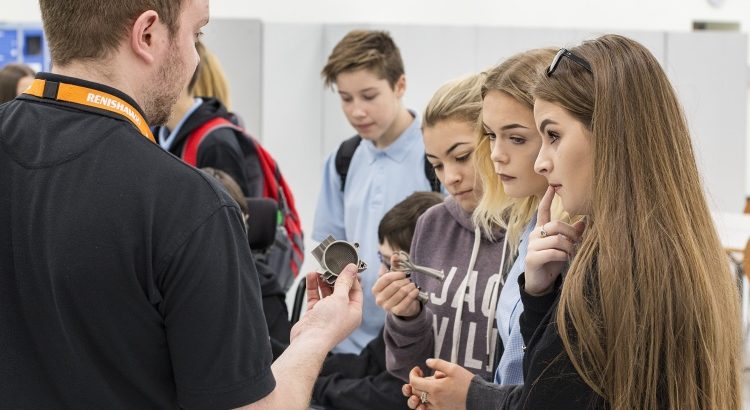
In recent years, the price of consumer 3D printers has dropped as the market has expanded. This makes the purchase of a machine easier to justify in the education sector, but for those schools that feel unable to justify the cost of owning a 3D printer despite recognising the benefits it can offer to learning, a purchase is not always necessary. Facilities such as the Fabrication Development Centre (FDC) at the Renishaw Miskin site, near Cardiff, contains five 3D printers that local schools use during their design and technology lessons.

Believed to be the only facility of its kind in the UK that is attached to a manufacturing site, Renishaw’s FDC enriches pupils’ learning experience further by showing them how industrial metal additive manufacturing machines are made and used to produce medical devices and dentures within the co-located Healthcare Centre of Excellence. This gives students the opportunity to see Renishaw manufactured metal 3D printers in action — producing objects such as dental frameworks and facial implants. Students are able to relate their learning in the classroom with practical applications in industry, a link that may otherwise be difficult to grasp.

3D printing has a number of benefits to a wide range of school subject areas, from design and technology to physics and even model building for subjects such as biology and geography. A major hurdle to overcome in the education sector was mastering 3D printing machines. However, the emergence of simple software packages and the availability of online tutorials have greatly improved accessibility to the technology. With the reduction in cost of materials and printers, and schools’ focus on active learning and addressing the skills gap, it would be logical for 3D printers to become a widely used educational tool in years to come. Who knows, they might even prove as popular as the electronic calculator.

Source:

https://www.theengineer.co.uk/3d-printing-education/

Comparte este contenido:

Need more social spending on health, education: Survey

Survey

Spending on social services in India grew by 11.5 per cent to Rs 11,18,094 crore in 2016-17, but the country needs to strengthen social infrastructure by investing in health and education as it is emerging as a knowledge-based economy, Economic Survey said today.

The mid-year survey, tabled in Parliament, also said that although India’s social policies have focused on welfare of the people, challenges remain in overcoming social and economic barriers to advance capabilities of the marginalised, women and other weaker sections of the society.

The total expenditure on social services, including art and culture, family welfare, housing, urban development, welfare of SCs, STs and OBCs, besides health and education, was Rs 10,02,591 in 2015-16, it said.

Expenditure on education has grown from 2.8 per cent in 2014-15 to 3.2 per cent of the GDP in FY17, while health sector saw it going up up from 1.2 per cent in 2014-15 to 1.5 per cent in the last fiscal, Economic Survey said.

«The expenditure on social services by the Centre and States as a proportion of GDP which remained stagnant in the range of 6 per cent during 2011-12 to 2014-15, recorded an increase of 1 percentage point during 2015-16 and 2016-17,» the survey tabled said.

As percentage to GDP, the expenditure on social services was at 7.4 per cent during the fiscal.

While expenditure of education during the fiscal stood at Rs 4,74,672 crore as against Rs 4,23,171 crore previous fiscal, health sector saw expenses of Rs 2,21,466 crore compared to Rs 1,91,141 crore in FY16, as per the survey.

«India is emerging as a knowledge based economy, poised for double digit growth, and needs to strengthen social infrastructure by investing in health and education,» said the survey authored by Chief Economic Adviser Arvind Subramanian.

Stating that on the Global Hunger Index (GHI) 2016, India ranks 97 out of 118 developing countries with prevalence of stunting among children aged below 5 years at around 39 per cent, the survey said it requires effective investments in social infrastructure in order to achieve the Sustainable Development Goals (SDGs).

Besides, the survey said, India’s rank in Human Development Index (HDI) is at 131 out of 188 countries as per HDR, 2016, leaving much to be desired.

It said the government is committed to achieving SDG for health that ensures healthy lives for all at all ages by 2030. Towards this, it has formulated the National Health Policy, 2017, which aims at attaining the highest level of good health and well-being, through preventive and promotive health care orientation. PRJ RKL SA

Source:

http://timesofindia.indiatimes.com/business/india-business/need-more-social-spending-on-health-education-survey/articleshow/60021429.cms

Comparte este contenido:

KZN Education: School failed to properly deal with brutal school attack

 South Africa/August 15, 2017/ By: Ziyanda Ngcobo/Source: http://ewn.co.za

The KwaZulu-Natal Education Department says it’s established that the brutal attack on a pupil happened last November but the school failed to properly deal with the issue at the time.

In a video of the incident currently circulating on social media, a schoolboy can be seen pinning the girl against a wall before tripping her and then kicking her in the head and back several times.

Provincial education officials visited the Siyathuthuka School in Inanda on Friday.

KZN Education’s Muzi Mahlambi says the school did not investigate the matter properly last year and the department has now launched its own probe.

“Based on the findings of our investigation, we will then take appropriate and relevant action that needs to be taken. Obviously, with the perpetrator … he needs to be disciplined.”

Relatives of the victim, who was in grade 10 at the time of the incident, say they’re disappointed in police whom they claim failed to take action against the boy.

The family says this forced them to move the girl to another school.

The perpetrator has also changed schools since the incident but his whereabouts still need to be confirmed by the department.

Mahlambi says the person who took the video will be key in tracking down the boy.

“The one who’s laughing still goes to that school but when we went to his class, he jumped out of the window. That’s the boy we’re going to use to lead us to the other perpetrators.

The provincial Education Department says it will begin a new investigation on Monday.

Source:

http://ewn.co.za/2017/08/11/kzn-education-school-failed-to-properly-deal-with-brutal-school-attack

Comparte este contenido:

The United States’ War on Youth: From Schools to Debtors’ Prisons

By: Henry A. Giroux

If one important measure of a democracy is how a society treats its children, especially poor youth of color, there can be little doubt that American society is failing. As the United States increasingly models its schools after prisons and subjects children to a criminal legal system marked by severe class and racial inequities, it becomes clear that such children are no longer viewed as a social investment but as suspects. Under a neoliberal regime in which some children are treated as criminals and increasingly deprived of decent health care, education, food and  housing, it has become clear that the United States has both failed its children and democracy itself.

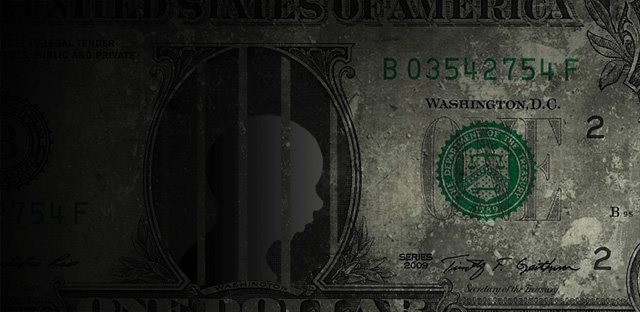
Not only is the United States the only nation in the world that sentences children to life in prison without parole, the criminal legal system often functions so as to make it more difficult for young people to escape the reach of a punishing and racist legal system. For instance, according to a recent report published by the Juvenile Law Center, there are close to a million children who appear in juvenile court each year subject to a legal system rife with racial disparities and injustices. This is made clear by Jessica Feierman, associate director of the Juvenile Law Center in her report «Debtors’ Prison for Kids? The High Cost of Fines and Fees in the Juvenile Justice System.» In an interview with the Arkansas Times, Feierman said:

Racial disparities pervade our juvenile justice system. Our research suggests that we can reduce those disparities through legislative action aimed at costs, fines, fees, and restitution … In every state, youth and families can be required to pay juvenile court costs, fees, fines, or restitution. The costs for court related services, including probation, a «free appointed attorney,» mental health evaluations, the costs of incarceration, treatment, or restitution payments, can push poor children deeper into the system and families deeper into debt. Youth who can’t afford to pay for their freedom often face serious consequences, including incarceration, extended probation, or denial of treatment — they are unfairly penalized for being poor. Many families either go into debt trying to pay these costs or forego basic necessities like groceries to keep up with payments.

According to the report, sometimes when a family can’t pay court fees and fines, the child is put in a juvenile detention facility. Such punitive measures are invoked without a degree of conscience or informed judgment as when children are fined for being truant from school. In her article in Common Dreams, Nika Knight pointed to one case in which a child was fined $500 for being truant and because he could not pay the fine, «spent three months in a locked facility at age 13.» In many states, the parents are incarcerated if they cannot pay for their child’s court fees. For many parents, such fines represent a crushing financial burden, which they cannot meet, and consequently their children are subjected to the harsh confines of juvenile detention centers. Erik Eckholm has written in The New York Times about the story of Dequan Jackson, which merges the horrid violence suffered by the poor in a Dickens novel with the mindless brutality and authoritarianism at the heart of one of Kafka’s tales. Eckholm is worth quoting at length:

When Dequan Jackson had his only brush with the law, at 13, he tried to do everything right. Charged with battery for banging into a teacher while horsing around in a hallway, he pleaded guilty with the promise that after one year of successful probation, the conviction would be reduced to a misdemeanor. He worked 40 hours in a food bank. He met with an anger management counselor. He kept to an 8 p.m. curfew except when returning from football practice or church. And he kept out of trouble. But Dequan and his mother, who is struggling to raise two sons here on wisps of income, were unable to meet one final condition: payment of $200 in court and public defender fees. For that reason alone, his probation was extended for what turned out to be 14 more months, until they pulled together the money at a time when they had trouble finding quarters for the laundromat.

Not only do such fines create a two-tier system of justice that serves the wealthy and punishes the poor, they also subject young people to a prison system fraught with incidents of violent assault, rape and suicide. Moreover, many young people have health needs and mental health problems that are not met in these detention centers, and incarceration also fuels mental health problems.

Suicide rates behind bars «are more than four times higher than for adolescents overall,» according to the Child Trends Data Bank. Moreover, «between 50 and 75 percent of adolescents who have spent time in juvenile detention centers are incarcerated later in life.» Finally, as the «Debtors’ Prison for Kids Report» makes clear, kids are being sent to jail at increasing rates while youth crime is decreasing. The criminal legal system is mired in a form of casino capitalism that not only produces wide inequalities in wealth, income and power, but it also corrupts municipal court systems that are underfunded and turn to unethical and corrupt practices in order to raise money, while creating new paths to prison, especially for children.

Debtors’ prisons for young people exemplify how a warfare culture can affect the most vulnerable populations in a society, exhibiting a degree of punitiveness and cruelty that indicts the most fundamental political, economic and social structures of a society. Debtors’ prisons for young people have become the dumping grounds for those youth considered disposable, and they are also a shameful source of profit for municipalities across the United States. They operate as legalized extortion rackets, underscoring how our society has come to place profits above the welfare of children. They also indicate how a society has turned its back on young people, the most vulnerable group of people in our society.

There is nothing new about the severity of the American government’s attack on poor people, especially those on welfare, and both political parties have shared in this ignoble attack. What is often overlooked, however, is the degree to which children are impacted by scorched-earth policies that extend from cutting social provisions to the ongoing criminalization of a vast range of behaviors. It appears that particularly when it comes to young people, especially poor youth and youth of color, society’s obligations to justice and social responsibility disappear.

Modeling Schools After Prisons

We live at a time in which institutions that were meant to limit human suffering and misfortune and protect young people from the excesses of the police state and the market have been either weakened or abolished. The consequences can be seen clearly in the ongoing and ruthless assault on public education, poor students and students of color. Schools have become, in many cases, punishment factories that increasingly subject students to pedagogies of control, discipline and surveillance. Pedagogy has been emptied of critical content and now imposes on students mind-numbing teaching practices organized around teaching for the test. The latter constitutes both a war on the imagination and a disciplinary practice meant to criminalize the behavior of children who do not accept a pedagogy of conformity and overbearing control.

No longer considered democratic public spheres intended to create critically informed and engaged citizens, many schools now function as punishing factories, work stations that mediate between warehousing poor students of color and creating a path that will lead them into the hands of the criminal legal system and eventually, prison. Under such circumstances, it becomes more difficult to reclaim a notion of public schooling in which the culture of punishment and militarization is not the culture of education. Hope in this instance has to begin with a critical discourse among teachers, students, parents and administrators unwilling to model the schools after a prison culture.

Many schools are now modeled after prisons and organized around the enactment of zero tolerance policies which, as John W. Whitehead has pointed out, put «youth in the bullseye of police violence.» Whitehead argues rightfully that:

The nation’s public schools — extensions of the world beyond the schoolhouse gates, a world that is increasingly hostile to freedom — have become microcosms of the American police state, containing almost every aspect of the militarized, intolerant, senseless, overcriminalized, legalistic, surveillance-riddled, totalitarian landscape that plagues those of us on the «outside.»

Not only has there been an increase in the number of police in the schools, but the behavior of kids is being criminalized in ways that legitimate what many call the school-to-prison pipeline. School discipline has been transformed into a criminal matter now handled mostly by the police rather than by teachers and school administrators, especially in regard to the treatment of poor Black and Brown kids. But cops are doing more than arresting young people for trivial infractions, they are also handcuffing them, using tasers on children, applying physical violence on youth, and playing a crucial role in getting kids suspended or expelled from schools every year.

The Civil Rights Project rightly argues that public schools are becoming «gateways to prisons.» One estimate suggests that a growing number of young people will have been arrested for minor misbehaviors by the time they finish high school. This is not surprising in schools that already look like quasi-prisons with their drug-sniffing dogs, surveillance systems, metal detectors, police patrolling school corridors, and in some cases, police systems that resemble SWAT teams.

While there has been a great deal of publicity nationwide over police officers killing Black people, there has been too little scrutiny regarding the use of force by police in the schools. As Jaeah Lee observed in Mother Jones, the «use of force by cops in schools … has drawn far less attention [in spite of the fact that] over the past five years at least 28 students have been seriously injured, and in one case shot to death, by so-called school resource officers — sworn, uniformed police assigned to provide security on k-12 campuses.»

According to Democracy Now, there are over 17,000 school resource officers in more than half of the public schools in the United States, while only a small percentage have been trained to work in schools. In spite of the fact that violence in schools has dropped precipitously, school resource officers are the fastest growing segment of law enforcement and their presence has resulted in more kids being ticketed, fined, arrested, suspended and pushed into the criminal legal system.

In 2014 over 92,000 students were subject to school-related arrests. In the last few years, videos have been aired showing a police officer inside Spring Valley High School in Columbia, South Carolina throwing a teenage girl to the ground and dragging her out of her classroom. In Mississippi schools, a student was handcuffed for not wearing a belt, a black female student was choked by the police, and one cop threatened to shoot students on a bus.

Neoliberalism is not only obsessed with accumulating capital, it has also lowered the threshold for extreme violence to such a degree that it puts into place a law-and-order educational regime that criminalizes children who doodle on desks, bump into teachers in school corridors, throw peanuts at a bus, or fall asleep in class. Fear, insecurity, humiliation, and the threat of imprisonment are the new structuring principles in schools that house our most vulnerable populations. The school has become a microcosm of the warfare state, designed to provide a profit for the security industries, while imposing a pedagogy of repression on young people.

According to the US Department of Education Office for Civil Rights, a disproportionate number of students subject to arrests are Black. It states: «While black students represent 16% of student enrollment, they represent 27% of students referred to law enforcement and 31% of students subjected to a school-related arrest.»

Too many children in the Unites States confront violence in almost every space in which they find themselves — in the streets, public schools, parks, and wider culture. In schools, according to Whitehead, «more than 3 million students are suspended or expelled every year.» Violence has become central to America’s identity both with regards to its foreign policy and increasingly in its domestic policies.  How else to explain what Lisa Armstrong revealed in The Intercept: «The United States is the only country in the world that routinely sentences children to life in prison without parole, and, according to estimates from nonprofits and advocacy groups, there are between 2,300 and 2,500 people serving life without parole for crimes committed when they were minors.»

The predatory financial system targets poor, Black and Brown children instead of crooked bankers, hedge fund managers, and big corporations who engage in massive corruption and fraud while pushing untold numbers of people into bankruptcy, poverty and even homelessness. For example, according to Forbes, the international banking giant HSBC exposed the US financial system to «a wide array of money laundering, drug trafficking, and terrorist financing … and channeled $7 billion into the U.S. between 2007 and 2008 which possibly included proceeds from illegal drug sales in the United States.» Yet, no major CEO went to jail. Even more astounding is that «the profligate and dishonest behavior of Wall Street bankers, traders, and executives in the years leading up to the 2008 financial crisis … went virtually unpunished.»

Resisting Criminalization of School Discipline and Everyday Behavior

Violence against children in various sites is generally addressed through specific reforms, such as substituting community service for detention centers, eliminating zero tolerance policies in schools, and replacing the police with social workers, while creating supportive environments for young people. The latter might include an immediate stoppage to suspending, expelling and arresting students for minor misbehaviors. Legal scholar Kerrin C. Wolf has proposed a promising three-tier system of reform that includes the following:

The first tier of the system provides supports for the entire student body. Such supports include clearly defining and teaching expected behaviors, rewarding positive behavior, and applying a continuum of consequences for problem behavior. The second tier targets at-risk students — students who exhibit behavior problems despite the supports provided in the first tier — with enhanced interventions and supports, often in group settings. These may include sessions that teach social skills and informal meetings during which the students «check in» to discuss how they have been behaving. The third tier provided individualized and specialized interventions and supports for high-risk students — students who do not respond to the first and second tier supports and interventions. The interventions and supports are based on a functional behavior assessment and involve a community of teachers and other school staff working with the student to change his or her behavior patterns.

Regarding the larger culture of violence, there have also been public demands that police wear body cameras and come under the jurisdiction of community. In addition, there has been a strong but largely failed attempt on the part of gun reform advocates to establish policies and laws that would control the manufacture, sale, acquisition, circulation, use, transfer, modification or use of firearms by private citizens. At the same time, there is a growing effort to also pass legislation that would not allow such restrictions to be used as a further tool to incarcerate youth of color. In short, this means not allowing the war on gun violence to become another war on poor people of color similar to what happened under the racially biased war on drugs. And while such reforms are crucial in the most immediate sense to protect young people and lessen the violence to which they are subjected, they do not go far enough. Violence has reached epidemic proportions in the United States and bears down egregiously on children, especially poor youth and youth of color. If such violence is to be stopped, a wholesale restructuring of the warfare state must be addressed. The underlying structure of state and everyday violence must be made visible, challenged and dismantled.

The violence waged against children must become a flashpoint politically to point to the struggles that must be waged against the gun industry, the military-industrial-academic complex, and an entertainment culture that fuels what Dr. Phil Wolfson describes in Tikkun Magazine as «fictive identifications» associated with «murderous combat illusions and delusions.» Violence must be viewed as endemic to a regime of neoliberalism that breeds racism, class warfare, bigotry and a culture of cruelty. Capitalism produces the warfare state, and any reasonable struggle for a real democracy must address both the institutions organized for the production of violence and the political, social, educational and economic tools and strategies necessary for getting rid of it.

Americans live at a time in which the destruction and violence pursued under the regime of neoliberalism is waged unapologetically and without pause. One consequence is that it has become more difficult to defend a system that punishes its children, destroys the lives of workers, derides public servants, plunders the planet and destroys public goods.  Americans live in an age of disposability in which the endless throwing away of goods is matched by a system that views an increasing number of people — poor Black and Brown youth, immigrants, Muslims, unemployed workers and those unable to participate in the formal economy — as excess and subject to zones of social and economic abandonment. As Gayatri Spivak rightly observes, «When human beings are valued as less than human, violence begins to emerge as the only response.» At issue here is not just the crushing of the human spirit, mind and body, but the abandonment of democratic politics itself. Violence wages war against hope, obliterates the imagination, and undermines any sense of critical agency and collective struggle.

Sites of Resistance

Yet, resistance cannot be obliterated, and we are seeing hopeful signs of it all over the world. In the US, Black youth are challenging police and state violence, calling for widespread alliances among diverse groups of young people, such as the Movement for Black Lives (M4BL), worker-controlled labor movements,  the movement around climate change, movements against austerity and movements that call for the abolition of the prison system among others. All of these are connecting single issues to a broader comprehensive politics, one that is generating radical policy proposals that reach deep into demands for power, freedom and justice. Such proposals extend from reforming the criminal legal system to ending the exploitative privatization of natural resources. What is being produced by these young people is less a blueprint for short-term reform than a vision of the power of the radical imagination in addressing long term, transformative organizing and a call for a radical restructuring of society.

What we are seeing is the birth of a radical vision and a corresponding mode of politics that calls for the end of violence in all of its crude and militant death-dealing manifestations.  Such movements are not only calling for the death of the two-party system and the distribution of wealth, power and income, but also for a politics of civic memory and courage, one capable of analyzing the ideology, structures and mechanisms of capitalism and other forms of oppression. For the first time since the 1960s, political unity is no longer a pejorative term, new visions matter and coalitions arguing for a broad-based social movement appear possible again.

A new politics of insurrection is in the air, one that is challenging the values, policies, structure and relations of power rooted in a warfare society and war culture that propagate intolerable violence. State violence in both its hidden and visible forms is no longer a cause for despair but for informed and collective resistance. Zygmunt Bauman is right in insisting that the bleakness and dystopian politics of our times necessitates the ability to dream otherwise, to imagine a society «which thinks it is not just enough, which questions the sufficiency of any achieved level of justice and considers justice always to be a step or more ahead. Above all, it is a society that reacts angrily to any case of injustice and promptly sets about correcting it.»

It is precisely such a collective spirit informing a resurgent politics within the Black Lives Matter movement and other movements — a politics that is being rewritten in the discourse of critique and hope, emancipation and transformation. Once again, the left has a future and the future has a left.

Source:

http://www.truth-out.org/news/item/38044-america-s-war-on-youth-from-schools-to-debtors-prisons

Comparte este contenido:

Education Secretary Betsy DeVos’ interview with The Associated Press

By The Associated Press

A transcript of Education Secretary Betsy DeVos’ interview with The Associated Press, conducted last Wednesday in her office:

___

AP: President Trump has talked a lot about undoing some of the Obama legacy. When it comes to education can you talk to us about the areas where you think you’ve been successful in this regard? What is the federal role, the federal government’s role in education and how do you accomplish those goals?

DeVOS: Well those are a number of questions. Let me start with what we believe the federal government’s role is in education and that is a much less heavy footprint than has been present in recent years. We really believe that states are the best laboratories of democracy on many fronts and we are in the middle of moving to implement the ESSA, the Every Student Succeeds Act, which really dissolves power back to the states and gives them a lot more flexibility around meeting the needs of students in their unique states and with their unique situations. And we think that there has been an overreach in many cases on the part of the federal government in really intruding on states’ issues and states’ areas of responsibility as well as trying to engineer things from the federal level in a way that is not helpful to students overall.

AP: What about the Obama legacy? Have you been successful in looking at things that were done before and were …

DeVOS: From a higher ed perspective there were a number of regulations which we think have been very onerous and have targeted certain kinds of institutions based on their tax status and has been to the detriment ultimately of both those institutions and the students that are served. Those are areas in which we are pausing the regulations around gainful employment, borrower defense repayment, and we’re really examining a lot of other regulations and letters that have been put out in the course of the last eight years to see what ones really are serving students well and are really respectful of everyone involved.

___

AP: Just to follow up on that. You talked about institutions based on their tax status, so the for-profit schools, many of them have been found to have defrauded students, that have not provided the education that they were promised and the ability to find jobs. Has the fact that President Trump had a for-profit college, Trump University, that was sued for fraud complicated your efforts in this area at all.

DeVOS: Well, I go back to what I said originally about the fact that we believe the last administration really stepped much more heavily into areas that it should not and at the expense of a broader look at all institutions. Look, we are concerned and we are, we want to make sure that students have the best chance for a bright future. That involves first of all being much more aware of the full range of options and pathways of higher education so that’s a principle that you’re going to hear the president and me and others in the administration talk more broadly about. We have not done a good job at encouraging students to look at all their options when pursuing post-high school education. Career and technical education has been sort of diminished and dismissed over many years. That is an area we believe has bright promise for many students and needs to be elevated and honored in a way that really is, notes the opportunities there. But back to your original question around students and the opportunities they have, let’s be clear, no student should be defrauded and in case of fraud there should be remedy. But we also know this approach has been unevenly applied and if there’s going to be regulation around some institutions we believe it needs to be fairly applied across the board. And so going back and going through a whole proper process to look at this area and these regulations involves really a balanced approach involving feedback and input from all stakeholders, students, institutions alike.

AP: Can you talk to us a little bit about your relationship with President Trump and Vice President Pence? How often do you see them? Do you talk to them? Do they ask for your feedback? Do you get their feedback? And also President Trump’s disapproval ratings are about 57 percent. Does serving an unpopular president complicate your efforts in your job?

DeVOS: Well, we just had the vice president here in this building on Monday. He came joined for lunch with a small group of our team and then a broader group for a little bit of conversation and discussion. As you well know, as governor, Vice President Pence was very, very involved in education issues in Indiana and as a congressman before that and has been a real champion of the work that we’ve been doing, as has the president, frankly. And my interactions with the president have been consistently very encouraging, very positive, empowering of the work we are doing here. In terms of his leadership, I think he is a very strong and effective leader, in first of all selecting strong people to lead in the various agencies and departments and then giving us the opportunity to do what we do best and that is to pursue the policies and the direction that he has set out in a broad way and that each of us have expertise in pursuing in more granular detail.

___

AP: So how often do you meet …

DeVOS: There is not a consistent pattern, but I’m expecting to talk with him very soon. I’m probably not at liberty to say exactly when. But I’m scheduled to meet with him very soon and I look forward to that opportunity.

___

AP: You took office, President Trump took office, as big proponents of school choice, of ways to give America’s schoolchildren different options of where they are going to attend school. What do you see as the best way to accomplish this, especially given some of the budget fights we’ve seen so far on Capitol Hill, and the fact that we have such polarization and partisanship in Congress.

DeVOS: The primary way to accomplish this is for states to pass robust programs, which some of them have, and more are considering, but when we recall the fact that about 92 percent of education spending originates in the states and only 8 percent from the federal level, the federal government the federal role in funding of education is certainly negligible as compared to the states. That said, I think there is an opportunity for the federal government to set a tone and I’m working to continue to do so every opportunity I have to talk about this to encourage states to look at programs within their states to consider the president’s … the president has talked repeatedly about empowering parents with more choices and we are collectively discussing the best way to implement something like that, to encourage that from the federal level without enacting a big new federal program that’s going to require a lot of administration. So those discussions are ongoing and as soon as we have something more specific in that area we’ll be happy to share that with you.

___

AP: So let me follow up on that a little bit. About a third of the states have established tax-credit scholarships as a way of promoting choice. We’ve heard a lot about tax reform as the president’s next focus in Congress, to try to get tax reform passed. Can you envision a federal tax credit scholarship program will be part of any tax reform proposal that the administration puts forward?

DeVOS: It’s certainly part of our discussion.

___

AP: Just one more question on the tax-credit scholarships and also on state voucher programs that have been established. How do you hold them accountable? How do you measure success? What would you like to see as the secretary of education that states implement to make sure that they’re doing the job that they’re supposed to be doing?

DeVOS: Well, I think the first line of accountability is frankly with the parents. When parents are choosing school they are proactively making that choice. And schools are accountable to the parents. And vice versa, the students doing well and working to achieve in the schools. I think it’s important for parents to have information about how their students are doing, how they’re achieving, how they’re progressing. And that kind of transparency and accountability I think is really the best approach to holding schools accountable broadly. It starts with holding themselves accountable to communication of relevant and important information to students and parents about how they are doing. And we know from, that when parents choose and they are unhappy with whatever the school setting is they will choose something different. And that’s the beauty of having choices.

___

AP: Given your experience in Michigan with charter schools, what are some of the lessons we can learn? What were some of the good things about charter schools there? What are some of the difficulties, challenges that you encountered, and can we solve them?

DeVOS: As you know, Michigan is limited in its offering of choice to having only charter schools so there’s no private school program choice in Michigan largely due to the fact that we have a very restrictive Blaine amendment in Michigan. But the charter school, the growth of charter school offerings in Michigan, is responding to the demand of parents and today there are still tens of thousands of parents wanting and waiting to get their children into charter schools, so the growth of them you can see has not kept up with the demand. Michigan has had a very robust accountability mechanism in that the chartering authorizers are held accountable for the performance of the schools that they charter. And there have been charters schools that have closed because of lack of enough students, so not enough parents choosing to send their child to whatever school or their fiscal performance. The fact that there have been charter schools closed I think is evidence of the fact that there is accountability. At the same time, there have been zero traditional public schools closed in Michigan for performance and I think that’s a problem. I think that’s really a problem particularly in the city of Detroit where there have been schools that have not served students well for many, many years and yet students are still forced to go there year after year after year. You know every year that this is not addressed and dramatic changes are not made, it takes a toll on the students that are forced to go there.

___

AP: I’d like to talk higher ed for a minute. In recent days, we had, there was a leak of the internal Justice job posting related to affirmative action. We see Justice is going ahead and pursuing the case against Harvard on claims of discrimination filed by Asian-American students. The Education Department hasn’t weighed in on this, on the topic of affirmative action. Do you favor affirmative action programs in college admissions?

DeVOS: Well, I think this has been a question before the courts and the courts have opined. We have not been involved with the Justice Department’s posting and again I think as they have stated, this was an internal issue and one that they are continuing to move forward on. I think the bottom line here is that we want an environment where all students have an opportunity, an equal opportunity to get a great education whether that’s at the K-12 level or the higher-ed level. And it’s our goal to see all students have the opportunity to succeed, no matter where they come from, no matter their family background, no matter their family income and that’s my goal, that’s my personal goal and I know that’s the goal of our team here at the Department.

___

AP: There has been some mistrust of you and the department among the minority communities after comments you made about the historically black colleges and universities, the action of LGBTQ, transgender bathroom issue. How do you counteract that? How do you let these communities know just what you are saying, that you are on their side?

DeVOS: Well, let me just comment on what I think was an out of context comment and a misunderstanding with the HBCUs. When I talked about it being a pioneer in choice it was because I acknowledge that racism was rampant and there were no choices. These HBCUs provided choices for black students that they didn’t have. I think that that comment was — while I could have said it, stated it much better — my intention was to say they were pioneering on behalf of students that didn’t have another choice. This was their only choice. And at the same time I should have decried much more forcefully the ravages of racism in this country. My last three decades have been working on behalf of primarily minority families and students to allow them to make choices for their kids. And to think anything otherwise, my feelings otherwise for providing opportunities for minority students is just absolutely false. I mean, that’s where my heart has been for three decades is to really empower and allow all families the same kind of opportunities I’ve had for my kids.

___

AP: Have you reached out to some of the organizations, NAACP and others to tell them what you are just telling us?

DeVOS: I’ve had these conversations with some of the African-American organizations that represent higher education, but probably not as explicitly as I am right now.

___

AP: Just to follow up. I know you said the Department of Education hasn’t been involved in that internal memo with the Justice Department. Do you personally believe that race should play a role in admissions? Race, ethnicity?

DeVOS: Well, what I believe is that we have to change the dynamic for kids on the K-12 system that for all too many kids who are minority students is failing them. It is not fair to think that when students transit through a K-12 system that is not preparing them for beyond, that somehow we are going to waive a magic wand and things are going to be perfect for them at the higher-ed level. So I’ve always said: What we should really be talking about is what are we doing to ensure that every single child no matter their family income, no matter their racial background, no matter their zip code has equal opportunities to access a quality education. We have seen decades of top-down mandated approaches that protect a system at the expense of individual students. I am for individual students. I want each of them to have opportunity to go to a school that works for them.

___

AP: When college admissions officers look at students’ applications, they look at their scores, their grades, their credits, their classes, music. Should they also look at their race when deciding whether to admit them or not?

DeVOS: Well, they are looking at that. That is a factor today. I am not going to debate that, I am not going to discuss that. What I want to discuss is the process that gets them from kindergarten through 12th grade and the fact that there are not enough choices and there are not enough options for all students to find the right niche for them. It also feeds into the higher-ed issue is incumbent on K-12.

___

AP: What will be the department’s role, if any, in that Harvard lawsuit?

DeVOS: I can’t comment to that. We are not really involved in that. I just don’t have anything additional to add to that right now.

___

AP: After your day long listening session on campus sexual assaults, you said, “We can’t go back to the days when allegations were swept under the rug,” but also added that it’s “an issue we’re not getting right? Do you plan to withdraw the Dear Colleague letter the Obama administration issued to campuses telling them what they need to do pursue investigations of allegations of assault?

DeVOS: What we are continuing to do is listen to and talk with individuals from all perspectives on this issue because as we know as a fact no matter where we’re coming from, whether you’re a survivor, whether you’re an accused individual, whether you’re part of an institution charged with navigating these issues, it is not working right and well for anyone. All the individuals I’ve talked with have said we need to have a process and a system that we know is right and fair for everyone involved. So, we’re continuing to have those conversations and are continuing to learn and to research what some of the options might be going forward. But we know we have to get this right. We have to get this right on behalf of all students. I think it goes without saying, but I’ll say it, sexual assault anywhere at any time is horrible and we need to decry it and at the same time we need to ensure that the processes to address it when it happens are done right.

___

AP: Some of our colleagues at the AP did an investigation looking at sexual assaults from K-12 and found that in a four-year period there were about 17,000 cases. So, it’s clearly not just a higher ed issue? What do you think schools need to do to educate their students about that issue and how early should that education begin?

DeVOS: I don’t think it can begin too early. Clearly, it has to begin in the home and from the earliest conversations and I think it begins with adults modeling respect for one another and I think that again the … dealing with an issue of sexual assault. It is one of end of the spectrum. The other end is how do we help foster and create environments where men and women respect one another and treat one another with respect. And that starts with adults modeling it for the children in their own families and classrooms and any environment where you have the opportunity to interact with kids.

___

AP: Should schools have a role in this?

DeVOS: Well, I think schools naturally do. I think again there is opportunity for adults to behave like adults and model the kind of behavior that we would help for children to learn and respect as they grow up.

___

What about classes in the K-12 system, like sexual education, anti-sexual assault classes?

DeVOS: Having conversation around how you treat one another is a good thing, but also know that often actions speak louder than words and so I think the opportunity to model good behavior when children are at a very young age is important. I have six grandchildren and I’m keenly aware of the opportunity I have as a grandmother and my husband as a grandfather to pour into those children. And I would just hope that all parents and grandparents are really intentional about that. They’re the primary educators. Clearly educators in the classroom have an opportunity as well but it’s not a one place, one time conversation. It’s really is a lifetime of conversation and modeling I think.

___

AP: One final question, quickly. Some of your critics call you a public school denier. You didn’t have a lot of experience with public schools before you started this job. What have you learned about public schools? What are some of their strengths? What can you learn from them? Maybe some of their successes that need to be replicated.

DeVOS: Well, I am first of all a very strong supporter of public schools, of great public schools. I know there are many schools that do a great job for the students they serve. And at the same time I know that even the best public school might not be a great fit for every single child and we need to recognize and acknowledge that. But we also need to encourage schools, public schools that are doing a great job to not rest on their laurels but to continue to improve because unless you’re constantly oriented around continuous improvement and excellence we know that there’s going to be reversion to something less than that. So it will be my continued encouragement that they are oriented around continuing to do better and better and better each and every year, each and every day, each and every month, each and every year that they’re continuing to serve students. And, hand in glove with that, is the really important role that classroom teachers play and I think we need to honor and support great teachers in a way that I don’t think they’ve been probably recognized as much recently, and we also need to be honest if there are classroom teachers who are not doing the job and I think there’s got to be more conversation around that because we know for a fact that great classroom teachers are irreplaceable when it comes to students’ ability to advance and achieve.

Source:

https://federalnewsradio.com/government-news/2017/08/transcript-of-education-secretary-devos-interview-with-ap/


Comparte este contenido:

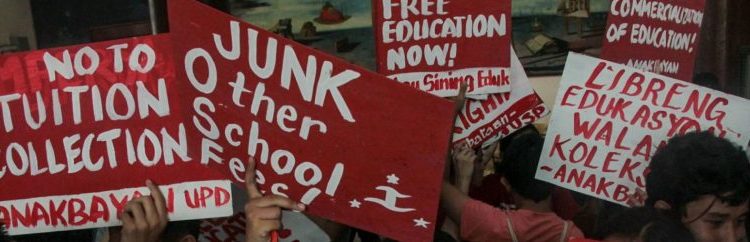
Philippines: Makabayan solons push for inclusion of budget for free college education for 2018

Philippines/August 15, 2017/By ANNE MARXZE D. UMIL/Source: http://bulatlat.com

The Makabayan bloc in Congress pushes for the realignment of budget allocation for the Build, Build, Build infrastructure projects, military spending and debt servicing in the 2018 national budget to ensure funds to implement the newly-enacted free college education law.

The budget earmarked for the said items is worth a whopping P1 trillion ($19.6 billion), said Gabriela Women’s Party Rep. Arlene Brosas.

“Instead of funding war expenses and big-ticket infrastructure projects that will displace communities, the Duterte administration should allocate sufficient funds for the realization of the free higher education law,” she said in a statement.

On Aug. 3, President Duterte signed Republic Act 10931, the Universal Access to Quality Tertiary Education Act, but said that the government will still have to look for funds for state universities and colleges (SUCs).

Kabataan Partylist Rep. Sarah Elago said, “it is not a question of funds, but rather of priorities.” She said Duterte’s economic managers are geared towards profiteering from education by implementing neoliberal policies instead of putting funds to provide basic social services for the people.

‘BBB program will wipe out communities’

Brosas said the BBB program accounts for nearly a third of the proposed P3.7 trillion ($72.5 billion) 2018 national budget. The BBB program aims to construct railway networks, airports, roads and other infrastructure projects from Luzon to Mindanao. However, the government’s infrastructure project will wipe out communities and resources around the country.

One such project is the National Reclamation Plan (NRP) which will construct commercial establishments, eco-tourism, industrial and business hubs to the detriment of fisherfolk communities.

Progressive fisherfolk group Pambansang Lakas ng Kilusang Mamamalakaya ng Pilipinas (Palamakaya-Pilipinas) said the NRP has 100 coastal reclamation projects covering almost 400,000 hectares of fishing waters and coastal communities.

“Build, Build, Build is privatization of public lands and facilities and debt-driven program that will benefit no one but the giant local and foreign oligarchs. In the end, hardworking Filipinos will shoulder the burden of this Dutertenomics’ mess through unwarranted tax increase,” said Pamalakaya chairperson, Fernando Hicap in a statement.

Brosas also said that there are other funding sources in the 2018 national budget such as the P2.1 billion ($41 million) power subsidy under the budget of the Philippine Economic Zone Authority (PEZA) and the P1.6 billion ($31 million) Comprehensive Automotive Resurgence Strategy program of the Department of Trade and Industry (DTI).

“The truth is there are many sources for funding in the 2018 budget,” Brosas said.

Budget cut persists

During the deliberation of the budget of the Commission on Higher Education (Ched) on Aug. 10, Elago noted budget cuts and underfunding. Ched’s budget had increased from P 58.9 billion to P61.4 billion, but some SUCs are still set to get cuts next year.

Elago said 23 SUCs will suffer cuts in their Personal Service (PS) budget, 50 will have cuts in their Maintenance and Operating Expenses (MOOE) budget and 49 have cuts in their Capital Outlay (CO) budget.

“In fact, the Philippine State College of Aeronautics has zero budget for CO for 2018,” she added.

She also noted the expected internal income from SUCs. Elago said based on the 2018 Budget of Expenditures and Sources of Financing, the Department of Budget and Management expects SUCs to earn P44.7 billion ($876 million) from their internal income for 2018. P13.2 billion ($258 million) is expected to come from tuition collection.

Elago stressed that the new law prohibits the collection of tuition and other fees in SUCs.

“How do they plan to achieve this huge income? Is there a new scheme or policy to be implemented to increase the income of SUCs?” Elago asked.

Elago challenged Ched “to ensure that it will not renege on the youth’s clamor as expressed by the initial victory in having a free education bill signed into law.”

Source:

http://bulatlat.com/main/2017/08/12/makabayan-solons-push-inclusion-budget-free-college-education-2018/


Comparte este contenido:
Page 135 of 144
1 133 134 135 136 137 144