By: HENRY A. GIROUX
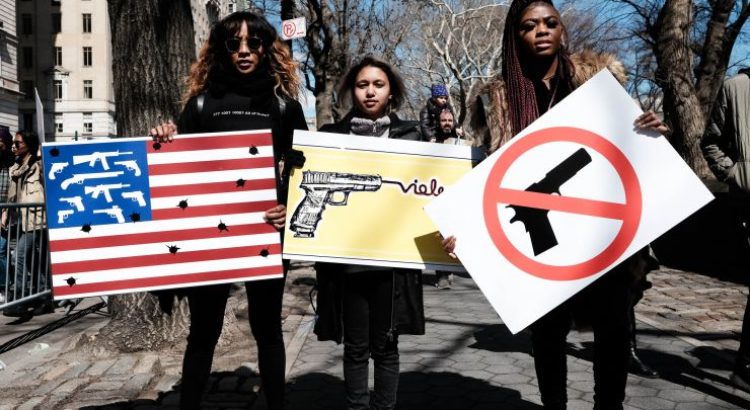
Since Donald Trump’s election in November 2016, there have been few occasions to feel hopeful about politics. But now we are witnessing a proliferation of causes for hope, as brave students from Parkland, Florida, and equally courageous teachers throughout the United States lead movements of mass demonstrations, walkouts, and strikes.
The United States is in the midst of a crisis of values, ethics, and politics. It has been decades in the making, produced largely by a neoliberal system that has subordinated all aspects of social life to the dictates of the market while stripping assets from public goods and producing untenable levels of inequality. What we are now living through is the emergence of a new political formation in which neoliberalism has put on the mantle of fascism.
The assault on public education, the slow violence of teacher disenfranchisement, and the fast violence of guns can only be understood as part of a larger war on liberal democracy.
Amidst this cataclysm, public schools have been identified as a major threat to the conservative ruling elite because public education has long been integral to U.S. democracy’s dependence on an informed, engaged citizenry. Democracy is predicated on faith in the capacity of all humans for intelligent judgment, deliberation, and action, but this innate capacity must be nurtured. The recognition of this need explains why the United States has, since its earliest days, emphasized the value of public education at least as an ideal. An education that teaches one to think critically and mediate charged appeals to one’s emotions is key to making power accountable and embracing a mature sense of the social contract.
Now, as our public schools are stretched to their breaking, their students and teachers are leading the call for a moral awakening. Both argue that the crisis of public schooling and the war on youth are related, and that the assaults on public schooling can only be understood as part of a larger war on liberal democracy.
No one movement or group can defeat the powerful and connected forces of neoliberal fascism, but energized young people and teachers are helping to open a space in which change looks more possible than at any time in the recent past. The Parkland students have embraced a grassroots approach and teachers are following their lead. Both are primed for action and are ready to challenge those eager to dismantle the public education system. They recognize that education is a winning issue because most Americans still view it as a path through which their children can gain access to decent jobs and a good life. The usual neoliberal bromides advocating privatization, charter schools, vouchers, and teaching for the test have lost all legitimacy at a moment when the ruling elite act with blatant disregard for the democratizing ethos that has long been a keystone of our society.
All of the states in which teachers have engaged in wildcat strikes, demonstrations, and protests have been subject to the toxic austerity measures that have come to characterize the neoliberal economy. In these states, teachers have faced low and stagnant wages, crumbling and overfilled classrooms, lengthening work days, and slashed budgets that have left them without classroom essentials such as books and even toilet paper—necessities that, in many cases, teachers have purchased themselves with their paltry salaries. It is significant that teachers have refused to confine their protests to the immediate needs of their profession or the understandable demand for higher wages. Rather, they have couched these demands within a broader critique of the war on public goods, calling repeatedly for more funding for schools in order to provide students with decent conditions for learning.
Likewise, students protesting gun violence have contextualized their demands for gun control by addressing the roots of gun violence in state violence and political and economic disenfranchisement. Refusing to be silenced by politicians bought and sold by the NRA, these students have called for a vision of social justice rooted in the belief that they can not only challenge systemic oppression, but can change the fundamental nature of an oppressive social order. They recognize that they have not only been treated as disposable populations written out of the script of democracy, they also are capable of using the new tools of social media to surmount the deadening political horizons preached by conventional media outlets and established politicians.
The attack on public education is one side of the neoliberal ledger. The other side is the explosion of the punishing state with its accelerated apparatuses of incarceration and militarization.
What is so promising about the student-led movement is that not only is it exposing the politicians and gun lobbies that argue against gun control and reframe the gun debate while endangering the lives of young people, they have also energized millions of youth by encouraging a sense of individual and collective agency. They are asking their peers to mobilize against gun violence, vote in the midterm November elections, and be prepared for a long struggle against the underlying ideologies, structures, and institutions that promote death-dealing violence in the United States. As Charlotte Alter pointed out in TIME:
They envision a youth political movement that will address many of the other issues affecting the youngest Americans. [Parkland student leader David] Hogg says he would like to have a youth demonstration every year on March 24, harnessing the power of teenage anger to demand action on everything from campaign-finance reform to net neutrality to climate change.
This statement makes clear that these young people recognize that the threat they face goes far beyond the gun debate and that what they need to address is a wider culture of cruelty, silence, and indifference. Violence comes in many forms, some hidden, many more spectacularized, cultivated, valued, eroticized, and normalized. Some are fast, and others are slow, and thus harder to perceive. The key is to address the underlying structures and relations of power that give rise to this landscape of both spectacular gun violence and the everyday violence experienced by the poor, people of color, the undocumented, and other “disposable” people. The attack on public education and the rights and working conditions of teachers is one side of the neoliberal ledger. The other side is the explosion of the punishing state with its accelerated apparatuses of containment, militarized police, borders, walls, mass incarceration, the school-to-prison pipeline, and the creation of an armed society. These issues need to be connected as part of a wider refusal to equate rapacious, neoliberal capitalism with democracy.
The Parkland student movement and the teacher walkouts have already advanced the possibilities of mass resistance by connecting the dots between the crises that each group is experiencing. The “slow violence” (to borrow Rob Nixon’s term) of teacher disenfranchisement needs to be understood in relation to the fast violence that has afflicted students, both of which arise from a state that has imported the language of perpetual war into its relationship with its citizens. As Judith Levine points out, every public sphere has been transformed into a virtual war zone, “a zone of permanent vigilance, enforcement, and violence.”
In the face of this, the need is for disruptive social movements that call for nothing less than the restructuring of U.S. society. In the spirit of Martin Luther King, Jr., this means a revolution in values, a shift in public consciousness, and a change in power relations and public policies. The Parkland students and the teachers protesting across the nation are not only challenging the current attacks on public education, they also share an effort in constructing a new narrative about the United States—one that reengages the public’s ethical imagination toward developing an equitable, just, and inclusive democracy. Their protests point to the possibility of a new public imagination that moves beyond the narrow realm of specific interest to a more comprehensive understanding of politics that is rooted in a practice of open defiance to corporate tyranny. This is a politics that refuses “leftist” centrism, the extremism of the right, and a deeply unequal society modeled on the iniquitous precarity and toxic structures of savage capitalism. This new political horizon foreshadows the need to organize new political formations, massive social movements, and a third political party that can make itself present in a variety of institutional, educational, social, and cultural spheres.
The teacher and student protests have made clear that real change can be made through mass collective movements inspired by hope in the service of a radical democracy.
What the teacher and student protests have made clear is that change and coalition-building are possible, and that real change can be made through mass collective movements inspired by hope in the service of a radical democracy. This is a movement that must make education central to its politics and be willing to develop educational spheres which listen to and speak to the concrete problems that educators, students, minorities of color and class, and others face in a world moving into the abyss of tyranny.
The long-term success of the movements begun by the teachers and students will likely hinge on whether they connect with wider struggles for minority rights, economic justice, and social equality. If they open to a vision of shared struggle, they may find their way to a radical democratic recuperation that benefits all people whose needs are being sacrificed on the altar of neoliberal fascism. What we have learned from the student and teacher demonstrations is that politics depends “on the possibility of making the public exist in the first place” and that what we share in common is more important than what separates us. At a time when tyranny is on the rise and the world seems deprived of radical imagination, such courageous acts of mass resistance are a welcome relief and hopeful indicator of an energetic struggle to secure a democratic future.
Source:
https://bostonreview.net/education-opportunity/henry-giroux-slow-and-fast-assault-public-education





 Users Today : 34
 Total Users : 35461220
 Views Today : 168
 Total views : 3421267
My family was murdered before I could tie my shoes. As a young boy in Sierra Leone, years that should have been playful and carefree were spent fighting in someone else’s war. For me, childhood was a nightmare; escape always seemed impossible. But when the war officially ended, in 2002, I began finding ways to recover. One of the most important has been an opportunity I couldn’t have imagined as an angry, illiterate, nine-year-old soldier: school.
I am living proof of the transformative power of education. Thanks to hard work and lots of good fortune, I managed to graduate from high school and then university. Now, in just a few months, I will begin graduate classes at the Fordham University School of Law, an unimaginable destination for most of the former child soldiers in my country.
And yet, throughout my brief educational journey, one question has always nagged me: why did luck play such a crucial role? After all,education is supposed to be a universal human right. If only it were that simple.
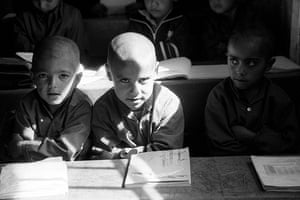
Today, more than 260 million children are out of school, and over 500 million boys and girls who do attend are not receiving a quality education, as the International Commission on Financing Global Education Opportunitydiscovered. By 2030, more than half of the world’s school-age children – some 800 million kids – will lack the basic skills needed to thrive or secure a job in the workplace of the future.
Addressing this requires money. But while education may be the best investment a government can make to ensure a better future for its people, education financing worldwide is far too low. In fact, education accounts for just 10% of total international development aid, down from 13% a decade ago. To put this in perspective, developing countries receive just $10 per child annually in global education support, barely enough to cover the cost of a single textbook. In an age of self-driving cars and smart refrigerators, this dearth of funding is simply unacceptable.
Over the past few years, I have advocated on behalf of three global education initiatives – the International Commission on Financing Global Education Opportunity (Education Commission), the Global Partnership for Education (GPE), and the Education Cannot Wait fund (ECW). I have done so eagerly, because these organizations are working collectively toward the same goal: to raise funds to make quality education for every child, everywhere, more than a matter of luck.
One of the best ways to do this is by supporting theInternational Finance Facility for Education, an initiative spearheaded by the Education Commission that could unlock the greatest global investment in education ever recorded. Young people around the world understand what’s at stake. Earlier this month, Global Youth Ambassadors presented a petition, signed by more than 1.5 million children in some 80 countries, to United Nations Secretary-General António Guterres, calling for the UN to support the finance facility.
By leveraging roughly $2 billion in donor guarantees, the finance facility aims to make $8 billion in new funding available to countries that need it most. If adopted widely, the program could make it possible for developing countries to provide quality education to millions more children, including refugees, young girls, and former child soldiers like me.
Politicians often say that young people are the leaders of tomorrow. That’s true; we are. But platitudes not backed by financial support are meaningless. Simply put, the world must unite to fund quality education for everyone. The International Finance Facility for Education – which is already backed by the World Bank, regional development banks, GPE, ECW, and numerous UN agencies – is among the best ways to make that happen.
Twenty years ago, law school was an impossible dream for me. Today, thanks to hard work, global support, and much good fortune, my future is brighter than it has ever been. But my story should not be an exception. To ensure that others can gain a quality education and follow the path that has opened up to me, we must remove luck from the equation.
*Fuente: https://www.project-syndicate.org/commentary/financing-universal-quality-education-by-mohamed-sidibay-2018-05